wiper HYUNDAI IONIQ 2020 User Guide
[x] Cancel search | Manufacturer: HYUNDAI, Model Year: 2020, Model line: IONIQ, Model: HYUNDAI IONIQ 2020Pages: 561, PDF Size: 24.5 MB
Page 423 of 561
7-17
7
Maintenance
W WI
IP
PE
ER
R
B
BL
LA
AD
DE
ES
S
Blade Inspection
Contamination of either the wind-
shield or the wiper blades with for-
eign matter can reduce the effective-
ness of the windshield wipers.
Common sources of contamination
are insects, tree sap, and hot wax
treatments used by some commer-
cial car washes. If the blades are not
wiping properly, clean both the win-
dow and the blades with a good
cleaner or mild detergent, and rinse
thoroughly with clean water.To prevent damage to the wiper
blades, arms or other compo-
nents, do not:
Use gasoline, kerosene, paint
thinner, or other solvents on or
near them.
Attempt to move the wipers
manually.
Use non-specified wiper blades.
Information
Commercial hot waxes applied by
automatic car washes have been
known to make the windshield diffi-
cult to clean.
Blade Replacement
When the wipers no longer clean
adequately, the blades may be worn
or cracked, and require replacement.
In order to prevent damage to
the hood and the wiper arms, the
wiper arms should only be lifted
when in the top wiping position.
Always return the wiper arms to
the windshield before driving.
NOTICE
i
NOTICE
Page 424 of 561
7-18
Maintenance
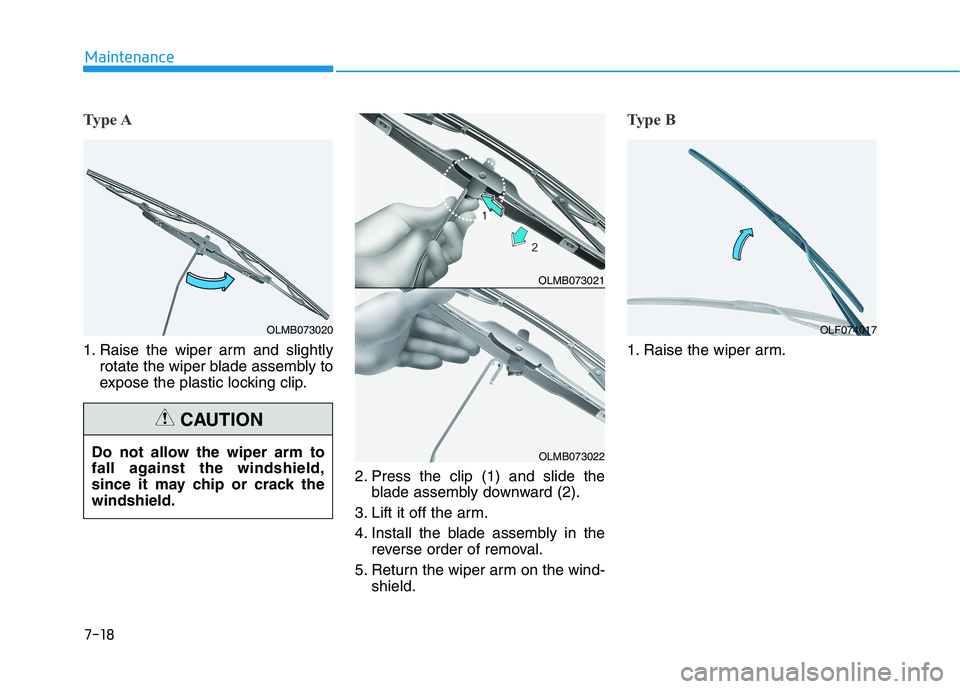
Type A
1. Raise the wiper arm and slightly
rotate the wiper blade assembly to
expose the plastic locking clip.
2. Press the clip (1) and slide the
blade assembly downward (2).
3. Lift it off the arm.
4. Install the blade assembly in the
reverse order of removal.
5. Return the wiper arm on the wind-
shield.
Type B
1. Raise the wiper arm.
OLF074017OLMB073020
Do not allow the wiper arm to
fall against the windshield,
since it may chip or crack the
windshield.
CAUTION
OLMB073021
OLMB073022
Page 425 of 561
7-19
7
Maintenance
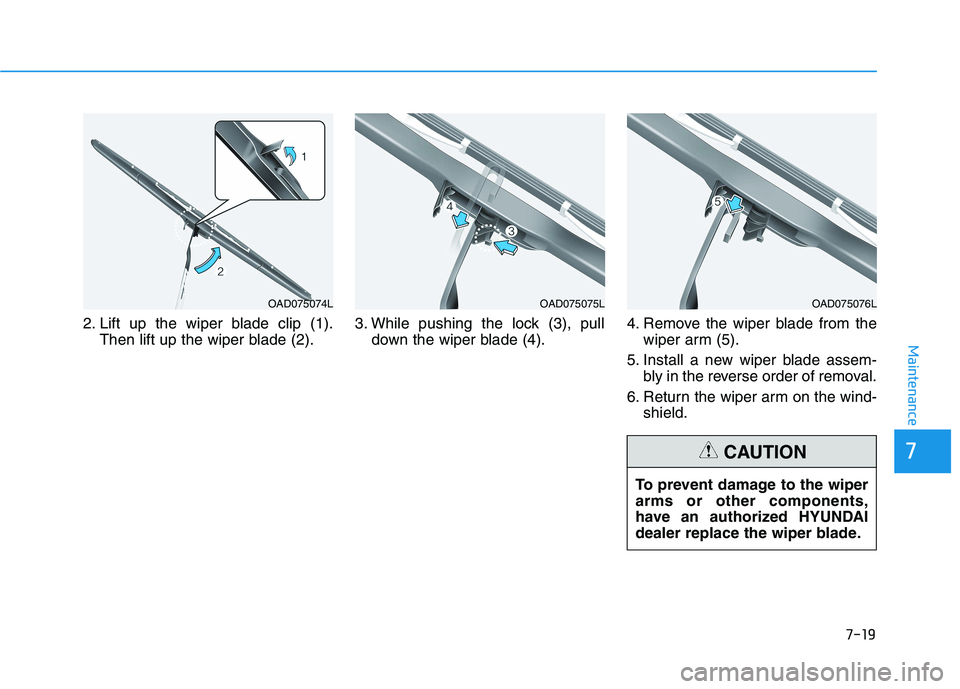
2. Lift up the wiper blade clip (1).
Then lift up the wiper blade (2).3. While pushing the lock (3), pull
down the wiper blade (4).4. Remove the wiper blade from the
wiper arm (5).
5. Install a new wiper blade assem-
bly in the reverse order of removal.
6. Return the wiper arm on the wind-
shield.
OAD075074LOAD075075LOAD075076L
To prevent damage to the wiper
arms or other components,
have an authorized HYUNDAI
dealer replace the wiper blade.
CAUTION
Page 453 of 561
7-47
7
Maintenance
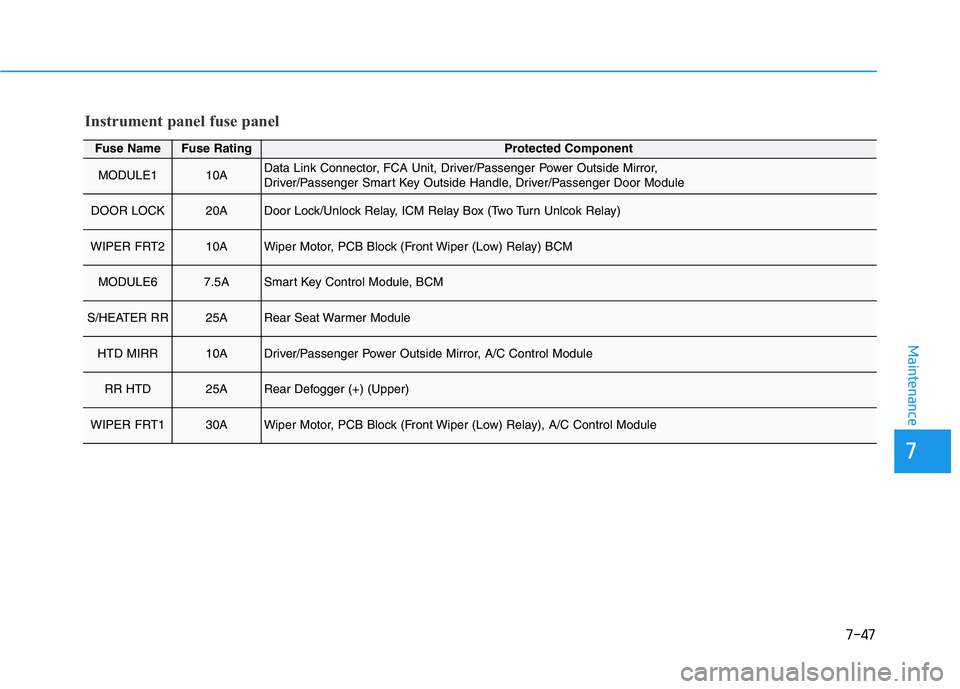
Fuse NameFuse RatingProtected Component
MODULE110AData Link Connector, FCA Unit, Driver/Passenger Power Outside Mirror,
Driver/Passenger Smart Key Outside Handle, Driver/Passenger Door Module
DOOR LOCK20ADoor Lock/Unlock Relay, ICM Relay Box (Two Turn Unlcok Relay)
WIPER FRT210AWiper Motor, PCB Block (Front Wiper (Low) Relay) BCM
MODULE67.5ASmart Key Control Module, BCM
S/HEATER RR25ARear Seat Warmer Module
HTD MIRR10ADriver/Passenger Power Outside Mirror, A/C Control Module
RR HTD25ARear Defogger (+) (Upper)
WIPER FRT130AWiper Motor, PCB Block (Front Wiper (Low) Relay), A/C Control Module
Instrument panel fuse panel
Page 491 of 561
H3
Electric Vehicle
An electric vehicle is driven using a
battery and an electric motor. While
general vehicles use an internal
combustion engine and gasoline as
fuel, electric vehicles use electrical
energy that is charged inside the
high voltage battery. As a result,
electric vehicles are eco-friendly in
that they do not require fuel and do
not emit exhaust gases.
Characteristics of Electric
Vehicles
1. It is driven using the electrical
energy that is charged inside the
high voltage battery. This method
prevents air pollution since fuel,
like gasoline, is not required,
negating the emission of exhaust
gases.
2. A high performance motor is used
in the vehicle as well. Compared
to standard, internal combustion
engine vehicles, engine noise and
vibrations are much more minimal
when driving.
3. When decelerating or driving
downhill, regenerative braking is
utilized to charge the high voltage
battery. This minimizes energy
loss and increases the distance to
empty.
4. When the battery charge is not
sufficient, AC charge, DC charge
and trickle charge are available.
(Refer to "Charge Types for
Electric Vehicle" for details.)
Information
What does regenerative braking do?
It uses the electric motor when decel-
erating or braking which transforms
vehicle motion (kinetic energy) to elec-
trical energy to charge the high volt-
age batteries. (Torque is applied in the
opposite direction when decelerating
to generate braking force and electric
energy.)
Battery Information
• The vehicle is composed of a high
voltage battery that drives the
motor and air-conditioner, and an
auxiliary battery (12 V) that drives
the lamps, wipers, and audio sys-
tem.
The auxiliary battery is automati-
cally charged when the vehicle is in
the ready ( ) mode or the high
voltage battery is being charged.
i
E EL
LE
EC
CT
TR
RI
IC
C
V
VE
EH
HI
IC
CL
LE
E
Page 492 of 561
H4
Main Components
On-Board Charger (OBC) :
A device that charges the high volt-
age battery by converting AC
power from a charging station to
DC power.
• Inverter :A device that transforms
direct current (DC) from the high
voltage battery into alternating cur-
rent (AC) to supply power to the
electric motor and transforms AC
back into DC when available to
charge the high voltage battery.
LDC :An LDC is a Low Voltage
DC-to-DC converter that trans-
forms power from the high voltage
battery to the low voltage battery
(12V) in order to supply electrical
power to the vehicle to operate the
lights, wipers, multimedia, etc. Electric Motor :A device that con-
verts electrical energy from the
high voltage battery into mechani-
cal energy which is then trans-
ferred as rotational torque to the
wheels in order to drive the vehicle.
Reduction gear :Delivers rota-
tional force of the motor to the tires
at appropriate speeds and torque.
EV Battery (Lithium-ion) :On
board high voltage storage device
with a capacity up to 64 kWh
❈OBC : On-Board Charger
❈LDC : Low Voltage DC-DC Converter
M
MA
AI
IN
N
C
CO
OM
MP
PO
ON
NE
EN
NT
TS
S
O
OF
F
E
EL
LE
EC
CT
TR
RI
IC
C
V
VE
EH
HI
IC
CL
LE
E
Do not remove or disassem-
ble high voltage components
and high voltage battery con-
nectors and wires. Also, be
careful not to damage high
voltage components and the
high voltage battery. It may
cause serious injury and sig-
nificantly impact the perform-
ance and durability of the
vehicle.
When inspection and mainte-
nance is required for high volt-
age components, contact an
authorized HYUNDAI dealer.
WARNING
Page 561 of 561
I-8
Towing ............................................................................6-21
Emergency Towing.....................................................6-23
Removable Towing Hook...........................................6-22
Towing service ...........................................................6-21
Trailer Towing...............................................................5-146
TRIP Computer ...............................................................3-96
Trip modes ..................................................................3-96
Vehicle Certification Label ...............................................8-7
Vehicle Identification Number (VIN) ...............................8-7
Vehicle load limit ..........................................................5-142
Tire Loading Information Label...............................5-142
Volume and Weight ...........................................................8-5Washer Fluid ...................................................................7-14
Checking the Washer Fluid Level ..............................7-14
Windows .........................................................................3-41
Power Windows..........................................................3-42
Windshield defrosting and defogging ...........................3-132
Auto Defogging System ..........................................3-134
Defogging Logic ......................................................3-133
To Defog Inside Windshield.....................................3-132
To Defrost Outside Windshield ................................3-133
Winter driving ...............................................................5-138
Snow or Icy Conditions............................................5-138
Winter Precautions ...................................................5-140
Wiper Blades ...................................................................7-17
Blade Inspection .........................................................7-17
Blade Replacement .....................................................7-17
Wipers and washers .....................................................3-114
Windshield Washers ................................................3-115
Windshield Wipers ..................................................3-114
Index
V
W