coolant HYUNDAI IONIQ 5 2023 Owners Manual
[x] Cancel search | Manufacturer: HYUNDAI, Model Year: 2023, Model line: IONIQ 5, Model: HYUNDAI IONIQ 5 2023Pages: 680, PDF Size: 48.22 MB
Page 77 of 680
2-7
02
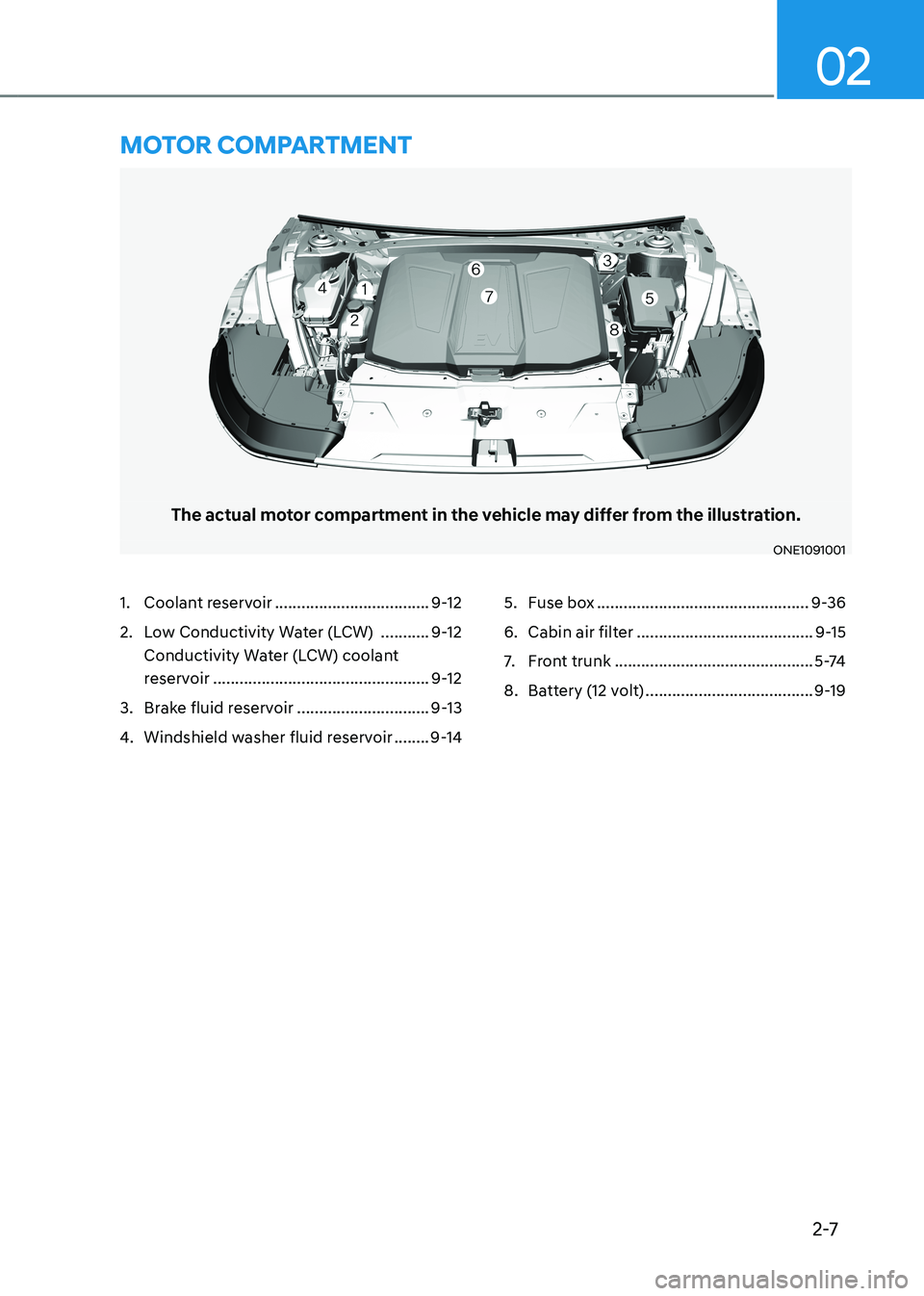
The actual motor compartment in the vehicle may differ from the illustration.
ONE1091001
1. Coolant reservoir ................................... 9-12
2. Low Conductivity Water (LCW) ...........9-12
Conductivity Water (LCW) coolant
reservoir ................................................. 9-12
3. Brake fluid reservoir ..............................9-13
4. Windshield washer fluid reservoir ........9-14 5. Fuse box
................................................ 9-36
6. Cabin air filter ........................................ 9-15
7. Front trunk ............................................. 5 -74
8. Battery (12 volt) ...................................... 9-19
Motor coMpartMent
Page 82 of 680
Vehicle Information, Consumer Information and Reporting Safety Defects
2-12
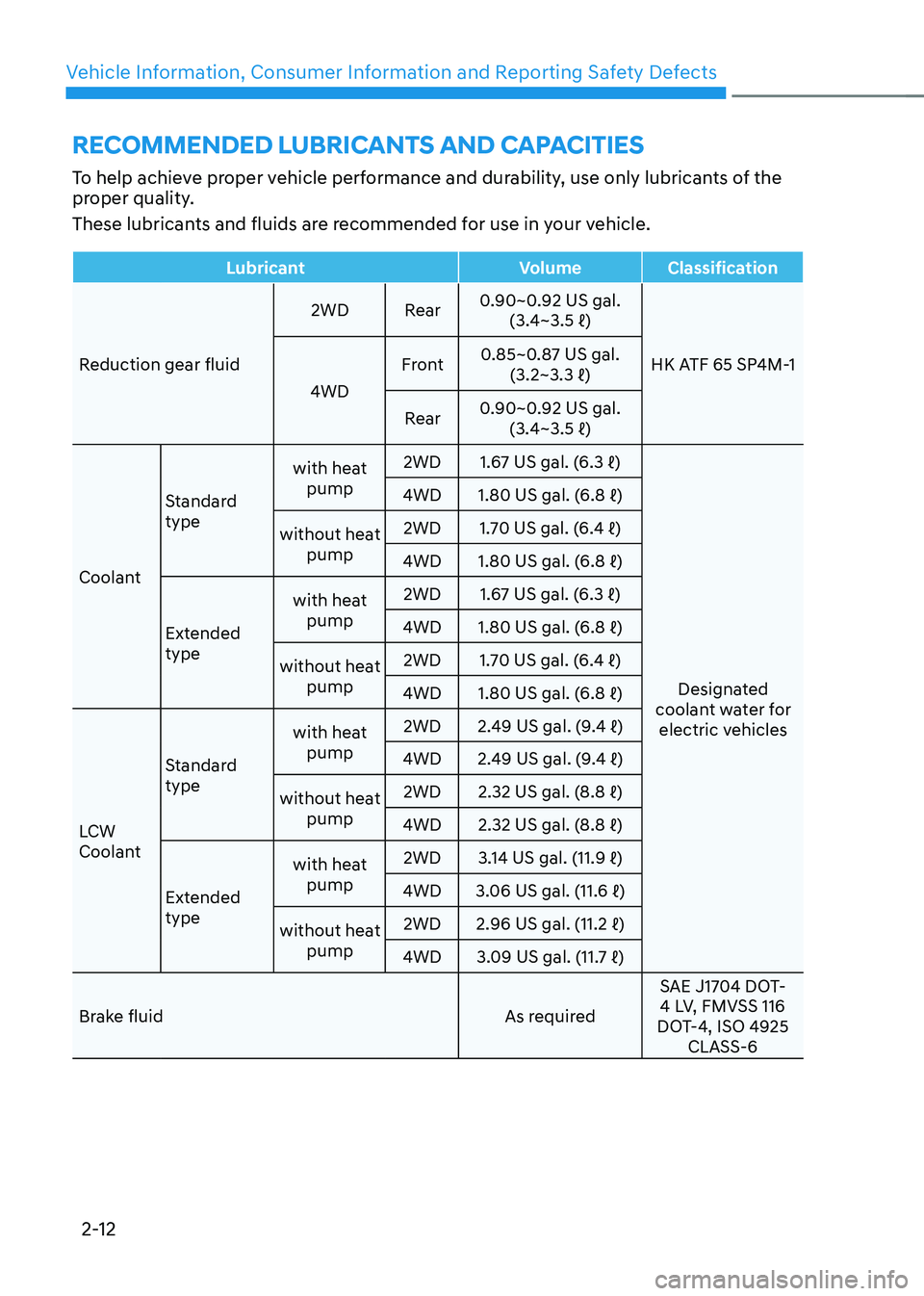
To help achieve proper vehicle performance and durability, use only lubricants of the
proper quality.
These lubricants and fluids are recommended for use in your vehicle.
Lubricant Volume Classification
Reduction gear fluid
2WD Rear
0.90~0.92 US gal.
(3.4~3.5 ℓ)
HK ATF 65 SP4M-1
4WD Front
0.85~0.87 US gal.
(3.2~3.3 ℓ)
Rear 0.90~0.92 US gal.
(3.4~3.5 ℓ)
Coolant Standard type
with heat
pump 2WD
1.67 US gal. (6.3 ℓ)
Designated
coolant water for electric vehicles
4WD
1.80 US gal. (6.8 ℓ)
without heat pump 2WD
1.70 US gal. (6.4 ℓ)
4WD 1.80 US gal. (6.8 ℓ)
Extended type with heat
pump 2WD
1.67 US gal. (6.3 ℓ)
4WD 1.80 US gal. (6.8 ℓ)
without heat pump 2WD
1.70 US gal. (6.4 ℓ)
4WD 1.80 US gal. (6.8 ℓ)
LCW
Coolant Standard type
with heat
pump 2WD
2.49 US gal. (9.4 ℓ)
4WD 2.49 US gal. (9.4 ℓ)
without heat pump 2WD
2.32 US gal. (8.8 ℓ)
4WD 2.32 US gal. (8.8 ℓ)
Extended type with heat
pump 2WD
3.14 US gal. (11.9 ℓ)
4WD 3.06 US gal. (11.6 ℓ)
without heat pump 2WD
2.96 US gal. (11.2 ℓ)
4WD 3.09 US gal. (11.7 ℓ)
Brake fluid As requiredSAE J1704 DOT-
4 LV, FMVSS 116
DOT-4, ISO 4925 CLASS-6
recoMMenDeD luBrIcants anD capacItIes
Page 373 of 680
06
6-47
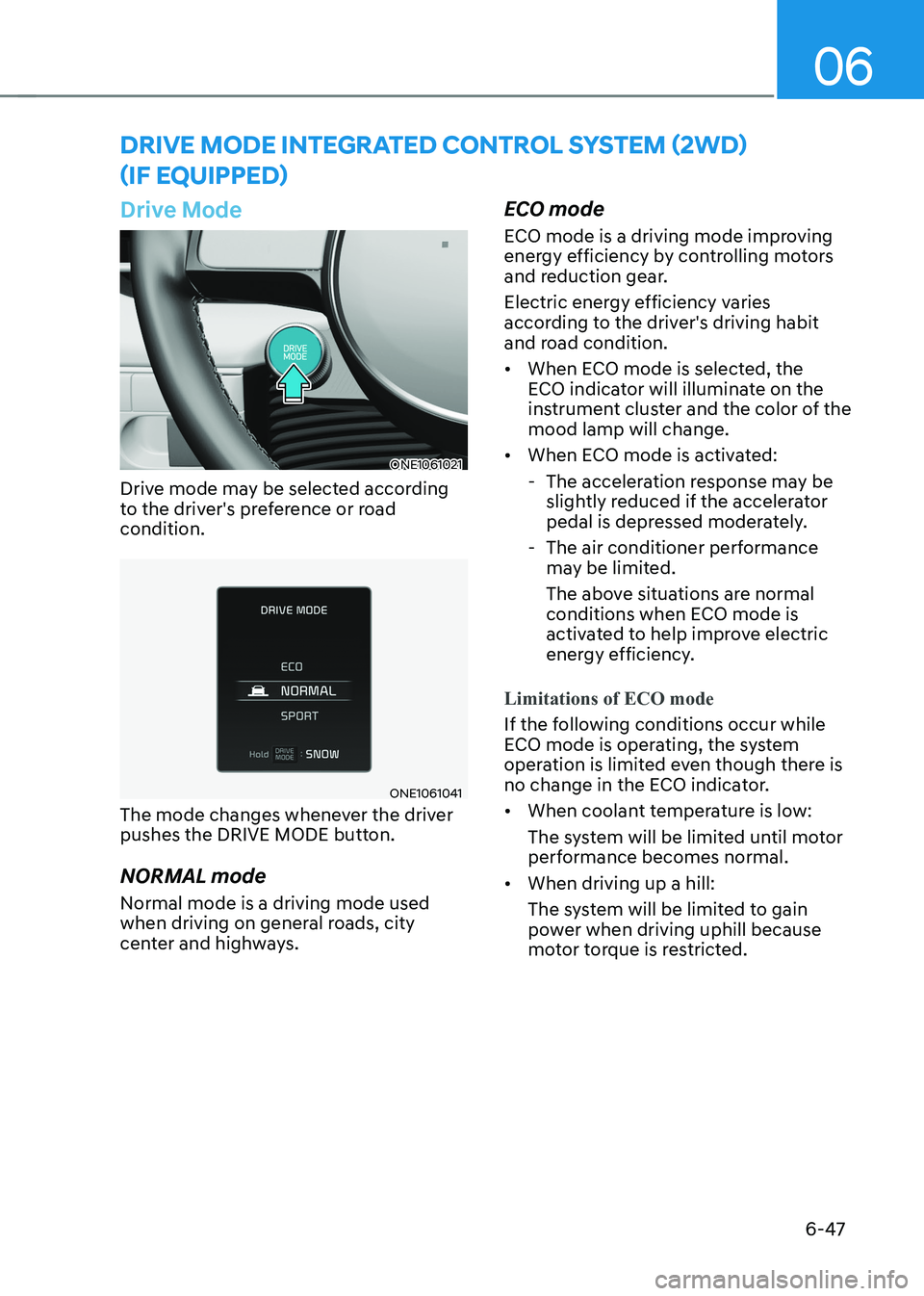
Drive Mode
ONE1061021
Drive mode may be selected according
to the driver's preference or road condition.
ONE1061041
The mode changes whenever the driver
pushes the DRIVE MODE button. NORMAL mode
Normal mode is a driving mode used
when driving on general roads, city
center and highways. ECO mode
ECO mode is a driving mode improving
energy efficiency by controlling motors
and reduction gear.
Electric energy efficiency varies
according to the driver's driving habit
and road condition. •
When ECO mode is selected, the
ECO indicator will illuminate on the
instrument cluster and the color of the mood lamp will change.
• When ECO mode is activated:
- The acceleration response may be slightly reduced if the accelerator
pedal is depressed moderately.
- The air conditioner performance may be limited.
The above situations are normal
conditions when ECO mode is
activated to help improve electric
energy efficiency.
Limitations of ECO mode
If the following conditions occur while
ECO mode is operating, the system
operation is limited even though there is
no change in the ECO indicator. • When coolant temperature is low:
The system will be limited until motor
performance becomes normal.
• When driving up a hill:
The system will be limited to gain
power when driving uphill because
motor torque is restricted.
Drive moDe integrAteD control system (2WD)
(iF eQUiPPeD)
Page 376 of 680
Driving Your Vehicle
6-50
Limitations of ECO mode
If the following conditions occur while
ECO mode is operating, the system
operation is limited even though there is
no change in the ECO indicator. • When coolant temperature is low:
The system will be limited until motor
performance becomes normal.
• When driving up a hill:
The system will be limited to gain
power when driving uphill because
motor torque is restricted.
SPORT mode
SPORT mode is a driving mode
improving driving performance by fixing
AWD system and controlling reduction
gear.
In SPORT mode, the electric energy
efficiency may decrease. • When SPORT mode is selected, the
SPORT indicator will illuminate on the
instrument cluster and the color of the mood lamp will change.
• Whenever the vehicle is restarted,
the drive mode will revert back to
NORMAL mode. If SPORT mode is
desired, re-select SPORT mode.
SNOW mode
SNOW mode is a driving mode improving
driving performance by changing
the engagement status of the motor
according to the situation required. Auto
changing the driving mode(2WD/AWD)
helps improve driving stability. • Press and hold the drive mode button
to select SNOW mode.
• When SNOW mode is selected, the
SNOW indicator will illuminate on the
instrument cluster and the color of the mood lamp will change.
• When SNOW mode is activated, the
driving power is distributed to four
wheels automatically, increasing the
stability of the vehicle.
NOTICE
• Depress the accelerator pedal softly
on the snow and the ice.
• Keep the distance from the vehicle in
the front.
• Prevent rapid acceleration,
deceleration and steering control.
Abrupt driving on the snow may
cause the accident.
Page 381 of 680
06
6-55
Hydroplaning
If the road is wet enough and you are
going fast enough, your vehicle may
have little or no contact with the road
surface and actually ride on the water.
The best advice is SLOW DOWN when
the road is wet.
The risk of hydroplaning increases as
the depth of tire tread decreases, refer
to “Tire Tread” section in chapter 9.
Driving in Flooded Areas
Avoid driving through flooded areas
unless you are sure the water is no
higher than the bottom of the wheel hub.
Drive through any water slowly. Allow
adequate stopping distance because
brake performance may be reduced.
After driving through water, dry the
brakes by gently applying them several
times while the vehicle is moving slowly.
Highway Driving
Tires
Adjust the tire inflation, as specified.
Under-inflation may overheat or damage
the tires.
Do not install worn-out or damaged tires,
which may reduce traction or fail the
braking operation.
Information
Never over-inflate your tires above the
maximum inflation pressure, as specified
on your tires.
Coolant and high voltage battery
Driving at higher speeds on the highway
consumes more electric energy and is
less efficient than driving at a slower,
more moderate speed. Maintain a
moderate speed in order to conserve
electric energy when driving on the
highway.
Be sure to check both the coolant level
and the electric energy level before driving.
Page 386 of 680
Driving Your Vehicle
6-60
Winter Precautions
Check battery and cables
Winter temperatures affect battery
performance. Inspect the battery and
cables, as specified in chapter 9. The
battery charging level can be checked
by an authorized HYUNDAI dealer or in a
service station.
To prevent locks from freezing
To prevent the locks from being frozen,
spray approved de-icing fluid or glycerin
into key holes. When a lock opening is
already covered with ice, spray approved
de-icing fluid over the ice to remove it.
When an internal part of a lock freezes,
try to thaw it with a heated key. Carefully
use the heated key to avoid an injury.
Use approved window washer anti-
freeze solution in system
To prevent the window washer from
being frozen, add authorized window
washer anti-freeze solution, as specified
on the window washer container.
Window washer anti-freeze solution is
available from an authorized HYUNDAI
dealer, and most vehicle accessory
outlets. Do not use coolant or other types
of anti-freeze solution, to prevent any
damage to the vehicle paint. Do not let your parking brake freeze
Under some conditions your parking
brake can freeze in the engaged position.
This is most likely to happen when there
is an accumulation of snow or ice around
or near the rear brakes or if the brakes
are wet. When there is the risk that your
parking brake may freeze, temporarily
apply it with the gear in P (Park). Also,
block the rear wheels in advance, so the
vehicle may not roll. Then, release the
parking brake.
Do not let ice and snow accumulate
underneath
Under some conditions, snow and ice
can build up under the fenders and
interfere with the steering. When driving
in such conditions during the severe
winter, you should check underneath
the vehicle on a regular basis, to ensure
that the front wheels and the steering
components is unblocked.
Carry emergency equipment
In accordance with weather conditions,
you should carry appropriate emergency
equipment, while driving. Some of the
items you may want to carry include tire
chains, tow straps or chains, flashlight,
emergency flares, sand, shovel, jumper
cables, window scraper, gloves, ground
cloth, coveralls, blanket, etc.
Do not place objects or materials in the
motor compartment
Putting objects or materials in the motor
compartment may cause an motor
failure. Such damage will not be covered
by the manufacturer’s warranty.
Page 602 of 680
9
9. Maintenance
Motor Compartment ........................................................................................ 9-3
Maintenance Services ...................................................................................... 9-4
Owner’s Responsibility ............................................................................................... 9-4
Owner Maintenance Precautions ............................................................................... 9-4
Owner Maintenance ......................................................................................... 9-5
Owner Maintenance Schedule ................................................................................... 9-6
Scheduled Maintenance Services .................................................................... 9 -7
Normal Maintenance Schedule ................................................................................. 9-8
Normal Maintenance Schedule .................................................................................. 9-9
Maintenance Under Severe Usage Conditions ........................................................9-10
Explanation of Scheduled Maintenance Items ...............................................9-11
Coolant ............................................................................................................. 9-12
Brake Fluid ........................................................................................................ 9-13
Checking the Brake Fluid Level ................................................................................. 9-13
Reduction Gear Fluid ....................................................................................... 9-14
Washer Fluid ..................................................................................................... 9-14
Checking the Washer Fluid Level .............................................................................. 9-14
Cabin Air Filter .................................................................................................. 9-15
Filter Inspection.......................................................................................................... 9-15 Filter Replacement ..................................................................................................... 9-15
Wiper Blades .................................................................................................... 9-16
Blade Inspection ........................................................................................................ 9-16
Blade Replacement .................................................................................................... 9-16
Battery (12 volt) ................................................................................................ 9-19
For best battery service ............................................................................................ 9-20
Battery Capacity Label .............................................................................................. 9-20
Battery Recharging ................................................................................................... 9-20
Reset Items ................................................................................................................. 9-21
Page 604 of 680
9-3
09
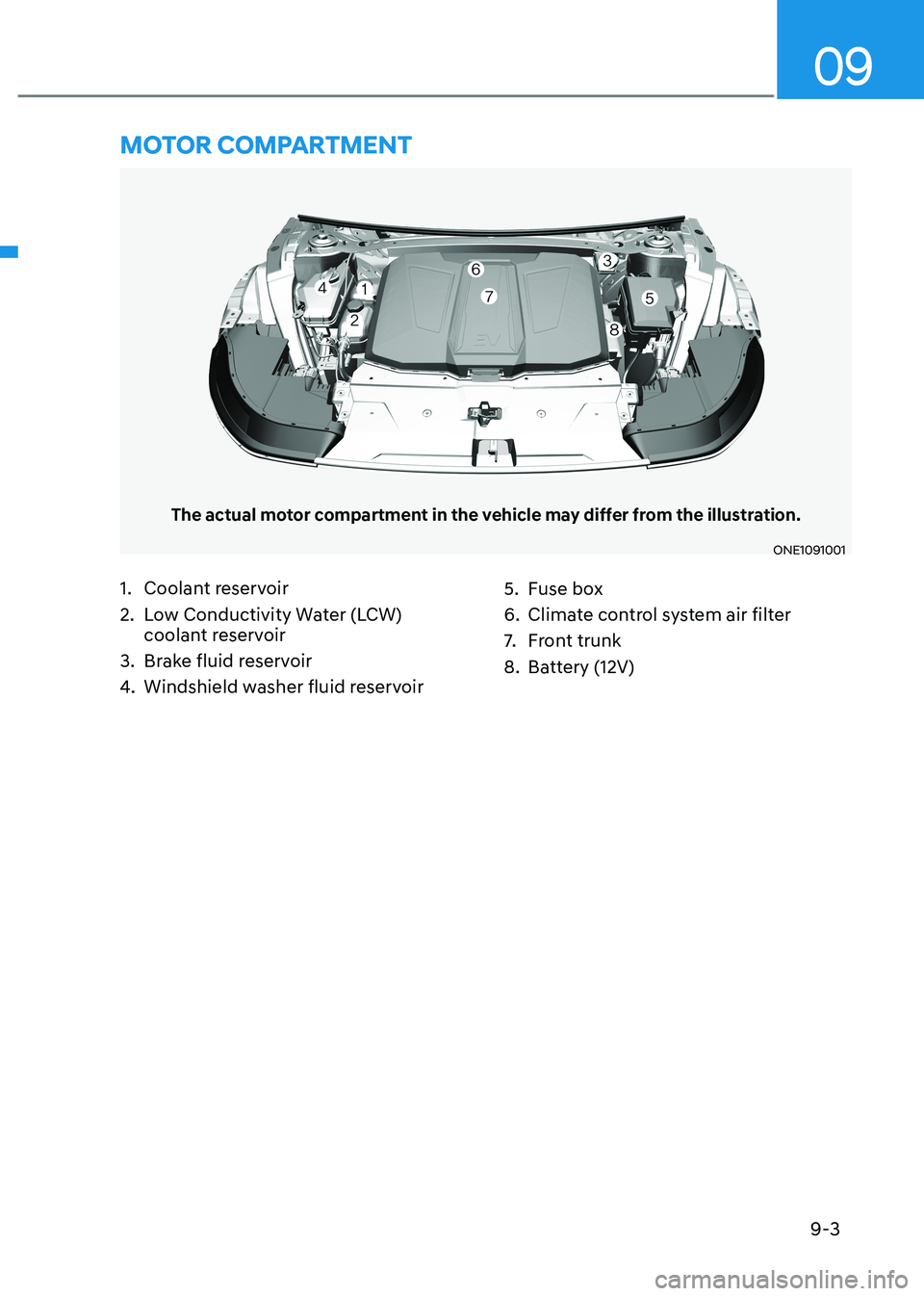
The actual motor compartment in the vehicle may differ from the illustration.
ONE1091001
1. Coolant reservoir
2. Low Conductivity Water (LCW) coolant reservoir
3. Brake fluid reservoir
4. Windshield washer fluid reservoir 5. Fuse box
6. Climate control system air filter
7.
Front trunk
8. Battery (12V)
Motor coMpartMent
Page 607 of 680
Maintenance
9-6
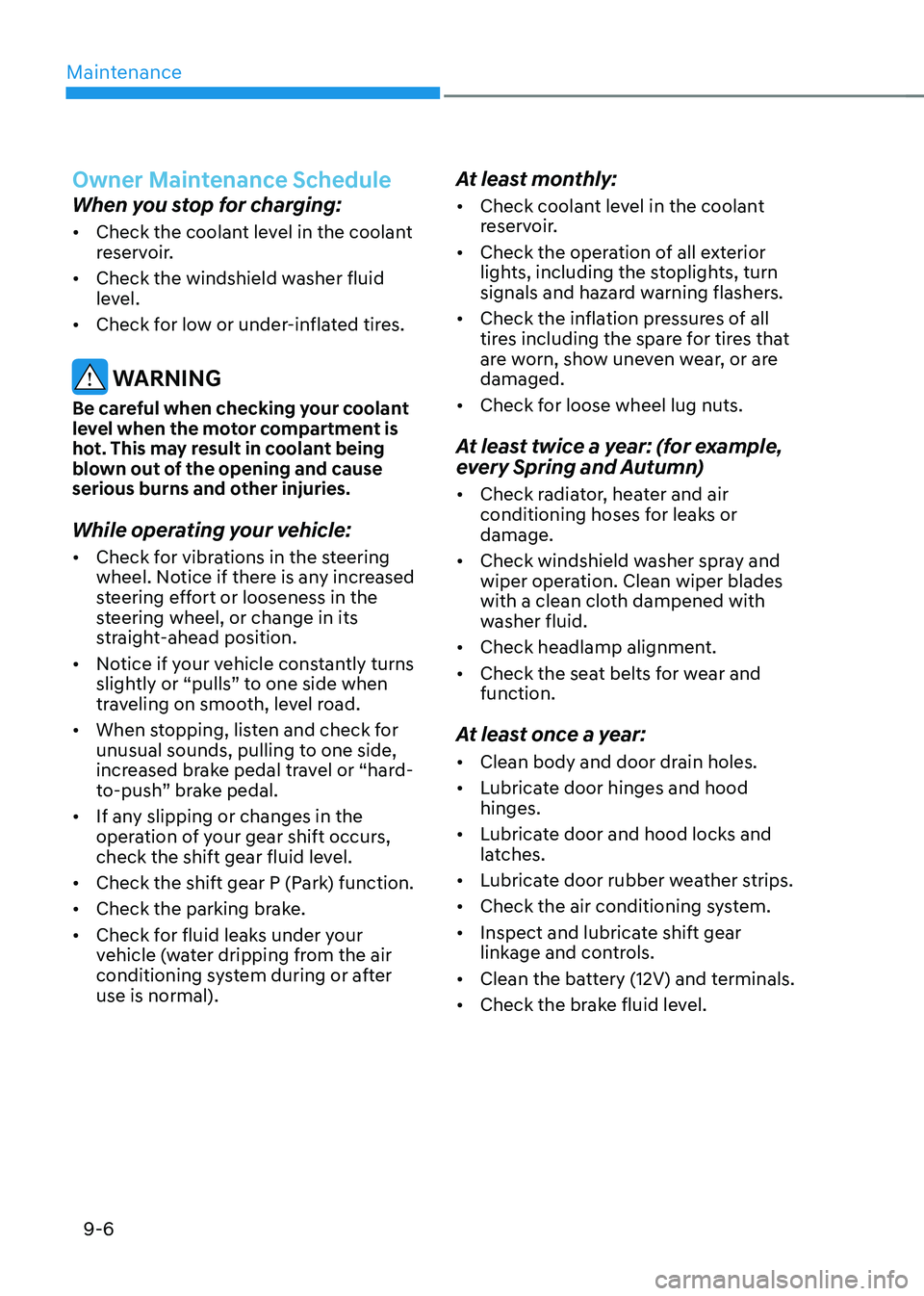
Owner Maintenance Schedule
When you stop for charging: • Check the coolant level in the coolant
reservoir.
• Check the windshield washer fluid
level.
• Check for low or under-inflated tires.
WARNING
Be careful when checking your coolant
level when the motor compartment is
hot. This may result in coolant being
blown out of the opening and cause
serious burns and other injuries.
While operating your vehicle: • Check for vibrations in the steering
wheel. Notice if there is any increased
steering effort or looseness in the
steering wheel, or change in its
straight-ahead position.
• Notice if your vehicle constantly turns
slightly or “pulls” to one side when
traveling on smooth, level road.
• When stopping, listen and check for
unusual sounds, pulling to one side,
increased brake pedal travel or “hard-
to-push” brake pedal.
• If any slipping or changes in the
operation of your gear shift occurs,
check the shift gear fluid level.
• Check the shift gear P (Park) function.
• Check the parking brake.
• Check for fluid leaks under your
vehicle (water dripping from the air
conditioning system during or after use is normal). At least monthly: •
Check coolant level in the coolant
reservoir.
• Check the operation of all exterior
lights, including the stoplights, turn
signals and hazard warning flashers.
• Check the inflation pressures of all
tires including the spare for tires that
are worn, show uneven wear, or are damaged.
• Check for loose wheel lug nuts.
At least twice a year: (for example,
every Spring and Autumn) • Check radiator, heater and air
conditioning hoses for leaks or damage.
• Check windshield washer spray and
wiper operation. Clean wiper blades
with a clean cloth dampened with
washer fluid.
• Check headlamp alignment.
• Check the seat belts for wear and function.
At least once a year: • Clean body and door drain holes.
• Lubricate door hinges and hood hinges.
• Lubricate door and hood locks and
latches.
• Lubricate door rubber weather strips.
• Check the air conditioning system.
• Inspect and lubricate shift gear
linkage and controls.
• Clean the battery (12V) and terminals.
• Check the brake fluid level.
Page 609 of 680
9-8
Maintenance
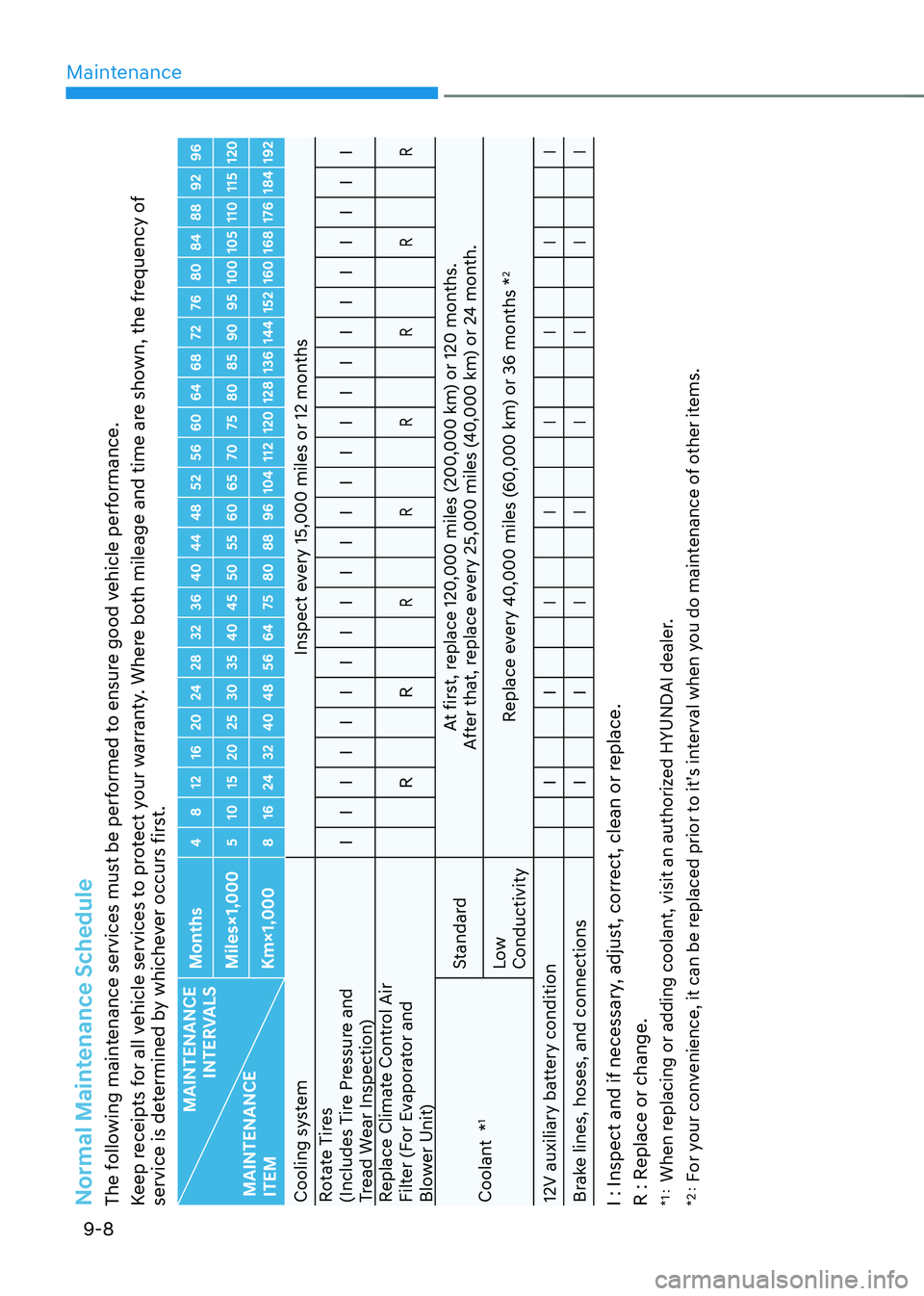
Normal Maintenance Schedule The following maintenance services must be performed to ensure good vehicle performance.
Keep receipts for all vehicle services to protect your warranty. Where both mileage and time are shown, the frequency of
service is determined by whichever occurs first.
MAINTENANCE INTERVALS
MAINTENANCE ITEM Months
4 8 12 16 20 24 28 32 36 40 44 48 52 56 60 64 68 72 76 80 84 88 92 96
Miles×1,000 5 10 15 20 25 30 35 40 45 50 55 60 65 70 75 80 85 90 95 100 105 110 115 120
Km×1,000 8 16 24 32 40 48 56 64 75 80 88 96 104 112 120 128 136 144 152 160 168 176 184 192
Cooling system
Inspect every 15,000 miles or 12 months
Rotate Tires
(Includes Tire Pressure and
Tread Wear Inspection) I I I I I I I I I I I I I I I I I I I I I I I I
Replace Climate Control Air
Filter (For Evaporator and
Blower Unit) R R
R R R R R R
Coolant *
1 Standard
At first, replace 120,000 miles (200,000 km) or 120 months.
After that, replace every 25,000 miles (40,000 km) or 24 month.
Low Conductivity Replace every 40,000 miles (60,000 km) or 36 months *
2
12V auxiliary battery condition I I
I I I I I I
Brake lines, hoses, and connections I I
I I I I I I
I : Inspect and if necessary, adjust, correct, clean or replace.
R : Replace or change. *1 : When replacing or adding coolant, visit an authorized HYUNDAI dealer.
*2 : For your convenience, it can be replaced prior to it’s interval when you do maintenance of other items.