battery capacity HYUNDAI IONIQ 6 2023 Owners Manual
[x] Cancel search | Manufacturer: HYUNDAI, Model Year: 2023, Model line: IONIQ 6, Model: HYUNDAI IONIQ 6 2023Pages: 582, PDF Size: 10.77 MB
Page 15 of 582
1
1-9
Understanding Your Electric Vehicle
Electric vehicles are driven using a battery and an electric motor. Understand the
characteristics of your electric vehicle and check the features that you must know before
driving it.
Characteristics of Your Electric Vehicle
The characteristics that differentiate electric vehicles from gasoline vehicles are as
follows:
• Electric vehicles are eco-friendly because they do not use fossil fuels for driving. Additionally, unlike gasoline vehicles, noise and vibration are minimal, and the
vehicle’s lifespan is relatively long.
• When slowing down or driving downhill, regenerative braking is used. Regenerative braking charges the high voltage battery and minimizes energy loss.
• If the high voltage battery is running low, you can charge the vehicle using the AC charger, DC charger, or portable charging cables. For more information, refer to the
"Charging Your Electric Vehicle" section in this chapter.
Information Regenerative braking uses an electric motor when decelerating and braking, and it transforms
kinetic energy to electrical energy in order to charge the high voltage battery.
Battery information
The batteries used in the electric vehicle are as follows:
•High voltage battery (high capacity) : Drives the motor and operates the air
conditioner and heater. It can be charged via an AC charger, DC charger, or portable
charger.
• 12 V battery : Operates all lights, wipers, and audio system. The 12 V battery charge can
also be maintained by the high voltage battery at parked condition at certain
conditions.
Main components of your electric vehicle
The main components of your electric vehicle and their functions are as follows:
• On-Board Charger (OBC) : Charges the high voltage battery by converting the power
grid’s AC power to DC power.
• Inverter : Converts power from direct current (DC) to alternating current (AC) and
supplies power to the motor, and converts power from AC to DC to charge the high
voltage battery during deceleration and braking.
• Low Voltage DC-DC Converter (LDC) : Converts the high voltage battery’s power
source to a low voltage (12 V) power source for supply of power to the electrical devices
on the vehicle.
Hyundai_CE_en_US.book Page 9
Page 16 of 582
Introduction/Getting Started with Your Electric Vehicle
1-10
•Vehicle Control Unit (VCU) : Controls the various controllers and sensors on the
vehicle.
• Motor : Uses electricity accumulated on the high voltage battery to drive the vehicle
(same role as an engine in gasoline vehicles).
• Gear: Delivers the rotational force of the motor to the tires at appropriate speeds and
torque.
• High voltage battery (Lithium-ion battery) : Stores and supplies power necessary for
the electric vehicle to operate. (The separately installed 12 V battery provides power to
the vehicle when the vehicle is in ACC or OFF.)
WARNING • Do not remove or disassemble any high voltage battery’s connectors and wires. Doing so may lead to accidents, such as electric shock, and result in serious injury and
significantly degrade the vehicle’s performance and durability.
• When the high voltage battery or its related components require inspection and maintenance, contact an authorized HYUNDAI dealer.
Precautions When Using the High Voltage Battery
Precautions for high voltage battery when driving and storing the vehicle are as follows:
CAUTION • Keep the gauge of the high voltage battery from going below 10 %. Storing the vehicle while the battery level is too low for a long time may damage the battery or reduce the
battery’s capacity.
• If a collision occurs and the vehicle is impacted, have the vehicle inspected by an authorized HYUNDAI dealer and check the battery connection status.
• Using the V2L function may reduce the driving distance due to the use of high voltage battery energy, and repeated use of the V2L function may impact battery life.
• Frequent use of DC charging may impact battery life.
• The high voltage battery level may reduce naturally even if the vehicle is not driven.
• Storing the vehicle in temperatures that are too hot or cold may degrade the battery performance.
• The distance to empty or power output may vary depending on the driving conditions, such as the outside temperature. Driving on highway at high speeds or uphill will
increase battery consumption, resulting in a shorter distance to empty.
• If you use the air conditioner or heater, which is powered by the high voltage battery, the distance to empty will be reduced. Maintain reasonable temperature when using
the air conditioner or heater to maximize distance to empty.
• Depending on the vehicle’s period of use, natural degradation of the battery may occur that reduces distance to empty over long period of vehicle life. When the charge
Hyundai_CE_en_US.book Page 10
Page 17 of 582
1
1-11
capacity and distance to empty keep failing, have the vehicle inspected by an
authorized HYUNDAI dealer.
• If you do not use the vehicle for a long time, charge the vehicle at least once every three months to prevent both the high voltage and the 12 V battery from fully discharging.
When the battery level has low level, immediately charge the vehicle.
• Using AC charging as much as possible can help keep the battery in optimal condition. Fully charging the battery when it is 20 % or lower helps to keep the battery in optimal
condition. (Charging once a month or more is recommended.)
• The charging level value displayed on the instrument cluster may decrease according to the charging conditions (charger status, outside temperature, battery temperature,
etc.). For longer battery life and safety, after a certain charging level is reached, the
charging current is gradually lowered to fully charge the battery.
Other Precautions for Electric Vehicle Management
CAUTION • When heat treatment after repairs or painting is applied to the vehicle due to an accident, the high voltage battery’s performance may be degraded. If heat treatment
is required, contact an authorized HYUNDAI dealer.
• When cleaning the motor compartment, do not use a high pressure washer. Doing so may result in electric shock, due to a discharge in high voltage electricity, or damage
the vehicle’s electric system.
• Do not install third-party parts or modified parts on the vehicle. Doing so may damage the electric power system. Only use or install genuine parts.
Hyundai_CE_en_US.book Page 11
Page 22 of 582
Introduction/Getting Started with Your Electric Vehicle
1-16
Information Type 3R enclosure satisfies the requirements of UL 50E standard when the charging connector is
connected to the vehicle side charging inlet. An additional Type 3R enclosure should be provided
in the end installation of the vehicle side charging inlet. The "Type 3R" marking can be found on
the charging inlet.
• What is type 3R?: Performance requirement for enclosures intended for outdoor use that provides a degree of protection against falling dirt, rain, sleet, and/or snow.
CAUTION • Risk of electric shock. Do not disconnect under load.
• Suitable for use on a circuit capable of delivering not more than 5000 rms symmetrical Amperes, 120 V AC Maximum.
• Suitable for use on a circuit capable of delivering not more than 30000 rms symmetrical Amperes, 1000 V DC Maximum.
CAUTION • Battery performance and life may deteriorate if the DC charger is used constantly. It is best to occasionally use AC charger to optimize battery life.
• The electrical outlet at home must comply with regulations and can safely accommodate the Voltage, Current (Amps), and Power (Watts) ratings specified on the
portable charger. If not, the vehicle may not be charged or safety hazards, such as fire,
may occur.
• If the power distributor exceeds its capacity while charging the vehicle with a portable charger at home, the power to home may be cut off or a fire may occur.
• If you use a portable charger to charge your electric vehicle with household electricity, you will be charged on your household electricity bill.
Hyundai_CE_en_US.book Page 16
Page 33 of 582
1
1-27
• If the power distributor exceeds its capacity while charging the vehicle with a portable charger at home, the power to the home may be cut off or a fire may occur.
• Immediately stop charging if you discover abnormal conditions, such as odor or smoke.
• Use a portable charger only in emergencies, and do not use it to fully charge the battery.
• If you charge the vehicle with household electricity, you will be charged electricity bill according to the home rate system, not the electric vehicle rate system.
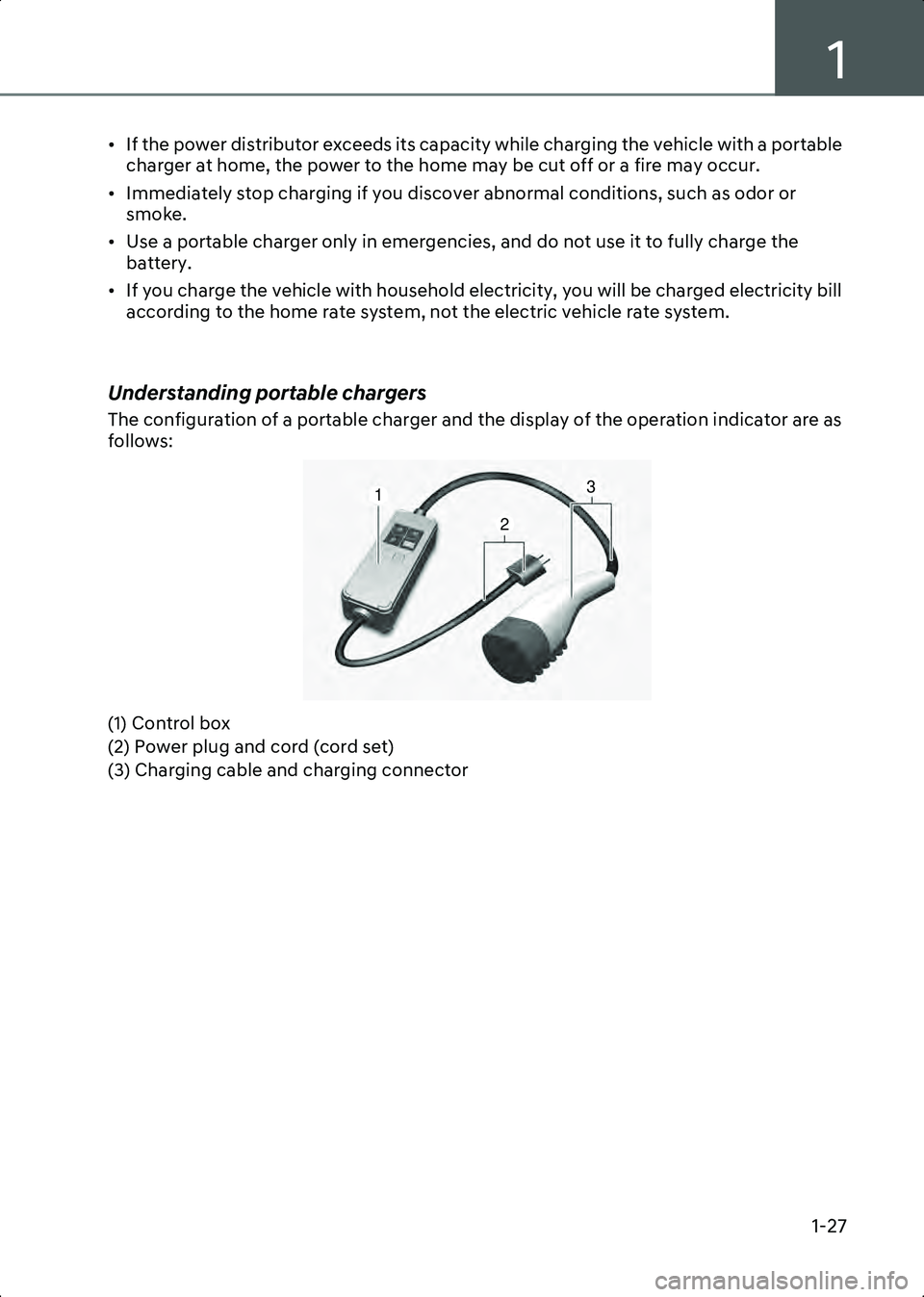
Understanding portable chargers
The configuration of a portable charger and the display of the operation indicator are as
follows:
B0001201(1) Control box
(2) Power plug and cord (cord set)
(3) Charging cable and charging connector
1
2
3
Hyundai_CE_en_US.book Page 27
Page 55 of 582
1
1-49
Information • When the V2L connector is connected to the charging inlet of the vehicle, all doors and connectors will be automatically locked to prevent theft and separation. To disconnect the V2L
connector, unlock the door and pull the connector with the open switch pressed.
• Before using the V2L function, deactivate the scheduled climate setting referring to the “Setting Scheduled Charging and Climate”. The V2L function may be cut off depending on the
scheduled climate setting.
• To check and change the V2L setting, refer to the “Setting a Battery Discharging Limit When Using Vehicle to Load (V2L)”.
• If an electric device that exceeds the maximum power capacity is connected, a warning message appears on the instrument cluster and the power supply shuts off immediately.
Using Electricity Inside the Vehicle
You can connect home appliances or electric devices to the power outlet inside the
vehicle.
WARNING Do not use an electric heating appliances like electric kettle, toaster, or iron in the vehicle.
It may cause a fire or injury.
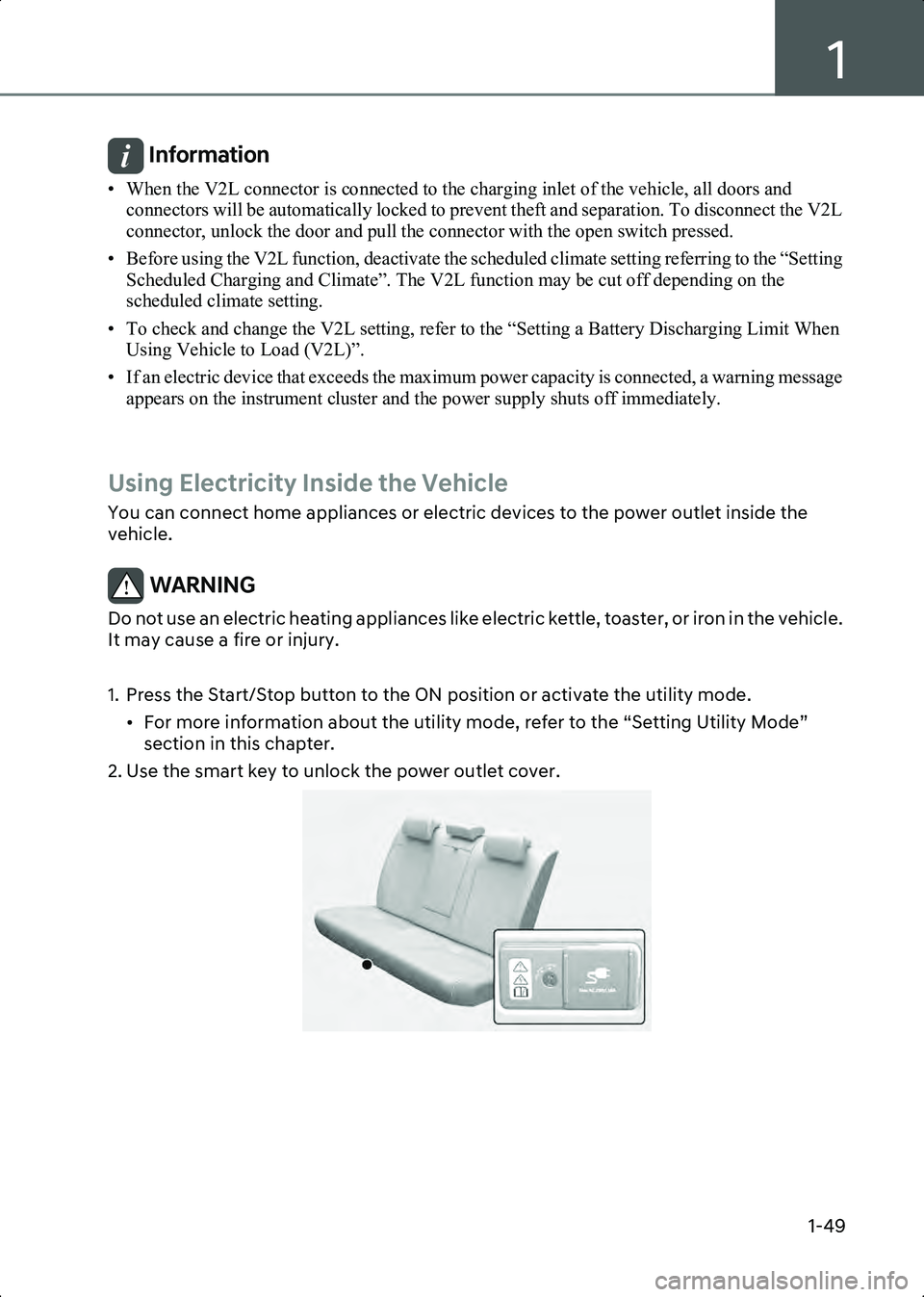
1. Press the Start/Stop button to the ON position or activate the utility mode. • For more information about the utility mode, refer to the “Setting Utility Mode” section in this chapter.
2. Use the smart key to unlock the power outlet cover.
B0002501
Hyundai_CE_en_US.book Page 49
Page 84 of 582
Vehicle Information, Consumer Information, and Reporting Safety Defects
2-10
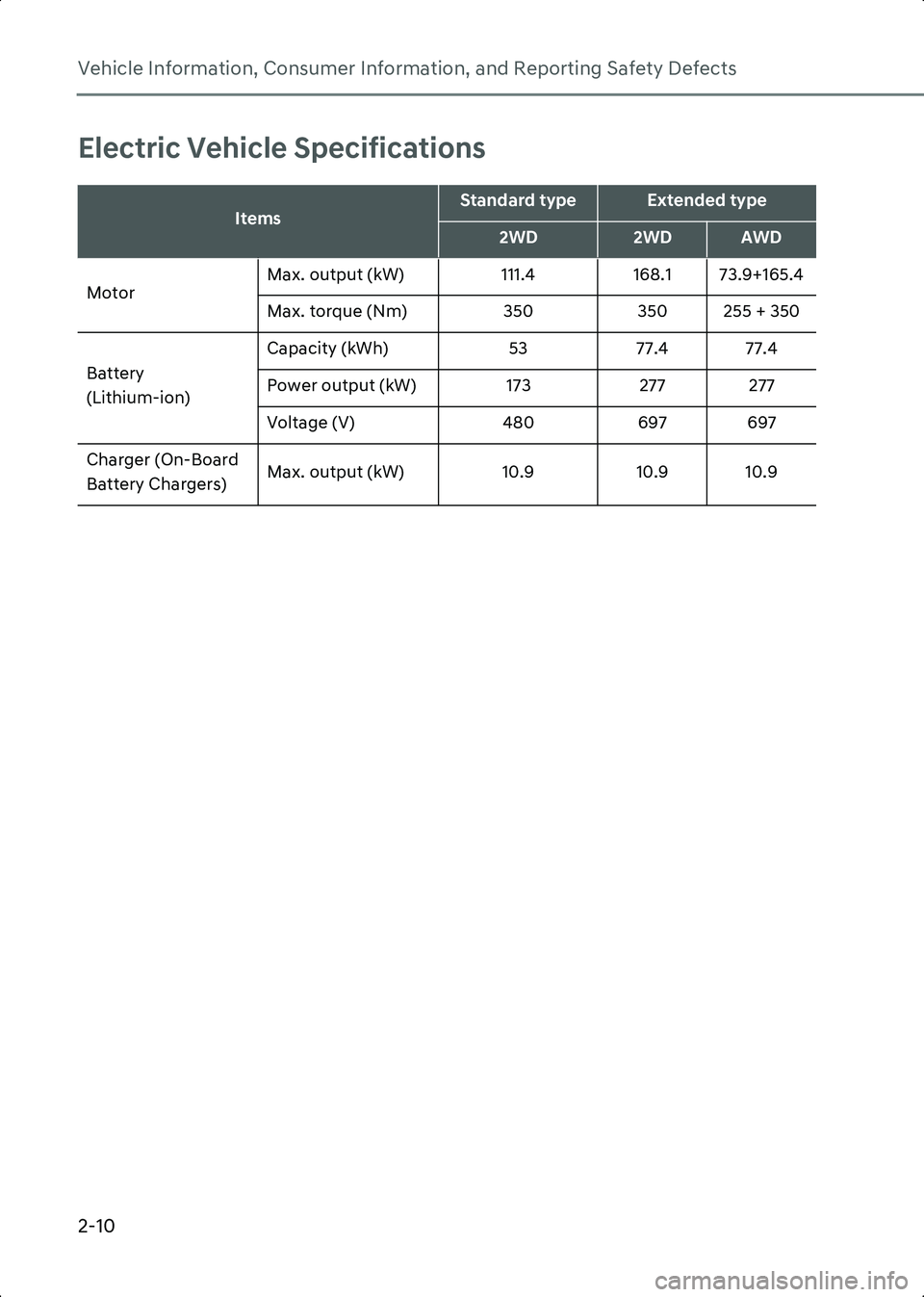
Electric Vehicle Specifications
ItemsStandard typeExtended type
2WD2WDAWD
Motor Max. output (kW)
111.4168.1 73.9+165.4
Max. torque (Nm) 350350 255 + 350
Battery
(Lithium-ion) Capacity (kWh)
5377.4 77.4
Power output (kW) 173 277 277
Voltage (V) 480697 697
Charger (On-Board
Battery Chargers) Max. output (kW)
10.910.9 10.9
Hyundai_CE_en_US.book Page 10
Page 518 of 582
9
For Best Battery Service ............................................................................................ 9-18
Battery Capacity Label ............................................................................................... 9-19
Battery Recharging .................................................................................................... 9-19
Reset Items ................................................................................................................ 9-20
Tires and Wheels ........................................................................................................... 9-20 Tire Care ...................................................................................................................... 9-21
Recommended Cold Tire Inflation Pressures........................................................... 9-21
Check Tire Inflation Pressure.....................................................................................9-22
Tire Rotation ...............................................................................................................9-22
Wheel Alignment and Tire Balance .......................................................................... 9-23
Tire Replacement ...................................................................................................... 9-23
Wheel Replacement .................................................................................................. 9-24
Tire Traction ............................................................................................................... 9-24
Tire Maintenance....................................................................................................... 9-24
Tire Sidewall Labeling ............................................................................................... 9-24
Tire Terminology and Definitions .............................................................................. 9-27
All Season Tires .......................................................................................................... 9-30
Summer Tires ............................................................................................................. 9-30
Snow Tires .................................................................................................................. 9-30
Radial-Ply Tires .......................................................................................................... 9-30
Low Aspect Ratio Tires ............................................................................................... 9-31
Fuses .............................................................................................................................. 9-32
Blade type...................................................................................................................... 9-32
Cartridge type ............................................................................................................... 9-32
Multi type....................................................................................................................... 9-32 Instrument Panel Fuse Replacement....................................................................... 9-33
Motor compartment.................................................................................................. 9-33
Motor Compartment Panel Fuse Replacement ...................................................... 9-33
Fuse/Relay Panel Description .................................................................................. 9-35
Light Bulbs ..................................................................................................................... 9-43 Headlight, Parking Light, Turn Signal Light, Daytime Running Light (DRL)
Replacement.............................................................................................................. 9-44
Side Repeater Light Replacement ........................................................................... 9-44Rear Combination Light Replacement .................................................................... 9-44
High Mounted Stop Light Replacement .................................................................. 9-45
License Plate Light Replacement ............................................................................. 9-45
Front Trunk Light Replacement ............................................................................... 9-45
Hyundai_CE_en_US.book Page 2
Page 535 of 582
9
9-19
• If the vehicle is not going to be used for an extended time, disconnect the
battery cables.
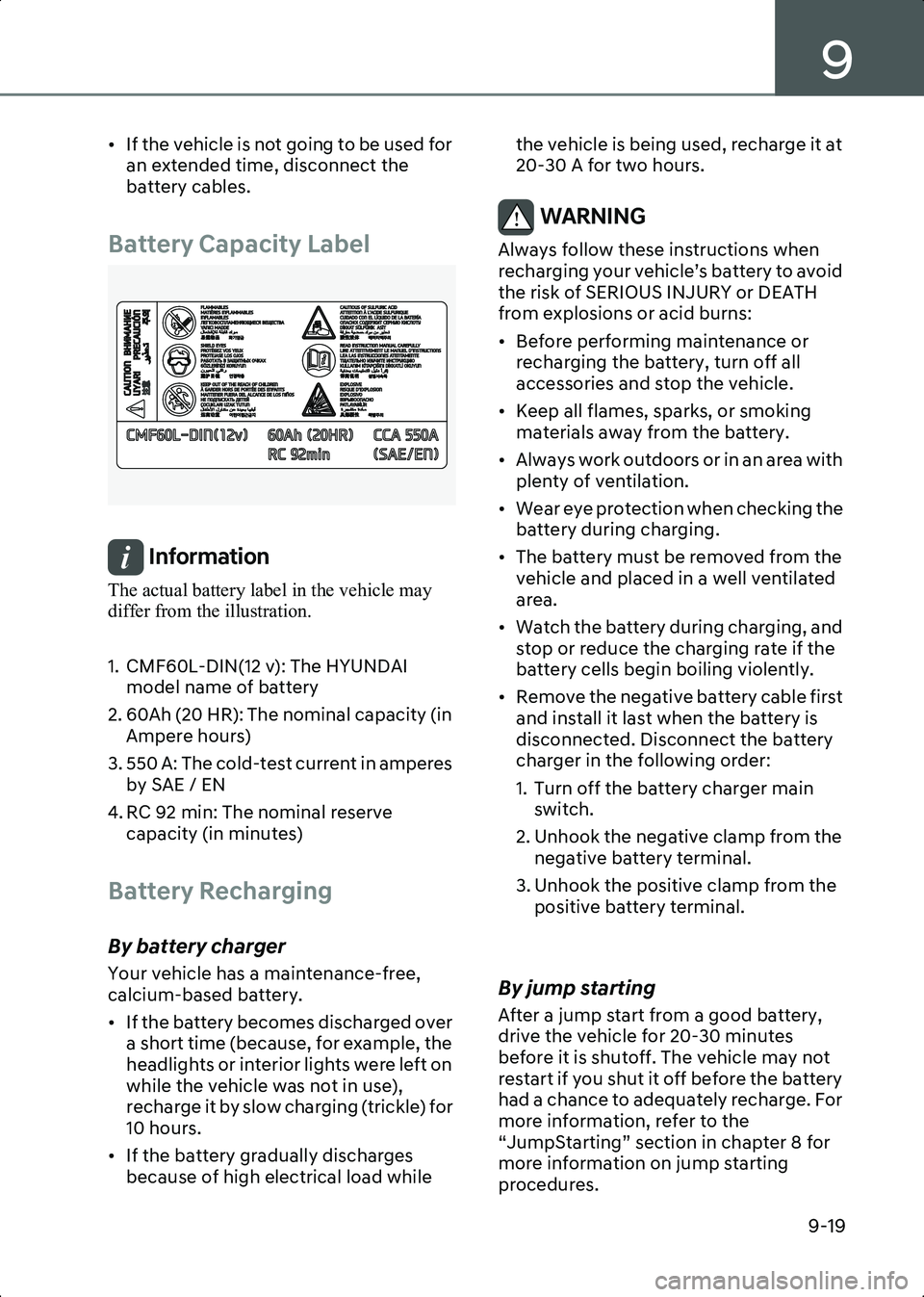
Battery Capacity Label
OLMB073072
Information The actual battery label in the vehicle may
differ from the illustration.
1. CMF60L-DIN(12 v): The HYUNDAI model name of battery
2. 60Ah (20 HR): The nominal capacity (in Ampere hours)
3. 550 A: The cold-test current in amperes by SAE / EN
4. RC 92 min: The nominal reserve capacity (in minutes)
Battery Recharging
By battery charger
Your vehicle has a maintenance-free,
calcium-based battery.
• If the battery becomes discharged over a short time (because, for example, the
headlights or interior lights were left on
while the vehicle was not in use),
recharge it by slow charging (trickle) for
10 hours.
• If the battery gradually discharges because of high electrical load while the vehicle is being used, recharge it at
20-30 A for two hours.
WARNING Always follow these instructions when
recharging your vehicle’s battery to avoid
the risk of SERIOUS INJURY or DEATH
from explosions or acid burns:
• Before performing maintenance or
recharging the battery, turn off all
accessories and stop the vehicle.
• Keep all flames, sparks, or smoking materials away from the battery.
• Always work outdoors or in an area with plenty of ventilation.
• Wear eye protection when checking the battery during charging.
• The battery must be removed from the vehicle and placed in a well ventilated
area.
• Watch the battery during charging, and stop or reduce the charging rate if the
battery cells begin boiling violently.
• Remove the negative battery cable first and install it last when the battery is
disconnected. Disconnect the battery
charger in the following order:
1. Turn off the battery charger main switch.
2. Unhook the negative clamp from the negative battery terminal.
3. Unhook the positive clamp from the positive battery terminal.
By jump starting
After a jump start from a good battery,
drive the vehicle for 20-30 minutes
before it is shutoff. The vehicle may not
restart if you shut it off before the battery
had a chance to adequately recharge. For
more information, refer to the
“JumpStarting” section in chapter 8 for
more information on jump starting
procedures.
Hyundai_CE_en_US.book Page 19
Page 545 of 582
9
9-29
Passenger (P-Metric) tire
A tire used on passenger cars and
some light duty trucks and
multipurpose vehicles.
Ply
A layer of rubber-coated parallel
cords.
Pneumatic tire
A mechanical device made of rubber,
chemicals, fabric and steel or other
materials, that, when mounted on an
automotive wheel provides the
traction and contains the gas or fluid
that sustains the load.
Pneumatic options weight
The combined weight of installed
regular production options weighing
over 5 lbs. (2.3 kg) in excess of the
standard items which they replace,
not previously considered in curb
weight or accessory weight,
including heavy duty breaks, ride
levelers, roof rack, heavy duty
battery, and special trim.
Recommended inflation pressure
Vehicle manufacturer’s
recommended tire inflation pressure
as shown on the tire placard.
Radial ply tire
A pneumatic tire in which the ply
cords that extend to the beads are
laid at 90 degrees to the centerline of
the tread.
Rim
A metal support for a tire and upon
which the tire beads are seated.Sidewall
The portion of a tire between the
tread and the bead.
Speed rating
An alphanumeric code assigned to a
tire indicating the maximum speed at
which a tire can operate.
Traction
The friction between the tire and the
road surface. The amount of grip
provided.
Tread
The portion of a tire that comes into
contact with the road.
Treadwear indicators
Narrow bands, sometimes called
“wear bars”, that show across the
tread of a tire when only 1/16 in. of
tread remains.
UTQGS
Uniform Tire Quality Grading
Standards is a tire information system
that provides consumers with ratings
for a tire’s traction, temperature and
treadwear. Ratings are determined
by tire manufacturers using
government testing procedures. The
ratings are molded into the sidewall
of the tire.
Vehicle capacity weight
The number of designated seating
positions multiplied by 150 lbs. (68
kg) plus the rated cargo and luggage
load.
Hyundai_CE_en_US.book Page 29