radiator HYUNDAI IONIQ 6 2023 Owners Manual
[x] Cancel search | Manufacturer: HYUNDAI, Model Year: 2023, Model line: IONIQ 6, Model: HYUNDAI IONIQ 6 2023Pages: 582, PDF Size: 10.77 MB
Page 88 of 582
Vehicle Information, Consumer Information, and Reporting Safety Defects
2-14
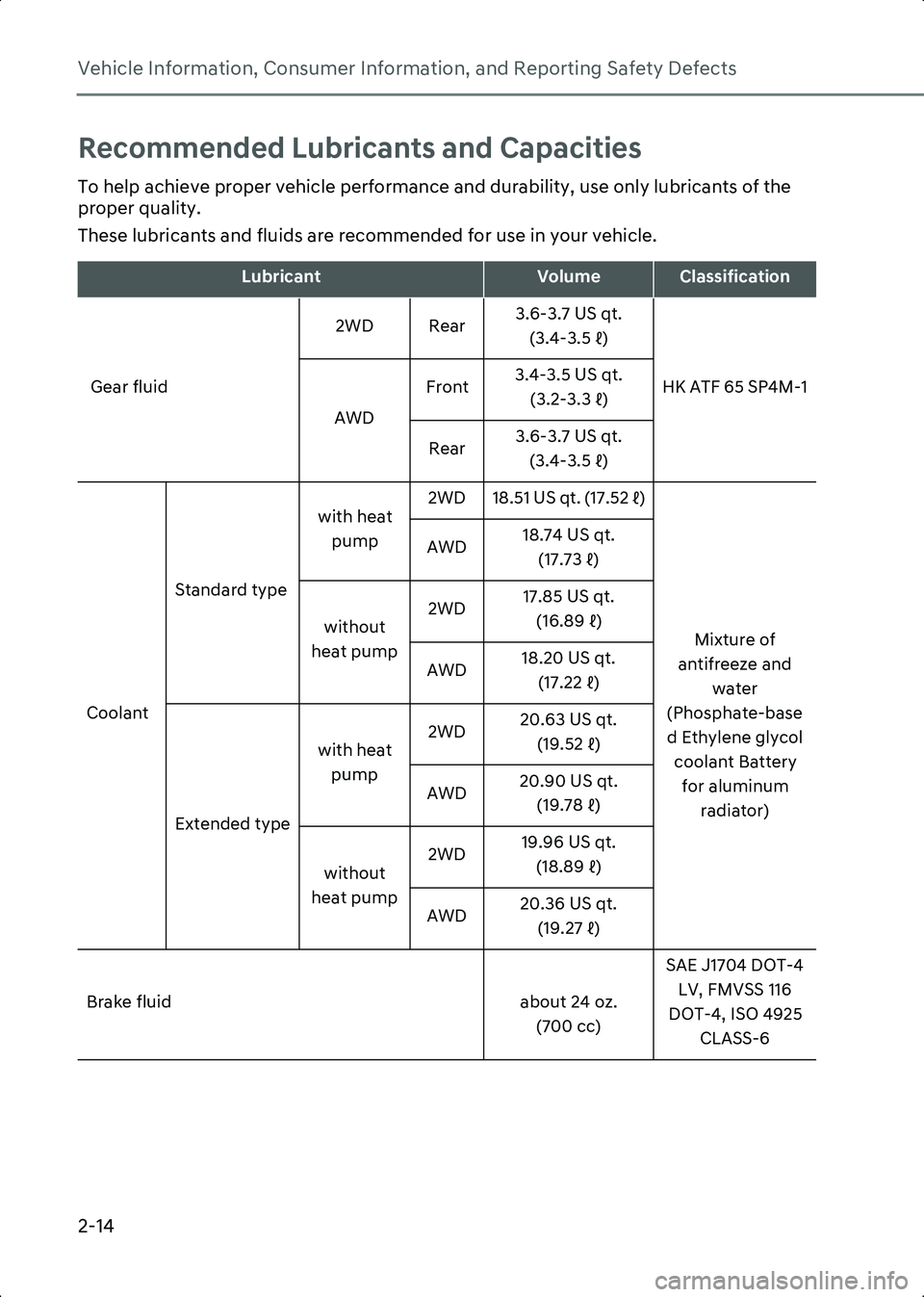
Recommended Lubricants and Capacities
To help achieve proper vehicle performance and durability, use only lubricants of the
proper quality.
These lubricants and fluids are recommended for use in your vehicle.
LubricantVolumeClassification
Gear fluid 2WD Rear
3.6-3.7 US qt.
(3.4-3.5 ℓ)
HK ATF 65 SP4M-1
AWD Front
3.4-3.5 US qt.
(3.2-3.3 ℓ)
Rear 3.6-3.7 US qt.
(3.4-3.5 ℓ)
Coolant Standard type
with heat
pump 2WD 18.51 US qt. (17.52 ℓ)
Mixture of
antifreeze and water
(Phosphate-base
d Ethylene glycol coolant Battery for aluminum radiator)
AWD
18.74 US qt.
(17.73 ℓ)
without
heat pump 2WD
17.85 US qt.
(16.89 ℓ)
AWD 18.20 US qt.
(17.22 ℓ)
Extended type with heat
pump 2WD
20.63 US qt.
(19.52 ℓ)
AWD 20.90 US qt.
(19.78 ℓ)
without
heat pump 2WD
19.96 US qt.
(18.89 ℓ)
AWD 20.36 US qt.
(19.27 ℓ)
Brake fluid
about 24 oz. (700 cc) SAE J1704 DOT-4
LV, FMVSS 116
DOT-4, ISO 4925 CLASS-6
Hyundai_CE_en_US.book Page 14
Page 371 of 582
7
7-27
• Forward Collision-Avoidance Assist may not operate for 15 seconds after
the vehicle is started, or the front view
camera is initialized.
Information This device complies with Part 15 of the FCC
rules.
Operation is subject to the following three
conditions:
1. This device may not cause harmful interference, and
2. This device must accept any interference received, including interference that may
cause undesired operation.
3. Changes or modifications not expressly approved by the party responsible for
compliance could void the user’s authority
to operate the device.
Information Radio frequency radiation exposure
information:
This equipment complies with FCC radiation
exposure limits set forth for an uncontrolled
environment.
This equipment should be installed and
operated with minimum distance of 8 in. (20
cm) between the radiator (antenna) and your
body.
This transmitter must not be co-located or
operating in conjunction with any other
antenna or transmitter.
Lane Keeping Assist (LKA)
While driving over a certain speed, Lane
Keeping Assist detects lane markings (or
road edges) and may warn you if your
vehicle leaves the lane without using the
turn signal and may assist with steering to
prevent your vehicle departing from its
travel lane.
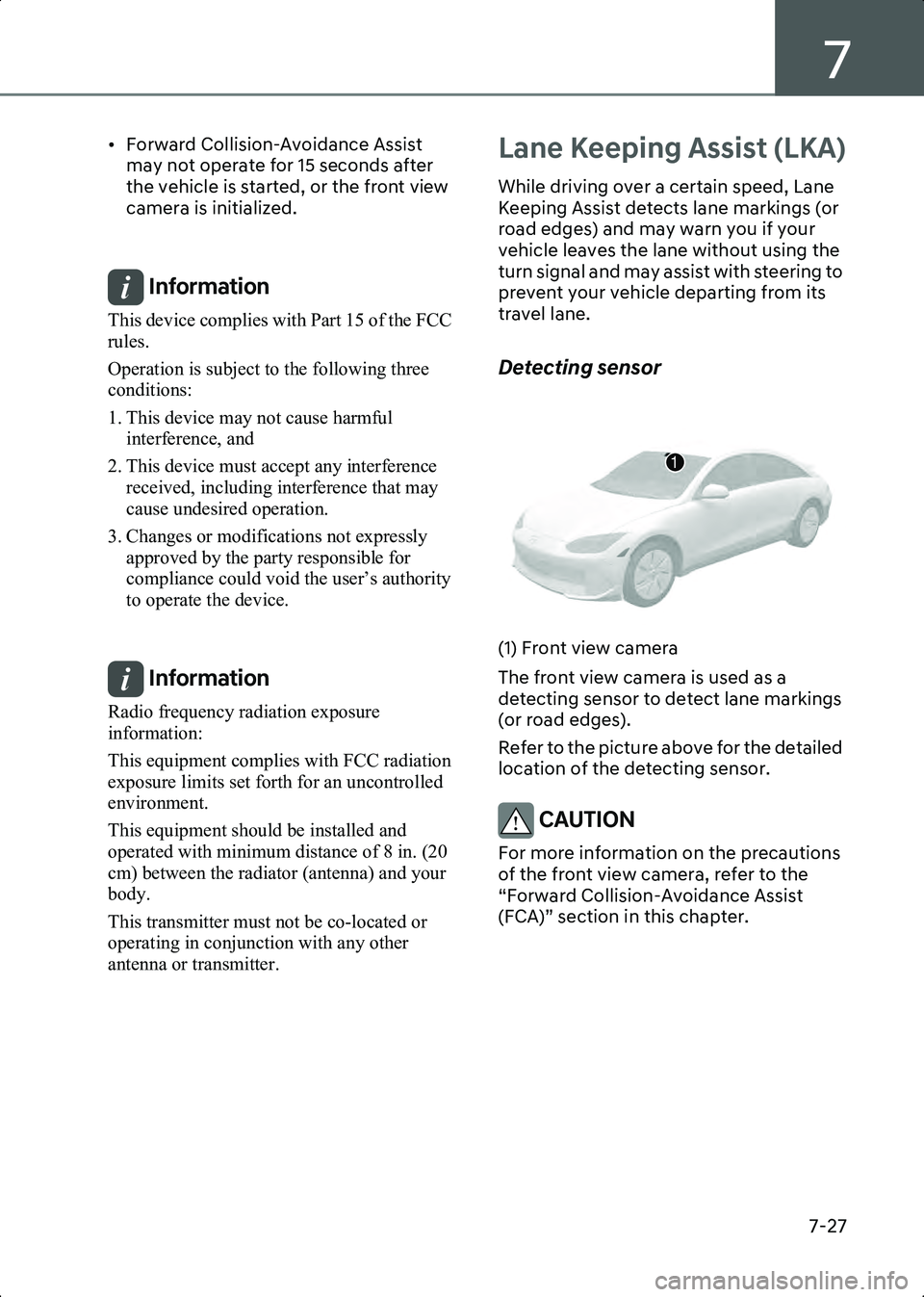
Detecting sensor
B7000901(1) Front view camera
The front view camera is used as a
detecting sensor to detect lane markings
(or road edges).
Refer to the picture above for the detailed
location of the detecting sensor.
CAUTION For more information on the precautions
of the front view camera, refer to the
“Forward Collision-Avoidance Assist
(FCA)” section in this chapter.
1
Hyundai_CE_en_US.book Page 27
Page 386 of 582
Driver Assistance System
7-42
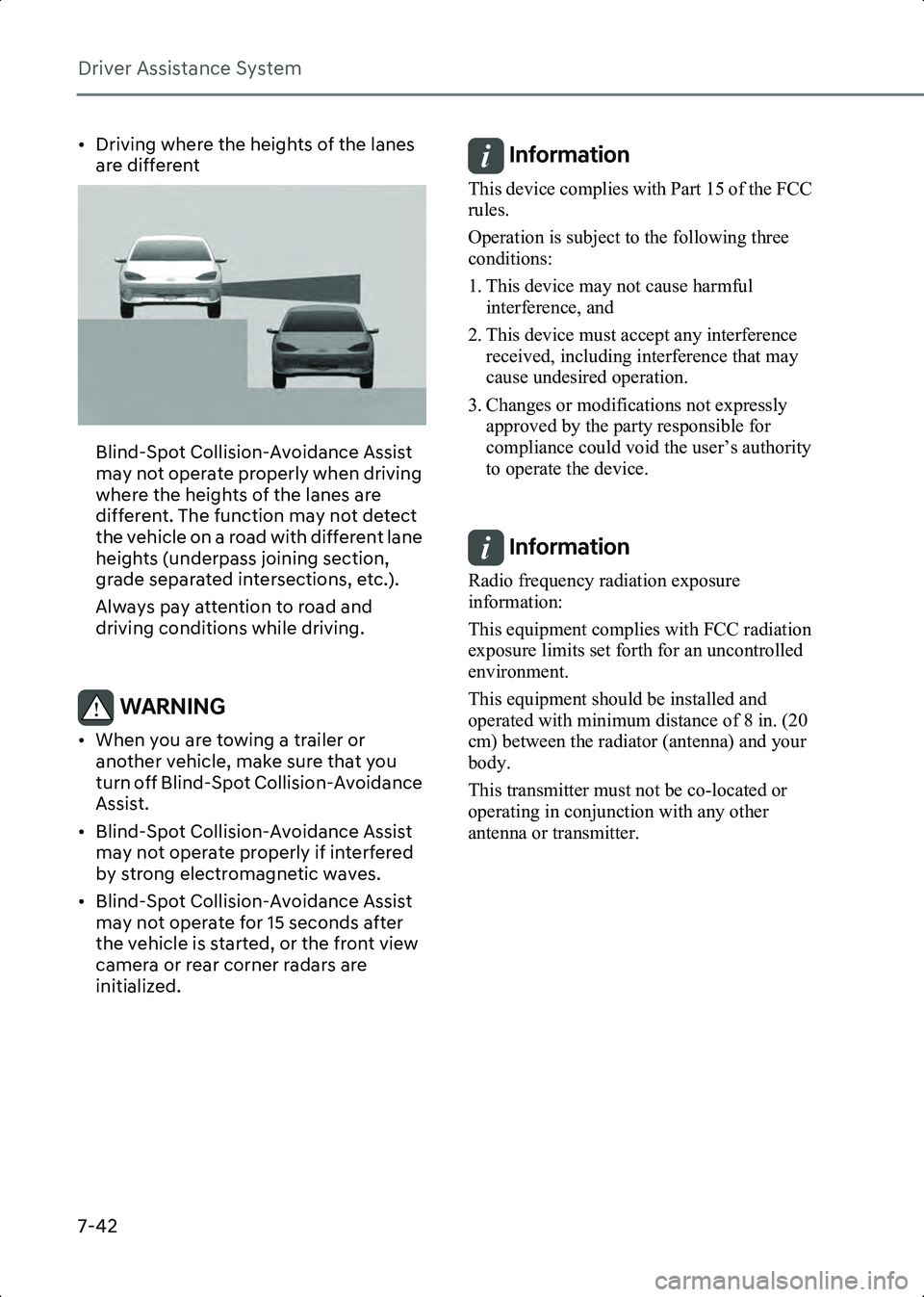
• Driving where the heights of the lanes are different
B7001616
Blind-Spot Collision-Avoidance Assist
may not operate properly when driving
where the heights of the lanes are
different. The function may not detect
the vehicle on a road with different lane
heights (underpass joining section,
grade separated intersections, etc.).
Always pay attention to road and
driving conditions while driving.
WARNING • When you are towing a trailer or another vehicle, make sure that you
turn off Blind-Spot Collision-Avoidance
Assist.
• Blind-Spot Collision-Avoidance Assist may not operate properly if interfered
by strong electromagnetic waves.
• Blind-Spot Collision-Avoidance Assist may not operate for 15 seconds after
the vehicle is started, or the front view
camera or rear corner radars are
initialized.
Information This device complies with Part 15 of the FCC
rules.
Operation is subject to the following three
conditions:
1. This device may not cause harmful interference, and
2. This device must accept any interference received, including interference that may
cause undesired operation.
3. Changes or modifications not expressly approved by the party responsible for
compliance could void the user’s authority
to operate the device.
Information Radio frequency radiation exposure
information:
This equipment complies with FCC radiation
exposure limits set forth for an uncontrolled
environment.
This equipment should be installed and
operated with minimum distance of 8 in. (20
cm) between the radiator (antenna) and your
body.
This transmitter must not be co-located or
operating in conjunction with any other
antenna or transmitter.
Hyundai_CE_en_US.book Page 42
Page 420 of 582
Driver Assistance System
7-76
B7004410
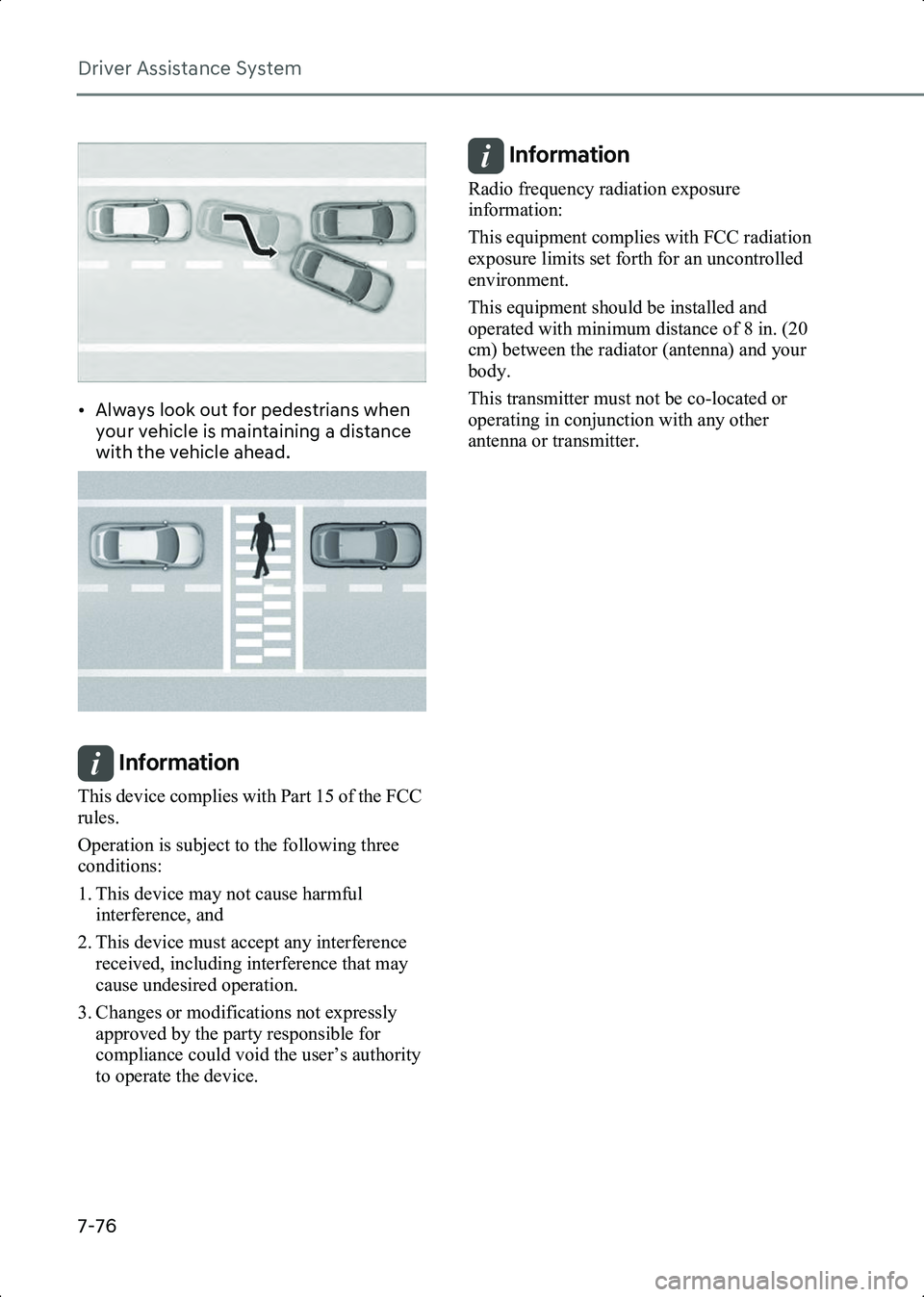
• Always look out for pedestrians when your vehicle is maintaining a distance
with the vehicle ahead.
B7004411
Information This device complies with Part 15 of the FCC
rules.
Operation is subject to the following three
conditions:
1. This device may not cause harmful interference, and
2. This device must accept any interference received, including interference that may
cause undesired operation.
3. Changes or modifications not expressly approved by the party responsible for
compliance could void the user’s authority
to operate the device.
Information Radio frequency radiation exposure
information:
This equipment complies with FCC radiation
exposure limits set forth for an uncontrolled
environment.
This equipment should be installed and
operated with minimum distance of 8 in. (20
cm) between the radiator (antenna) and your
body.
This transmitter must not be co-located or
operating in conjunction with any other
antenna or transmitter.
Hyundai_CE_en_US.book Page 76
Page 425 of 582
7
7-81
decelerate the vehicle. However, if the
accelerator pedal is depressed
insufficiently, the vehicle may
decelerate.
• If the driver accelerates and releases the accelerator pedal while
Navigation-based Smart Cruise Control
is operating, the vehicle may not
decelerate sufficiently or may rapidly
decelerate to a safe speed.
• If the curve is too large or too small, Navigation-based Smart Cruise Control
may not operate.
Information • A time gap could occur between the navigation’s guidance and when
Navigation-based Smart Cruise Control
operation starts and ends.
• The speed information on the instrument cluster and navigation may differ.
• Even if you are driving at a speed lower than Smart Cruise Control set speed,
acceleration may be limited by the curve
sections ahead.
• If Navigation-based Smart Cruise Control is operating while leaving the main road to
enter an interchange, junction, rest area,
etc., the function may operate for a certain
period of time.
• Deceleration by Navigation-based Smart Cruise Control may feel it is not sufficient
due to road conditions such as uneven road
surfaces, narrow lanes, etc.
Information This device complies with Part 15 of the FCC
rules.
Operation is subject to the following three
conditions:
1. This device may not cause harmful interference, and 2. This device must accept any interference
received, including interference that may
cause undesired operation.
3. Changes or modifications not expressly approved by the party responsible for
compliance could void the user’s authority
to operate the device.
Information Radio frequency radiation exposure
information:
This equipment complies with FCC radiation
exposure limits set forth for an uncontrolled
environment.
This equipment should be installed and
operated with minimum distance of 8 in. (20
cm) between the radiator (antenna) and your
body.
This transmitter must not be co-located or
operating in conjunction with any other
antenna or transmitter.
Hyundai_CE_en_US.book Page 81
Page 439 of 582
7
7-95
Information For more information on the limitations of the
front view camera, front radar, front corner
radar and rear corner radar, refer to the
“Forward Collision-Avoidance Assist (FCA)”
section in this chapter.
Information This device complies with Part 15 of the FCC
rules.
Operation is subject to the following three
conditions:
1. This device may not cause harmful interference, and
2. This device must accept any interference received, including interference that may
cause undesired operation.
3. Changes or modifications not expressly approved by the party responsible for
compliance could void the user’s authority
to operate the device.
Information Radio frequency radiation exposure
information:
This equipment complies with FCC radiation
exposure limits set forth for an uncontrolled
environment.
This equipment should be installed and
operated with minimum distance of 8 in. (20
cm) between the radiator (antenna) and your
body.
This transmitter must not be co-located or
operating in conjunction with any other
antenna or transmitter.
if equipped
Rear View Monitor (RVM)
Rear View Monitor displays the area
behind your vehicle to help with safe
parking or driving.
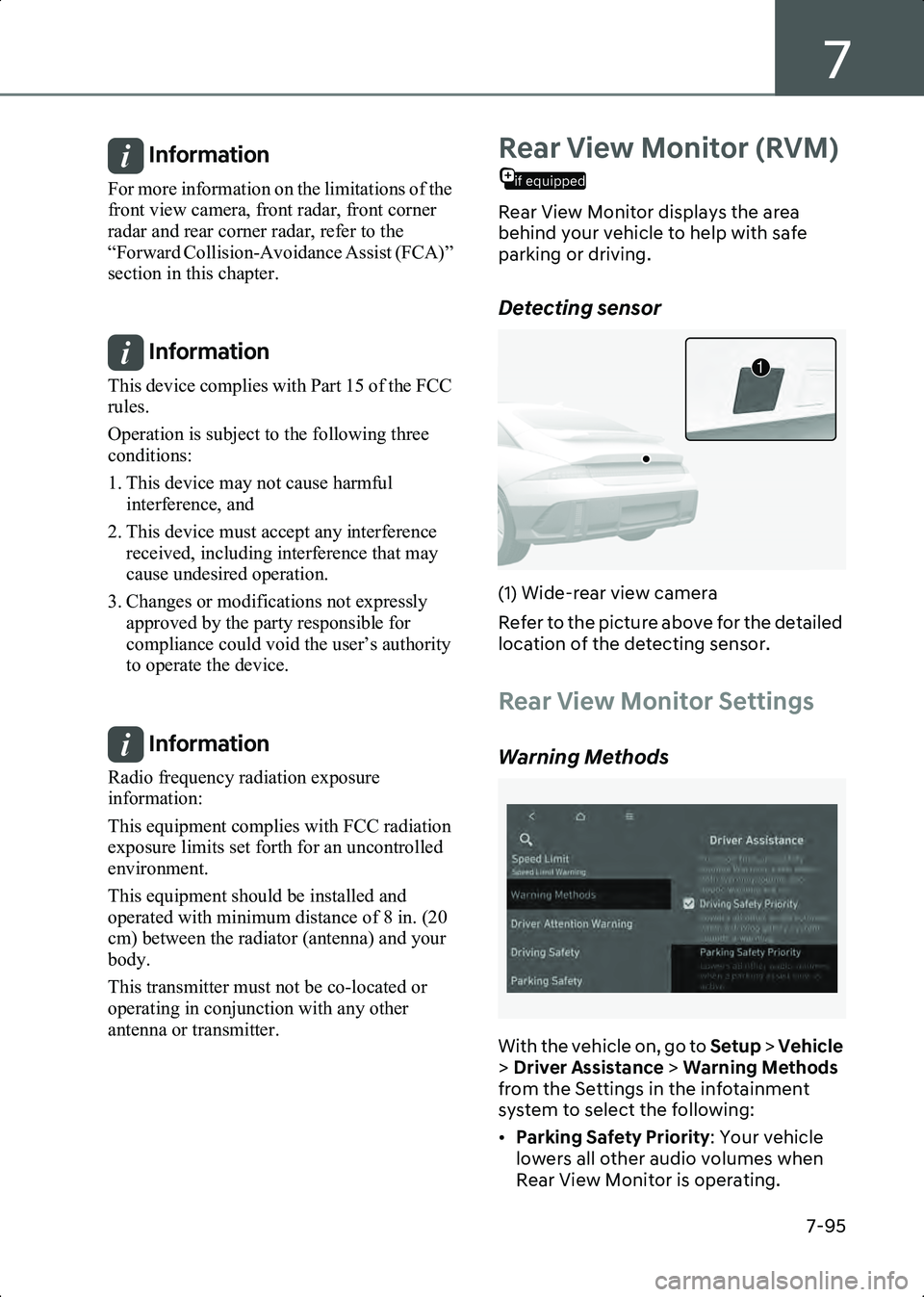
Detecting sensor
B7005801(1) Wide-rear view camera
Refer to the picture above for the detailed
location of the detecting sensor.
Rear View Monitor Settings
Warning Methods
B7005901
With the vehicle on, go to Setup > Vehicle
> Driver Assistance > Warning Methods
from the Settings in the infotainment
system to select the following:
• Parking Safety Priority : Your vehicle
lowers all other audio volumes when
Rear View Monitor is operating.
1
Hyundai_CE_en_US.book Page 95
Page 523 of 582
9
9-7
• Check for fluid leaks under your vehicle (water dripping from the air
conditioning system during or after use
is normal).
At least monthly:
• Check coolant level in the coolant reservoir.
• Check the operation of all exterior lights, including the stoplights, turn
signals and hazard warning flashers.
• Check the inflation pressures of all tires including the spare for tires that are
worn, show uneven wear, or are
damaged.
• Check for loose wheel lug nuts.
At least twice a year: (for example,
every Spring and Autumn)
• Check radiator, heater and air conditioning hoses for leaks or
damage.
• Check windshield washer spray and wiper operation. Clean wiper blades
with a clean cloth dampened with
washer fluid.
• Check headlight alignment.
• Check the seat belts for wear and function.
At least once a year:
• Clean body and door drain holes.
• Lubricate door hinges and hood hinges.
• Lubricate door and hood locks and latches.
• Lubricate door rubber weather strips.
• Check the air conditioning system.
• Inspect and lubricate shift gear linkage and controls.
• Clean the battery (12 V) and terminals.
• Check the brake fluid level.
Scheduled Maintenance
Services
Follow Normal Maintenance Schedule if
the vehicle is usually operated where
none of the following conditions apply. If
any of the following conditions apply, you
must follow the Maintenance Under
Severe Usage Conditions.
• Repeated driving short distance of less than 5 mi. (8 km) in normal temperature
or less than 10 mi. (16 km) in freezing
temperature
• Driving on rough, dusty, muddy, unpaved, graveled or salt-spread roads
• Driving in areas using salt or other corrosive materials or in very cold
weather
• Driving in heavy dust condition
• Driving in heavy traffic area with the ambient temperature higher than 90 ºF
(32 ºC) while consuming more than 50%
of electric energy.
• Driving on uphill, downhill, or mountain roads repeatedly
• Towing a trailer or using a camper, or driving with loads on the roof
• Driving as a patrol car, taxi, other commercial use or vehicle towing
• Frequently driving under high speed or rapid acceleration/deceleration
• Frequently driving in stop-and-go conditions
If your vehicle is operated under the
above conditions, you should inspect,
replace or refill more frequently than the
following Normal Maintenance Schedule.
After the periods or distance shown in the
chart, continue to follow the prescribed
maintenance intervals.
Hyundai_CE_en_US.book Page 7
Page 527 of 582
9
9-11
Explanation of Scheduled
Maintenance Items
Cooling System
Check cooling system components, such
as radiator, coolant reservoir, hoses and
connections for leakage and damage.
Replace any damaged parts.
Coolant
The coolant should be changed at the
intervals specified in the maintenance
schedule.
Gear Fluid
The gear fluid should be inspected and
replaced according to the intervals
specified in the maintenance schedule.
Brake Hoses and Lines
Visually check for proper installation,
chafing, cracks, deterioration and any
leakage. Replace any deteriorated or
damaged parts immediately.
Brake Fluid
Check the brake fluid level in the brake
fluid reservoir. The level should be
between the MIN and the MAX marks on
the side of the reservoir. Use only
hydraulic brake fluid conforming to DOT 4
specification.
Brake Discs, Pads, Calipers
and Rotors
Check the pads, the discs, and the rotors
for any excessive wear-out. Inspect
calipers for any fluid leakage.
Suspension Mounting Bolts
Check the suspension connections for
looseness or damage. Retighten to the
specified torque.
Steering Gear Box, Linkage &
Boots/Lower Arm Ball Joint
With the vehicle stopped and the vehicle
off, check for excessive free-play in the
steering wheel. Check the linkage for
bends or damage. Check the dust boots
and ball joints for deterioration, cracks, or
damage.
Replace any damaged parts.
Drive Shafts and Boots
Check the drive shafts, boots and clamps
for cracks, deterioration, or damage.
Replace any damaged parts and, if
necessary, repack the grease.
Air Conditioning Refrigerant
Check the air conditioning lines and
connections for leakage and damage.
Hyundai_CE_en_US.book Page 11