ESP HYUNDAI IONIQ ELECTRIC 2021 Owners Manual
[x] Cancel search | Manufacturer: HYUNDAI, Model Year: 2021, Model line: IONIQ ELECTRIC, Model: HYUNDAI IONIQ ELECTRIC 2021Pages: 546, PDF Size: 34.82 MB
Page 23 of 546
H14
Charging Information
AC Charge :
The electric vehicle is charged by
plugging into a AC charger installed
in your home or a public charging
station. (For further details, refer to
the 'AC Charge'.)
DC Charge (if equipped):
You can charge at high speeds at
public charging stations. Refer to
the respective company's manual
that is provided for each DC charg-
er type.
Battery performance and durability
can deteriorate if the DC charger is
used constantly. Use of DC charge should be mini-
mized in order to help prolong high
voltage battery life.
Trickle Charge :
The Electric vehicle can be charged
by using household electricity. The
electrical outlet in your home mustcomply with regulations and can
safely accommodate the Voltage /
Current (Amps) / Power (Watts) rat-
ings specified on the portable
charge.
Charging Time Information
AC Charge :
Takes about 6 hours 5 minutes at
room temperature. (Can becharged to 100%.)
DC Charge (if equipped):
- 50 kw charger : Takes about 57
minutes at room temperature when charged to 80%.
- 100 kw charger : Takes about 54 minutes at room temperaturewhen charged to 80%.
Both 50/100 kw charger can becharged to 100%.
Trickle Charge :
Takes about 35 hours 30 minutes
at room temperature. (120V-12A)(Can be charged to 100%.) Information
Depending on the condition and dura-
bility of the high voltage battery,
charger specifications, and ambient
temperature, the time required for
charging the high voltage battery may
vary.
i
CC HH AARRGG EE TT YY PPEESS FF OO RR EE LLEE CCTT RR IICC VV EEHH IICC LLEE
Page 37 of 546
H28
DC Charge (if equipped)
You can charge at high speeds at
public charging stations. Refer to the
respective company's manual that is
provided for each DC charger type.
Battery performance and durability
can deteriorate if the DC charger is
used constantly. Use of DC charge should be mini-
mized in order to help prolong high
voltage battery life.
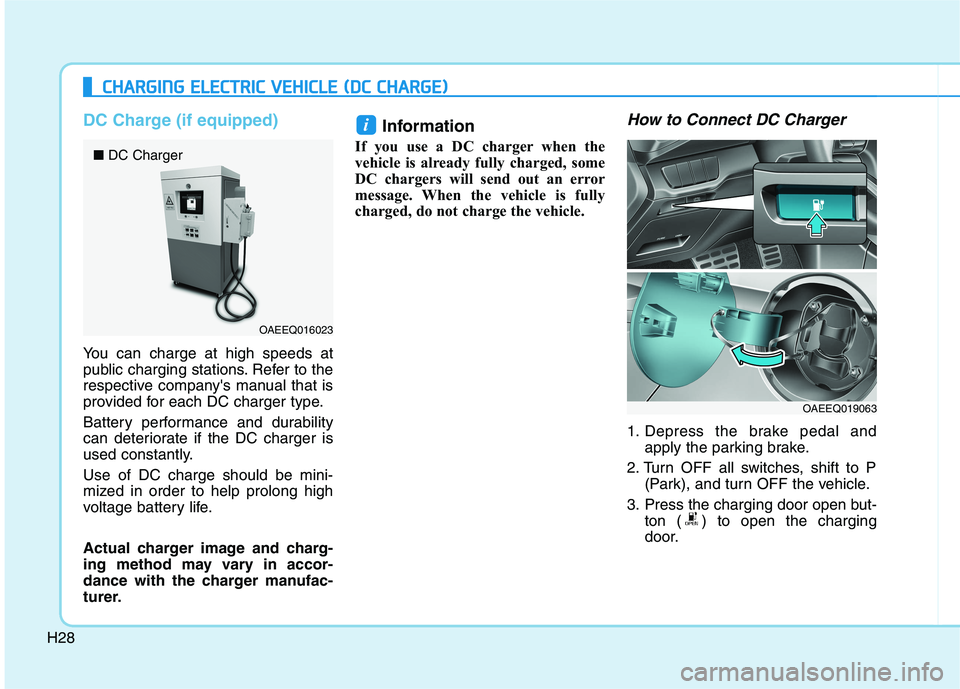
Actual charger image and charg-
ing method may vary in accor-
dance with the charger manufac-
turer.Information
If you use a DC charger when the
vehicle is already fully charged, some
DC chargers will send out an error
message. When the vehicle is fully
charged, do not charge the vehicle.
How to Connect DC Charger
1. Depress the brake pedal and apply the parking brake.
2. Turn OFF all switches, shift to P (Park), and turn OFF the vehicle.
3. Press the charging door open but- ton ( ) to open the charging
door.
i
CCHH AARRGG IINN GG EE LLEE CCTT RR IICC VV EEHH IICC LLEE (( DD CC CC HH AARRGG EE))
OAEEQ016023
■
DC Charger
OAEEQ019063
Page 41 of 546
H32
How to Disconnect DC Charger
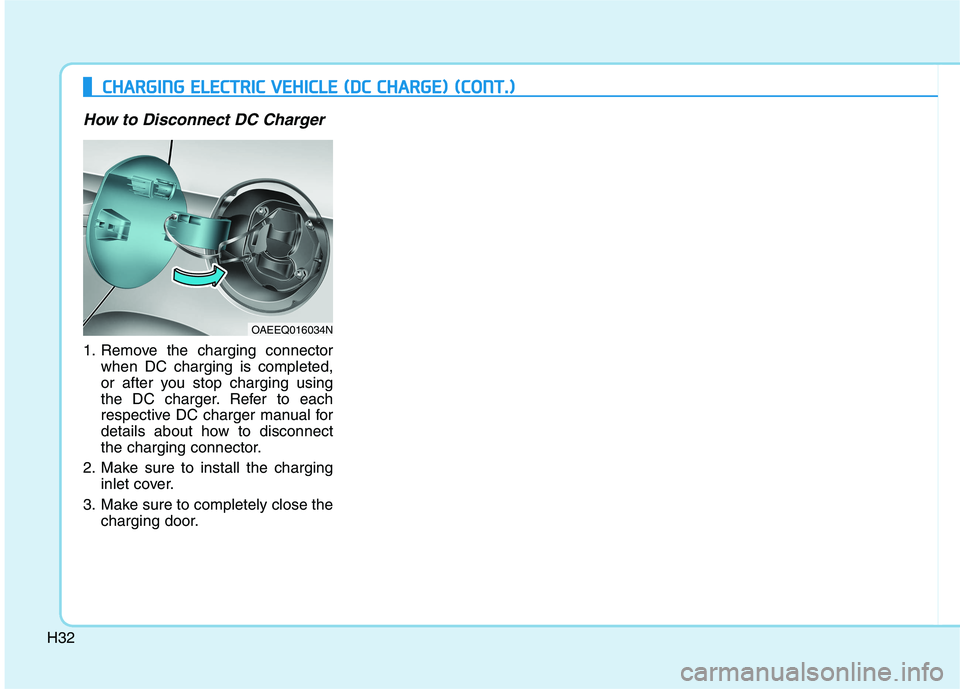
1. Remove the charging connectorwhen DC charging is completed,
or after you stop charging using
the DC charger. Refer to each
respective DC charger manual for
details about how to disconnect
the charging connector.
2. Make sure to install the charging inlet cover.
3. Make sure to completely close the charging door.
OAEEQ016034N
CCHH AARRGG IINN GG EE LLEE CCTT RR IICC VV EEHH IICC LLEE (( DD CC CC HH AARRGG EE)) (( CC OO NNTT..))
Page 82 of 546
2-2
You will find many safety precautions and recommendations throughoutthis section, and throughout this man-
ual. The safety precautions in this sec-
tion are among the most important.
Always Wear Your Seat Belt
A seat belt is your best protection in
all types of accidents. Air bags are
designed to supplement seat belts,
not replace them. So even though
your vehicle is equipped with air bags,
ALWAYS make sure you and your
passengers wear your seat belts, and
wear them properly.
Restrain All Children
All children under age 13 should ride
in your vehicle properly restrained in
a rear seat, not the front seat. Infantsand small children should be
restrained in an appropriate child
restraint. Larger children should usea booster seat with the lap/shoulder
belt until they can use the seat belt
properly without a booster seat.
Air Bag Hazards
While air bags can save lives, they
can also cause serious or fatal
injuries to occupants who sit tooclose to them, or who are not prop-
erly restrained. Infants, young chil-
dren, and shorter adults are at the
greatest risk of being injured by an
inflating air bag. Follow all instruc-
tions and warnings in this manual.
Driver Distraction
Driver distraction presents a serious
and potentially deadly danger, espe-
cially for inexperienced drivers. Safety
should be the first concern when
behind the wheel and drivers need to
be aware of the wide array of potential
distractions, such as drowsiness,
reaching for objects, eating, personal
grooming, other passengers, and
using cellular phones.
Drivers can become distracted when
they take their eyes and attention offthe road or their hands off the wheel
to focus on activities other than driv-
ing. To reduce your risk of distractionor getting into an accident:
II
MM PPOO RRTTAA NN TT SS AA FFEE TT YY PP RR EECCAA UU TTIIOO NNSS
Safety system of your vehicle
Page 83 of 546
2-3
Safety system of your vehicle
• ALWAYS set up your mobiledevices (i.e., MP3 players, phones,
navigation units, etc.) when your
vehicle is parked or safely stopped.
ONLY use your mobile device when allowed by laws and when
conditions permit safe use. NEVER
text or email while driving. Most
countries have laws prohibiting
drivers from texting. Some coun-
tries and cities also prohibit drivers
from using handheld phones.
NEVER let the use of a mobile device distract you from driving.
You have a responsibility to yourpassengers and others on the road
to always drive safely, with your
hands on the wheel as well as your
eyes and attention on the road.Control Your Speed
Excessive speed is a major factor in
crash injuries and deaths. Generally,
the higher the speed, the greater the
risk, but serious injuries can also
occur at lower speeds. Never drive
faster than is safe for current condi-
tions, regardless of the maximumspeed posted.
Keep Your Vehicle in Safe Condition
Having a tire blowout or a mechanical
failure can be extremely hazardous. Toreduce the possibility of such prob-
lems, check your tire pressures and
condition frequently, and perform all
regularly scheduled maintenance.
2
Page 86 of 546
2-6
Safety system of your vehicle
Seat belts
Always fasten your seat belt before
starting any trip.
At all times, passengers should sit
upright and be properly restrained.
Infants and small children must be
restrained in appropriate child restraint
systems. Adults and children who
have outgrown a booster seat must be
restrained using the seat belts.
Front Seats
Take the following precautions
when adjusting your seat belt:
NEVER use one seat belt for more than one occupant.
Always position the seatback
upright with the lap portion of
the seat belt snug and low
across the hips.
NEVER allow children or small
infants to ride in a passenger'slap.
Do not route the seat belt
across your neck, across sharp
edges, or reroute the shoulder
strap away from your body.
Do not allow the seat belt to become caught or jammed.
WARNING
Take the following precautions
when adjusting your seat:
NEVER attempt to adjust the
seat while the vehicle is mov-
ing. The seat could respond
with unexpected movement
and may cause loss of vehicle
control resulting in an acci-dent.
Do not place anything under
the front seats. Loose objects
in the driver's foot area could
interfere with the operation of
the foot pedals, causing anaccident.
Do not allow anything to inter-
fere with the normal position
and proper locking of the seat-
back.
Do not place a cigarette lighter
on the floor or seat. When you
operate the seat, gas may exit
out of the lighter causing a fire.(Continued)
WARNING
Page 96 of 546
2-16
Safety system of your vehicle
Head Restraints
The vehicle's front and rear seats
have adjustable head restraints. The
head restraints provide comfort for
passengers, but more importantly
they are designed to help protectpassengers from whiplash and other
neck and spinal injuries during anaccident, especially in a rear impactcollision.To prevent damage, NEVER hit orpull on the head restraints.
NOTICE
To reduce the risk of serious
injury or death in an accident,
take the following precautions
when adjusting your headrestraints:
Always properly adjust the
head restraints for all passen-
gers BEFORE starting the
vehicle.
NEVER let anyone ride in a seat with the head restraints
removed.
(Continued)
(Continued)
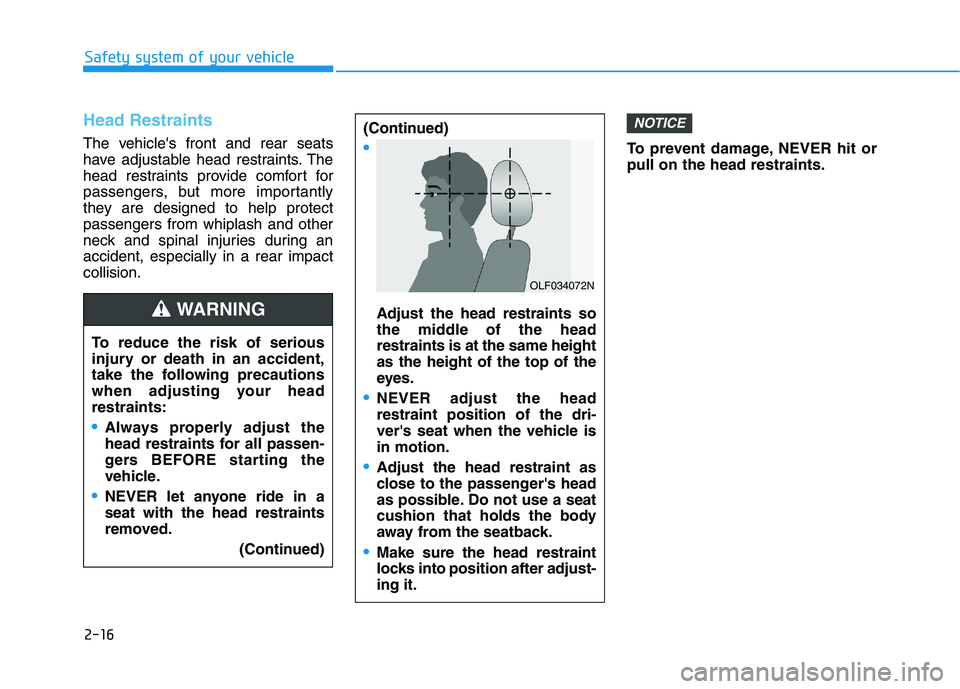
Adjust the head restraints so
the middle of the headrestraints is at the same heightas the height of the top of the
eyes.
NEVER adjust the head restraint position of the dri-
ver's seat when the vehicle isin motion.
Adjust the head restraint as
close to the passenger's head
as possible. Do not use a seat
cushion that holds the body
away from the seatback.
Make sure the head restraint
locks into position after adjust-ing it.
WARNING
OLF034072N
Page 100 of 546
2-20
Safety system of your vehicle
Seat Warmers
Front seat warmers
Seat warmers are provided to warm
the seats during cold weather.The seat warmers can cause a
SERIOUS BURN, even at low
temperatures and especially if
used for long periods of time.
Passengers must be able to feel if the seat is becoming too warm
so they can turn it off, if needed.
People who cannot detect tem-
perature change or pain to the
skin should use extreme cau-
tion, especially the following
types of passengers:
Infants, children, elderly or
disabled persons, or hospitaloutpatients.
People with sensitive skin or
who burn easily.
Fatigued individuals.
Intoxicated individuals.
People taking medication that
can cause drowsiness orsleepiness.
WARNING
NEVER place anything on the
seat that insulates against heatwhen the seat warmer is in oper-
ation, such as a blanket or seat
cushion. This may cause the
seat warmer to overheat, caus-
ing a burn or damage to the seat.
WARNING
Page 104 of 546
2-24
Safety system of your vehicle
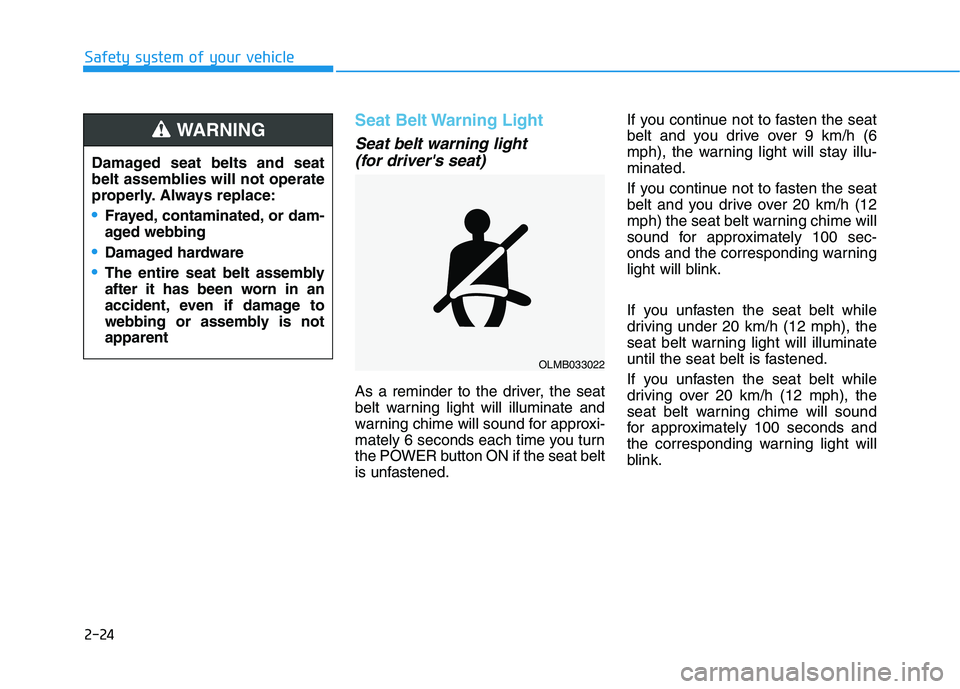
Seat Belt Warning Light
Seat belt warning light (for driver's seat)
As a reminder to the driver, the seat
belt warning light will illuminate and
warning chime will sound for approxi-
mately 6 seconds each time you turn
the POWER button ON if the seat belt
is unfastened. If you continue not to fasten the seat
belt and you drive over 9 km/h (6
mph), the warning light will stay illu-minated.
If you continue not to fasten the seat
belt and you drive over 20 km/h (12
mph) the seat belt warning chime will
sound for approximately 100 sec-
onds and the corresponding warning
light will blink.
If you unfasten the seat belt while
driving under 20 km/h (12 mph), the
seat belt warning light will illuminate
until the seat belt is fastened.
If you unfasten the seat belt while
driving over 20 km/h (12 mph), the
seat belt warning chime will sound
for approximately 100 seconds and
the corresponding warning light will
blink.
Damaged seat belts and seat
belt assemblies will not operate
properly. Always replace:
Frayed, contaminated, or dam-
aged webbing
Damaged hardware
The entire seat belt assembly
after it has been worn in an
accident, even if damage to
webbing or assembly is notapparent
WARNING
OLMB033022
Page 105 of 546
2-25
Safety system of your vehicle
2
Seat belt warning light (for front passenger's seat)
As a reminder to the front passenger,
the front passenger's seat belt warn-
ing lights will illuminate for approxi-
mately 6 seconds each time you turn
the POWER button to the ON posi-
tion regardless of belt fastening.
If you continue not to fasten the seat
belt and you drive over 9 km/h (6
mph), the warning light will stay illu-minated. If you continue not to fasten the seat
belt and you drive over 20 km/h (12
mph) the seat belt warning chime
will sound for approximately 100 sec-
onds and the corresponding warning
light will blink.
If you unfasten the seat belt while
driving under 20 km/h (12 mph) the
seat belt warning light will illuminate
until the seat belt is fastened.
If you unfasten the seat belt while
driving over 20 km/h (12 mph), the
seat belt warning chime will sound
for approximately 100 seconds and
the corresponding warning light will
blink. The front passenger's seat belt
warning light may not properly
operate if the front passenger
does not sit properly in the seat.
WARNING