clutch HYUNDAI IX20 2011 User Guide
[x] Cancel search | Manufacturer: HYUNDAI, Model Year: 2011, Model line: IX20, Model: HYUNDAI IX20 2011Pages: 420, PDF Size: 20.53 MB
Page 256 of 420
Driving your vehicle
36
5
The cruise control system allows you to
program the vehicle to maintain a con-stant speed without depressing the
accelerator pedal. This system is designed to function
above approximately 40 km/h (25 mph).✽✽
NOTICE
During normal cruise control operation,
when the SET switch is activated or
reactivated after applying the brakes,
the cruise control will energize after
approximately 3 seconds. This delay isnormal.
CRUISE CONTROL SYSTEM (IF EQUIPPED)
WARNING
If the cruise control is left on, (CRUISE indicator light in the
instrument cluster illuminated)
the cruise control can be
switched on accidentally. Keep
the cruise control system off
(CRUISE indicator light OFF)
when the cruise control is not in
use, to avoid inadvertently set-ting a speed.
Use the cruise control system only when driving on open high-
ways in good weather.
(Continued)
(Continued)
Do not use the cruise controlwhen it may not be safe to keep
the vehicle at a constant speed,
for instance, driving in heavy or
varying traffic, or on slippery
(rainy, icy or snow-covered) or
winding roads or over 6% up-hill
or down-hill roads.
Pay particular attention to the driving conditions whenever
using the cruise control system.
CAUTION
During cruise-speed driving with a
manual transaxle vehicle, do notshift into neutral without depress- ing the clutch pedal, since theengine will be overrevved. If this
happens, depress the clutch pedal or release the cruise control ON-OFF switch.
JC ENG 5.QXP 9/7/2010 11:52 AM Page 36
procarmanuals.com
Page 259 of 420
539
Driving your vehicle
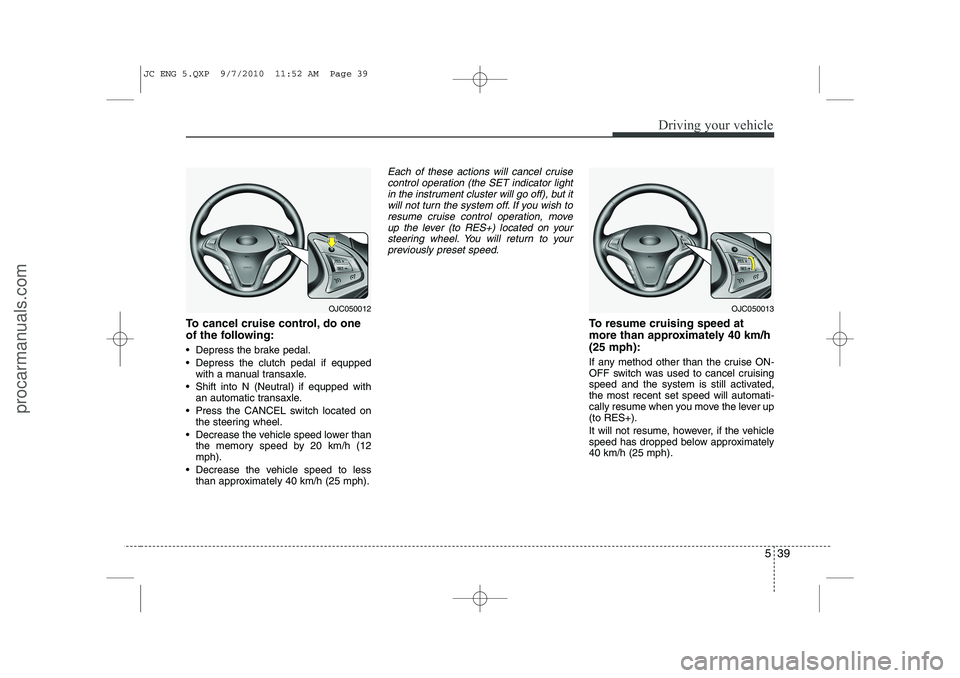
To cancel cruise control, do one
of the following:
Depress the brake pedal.
Depress the clutch pedal if equppedwith a manual transaxle.
Shift into N (Neutral) if equpped with an automatic transaxle.
Press the CANCEL switch located on the steering wheel.
Decrease the vehicle speed lower than the memory speed by 20 km/h (12 mph).
Decrease the vehicle speed to less than approximately 40 km/h (25 mph).
Each of these actions will cancel cruise
control operation (the SET indicator light in the instrument cluster will go off), but itwill not turn the system off. If you wish to
resume cruise control operation, moveup the lever (to RES+) located on your steering wheel. You will return to your
previously preset speed.
To resume cruising speed at
more than approximately 40 km/h(25 mph):
If any method other than the cruise ON-
OFF switch was used to cancel cruising
speed and the system is still activated,the most recent set speed will automati-
cally resume when you move the lever up(to RES+).
It will not resume, however, if the vehicle
speed has dropped below approximately40 km/h (25 mph).
OJC050012OJC050013
JC ENG 5.QXP 9/7/2010 11:52 AM Page 39
procarmanuals.com
Page 263 of 420
543
Driving your vehicle
Your vehicle's fuel economy depends
mainly on your style of driving, where you
drive and when you drive.
Each of these factors affects how many
kilometers (miles) you can get from a
liter (gallon) of fuel. To operate your vehi-
cle as economically as possible, use the
following driving suggestions to help
save money in both fuel and repairs:
Drive smoothly. Accelerate at a moder-ate rate. Don't make "jack-rabbit" starts or full-throttle shifts and maintain a
steady cruising speed. Don't race
between stoplights. Try to adjust your
speed to the traffic so you don't have to
change speeds unnecessarily. Avoid
heavy traffic whenever possible.
Always maintain a safe distance from
other vehicles so you can avoid unnec-
essary braking. This also reduces
brake wear.
Drive at a moderate speed. The faster you drive, the more fuel your vehicle
uses. Driving at a moderate speed,
especially on the highway, is one of the
most effective ways to reduce fuel con-sumption. Don't "ride" the brake or clutch pedal.
This can increase fuel consumption
and also increase wear on these com-
ponents. In addition, driving with your
foot resting on the brake pedal may
cause the brakes to overheat, which
reduces their effectiveness and may
lead to more serious consequences.
Take care of your tires. Keep them inflated to the recommended pressure.
Incorrect inflation, either too much or
too little, results in unnecessary tire
wear. Check the tire pressures at leastonce a month.
Be sure that the wheels are aligned correctly. Improper alignment can
result from hitting curbs or driving too
fast over irregular surfaces. Poor align-
ment causes faster tire wear and may
also result in other problems as well as
greater fuel consumption. Keep your vehicle in good condition.
For better fuel economy and reduced
maintenance costs, maintain your vehi-cle in accordance with the mainte-
nance schedule in section 7. If you
drive your vehicle in severe conditions,more frequent maintenance is required
(see section 7 for details).
Keep your vehicle clean. For maximum service, your vehicle should be kept
clean and free of corrosive materials. It
is especially important that mud, dirt,
ice, etc. not be allowed to accumulate
on the underside of the vehicle. This
extra weight can result in increased
fuel consumption and also contributeto corrosion.
Travel lightly. Don't carry unnecessary weight in your vehicle. Weight reduces
fuel economy.
Don't let the engine idle longer than necessary. If you are waiting (and not
in traffic), turn off your engine and
restart only when you're ready to go.
ECONOMICAL OPERATION
JC ENG 5.QXP 9/7/2010 11:53 AM Page 43
procarmanuals.com
Page 285 of 420
63
What to do in an emergency
IN CASE OF AN EMERGENCY WHILE DRIVING
If the engine stalls at a crossroad
or crossing
If the engine stalls at a crossroad or crossing, set the shift lever in the N
(Neutral) position and then push the
vehicle to a safe place.
If your vehicle has a manual transaxle not equipped with a ignition lock
switch, the vehicle can move forward
by shifting to the 2nd (Second) or 3 rd
(Third) gear and then turning the
starter without depressing the clutchpedal. If you have a flat tire while driving
If a tire goes flat while you are driving:
1. Take your foot off the accelerator pedal
and let the vehicle slow down while
driving straight ahead. Do not apply the
brakes immediately or attempt to pull
off the road as this may cause a loss of
control. When the vehicle has slowed
down to such a speed that it is safe to
do so, brake carefully and pull off the
road. Drive off the road as far as possi-
ble and park on a firm level ground. If
you are on a divided highway, do not
park in the median area between the
two traffic lanes.
2. When the vehicle is stopped, turn on your emergency hazard flashers, set
the parking brake and put the transaxle
in P (automatic transaxle) or Reverse
(manual transaxle).
3. Have all passengers get out of the vehicle. Be sure they all get out on the
side of the vehicle that is away from
traffic.
4. When changing a flat tire, follow the instruction provided later in this sec-tion. If engine stalls while driving
1. Reduce your speed gradually, keeping
a straight line. Move cautiously off the
road to a safe place.
2. Turn on your emergency flashers.
3. Try to start the engine again. If your vehicle will not start, contact an
authorized HYUNDAI dealer or seek
other qualified assistance.
JC ENG 6.QXP 9/7/2010 11:55 AM Page 3
procarmanuals.com
Page 314 of 420
7
Engine compartment / 7-2 Maintenance services / 7-3
Owner maintenance / 7-5Scheduled maintenance service / 7-7Explanation of scheduled maintenance items / 7-30Engine oil / 7-34Engine coolant / 7-35Brake/clutch fluid / 7-38Automatic transaxle fluid / 7-39
Washer fluid / 7-41Parking brake / 7-41
Fuel filter / 7-42
Air cleaner / 7-43
Wiper blades / 7-44Battery / 7-47
Tires and wheels / 7-50Fuses / 7-60Light bulbs / 7-71
Appearance care / 7-79
Emission control system / 7-85
Maintenance
JC ENG 7.QXP 9/7/2010 11:58 AM Page 1
procarmanuals.com
Page 319 of 420
Maintenance
6
7
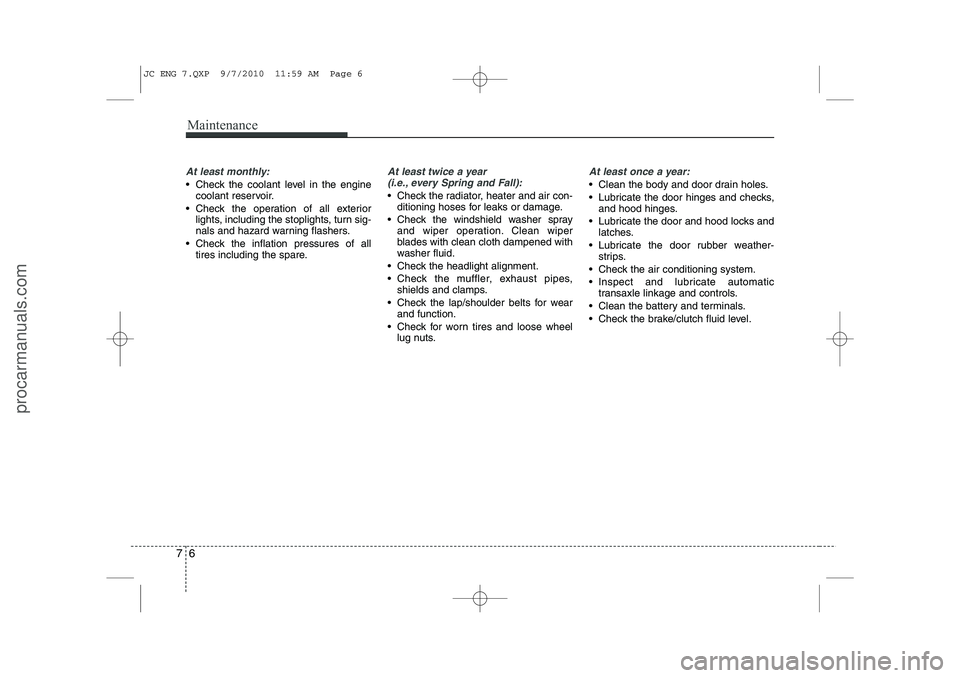
At least monthly:
Check the coolant level in the engine
coolant reservoir.
Check the operation of all exterior lights, including the stoplights, turn sig-
nals and hazard warning flashers.
Check the inflation pressures of all tires including the spare.
At least twice a year
(i.e., every Spring and Fall):
Check the radiator, heater and air con- ditioning hoses for leaks or damage.
Check the windshield washer spray and wiper operation. Clean wiper
blades with clean cloth dampened with
washer fluid.
Check the headlight alignment.
Check the muffler, exhaust pipes, shields and clamps.
Check the lap/shoulder belts for wear and function.
Check for worn tires and loose wheel lug nuts.
At least once a year:
Clean the body and door drain holes.
Lubricate the door hinges and checks,and hood hinges.
Lubricate the door and hood locks and latches.
Lubricate the door rubber weather- strips.
Check the air conditioning system.
Inspect and lubricate automatic transaxle linkage and controls.
Clean the battery and terminals.
Check the brake/clutch fluid level.
JC ENG 7.QXP 9/7/2010 11:59 AM Page 6
procarmanuals.com
Page 322 of 420
79
Maintenance
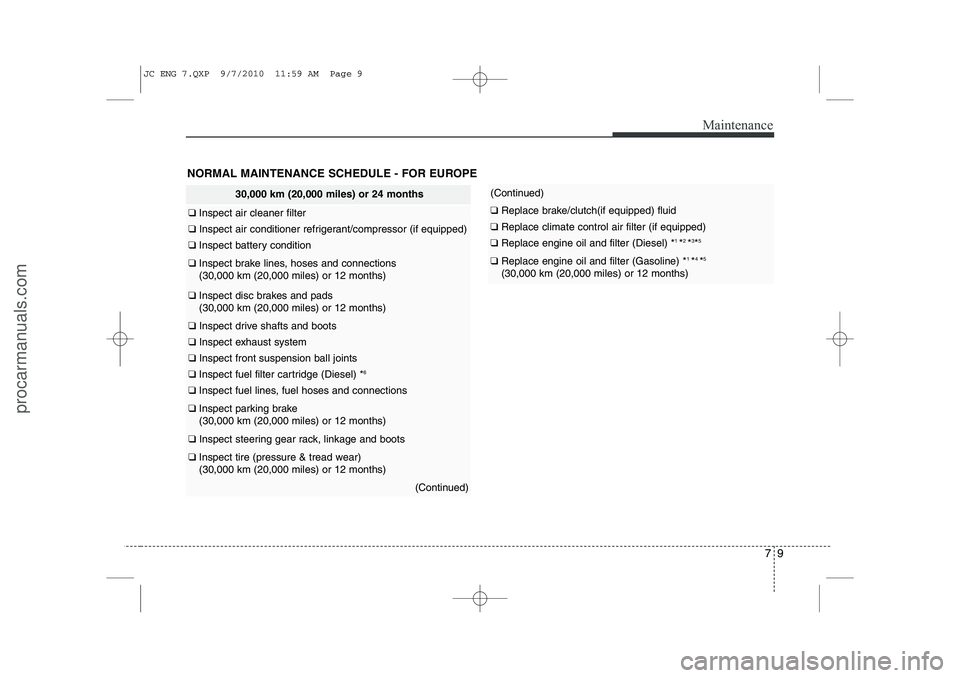
30,000 km (20,000 miles) or 24 months
❑ Inspect air cleaner filter
❑ Inspect air conditioner refrigerant/compressor (if equipped)
❑ Inspect battery condition
❑ Inspect brake lines, hoses and connections (30,000 km (20,000 miles) or 12 months)
❑ Inspect disc brakes and pads (30,000 km (20,000 miles) or 12 months)
❑ Inspect drive shafts and boots
❑ Inspect exhaust system
❑ Inspect front suspension ball joints
❑ Inspect fuel filter cartridge (Diesel) * 6
❑
Inspect fuel lines, fuel hoses and connections
❑ Inspect parking brake (30,000 km (20,000 miles) or 12 months)
❑ Inspect steering gear rack, linkage and boots
❑ Inspect tire (pressure & tread wear) (30,000 km (20,000 miles) or 12 months)
(Continued)
NORMAL MAINTENANCE SCHEDULE - FOR EUROPE
(Continued)
❑ Replace brake/clutch(if equipped) fluid
❑ Replace climate control air filter (if equipped)
❑ Replace engine oil and filter (Diesel) * 1
*2
*3
* 5
❑
Replace engine oil and filter (Gasoline) * 1
*4
*5
(30,000 km (20,000 miles) or 12 months)
JC ENG 7.QXP 9/7/2010 11:59 AM Page 9
procarmanuals.com
Page 323 of 420
Maintenance
10
7
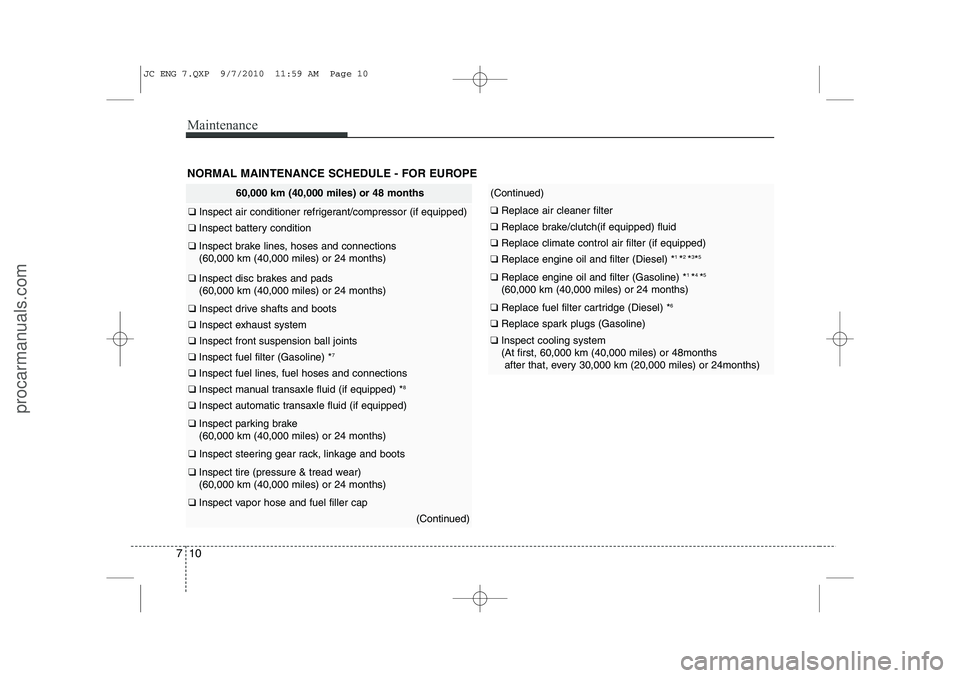
NORMAL MAINTENANCE SCHEDULE - FOR EUROPE
60,000 km (40,000 miles) or 48 months
❑ Inspect air conditioner refrigerant/compressor (if equipped)
❑ Inspect battery condition
❑ Inspect brake lines, hoses and connections (60,000 km (40,000 miles) or 24 months)
❑ Inspect disc brakes and pads (60,000 km (40,000 miles) or 24 months)
❑ Inspect drive shafts and boots
❑ Inspect exhaust system
❑ Inspect front suspension ball joints
❑ Inspect fuel filter (Gasoline) * 7
❑
Inspect fuel lines, fuel hoses and connections
❑ Inspect manual transaxle fluid (if equipped) * 8
❑
Inspect automatic transaxle fluid (if equipped)
❑ Inspect parking brake (60,000 km (40,000 miles) or 24 months)
❑ Inspect steering gear rack, linkage and boots
❑ Inspect tire (pressure & tread wear) (60,000 km (40,000 miles) or 24 months)
❑ Inspect vapor hose and fuel filler cap
(Continued)
(Continued)
❑ Replace air cleaner filter
❑ Replace brake/clutch(if equipped) fluid
❑ Replace climate control air filter (if equipped)
❑ Replace engine oil and filter (Diesel) * 1
*2
*3
* 5
❑
Replace engine oil and filter (Gasoline) * 1
*4
*5
(60,000 km (40,000 miles) or 24 months)
❑ Replace fuel filter cartridge (Diesel) * 6
❑
Replace spark plugs (Gasoline)
❑ Inspect cooling system
(At first, 60,000 km (40,000 miles) or 48months
after that, every 30,000 km (20,000 miles) or 24months)
JC ENG 7.QXP 9/7/2010 11:59 AM Page 10
procarmanuals.com
Page 324 of 420
711
Maintenance
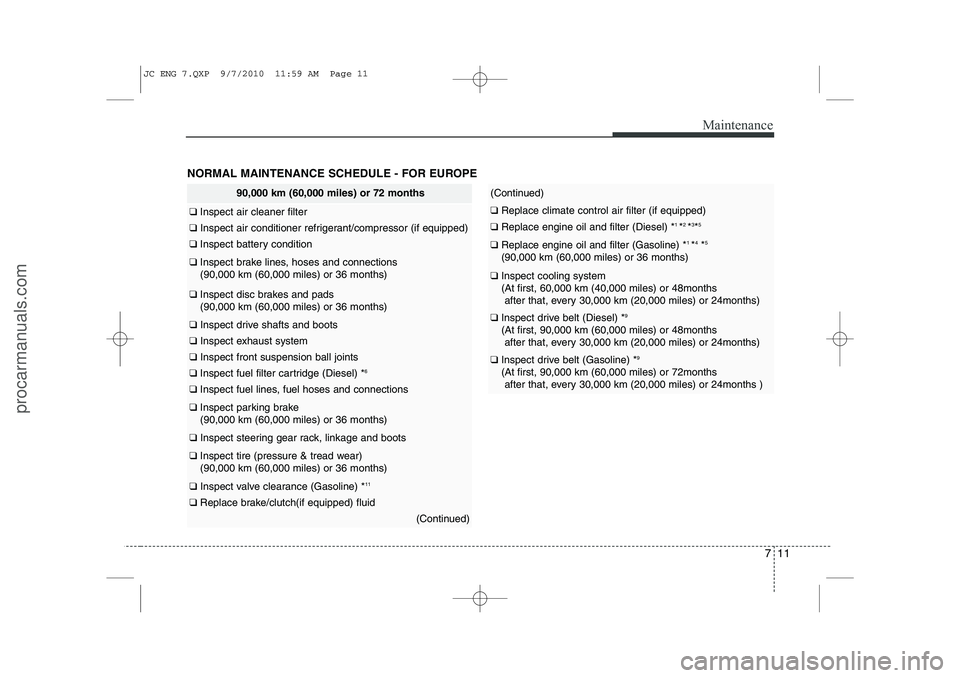
NORMAL MAINTENANCE SCHEDULE - FOR EUROPE
90,000 km (60,000 miles) or 72 months
❑ Inspect air cleaner filter
❑ Inspect air conditioner refrigerant/compressor (if equipped)
❑ Inspect battery condition
❑ Inspect brake lines, hoses and connections (90,000 km (60,000 miles) or 36 months)
❑ Inspect disc brakes and pads (90,000 km (60,000 miles) or 36 months)
❑ Inspect drive shafts and boots
❑ Inspect exhaust system
❑ Inspect front suspension ball joints
❑ Inspect fuel filter cartridge (Diesel) * 6
❑
Inspect fuel lines, fuel hoses and connections
❑ Inspect parking brake (90,000 km (60,000 miles) or 36 months)
❑ Inspect steering gear rack, linkage and boots
❑ Inspect tire (pressure & tread wear) (90,000 km (60,000 miles) or 36 months)
❑ Inspect valve clearance (Gasoline) * 11
❑
Replace brake/clutch(if equipped) fluid
(Continued)
(Continued)
❑ Replace climate control air filter (if equipped)
❑ Replace engine oil and filter (Diesel) * 1
*2
*3
* 5
❑
Replace engine oil and filter (Gasoline) * 1
*4
*5
(90,000 km (60,000 miles) or 36 months)
❑ Inspect cooling system
(At first, 60,000 km (40,000 miles) or 48months
after that, every 30,000 km (20,000 miles) or 24months)
❑ Inspect drive belt (Diesel) * 9
(At first, 90,000 km (60,000 miles) or 48months after that, every 30,000 km (20,000 miles) or 24months)
❑ Inspect drive belt (Gasoline) * 9
(At first, 90,000 km (60,000 miles) or 72months after that, every 30,000 km (20,000 miles) or 24months )
JC ENG 7.QXP 9/7/2010 11:59 AM Page 11
procarmanuals.com
Page 325 of 420
Maintenance
12
7
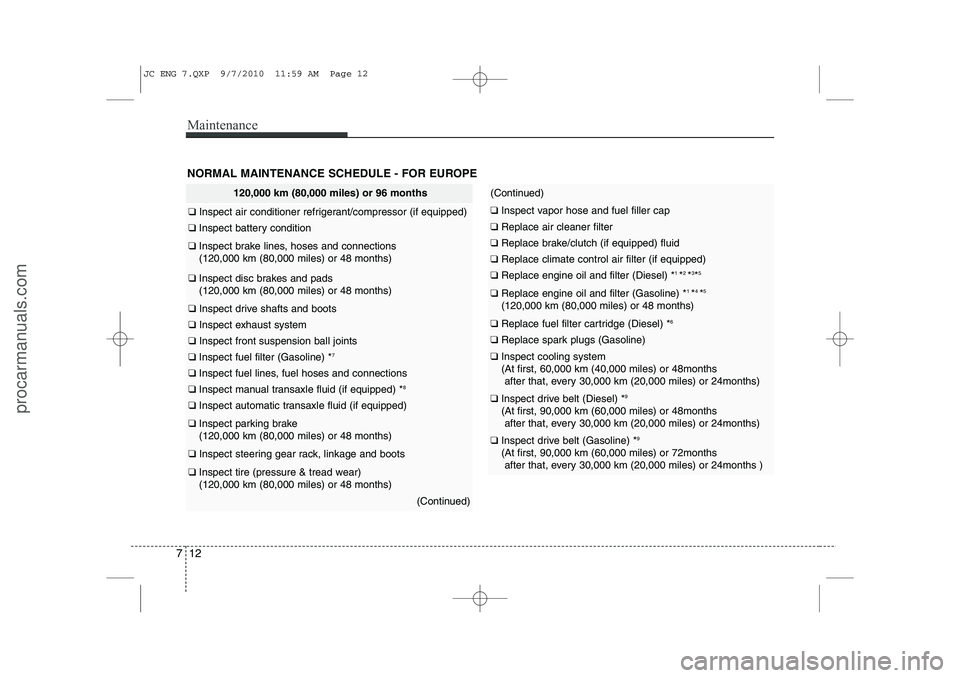
NORMAL MAINTENANCE SCHEDULE - FOR EUROPE
120,000 km (80,000 miles) or 96 months
❑ Inspect air conditioner refrigerant/compressor (if equipped)
❑ Inspect battery condition
❑ Inspect brake lines, hoses and connections (120,000 km (80,000 miles) or 48 months)
❑ Inspect disc brakes and pads (120,000 km (80,000 miles) or 48 months)
❑ Inspect drive shafts and boots
❑ Inspect exhaust system
❑ Inspect front suspension ball joints
❑ Inspect fuel filter (Gasoline) * 7
❑
Inspect fuel lines, fuel hoses and connections
❑ Inspect manual transaxle fluid (if equipped) * 8
❑
Inspect automatic transaxle fluid (if equipped)
❑ Inspect parking brake (120,000 km (80,000 miles) or 48 months)
❑ Inspect steering gear rack, linkage and boots
❑ Inspect tire (pressure & tread wear) (120,000 km (80,000 miles) or 48 months)
(Continued)
(Continued)
❑ Inspect vapor hose and fuel filler cap
❑ Replace air cleaner filter
❑ Replace brake/clutch (if equipped) fluid
❑ Replace climate control air filter (if equipped)
❑ Replace engine oil and filter (Diesel) * 1
*2
*3
* 5
❑
Replace engine oil and filter (Gasoline) * 1
*4
*5
(120,000 km (80,000 miles) or 48 months)
❑ Replace fuel filter cartridge (Diesel) * 6
❑
Replace spark plugs (Gasoline)
❑ Inspect cooling system
(At first, 60,000 km (40,000 miles) or 48months
after that, every 30,000 km (20,000 miles) or 24months)
❑ Inspect drive belt (Diesel) * 9
(At first, 90,000 km (60,000 miles) or 48months after that, every 30,000 km (20,000 miles) or 24months)
❑ Inspect drive belt (Gasoline) * 9
(At first, 90,000 km (60,000 miles) or 72months after that, every 30,000 km (20,000 miles) or 24months )
JC ENG 7.QXP 9/7/2010 11:59 AM Page 12
procarmanuals.com