coolant HYUNDAI IX20 2016 Owner's Manual
[x] Cancel search | Manufacturer: HYUNDAI, Model Year: 2016, Model line: IX20, Model: HYUNDAI IX20 2016Pages: 385, PDF Size: 13.67 MB
Page 330 of 385
719
Maintenance
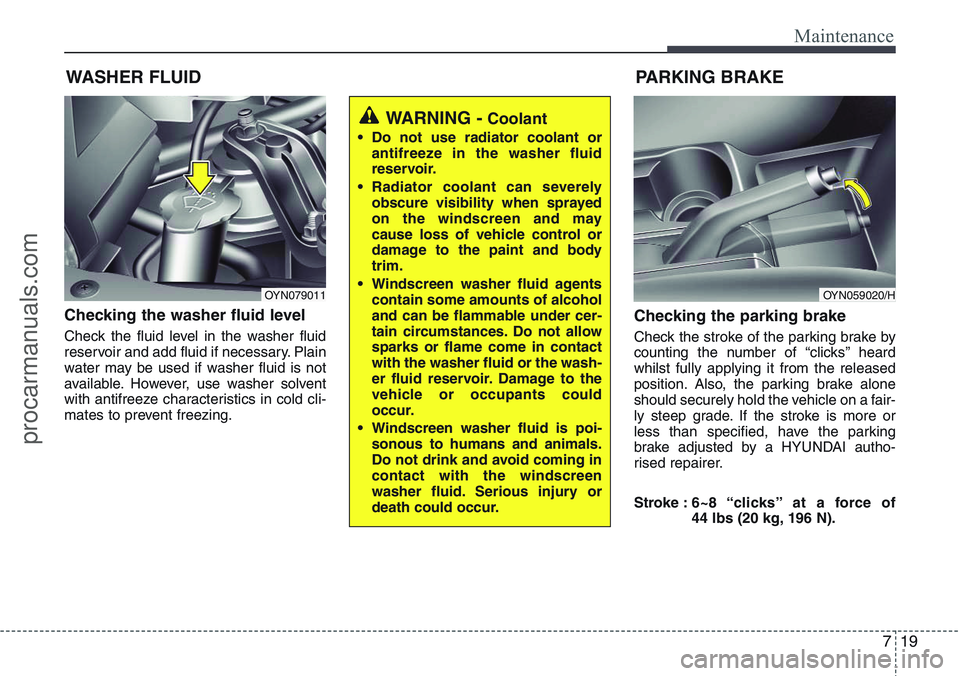
WASHER FLUID
Checking the washer fluid level
Check the fluid level in the washer fluid
reservoir and add fluid if necessary. Plain
water may be used if washer fluid is not
available. However, use washer solvent
with antifreeze characteristics in cold cli-
mates to prevent freezing.
Checking the parking brake
Check the stroke of the parking brake by
counting the number of “clicks’’ heard
whilst fully applying it from the released
position. Also, the parking brake alone
should securely hold the vehicle on a fair-
ly steep grade. If the stroke is more or
less than specified, have the parking
brake adjusted by a HYUNDAI autho-
rised repairer.
Stroke :6~8 “clicks’’ at a force of
44 lbs (20 kg, 196 N).
PARKING BRAKE
WARNING -Coolant
• Do not use radiator coolant or
antifreeze in the washer fluid
reservoir.
• Radiator coolant can severely
obscure visibility when sprayed
on the windscreen and may
cause loss of vehicle control or
damage to the paint and body
trim.
• Windscreen washer fluid agents
contain some amounts of alcohol
and can be flammable under cer-
tain circumstances. Do not allow
sparks or flame come in contact
with the washer fluid or the wash-
er fluid reservoir. Damage to the
vehicle or occupants could
occur.
• Windscreen washer fluid is poi-
sonous to humans and animals.
Do not drink and avoid coming in
contact with the windscreen
washer fluid. Serious injury or
death could occur.
OYN059020/HOYN079011
procarmanuals.com
Page 375 of 385
Maintenance
64 7
Canister
Fuel vapours generated inside the fuel
tank are absorbed and stored in the
onboard canister. When the engine is
running, the fuel vapours absorbed in the
canister are drawn into the surge tank
through the purge control solenoid valve.
Purge Control Solenoid Valve (PCSV)
The purge control solenoid valve is con-
trolled by the Engine Control Module
(ECM); when the engine coolant temper-
ature is low during idling, the PCSV clos-
es so that evaporated fuel is not taken
into the engine. After the engine warms
up during ordinary driving, the PCSV
opens to introduce evaporated fuel to the
engine.
3. Exhaust emission control
system
The Exhaust Emission Control System is
a highly effective system which controls
exhaust emissions whilst maintaining
good vehicle performance.
Vehicle modifications
This vehicle should not be modified.
Modification of your vehicle could affect
its performance, safety or durability and
may even violate governmental safety
and emissions regulations.
In addition, damage or performance
problems resulting from any modification
may not be covered under warranty.
Engine exhaust gas precautions (car-
bon monoxide)
• Carbon monoxide can be present with
other exhaust fumes. Therefore, if you
smell exhaust fumes of any kind inside
your vehicle, have it inspected and
repaired immediately. If you ever sus-
pect exhaust fumes are coming into
your vehicle, drive it only with all the
windows fully open. Have your vehicle
checked and repaired immediately.
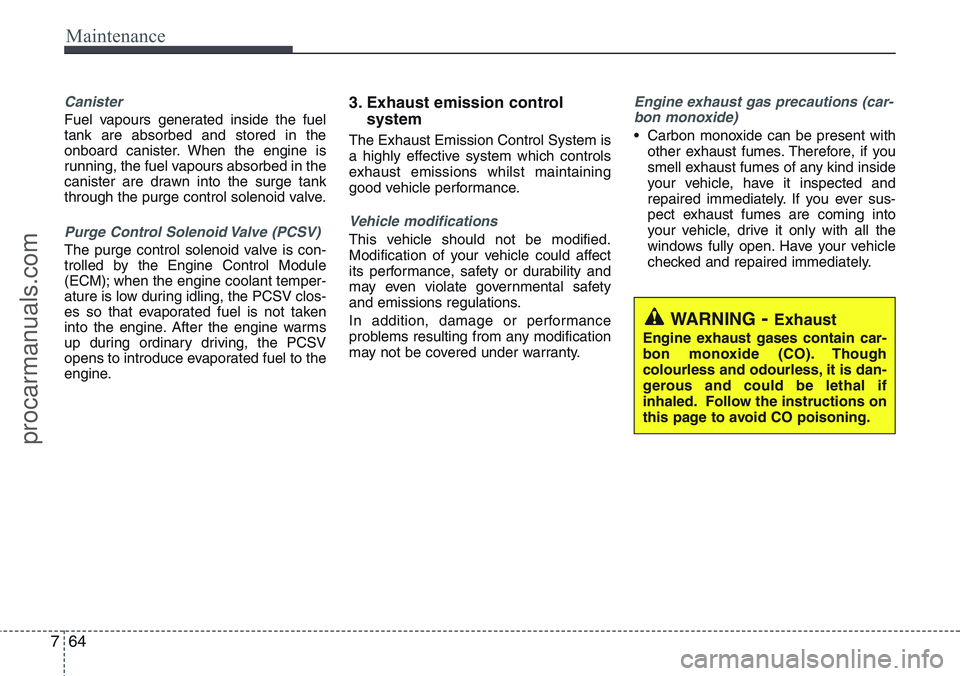
WARNING- Exhaust
Engine exhaust gases contain car-
bon monoxide (CO). Though
colourless and odourless, it is dan-
gerous and could be lethal if
inhaled. Follow the instructions on
this page to avoid CO poisoning.
procarmanuals.com
Page 382 of 385
85
Specifications & Consumer information
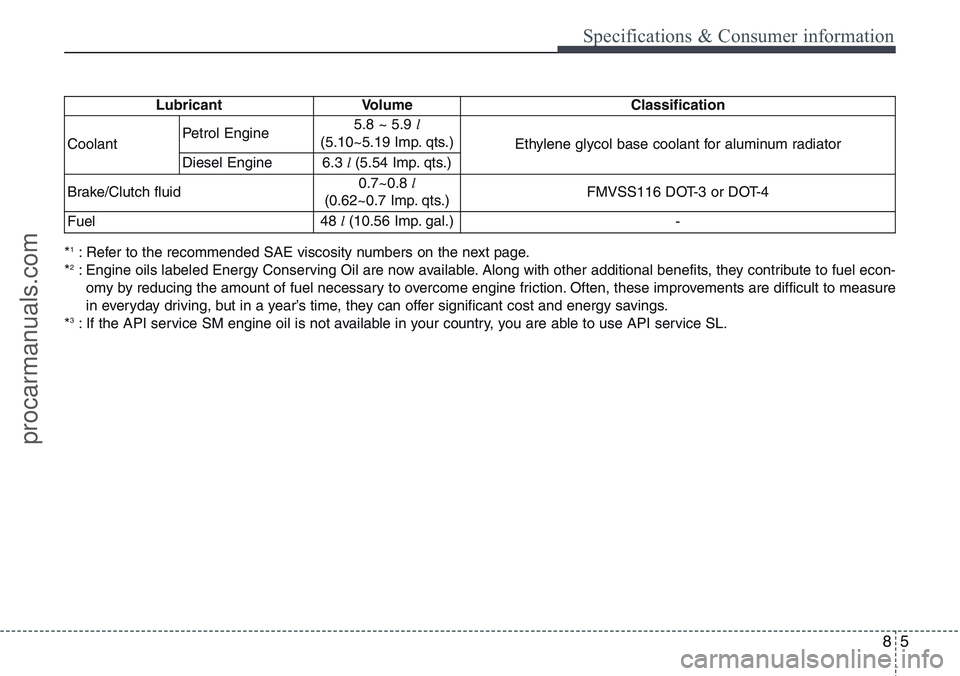
*1: Refer to the recommended SAE viscosity numbers on the next page.
*2: Engine oils labeled Energy Conserving Oil are now available. Along with other additional benefits, they contribute to fuel econ-
omy by reducing the amount of fuel necessary to overcome engine friction. Often, these improvements are difficult to measure
in everyday driving, but in a year’s time, they can offer significant cost and energy savings.
*
3: If the API service SM engine oil is not available in your country, you are able to use API service SL.Lubricant Volume Classification
CoolantPetrol Engine5.8 ~ 5.9 l
(5.10~5.19 Imp. qts.)
Ethylene glycol base coolant for aluminum radiator
Diesel Engine6.3l (5.54 Imp. qts.)
Brake/Clutch fluid0.7~0.8l
(0.62~0.7 Imp. qts.)FMVSS116 DOT-3 or DOT-4
Fuel48l (10.56 Imp. gal.)-
procarmanuals.com