air condition HYUNDAI IX20 2016 Workshop Manual
[x] Cancel search | Manufacturer: HYUNDAI, Model Year: 2016, Model line: IX20, Model: HYUNDAI IX20 2016Pages: 385, PDF Size: 13.67 MB
Page 347 of 385
Maintenance
36 7
5. Maximum permissible inflation
pressure
This number is the greatest amount
of air pressure that should be put in
the tyre. Do not exceed the maximum
permissible inflation pressure. Refer
to the Tyre and Loading Information
label for recommended inflation
pressure.
6. Maximum load rating
This number indicates the maximum
load in kilograms and pounds that
can be carried by the tyre. When
replacing the tyres on the vehicle,
always use a tyre that has the same
load rating as the factory installed
tyre.
7. Uniform tyre quality grading
Quality grades can be found where
applicable on the tyre sidewall
between tread shoulder and maxi-
mum section width.
For example:
TREAD wear 200
TRACTION AA
TEMPERATURE A
Tread wear
The tread wear grade is a compara-
tive rating based on the wear rate of
the tyre when tested under controlled
conditions on a specified govern-
ment test course. For example, a tyre
graded 150 would wear one-and-a-
half times (1½) as well on the gov-
ernment course as a tyre graded
100.
The relative performance of tyres
depends upon the actual conditions
of their use, however, and may
depart significantly from the norm
due to variations in driving habits,
service practices and differences in
road characteristics and climate.These grades are molded on the
side-walls of passenger vehicle
tyres. The tyres available as standard
or optional equipment on your vehi-
cle may vary with respect to grade.
Traction - AA, A, B & C
The traction grades, from highest to
lowest, are AA, A, B and C. Those
grades represent the tyre’s ability to
stop on wet pavement measured
under controlled conditions on spec-
ified government test surfaces of
asphalt and concrete. A tyre marked
C may have poor traction perform-
ance.
WARNING
The traction grade assigned to
this tyre is based on straight-
ahead braking traction tests,
and does not include accelera-
tion, cornering, hydroplaning,
or peak traction characteristics.
procarmanuals.com
Page 354 of 385
743
Maintenance
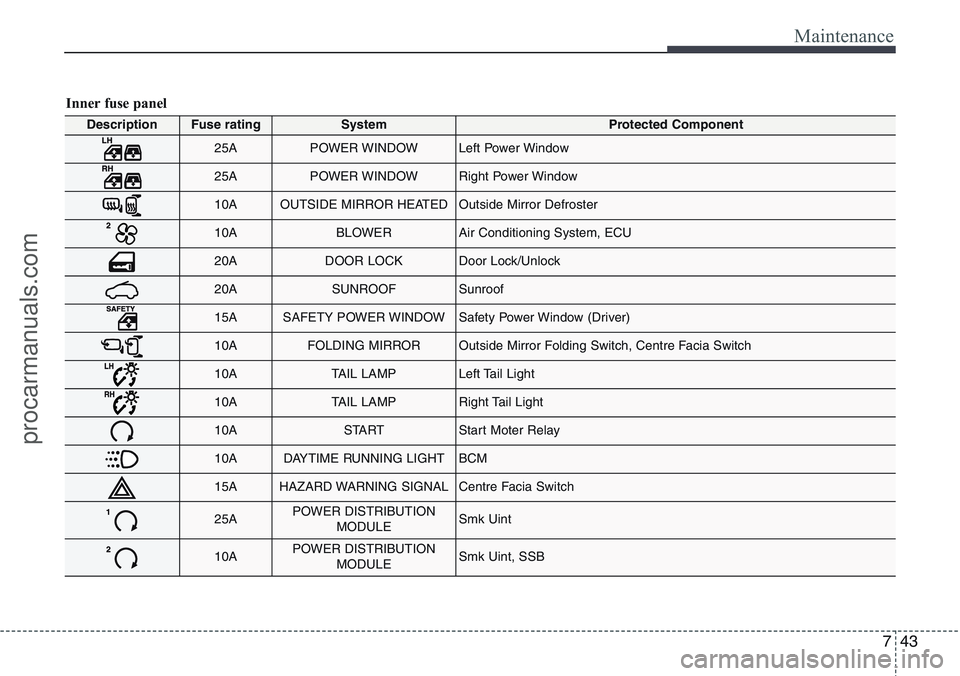
Inner fuse panel
DescriptionFuse ratingSystemProtected Component
25APOWER WINDOWLeft Power Window
25APOWER WINDOWRight Power Window
10AOUTSIDE MIRROR HEATEDOutside Mirror Defroster
10ABLOWERAir Conditioning System, ECU
20ADOOR LOCKDoor Lock/Unlock
20ASUNROOFSunroof
15ASAFETY POWER WINDOWSafety Power Window (Driver)
10AFOLDING MIRROROutside Mirror Folding Switch, Centre Facia Switch
10ATAIL LAMPLeft Tail Light
10ATAIL LAMPRight Tail Light
10ASTARTStart Moter Relay
10ADAYTIME RUNNING LIGHTBCM
15AHAZARD WARNING SIGNALCentre Facia Switch
25APOWER DISTRIBUTION
MODULESmk Uint
10APOWER DISTRIBUTION
MODULESmk Uint, SSB
procarmanuals.com
Page 355 of 385
Maintenance
44 7
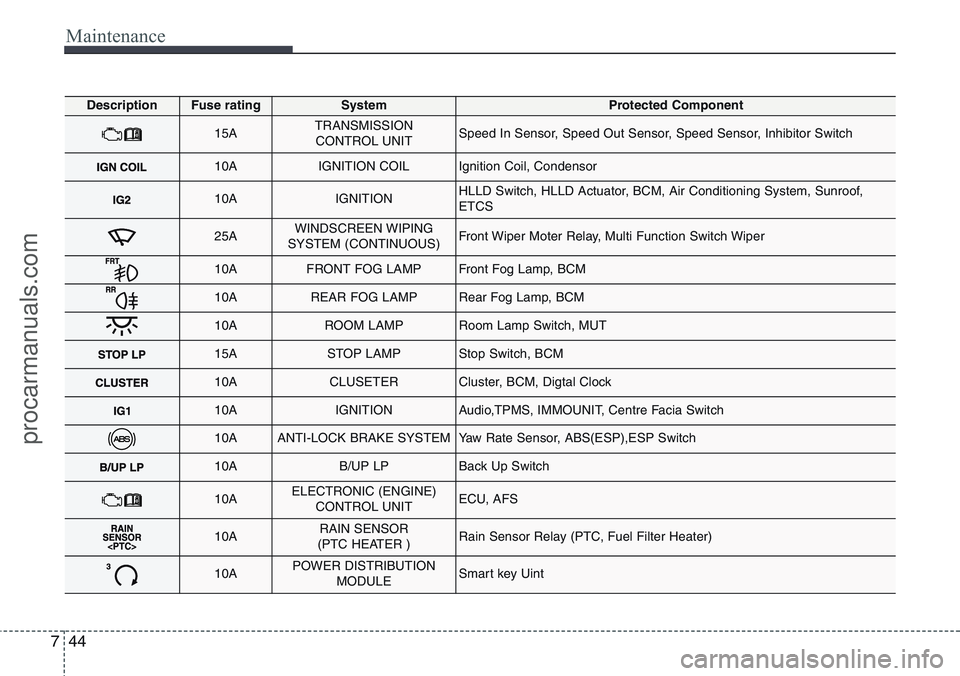
DescriptionFuse ratingSystemProtected Component
15ATRANSMISSION
CONTROL UNITSpeed In Sensor, Speed Out Sensor, Speed Sensor, Inhibitor Switch
10AIGNITION COILIgnition Coil, Condensor
10AIGNITIONHLLD Switch, HLLD Actuator, BCM, Air Conditioning System, Sunroof,
ETCS
25AWINDSCREEN WIPING
SYSTEM (CONTINUOUS)Front Wiper Moter Relay, Multi Function Switch Wiper
10AFRONT FOG LAMPFront Fog Lamp, BCM
10AREAR FOG LAMPRear Fog Lamp, BCM
10AROOM LAMPRoom Lamp Switch, MUT
15ASTOP LAMPStop Switch, BCM
10ACLUSETERCluster, BCM, Digtal Clock
10AIGNITIONAudio,TPMS, IMMOUNIT, Centre Facia Switch
10AANTI-LOCK BRAKE SYSTEMYaw Rate Sensor, ABS(ESP),ESP Switch
10AB/UP LPBack Up Switch
10AELECTRONIC (ENGINE)
CONTROL UNITECU, AFS
10ARAIN SENSOR
(PTC HEATER )Rain Sensor Relay (PTC, Fuel Filter Heater)
10APOWER DISTRIBUTION
MODULESmart key Uint
procarmanuals.com
Page 358 of 385
747
Maintenance
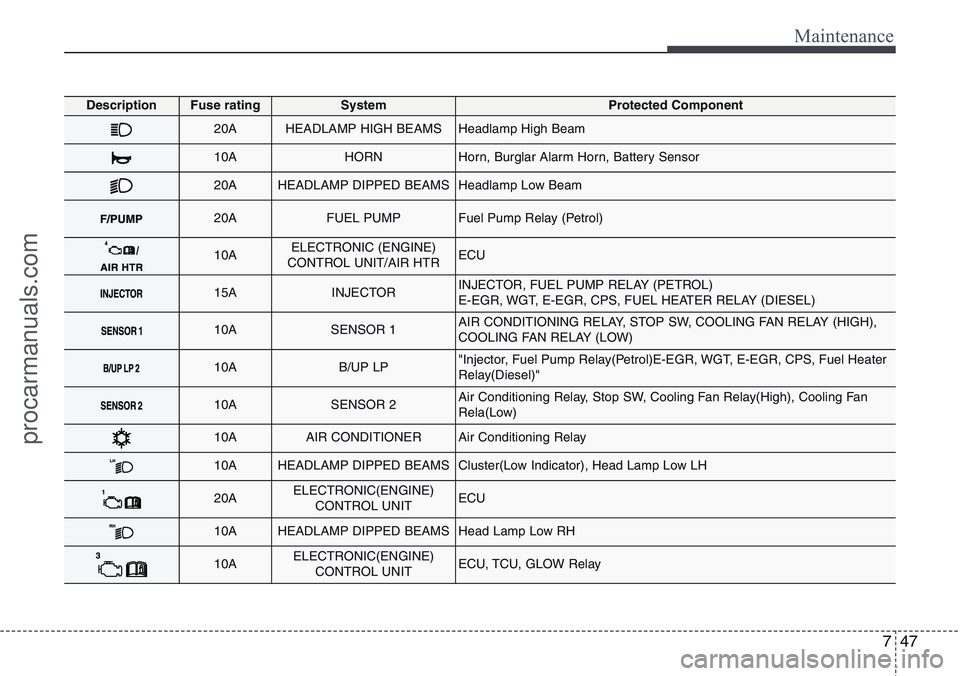
DescriptionFuse ratingSystemProtected Component
20AHEADLAMP HIGH BEAMSHeadlamp High Beam
10AHORNHorn, Burglar Alarm Horn, Battery Sensor
20AHEADLAMP DIPPED BEAMSHeadlamp Low Beam
20AFUEL PUMPFuel Pump Relay (Petrol)
10AELECTRONIC (ENGINE)
CONTROL UNIT/AIR HTRECU
15AINJECTORINJECTOR, FUEL PUMP RELAY (PETROL)
E-EGR, WGT, E-EGR, CPS, FUEL HEATER RELAY (DIESEL)
10ASENSOR 1AIR CONDITIONING RELAY, STOP SW, COOLING FAN RELAY (HIGH),
COOLING FAN RELAY (LOW)
10AB/UP LP"Injector, Fuel Pump Relay(Petrol)E-EGR, WGT, E-EGR, CPS, Fuel Heater
Relay(Diesel)"
10ASENSOR 2Air Conditioning Relay, Stop SW, Cooling Fan Relay(High), Cooling Fan
Rela(Low)
10AAIR CONDITIONERAir Conditioning Relay
10AHEADLAMP DIPPED BEAMSCluster(Low Indicator), Head Lamp Low LH
20AELECTRONIC(ENGINE)
CONTROL UNITECU
10AHEADLAMP DIPPED BEAMSHead Lamp Low RH
10AELECTRONIC(ENGINE)
CONTROL UNITECU, TCU, GLOW Relay
procarmanuals.com
Page 360 of 385
749
Maintenance
LIGHT BULBS
Use only the bulbs of the specified
wattage.
✽NOTICE
After heavy, driving rain or washing,
headlight and taillight lenses could
appear frosty. This condition is caused by
the temperature difference between the
lamp inside and outside. This is similar
to the condensation on your windows
inside your vehicle during the rain and
doesn’t indicate a problem with your
vehicle. If the water leaks into the lamp
bulb circuitry, have the vehicle checked
by a HYUNDAI authorised repairer.
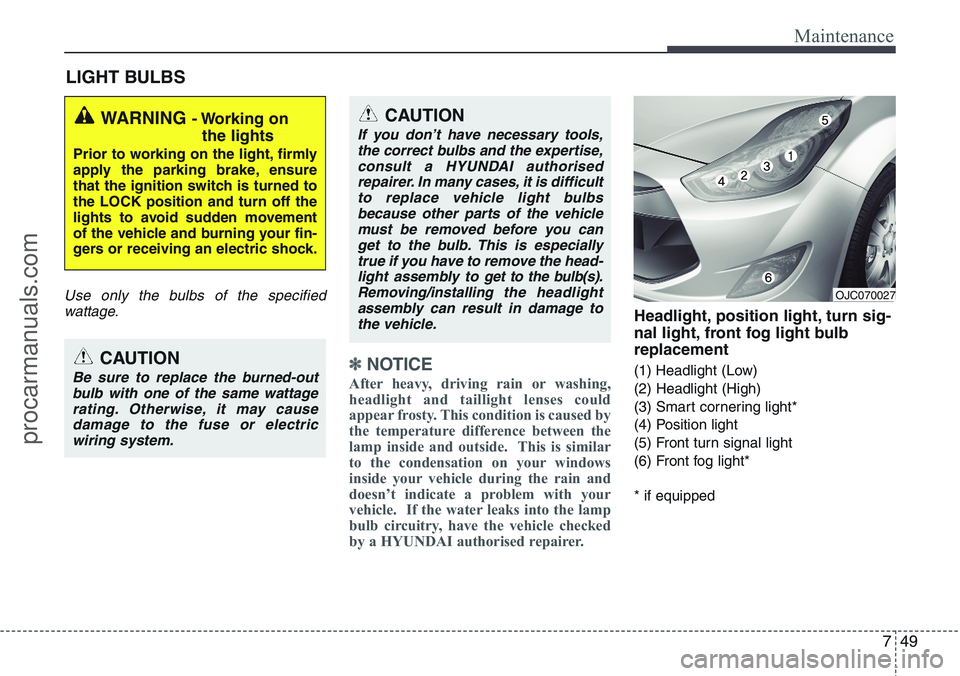
Headlight, position light, turn sig-
nal light, front fog light bulb
replacement
(1) Headlight (Low)
(2) Headlight (High)
(3) Smart cornering light*
(4) Position light
(5) Front turn signal light
(6) Front fog light*
* if equipped
WARNING - Working on
the lights
Prior to working on the light, firmly
apply the parking brake, ensure
that the ignition switch is turned to
the LOCK position and turn off the
lights to avoid sudden movement
of the vehicle and burning your fin-
gers or receiving an electric shock.
CAUTION
Be sure to replace the burned-out
bulb with one of the same wattage
rating. Otherwise, it may cause
damage to the fuse or electric
wiring system.
CAUTION
If you don’t have necessary tools,
the correct bulbs and the expertise,
consult a HYUNDAI authorised
repairer. In many cases, it is difficult
to replace vehicle light bulbs
because other parts of the vehicle
must be removed before you can
get to the bulb. This is especially
true if you have to remove the head-
light assembly to
get to the bulb(s).
Removing/installingthe headlight
assembly can result in damage to
the vehicle.OJC070027
procarmanuals.com
Page 371 of 385
Maintenance
60 7
Corrosion protection
Protecting your vehicle from corrosion
By using the most advanced design and
construction practices to combat corro-
sion, we produce vehicles of the highest
quality. However, this is only part of the
job. To achieve the long-term corrosion
resistance your vehicle can deliver, the
owner's cooperation and assistance is
also required.
Common causes of corrosion
The most common causes of corrosion
on your vehicle are:
• Road salt, dirt and moisture that is
allowed to accumulate underneath the
vehicle.
• Removal of paint or protective coatings
by stones, gravel, abrasion or minor
scrapes and dents which leave unpro-
tected metal exposed to corrosion.High-corrosion areas
If you live in an area where your vehicle
is regularly exposed to corrosive materi-
als, corrosion protection is particularly
important. Some of the common causes
of accelerated corrosion are road salts,
dust control chemicals, ocean air and
industrial pollution.Moisture breeds corrosion
Moisture creates the conditions in which
corrosion is most likely to occur. For
example, corrosion is accelerated by
high humidity, particularly when tempera-
tures are just above freezing. In such
conditions, the corrosive material is kept
in contact with the vehicle’s surface by
moisture that slowly evaporates.
Mud is particularly corrosive because it
dries slowly and holds moisture in con-
tact with the vehicle. Although the mud
appears to be dry, it can still retain mois-
ture and promote corrosion.
High temperatures can also accelerate
corrosion of parts that are not properly
ventilated so the moisture can be dis-
persed. For all these reasons, it is par-
ticularly important to keep your vehicle
clean and free of mud or accumulations
of other materials. This applies not only
to the visible surfaces but particularly to
the underside of the vehicle.
procarmanuals.com
Page 377 of 385
Maintenance
66 7
Diesel Particulate Filter (if equipped)
The Diesel Particulate Filter (DPF) sys-
tem removes the soot emitted from the
vehicle.
Unlike a disposable air filter, the DPF
system automatically burns (oxidizes)
and removes the accumulated soot
according to the driving condition. In
other words, the active burning by engine
control system and high exhaust gas
temperature caused by normal/high driv-
ing condition burns and removes the
accumulated soot.
However, if the vehicle continues to be
driven at low speed for a long time, the
accumulated soot may not be automati-
cally removed because of low exhaust
gas temperature. In this particular case,
the amount of soot is out of detection
limit, the soot oxidation process by
engine control system may not happen
and the malfunction indicator light may
blink.
When the malfunction indicator light
blinks, it may stop blinking by driving the
vehicle at more than 37 mph (60km/h) or
at more than second gear with 1500 ~
2000 engine rpm for a certain time (for
about 25 minutes).If the malfunction indicator light contin-
ues to blink in spite of the procedure,
please visit a HYUNDAI authorised
repairer and check the DPF system.
If you continue to drive with the malfunc-
tion indicator light blinking for a long
time, the DPF system can be damaged
and fuel consumption can worsen.
CAUTION- Diesel Fuel
(if equipped with DPF)
It is recommended to use the regu-
lated automotive diesel fuel for
diesel vehicle equipped with the
DPF system.
If you use diesel fuel including high
sulfur (more than 50 ppm sulfur)
and unspecified additives, it can
cause the DPF system to be dam-
aged and white smoke can be emit-
ted.
procarmanuals.com
Page 381 of 385
Specifications & Consumer information
4 8
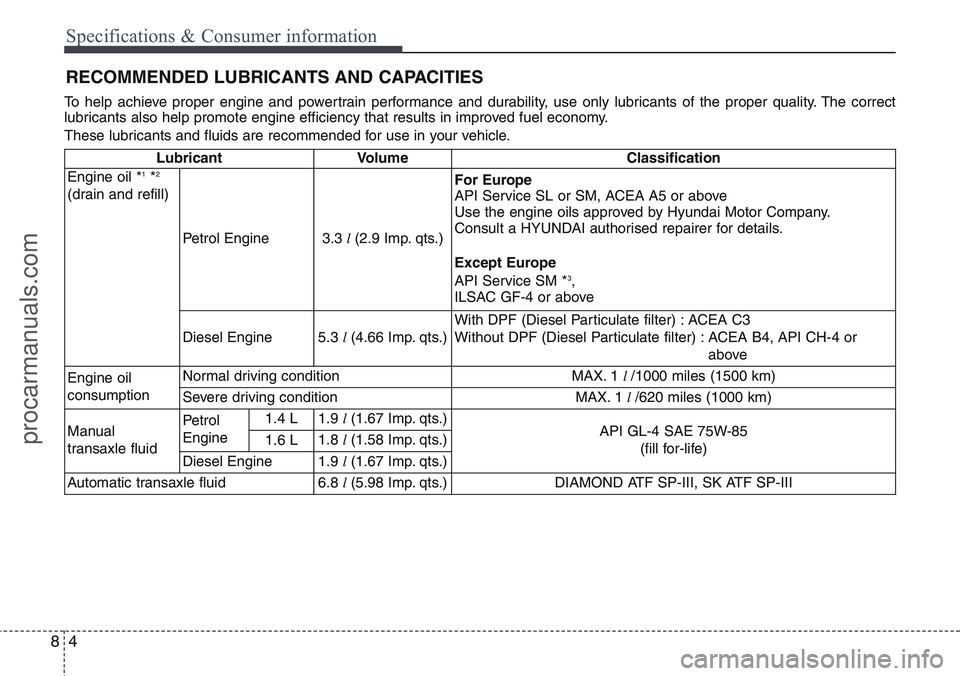
RECOMMENDED LUBRICANTS AND CAPACITIES
To help achieve proper engine and powertrain performance and durability, use only lubricants of the proper quality. The correct
lubricants also help promote engine efficiency that results in improved fuel economy.
These lubricants and fluids are recommended for use in your vehicle.
Lubricant Volume Classification
Engine oil *
1*2
(drain and refill)
Petrol Engine3.3l (2.9 Imp. qts.)For Europe
API Service SL or SM, ACEA A5 or above
Use the engine oils approved by Hyundai Motor Company.
Consult a HYUNDAI authorised repairer for details.
Except Europe
API Service SM *
3,
ILSAC GF-4 or above
Diesel Engine5.3l (4.66 Imp. qts.)With DPF (Diesel Particulate filter) : ACEA C3
Without DPF (Diesel Particulate filter) : ACEA B4, API CH-4 or
above
Engine oil
consumptionNormal driving conditionMAX. 1l /1000 miles (1500 km)
Severe driving conditionMAX. 1l /620 miles (1000 km)
Manual
transaxle fluidPetrol
Engine1.4 L1.9l (1.67 Imp. qts.)
API GL-4 SAE 75W-85
(fill for-life)
1.6 L1.8l (1.58 Imp. qts.)
Diesel Engine 1.9l (1.67 Imp. qts.)
Automatic transaxle fluid6.8l (5.98 Imp. qts.)
DIAMOND ATF SP-III, SK ATF SP-III
procarmanuals.com