TPMS HYUNDAI IX20 2017 User Guide
[x] Cancel search | Manufacturer: HYUNDAI, Model Year: 2017, Model line: IX20, Model: HYUNDAI IX20 2017Pages: 456, PDF Size: 9.46 MB
Page 332 of 456
What to do in an emergency
36
6
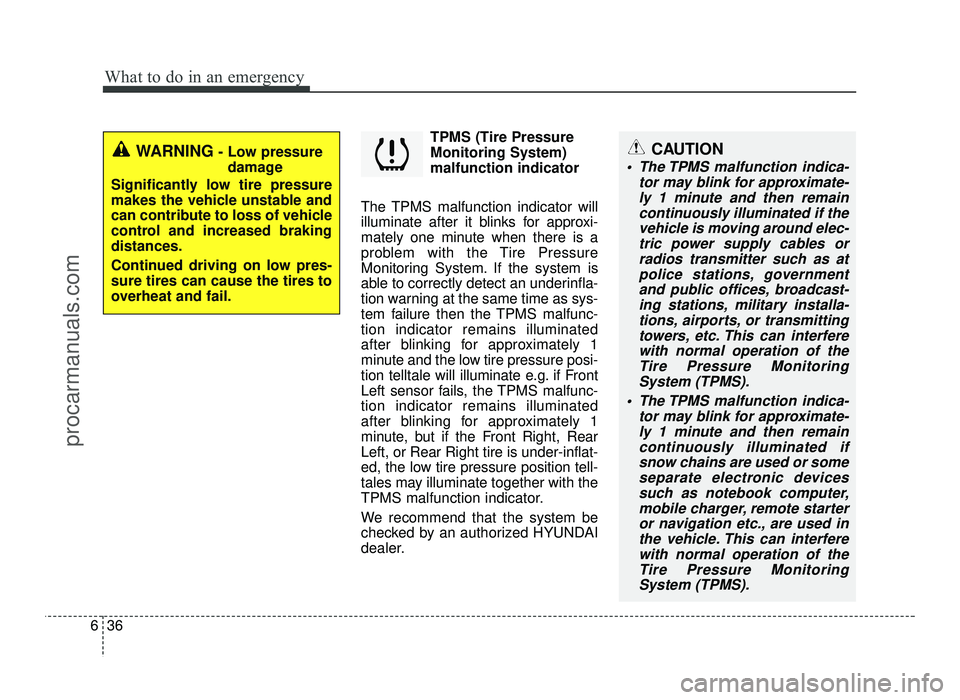
TPMS (Tire Pressure Monitoring System)malfunction indicator
The TPMS malfunction indicator will
illuminate after it blinks for approxi-
mately one minute when there is a
problem with the Tire Pressure
Monitoring System. If the system is
able to correctly detect an underinfla-
tion warning at the same time as sys-
tem failure then the TPMS malfunc-tion indicator remains illuminated
after blinking for approximately 1
minute and the low tire pressure posi-
tion telltale will illuminate e.g. if Front
Left sensor fails, the TPMS malfunc-tion indicator remains illuminated
after blinking for approximately 1
minute, but if the Front Right, RearLeft, or Rear Right tire is under-inflat-
ed, the low tire pressure position tell-
tales may illuminate together with the
TPMS malfunction indicator.
We recommend that the system be
checked by an authorized HYUNDAI
dealer.
WARNING - Low pressure
damage
Significantly low tire pressure
makes the vehicle unstable and
can contribute to loss of vehicle
control and increased brakingdistances.
Continued driving on low pres- sure tires can cause the tires to
overheat and fail.CAUTION
The TPMS malfunction indica- tor may blink for approximate-ly 1 minute and then remaincontinuously illuminated if thevehicle is moving around elec-tric power supply cables or radios transmitter such as atpolice stations, governmentand public offices, broadcast-ing stations, military installa-tions, airports, or transmitting towers, etc. This can interferewith normal operation of theTire Pressure MonitoringSystem (TPMS).
The TPMS malfunction indica- tor may blink for approximate-ly 1 minute and then remaincontinuously illuminated ifsnow chains are used or someseparate electronic devices such as notebook computer,mobile charger, remote starteror navigation etc., are used inthe vehicle. This can interferewith normal operation of the Tire Pressure MonitoringSystem (TPMS).
procarmanuals.com
Page 333 of 456
637
What to do in an emergency
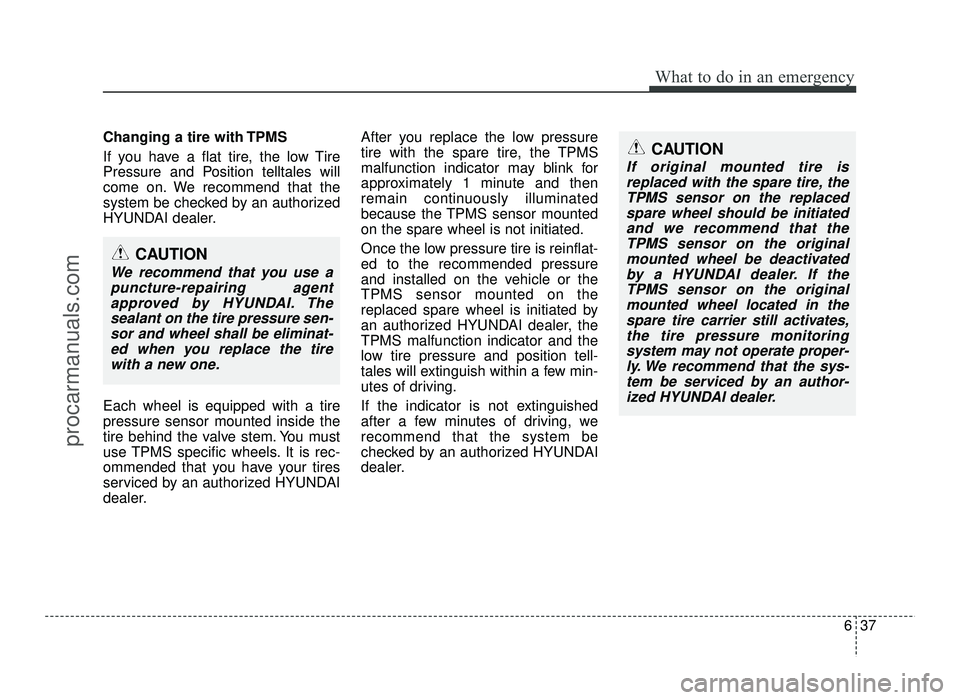
Changing a tire with TPMS
If you have a flat tire, the low Tire
Pressure and Position telltales will
come on. We recommend that the
system be checked by an authorized
HYUNDAI dealer. Each wheel is equipped with a tire pressure sensor mounted inside the
tire behind the valve stem. You must
use TPMS specific wheels. It is rec-
ommended that you have your tires
serviced by an authorized HYUNDAI
dealer.After you replace the low pressure
tire with the spare tire, the TPMS
malfunction indicator may blink for
approximately 1 minute and then
remain continuously illuminated
because the TPMS sensor mountedon the spare wheel is not initiated.
Once the low pressure tire is reinflat- ed to the recommended pressure
and installed on the vehicle or theTPMS sensor mounted on the
replaced spare wheel is initiated by
an authorized HYUNDAI dealer, theTPMS malfunction indicator and the
low tire pressure and position tell-
tales will extinguish within a few min-
utes of driving.
If the indicator is not extinguished
after a few minutes of driving, werecommend that the system be
checked by an authorized HYUNDAI
dealer.CAUTION
If original mounted tire is
replaced with the spare tire, theTPMS sensor on the replacedspare wheel should be initiated and we recommend that theTPMS sensor on the originalmounted wheel be deactivatedby a HYUNDAI dealer. If theTPMS sensor on the original mounted wheel located in thespare tire carrier still activates,the tire pressure monitoringsystem may not operate proper- ly. We recommend that the sys-tem be serviced by an author-ized HYUNDAI dealer.
CAUTION
We recommend that you use apuncture-repairing agentapproved by HYUNDAI. Thesealant on the tire pressure sen- sor and wheel shall be eliminat-ed when you replace the tirewith a new one.
procarmanuals.com
Page 334 of 456
What to do in an emergency
38
6
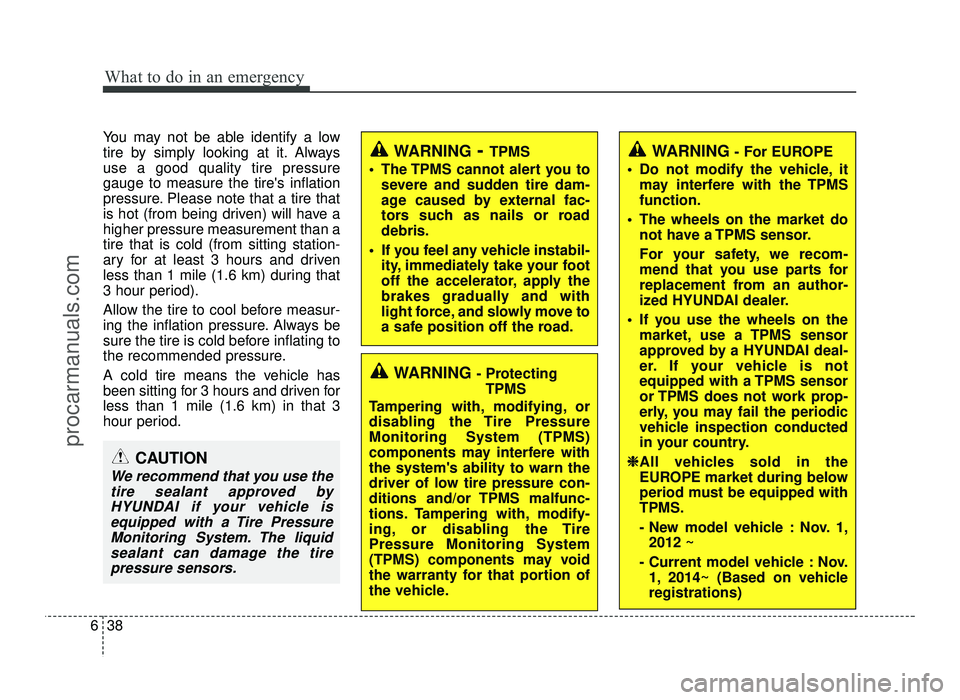
You may not be able identify a low
tire by simply looking at it. Alwaysuse a good quality tire pressuregauge to measure the tire's inflation
pressure. Please note that a tire that
is hot (from being driven) will have ahigher pressure measurement than atire that is cold (from sitting station-
ary for at least 3 hours and driven
less than 1 mile (1.6 km) during that
3 hour period).
Allow the tire to cool before measur-
ing the inflation pressure. Always be
sure the tire is cold before inflating to
the recommended pressure.
A cold tire means the vehicle has
been sitting for 3 hours and driven forless than 1 mile (1.6 km) in that 3
hour period.
CAUTION
We recommend that you use the
tire sealant approved byHYUNDAI if your vehicle isequipped with a Tire Pressure Monitoring System. The liquidsealant can damage the tirepressure sensors.
WARNING - Protecting
TPMS
Tampering with, modifying, or
disabling the Tire PressureMonitoring System (TPMS)
components may interfere withthe system's ability to warn the
driver of low tire pressure con-
ditions and/or TPMS malfunc-
tions. Tampering with, modify-
ing, or disabling the TirePressure Monitoring System
(TPMS) components may void
the warranty for that portion of
the vehicle.
WARNING - TPMS
The TPMS cannot alert you to severe and sudden tire dam-
age caused by external fac-
tors such as nails or roaddebris.
If you feel any vehicle instabil- ity, immediately take your foot
off the accelerator, apply the
brakes gradually and with
light force, and slowly move to
a safe position off the road.WARNING - For EUROPE
Do not modify the vehicle, it may interfere with the TPMS function.
The wheels on the market do not have a TPMS sensor.
For your safety, we recom-
mend that you use parts for
replacement from an author-
ized HYUNDAI dealer.
If you use the wheels on the market, use a TPMS sensor
approved by a HYUNDAI deal-
er. If your vehicle is not
equipped with a TPMS sensor
or TPMS does not work prop-
erly, you may fail the periodic
vehicle inspection conducted
in your country.
❈
❈ All vehicles sold in the
EUROPE market during below
period must be equipped withTPMS.
- New model vehicle : Nov. 1,
2012 ~
- Current model vehicle : Nov. 1, 2014~ (Based on vehicle registrations)
procarmanuals.com
Page 408 of 456
769
Maintenance
DescriptionFuse ratingSystemProtected Component
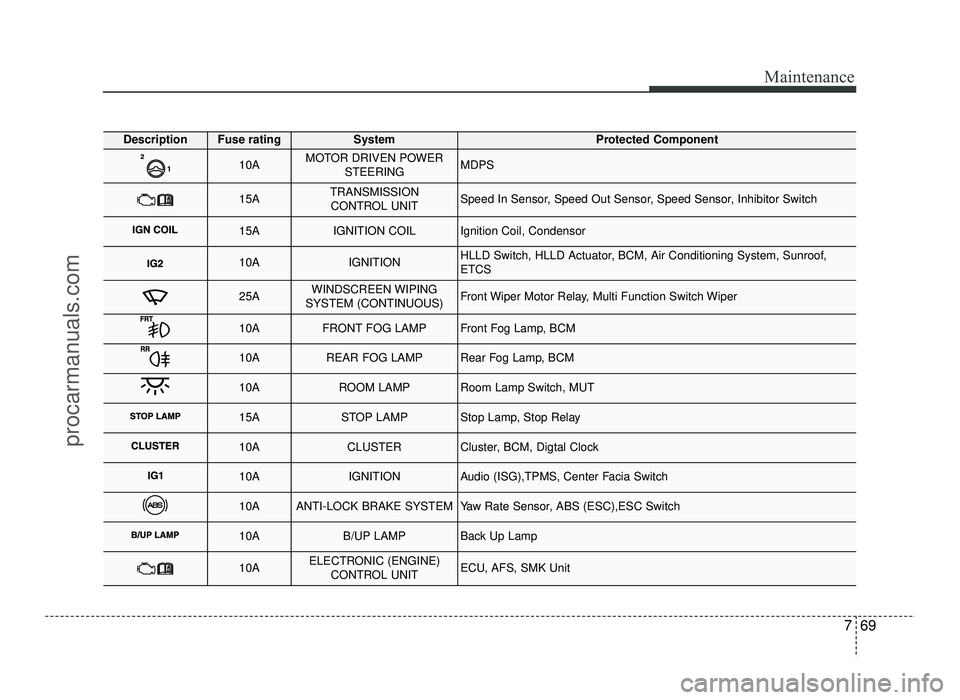
10AMOTOR DRIVEN POWERSTEERINGMDPS
15ATRANSMISSION CONTROL UNITSpeed In Sensor, Speed Out Sensor, Speed Sensor, Inhibitor Switch
15AIGNITION COILIgnition Coil, Condensor
10AIGNITIONHLLD Switch, HLLD Actuator, BCM, Air Conditioning System, Sunroof, ETCS
25AWINDSCREEN WIPING
SYSTEM (CONTINUOUS)Front Wiper Motor Relay, Multi Function Switch Wiper
10AFRONT FOG LAMPFront Fog Lamp, BCM
10AREAR FOG LAMPRear Fog Lamp, BCM
10AROOM LAMPRoom Lamp Switch, MUT
15ASTOP LAMPStop Lamp, Stop Relay
10ACLUSTERCluster, BCM, Digtal Clock
10AIGNITIONAudio (ISG),TPMS, Center Facia Switch
10AANTI-LOCK BRAKE SYSTEMYaw Rate Sensor, ABS (ESC),ESC Switch
10AB/UP LAMPBack Up Lamp
10AELECTRONIC (ENGINE) CONTROL UNITECU, AFS, SMK Unit
procarmanuals.com
Page 455 of 456
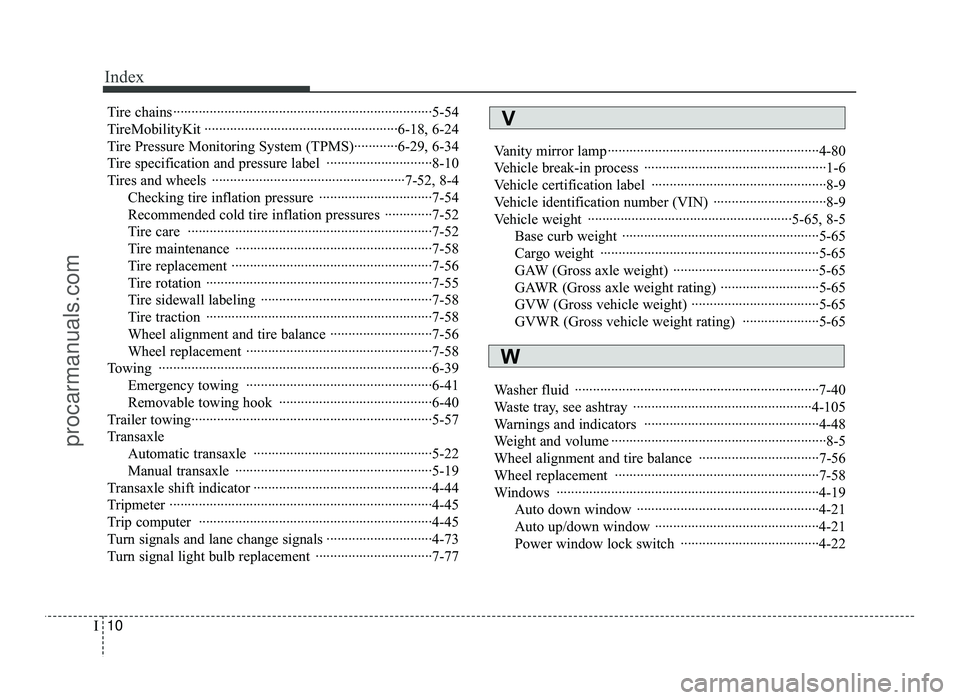
Index
10
I
Tire chains ·······································································5-54
TireMobilityKit ·····················································6-18, 6-24
Tire Pressure Monitoring System (TPMS)············6-29, 6-34
Tire specification and pressure label ·····························8-10
Tires and wheels ·····················································7-52, 8-4
Checking tire inflation pressure ·······························7-54
Recommended cold tire inflation pressures ·············7-52
Tire care ···································································7-52
Tire maintenance ······················································7-58
Tire replacement ·······················································7-56
Tire rotation ······························································7-55
Tire sidewall labeling ···············································7-58
Tire traction ······························································7-58
Wheel alignment and tire balance ····························7-56
Wheel replacement ···················································7-58
Towing ···········································································6-39 Emergency towing ···················································6-41
Removable towing hook ··········································6-40
Trailer towing··································································5-57
Transaxle Automatic transaxle ·················································5-22
Manual transaxle ······················································5-19
Transaxle shift indicator ·················································4-44
Tripmeter ········································································4-45
Trip computer ································································4-45
Turn signals and lane change signals ·····························4-73
Turn signal light bulb replacement ································7-77 Vanity mirror lamp··························································4-80
Vehicle break-in process ··················································1-6
Vehicle certification label ················································8-9
Vehicle identification number (VIN) ·······························8-9
Vehicle weight ························································5-65, 8-5
Base curb weight ······················································5-65
Cargo weight ····························································5-65
GAW (Gross axle weight) ········································5-65
GAWR (Gross axle weight rating) ···························5-65
GVW (Gross vehicle weight) ···································5-65
GVWR (Gross vehicle weight rating) ·····················5-65
Washer fluid ···································································7-40
Waste tray, see ashtray ·················································4-105
Warnings and indicators ················································4-48
Weight and volume ···························································8-5
Wheel alignment and tire balance ·································7-56
Wheel replacement ························································7-58
Windows ········································································4-19 Auto down window ··················································4-21
Auto up/down window ·············································4-21
Power window lock switch ······································4-22V
W
procarmanuals.com