cooling HYUNDAI IX20 2017 User Guide
[x] Cancel search | Manufacturer: HYUNDAI, Model Year: 2017, Model line: IX20, Model: HYUNDAI IX20 2017Pages: 456, PDF Size: 9.46 MB
Page 181 of 456
4103
Features of your vehicle
✽✽NOTICE
While using the cooling function, a small
amount of condensed moisture could
damage pieces of paper.
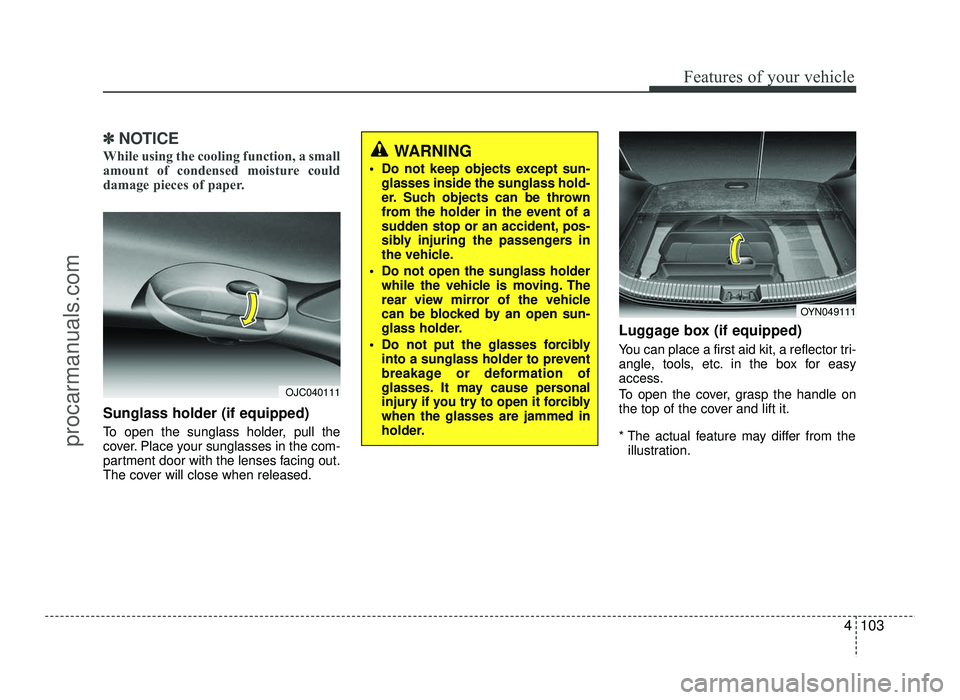
Sunglass holder (if equipped)
To open the sunglass holder, pull the
cover. Place your sunglasses in the com-
partment door with the lenses facing out.
The cover will close when released. Luggage box (if equipped)
You can place a first aid kit, a reflector tri-
angle, tools, etc. in the box for easy
access.
To open the cover, grasp the handle on
the top of the cover and lift it.
* The actual feature may differ from the
illustration.
OJC040111
OYN049111
WARNING
Do not keep objects except sun- glasses inside the sunglass hold-
er. Such objects can be thrown
from the holder in the event of a
sudden stop or an accident, pos-
sibly injuring the passengers in
the vehicle.
Do not open the sunglass holder while the vehicle is moving. The
rear view mirror of the vehicle
can be blocked by an open sun-
glass holder.
Do not put the glasses forcibly into a sunglass holder to prevent
breakage or deformation of
glasses. It may cause personal
injury if you try to open it forciblywhen the glasses are jammed in
holder.
procarmanuals.com
Page 202 of 456
Features of your vehicle
124
4
✽✽
NOTICE - USING VOICE COMMAND
The voice recognition feature of this product supports recognition of the
commands listed within this user’s
manual.
While using voice recognition, oper- ating the steering remote control or
the device will terminate voice recog-
nition and allow you to manually
operate desired functions.
Position the microphone above the head of the driver’s seat. For supe-
rior performance, maintain good
posture when saying voice com-
mands.
Voice recognition may not function
properly due to outside noise. The
following conditions can affect the
performance of Voice Recognition:
- When the windows and sunroof are open
- When the heating/cooling system is on
- When passing a tunnel
- When driving on rugged and uneven roads (Continued)(Continued)
After downloading
Bluetooth®
Wireless Technology phone book,
the system requires some times to
convert the phone book into voice
information. During this time, voice
recognition may not operate prop-
erly.
Upon inputting your phone book, special symbols and numbers can-
not be recognized by voice. For
example, “# John Doe%&” will be
recognized as “John Doe”.
procarmanuals.com
Page 286 of 456
555
Driving your vehicle
Use high quality ethylene glycol coolant
Your vehicle is delivered with high quality
ethylene glycol coolant in the cooling
system. It is the only type of coolant that
should be used because it helps prevent
corrosion in the cooling system, lubri-
cates the water pump and prevents
freezing. Be sure to replace or replenish
your coolant in accordance with themaintenance schedule in section 7.
Before winter, have your coolant tested toassure that its freezing point is sufficient
for the temperatures anticipated during
the winter.
Check battery and cables
Winter puts additional burdens on the
battery system. Visually inspect the bat-
tery and cables as described in section
7. We recommend that the system be
checked by an authorized HYUNDAI
dealer.Change to "winter weight" oil if
necessary In some climates it is recommended that
a lower viscosity "winter weight" oil be
used during cold weather. See section 8
for recommendations. If you aren't sure
what weight oil you should use, we rec-
ommend that you consult an authorized
HYUNDAI dealer.
Check spark plugs and ignition system
Inspect your spark plugs as described in
section 7 and replace them if necessary.
Also check all ignition wiring and compo-
nents to be sure they are not cracked,
worn or damaged in any way.
WARNING
- Tire chains
The use of chains may adversely affect vehicle handling.
Do not exceed 30 km/h (20 mph) or the chain manufacturer’s rec-
ommended speed limit, whichev-
er is lower.
Drive carefully and avoid bumps, holes, sharp turns, and other
road hazards, which may cause
the vehicle to bounce.
Avoid sharp turns or locked- wheel braking.
CAUTION
Chains that are the wrong size or
improperly installed can damageyour vehicle's brake lines, sus-pension, body and wheels.
Stop driving and retighten the chains any time you hear themhitting the vehicle.
procarmanuals.com
Page 287 of 456
Driving your vehicle
56
5
To keep locks from freezing
To keep the locks from freezing, squirt an
approved de-icer fluid or glycerine into
the key opening. If a lock is covered with
ice, squirt it with an approved de-icing
fluid to remove the ice. If the lock is
frozen internally, you may be able to thaw
it out by using a heated key. Handle the
heated key with care to avoid injury.
Use approved window washer
anti-freeze in system
To keep the water in the window washer
system from freezing, add an approved
window washer anti-freeze solution in
accordance with instructions on the con-
tainer. Window washer anti-freeze is
available from an authorized HYUNDAI
dealer and most auto parts outlets. Donot use engine coolant or other types of
anti-freeze as these may damage thepaint finish. Don't let your parking brake
freeze
Under some conditions your parking
brake can freeze in the engaged position.
This is most likely to happen when there
is an accumulation of snow or ice around
or near the rear brakes or if the brakes
are wet. If there is a risk the parking
brake may freeze, apply it only temporar-
ily while you put the shift lever in P (auto-
matic transaxle) or in first or reverse gear
(manual transaxle) and block the rear
wheels so the vehicle cannot roll. Then
release the parking brake.
Don't let ice and snow accumu- late underneath
Under some conditions, snow and ice
can build up under the fenders and inter-
fere with the steering. When driving in
severe winter conditions where this may
happen, you should periodically check
underneath the car to be sure the move-
ment of the front wheels and the steering
components is not obstructed.Carry emergency equipment
Depending on the severity of the weath-
er, you should carry appropriate emer-
gency equipment. Some of the items you
may want to carry include tire chains, tow
straps or chains, flashlight, emergency
flares, sand, shovel, jumper cables, win-
dow scraper, gloves, ground cloth, cover-
alls, blanket, etc.
Don't place foreign objects or
materials in the engine compart-ment
Placement of foreign objects or materials
which prevent cooling of the engine, in
the engine compartment, may cause a
failure or combustion. The manufacturer
is not responsible for the damage caused
by such placement.
procarmanuals.com
Page 293 of 456
Driving your vehicle
62
5
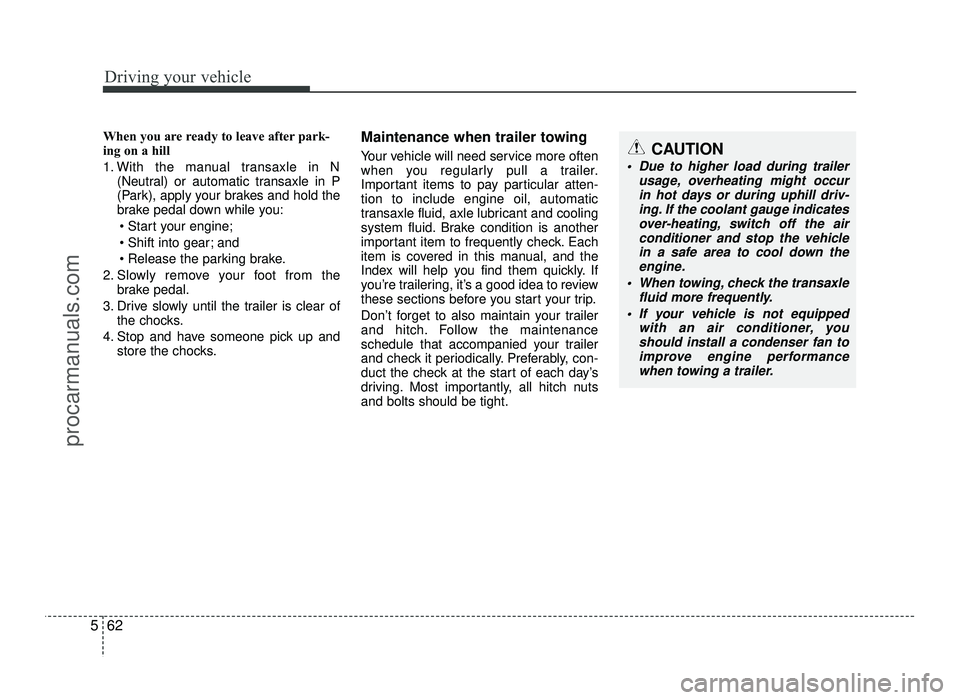
When you are ready to leave after park-
ing on a hill
1. With the manual transaxle in N
(Neutral) or automatic transaxle in P
(Park), apply your brakes and hold the
brake pedal down while you:
and
2. Slowly remove your foot from the brake pedal.
3. Drive slowly until the trailer is clear of the chocks.
4. Stop and have someone pick up and store the chocks. Maintenance when trailer towing
Your vehicle will need service more often
when you regularly pull a trailer.
Important items to pay particular atten-tion to include engine oil, automatic
transaxle fluid, axle lubricant and cooling
system fluid. Brake condition is another
important item to frequently check. Each
item is covered in this manual, and the
Index will help you find them quickly. If
you’re trailering, it’s a good idea to review
these sections before you start your trip.
Don’t forget to also maintain your trailer
and hitch. Follow the maintenance
schedule that accompanied your trailer
and check it periodically. Preferably, con-
duct the check at the start of each day’s
driving. Most importantly, all hitch nutsand bolts should be tight.CAUTION
Due to higher load during trailer
usage, overheating might occurin hot days or during uphill driv-
ing. If the coolant gauge indicates over-heating, switch off the airconditioner and stop the vehicle
in a safe area to cool down theengine.
When towing, check the transaxle fluid more frequently.
If your vehicle is not equipped with an air conditioner, youshould install a condenser fan to
improve engine performancewhen towing a trailer.
procarmanuals.com
Page 304 of 456
What to do in an emergency
8
6
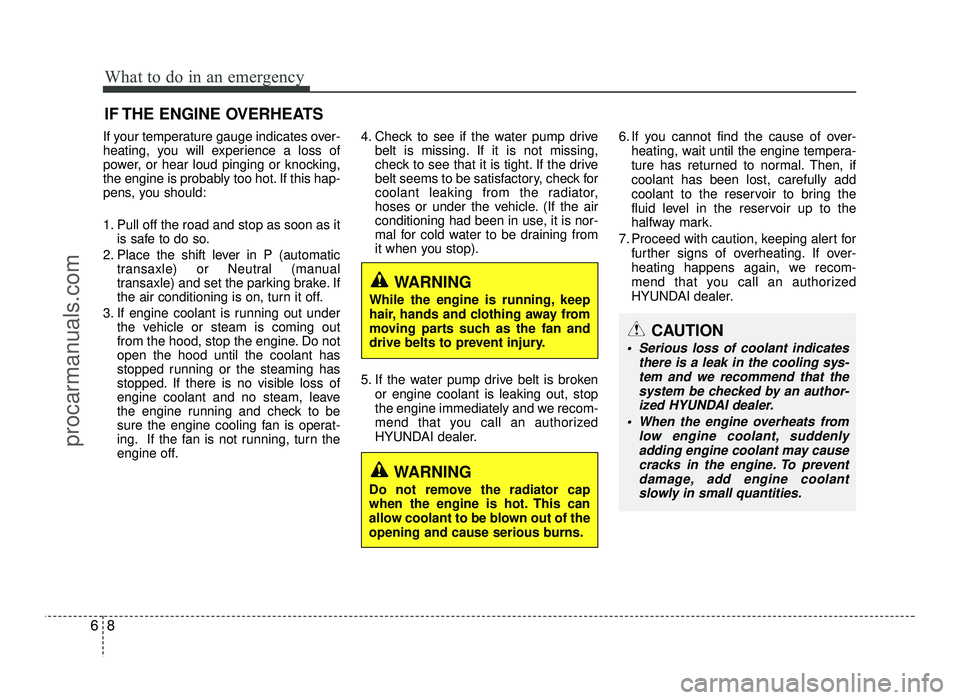
IF THE ENGINE OVERHEATS
If your temperature gauge indicates over-
heating, you will experience a loss of
power, or hear loud pinging or knocking,
the engine is probably too hot. If this hap-
pens, you should:
1. Pull off the road and stop as soon as it is safe to do so.
2. Place the shift lever in P (automatic transaxle) or Neutral (manual
transaxle) and set the parking brake. If
the air conditioning is on, turn it off.
3. If engine coolant is running out under the vehicle or steam is coming out
from the hood, stop the engine. Do notopen the hood until the coolant has
stopped running or the steaming has
stopped. If there is no visible loss of
engine coolant and no steam, leave
the engine running and check to be
sure the engine cooling fan is operat-
ing. If the fan is not running, turn the
engine off. 4. Check to see if the water pump drive
belt is missing. If it is not missing,
check to see that it is tight. If the drive
belt seems to be satisfactory, check for
coolant leaking from the radiator,
hoses or under the vehicle. (If the air
conditioning had been in use, it is nor-
mal for cold water to be draining from
it when you stop).
5. If the water pump drive belt is broken or engine coolant is leaking out, stop
the engine immediately and we recom-
mend that you call an authorized
HYUNDAI dealer. 6. If you cannot find the cause of over-
heating, wait until the engine tempera-
ture has returned to normal. Then, ifcoolant has been lost, carefully add
coolant to the reservoir to bring the
fluid level in the reservoir up to the
halfway mark.
7. Proceed with caution, keeping alert for further signs of overheating. If over-
heating happens again, we recom-
mend that you call an authorized
HYUNDAI dealer.
WARNING
While the engine is running, keep
hair, hands and clothing away from
moving parts such as the fan and
drive belts to prevent injury.
WARNING
Do not remove the radiator cap
when the engine is hot. This can
allow coolant to be blown out of the
opening and cause serious burns.
CAUTION
Serious loss of coolant indicates there is a leak in the cooling sys-tem and we recommend that the
system be checked by an author-ized HYUNDAI dealer.
When the engine overheats from low engine coolant, suddenlyadding engine coolant may cause cracks in the engine. To prevent
damage, add engine coolant slowly in small quantities.
procarmanuals.com
Page 343 of 456
Maintenance
4
7
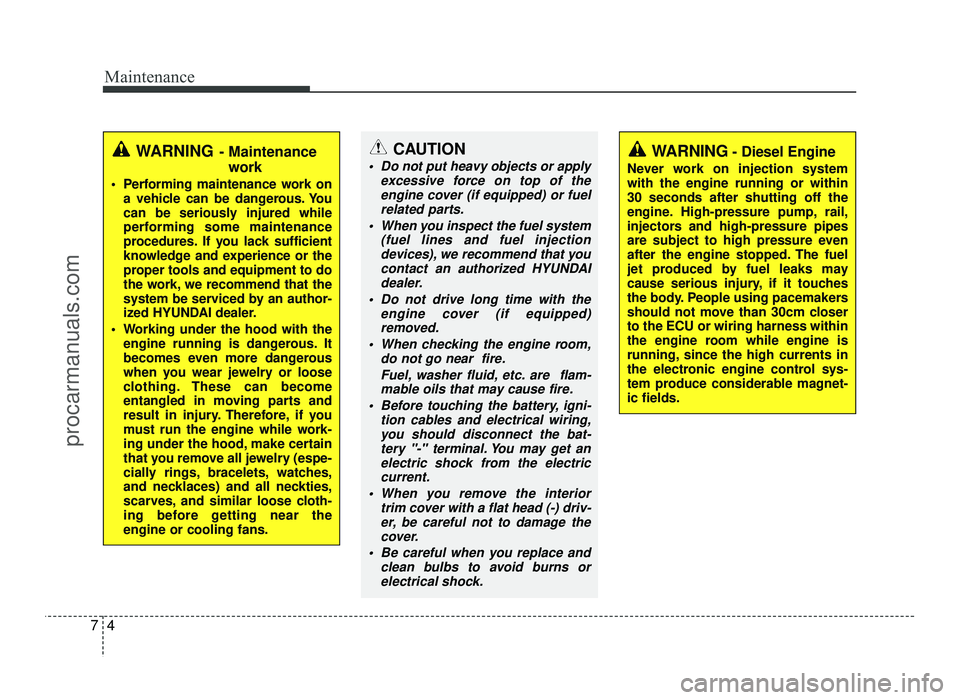
WARNING - Maintenance
work
Performing maintenance work on a vehicle can be dangerous. You
can be seriously injured while
performing some maintenance
procedures. If you lack sufficient
knowledge and experience or the
proper tools and equipment to do
the work, we recommend that the
system be serviced by an author-
ized HYUNDAI dealer.
Working under the hood with the engine running is dangerous. It
becomes even more dangerous
when you wear jewelry or loose
clothing. These can become
entangled in moving parts and
result in injury. Therefore, if you
must run the engine while work-
ing under the hood, make certain
that you remove all jewelry (espe-
cially rings, bracelets, watches,
and necklaces) and all neckties,
scarves, and similar loose cloth-
ing before getting near theengine or cooling fans.WARNING - Diesel Engine
Never work on injection system with the engine running or within30 seconds after shutting off the
engine. High-pressure pump, rail,
injectors and high-pressure pipes
are subject to high pressure even
after the engine stopped. The fuel
jet produced by fuel leaks may
cause serious injury, if it touches
the body. People using pacemakers
should not move than 30cm closerto the ECU or wiring harness within
the engine room while engine is
running, since the high currents in
the electronic engine control sys-
tem produce considerable magnet-ic fields.CAUTION
Do not put heavy objects or apply excessive force on top of theengine cover (if equipped) or fuel
related parts.
When you inspect the fuel system (fuel lines and fuel injection
devices), we recommend that youcontact an authorized HYUNDAI
dealer.
Do not drive long time with the engine cover (if equipped)
removed.
When checking the engine room, do not go near fire.
Fuel, washer fluid, etc. are flam-mable oils that may cause fire.
Before touching the battery, igni- tion cables and electrical wiring,
you should disconnect the bat- tery "-" terminal. You may get an
electric shock from the electriccurrent.
When you remove the interior trim cover with a flat head (-) driv-er, be careful not to damage the
cover.
Be careful when you replace and clean bulbs to avoid burns or
electrical shock.
procarmanuals.com
Page 349 of 456
Maintenance
10
7
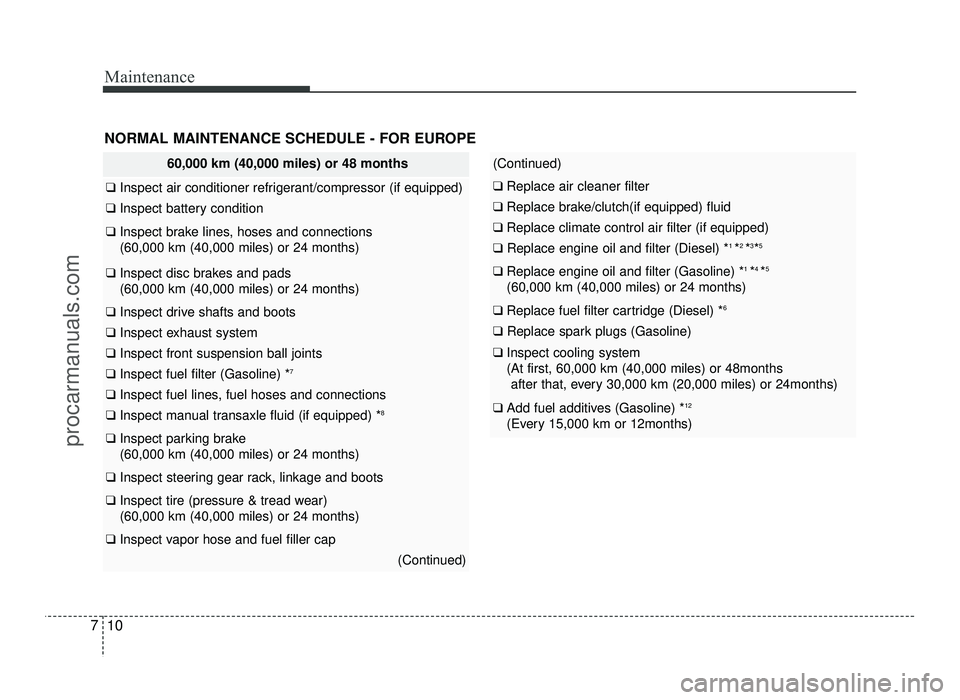
NORMAL MAINTENANCE SCHEDULE - FOR EUROPE
60,000 km (40,000 miles) or 48 months
❑ Inspect air conditioner refrigerant/compressor (if equipped)
❑ Inspect battery condition
❑ Inspect brake lines, hoses and connections (60,000 km (40,000 miles) or 24 months)
❑ Inspect disc brakes and pads (60,000 km (40,000 miles) or 24 months)
❑ Inspect drive shafts and boots
❑ Inspect exhaust system
❑ Inspect front suspension ball joints
❑ Inspect fuel filter (Gasoline) * 7
❑
Inspect fuel lines, fuel hoses and connections
❑ Inspect manual transaxle fluid (if equipped) * 8
❑
Inspect parking brake (60,000 km (40,000 miles) or 24 months)
❑ Inspect steering gear rack, linkage and boots
❑ Inspect tire (pressure & tread wear) (60,000 km (40,000 miles) or 24 months)
❑ Inspect vapor hose and fuel filler cap
(Continued)
(Continued)
❑ Replace air cleaner filter
❑ Replace brake/clutch(if equipped) fluid
❑ Replace climate control air filter (if equipped)
❑ Replace engine oil and filter (Diesel) * 1
*2
*3
* 5
❑
Replace engine oil and filter (Gasoline) * 1
*4
*5
(60,000 km (40,000 miles) or 24 months)
❑ Replace fuel filter cartridge (Diesel) * 6
❑
Replace spark plugs (Gasoline)
❑ Inspect cooling system
(At first, 60,000 km (40,000 miles) or 48months
after that, every 30,000 km (20,000 miles) or 24months)
❑ Add fuel additives (Gasoline) * 12
(Every 15,000 km or 12months)
procarmanuals.com
Page 350 of 456
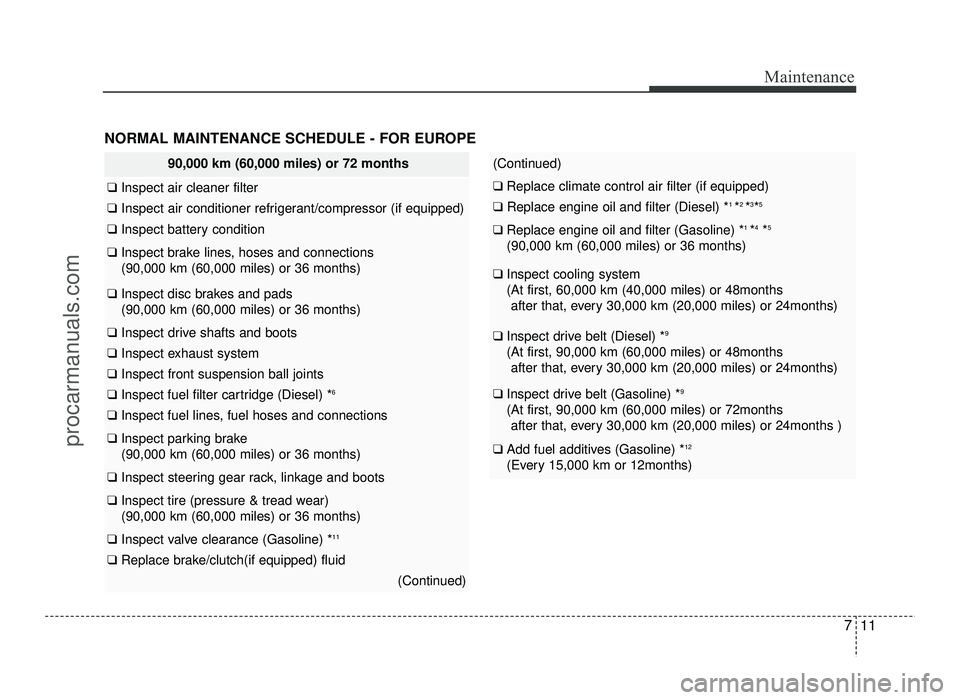
711
Maintenance
NORMAL MAINTENANCE SCHEDULE - FOR EUROPE
90,000 km (60,000 miles) or 72 months
❑ Inspect air cleaner filter
❑ Inspect air conditioner refrigerant/compressor (if equipped)
❑ Inspect battery condition
❑ Inspect brake lines, hoses and connections (90,000 km (60,000 miles) or 36 months)
❑ Inspect disc brakes and pads (90,000 km (60,000 miles) or 36 months)
❑ Inspect drive shafts and boots
❑ Inspect exhaust system
❑ Inspect front suspension ball joints
❑ Inspect fuel filter cartridge (Diesel) * 6
❑
Inspect fuel lines, fuel hoses and connections
❑ Inspect parking brake (90,000 km (60,000 miles) or 36 months)
❑ Inspect steering gear rack, linkage and boots
❑ Inspect tire (pressure & tread wear) (90,000 km (60,000 miles) or 36 months)
❑ Inspect valve clearance (Gasoline) * 11
❑
Replace brake/clutch(if equipped) fluid
(Continued)
(Continued)
❑ Replace climate control air filter (if equipped)
❑ Replace engine oil and filter (Diesel) * 1
*2
*3
* 5
❑
Replace engine oil and filter (Gasoline) * 1
*4
*5
(90,000 km (60,000 miles) or 36 months)
❑ Inspect cooling system
(At first, 60,000 km (40,000 miles) or 48months
after that, every 30,000 km (20,000 miles) or 24months)
❑ Inspect drive belt (Diesel) * 9
(At first, 90,000 km (60,000 miles) or 48months after that, every 30,000 km (20,000 miles) or 24months)
❑ Inspect drive belt (Gasoline) * 9
(At first, 90,000 km (60,000 miles) or 72months after that, every 30,000 km (20,000 miles) or 24months )
❑ Add fuel additives (Gasoline) * 12
(Every 15,000 km or 12months)
procarmanuals.com
Page 351 of 456
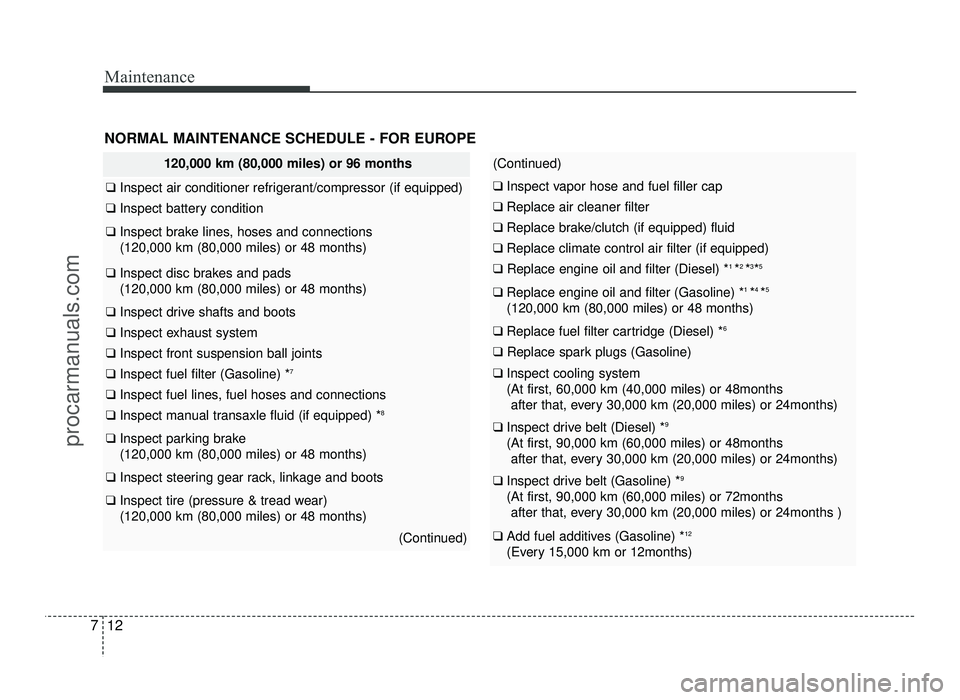
Maintenance
12
7
NORMAL MAINTENANCE SCHEDULE - FOR EUROPE
120,000 km (80,000 miles) or 96 months
❑ Inspect air conditioner refrigerant/compressor (if equipped)
❑ Inspect battery condition
❑ Inspect brake lines, hoses and connections (120,000 km (80,000 miles) or 48 months)
❑ Inspect disc brakes and pads (120,000 km (80,000 miles) or 48 months)
❑ Inspect drive shafts and boots
❑ Inspect exhaust system
❑ Inspect front suspension ball joints
❑ Inspect fuel filter (Gasoline) * 7
❑
Inspect fuel lines, fuel hoses and connections
❑ Inspect manual transaxle fluid (if equipped) * 8
❑
Inspect parking brake (120,000 km (80,000 miles) or 48 months)
❑ Inspect steering gear rack, linkage and boots
❑ Inspect tire (pressure & tread wear) (120,000 km (80,000 miles) or 48 months)
(Continued)
(Continued)
❑ Inspect vapor hose and fuel filler cap
❑ Replace air cleaner filter
❑ Replace brake/clutch (if equipped) fluid
❑ Replace climate control air filter (if equipped)
❑ Replace engine oil and filter (Diesel) * 1
*2
*3
* 5
❑
Replace engine oil and filter (Gasoline) * 1
*4
*5
(120,000 km (80,000 miles) or 48 months)
❑ Replace fuel filter cartridge (Diesel) * 6
❑
Replace spark plugs (Gasoline)
❑ Inspect cooling system
(At first, 60,000 km (40,000 miles) or 48months
after that, every 30,000 km (20,000 miles) or 24months)
❑ Inspect drive belt (Diesel) * 9
(At first, 90,000 km (60,000 miles) or 48months after that, every 30,000 km (20,000 miles) or 24months)
❑ Inspect drive belt (Gasoline) * 9
(At first, 90,000 km (60,000 miles) or 72months after that, every 30,000 km (20,000 miles) or 24months )
❑ Add fuel additives (Gasoline) * 12
(Every 15,000 km or 12months)
procarmanuals.com