weight HYUNDAI IX20 2017 User Guide
[x] Cancel search | Manufacturer: HYUNDAI, Model Year: 2017, Model line: IX20, Model: HYUNDAI IX20 2017Pages: 456, PDF Size: 9.46 MB
Page 292 of 456
561
Driving your vehicle
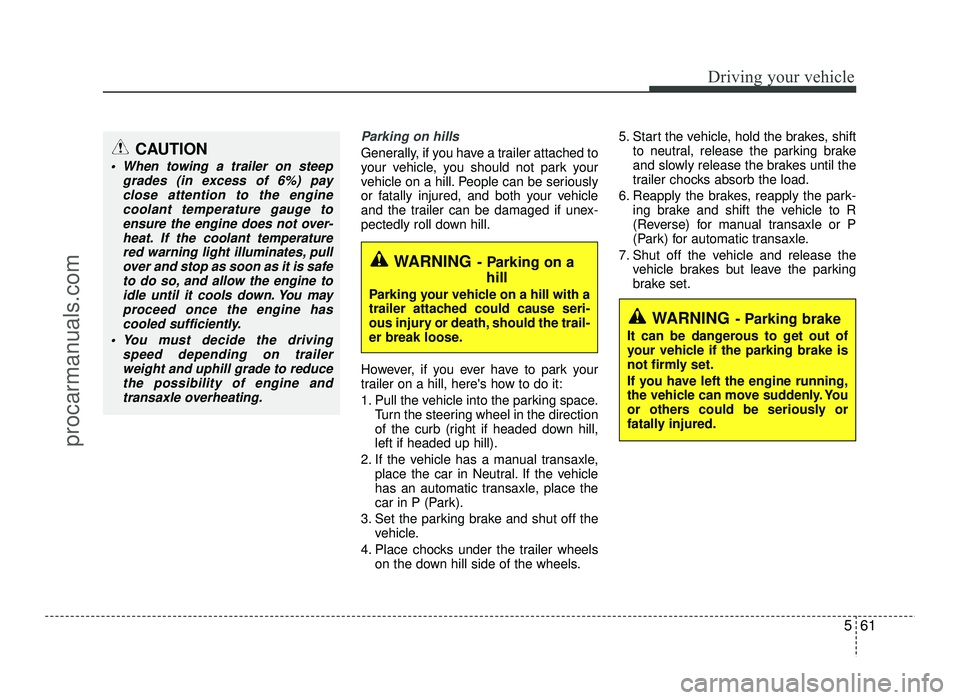
Parking on hills
Generally, if you have a trailer attached to
your vehicle, you should not park your
vehicle on a hill. People can be seriously
or fatally injured, and both your vehicle
and the trailer can be damaged if unex-
pectedly roll down hill.
However, if you ever have to park your
trailer on a hill, here's how to do it:
1. Pull the vehicle into the parking space.Turn the steering wheel in the direction
of the curb (right if headed down hill,left if headed up hill).
2. If the vehicle has a manual transaxle, place the car in Neutral. If the vehicle
has an automatic transaxle, place the
car in P (Park).
3. Set the parking brake and shut off the vehicle.
4. Place chocks under the trailer wheels on the down hill side of the wheels. 5. Start the vehicle, hold the brakes, shift
to neutral, release the parking brake
and slowly release the brakes until the
trailer chocks absorb the load.
6. Reapply the brakes, reapply the park- ing brake and shift the vehicle to R
(Reverse) for manual transaxle or P
(Park) for automatic transaxle.
7. Shut off the vehicle and release the vehicle brakes but leave the parking
brake set.CAUTION
When towing a trailer on steep
grades (in excess of 6%) payclose attention to the engine
coolant temperature gauge toensure the engine does not over-heat. If the coolant temperature
red warning light illuminates, pullover and stop as soon as it is safe
to do so, and allow the engine toidle until it cools down. You may
proceed once the engine has cooled sufficiently.
You must decide the driving speed depending on trailerweight and uphill grade to reduce
the possibility of engine andtransaxle overheating.
WARNING - Parking on a
hill
Parking your vehicle on a hill with a
trailer attached could cause seri-
ous injury or death, should the trail-
er break loose.
WARNING - Parking brake
It can be dangerous to get out of
your vehicle if the parking brake is
not firmly set.
If you have left the engine running,
the vehicle can move suddenly. You
or others could be seriously or
fatally injured.
procarmanuals.com
Page 294 of 456
563
Driving your vehicle
If you do decide to pull a trailer
Here are some important points if you
decide to pull a trailer:
Consider using a sway control. You canask a hitch dealer about sway control.
Do not do any towing with your car dur- ing its first 2,000 km (1,200 miles) in
order to allow the engine to properly
break in. Failure to heed this caution
may result in serious engine or
transaxle damage.
When towing a trailer, we recommend that you consult an authorized
HYUNDAI dealer on additional require-
ments such as a towing kit, etc.
Always drive your vehicle at a moder- ate speed (less than 100 km/h / 60
mph). If your vehicle is a commercial
vehicle, drive less than 80 km/h.
On a long uphill grade, do not exceed 70 km/h (45 mph) or the posted towing
speed limit, whichever is lower.
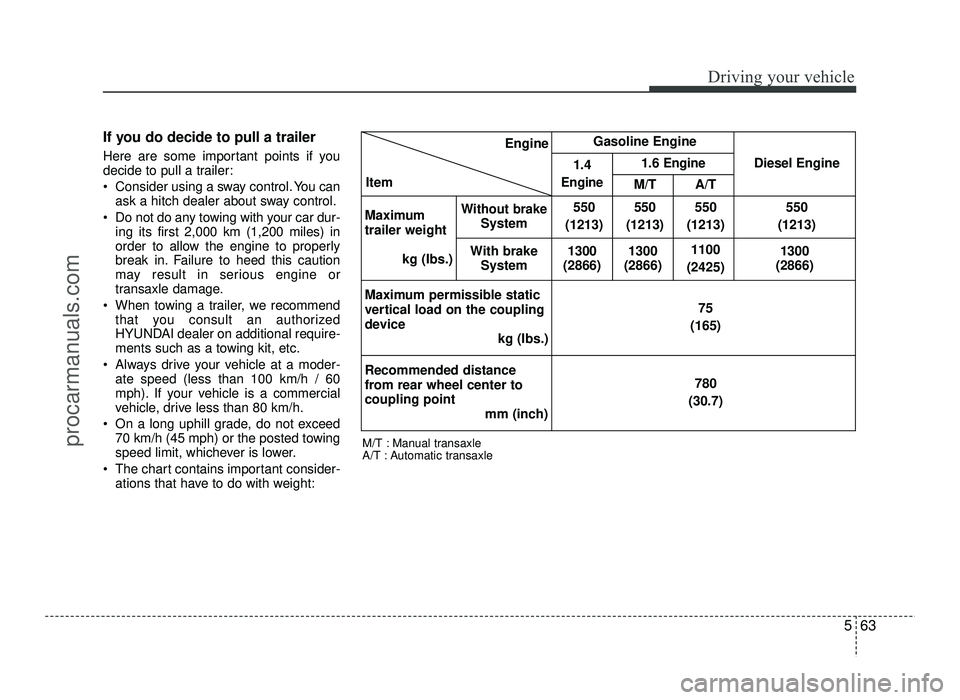
The chart contains important consider- ations that have to do with weight: M/T : Manual transaxle
A/T : Automatic transaxleEngine
Item Gasoline Engine
Diesel Engine
1.4
Engine
1.6 Engine
M/T A/T
Maximum trailer weight kg (Ibs.)
Without brakeSystem 550
(1213) 550
(1213)
550
(1213) 550
(1213)
With brake System 1300
(2866) 1300
(2866)
1100
(2425) 1300
(2866)
Maximum permissible static
vertical load on the coupling
device kg (Ibs.) 75
(165)
Recommended distance
from rear wheel center tocoupling point mm (inch) 780
(30.7)
procarmanuals.com
Page 295 of 456
Driving your vehicle
64
5
Weight of the trailer
What is the maximum safe weight of a
trailer? It should never weigh more than
the maximum trailer weight with trailer
brakes. But even that can be too heavy.
It depends on how you plan to use your
trailer. For example, speed, altitude, road
grades, outside temperature and how
often your vehicle is used to pull a trailer
are all important. The ideal trailer weight
can also depend on any special equip-
ment that you have on your vehicle.
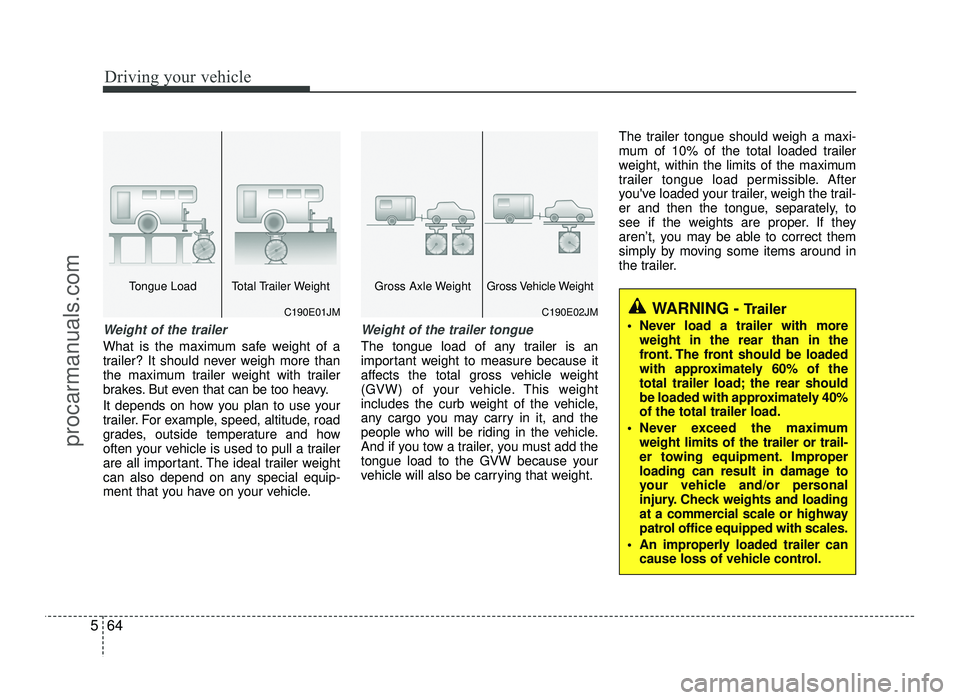
Weight of the trailer tongue
The tongue load of any trailer is an
important weight to measure because it
affects the total gross vehicle weight
(GVW) of your vehicle. This weight
includes the curb weight of the vehicle,
any cargo you may carry in it, and the
people who will be riding in the vehicle.
And if you tow a trailer, you must add the
tongue load to the GVW because your
vehicle will also be carrying that weight. The trailer tongue should weigh a maxi-
mum of 10% of the total loaded trailer
weight, within the limits of the maximum
trailer tongue load permissible. After
you've loaded your trailer, weigh the trail-
er and then the tongue, separately, to
see if the weights are proper. If they
aren’t, you may be able to correct them
simply by moving some items around in
the trailer.
C190E01JM
Tongue Load Total Trailer Weight
WARNING -
Trailer
Never load a trailer with more weight in the rear than in the
front. The front should be loaded
with approximately 60% of the
total trailer load; the rear should
be loaded with approximately 40%of the total trailer load.
Never exceed the maximum weight limits of the trailer or trail-
er towing equipment. Improper
loading can result in damage to
your vehicle and/or personal
injury. Check weights and loading
at a commercial scale or highway
patrol office equipped with scales.
An improperly loaded trailer can cause loss of vehicle control.C190E02JM
Gross Axle WeightGross Vehicle Weight
procarmanuals.com
Page 296 of 456

565
Driving your vehicle
This section will guide you in the proper
loading of your vehicle and/or trailer, to
keep your loaded vehicle weight within its
design rating capability, with or without a
trailer. Properly loading your vehicle will
provide maximum return of the vehicle
design performance. Before loading your
vehicle, familiarize yourself with the fol-
lowing terms for determining your vehi-
cle's weight ratings, with or without a
trailer, from the vehicle's specifications
and the certification label: Base curb weight
This is the weight of the vehicle including a full tank of fuel and all standard equip-
ment. It does not include passengers,
cargo, or optional equipment.
Vehicle curb weight
This is the weight of your new vehicle
when you picked it up from your dealer
plus any aftermarket equipment.Cargo weight
This figure includes all weight added to
the Base Curb Weight, including cargoand optional equipment.
GAW (Gross axle weight)
This is the total weight placed on each
axle (front and rear) - including vehicle
curb weight and all payload.
GAWR (Gross axle weight rating)
This is the maximum allowable weight
that can be carried by a single axle (front
or rear). These numbers are shown on
the certification label.
The total load on each axle must never
exceed its GAWR.
GVW (Gross vehicle weight)
This is the Base Curb Weight plus actual
Cargo Weight plus passengers.
GVWR (Gross vehicle weight rating)
This is the maximum allowable weight of
the fully loaded vehicle (including all
options, equipment, passengers and
cargo). The GVWR is shown on the cer-
tification label located on the driver’s (or
front passenger’s) door sill.
Overloading
VEHICLE WEIGHTWARNING -
Vehicle weight
The gross axle weight rating
(GAWR) and the gross vehicle
weight rating (GVWR) for your vehi-
cle are on the certification label
attached to the driver's (or front
passenger’s) door. Exceeding theseratings can cause an accident or
vehicle damage. You can calculate
the weight of your load by weighing
the items (and people) before put-
ting them in the vehicle. Be careful
not to overload your vehicle.
procarmanuals.com
Page 391 of 456
Maintenance
52
7
TIRES AND WHEELS
Tire care
For proper maintenance, safety, and
maximum fuel economy, you must
always maintain recommended tire
inflation pressures and stay within
the load limits and weight distribution
recommended for your vehicle. Recommended cold tire inflationpressures All tire pressures (including the
spare) should be checked when the
tires are cold. “Cold Tires” means the
vehicle has not been driven for at
least three hours or driven less than1.6 km (one mile).
Recommended pressures must be
maintained for the best ride, top vehi-
cle handling, and minimum tire wear.
For recommended inflation pressure,
refer to “Tire and wheels” in section 8.
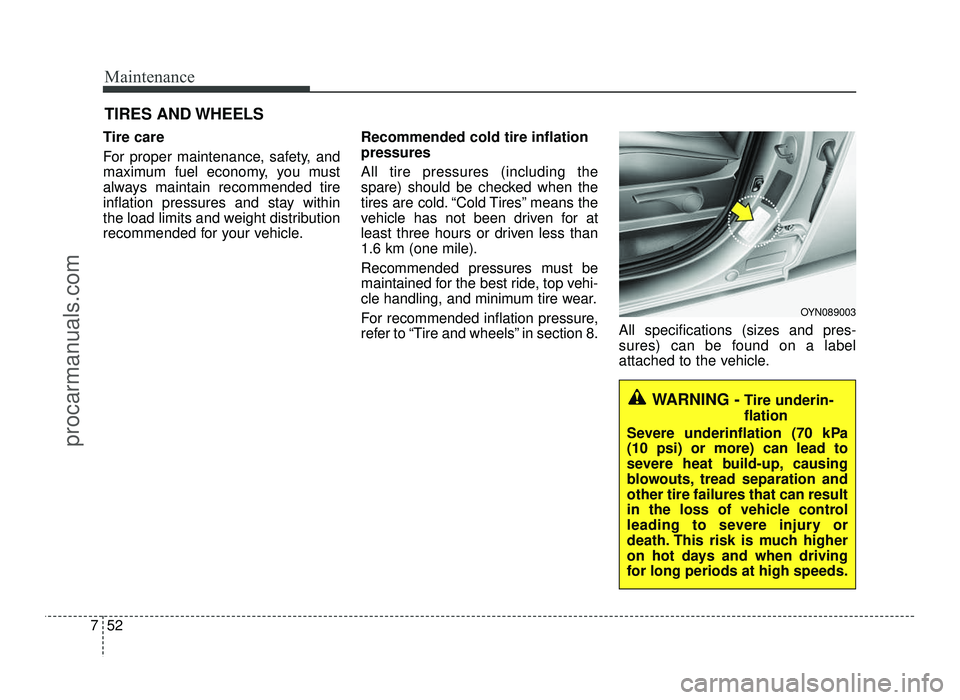
All specifications (sizes and pres-
sures) can be found on a label
attached to the vehicle.
WARNING -
Tire underin- flation
Severe underinflation (70 kPa(10 psi) or more) can lead to
severe heat build-up, causing
blowouts, tread separation andother tire failures that can result
in the loss of vehicle control
leading to severe injury or
death. This risk is much higher
on hot days and when driving
for long periods at high speeds.
OYN089003
procarmanuals.com
Page 395 of 456

Maintenance
56
7
Wheel alignment and tire balance
The wheels on your vehicle were aligned and balanced carefully at the
factory to give you the longest tire life
and best overall performance.
In most cases, you will not need to
have your wheels aligned again.
However, if you notice unusual tire
wear or your vehicle pulling one way
or the other, the alignment may needto be reset.
If you notice your vehicle vibrating
when driving on a smooth road, your
wheels may need to be rebalanced. Tire replacement
If the tire is worn evenly, a tread wear indicator will appear as a solid band
across the tread. This shows there isless than 1.6 mm (1/16 inch) of tread
left on the tire. Replace the tire when
this happens.
Do not wait for the band to appear
across the entire tread before replac-
ing the tire.
OEN076053
Tread wear indicator
CAUTION
Improper wheel weights can
damage your vehicle's alu-minum wheels. Use onlyapproved wheel weights.
CAUTION
When replacing the tires, recheck and tighten the wheelnuts after driving about 1,000 km(620 miles). If the steering wheelshakes or the vehicle vibrates while driving, the tire is out ofbalance. Align the tire balance. Ifthe problem is not solved, werecommend that you contact an authorized HYUNDAI dealer.
procarmanuals.com
Page 435 of 456
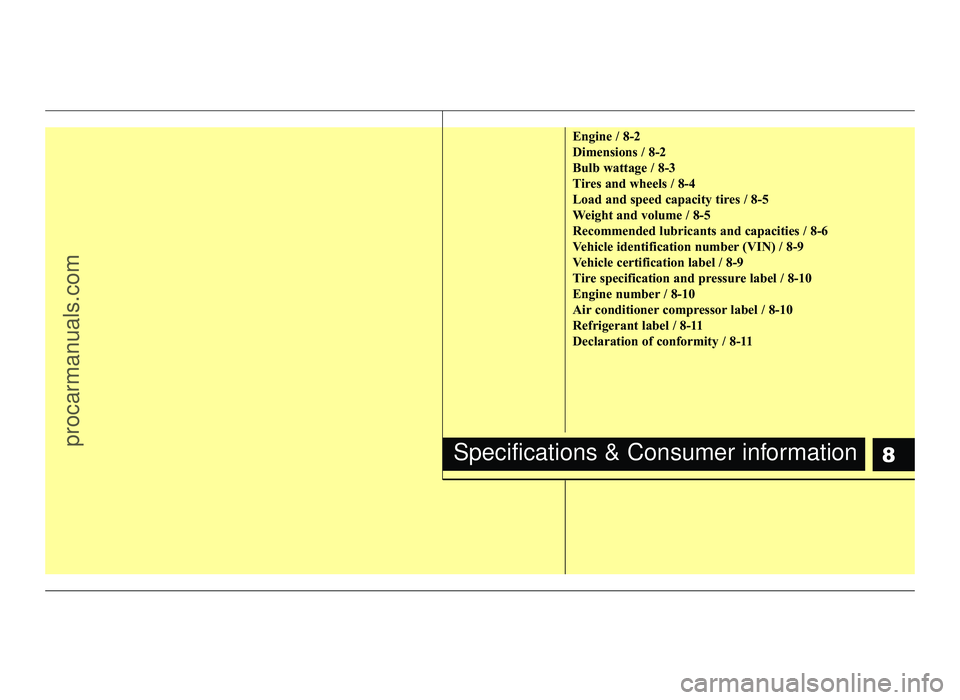
8
Engine / 8-2
Dimensions / 8-2
Bulb wattage / 8-3
Tires and wheels / 8-4
Load and speed capacity tires / 8-5
Weight and volume / 8-5
Recommended lubricants and capacities / 8-6
Vehicle identification number (VIN) / 8-9
Vehicle certification label / 8-9
Tire specification and pressure label / 8-10
Engine number / 8-10
Air conditioner compressor label / 8-10
Refrigerant label / 8-11
Declaration of conformity / 8-11
Specifications & Consumer information
procarmanuals.com
Page 439 of 456
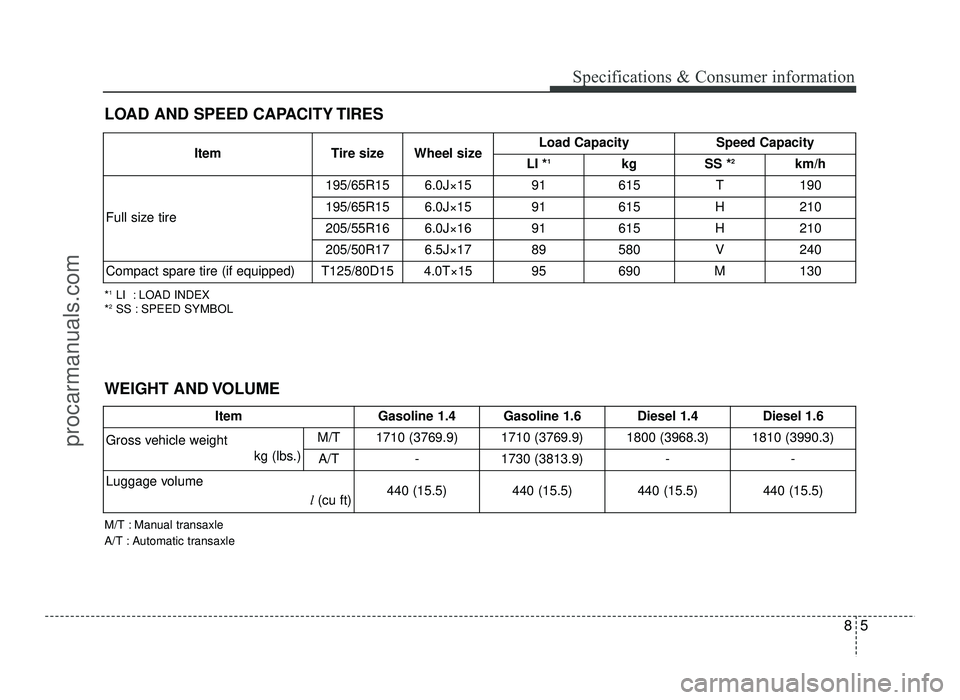
85
Specifications & Consumer information
*1
LI : LOAD INDEX
* 2
SS : SPEED SYMBOL
LOAD AND SPEED CAPACITY TIRES
Item Tire size Wheel size Load Capacity Speed Capacity
LI * 1
kg SS * 2
km/h
Full size tire 195/65R15 6.0J×15 91 615 T 190
195/65R15 6.0J×15 91 615 H 210
205/55R16 6.0J×16 91 615 H 210
205/50R17 6.5J×17 89 580 V 240
Compact spare tire (if equipped) T125/80D15 4.0T×15 95 690 M 130
WEIGHT AND VOLUME
Item Gasoline 1.4 Gasoline 1.6 Diesel 1.4
Diesel 1.6
Gross vehicle weight kg (lbs.)M/T 1710 (3769.9) 1710 (3769.9) 1800 (3968.3)
1810 (3990.3)
A/T-1730 (3813.9)--
Luggage volume l(cu ft) 440 (15.5) 440 (15.5) 440 (15.5)
440 (15.5)
M/T : Manual transaxle
A/T : Automatic transaxle
procarmanuals.com
Page 448 of 456
I3
Index
Capacities (Lubricants) ·····················································8-6
Care
Exterior care ······························································7-84
Interior care ·······························································7-89
Tire care·····································································7-52
Cargo weight ···································································5-65
Center console storage ··················································4-102
Central door lock/unlock switch ·····································4-14
Changing tires ·································································6-10
Chains Tire chains ·································································5-54
Checking tire inflation pressure ······································7-54
Child restraint system ·····················································3-28 Tether anchor system·················································3-33
ISOFIX system ·························································3-34
Child-protector rear door lock ·······································4-16
Cigarette lighter ····························································4-105
Climate control system (Automatic) ·····························4-91 Air conditioning ·······················································4-97
Automatic heating and air conditioning ···················4-92
Climate control air filter ·································4-98, 7-43
Manual heating and air conditioning ·······················4-93
Climate control system (Manual) ··································4-82 Air conditioning ·······················································4-87
Climate control air filter ··········································4-89
Heating and air conditioning ·····································4-83 Clock (Digital) ······························································4-104
Clothes hanger ······························································4-109
Combined instrument, see instrument cluster ················4-40
Cool box········································································4-102
Coolant ···········································································7-35
Cooling fluid, see engine coolant ··································7-35
Crankcase emission control system ·······························7-92
Cruise control system ····················································5-38
Cup holder ···································································4-106
Curtain air bag ·······························································3-53
Dashboard, see instrument cluster ·································4-40
Dashboard illumination, see instrument
panel illumination ·······················································4-41
Daytime running light ·····················································4-74
Defogging (Windshield) ················································4-99
Defroster ·········································································4-81 Outside mirror defroster ············································4-81
Rear window defroster ··············································4-81
Winshield deicer ························································4-81
Defrosting (Windshield) ················································4-99
Digital clock ·································································4-104
Dimensions ······································································8-2
Displays, see instrument cluster ····································4-40
Display illumination, see instrument panel illumination ·······················································4-41
C
D
procarmanuals.com
Page 455 of 456
Index
10
I
Tire chains ·······································································5-54
TireMobilityKit ·····················································6-18, 6-24
Tire Pressure Monitoring System (TPMS)············6-29, 6-34
Tire specification and pressure label ·····························8-10
Tires and wheels ·····················································7-52, 8-4
Checking tire inflation pressure ·······························7-54
Recommended cold tire inflation pressures ·············7-52
Tire care ···································································7-52
Tire maintenance ······················································7-58
Tire replacement ·······················································7-56
Tire rotation ······························································7-55
Tire sidewall labeling ···············································7-58
Tire traction ······························································7-58
Wheel alignment and tire balance ····························7-56
Wheel replacement ···················································7-58
Towing ···········································································6-39 Emergency towing ···················································6-41
Removable towing hook ··········································6-40
Trailer towing··································································5-57
Transaxle Automatic transaxle ·················································5-22
Manual transaxle ······················································5-19
Transaxle shift indicator ·················································4-44
Tripmeter ········································································4-45
Trip computer ································································4-45
Turn signals and lane change signals ·····························4-73
Turn signal light bulb replacement ································7-77 Vanity mirror lamp··························································4-80
Vehicle break-in process ··················································1-6
Vehicle certification label ················································8-9
Vehicle identification number (VIN) ·······························8-9
Vehicle weight ························································5-65, 8-5
Base curb weight ······················································5-65
Cargo weight ····························································5-65
GAW (Gross axle weight) ········································5-65
GAWR (Gross axle weight rating) ···························5-65
GVW (Gross vehicle weight) ···································5-65
GVWR (Gross vehicle weight rating) ·····················5-65
Washer fluid ···································································7-40
Waste tray, see ashtray ·················································4-105
Warnings and indicators ················································4-48
Weight and volume ···························································8-5
Wheel alignment and tire balance ·································7-56
Wheel replacement ························································7-58
Windows ········································································4-19 Auto down window ··················································4-21
Auto up/down window ·············································4-21
Power window lock switch ······································4-22V
W
procarmanuals.com