oil filter HYUNDAI IX20 2017 Owner's Manual
[x] Cancel search | Manufacturer: HYUNDAI, Model Year: 2017, Model line: IX20, Model: HYUNDAI IX20 2017Pages: 456, PDF Size: 9.46 MB
Page 366 of 456
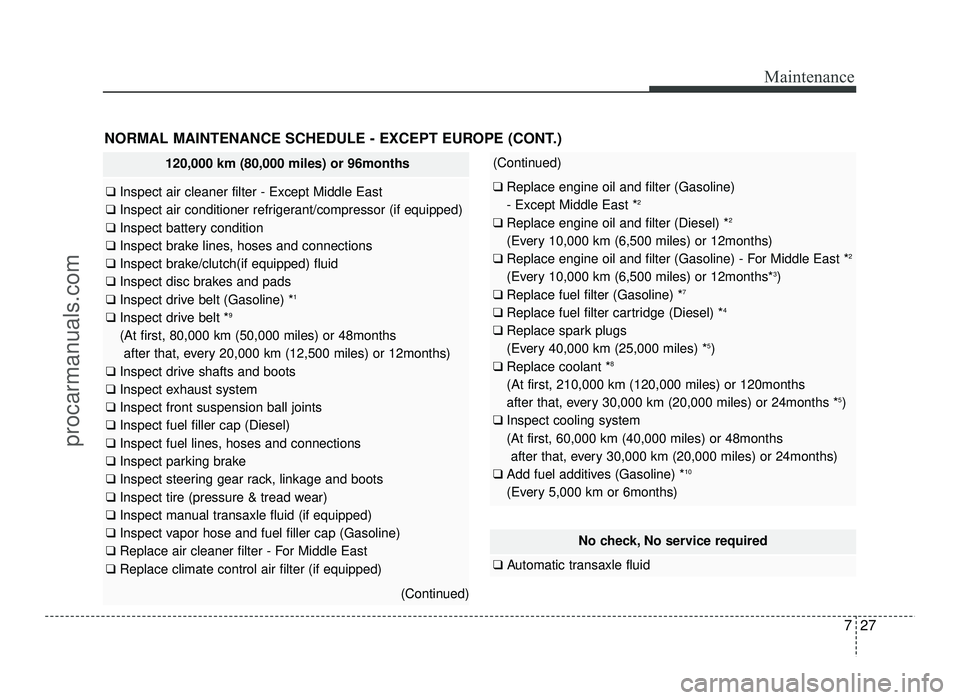
NORMAL MAINTENANCE SCHEDULE - EXCEPT EUROPE (CONT.)
727
Maintenance
120,000 km (80,000 miles) or 96months
❑ Inspect air cleaner filter - Except Middle East
❑ Inspect air conditioner refrigerant/compressor (if equipped)
❑ Inspect battery condition
❑ Inspect brake lines, hoses and connections
❑ Inspect brake/clutch(if equipped) fluid
❑ Inspect disc brakes and pads
❑ Inspect drive belt (Gasoline) * 1
❑ Inspect drive belt * 9
(At first, 80,000 km (50,000 miles) or 48months after that, every 20,000 km (12,500 miles) or 12months)
❑ Inspect drive shafts and boots
❑ Inspect exhaust system
❑ Inspect front suspension ball joints
❑ Inspect fuel filler cap (Diesel)
❑ Inspect fuel lines, hoses and connections
❑ Inspect parking brake
❑ Inspect steering gear rack, linkage and boots
❑ Inspect tire (pressure & tread wear)
❑ Inspect manual transaxle fluid (if equipped)
❑ Inspect vapor hose and fuel filler cap (Gasoline)
❑ Replace air cleaner filter - For Middle East
❑ Replace climate control air filter (if equipped)
(Continued)
(Continued)
❑ Replace engine oil and filter (Gasoline) - Except Middle East * 2
❑ Replace engine oil and filter (Diesel) * 2
(Every 10,000 km (6,500 miles) or 12months)
❑ Replace engine oil and filter (Gasoline) - For Middle East * 2
(Every 10,000 km (6,500 miles) or 12months* 3
)
❑ Replace fuel filter (Gasoline) * 7
❑ Replace fuel filter cartridge (Diesel) * 4
❑ Replace spark plugs
(Every 40,000 km (25,000 miles) * 5
)
❑ Replace coolant * 8
(At first, 210,000 km (120,000 miles) or 120months
after that, every 30,000 km (20,000 miles) or 24months * 5
)
❑ Inspect cooling system
(At first, 60,000 km (40,000 miles) or 48months
after that, every 30,000 km (20,000 miles) or 24months)
❑ Add fuel additives (Gasoline) * 10
(Every 5,000 km or 6months)
No check, No service required
❑ Automatic transaxle fluid
procarmanuals.com
Page 367 of 456
Maintenance
28
7
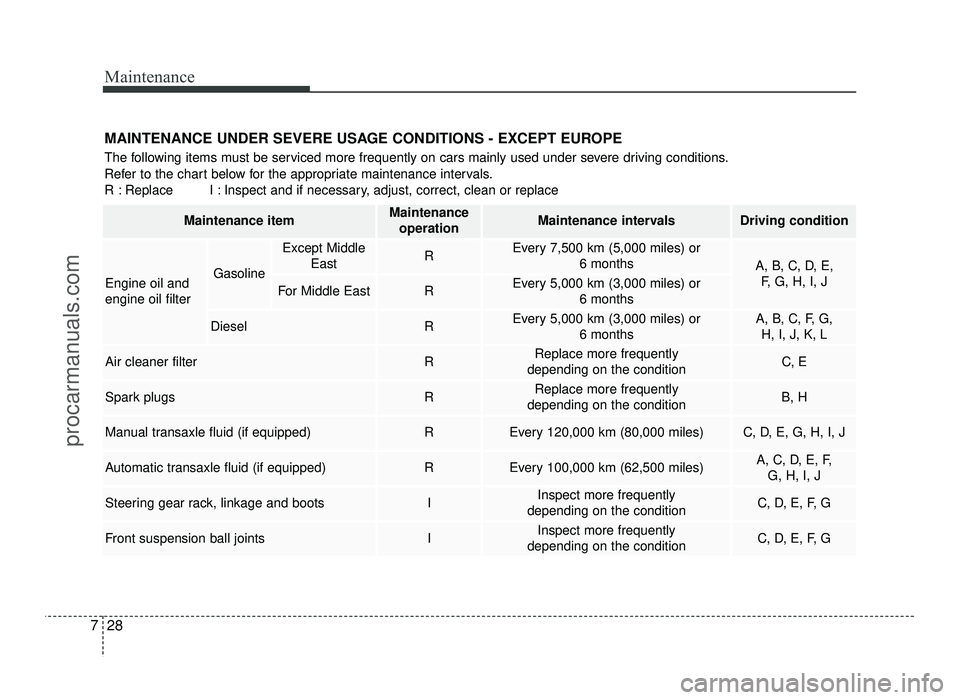
MAINTENANCE UNDER SEVERE USAGE CONDITIONS - EXCEPT EUROPE
The following items must be serviced more frequently on cars mainly used under severe driving conditions.
Refer to the chart below for the appropriate maintenance intervals.
R : Replace I : Inspect and if necessary, adjust, correct, clean or replace
Maintenance itemMaintenance
operationMaintenance intervalsDriving condition
Engine oil and engine oil filterGasoline
Except Middle EastREvery 7,500 km (5,000 miles) or 6 months
A, B, C, D, E, F, G, H, I, J
For Middle EastREvery 5,000 km (3,000 miles) or
6 months
DieselREvery 5,000 km (3,000 miles) or 6 monthsA, B, C, F, G, H, I, J, K, L
Air cleaner filterRReplace more frequently
depending on the conditionC, E
Spark plugs RReplace more frequently
depending on the conditionB, H
Manual transaxle fluid (if equipped)REvery 120,000 km (80,000 miles)C, D, E, G, H, I, J
Automatic transaxle fluid (if equipped)REvery 100,000 km (62,500 miles)A, C, D, E, F, G, H, I, J
Steering gear rack, linkage and bootsIInspect more frequently
depending on the conditionC, D, E, F, G
Front suspension ball jointsIInspect more frequently
depending on the conditionC, D, E, F, G
procarmanuals.com
Page 369 of 456
Maintenance
30
7
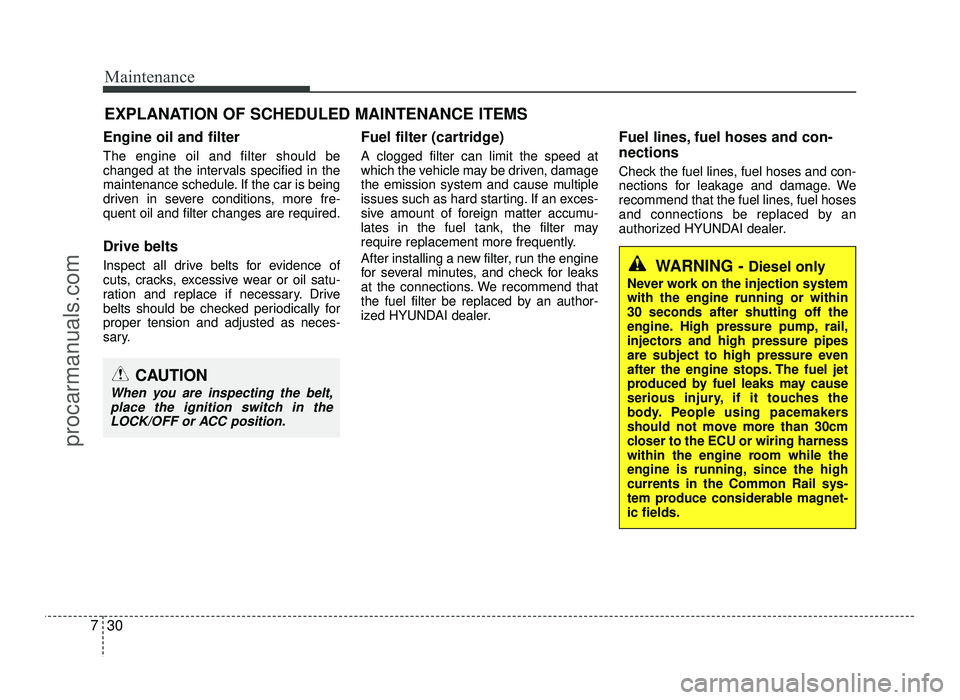
EXPLANATION OF SCHEDULED MAINTENANCE ITEMS
Engine oil and filter The engine oil and filter should be
changed at the intervals specified in the
maintenance schedule. If the car is being
driven in severe conditions, more fre-quent oil and filter changes are required. Drive belts
Inspect all drive belts for evidence of
cuts, cracks, excessive wear or oil satu-
ration and replace if necessary. Drive
belts should be checked periodically forproper tension and adjusted as neces-
sary. Fuel filter (cartridge) A clogged filter can limit the speed at
which the vehicle may be driven, damage
the emission system and cause multiple
issues such as hard starting. If an exces-
sive amount of foreign matter accumu-
lates in the fuel tank, the filter may
require replacement more frequently.
After installing a new filter, run the engine
for several minutes, and check for leaks
at the connections. We recommend that
the fuel filter be replaced by an author-
ized HYUNDAI dealer.
Fuel lines, fuel hoses and con- nections
Check the fuel lines, fuel hoses and con-
nections for leakage and damage. We
recommend that the fuel lines, fuel hoses
and connections be replaced by an
authorized HYUNDAI dealer.
WARNING -
Diesel only
Never work on the injection system with the engine running or within30 seconds after shutting off the
engine. High pressure pump, rail,
injectors and high pressure pipes
are subject to high pressure even
after the engine stops. The fuel jet
produced by fuel leaks may cause
serious injury, if it touches the
body. People using pacemakers
should not move more than 30cm
closer to the ECU or wiring harness
within the engine room while the
engine is running, since the highcurrents in the Common Rail sys-
tem produce considerable magnet-ic fields.
CAUTION
When you are inspecting the belt, place the ignition switch in the
LOCK/OFF or ACC position.
procarmanuals.com
Page 374 of 456
735
Maintenance
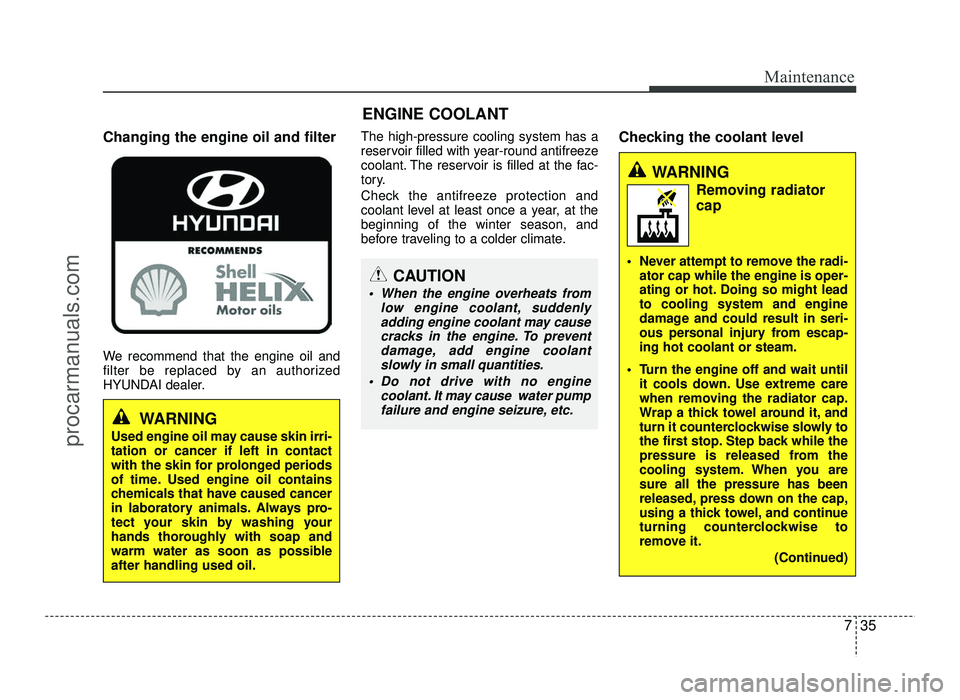
Changing the engine oil and filter
We recommend that the engine oil and
filter be replaced by an authorized
HYUNDAI dealer.The high-pressure cooling system has a
reservoir filled with year-round antifreeze
coolant. The reservoir is filled at the fac-
tory.
Check the antifreeze protection and
coolant level at least once a year, at thebeginning of the winter season, and
before traveling to a colder climate.
Checking the coolant level
WARNING
Used engine oil may cause skin irri- tation or cancer if left in contact
with the skin for prolonged periods
of time. Used engine oil contains
chemicals that have caused cancer
in laboratory animals. Always pro-
tect your skin by washing your
hands thoroughly with soap and
warm water as soon as possibleafter handling used oil.
ENGINE COOLANT
WARNING
Removing radiatorcap
Never attempt to remove the radi- ator cap while the engine is oper-
ating or hot. Doing so might leadto cooling system and engine
damage and could result in seri-
ous personal injury from escap-ing hot coolant or steam.
Turn the engine off and wait until it cools down. Use extreme care
when removing the radiator cap.
Wrap a thick towel around it, and
turn it counterclockwise slowly to
the first stop. Step back while the
pressure is released from the
cooling system. When you aresure all the pressure has been
released, press down on the cap,
using a thick towel, and continue
turning counterclockwise to
remove it.
(Continued)
CAUTION
When the engine overheats fromlow engine coolant, suddenlyadding engine coolant may cause
cracks in the engine. To prevent damage, add engine coolant
slowly in small quantities.
Do not drive with no engine coolant. It may cause water pump
failure and engine seizure, etc.
procarmanuals.com
Page 441 of 456
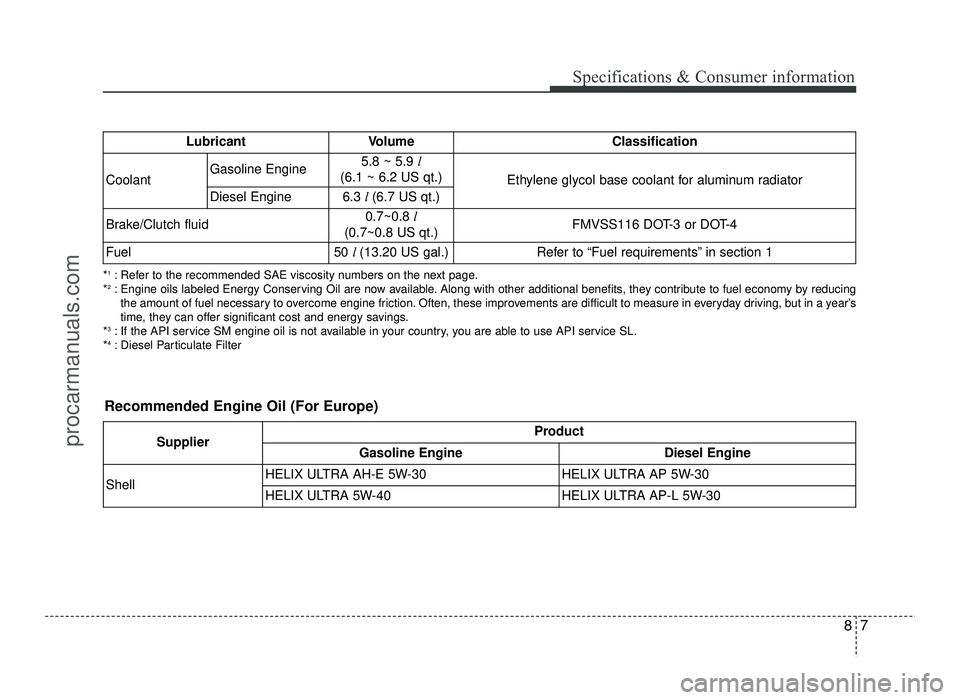
87
Specifications & Consumer information
*1
: Refer to the recommended SAE viscosity numbers on the next page.
* 2
: Engine oils labeled Energy Conserving Oil are now available. Along with other additional benefits, they contribute to fuel economy by reducing
the amount of fuel necessary to overcome engine friction. Often, these improvements are difficult to measure in everyday driving, but in a year’s
time, they can offer significant cost and energy savings.
* 3
: If the API service SM engine oil is not available in your country, you are able to use API service SL.
* 4
: Diesel Particulate Filter Lubricant Volume Classification
CoolantGasoline Engine5.8 ~ 5.9
l
(6.1 ~ 6.2 US qt.)
Ethylene glycol base coolant for aluminum radiator
Diesel Engine6.3 l (6.7 US qt.)
Brake/Clutch fluid0.7~0.8 l
(0.7~0.8 US qt.)FMVSS116 DOT-3 or DOT-4
Fuel50 l (13.20 US gal.)Refer to “Fuel requirements” in section 1
Recommended Engine Oil (For Europe)
Supplier Product
Gasoline Engine Diesel Engine
Shell HELIX ULTRA AH-E 5W-30 HELIX ULTRA AP 5W-30
HELIX ULTRA 5W-40 HELIX ULTRA AP-L 5W-30
procarmanuals.com