maintenance HYUNDAI IX35 2012 Manual PDF
[x] Cancel search | Manufacturer: HYUNDAI, Model Year: 2012, Model line: IX35, Model: HYUNDAI IX35 2012Pages: 560, PDF Size: 28.31 MB
Page 381 of 560
761
Maintenance
Keep your car clean
The best way to prevent corrosion is to
keep your car clean and free of corrosive
materials. Attention to the underside of
the car is particularly important.
If you live in a high-corrosion area —where road salts are used, near the
ocean, areas with industrial pollution,
acid rain, etc.—, you should take extra
care to prevent corrosion. In winter,
hose off the underside of your car atleast once a month and be sure toclean the underside thoroughly when
winter is over.
When cleaning underneath the car, give particular attention to the compo-
nents under the fenders and other
areas that are hidden from view. Do a
thorough job; just dampening the accu-
mulated mud rather than washing it
away will accelerate corrosion rather
than prevent it. Water under high pres-
sure and steam are particularly effec-
tive in removing accumulated mud and
corrosive materials.
When cleaning lower door panels, rocker panels and frame members, be
sure that drain holes are kept open sothat moisture can escape and not be
trapped inside to accelerate corrosion. Keep your garage dry
Don't park your car in a damp, poorly
ventilated garage. This creates a favor-
able environment for corrosion. This is
particularly true if you wash your car in
the garage or drive it into the garage
when it is still wet or covered with snow,
ice or mud. Even a heated garage can
contribute to corrosion unless it is well
ventilated so moisture is dispersed.
Keep paint and trim in good condition
Scratches or chips in the finish should be
covered with "touch-up" paint as soon as
possible to reduce the possibility of cor-
rosion. If bare metal is showing through,the attention of a qualified body and paintshop is recommended.
Bird droppings : Bird droppings are high-
ly corrosive and may damage painted
surfaces in just a few hours. Always
remove bird droppings as soon as possi-
ble.
Don't neglect the interior Moisture can collect under the floor mats
and carpeting to cause corrosion. Check
under the mats periodically to be sure
the carpeting is dry. Use particular care if
you carry fertilizers, cleaning materials or
chemicals in the car.
These should be carried only in proper
containers and any spills or leaks should
be cleaned up, flushed with clean water
and thoroughly dried.
EL UK 7.QXP 1/25/2010 10:06 AM Page 61
Page 382 of 560
Maintenance
62
7
Interior care
Interior general precautions
Prevent caustic solutions such as per- fume and cosmetic oil from contacting
the dashboard because they may cause
damage or discoloration. If they do con-tact the dashboard, wipe them off imme-
diately. See the instructions that follow for
the proper way to clean vinyl.
Cleaning the upholstery and interior
trim
Vinyl
Remove dust and loose dirt from vinyl
with a whisk broom or vacuum cleaner.
Clean vinyl surfaces with a vinyl cleaner. Fabric
Remove dust and loose dirt from fabric
with a whisk broom or vacuum cleaner.Clean with a mild soap solution recom-
mended for upholstery or carpets.
Remove fresh spots immediately with a
fabric spot cleaner. If fresh spots do not
receive immediate attention, the fabriccan be stained and its colour can be
affected. Also, its fire-resistant properties
can be reduced if the material is not
properly maintained.
Cleaning the lap/shoulder belt web- bing
Clean the belt webbing with any mild
soap solution recommended for cleaning
upholstery or carpet. Follow the instruc-
tions provided with the soap. Do not
bleach or re-dye the webbing because
this may weaken it.
Cleaning the interior window glass
If the interior glass surfaces of the vehi-
cle become fogged (that is, covered with
an oily, greasy or waxy film), they should
be cleaned with glass cleaner. Follow the
directions on the glass cleaner container.CAUTION
Never allow water or other liquidsto come in contact with
electrical/electronic componentsinside the vehicle as this may dam-age them.
CAUTION
Using anything but recommended
cleaners and procedures may affect the fabric’s appearance and fire-resistant properties.
CAUTION
When cleaning leather products (steering wheel, seats etc.), use neutral detergents or low alcoholcontent solutions. If you use high
alcohol content solutions oracid/alkaline detergents, the colour of the leather may fade or the sur-face may get stripped off.
CAUTION
Do not scrape or scratch the insideof the rear window. This may result
in damage to the rear windowdefroster grid.
EL UK 7.QXP 1/25/2010 10:06 AM Page 62
Page 383 of 560
763
Maintenance
EMISSION CONTROL SYSTEM
The emission control system of your
vehicle is covered by a written limited
warranty. Please see the warranty infor-
mation contained in the Service Passport
in your vehicle.
Your vehicle is equipped with an emis- sion control system to meet all emission
regulations. There are three emission control sys-
tems which are as follows.
(1) Crankcase emission control system
(2) Evaporative emission control system(3) Exhaust emission control system In order to assure the proper function of
the emission control systems, it is rec-
ommended that you have your car
inspected and maintained by a
HYUNDAI authorised repairer in accor-
dance with the maintenance schedule. Caution for the Inspection and
Maintenance Test (With Electronic
Stability Program (ESP) system)
To prevent the vehicle from misfir-
ing during dynamometer testing,
turn the Electronic Stability
Program (ESP) system off by press-
ing the ESP switch.
After dynamometer testing is com- pleted, turn the ESP system back on
by pressing the ESP switch again.
1. Crankcase emission control system
The positive crankcase ventilation sys-
tem is employed to prevent air pollution
caused by blow-by gases being emitted
from the crankcase. This system supplies
fresh filtered air to the crankcase through
the air intake hose. Inside the crankcase,
the fresh air mixes with blow-by gases,
which then pass through the PCV valveinto the induction system. 2. Evaporative emission control
System
The Evaporative Emission Control
System is designed to prevent fuel
vapours from escaping into the atmos-
phere.
Canister
Fuel vapours generated inside the fuel tank are absorbed and stored in the
onboard canister. When the engine is
running, the fuel vapours absorbed in the
canister are drawn into the surge tank
through the purge control solenoid valve.
Purge Control Solenoid Valve (PCSV)
The purge control solenoid valve is con-
trolled by the Engine Control Module
(ECM); when the engine coolant temper-
ature is low during idling, the PCSV clos-
es so that evaporated fuel is not taken
into the engine. After the engine warms-
up during ordinary driving, the PCSV
opens to introduce evaporated fuel to the
engine.
EL UK 7.QXP 1/25/2010 10:06 AM Page 63
Page 384 of 560
Maintenance
64
7
3. Exhaust emission control
system
The Exhaust Emission Control System is
a highly effective system which controls
exhaust emissions whilst maintaining
good vehicle performance.
Vehicle modifications
This vehicle should not be modified.
Modification of your vehicle could affect
its performance, safety or durability and
may even violate governmental safety
and emissions regulations.
In addition, damage or performance
problems resulting from any modification
may not be covered under warranty.
Engine exhaust gas precautions (carbon monoxide)
Carbon monoxide can be present with other exhaust fumes. Therefore, if you
smell exhaust fumes of any kind inside
your vehicle, have it inspected and
repaired immediately. If you ever sus-
pect exhaust fumes are coming into
your vehicle, drive it only with all the
windows fully open. Have your vehicle
checked and repaired immediately. Do not operate the engine in confined
or closed areas (such as garages) any
more than what is necessary to move
the vehicle in or out of the area.
When the vehicle is stopped in an open area for more than a short time
with the engine running, adjust the
ventilation system (as needed) to draw
outside air into the vehicle.
Never sit in a parked or stopped vehi- cle for any extended time with the
engine running.
When the engine stalls or fails to start, excessive attempts to restart the
engine may cause damage to theemission control system.
WARNING - Exhaust
Engine exhaust gases contain car-
bon monoxide (CO). Though
colourless and odourless, it is dan-
gerous and could be lethal if
inhaled. Follow the instructions
following to avoid CO poisoning.
EL UK 7.QXP 1/25/2010 10:06 AM Page 64
Page 385 of 560
765
Maintenance
Operating precautions for catalyticconverters (if equipped)
Your vehicle is equipped with a catalytic
converter emission control device.
Therefore, the following precautions
must be observed:
Use only UNLEADED FUEL for petrol engine.
Do not operate the vehicle when there are signs of engine malfunction, such
as misfire or a noticeable loss of per-
formance.
Do not misuse or abuse the engine. Examples of misuse are coasting withthe ignition off and descending steep
grades in gear with the ignition off. Do not operate the engine at high idle
speed for extended periods (5 minutesor more).
Do not modify or tamper with any part of the engine or emission control sys-
tem. All inspections and adjustments
must be made by a HYUNDAI autho-
rised repairer.
Avoid driving with a extremely low fuel level. Running out of fuel cause the
engine to misfire, damaging the cat-
alytic converter.
Failure to observe these precautionscould result in damage to the catalytic
converter and to your vehicle.
Additionally, such actions could void your
warranties.
Diesel Particulate Filter (if equipped)
The Diesel Particulate Filter (DPF) sys-
tem removes the soot emitted from the
vehicle.
Unlike a disposable air filter, the DPF
system automatically burns (oxidizes)
and removes the accumulated soot
according to the driving condition. In
other words, the active burning by engine
control system and high exhaust gas
temperature caused by normal/high driv-
ing condition burns and removes the
accumulated soot.
However, if the vehicle continues to be
driven at low speed for long time, the
accumulated soot may not be automati-
cally removed because of low exhaust
gas temperature. In this particular case,the amount of soot is out of detection
limit, the soot oxidation process by
engine control system may not happen
and the malfunction indicator light may
blink. When the malfunction indicator light
blinks, it may stop blinking by driving the
vehicle at more than 37 mph (60km/h) orat more than second gear with 1500 ~
2000 engine rpm for a certain time (for
about 25 minutes).
WARNING - Fire
A hot exhaust system can ignite
flammable items under your vehi-
cle. Do not park, idle, or drive the
vehicle over or near flammable
objects, such as dry grass, paper,
leaves, etc.
EL UK 7.QXP 1/25/2010 10:06 AM Page 65
Page 386 of 560
Maintenance
66
7
If the malfunction indicator light contin-
ues to be blinked in spite of the proce-
dure, please visit a HYUNDAI authorised
repairer and then check the DPF system.
If you continue to drive with the malfunc-
tion indicator light blinking for a long
time, the DPF system can be damaged
and fuel consumption can be worsen.
CAUTION - Diesel Fuel
(if equipped with DPF)
It is recommended to use the regu- lated automotive diesel fuel fordiesel vehicle equipped with the
DPF system.
If you use diesel fuel including highsulfur (more than 50 ppm sulfur) and unspecified additives, it cancause the DPF system to be dam-
aged and white smoke can be emit- ted.
EL UK 7.QXP 1/25/2010 10:06 AM Page 66
Page 395 of 560
OOWW NNEERR ''SS
MM AANN UUAA LL
Operation MaintenanceSpecifications
The information in this Owner's Manual is current at the time of publication.
However, the right to amend specifications without notice or obligation to
incorporate such amendments into vehicles already produced is reserved.
This manual applies to all markets and includes descriptions and explana-
tions of optional as well as standard equipment. As a result, some of the
equipment operating descriptions referred to may not apply to the particu-
lar vehicle with which this manual is supplied.
Please refer to the nearest Hyundai authorised repairer for information
regarding current standard and optional equipment levels.
EL UK FOREWORD.QXP 1/12/2010 2:49 PM Page 1
Page 398 of 560
F4FOREWORD
Hyundai Motor Company wish to take this opportunity to thank you for purchasing a Hyundai product and to welcome you to the
ever increasing number of discriminating motorists who drive Hyundai vehicles. The advanced engineering and construction meth-
ods employed during both design and production of the Hyundai marque are something of which we are proud, and this commit-
ment to providing a high quality product is supported by a comprehensive after sales and warranty service of which we are equal -
ly proud.
This owner's manual will introduce the operating and maintenance requirements for the vehicle and it is recommended that it is
carefully read to ensure that the maximum performance and durability along with safe and satisfactory operation are obtained. Th e
recommended routine maintenance servicing along with any running repairs that may be required should be entrusted to a
Hyundai authorised repairer to ensure that only the latest methods and genuine Hyundai replacement parts are used for the con-
tinued reliability, safety and performance of the vehicle.
Should any question or query exist regarding any aspect of your Hyundai please contact the nearest Hyundai authorised repairer
who will be only too pleased to assist wherever possible. Note : This owners manual should be considered as part of the vehicle and should be kept in the vehicle at all times for ease of
reference.
In the event of the vehicle being sold please ensure that this manual is left in the vehicle for the reference of the new owner .
Copyright 2010 Hyundai Motor Company. All rights reserved. No part of this publication may be reproduced, stored in any retrieva l
system or transmitted in any form or by any means without the prior written permission of Hyundai Motor Company.
CAUTION
Severe engine and transaxle damage may result from the use of poor quality fuels and lubricants that do not meet Hyundai specifications. You must always use high quality fuels and lubricants that meet the specifications listed on Page 8-4 in the Vehicle Specifications section of the Owner's Manual.
EL UK FOREWORD.QXP 1/12/2010 2:49 PM Page 4
Page 401 of 560
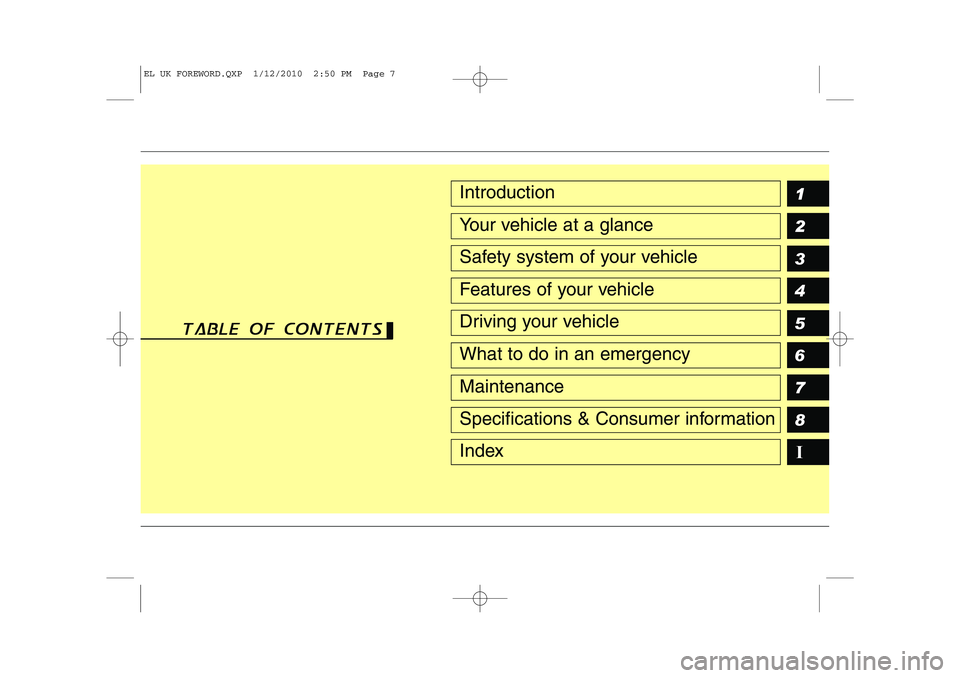
1 2 3 4 5 6 78IIntroduction
Your vehicle at a glance
Safety system of your vehicle
Features of your vehicle
Driving your vehicle
What to do in an emergency
Maintenance
Specifications & Consumer information
Index
table of contents
EL UK FOREWORD.QXP 1/12/2010 2:50 PM Page 7
Page 406 of 560
I5
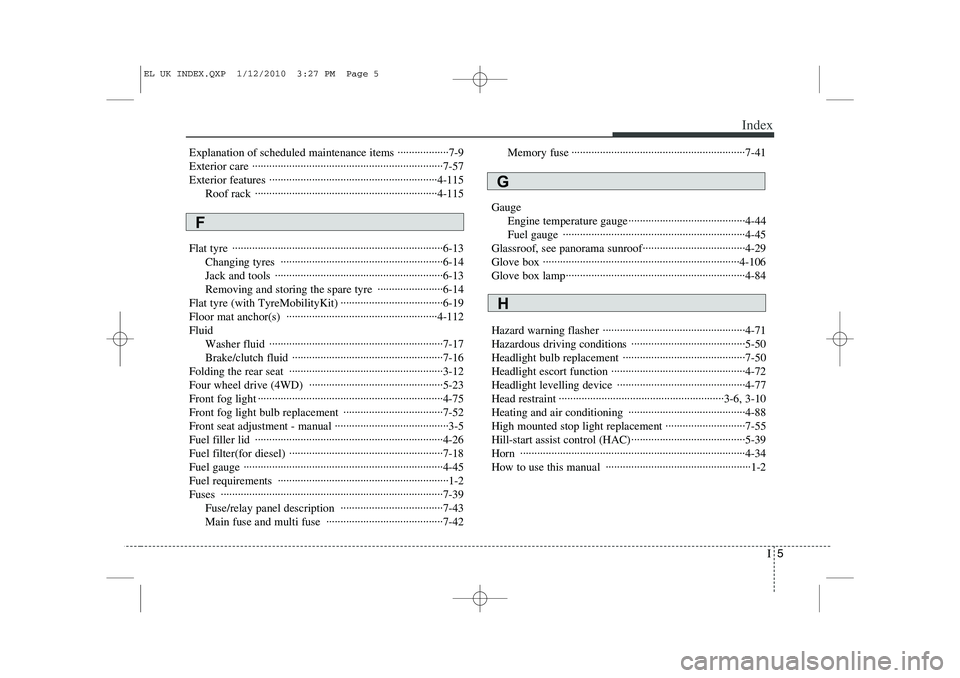
Index
Explanation of scheduled maintenance items ··················7-9
Exterior care ···································································7-57
Exterior features ···························································4-115
Roof rack ································································4-115
Flat tyre ··········································································6-13 Changing tyres ·························································6-14
Jack and tools ···························································6-13
Removing and storing the spare tyre ·······················6-14
Flat tyre (with TyreMobilityKit) ····································6-19
Floor mat anchor(s) ·····················································4-112Fluid Washer fluid ·····························································7-17
Brake/clutch fluid ·····················································7-16
Folding the rear seat ······················································3-12
Four wheel drive (4WD) ···············································5-23
Front fog light ·································································4-75
Front fog light bulb replacement ···································7-52Front seat adjustment - manual ········································3-5
Fuel filler lid ··································································4-26
Fuel filter(for diesel) ······················································7-18
Fuel gauge ······································································4-45
Fuel requirements ····························································1-2Fuses ··············································································7-39 Fuse/relay panel description ····································7-43
Main fuse and multi fuse ·········································7-42 Memory fuse ·····························································7-41
Gauge Engine temperature gauge·········································4-44
Fuel gauge ································································4-45
Glassroof, see panorama sunroof····································4-29
Glove box ·····································································4-106
Glove box lamp·······························································4-84
Hazard warning flasher ··················································4-71
Hazardous driving conditions ········································5-50
Headlight bulb replacement ···········································7-50
Headlight escort function ···············································4-72
Headlight levelling device ·············································4-77
Head restraint ··························································3-6, 3-10
Heating and air conditioning ·········································4-88High mounted stop light replacement ····························7-55
Hill-start assist control (HAC)········································5-39Horn ···············································································4-34
How to use this manual ···················································1-2
F
G
H
EL UK INDEX.QXP 1/12/2010 3:27 PM Page 5