maintenance HYUNDAI IX35 2014 Owners Manual
[x] Cancel search | Manufacturer: HYUNDAI, Model Year: 2014, Model line: IX35, Model: HYUNDAI IX35 2014Pages: 1534, PDF Size: 39.76 MB
Page 376 of 1534
Maintenance
82
7
Interior care
Interior general precautions
Prevent chemicals such as perfume, cos-
metic oil, sun cream, hand cleaner, and
air freshener from contacting the interior
parts because they may cause damage
or discoloration. If they do contact the
interior parts, wipe them off immediately.
See the instructions that follow for the
proper way to clean vinyl.
Cleaning the upholstery and interior
trim
Vinyl
Remove dust and loose dirt from vinyl
with a whisk broom or vacuum cleaner.
Clean vinyl surfaces with a vinyl cleaner. Fabric
Remove dust and loose dirt from fabric
with a whisk broom or vacuum cleaner.Clean with a mild soap solution recom-
mended for upholstery or carpets.
Remove fresh spots immediately with a
fabric spot cleaner. If fresh spots do not
receive immediate attention, the fabriccan be stained and its colour can be
affected. Also, its fire-resistant properties
can be reduced if the material is not
properly maintained.
Cleaning the lap/shoulder belt web- bing
Clean the belt webbing with any mild
soap solution recommended for cleaning
upholstery or carpet. Follow the instruc-
tions provided with the soap. Do not
bleach or re-dye the webbing because
this may weaken it.
Cleaning the interior window glass
If the interior glass surfaces of the vehi-
cle become fogged (that is, covered with
an oily, greasy or waxy film), they should
be cleaned with glass cleaner. Follow the
directions on the glass cleaner container.
CAUTION
Never allow water or other liquidsto come in contact with
electrical/electronic componentsinside the vehicle as this may dam- age them.
CAUTION
Using anything but recommended
cleaners and procedures may affectthe fabric’s appearance and fire- resistant properties.
CAUTION
When cleaning leather products(steering wheel, seats etc.), useneutral detergents or low alcoholcontent solutions. If you use high
alcohol content solutions oracid/alkaline detergents, the colourof the leather may fade or the sur- face may get stripped off.
CAUTION
Do not scrape or scratch the insideof the rear window. This may result
in damage to the rear windowdefroster grid.
EL(FL) Aust 7.QXP 7/26/2013 2:26 PM Page 82
Page 377 of 1534
783
Maintenance
EMISSION CONTROL SYSTEM
The emission control system of your
vehicle is covered by a written limited
warranty. Please see the warranty infor-
mation contained in the Service Passport
in your vehicle.
Your vehicle is equipped with an emis-
sion control system to meet all Australian
Design Rules (ADR) requirements. There are three emission control sys-
tems which are as follows.
(1) Crankcase emission control system
(2) Evaporative emission control system(3) Exhaust emission control system In order to assure the proper function of
the emission control systems, it is rec-
ommended that you have your car
inspected and maintained by an autho-
rised HYUNDAI dealer or other repairshops that use qualified technicians inaccordance with the maintenance sched-
ule in this manual. Caution for the Inspection and
Maintenance Test (With ElectronicStability Contol (ESC) system)
To prevent the vehicle from misfir-
ing during dynamometer testing,
turn the Electronic Stability Contol
(ESC) system off by pressing the
ESC switch.
After dynamometer testing is com- pleted, turn the ESC system back on
by pressing the ESC switch again.
1. Crankcase emission control system
The positive crankcase ventilation sys-
tem is employed to prevent air pollution
caused by blow-by gases being emitted
from the crankcase. This system supplies
fresh filtered air to the crankcase through
the air intake hose. Inside the crankcase,
the fresh air mixes with blow-by gases,
which then pass through the PCV valveinto the induction system. 2. Evaporative emission control
System
The Evaporative Emission Control
System is designed to prevent fuel
vapours from escaping into the atmos-
phere.
Canister
Fuel vapours generated inside the fuel tank are absorbed and stored in the
onboard canister. When the engine is
running, the fuel vapours absorbed in the
canister are drawn into the surge tank
through the purge control solenoid valve.
Purge Control Solenoid Valve (PCSV)
The purge control solenoid valve is con-
trolled by the Engine Control Module
(ECM); when the engine coolant temper-
ature is low during idling, the PCSV clos-
es so that evaporated fuel is not taken
into the engine. After the engine warms-
up during ordinary driving, the PCSV
opens to introduce evaporated fuel to the
engine.
EL(FL) Aust 7.QXP 7/26/2013 2:26 PM Page 83
Page 378 of 1534
Maintenance
84
7
3. Exhaust emission control
system
The Exhaust Emission Control System is
a highly effective system which controls
exhaust emissions whilst maintaining
good vehicle performance.
Vehicle modifications
This vehicle should not be modified. Modification of your vehicle could
affect its performance, safety or dura-
bility and may even violate governmen-
tal safety and emissions regulations.
In addition, damage or performance
problems resulting from any modifica-
tion may not be covered under warran-
ty.
If you use unauthorised electronic devices, it may cause the vehicle to
operate abnormally, wire damage, bat-
tery discharge and fire. For your safety,
do not use unauthorised electronic
devices.
Engine exhaust gas precautions
(carbon monoxide)
Carbon monoxide can be present with other exhaust fumes. Therefore, if you
smell exhaust fumes of any kind inside
your vehicle, have it inspected and
repaired immediately. If you ever sus-
pect exhaust fumes are coming into
your vehicle, drive it only with all the
windows fully open. Have your vehicle
checked and repaired immediately. Do not operate the engine in confined
or closed areas (such as garages) any
more than what is necessary to move
the vehicle in or out of the area.
When the vehicle is stopped in an open area for more than a short time
with the engine running, adjust the
ventilation system (as needed) to draw
outside air into the vehicle.
Never sit in a parked or stopped vehi- cle for any extended time with the
engine running.
When the engine stalls or fails to start, excessive attempts to restart the
engine may cause damage to theemission control system.
WARNING - Exhaust
Engine exhaust gases contain car-
bon monoxide (CO). Though
colourless and odourless, it is dan-
gerous and could be lethal if
inhaled. Follow the instructions
following to avoid CO poisoning.
EL(FL) Aust 7.QXP 7/26/2013 2:26 PM Page 84
Page 379 of 1534
785
Maintenance
Operating precautions for catalyticconverters (if equipped)Your vehicle is equipped with a catalytic
converter emission control device.
Therefore, the following precautions
must be observed:
Use only UNLEADED FUEL for petrol engine.
Do not operate the vehicle when there are signs of engine malfunction, such
as misfire or a noticeable loss of per-
formance.
Do not misuse or abuse the engine. Examples of misuse are coasting withthe ignition off and descending steep
grades in gear with the ignition off.
Do not operate the engine at high idle speed for extended periods (5 minutesor more).
Do not modify or tamper with any part of the engine or emission control sys-
tem. We recommend that the system
be inspected by an authorised
HYUNDAI dealer.
Avoid driving with a extremely low fuel level. Running out of fuel cause the
engine to misfire, damaging the cat-
alytic converter.
Failure to observe these precautionscould result in damage to the catalytic
converter and to your vehicle.
Additionally, such actions could void your
warranties.Diesel Particulate Filter (if equipped)
The Diesel Particulate Filter (DPF) sys-
tem removes the soot emitted from the
vehicle.
Unlike a disposable air filter, the DPF
system automatically burns (oxidizes)
and removes the accumulated soot
according to the driving condition. In
other words, the active burning by engine
control system and high exhaust gas
temperature caused by normal/high driv-
ing condition burns and removes the
accumulated soot.
However, if the vehicle continues to be
driven at low speed for long time, the
accumulated soot may not be automati-
cally removed because of low exhaust
gas temperature. In this particular case,the amount of soot is out of detection
limit, the soot oxidation process by
engine control system may not happen
and the malfunction indicator light may
blink. When the malfunction indicator light
blinks, it may stop blinking by driving the
vehicle at more than 60km/h (37 mph) orat more than second gear with 1500 ~
2000 engine rpm for a certain time (for
about 25 minutes).
WARNING - Fire
A hot exhaust system can ignite flammable items under your vehi-
cle. Do not park, idle, or drive the
vehicle over or near flammable
objects, such as dry grass, paper,
leaves, etc.
The exhaust system and catalytic system are very hot whilst the
engine is running or immediately
after the engine is turned off.
Keep away from the exhaust sys-
tem and catalytic, you may get
burned.
Also, do not remove the heat sink
around the exhaust system, do
not seal the bottom of the vehicle
or do not coat the vehicle for cor-
rosion control. It may present a
fire risk under certain conditions.
EL(FL) Aust 7.QXP 7/26/2013 2:26 PM Page 85
Page 380 of 1534
Maintenance
86
7
If the malfunction indicator light contin-
ues to blink in spite of the procedure, we
recommend that the system be checked
by an authorised HYUNDAI dealer.
If you continue to drive with the malfunc-
tion indicator light blinking for a long
time, the DPF system can be damaged
and fuel consumption can be worsen.
CAUTION - Diesel Fuel
(if equipped with DPF)
It is recommended to use the regu- lated automotive diesel fuel for diesel vehicle equipped with the
DPF system.
If you use diesel fuel including highsulfur (more than 50 ppm sulfur) and unspecified additives, it cancause the DPF system to be dam-
aged and white smoke can be emit-ted.
EL(FL) Aust 7.QXP 7/26/2013 2:26 PM Page 86
Page 391 of 1534
OOWW NNEERR ''SS MM AANN UUAA LL
Operation MaintenanceSpecifications
All information in this Owner's Manual is current at the time of publication.
However, in line with the Hyundai policy of continual product improvement,
the right to amend or change specifications without prior notice or obliga-
tion to incorporate such amendments or changes into vehicles already pro-
duced, is reserved.
This manual applies to all models of this vehicle and includes descriptions
and explanations of optional as well as standard equipment. As a result,
you may find material in this manual that does not apply to your specific
vehicle.
EL(FL) Aust FOREWORD.QXP 7/26/2013 1:59 PM Page 1
Page 394 of 1534
F4FOREWORD
Thank you for choosing Hyundai. We are pleased to welcome you to the growing number of discerning people who drive Hyundais.
The advanced engineering and high-quality construction of each Hyundai we build is something of which we're very proud.
Your Owner's Manual will introduce you to the features and operation of your new Hyundai. It is suggested that you read it care-
fully because the information it contains can contribute greatly to the satisfaction you receive from your new car.
The manufacturer also recommends that service and maintenance on your vehicle be performed by an authorised Hyundai dealer.
HYUNDAI MOTOR COMPANY
Note : If for any reason in the future you should sell your Hyundai, please leave this manual in the vehicle for the new owner's use.
Copyright 2013 Hyundai Motor Company. All rights reserved. No part of this publication may be reproduced, stored in any retrieva l
system or transmitted in any form or by any means without the prior written permission of Hyundai Motor Company.
CAUTION
Severe engine and transaxle damage may result from the use of poor quality fuels and lubricants that do not meet Hyundai specifications. You must always use high quality fuels and lubricants that meet the specifications listed on Page 8-6 in theVehicle Specifications section of the Owner's Manual.
EL(FL) Aust FOREWORD.QXP 7/26/2013 1:59 PM Page 4
Page 397 of 1534
1 234567
8I
Introduction
Your vehicle at a glance
Safety features of your vehicle
Features of your vehicle
Driving your vehicle
What to do in an emergency
Maintenance
Specifications & Consumer information
Index
table of contents
EL(FL) Aust FOREWORD.QXP 7/26/2013 1:59 PM Page 7
Page 401 of 1534
Index
4
I
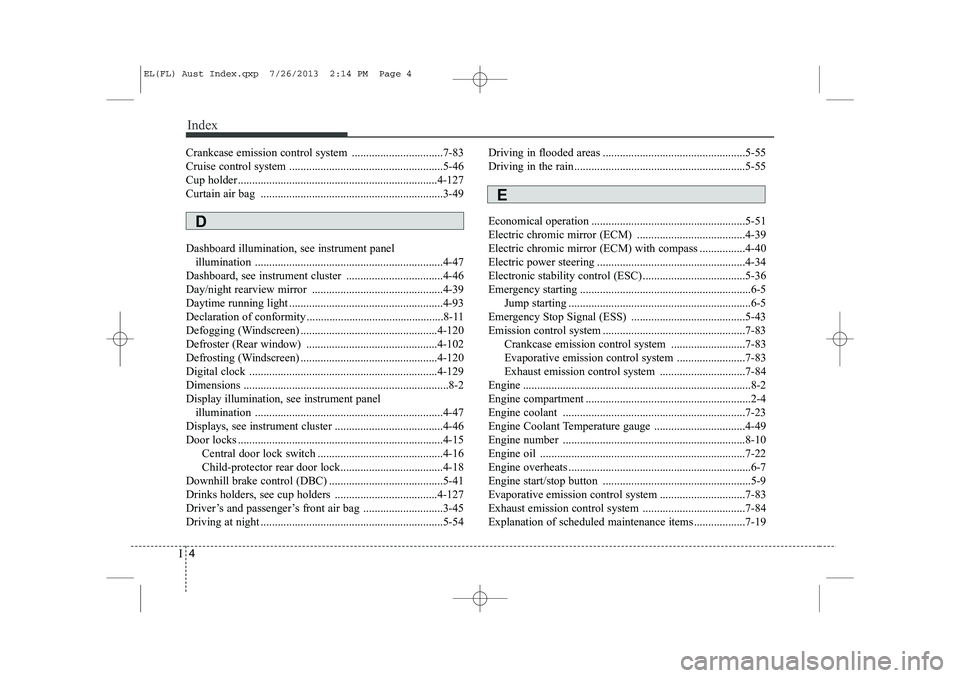
Crankcase emission control system ................................7-83
Cruise control system ......................................................5-46
Cup holder......................................................................4-127
Curtain air bag ................................................................3-49 Dashboard illumination, see instrument panel
illumination ..................................................................4-47
Dashboard, see instrument cluster ..................................4-46
Day/night rearview mirror ..............................................4-39
Daytime running light ......................................................4-93
Declaration of conformity ................................................8-11
Defogging (Windscreen) ................................................4-120
Defroster (Rear window) ..............................................4-102
Defrosting (Windscreen) ................................................4-120
Digital clock ..................................................................4-129
Dimensions ........................................................................8-2Display illumination, see instrument panel illumination ..................................................................4-47
Displays, see instrument cluster ......................................4-46
Door locks ........................................................................4-15 Central door lock switch ............................................4-16
Child-protector rear door lock....................................4-18
Downhill brake control (DBC) ........................................5-41
Drinks holders, see cup holders ....................................4-127
Driver’s and passenger’s front air bag ............................3-45
Driving at night ................................................................5-54 Driving in flooded areas ..................................................5-55
Driving in the rain ............................................................5-55
Economical operation ......................................................5-51
Electric chromic mirror (ECM) ......................................4-39
Electric chromic mirror (ECM) with compass ................4-40
Electric power steering ....................................................4-34
Electronic stability control (ESC) ....................................5-36
Emergency starting ............................................................6-5
Jump starting ................................................................6-5
Emergency Stop Signal (ESS) ........................................5-43
Emission control system ..................................................7-83 Crankcase emission control system ..........................7-83
Evaporative emission control system ........................7-83
Exhaust emission control system ..............................7-84
Engine ................................................................................8-2
Engine compartment ..........................................................2-4
Engine coolant ................................................................7-23
Engine Coolant Temperature gauge ................................4-49
Engine number ................................................................8-10
Engine oil ........................................................................7-22
Engine overheats ................................................................6-7
Engine start/stop button ....................................................5-9
Evaporative emission control system ..............................7-83
Exhaust emission control system ....................................7-84
Explanation of scheduled maintenance items ..................7-19
E
D
EL(FL) Aust Index.qxp 7/26/2013 2:14 PM Page 4
Page 404 of 1534
I7
Index
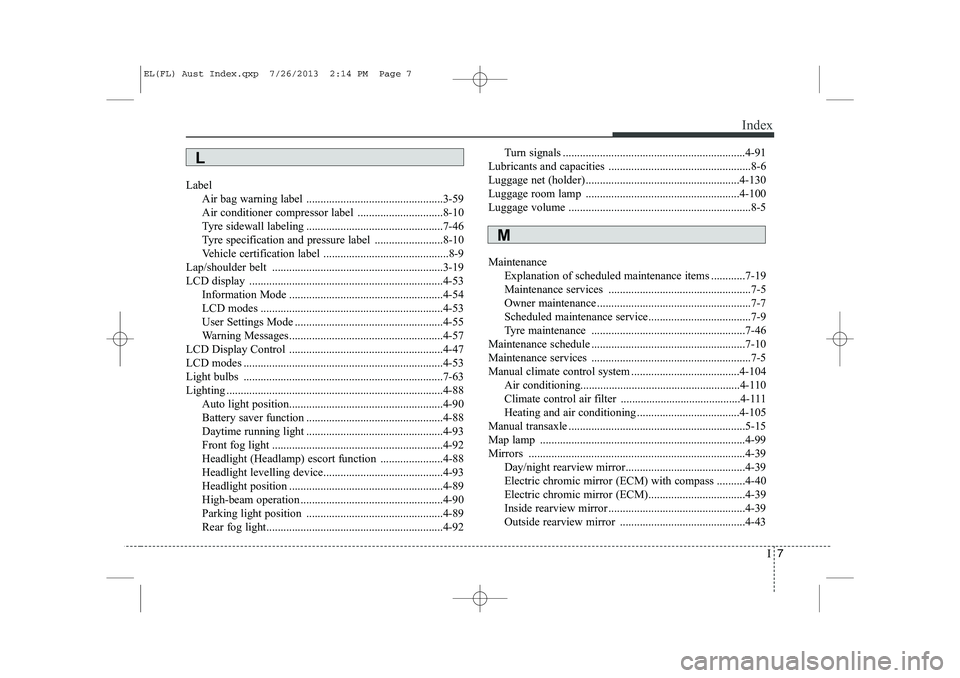
Label
Air bag warning label ................................................3-59
Air conditioner compressor label ..............................8-10
Tyre sidewall labeling ................................................7-46
Tyre specification and pressure label ........................8-10
Vehicle certification label ............................................8-9
Lap/shoulder belt ............................................................3-19
LCD display ....................................................................4-53 Information Mode ......................................................4-54
LCD modes ................................................................4-53
User Settings Mode ....................................................4-55
Warning Messages......................................................4-57
LCD Display Control ......................................................4-47
LCD modes ......................................................................4-53
Light bulbs ......................................................................7-63
Lighting ............................................................................4-88 Auto light position......................................................4-90
Battery saver function ................................................4-88
Daytime running light ................................................4-93
Front fog light ............................................................4-92
Headlight (Headlamp) escort function ......................4-88
Headlight levelling device..........................................4-93
Headlight position ......................................................4-89
High-beam operation ..................................................4-90
Parking light position ................................................4-89
Rear fog light..............................................................4-92 Turn signals ................................................................4-91
Lubricants and capacities ..................................................8-6
Luggage net (holder) ......................................................4-130
Luggage room lamp ......................................................4-100
Luggage volume ................................................................8-5 Maintenance Explanation of scheduled maintenance items ............7-19
Maintenance services ..................................................7-5
Owner maintenance ......................................................7-7
Scheduled maintenance service....................................7-9
Tyre maintenance ......................................................7-46
Maintenance schedule ......................................................7-10
Maintenance services ........................................................7-5
Manual climate control system ......................................4-104 Air conditioning........................................................4-110
Climate control air filter ..........................................4-111
Heating and air conditioning ....................................4-105
Manual transaxle ..............................................................5-15
Map lamp ........................................................................4-99
Mirrors ............................................................................4-39 Day/night rearview mirror..........................................4-39
Electric chromic mirror (ECM) with compass ..........4-40
Electric chromic mirror (ECM)..................................4-39
Inside rearview mirror ................................................4-39
Outside rearview mirror ............................................4-43
M
L
EL(FL) Aust Index.qxp 7/26/2013 2:14 PM Page 7