maintenance HYUNDAI IX35 2014 Owner's Manual
[x] Cancel search | Manufacturer: HYUNDAI, Model Year: 2014, Model line: IX35, Model: HYUNDAI IX35 2014Pages: 1534, PDF Size: 39.76 MB
Page 306 of 1534
Maintenance
12
7
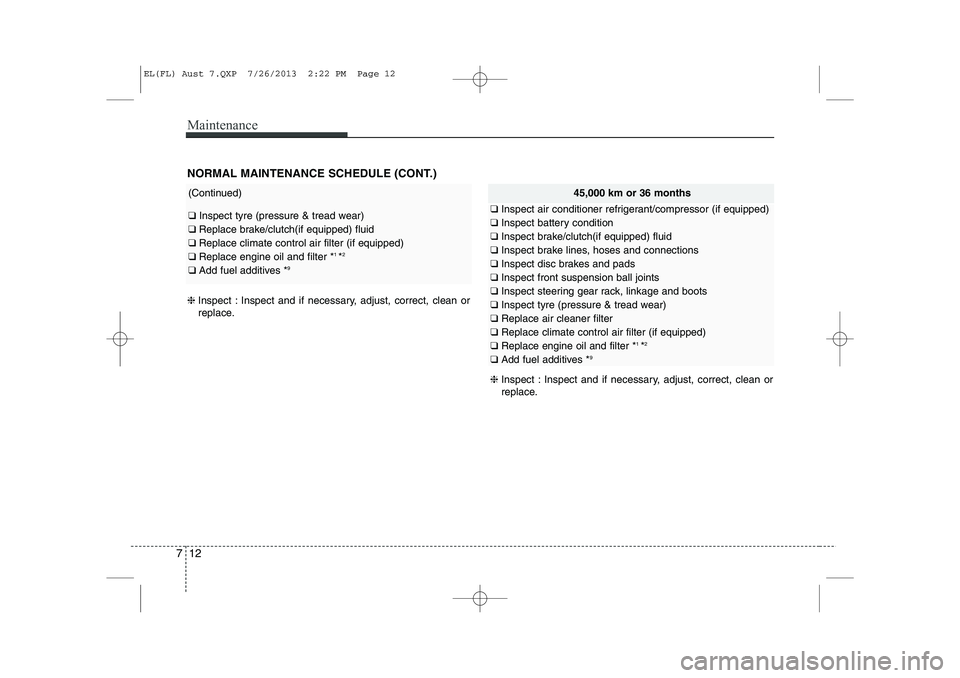
NORMAL MAINTENANCE SCHEDULE (CONT.)
(Continued)
❑ Inspect tyre (pressure & tread wear)
❑ Replace brake/clutch(if equipped) fluid
❑ Replace climate control air filter (if equipped)
❑ Replace engine oil and filter * 1
*2
❑ Add fuel additives * 9
45,000 km or 36 months
❑
Inspect air conditioner refrigerant/compressor (if equipped)
❑ Inspect battery condition
❑ Inspect brake/clutch(if equipped) fluid
❑ Inspect brake lines, hoses and connections
❑ Inspect disc brakes and pads
❑ Inspect front suspension ball joints
❑ Inspect steering gear rack, linkage and boots
❑ Inspect tyre (pressure & tread wear)
❑ Replace air cleaner filter
❑ Replace climate control air filter (if equipped)
❑ Replace engine oil and filter * 1
*2
❑ Add fuel additives * 9
❈
Inspect : Inspect and if necessary, adjust, correct, clean or
replace.
❈Inspect : Inspect and if necessary, adjust, correct, clean or
replace.
EL(FL) Aust 7.QXP 7/26/2013 2:22 PM Page 12
Page 307 of 1534
713
Maintenance
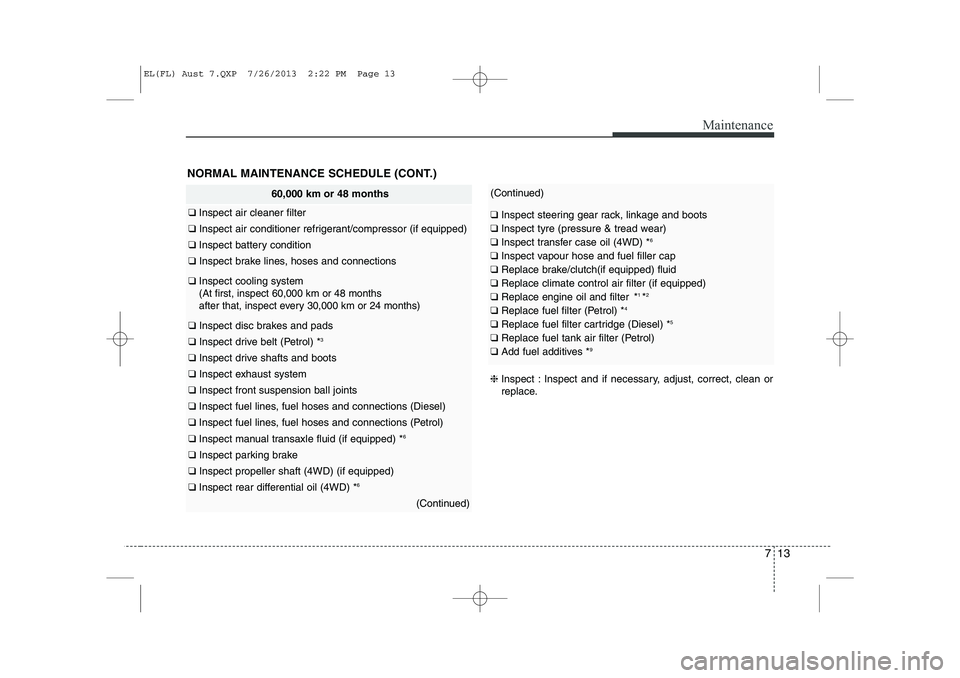
NORMAL MAINTENANCE SCHEDULE (CONT.)
60,000 km or 48 months
❑ Inspect air cleaner filter
❑ Inspect air conditioner refrigerant/compressor (if equipped)
❑ Inspect battery condition
❑ Inspect brake lines, hoses and connections
❑ Inspect cooling system
(At first, inspect 60,000 km or 48 months
after that, inspect every 30,000 km or 24 months)
❑ Inspect disc brakes and pads
❑ Inspect drive belt (Petrol) * 3
❑
Inspect drive shafts and boots
❑ Inspect exhaust system
❑ Inspect front suspension ball joints
❑ Inspect fuel lines, fuel hoses and connections (Diesel)
❑ Inspect fuel lines, fuel hoses and connections (Petrol)
❑ Inspect manual transaxle fluid (if equipped) * 6
❑
Inspect parking brake
❑ Inspect propeller shaft (4WD) (if equipped)
❑ Inspect rear differential oil (4WD) * 6
(Continued)
(Continued)
❑
Inspect steering gear rack, linkage and boots
❑ Inspect tyre (pressure & tread wear)
❑ Inspect transfer case oil (4WD) * 6
❑ Inspect vapour hose and fuel filler cap
❑ Replace brake/clutch(if equipped) fluid
❑ Replace climate control air filter (if equipped)
❑ Replace engine oil and filter * 1
*2
❑ Replace fuel filter (Petrol) * 4
❑ Replace fuel filter cartridge (Diesel) * 5
❑ Replace fuel tank air filter (Petrol)
❑ Add fuel additives * 9
❈ Inspect : Inspect and if necessary, adjust, correct, clean or
replace.
EL(FL) Aust 7.QXP 7/26/2013 2:22 PM Page 13
Page 308 of 1534
Maintenance
14
7
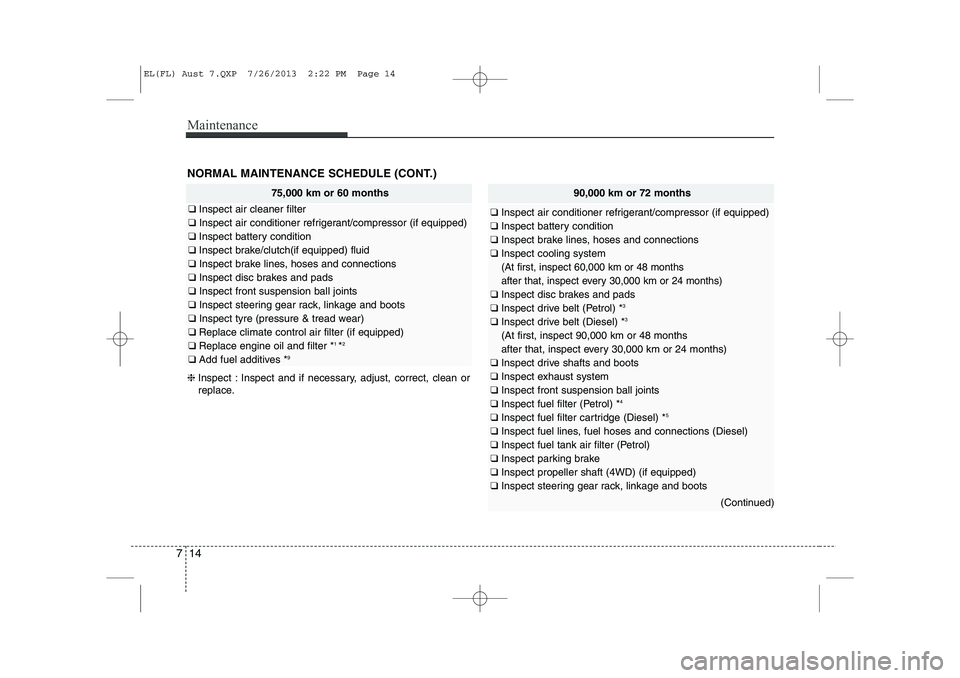
NORMAL MAINTENANCE SCHEDULE (CONT.)
75,000 km or 60 months
❑ Inspect air cleaner filter
❑ Inspect air conditioner refrigerant/compressor (if equipped)
❑ Inspect battery condition
❑ Inspect brake/clutch(if equipped) fluid
❑ Inspect brake lines, hoses and connections
❑ Inspect disc brakes and pads
❑ Inspect front suspension ball joints
❑ Inspect steering gear rack, linkage and boots
❑ Inspect tyre (pressure & tread wear)
❑ Replace climate control air filter (if equipped)
❑ Replace engine oil and filter * 1
*2
❑ Add fuel additives * 9
❈
Inspect : Inspect and if necessary, adjust, correct, clean or
replace.
90,000 km or 72 months
❑ Inspect air conditioner refrigerant/compressor (if equipped)
❑ Inspect battery condition
❑ Inspect brake lines, hoses and connections
❑ Inspect cooling system
(At first, inspect 60,000 km or 48 months
after that, inspect every 30,000 km or 24 months)
❑ Inspect disc brakes and pads
❑ Inspect drive belt (Petrol) * 3
❑ Inspect drive belt (Diesel) * 3
(At first, inspect 90,000 km or 48 months
after that, inspect every 30,000 km or 24 months)
❑ Inspect drive shafts and boots
❑ Inspect exhaust system
❑ Inspect front suspension ball joints
❑ Inspect fuel filter (Petrol) * 4
❑ Inspect fuel filter cartridge (Diesel) * 5
❑ Inspect fuel lines, fuel hoses and connections (Diesel)
❑ Inspect fuel tank air filter (Petrol)
❑ Inspect parking brake
❑ Inspect propeller shaft (4WD) (if equipped)
❑ Inspect steering gear rack, linkage and boots
(Continued)
EL(FL) Aust 7.QXP 7/26/2013 2:22 PM Page 14
Page 309 of 1534
715
Maintenance
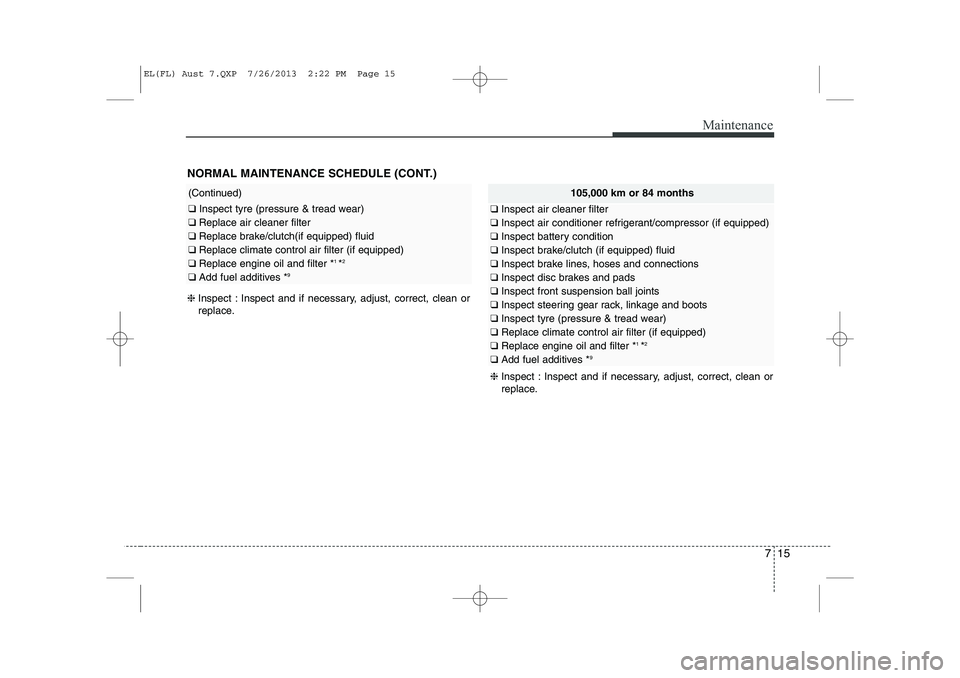
NORMAL MAINTENANCE SCHEDULE (CONT.)
105,000 km or 84 months
❑ Inspect air cleaner filter
❑ Inspect air conditioner refrigerant/compressor (if equipped)
❑ Inspect battery condition
❑ Inspect brake/clutch (if equipped) fluid
❑ Inspect brake lines, hoses and connections
❑ Inspect disc brakes and pads
❑ Inspect front suspension ball joints
❑ Inspect steering gear rack, linkage and boots
❑ Inspect tyre (pressure & tread wear)
❑ Replace climate control air filter (if equipped)
❑ Replace engine oil and filter * 1
*2
❑ Add fuel additives * 9
❈
Inspect : Inspect and if necessary, adjust, correct, clean or
replace.
❈Inspect : Inspect and if necessary, adjust, correct, clean or
replace.
(Continued)
❑ Inspect tyre (pressure & tread wear)
❑ Replace air cleaner filter
❑ Replace brake/clutch(if equipped) fluid
❑ Replace climate control air filter (if equipped)
❑ Replace engine oil and filter * 1
*2
❑ Add fuel additives * 9
EL(FL) Aust 7.QXP 7/26/2013 2:22 PM Page 15
Page 310 of 1534
Maintenance
16
7
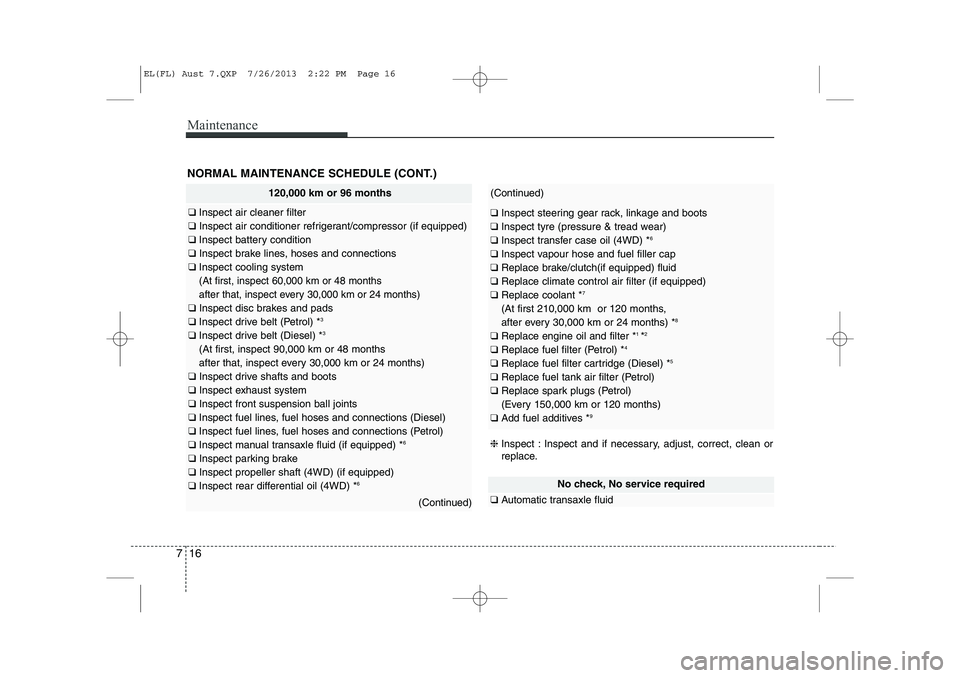
NORMAL MAINTENANCE SCHEDULE (CONT.)
120,000 km or 96 months
❑ Inspect air cleaner filter
❑ Inspect air conditioner refrigerant/compressor (if equipped)
❑ Inspect battery condition
❑ Inspect brake lines, hoses and connections
❑ Inspect cooling system
(At first, inspect 60,000 km or 48 months
after that, inspect every 30,000 km or 24 months)
❑ Inspect disc brakes and pads
❑ Inspect drive belt (Petrol) * 3
❑ Inspect drive belt (Diesel) * 3
(At first, inspect 90,000 km or 48 months
after that, inspect every 30,000 km or 24 months)
❑ Inspect drive shafts and boots
❑ Inspect exhaust system
❑ Inspect front suspension ball joints
❑ Inspect fuel lines, fuel hoses and connections (Diesel)
❑ Inspect fuel lines, fuel hoses and connections (Petrol)
❑ Inspect manual transaxle fluid (if equipped) * 6
❑ Inspect parking brake
❑ Inspect propeller shaft (4WD) (if equipped)
❑ Inspect rear differential oil (4WD) * 6
(Continued)
(Continued)
❑
Inspect steering gear rack, linkage and boots
❑ Inspect tyre (pressure & tread wear)
❑ Inspect transfer case oil (4WD) * 6
❑ Inspect vapour hose and fuel filler cap
❑ Replace brake/clutch(if equipped) fluid
❑ Replace climate control air filter (if equipped)
❑ Replace coolant * 7
(At first 210,000 km or 120 months,
after every 30,000 km or 24 months) * 8
❑ Replace engine oil and filter * 1
*2
❑ Replace fuel filter (Petrol) * 4
❑ Replace fuel filter cartridge (Diesel) * 5
❑ Replace fuel tank air filter (Petrol)
❑ Replace spark plugs (Petrol)
(Every 150,000 km or 120 months)
❑ Add fuel additives * 9
❈ Inspect : Inspect and if necessary, adjust, correct, clean or
replace.
No check, No service required
❑Automatic transaxle fluid
EL(FL) Aust 7.QXP 7/26/2013 2:22 PM Page 16
Page 311 of 1534
717
Maintenance
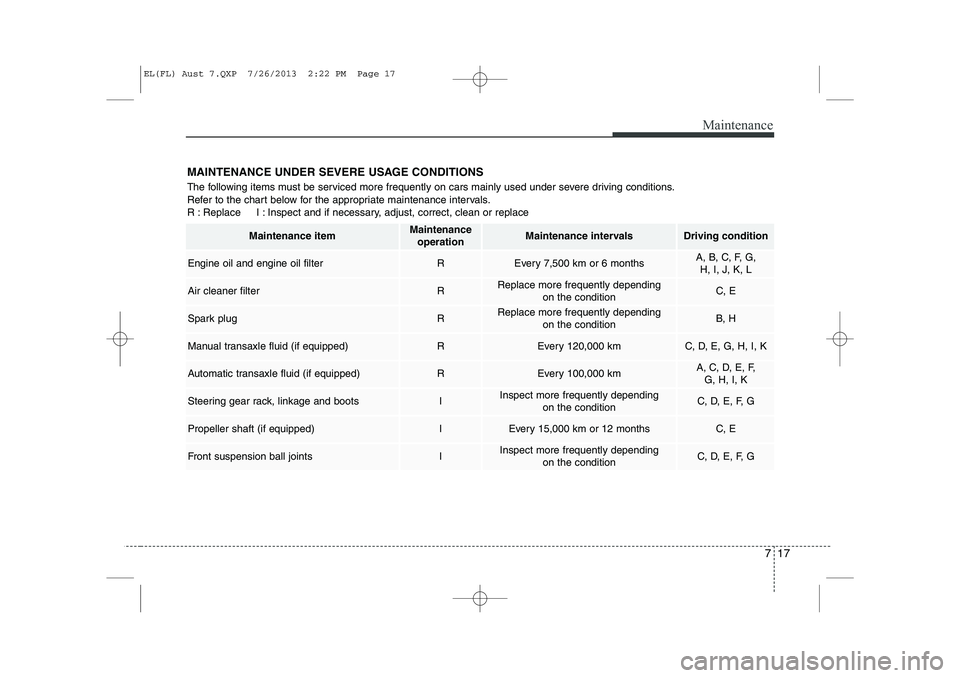
MAINTENANCE UNDER SEVERE USAGE CONDITIONS
The following items must be serviced more frequently on cars mainly used under severe driving conditions.
Refer to the chart below for the appropriate maintenance intervals.
R : Replace I : Inspect and if necessary, adjust, correct, clean or replace
Maintenance itemMaintenanceoperationMaintenance intervalsDriving condition
Engine oil and engine oil filterREvery 7,500 km or 6 monthsA, B, C, F, G, H, I, J, K, L
Air cleaner filterRReplace more frequently depending on the conditionC, E
Spark plugRReplace more frequently depending on the conditionB, H
Manual transaxle fluid (if equipped)REvery 120,000 kmC, D, E, G, H, I, K
Automatic transaxle fluid (if equipped)REvery 100,000 kmA, C, D, E, F, G, H, I, K
Steering gear rack, linkage and bootsIInspect more frequently depending
on the conditionC, D, E, F, G
Propeller shaft (if equipped) IEvery 15,000 km or 12 monthsC, E
Front suspension ball jointsIInspect more frequently depending on the conditionC, D, E, F, G
EL(FL) Aust 7.QXP 7/26/2013 2:22 PM Page 17
Page 312 of 1534
Maintenance
18
7
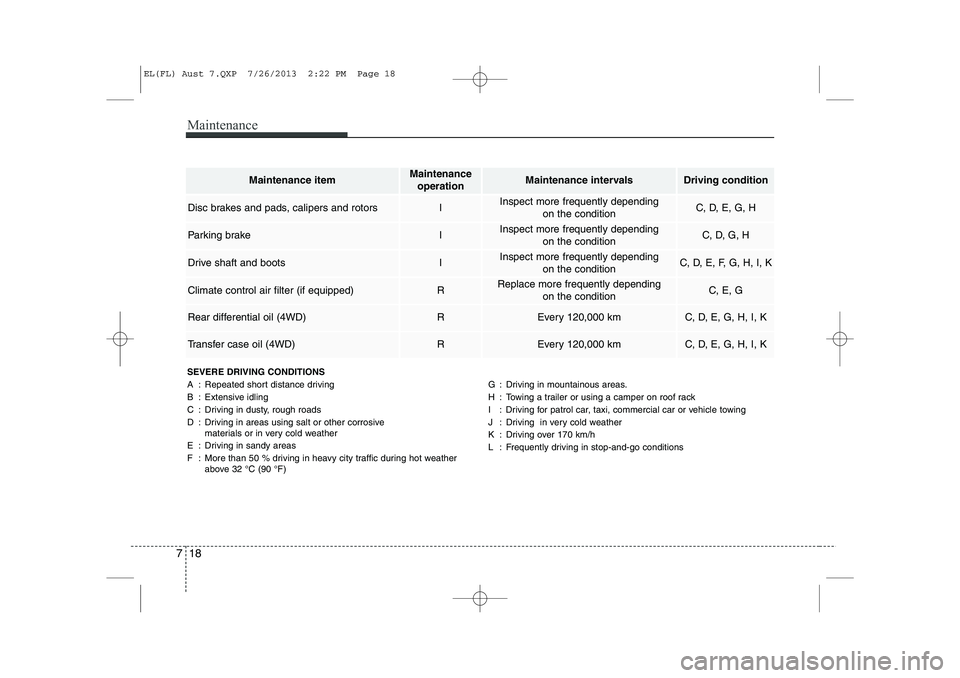
SEVERE DRIVING CONDITIONS
A : Repeated short distance driving
B : Extensive idling
C : Driving in dusty, rough roads
D : Driving in areas using salt or other corrosive
materials or in very cold weather
E : Driving in sandy areas
F : More than 50 % driving in heavy city traffic during hot weather above 32 °C (90 °F) G : Driving in mountainous areas.
H : Towing a trailer or using a camper on roof rack
I : Driving for patrol car, taxi, commercial car or vehicle towing
J : Driving in very cold weather
K : Driving over 170 km/h
L : Frequently driving in stop-and-go conditions
Maintenance itemMaintenance
operationMaintenance intervalsDriving condition
Disc brakes and pads, calipers and rotorsIInspect more frequently depending on the conditionC, D, E, G, H
Parking brakeIInspect more frequently depending on the conditionC, D, G, H
Drive shaft and bootsIInspect more frequently depending on the conditionC, D, E, F, G, H, I, K
Climate control air filter (if equipped) RReplace more frequently depending on the conditionC, E, G
Rear differential oil (4WD)REvery 120,000 kmC, D, E, G, H, I, K
Transfer case oil (4WD)REvery 120,000 kmC, D, E, G, H, I, K
EL(FL) Aust 7.QXP 7/26/2013 2:22 PM Page 18
Page 313 of 1534
719
Maintenance
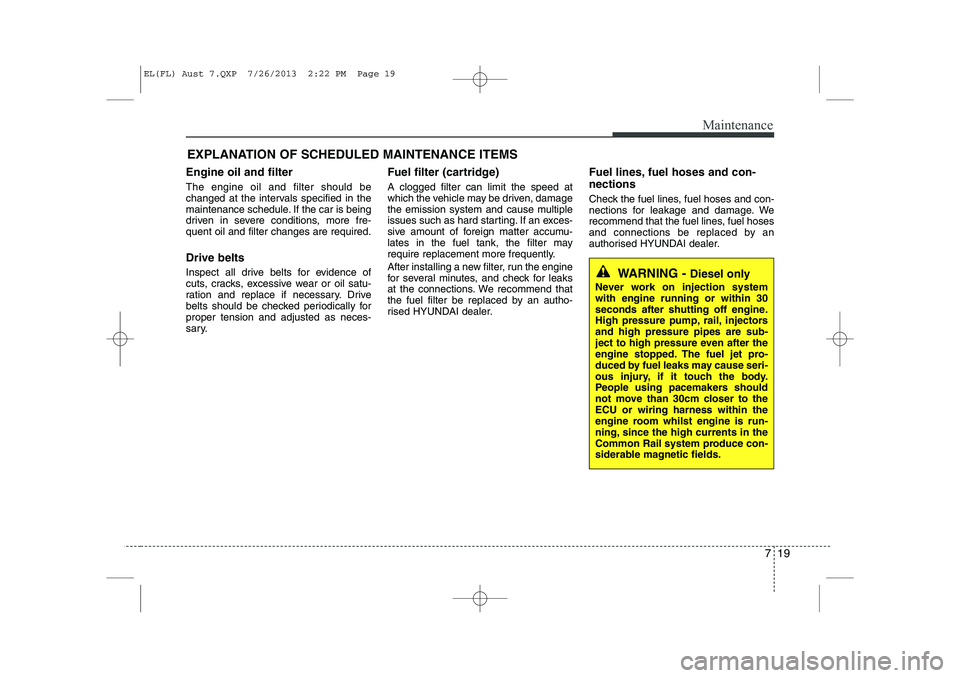
EXPLANATION OF SCHEDULED MAINTENANCE ITEMS
Engine oil and filter The engine oil and filter should be
changed at the intervals specified in the
maintenance schedule. If the car is being
driven in severe conditions, more fre-quent oil and filter changes are required. Drive belts
Inspect all drive belts for evidence of
cuts, cracks, excessive wear or oil satu-
ration and replace if necessary. Drive
belts should be checked periodically forproper tension and adjusted as neces-
sary. Fuel filter (cartridge) A clogged filter can limit the speed at
which the vehicle may be driven, damage
the emission system and cause multiple
issues such as hard starting. If an exces-
sive amount of foreign matter accumu-
lates in the fuel tank, the filter may
require replacement more frequently.
After installing a new filter, run the engine
for several minutes, and check for leaks
at the connections. We recommend that
the fuel filter be replaced by an autho-
rised HYUNDAI dealer.
Fuel lines, fuel hoses and con- nections
Check the fuel lines, fuel hoses and con-
nections for leakage and damage. We
recommend that the fuel lines, fuel hoses
and connections be replaced by an
authorised HYUNDAI dealer.
WARNING -
Diesel only
Never work on injection system with engine running or within 30
seconds after shutting off engine.
High pressure pump, rail, injectorsand high pressure pipes are sub-
ject to high pressure even after the
engine stopped. The fuel jet pro-
duced by fuel leaks may cause seri-
ous injury, if it touch the body.
People using pacemakers should
not move than 30cm closer to theECU or wiring harness within the
engine room whilst engine is run-
ning, since the high currents in the
Common Rail system produce con-
siderable magnetic fields.
EL(FL) Aust 7.QXP 7/26/2013 2:22 PM Page 19
Page 314 of 1534
Maintenance
20
7
Vapour hose and fuel filler cap
The vapour hose and fuel filler cap
should be inspected at those intervals
specified in the maintenance schedule.
Make sure that a new vapour hose or fuelfiller cap is correctly replaced.
Vacuum crankcase ventilation hoses (if equipped)
Inspect the surface of hoses for evidence
of heat and/or mechanical damage. Hard
and brittle rubber, cracking, tears, cuts,
abrasions, and excessive swelling indi-
cate deterioration. Particular attention
should be paid to examine those hose
surfaces nearest to high heat sources,
such as the exhaust manifold. Inspect the hose routing to assure that the hoses do not come in contact with
any heat source, sharp edges or movingcomponent which might cause heat dam-
age or mechanical wear. Inspect all hose
connections, such as clamps and cou-
plings, to make sure they are secure, and
that no leaks are present. Hoses should
be replaced immediately if there is any
evidence of deterioration or damage. Air cleaner filter
We recommend that you use air cleaner
filter for replacement from an authorised
HYUNDAI dealer.
Spark plugs (for petrol engine)
Make sure to install new spark plugs of
the correct heat range. Cooling system
Check the cooling system parts, such as
radiator, coolant reservoir, hoses and
connections for leakage and damage.
Replace any damaged parts. Coolant The coolant should be changed at the
intervals specified in the maintenance
schedule.
Manual transaxle fluid (if equipped)
Inspect the manual transaxle fluid
according to the maintenance schedule.
Automatic transaxle fluid (if equipped)
Automatic transaxle fluid should not be
checked under normal usage conditions.
But in severe conditions, we recommend
that the fluid be changed by an autho-
rised HYUNDAI dealer in accordance tothe scheduled maintenance at the begin-
ning of this chapter.
✽✽
NOTICE
Automatic transaxle fluid colour is basi-
cally red. As the vehicle is driven, the automatic
transaxle fluid will begin to look darker.It is normal condition and you should
not judge the need to replace the fluid
based upon the changed colour.
EL(FL) Aust 7.QXP 7/26/2013 2:22 PM Page 20
Page 315 of 1534
721
Maintenance
Brake hoses and lines
Visually check for proper installation,
chafing, cracks, deterioration and any
leakage. Replace any deteriorated or
damaged parts immediately. Brake fluid
Check brake fluid level in the brake fluid
reservoir. The level should be between
“MIN” and “MAX” marks on the side of
the reservoir. Use only hydraulic brake
fluid conforming to DOT 3 or DOT 4specification.Parking brake
Inspect the parking brake system includ-
ing the parking brake lever and cables.
Brake pads, calipers and rotors
Check the pads for excessive wear, discs
for run out and wear, and calipers for fluid
leakage.
For more information on checking the
pads or lining wear limit, refer to the
Hyundai web site. (
http://brakeman
ual.hmc.co.kr)
Suspension mounting bolts
Check the suspension connections for
looseness or damage. Retighten to the
specified torque. Steering gear box, linkage &
boots/lower arm ball joint
With the vehicle stopped and engine off,
check for excessive free-play in the
steering wheel.
Check the linkage for bends or damage.
Check the dust boots and ball joints for
deterioration, cracks, or damage.
Replace any damaged parts. Drive shafts and boots
Check the drive shafts, boots and clamps
for cracks, deterioration, or damage.
Replace any damaged parts and, if nec-
essary, repack the grease.
Air conditioning refrigerant/ compressor (if equipped)
Check the air conditioning lines and con-
nections for leakage and damage.
CAUTION
The use of a non-specified fluid
could result in transaxle malfunc-
tion and failure.
Use only specified automatictransaxle fluid. (Refer to“Recommended lubricants and
capacities” in section 8.)
EL(FL) Aust 7.QXP 7/26/2013 2:22 PM Page 21