clutch HYUNDAI IX35 2014 Manual PDF
[x] Cancel search | Manufacturer: HYUNDAI, Model Year: 2014, Model line: IX35, Model: HYUNDAI IX35 2014Pages: 1534, PDF Size: 39.76 MB
Page 910 of 1534
745
Maintenance
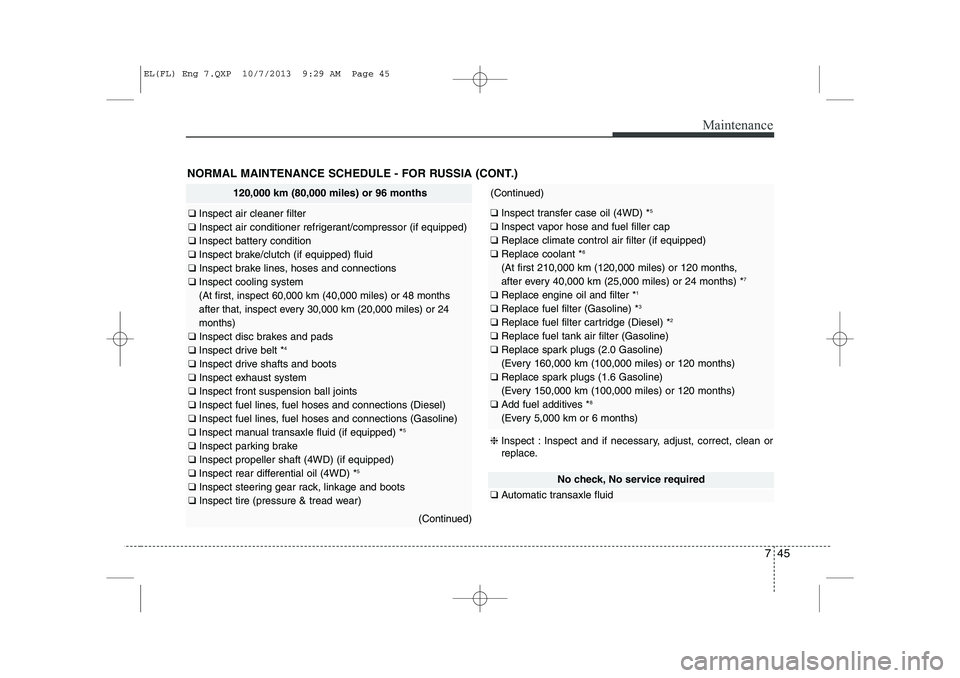
NORMAL MAINTENANCE SCHEDULE - FOR RUSSIA (CONT.)
No check, No service required
❑Automatic transaxle fluid
❈ Inspect : Inspect and if necessary, adjust, correct, clean or
replace.
120,000 km (80,000 miles) or 96 months
❑ Inspect air cleaner filter
❑ Inspect air conditioner refrigerant/compressor (if equipped)
❑ Inspect battery condition
❑ Inspect brake/clutch (if equipped) fluid
❑ Inspect brake lines, hoses and connections
❑ Inspect cooling system
(At first, inspect 60,000 km (40,000 miles) or 48 months
after that, inspect every 30,000 km
(20,000 miles)or 24
months)
❑ Inspect disc brakes and pads
❑ Inspect drive belt * 4
❑ Inspect drive shafts and boots
❑ Inspect exhaust system
❑ Inspect front suspension ball joints
❑ Inspect fuel lines, fuel hoses and connections (Diesel)
❑ Inspect fuel lines, fuel hoses and connections (Gasoline)
❑ Inspect manual transaxle fluid (if equipped) * 5
❑ Inspect parking brake
❑ Inspect propeller shaft (4WD) (if equipped)
❑ Inspect rear differential oil (4WD) * 5
❑ Inspect steering gear rack, linkage and boots
❑ Inspect tire (pressure & tread wear)
(Continued)
(Continued)
❑ Inspect transfer case oil (4WD) * 5
❑ Inspect vapor hose and fuel filler cap
❑ Replace climate control air filter (if equipped)
❑ Replace coolant * 6
(At first 210,000 km (120,000 miles) or 120 months,
after every 40,000 km (25,000 miles) or 24 months) * 7
❑ Replace engine oil and filter * 1
❑ Replace fuel filter (Gasoline) * 3
❑ Replace fuel filter cartridge (Diesel) * 2
❑ Replace fuel tank air filter (Gasoline)
❑ Replace spark plugs (2.0 Gasoline)
(Every 160,000 km (100,000 miles) or 120 months)
❑ Replace spark plugs (1.6 Gasoline)
(Every 150,000 km (100,000 miles) or 120 months)
❑ Add fuel additives * 8
(Every 5,000 km or 6 months)
EL(FL) Eng 7.QXP 10/7/2013 9:29 AM Page 45
Page 920 of 1534
755
Maintenance
BRAKE/CLUTCH FLUID (IF EQUIPPED)
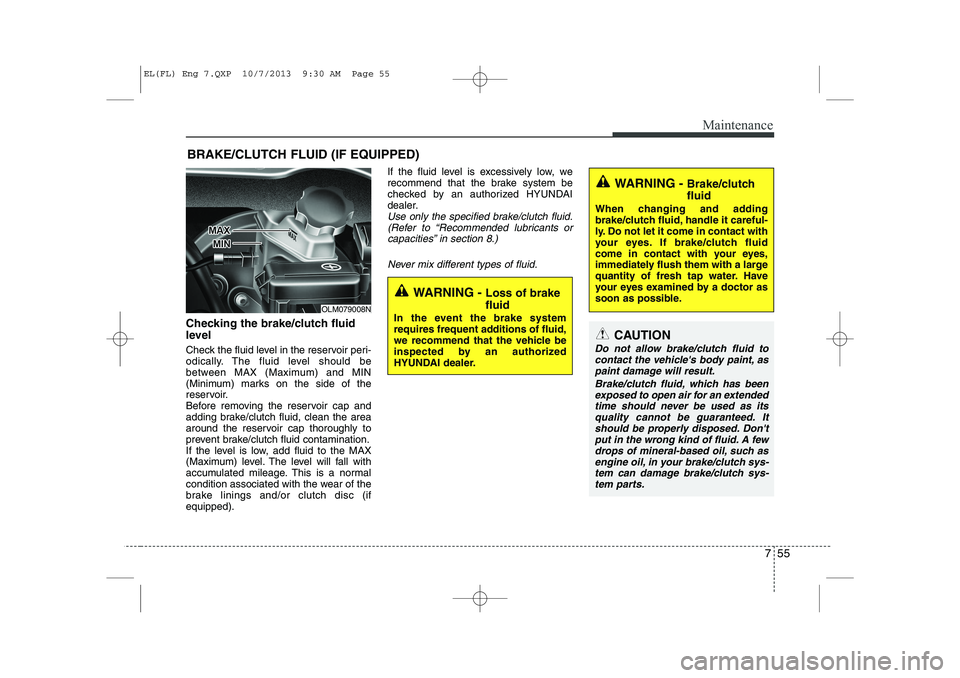
Checking the brake/clutch fluid
level
Check the fluid level in the reservoir peri-
odically. The fluid level should be
between MAX (Maximum) and MIN
(Minimum) marks on the side of the
reservoir.
Before removing the reservoir cap and
adding brake/clutch fluid, clean the area
around the reservoir cap thoroughly to
prevent brake/clutch fluid contamination.
If the level is low, add fluid to the MAX
(Maximum) level. The level will fall with
accumulated mileage. This is a normal
condition associated with the wear of the
brake linings and/or clutch disc (ifequipped). If the fluid level is excessively low, we
recommend that the brake system be
checked by an authorized HYUNDAI
dealer.
Use only the specified brake/clutch fluid.
(Refer to “Recommended lubricants or capacities” in section 8.)
Never mix different types of fluid.
OLM079008N
WARNING - Loss of brake fluid
In the event the brake system
requires frequent additions of fluid,
we recommend that the vehicle be
inspected by an authorized
HYUNDAI dealer.
WARNING - Brake/clutch fluid
When changing and adding
brake/clutch fluid, handle it careful-
ly. Do not let it come in contact with
your eyes. If brake/clutch fluid
come in contact with your eyes,
immediately flush them with a large
quantity of fresh tap water. Have
your eyes examined by a doctor as
soon as possible.
CAUTION
Do not allow brake/clutch fluid to contact the vehicle's body paint, as paint damage will result.
Brake/clutch fluid, which has beenexposed to open air for an extendedtime should never be used as its quality cannot be guaranteed. Itshould be properly disposed. Don't
put in the wrong kind of fluid. A fewdrops of mineral-based oil, such as engine oil, in your brake/clutch sys-tem can damage brake/clutch sys-
tem parts.
EL(FL) Eng 7.QXP 10/7/2013 9:30 AM Page 55
Page 988 of 1534
87
Specifications & Consumer information
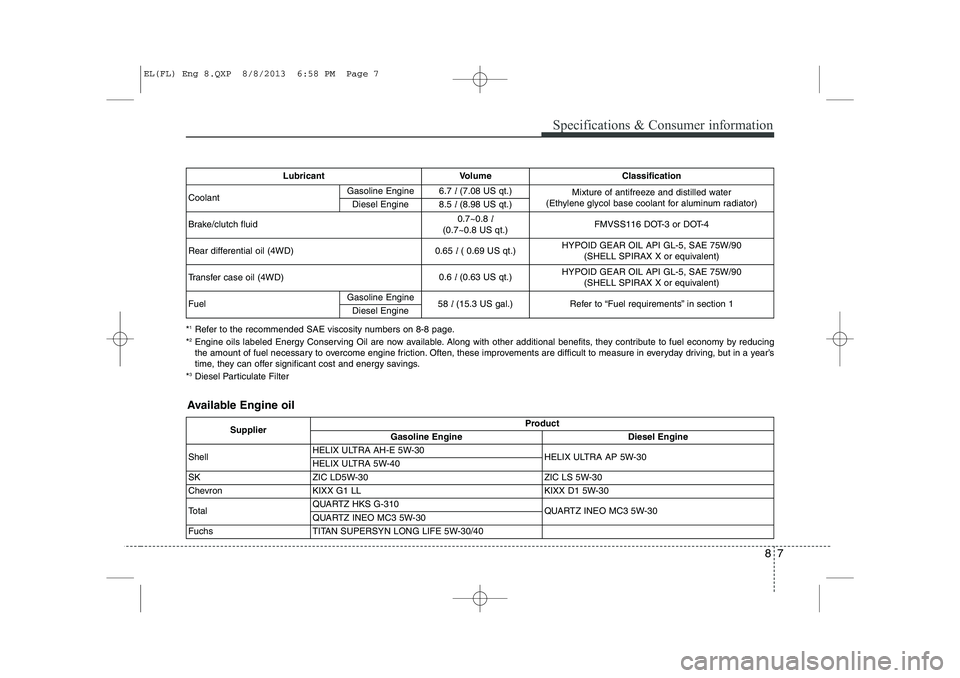
Lubricant Volume Classification
Coolant Gasoline Engine6.7 l(7.08 US qt.)Mixture of antifreeze and distilled water
(Ethylene glycol base coolant for aluminum radiator)
Diesel Engine8.5 l(8.98 US qt.)
Brake/clutch fluid0.7~0.8 l
(0.7~0.8 US qt.)FMVSS116 DOT-3 or DOT-4
Rear differential oil (4WD) 0.65
l( 0.69 US qt.) HYPOID GEAR OIL API GL-5, SAE 75W/90
(SHELL SPIRAX X or equivalent)
Transfer case oil (4WD) 0.6
l(0.63 US qt.) HYPOID GEAR OIL API GL-5, SAE 75W/90
(SHELL SPIRAX X or equivalent)
Fuel Gasoline Engine
58 l(15.3 US gal.)
Refer to “Fuel requirements” in section 1
Diesel Engine
Available Engine oil
Supplier Product
Gasoline Engine Diesel Engine
Shell HELIX ULTRA AH-E 5W-30
HELIX ULTRA AP 5W-30
HELIX ULTRA 5W-40
SK ZIC LD5W-30 ZIC LS 5W-30
Chevron KIXX G1 LL KIXX D1 5W-30
Total QUARTZ HKS G-310
QUARTZ INEO MC3 5W-30
QUARTZ INEO MC3 5W-30
Fuchs TITAN SUPERSYN LONG LIFE 5W-30/40
* 1
Refer to the recommended SAE viscosity numbers on 8-8 page.
* 2
Engine oils labeled Energy Conserving Oil are now available. Along with other additional benefits, they contribute to fuel economy by reducing
the amount of fuel necessary to overcome engine friction. Often, these improvements are difficult to measure in everyday driving, but in a year’s
time, they can offer significant cost and energy savings.
* 3
Diesel Particulate Filter
EL(FL) Eng 8.QXP 8/8/2013 6:58 PM Page 7
Page 1003 of 1534
Your vehicle at a glance
4
2
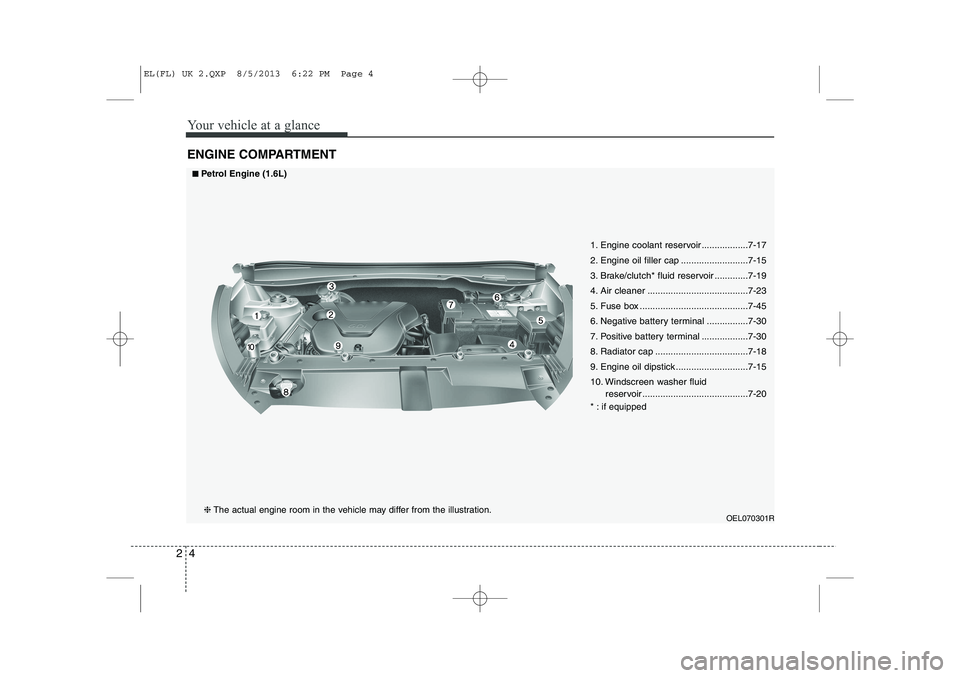
ENGINE COMPARTMENT
OEL070301R
1. Engine coolant reservoir ..................7-17
2. Engine oil filler cap ..........................7-15
3. Brake/clutch* fluid reservoir .............7-19
4. Air cleaner .......................................7-23
5. Fuse box ..........................................7-45
6. Negative battery terminal ................7-30
7. Positive battery terminal ..................7-30
8. Radiator cap ....................................7-18
9. Engine oil dipstick ............................7-15
10. Windscreen washer fluid
reservoir .........................................7-20
* : if equipped
■■Petrol Engine (1.6L)
❈ The actual engine room in the vehicle may differ from the illustration.
EL(FL) UK 2.QXP 8/5/2013 6:22 PM Page 4
Page 1004 of 1534
25
Your vehicle at a glance
OEL073300R
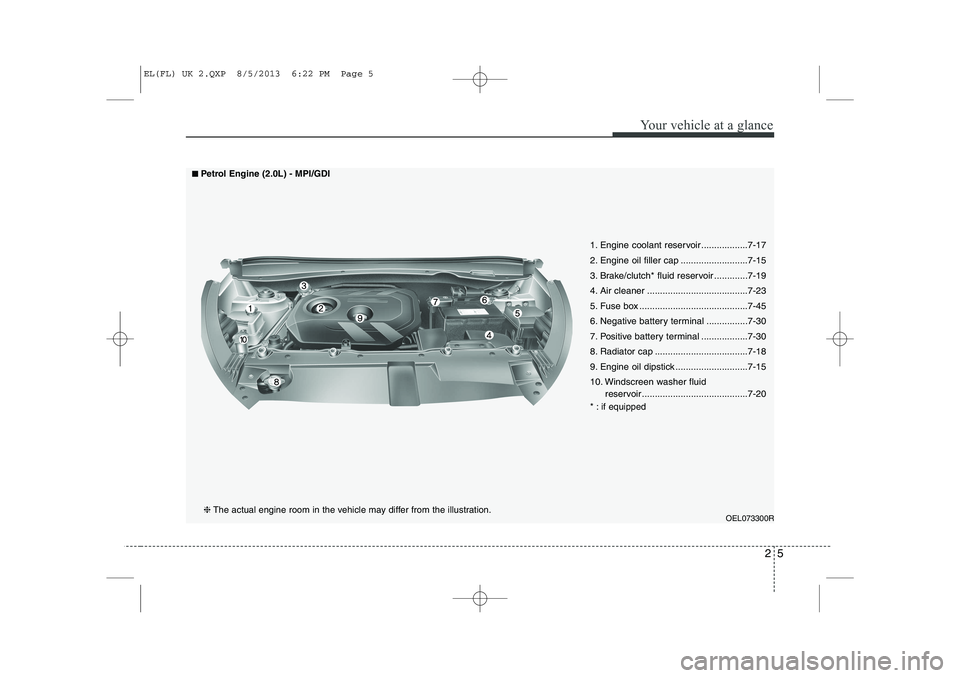
1. Engine coolant reservoir ..................7-17
2. Engine oil filler cap ..........................7-15
3. Brake/clutch* fluid reservoir .............7-19
4. Air cleaner .......................................7-23
5. Fuse box ..........................................7-45
6. Negative battery terminal ................7-30
7. Positive battery terminal ..................7-30
8. Radiator cap ....................................7-18
9. Engine oil dipstick ............................7-15
10. Windscreen washer fluidreservoir .........................................7-20
* : if equipped
■■Petrol Engine (2.0L) - MPI/GDI
❈ The actual engine room in the vehicle may differ from the illustration.
EL(FL) UK 2.QXP 8/5/2013 6:22 PM Page 5
Page 1005 of 1534
26
Your vehicle at a glance
OEL070302R
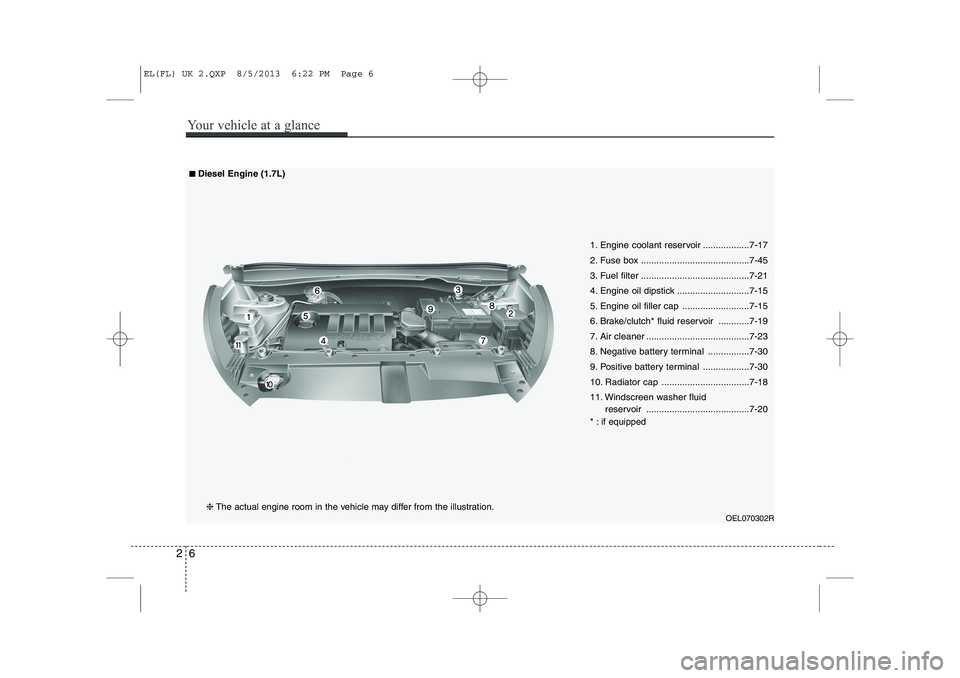
1. Engine coolant reservoir ..................7-17
2. Fuse box ..........................................7-45
3. Fuel filter ..........................................7-21
4. Engine oil dipstick ............................7-15
5. Engine oil filler cap ..........................7-15
6. Brake/clutch* fluid reservoir ............7-19
7. Air cleaner ........................................7-23
8. Negative battery terminal ................7-30
9. Positive battery terminal ..................7-30
10. Radiator cap ..................................7-18
11. Windscreen washer fluidreservoir ........................................7-20
* : if equipped
■■Diesel Engine (1.7L)
❈ The actual engine room in the vehicle may differ from the illustration.
EL(FL) UK 2.QXP 8/5/2013 6:22 PM Page 6
Page 1006 of 1534

27
Your vehicle at a glance
OLM079002R
1. Engine coolant reservoir ..................7-17
2. Fuse box ..........................................7-45
3. Fuel filter ..........................................7-21
4. Engine oil dipstick ............................7-15
5. Engine oil filler cap ..........................7-15
6. Brake/clutch* fluid reservoir ............7-19
7. Air cleaner ........................................7-23
8. Negative battery terminal ................7-30
9. Positive battery terminal ..................7-30
10. Radiator cap ..................................7-18
11. Windscreen washer fluidreservoir ........................................7-20
* : if equipped
■■Diesel Engine (2.0L)
❈ The actual engine room in the vehicle may differ from the illustration.
EL(FL) UK 2.QXP 8/5/2013 6:22 PM Page 7
Page 1131 of 1534
Features of your vehicle
60
4
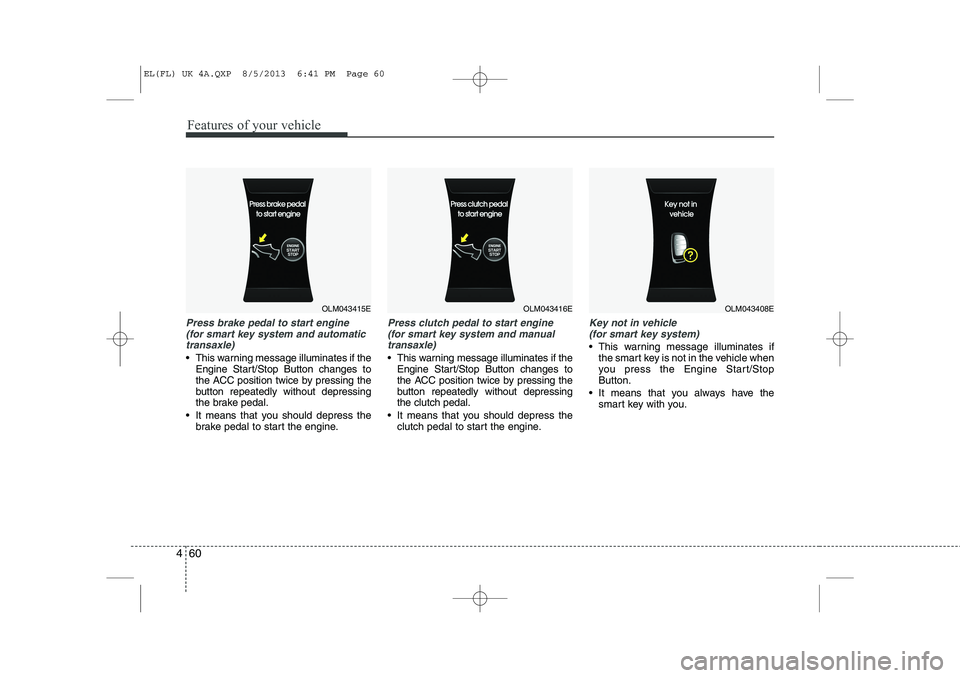
Press brake pedal to start engine
(for smart key system and automatic
transaxle)
This warning message illuminates if the Engine Start/Stop Button changes to
the ACC position twice by pressing the
button repeatedly without depressing
the brake pedal.
It means that you should depress the brake pedal to start the engine.
Press clutch pedal to start engine
(for smart key system and manual
transaxle)
This warning message illuminates if the Engine Start/Stop Button changes to
the ACC position twice by pressing the
button repeatedly without depressingthe clutch pedal.
It means that you should depress the clutch pedal to start the engine.
Key not in vehicle
(for smart key system)
This warning message illuminates if the smart key is not in the vehicle when
you press the Engine Start/StopButton.
It means that you always have the smart key with you.
OLM043415EOLM043416EOLM043408E
EL(FL) UK 4A.QXP 8/5/2013 6:41 PM Page 60
Page 1161 of 1534
Features of your vehicle
90
4
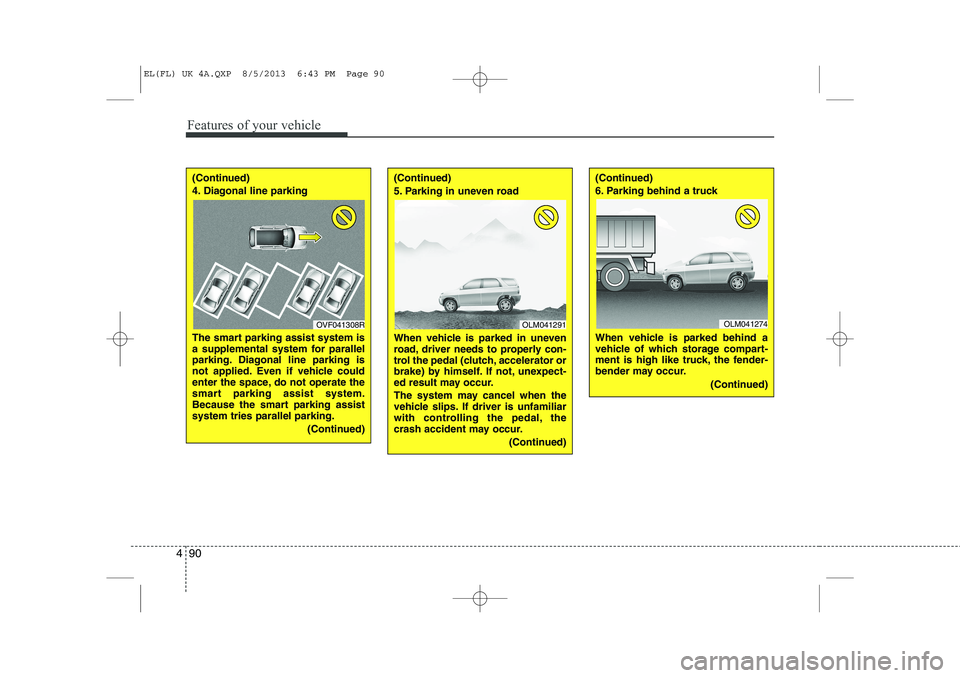
(Continued)
4. Diagonal line parking
The smart parking assist system is
a supplemental system for parallel
parking. Diagonal line parking is
not applied. Even if vehicle could
enter the space, do not operate the
smart parking assist system.
Because the smart parking assistsystem tries parallel parking.
(Continued)(Continued)
5. Parking in uneven road
When vehicle is parked in uneven
road, driver needs to properly con-
trol the pedal (clutch, accelerator or
brake) by himself. If not, unexpect-
ed result may occur.
The system may cancel when the
vehicle slips. If driver is unfamiliar
with controlling the pedal, the
crash accident may occur.(Continued)(Continued)
6. Parking behind a truck
When vehicle is parked behind a
vehicle of which storage compart-
ment is high like truck, the fender-
bender may occur.(Continued)
OVF041308ROLM041291OLM041274
EL(FL) UK 4A.QXP 8/5/2013 6:43 PM Page 90
Page 1341 of 1534
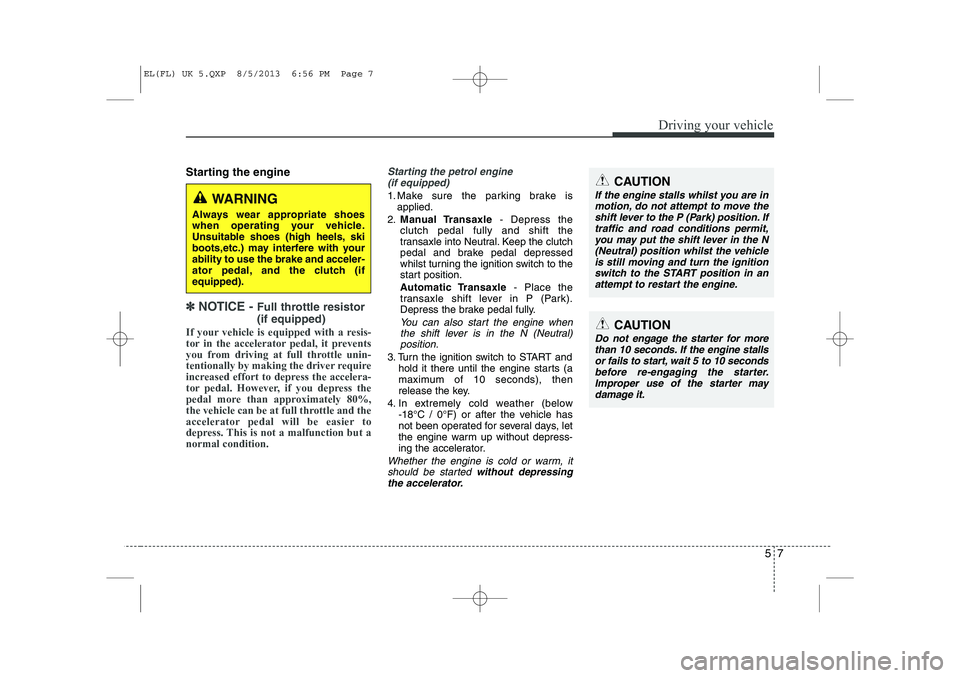
57
Driving your vehicle
Starting the engine
✽✽
NOTICE - Full throttle resistor (if equipped)
If your vehicle is equipped with a resis-
tor in the accelerator pedal, it prevents
you from driving at full throttle unin-
tentionally by making the driver require
increased effort to depress the accelera-
tor pedal. However, if you depress the
pedal more than approximately 80%,
the vehicle can be at full throttle and the
accelerator pedal will be easier to
depress. This is not a malfunction but anormal condition.
Starting the petrol engine (if equipped)
1. Make sure the parking brake is applied.
2. Manual Transaxle - Depress the
clutch pedal fully and shift the
transaxle into Neutral. Keep the clutch
pedal and brake pedal depressed
whilst turning the ignition switch to the
start position.
Automatic Transaxle - Place the
transaxle shift lever in P (Park).
Depress the brake pedal fully.
You can also start the engine when
the shift lever is in the N (Neutral)position.
3. Turn the ignition switch to START and hold it there until the engine starts (a
maximum of 10 seconds), then
release the key.
4. In extremely cold weather (below -18°C / 0°F) or after the vehicle has
not been operated for several days, let
the engine warm up without depress-
ing the accelerator.
Whether the engine is cold or warm, it
should be started without depressing
the accelerator.
CAUTION
If the engine stalls whilst you are in motion, do not attempt to move the
shift lever to the P (Park) position. If traffic and road conditions permit,you may put the shift lever in the N (Neutral) position whilst the vehicle
is still moving and turn the ignitionswitch to the START position in an attempt to restart the engine.
CAUTION
Do not engage the starter for morethan 10 seconds. If the engine stallsor fails to start, wait 5 to 10 seconds
before re-engaging the starter.Improper use of the starter may damage it.
WARNING
Always wear appropriate shoes
when operating your vehicle.
Unsuitable shoes (high heels, ski
boots,etc.) may interfere with yourability to use the brake and acceler-
ator pedal, and the clutch (ifequipped).
EL(FL) UK 5.QXP 8/5/2013 6:56 PM Page 7