engine HYUNDAI IX35 2016 Owners Manual
[x] Cancel search | Manufacturer: HYUNDAI, Model Year: 2016, Model line: IX35, Model: HYUNDAI IX35 2016Pages: 550, PDF Size: 11.23 MB
Page 509 of 550
749
Maintenance
Engine compartment
OLM079026R/OLM079053R/OLM079027/OEL070306R/OLM079028
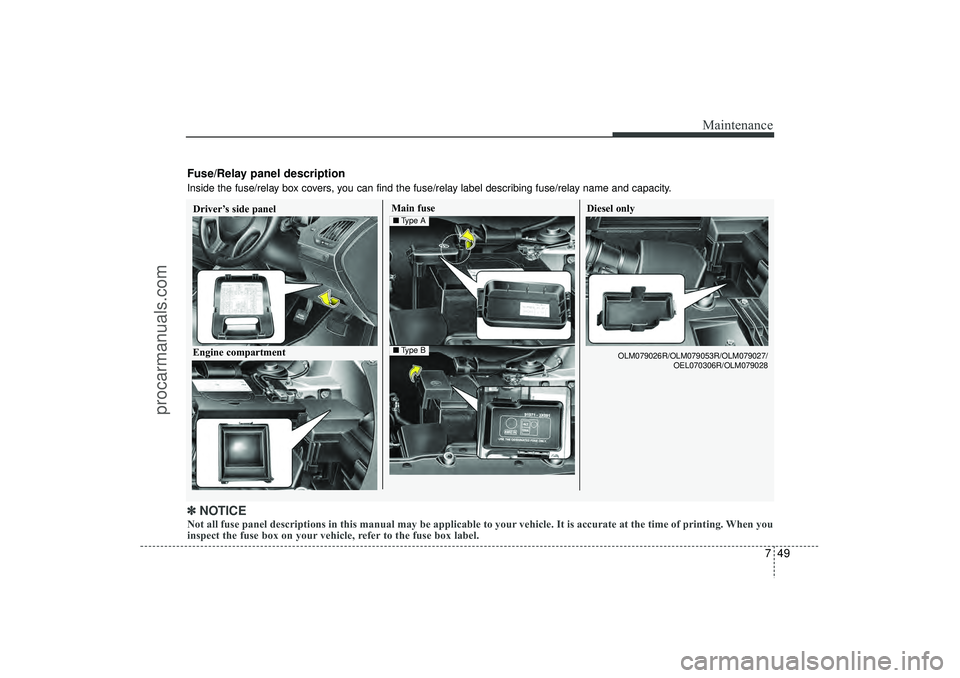
Fuse/Relay panel descriptionInside the fuse/relay box covers, you can find the fuse/relay label describing fuse/relay name and capacity.
Diesel only
Driver’s side panel Main fuse
■
Type A■Type B
✽
✽
NOTICENot all fuse panel descriptions in this manual may be applicable to your\
vehicle. It is accurate at the time of printing. When you
inspect the fuse box on your vehicle, refer to the fuse box label.
EL(FL) UK 7.QXP 3/4/2015 9:07 PM Page 49
procarmanuals.com
Page 513 of 550
753
Maintenance
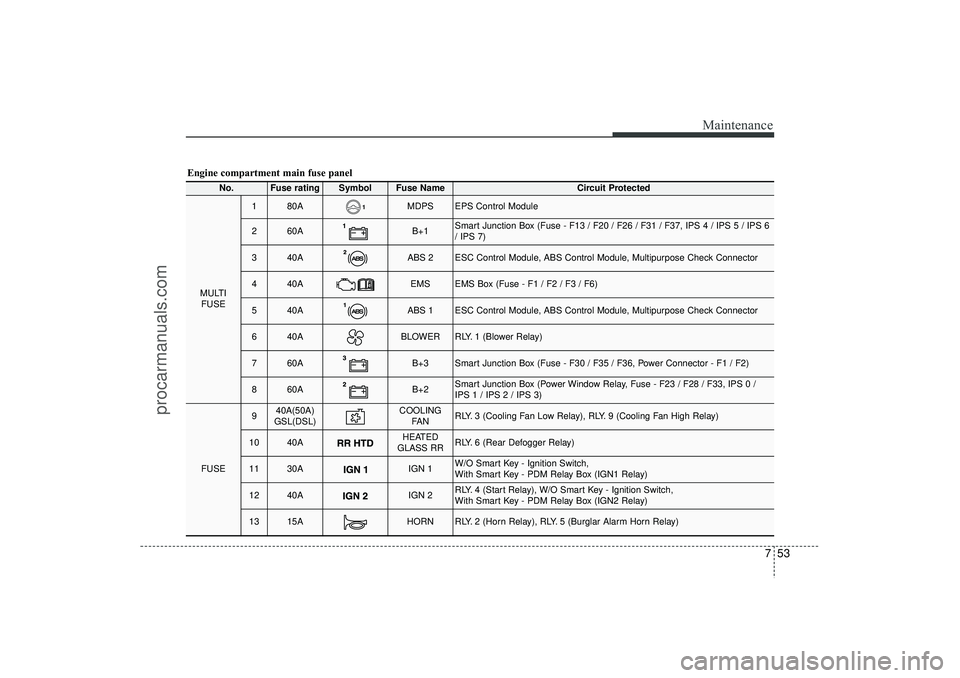
Engine compartment main fuse panel
No.
Fuse rating
Symbol
Fuse Name
Circuit Protected
MULTIFUSE
1
80A
MDPS
EPS Control Module
2
60A
B+1
Smart Junction Box (Fuse - F13 / F20 / F26 / F31 / F37, IPS 4 / IPS 5 / IPS 6
/ IPS 7)
3
40A
ABS 2
ESC Control Module, ABS Control Module, Multipurpose Check Connector
4
40A
EMS
EMS Box (Fuse - F1 / F2 / F3 / F6)
5
40A
ABS 1
ESC Control Module, ABS Control Module, Multipurpose Check Connector
6
40A
BLOWER
RLY. 1 (Blower Relay)
7
60A
B+3
Smart Junction Box (Fuse - F30 / F35 / F36, Power Connector - F1 / F2)
8
60A
B+2
Smart Junction Box (Power Window Relay, Fuse - F23 / F28 / F33, IPS 0 /
IPS 1 / IPS 2 / IPS 3)
FUSE
9
40A(50A)
GSL(DSL)
COOLING FA N
RLY. 3 (Cooling Fan Low Relay), RLY. 9 (Cooling Fan High Relay)
10
40A
HEATED
GLASS RR
RLY. 6 (Rear Defogger Relay)
11
30A
IGN 1
W/O Smart Key - Ignition Switch,
With Smart Key - PDM Relay Box (IGN1 Relay)
12
40A
IGN 2
RLY. 4 (Start Relay), W/O Smart Key - Ignition Switch,
With Smart Key - PDM Relay Box (IGN2 Relay)
13
15A
HORN
RLY. 2 (Horn Relay), RLY. 5 (Burglar Alarm Horn Relay)
EL(FL) UK 7.QXP 3/4/2015 9:07 PM Page 53
procarmanuals.com
Page 515 of 550
755
Maintenance
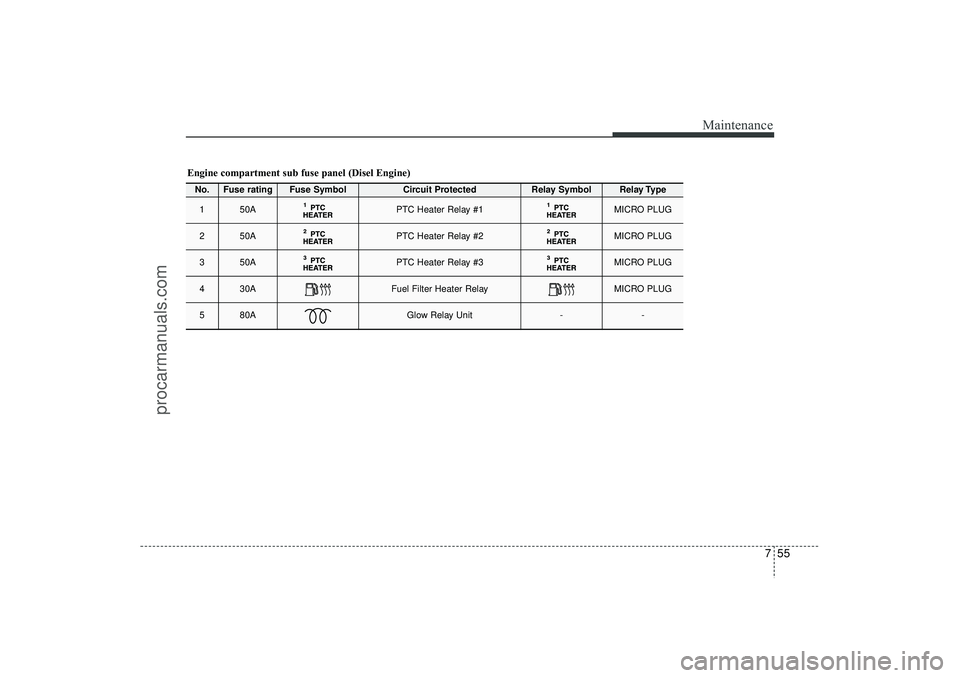
Engine compartment sub fuse panel (Disel Engine)No.
Fuse rating
Fuse Symbol
Circuit Protected
Relay Symbol
Relay Type
1
50A
PTC Heater Relay #1
MICRO PLUG
2
50A
PTC Heater Relay #2
MICRO PLUG
3
50A
PTC Heater Relay #3
MICRO PLUG
4
30A
Fuel Filter Heater Relay
MICRO PLUG
5
80A
Glow Relay Unit
-
-
EL(FL) UK 7.QXP 3/4/2015 9:07 PM Page 55
procarmanuals.com
Page 519 of 550
759
Maintenance
Turn signal light/Position lightTurn signal light
1. Turn off the engine and open the bon-net.
2. Remove the socket from the assembly by turning the socket counterclockwise
until the tabs on the socket align with
the slots on the assembly.
3. Remove the bulb from the socket by pressing it in and rotating it counter-
clockwise until the tabs on the bulb
align with the slots in the socket. Pull
the bulb out of the socket.
4. Insert a new bulb by inserting it into the socket and rotating it until it locks
into place.
5. Install the socket in the assembly by aligning the tabs on the socket with the
slots in the assembly. Push the socket
into the assembly and turn the socket
clockwise.
Position light
If the light bulb does not operate, we rec-
ommend that the system be checked by
a HYUNDAI authorised repairer.
(Continued)
If a bulb becomes damaged or cracked, replace it immediately
and carefully dispose of it.
Wear eye protection when chang- ing a bulb. Allow the bulb to cool
down before handling it.
WARNING
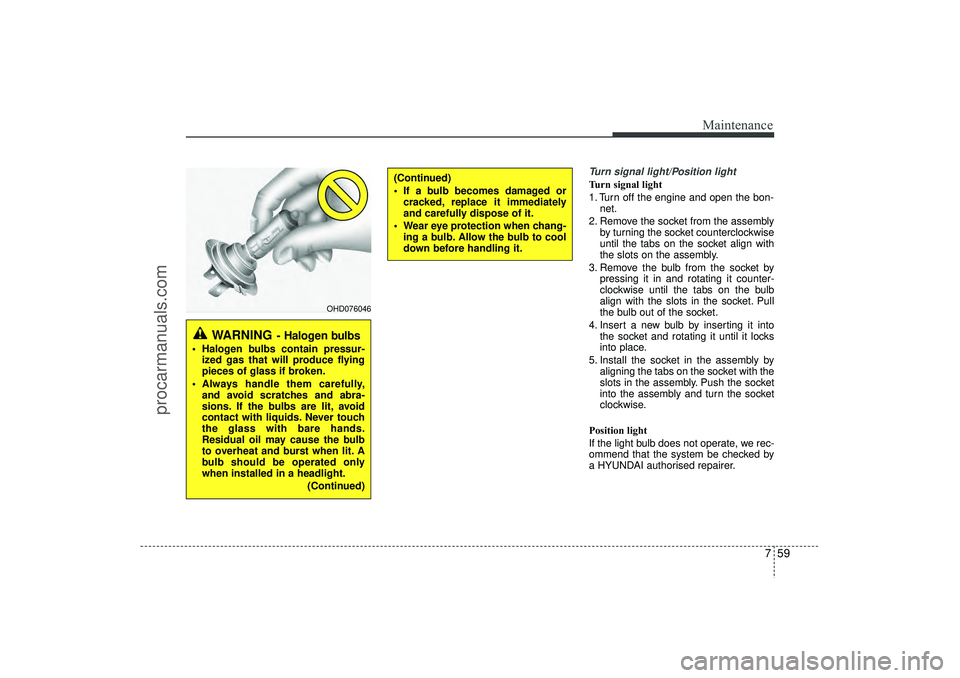
- Halogen bulbs
Halogen bulbs contain pressur-ized gas that will produce flying
pieces of glass if broken.
Always handle them carefully, and avoid scratches and abra-
sions. If the bulbs are lit, avoid
contact with liquids. Never touch
the glass with bare hands.
Residual oil may cause the bulb
to overheat and burst when lit. A
bulb should be operated only
when installed in a headlight.
(Continued)
OHD076046
EL(FL) UK 7.QXP 3/4/2015 9:07 PM Page 59
procarmanuals.com
Page 531 of 550
771
Maintenance
Waxing
Wax the vehicle when water will no
longer bead on the paint.
Always wash and dry the vehicle before
waxing. Use a good quality liquid or
paste wax, and follow the manufacturer’s
instructions. Wax all metal trim to protect
it and to maintain its luster.
Removing oil, tar, and similar materials
with a spot remover will usually strip the
wax from the finish. Be sure to re-wax
these areas even if the rest of the vehicle
does not yet need waxing.
Finish damage repair Deep scratches or stone chips in the
painted surface must be repaired
promptly. Exposed metal will quickly rust
and may develop into a major repair
expense.✽ ✽NOTICEIf your vehicle is damaged and requires
any metal repair or replacement, be sure
the body shop applies anti-corrosion
materials to the parts repaired or
replaced.
CAUTION
Wiping dust or dirt off the body
with a dry cloth will scratch thefinish.
Do not use steel wool, abrasive cleaners, or strong detergentscontaining highly alkaline orcaustic agents on chrome-platedor anodized aluminium parts. This may result in damage to the pro-tective coating and cause discol- oration or paint deterioration.
CAUTION
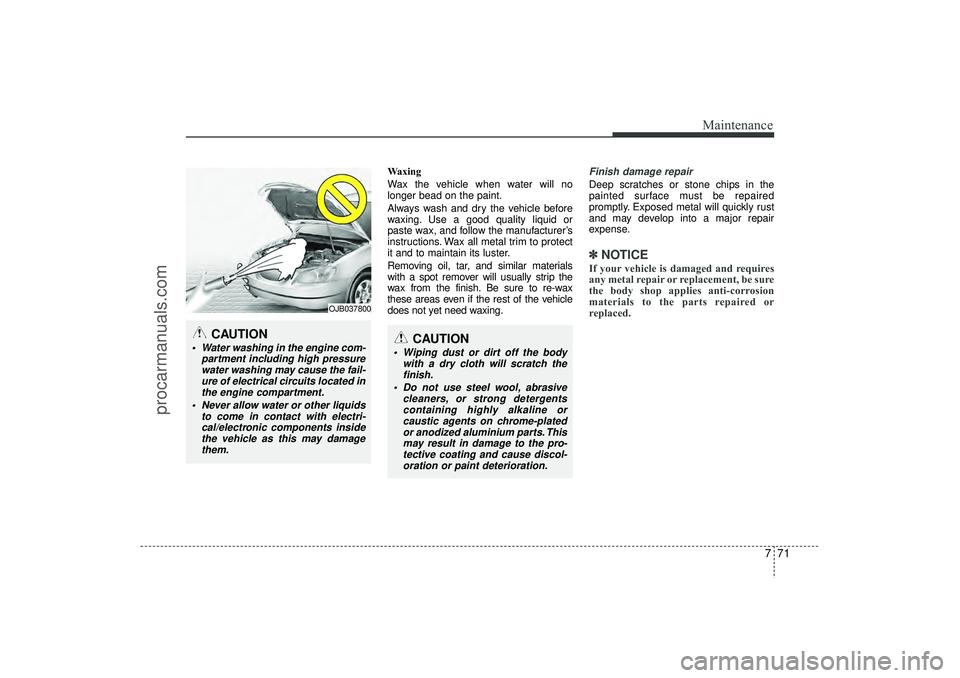
Water washing in the engine com- partment including high pressurewater washing may cause the fail-ure of electrical circuits located inthe engine compartment.
Never allow water or other liquids to come in contact with electri-cal/electronic components insidethe vehicle as this may damage them.
OJB037800
EL(FL) UK 7.QXP 3/4/2015 9:08 PM Page 71
procarmanuals.com
Page 536 of 550
Maintenance76
7EMISSION CONTROL SYSTEMThe emission control system of your
vehicle is covered by a written limited
warranty. Please see the warranty infor-
mation contained in the Service Passport
in your vehicle.
Your vehicle is equipped with an emis-
sion control system to meet all emission
regulations.
There are three emission control sys-
tems which are as follows.
(1) Crankcase emission control system
(2) Evaporative emission control system
(3) Exhaust emission control system
In order to assure the proper function of
the emission control systems, it is rec-
ommended that you have your car
inspected and maintained by a
HYUNDAI authorised repairer in accor-
dance with the maintenance schedule. Caution for the Inspection and
Maintenance Test (With Electronic
Stability Control (ESC) system)
To prevent the vehicle from misfir-
ing during dynamometer testing,
turn the Electronic Stability Control
(ESC) system off by pressing the
ESC switch.
After dynamometer testing is com- pleted, turn the ESC system back on
by pressing the ESC switch again.
1. Crankcase emission control systemThe positive crankcase ventilation sys-
tem is employed to prevent air pollution
caused by blow-by gases being emitted
from the crankcase. This system supplies
fresh filtered air to the crankcase through
the air intake hose. Inside the crankcase,
the fresh air mixes with blow-by gases,
which then pass through the PCV valve
into the induction system.
2. Evaporative emission controlSystemThe Evaporative Emission Control
System is designed to prevent fuel
vapours from escaping into the atmos-
phere.CanisterFuel vapours generated inside the fuel
tank are absorbed and stored in the
onboard canister. When the engine is
running, the fuel vapours absorbed in the
canister are drawn into the surge tank
through the purge control solenoid valve.Purge Control Solenoid Valve (PCSV)The purge control solenoid valve is con-
trolled by the Engine Control Module
(ECM); when the engine coolant temper-
ature is low during idling, the PCSV clos-
es so that evaporated fuel is not taken
into the engine. After the engine warms-
up during ordinary driving, the PCSV
opens to introduce evaporated fuel to the
engine.
EL(FL) UK 7.QXP 3/4/2015 9:08 PM Page 76
procarmanuals.com
Page 537 of 550
777
Maintenance
3. Exhaust emission control systemThe Exhaust Emission Control System is
a highly effective system which controls
exhaust emissions whilst maintaining
good vehicle performance.Vehicle modifications This vehicle should not be modified.
Modification of your vehicle could
affect its performance, safety or dura-
bility and may even violate governmen-
tal safety and emissions regulations.
In addition, damage or performance
problems resulting from any modifica-
tion may not be covered under warran-
ty.
If you use unauthorised electronic devices, it may cause the vehicle to
operate abnormally, wire damage, bat-
tery discharge and fire. For your safety,
do not use unauthorised electronic
devices.
Engine exhaust gas precautions (carbon monoxide) Carbon monoxide can be present with other exhaust fumes. Therefore, if you
smell exhaust fumes of any kind inside
your vehicle, have it inspected and
repaired immediately. If you ever sus-
pect exhaust fumes are coming into
your vehicle, drive it only with all the
windows fully open. Have your vehicle
checked and repaired immediately. Do not operate the engine in confined
or closed areas (such as garages) any
more than what is necessary to move
the vehicle in or out of the area.
When the vehicle is stopped in an open area for more than a short time
with the engine running, adjust the
ventilation system (as needed) to draw
outside air into the vehicle.
Never sit in a parked or stopped vehi- cle for any extended time with the
engine running.
When the engine stalls or fails to start, excessive attempts to restart the
engine may cause damage to the
emission control system.
WARNING
- Exhaust
Engine exhaust gases contain car-
bon monoxide (CO). Though
colourless and odourless, it is dan-
gerous and could be lethal if
inhaled. Follow the instructions
following to avoid CO poisoning.
EL(FL) UK 7.QXP 3/4/2015 9:08 PM Page 77
procarmanuals.com
Page 538 of 550
Maintenance78
7Operating precautions for catalytic
converters (if equipped)
Your vehicle is equipped with a catalytic
converter emission control device.
Therefore, the following precautions
must be observed:
Use only UNLEADED FUEL for petrol engine.
Do not operate the vehicle when there are signs of engine malfunction, such
as misfire or a noticeable loss of per-
formance.
Do not misuse or abuse the engine. Examples of misuse are coasting with
the ignition off and descending steep
grades in gear with the ignition off.
Do not operate the engine at high idle speed for extended periods (5 minutes
or more).
Do not modify or tamper with any part of the engine or emission control sys-
tem. We recommend that the system
be inspected by a HYUNDAI autho-
rised repairer.
Avoid driving with a extremely low fuel level. Running out of fuel cause the
engine to misfire, damaging the cat-
alytic converter.
Failure to observe these precautions
could result in damage to the catalytic
converter and to your vehicle.
Additionally, such actions could void your
warranties.
Diesel Particulate Filter (if equipped)The Diesel Particulate Filter (DPF) sys-
tem removes the soot emitted from the
vehicle.
Unlike a disposable air filter, the DPF
system automatically burns (oxidizes)
and removes the accumulated soot
according to the driving condition. In
other words, the active burning by engine
control system and high exhaust gas
temperature caused by normal/high driv-
ing condition burns and removes the
accumulated soot.
However, if the vehicle continues to be
driven at low speed for long time, the
accumulated soot may not be automati-
cally removed because of low exhaust
gas temperature. In this particular case,
the amount of soot is out of detection
limit, the soot oxidation process by
engine control system may not happen
and the malfunction indicator light may
blink.
When the malfunction indicator light
blinks, it may stop blinking by driving the
vehicle at more than 37 mph (60km/h) or
at more than second gear with 1500 ~
2000 engine rpm for a certain time (for
about 25 minutes).
WARNING
- Fire
A hot exhaust system can ignite flammable items under your vehi-
cle. Do not park, idle, or drive the
vehicle over or near flammable
objects, such as dry grass, paper,
leaves, etc.
The exhaust system and catalytic system are very hot whilst the
engine is running or immediately
after the engine is turned off. Keep
away from the exhaust system
and catalytic, you may get burned.
Also, do not remove the heat sink
around the exhaust system, do
not seal the bottom of the vehicle
or do not coat the vehicle for cor-
rosion control. It may present a
fire risk under certain conditions.
EL(FL) UK 7.QXP 3/4/2015 9:08 PM Page 78
procarmanuals.com
Page 540 of 550

Specifications & Consumer informationDimensions . . . . . . . . . . . . . . . . . . . . . . . . . . . . . . . . 8-2
Engine . . . . . . . . . . . . . . . . . . . . . . . . . . . . . . . . . . . . \
8-2
Air conditioning system . . . . . . . . . . . . . . . . . . . . . . 8-2
Bulb wattage . . . . . . . . . . . . . . . . . . . . . . . . . . . . . . . 8-3
Tyres and wheels . . . . . . . . . . . . . . . . . . . . . . . . . . . 8-4
Load and speed capacity tyres . . . . . . . . . . . . . . . . 8-4
Gross vehicle weight. . . . . . . . . . . . . . . . . . . . . . . . . 8-5
Luggage volume . . . . . . . . . . . . . . . . . . . . . . . . . . . . 8-5
Recommended lubricants and capacities . . . . . . . 8-6• Recommended engine oil . . . . . . . . . . . . . . . . . . . . . . . 8-7
• Recommended SAE viscosity number . . . . . . . . . . . 8-8Vehicle identification number (VIN) . . . . . . . . . . . 8-9
Vehicle certification label. . . . . . . . . . . . . . . . . . . . . 8-9
Tyre specification and pressure label . . . . . . . . . . 8-10
Engine number . . . . . . . . . . . . . . . . . . . . . . . . . . . . 8-10
Air conditioner compressor label . . . . . . . . . . . . . 8-11
Declaration of conformity . . . . . . . . . . . . . . . . . . . 8-11
8
EL(FL) UK 8.QXP 3/13/2015 5:44 PM Page 1
procarmanuals.com
Page 541 of 550
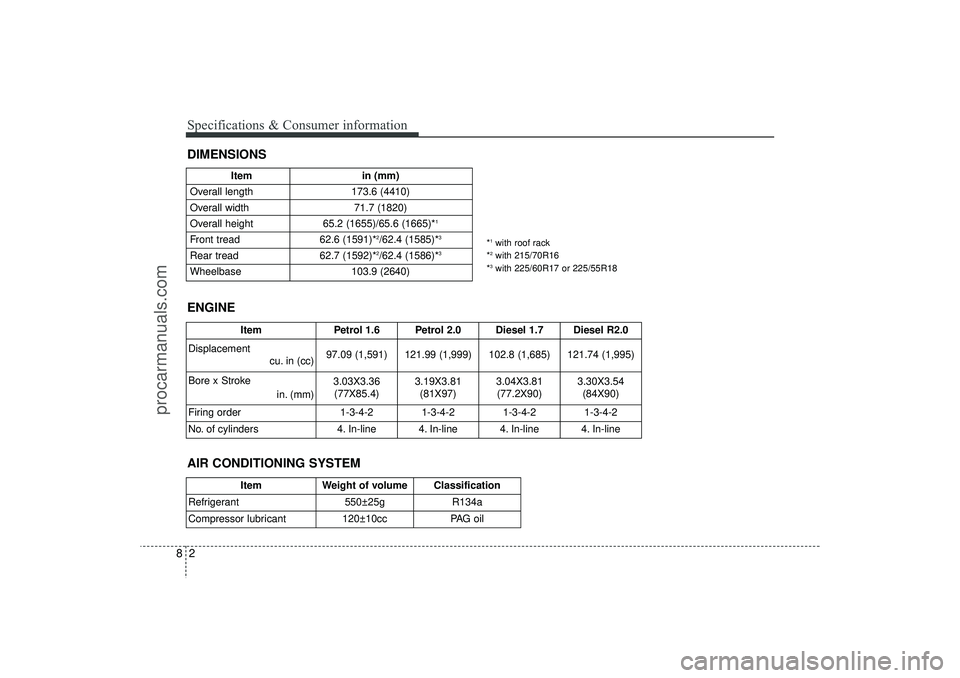
Specifications & Consumer information28DIMENSIONS
Itemin (mm)
Overall length 173.6 (4410)
Overall width 71.7 (1820)
Overall height 65.2 (1655)/65.6 (1665)*
1
Front tread62.6 (1591)*
2/62.4 (1585)*
3
Rear tread62.7 (1592)*
2/62.4 (1586)*
3
Wheelbase 103.9 (2640)
*1with roof rack
*2with 215/70R16
*3with 225/60R17 or 225/55R18
ENGINE
Item
Petrol 1.6 Petrol 2.0
Diesel 1.7
Diesel R2.0
Displacement cu. in (cc)
97.09 (1,591) 121.99 (1,999)
102.8 (1,685)
121.74 (1,995)
Bore x Stroke in. (mm)
3.03X3.36(77X85.4) 3.19X3.81
(81X97)
3.04X3.81(77.2X90)
3.30X3.54 (84X90)
Firing order
1-3-4-2 1-3-4-2
1-3-4-2
1-3-4-2
No. of cylinders
4. In-line 4. In-line
4. In-line
4. In-line
Item
Weight of volume Classification
Refrigerant
550±25g R134a
Compressor lubricant120±10cc PAG oil
AIR CONDITIONING SYSTEM
EL(FL) UK 8.QXP 3/13/2015 5:44 PM Page 2
procarmanuals.com