cooling HYUNDAI IX35 2016 User Guide
[x] Cancel search | Manufacturer: HYUNDAI, Model Year: 2016, Model line: IX35, Model: HYUNDAI IX35 2016Pages: 550, PDF Size: 9.92 MB
Page 411 of 550
563
Driving your vehicle
Use high quality ethylene glycol
coolantYour vehicle is delivered with high quality
ethylene glycol coolant in the cooling
system. It is the only type of coolant that
should be used because it helps prevent
corrosion in the cooling system, lubri-
cates the water pump and prevents
freezing. Be sure to replace or replenish
your coolant in accordance with the
maintenance schedule. Before winter,
have your coolant tested to assure that
its freezing point is sufficient for the tem-
peratures anticipated during the winter.Check battery and cablesWinter puts additional burdens on the
battery system. Visually inspect the bat-
tery and cables as described in section
7. We recommend that the system be
checked by a HYUNDAI authorised
repairer.
Change to "winter weight" oil if
necessaryIn some climates it is recommended that
a lower viscosity "winter weight" oil be
used during cold weather. See section 8
for recommendations. If you aren't sure
what weight oil you should use, we rec-
ommend that you consult a HYUNDAI
authorised repairer.Check spark plugs and ignition
systemInspect your spark plugs and replace
them if necessary. Also check all ignition
wiring and components to be sure they
are not cracked, worn or damaged in any
way.
CAUTION
Chains that are the wrong size orimproperly installed can damageyour vehicle's brake lines, sus-pension, body and wheels.
Stop driving and retighten the chains any time you hear themhitting the vehicle.
WARNING
- Tyre chains
The use of chains may adversely affect vehicle handling.
Do not exceed 20 mph (30 km/h) or the chain manufacturer’s rec-
ommended speed limit, whichev-
er is lower.
Drive carefully and avoid bumps, holes, sharp turns, and other
road hazards, which may cause
the vehicle to bounce.
Avoid sharp turns or locked- wheel braking.
EL(FL) UK 5.QXP 12/16/2014 8:10 PM Page 63
Page 412 of 550
Driving your vehicle64
5To keep locks from freezingTo keep the locks from freezing, squirt an
approved de-icer fluid or glycerine into
the key opening. If a lock is covered with
ice, squirt it with an approved de-icing
fluid to remove the ice. If the lock is
frozen internally, you may be able to thaw
it out by using a heated key. Handle the
heated key with care to avoid injury.Use approved window washer
anti-freeze in systemTo keep the water in the window washer
system from freezing, add an approved
window washer anti-freeze solution in
accordance with instructions on the con-
tainer. Window washer anti-freeze is
available from a HYUNDAI authorised
repairer and most auto parts outlets. Do
not use engine coolant or other types of
anti-freeze as these may damage the
paint finish.
Don't let your parking brake
freezeUnder some conditions your parking
brake can freeze in the engaged position.
This is most likely to happen when there
is an accumulation of snow or ice around
or near the rear brakes or if the brakes
are wet. If there is a risk the parking
brake may freeze, apply it only temporar-
ily whilst you put the shift lever in P (auto-
matic transaxle) or in first or reverse gear
(manual transaxle) and block the rear
wheels so the vehicle cannot roll. Then
release the parking brake.
Do not park a vehicle on a public road
without the parking brake applied.Don't let ice and snow accumu-
late underneathUnder some conditions, snow and ice
can build up under the fenders and inter-
fere with the steering. When driving in
severe winter conditions where this may
happen, you should periodically check
underneath the vehicle to be sure the
movement of the front wheels and the
steering components is not obstructed.
Carry emergency equipmentDepending on the severity of the weath-
er, you should carry appropriate emer-
gency equipment. Some of the items you
may want to carry include tyre chains,
tow straps or chains, flashlight, emer-
gency flares, sand, a shovel, jumper
cables, a window scraper, gloves, ground
cloth, coveralls, a blanket, etc.Don’t place foreign objects or
materials in the engine compart-
mentPlacement of foreign object or materials
which prevent cooling of the engine, in
the engine compartment, may cause a
failure or combustion. The manufacturer
is not responsible for the damage caused
by such placement.
EL(FL) UK 5.QXP 12/16/2014 8:10 PM Page 64
Page 419 of 550
571
Driving your vehicle
When you are ready to leave after park-
ing on a hill
1. With the manual transaxle in Neutralor automatic transaxle in P (Park),
apply your brakes and hold the brake
pedal down whilst you:
Start your engine;
Shift into gear; and
Release the parking brake.
2. Slowly remove your foot from the brake pedal.
3. Drive slowly until the trailer is clear of the chocks.
4. Stop and have someone pick up and store the chocks.
Maintenance when trailer towing Your vehicle will need service more often
when you regularly pull a trailer.
Important items to pay particular atten-
tion to include engine oil, automatic
transaxle fluid, axle lubricant and cooling
system fluid. Brake condition is another
important item to frequently check. Each
item is covered in this manual, and the
Index will help you find them quickly. If
you’re trailering, it’s a good idea to review
these sections before you start your trip.
Don’t forget to also maintain your trailer
and towbar. Follow the maintenance
schedule that accompanied your trailer
and check it periodically. Preferably, con-
duct the check at the start of each day’s
driving. Most importantly, all towbar nuts
and bolts should be tight.
CAUTION
Due to higher load during trailer usage, overheating might occurin hot days or during uphill driv-ing. If the coolant gauge indicatesover-heating, switch off the A/C and stop the vehicle in a safe areato cool down the engine.
When towing check transaxle fluid more frequently.
If your vehicle is not equipped with the air conditioner, youshould install a condenser fan toimprove engine performance when towing a trailer.
EL(FL) UK 5.QXP 12/16/2014 8:10 PM Page 71
Page 429 of 550
67
What to do in an emergency
IF THE ENGINE OVERHEATSIf your temperature gauge indicates over-
heating, you experience a loss of power,
or hear loud pinging or knocking, the
engine is probably too hot. If this hap-
pens, you should:
1. Pull off the road and stop as soon as itis safe to do so.
2. Place the shift lever in P (automatic transaxle) or neutral (manual
transaxle) and set the parking brake. If
the air conditioning is on, turn it off.
3. If engine coolant is running out under the vehicle or steam is coming out
from the bonnet, stop the engine. Do
not open the bonnet until the coolant
has stopped running or the steaming
has stopped. If there is no visible loss
of engine coolant and no steam, leave
the engine running and check to be
sure the engine cooling fan is operat-
ing. If the fan is not running, turn the
engine off.
4. Check to see if the water pump drive belt is missing. If it is not missing,
check to see that it is tight. If the drive
belt seems to be satisfactory, check
for coolant leaking from the radiator,
hoses or under the vehicle. (If the air
conditioning had been in use, it is nor-
mal for cold water to be draining from
it when you stop). 5. If the water pump drive belt is broken
or engine coolant is leaking out, stop
the engine immediately and we recom-
mend that you call a HYUNDAI autho-
rised repairer. 6. If the cause of the overheating cannot
be found, wait until the engine temper-
ature has returned to normal. Then, if
coolant has been lost, carefully add
coolant to the reservoir to bring the
fluid level in the reservoir up to the
base of the radiator fill opening. Fill the
coolant expansion tank to the halfway
mark. To ensure the correct water to
coolant mix is obtained after top up,
testing by a HYUNDAI authorised
repairer is required.
7. Proceed with caution, keeping alert for further signs of overheating. If over-
heating happens again, we recom-
mend that you call a HYUNDAI autho-
rised repairer.
CAUTION
Serious loss of coolant indicates there is a leak in the cooling sys-tem and we recommend that the system be checked by a HYUNDAIauthorised repairer.
When the engine overheats from low engine coolant, suddenlyadding engine coolant may causecracks in the engine. To prevent damage, add engine coolantslowly in small quantities.
WARNING
Whilst the engine is running, keep
hair, hands and clothing away from
moving parts such as the fan and
drive belts to prevent injury.
WARNING
Do not remove the radiator cap
when the engine is hot. This can
allow coolant to be blown out of the
opening and cause serious burns.
EL(FL) UK 6.QXP 12/16/2014 8:12 PM Page 7
Page 468 of 550
Maintenance87
Engine compartment precautions
(Diesel engine)• The piezo injector operates at highvoltage (maximum 200v). Therefore,
the following accidents may occur.
- Direct contact with the injector orinjector wiring may cause electric
shock or damage your muscle or
nerve system.
- The electromagnetic wave from the operating injector may cause the arti-
ficial heart pacemaker to malfunction.
Follow the safety tips provided below, when you are checking the engine
room whilst the engine is running.
- Do not touch the injector, injectorwirings, and the engine computer
whilst the engine is running.
- Do not remove the injector connector whilst the engine is running.
- People using pacemakers must not go near the engine whilst the engine
is starting or running.
WARNING
- Maintenance work
Performing maintenance work on
a vehicle can be dangerous. You
can be seriously injured whilst
performing some maintenance
procedures. If you lack sufficient
knowledge and experience or the
proper tools and equipment to do
the work, we recommend that the
system be serviced by a
HYUNDAI authorised repairer.
Working under the bonnet with the engine running is dangerous.
It becomes even more dangerous
when you wear jewellery or loose
clothing. These can become
entangled in moving parts and
result in injury. Therefore, if you
must run the engine whilst work-
ing under the bonnet, make cer-
tain that you remove all jewellery
(especially rings, bracelets,
watches, and necklaces) and all
neckties, scarves, and similar
loose clothing before getting
near the engine or cooling fans.
CAUTION
Do not put heavy objects or apply excessive force on top of theengine cover (if equipped) or fuel related parts.
When you inspect the fuel system (fuel lines and fuel injectiondevices), we recommend that you contact a HYUNDAI authorisedrepairer.
Do not drive long time with the engine cover (if equipped)removed.
When checking the engine room, do not go near fire.
Fuel, washer fluid, etc. are flam-mable oils that may cause fire.
Before touching the battery, igni- tion cables and electrical wiring,you should disconnect the bat-tery "-" terminal. You may get an electric shock from the electriccurrent.
When you remove the interior trim cover with a flat bed (-) driv-er, be careful not to damage thecover.
Be careful when you replace and clean bulbs to avoid burns orelectrical shock.
EL(FL) UK 7.QXP 3/4/2015 9:04 PM Page 8
Page 473 of 550
713
Maintenance
Vapour hose and fuel filler capThe vapour hose and fuel filler cap
should be inspected at those intervals
specified in the maintenance schedule.
Make sure that a new vapour hose or fuel
filler cap is correctly replaced.Vacuum crankcase ventilation
hoses (if equipped)Inspect the surface of hoses for evidence
of heat and/or mechanical damage. Hard
and brittle rubber, cracking, tears, cuts,
abrasions, and excessive swelling indi-
cate deterioration. Particular attention
should be paid to examine those hose
surfaces nearest to high heat sources,
such as the exhaust manifold.
Inspect the hose routing to assure that
the hoses do not come in contact with
any heat source, sharp edges or moving
component which might cause heat dam-
age or mechanical wear. Inspect all hose
connections, such as clamps and cou-
plings, to make sure they are secure, and
that no leaks are present. Hoses should
be replaced immediately if there is any
evidence of deterioration or damage.
Air cleaner filterWe recommend that you use air cleaner
filter for replacement from a HYUNDAI
authorised repairer.Spark plugs (for petrol engine)Make sure to install new spark plugs of
the correct heat range.Cooling systemCheck the cooling system parts, such as
radiator, coolant reservoir, hoses and
connections for leakage and damage.
Replace any damaged parts.CoolantThe coolant should be changed at the
intervals specified in the maintenance
schedule.
Manual transaxle fluid
(if equipped)Inspect the manual transaxle fluid
according to the maintenance schedule.Automatic transaxle fluid
(if equipped)Automatic transaxle fluid should not be
checked under normal usage conditions.
But in severe conditions, we recommend
that the fluid be changed by a HYUNDAI
authorised repairer in accordance to the
scheduled maintenance at the beginning
of this chapter.✽ ✽NOTICEAutomatic transaxle fluid colour is basi-
cally red.
As the vehicle is driven, the automatic
transaxle fluid will begin to look darker.
It is normal condition and you should
not judge the need to replace the fluid
based upon the changed colour.
WARNING
Do not disconnect and inspect
spark plugs when the engine is hot.
You may burn yourself.
EL(FL) UK 7.QXP 3/4/2015 9:04 PM Page 13
Page 476 of 550
Maintenance16
7
ENGINE COOLANT
Changing the engine oil and filterWe recommend that the engine oil and
filter be replaced by a HYUNDAI autho-
rised repairer. The high-pressure cooling system has a
reservoir filled with year-round antifreeze
coolant. The reservoir is filled at the fac-
tory.
Check the antifreeze protection and
coolant concentration level at least once
a year, at the beginning of the winter sea-
son, and before travelling to a colder cli-
mate.
WARNING
Prolonged and repeated contact
with used engine oils may result in
serious skin disorders including
dermatitis and cancer. Avoid con-
tact with skin as far as possible and
always wash thoroughly after any
contact. Keep used oils out of
reach of children. It is illegal to pol-
lute drains, water courses and soil.
Use only authorised waste collec-
tion facilities including civic ameni-
ty sites and garages for the dispos-
al of used oil and oil filters. If in
doubt, contact the local authority
for disposal instructions.
CAUTION
When the engine overheats from
low engine coolant, suddenlyadding engine coolant may causecracks in the engine. To prevent damage, add engine coolantslowly in small quantities.
Do not drive with no engine coolant. It may cause water pumpfailure and engine seizure, etc.
EL(FL) UK 7.QXP 3/4/2015 9:04 PM Page 16
Page 477 of 550
717
Maintenance
Checking the coolant level
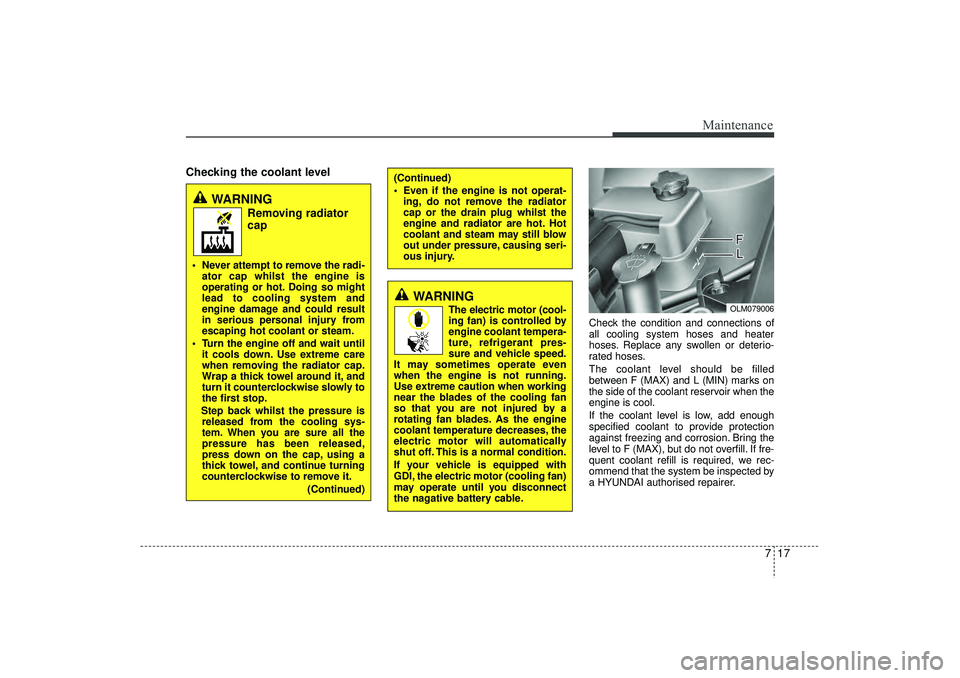
Check the condition and connections of
all cooling system hoses and heater
hoses. Replace any swollen or deterio-
rated hoses.
The coolant level should be filled
between F (MAX) and L (MIN) marks on
the side of the coolant reservoir when the
engine is cool.
If the coolant level is low, add enough
specified coolant to provide protection
against freezing and corrosion. Bring the
level to F (MAX), but do not overfill. If fre-
quent coolant refill is required, we rec-
ommend that the system be inspected by
a HYUNDAI authorised repairer.
OLM079006
(Continued)
Even if the engine is not operat-ing, do not remove the radiator
cap or the drain plug whilst the
engine and radiator are hot. Hot
coolant and steam may still blow
out under pressure, causing seri-
ous injury.
WARNING
The electric motor (cool-
ing fan) is controlled by
engine coolant tempera-
ture, refrigerant pres-
sure and vehicle speed.
It may sometimes operate even
when the engine is not running.
Use extreme caution when working
near the blades of the cooling fan
so that you are not injured by a
rotating fan blades. As the engine
coolant temperature decreases, the
electric motor will automatically
shut off. This is a normal condition.
If your vehicle is equipped with
GDI, the electric motor (cooling fan)
may operate until you disconnect
the nagative battery cable.
WARNING
Removing radiator
cap
Never attempt to remove the radi- ator cap whilst the engine is
operating or hot. Doing so might
lead to cooling system and
engine damage and could result
in serious personal injury from
escaping hot coolant or steam.
Turn the engine off and wait until it cools down. Use extreme care
when removing the radiator cap.
Wrap a thick towel around it, and
turn it counterclockwise slowly to
the first stop.
Step back whilst the pressure is released from the cooling sys-
tem. When you are sure all the
pressure has been released,
press down on the cap, using a
thick towel, and continue turning
counterclockwise to remove it.
(Continued)
EL(FL) UK 7.QXP 3/4/2015 9:04 PM Page 17
Page 513 of 550
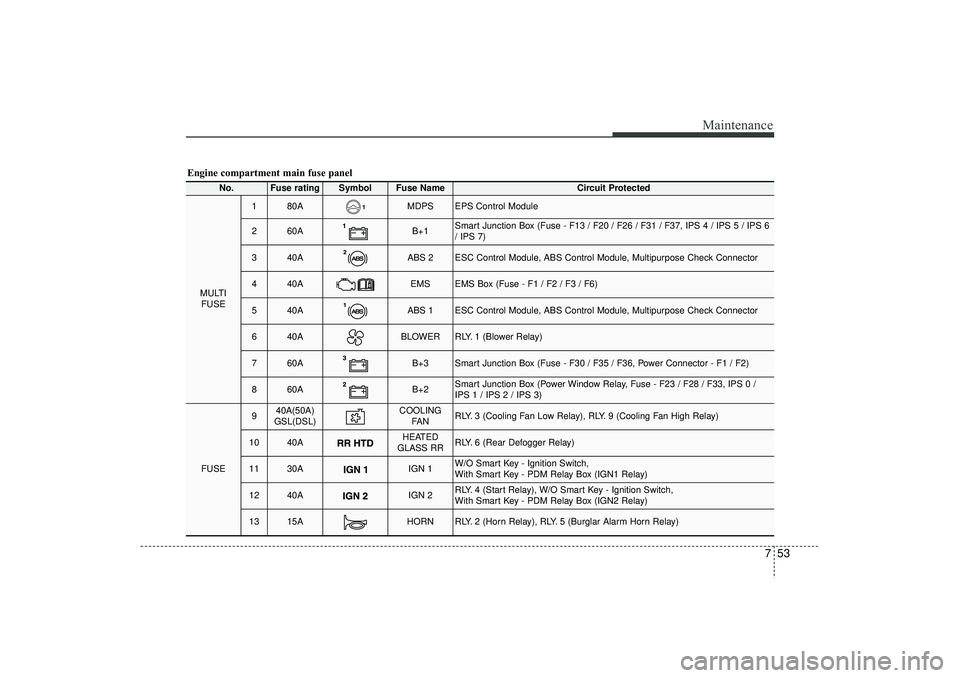
753
Maintenance
Engine compartment main fuse panel
No.
Fuse rating
Symbol
Fuse Name
Circuit Protected
MULTIFUSE
1
80A
MDPS
EPS Control Module
2
60A
B+1
Smart Junction Box (Fuse - F13 / F20 / F26 / F31 / F37, IPS 4 / IPS 5 / IPS 6
/ IPS 7)
3
40A
ABS 2
ESC Control Module, ABS Control Module, Multipurpose Check Connector
4
40A
EMS
EMS Box (Fuse - F1 / F2 / F3 / F6)
5
40A
ABS 1
ESC Control Module, ABS Control Module, Multipurpose Check Connector
6
40A
BLOWER
RLY. 1 (Blower Relay)
7
60A
B+3
Smart Junction Box (Fuse - F30 / F35 / F36, Power Connector - F1 / F2)
8
60A
B+2
Smart Junction Box (Power Window Relay, Fuse - F23 / F28 / F33, IPS 0 /
IPS 1 / IPS 2 / IPS 3)
FUSE
9
40A(50A)
GSL(DSL)
COOLING FA N
RLY. 3 (Cooling Fan Low Relay), RLY. 9 (Cooling Fan High Relay)
10
40A
HEATED
GLASS RR
RLY. 6 (Rear Defogger Relay)
11
30A
IGN 1
W/O Smart Key - Ignition Switch,
With Smart Key - PDM Relay Box (IGN1 Relay)
12
40A
IGN 2
RLY. 4 (Start Relay), W/O Smart Key - Ignition Switch,
With Smart Key - PDM Relay Box (IGN2 Relay)
13
15A
HORN
RLY. 2 (Horn Relay), RLY. 5 (Burglar Alarm Horn Relay)
EL(FL) UK 7.QXP 3/4/2015 9:07 PM Page 53