tow HYUNDAI IX35 2016 Service Manual
[x] Cancel search | Manufacturer: HYUNDAI, Model Year: 2016, Model line: IX35, Model: HYUNDAI IX35 2016Pages: 550, PDF Size: 9.92 MB
Page 454 of 550
What to do in an emergency32
6
CAUTION
- Tyre pressure
sensor
The sealant on the tyre pressuresensor and wheel should beremoved when you replace thetyre with a new one and inspectthe tyre pressure sensors inauthorised dealer.
Checking the tyre inflation pres-
sure
1. After driving approximately 4~6 miles (7~10 km or about 10 min),
stop at a safety location.
2. Connect connection hose (9) of the compressor directly to the tyre
valve.
3. Plug the compressor power cord into the vehicle power outlet.
4. Adjust the tyre inflation pressure to the recomended tyre inflation.
With the ignition switched on, pro-
ceed as follows.
- To increase the inflation pres- sure: Switch on the compressor,
position I. To check the current
inflation pressure setting, briefly
switch off the compressor.
✽ ✽ NOTICEThe pressure gauge may show high-
er than actual reading when the
compressor is running. To get an
accurate tyre reading, the compres-
sor needs to be turned off.- To reduce the inflation pres-
sure: Press the button 8 on the
compressor.
WARNING
Do not let the compressor run
for more than 10 minutes, other-
wise the device will overheat
and may be damaged.
CAUTION
If the inflation pressure is not maintained, drive the vehicle asecond time, refer toDistributing the sealant. Thenrepeat steps 1 to 4.
Use of the TMK may be ineffec-tual for tyre damage larger thanapproximately 4 mm (0.16 in).
We recommend that you contacta HYUNDAI authorised repairerif the tyre cannot be made road-worthy with the Tyre MobilityKit.
WARNING
The tyre inflation pressure must
be at least 220 kPa (32 psi). If it
is not, do not continue driving.
Call for road side service or
towing.
EL(FL) UK 6.QXP 12/16/2014 8:13 PM Page 32
Page 456 of 550
What to do in an emergency34
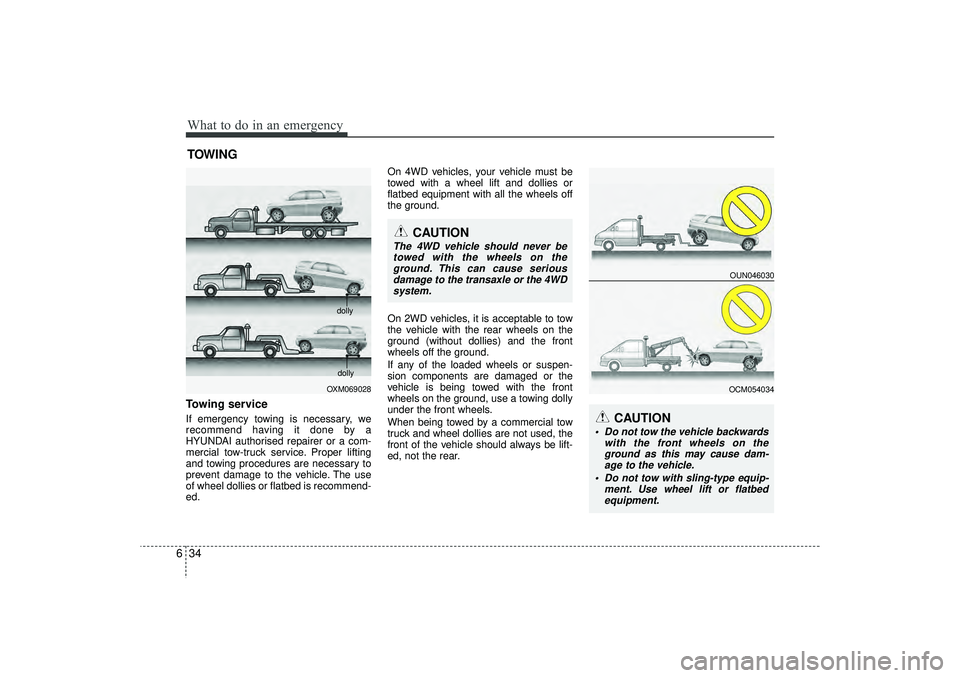
6TOWINGTowing serviceIf emergency towing is necessary, we
recommend having it done by a
HYUNDAI authorised repairer or a com-
mercial tow-truck service. Proper lifting
and towing procedures are necessary to
prevent damage to the vehicle. The use
of wheel dollies or flatbed is recommend-
ed. On 4WD vehicles, your vehicle must be
towed with a wheel lift and dollies or
flatbed equipment with all the wheels off
the ground.
On 2WD vehicles, it is acceptable to tow
the vehicle with the rear wheels on the
ground (without dollies) and the front
wheels off the ground.
If any of the loaded wheels or suspen-
sion components are damaged or the
vehicle is being towed with the front
wheels on the ground, use a towing dolly
under the front wheels.
When being towed by a commercial tow
truck and wheel dollies are not used, the
front of the vehicle should always be lift-
ed, not the rear.
OXM069028
dollydolly
CAUTION
The 4WD vehicle should never be
towed with the wheels on theground. This can cause seriousdamage to the transaxle or the 4WDsystem.
CAUTION
Do not tow the vehicle backwards with the front wheels on theground as this may cause dam- age to the vehicle.
Do not tow with sling-type equip- ment. Use wheel lift or flatbedequipment.
OUN046030OCM054034
EL(FL) UK 6.QXP 12/16/2014 8:13 PM Page 34
Page 457 of 550
635
What to do in an emergency
When towing your vehicle in an emer-
gency without wheel dollies :
1. Set the ignition switch in the ACC posi-tion.
2. Place the transaxle shift lever in N (Neutral).
3. Release the parking brake.
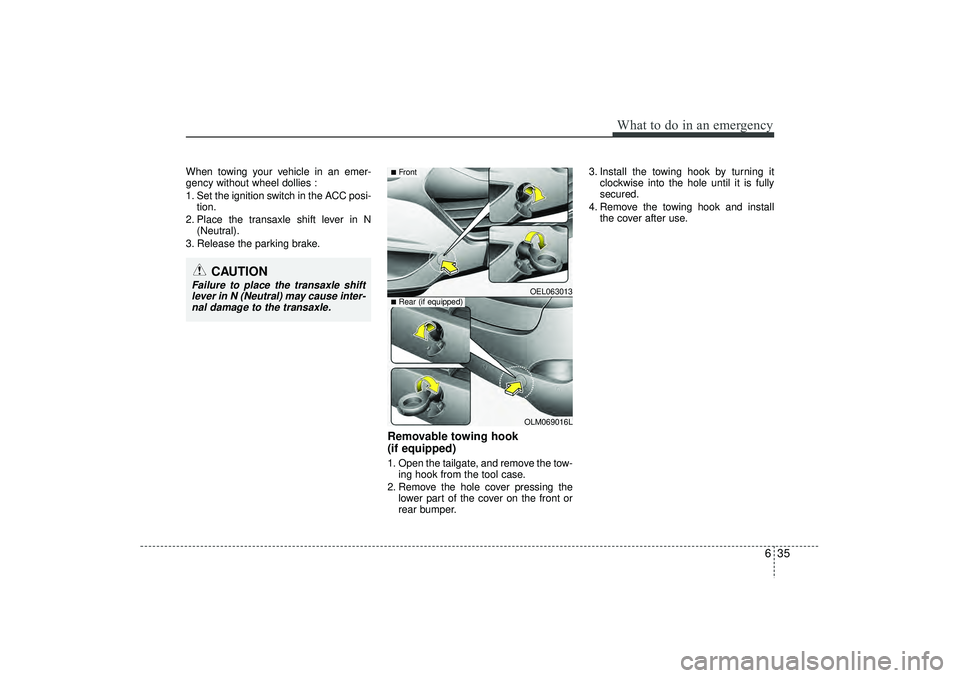
Removable towing hook
(if equipped)1. Open the tailgate, and remove the tow- ing hook from the tool case.
2. Remove the hole cover pressing the lower part of the cover on the front or
rear bumper. 3. Install the towing hook by turning it
clockwise into the hole until it is fully
secured.
4. Remove the towing hook and install the cover after use.
CAUTION
Failure to place the transaxle shiftlever in N (Neutral) may cause inter- nal damage to the transaxle.
OEL063013OLM069016L
■Front■Rear (if equipped)
EL(FL) UK 6.QXP 12/16/2014 8:13 PM Page 35
Page 458 of 550
What to do in an emergency36
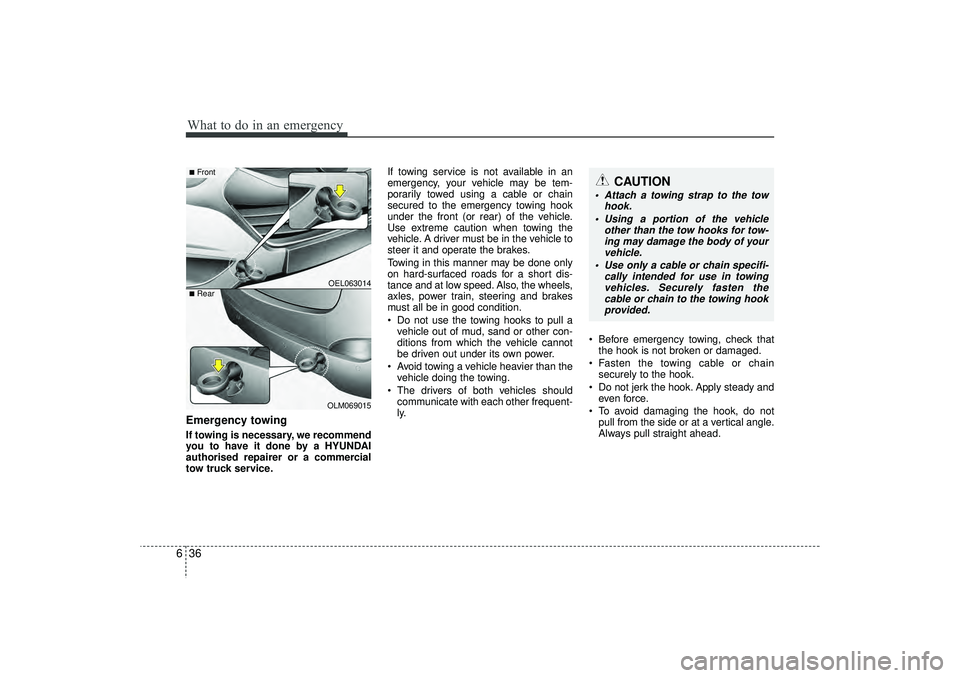
6Emergency towingIf towing is necessary, we recommend
you to have it done by a HYUNDAI
authorised repairer or a commercial
tow truck service. If towing service is not available in an
emergency, your vehicle may be tem-
porarily towed using a cable or chain
secured to the emergency towing hook
under the front (or rear) of the vehicle.
Use extreme caution when towing the
vehicle. A driver must be in the vehicle to
steer it and operate the brakes.
Towing in this manner may be done only
on hard-surfaced roads for a short dis-
tance and at low speed. Also, the wheels,
axles, power train, steering and brakes
must all be in good condition.
Do not use the towing hooks to pull a
vehicle out of mud, sand or other con-
ditions from which the vehicle cannot
be driven out under its own power.
Avoid towing a vehicle heavier than the vehicle doing the towing.
The drivers of both vehicles should communicate with each other frequent-
ly. Before emergency towing, check that
the hook is not broken or damaged.
Fasten the towing cable or chain securely to the hook.
Do not jerk the hook. Apply steady and even force.
To avoid damaging the hook, do not pull from the side or at a vertical angle.
Always pull straight ahead.
CAUTION
Attach a towing strap to the tow hook.
Using a portion of the vehicle other than the tow hooks for tow-ing may damage the body of yourvehicle.
Use only a cable or chain specifi- cally intended for use in towingvehicles. Securely fasten thecable or chain to the towing hook provided.
OEL063014OLM069015
■Front■Rear
EL(FL) UK 6.QXP 12/16/2014 8:13 PM Page 36
Page 459 of 550
637
What to do in an emergency
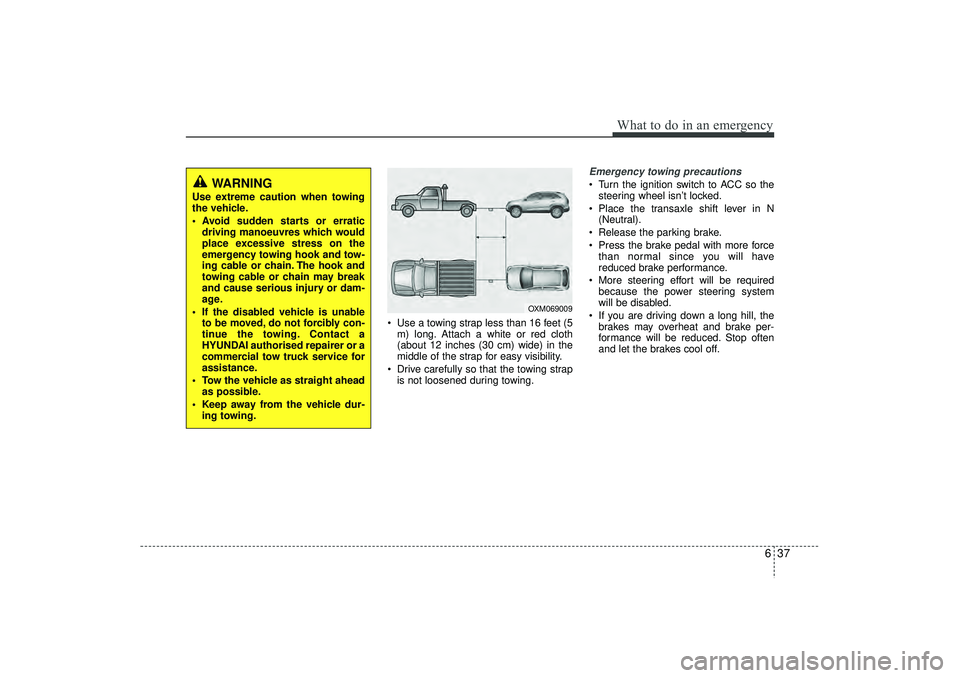
Use a towing strap less than 16 feet (5m) long. Attach a white or red cloth
(about 12 inches (30 cm) wide) in the
middle of the strap for easy visibility.
Drive carefully so that the towing strap is not loosened during towing.
Emergency towing precautions Turn the ignition switch to ACC so thesteering wheel isn’t locked.
Place the transaxle shift lever in N (Neutral).
Release the parking brake.
Press the brake pedal with more force than normal since you will have
reduced brake performance.
More steering effort will be required because the power steering system
will be disabled.
If you are driving down a long hill, the brakes may overheat and brake per-
formance will be reduced. Stop often
and let the brakes cool off.
WARNING
Use extreme caution when towing
the vehicle.
Avoid sudden starts or erratic driving manoeuvres which would
place excessive stress on the
emergency towing hook and tow-
ing cable or chain. The hook and
towing cable or chain may break
and cause serious injury or dam-
age.
If the disabled vehicle is unable to be moved, do not forcibly con-
tinue the towing. Contact a
HYUNDAI authorised repairer or a
commercial tow truck service for
assistance.
Tow the vehicle as straight ahead as possible.
Keep away from the vehicle dur- ing towing.
OXM069009
EL(FL) UK 6.QXP 12/16/2014 8:13 PM Page 37
Page 460 of 550
CAUTION - Automatictransaxle
If the car is being towed with all
four wheels on the ground, it canbe towed only from the front. Besure that the transaxle is in neu-tral. Be sure the steering is unlocked by placing the ignitionswitch in the ACC position. Adriver must be in the towed vehi- cle to operate the steering andbrakes.
To avoid serious damage to the automatic transaxle, limit thevehicle speed to 10 mph (15 km/h) and drive less than 1 mile (1.5km) when towing.
Before towing, check the auto- matic transaxle fluid leak underyour vehicle. If the automatic transaxle fluid is leaking, aflatbed equipment or towing dollymust be used.
638What to do in an emergency
EL(FL) UK 6.QXP 12/16/2014 8:13 PM Page 38
Page 477 of 550
717
Maintenance
Checking the coolant level
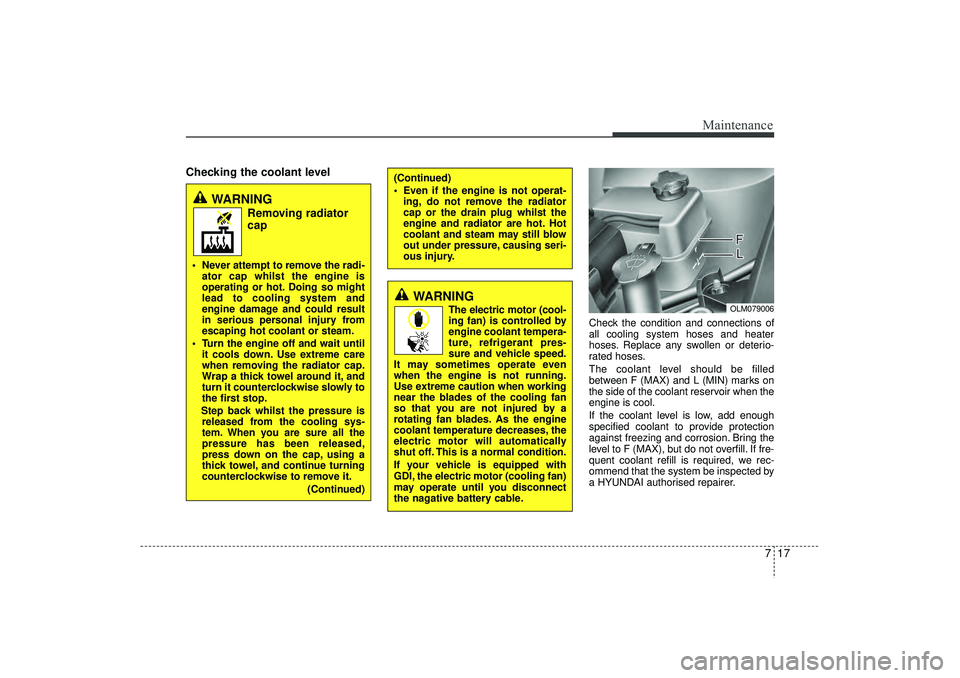
Check the condition and connections of
all cooling system hoses and heater
hoses. Replace any swollen or deterio-
rated hoses.
The coolant level should be filled
between F (MAX) and L (MIN) marks on
the side of the coolant reservoir when the
engine is cool.
If the coolant level is low, add enough
specified coolant to provide protection
against freezing and corrosion. Bring the
level to F (MAX), but do not overfill. If fre-
quent coolant refill is required, we rec-
ommend that the system be inspected by
a HYUNDAI authorised repairer.
OLM079006
(Continued)
Even if the engine is not operat-ing, do not remove the radiator
cap or the drain plug whilst the
engine and radiator are hot. Hot
coolant and steam may still blow
out under pressure, causing seri-
ous injury.
WARNING
The electric motor (cool-
ing fan) is controlled by
engine coolant tempera-
ture, refrigerant pres-
sure and vehicle speed.
It may sometimes operate even
when the engine is not running.
Use extreme caution when working
near the blades of the cooling fan
so that you are not injured by a
rotating fan blades. As the engine
coolant temperature decreases, the
electric motor will automatically
shut off. This is a normal condition.
If your vehicle is equipped with
GDI, the electric motor (cooling fan)
may operate until you disconnect
the nagative battery cable.
WARNING
Removing radiator
cap
Never attempt to remove the radi- ator cap whilst the engine is
operating or hot. Doing so might
lead to cooling system and
engine damage and could result
in serious personal injury from
escaping hot coolant or steam.
Turn the engine off and wait until it cools down. Use extreme care
when removing the radiator cap.
Wrap a thick towel around it, and
turn it counterclockwise slowly to
the first stop.
Step back whilst the pressure is released from the cooling sys-
tem. When you are sure all the
pressure has been released,
press down on the cap, using a
thick towel, and continue turning
counterclockwise to remove it.
(Continued)
EL(FL) UK 7.QXP 3/4/2015 9:04 PM Page 17