check engine Hyundai Kona 2019 Repair Manual
[x] Cancel search | Manufacturer: HYUNDAI, Model Year: 2019, Model line: Kona, Model: Hyundai Kona 2019Pages: 485, PDF Size: 15.75 MB
Page 436 of 485
7-64
Maintenance
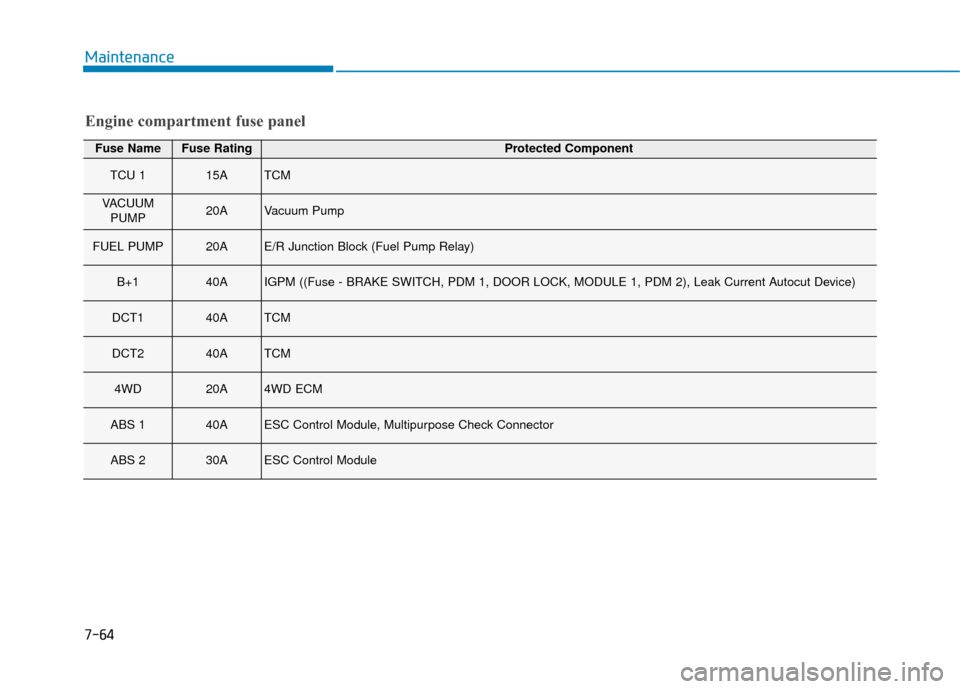
Engine compartment fuse panel
Fuse NameFuse RatingProtected Component
TCU 115ATCM
VACUUMPUMP20AVacuum Pump
FUEL PUMP20AE/R Junction Block (Fuel Pump Relay)
B+140AIGPM ((Fuse - BRAKE SWITCH, PDM 1, DOOR LOCK, MODULE 1, PDM 2), Leak \
Current Autocut Device)
DCT140ATCM
DCT240ATCM
4WD20A4WD ECM
ABS 140AESC Control Module, Multipurpose Check Connector
ABS 230AESC Control Module
Page 437 of 485
7-65
7
Maintenance
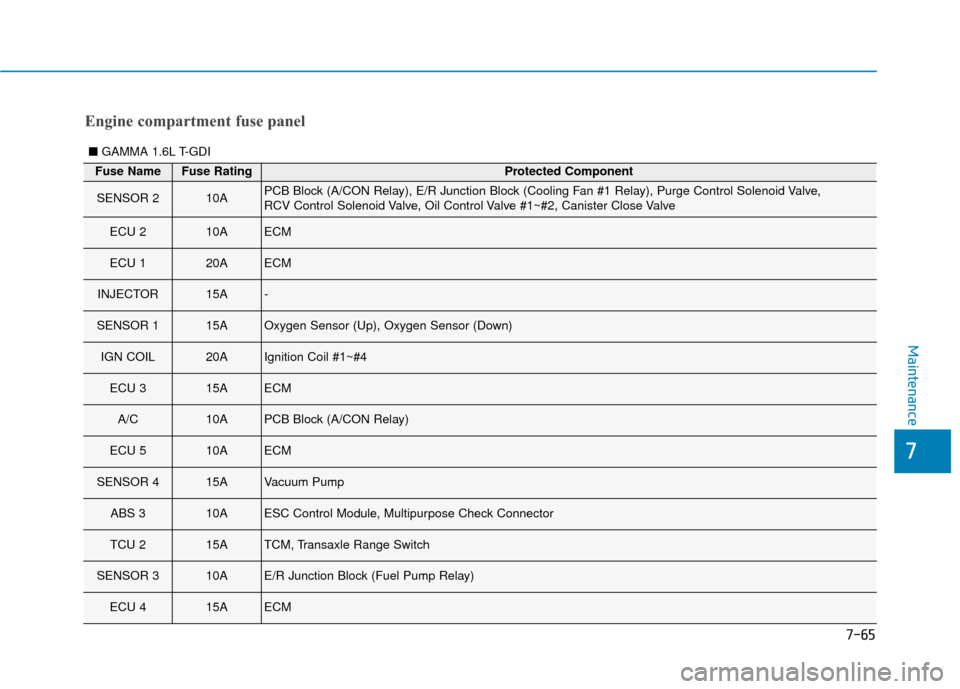
Fuse NameFuse RatingProtected Component
SENSOR 210APCB Block (A/CON Relay), E/R Junction Block (Cooling Fan #1 Relay), Purge Control Solenoid Valve,
RCV Control Solenoid Valve, Oil Control Valve #1~#2, Canister Close Valve
ECU 210AECM
ECU 120AECM
INJECTOR15A-
SENSOR 115AOxygen Sensor (Up), Oxygen Sensor (Down)
IGN COIL20AIgnition Coil #1~#4
ECU 315AECM
A/C10APCB Block (A/CON Relay)
ECU 510AECM
SENSOR 415AVacuum Pump
ABS 310AESC Control Module, Multipurpose Check Connector
TCU 215ATCM, Transaxle Range Switch
SENSOR 310AE/R Junction Block (Fuel Pump Relay)
ECU 415AECM
■ GAMMA 1.6L T-GDI
Engine compartment fuse panel
Page 440 of 485
7-68
Maintenance
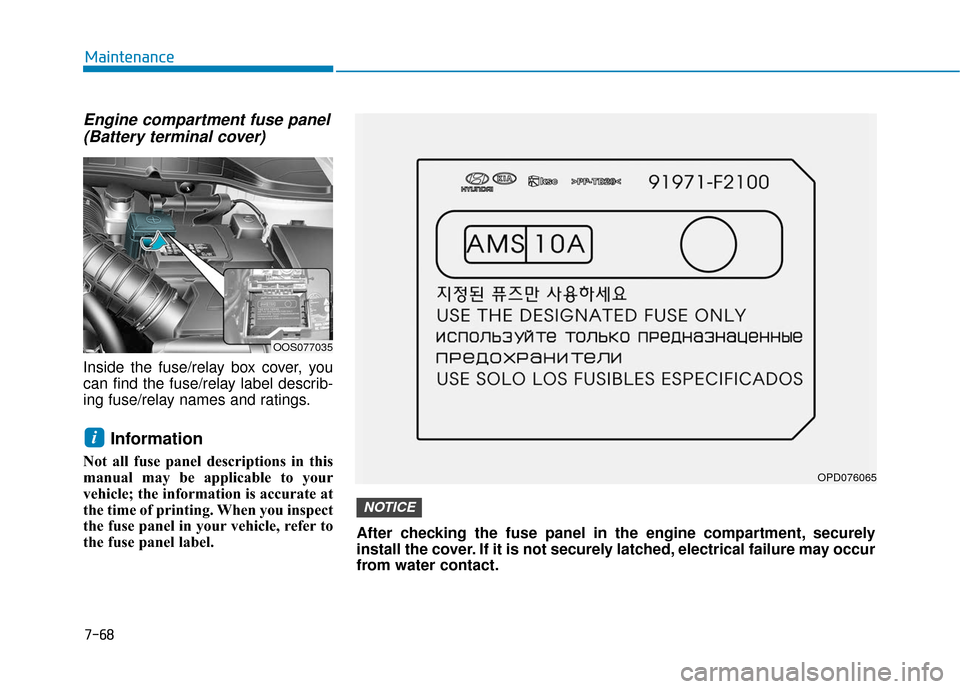
Engine compartment fuse panel(Battery terminal cover)
Inside the fuse/relay box cover, you
can find the fuse/relay label describ-
ing fuse/relay names and ratings.
Information
Not all fuse panel descriptions in this
manual may be applicable to your
vehicle; the information is accurate at
the time of printing. When you inspect
the fuse panel in your vehicle, refer to
the fuse panel label.
i
OOS077035
OPD076065
After checking the fuse panel in the engine compartment, securely
install the cover. If it is not securely latched, electrical failure may occur
from water contact.
NOTICE
Page 460 of 485
7-88
Maintenance
Canister
Fuel vapors generated inside the fuel
tank are absorbed and stored in the
onboard canister. When the engine is
running, the fuel vapors absorbed in
the canister are drawn into the surge
tank through the purge control sole-
noid valve.
Purge Control Solenoid Valve(PCSV)
The purge control solenoid valve is
controlled by the Engine Control
Module (ECM); when the engine
coolant temperature is low during
idling, the PCSV closes so that evap-
orated fuel is not taken into the
engine. After the engine warms-up
during ordinary driving, the PCSV
opens to introduce evaporated fuel to
the engine.
3. Exhaust Emission Control System
The Exhaust Emission Control
System is a highly effective system
which controls exhaust emissions
while maintaining good vehicle per-
formance.
When the engine starts or fails to
start, excessive attempts to restart
the engine may cause damage to the
emission system.
Engine exhaust (carbon monox-
ide) precautions
Carbon monoxide can be present
with other exhaust fumes. If you
smell exhaust fumes of any kind in
your vehicle, drive with all the win-
dows fully open. Have your vehicle
checked and repaired immediately.
Engine exhaust gases contain
carbon monoxide (CO). Though
colorless and odorless, it is
dangerous and could be lethal if
inhaled. Follow the instructions
on this page to avoid CO poi-
soning.
WARNING
Page 472 of 485
8-9
88
Specifications, Consumer information and Reporting safety defects
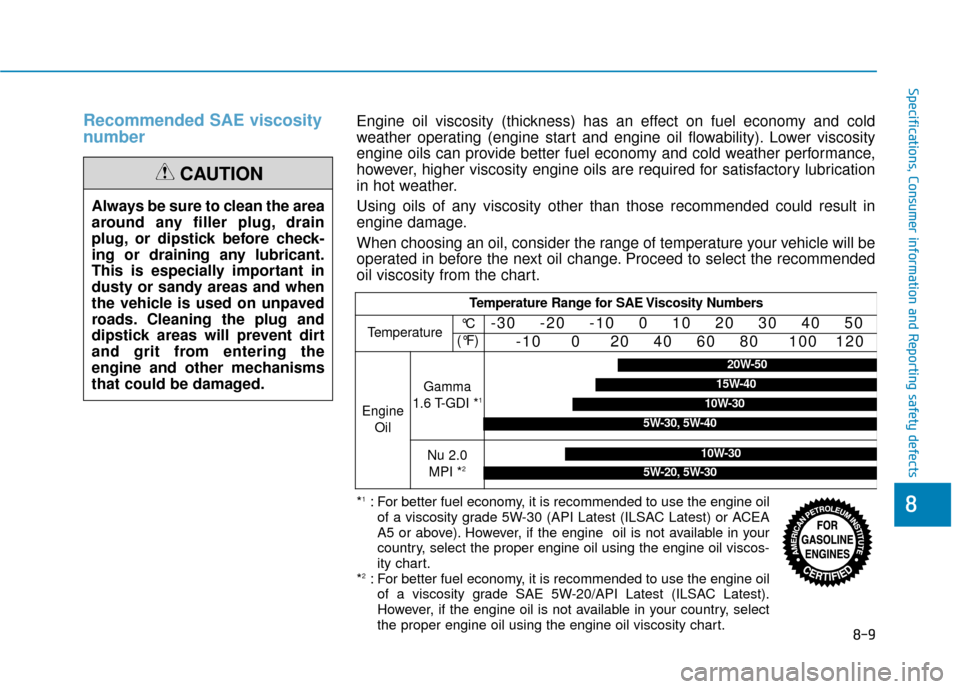
Recommended SAE viscosity
number
Always be sure to clean the area
around any filler plug, drain
plug, or dipstick before check-
ing or draining any lubricant.
This is especially important in
dusty or sandy areas and when
the vehicle is used on unpaved
roads. Cleaning the plug and
dipstick areas will prevent dirt
and grit from entering the
engine and other mechanisms
that could be damaged.
CAUTION
Temperature Range for SAE Viscosity Numbers
Temperature -30 -20 -10 0 10 20 30 40 50
-10 0 20 40 60 80 100 120
Engine Oil
Gamma
1.6 T-GDI *1
Nu 2.0 MPI *2
°C
(°F)
*1: For better fuel economy, it is recommended to use the engine oil of a viscosity grade 5W-30 (API Latest (ILSAC Latest) or ACEA
A5 or above). However, if the engine oil is not available in your
country, select the proper engine oil using the engine oil viscos-
ity chart.
*
2: For better fuel economy, it is recommended to use the engine oil of a viscosity grade SAE 5W-20/API Latest (ILSAC Latest).
However, if the engine oil is not available in your country, select
the proper engine oil using the engine oil viscosity chart.
5W-30, 5W-40
10W-30
15W-40
20W-50
10W-30
5W-20, 5W-30
Engine oil viscosity (thickness) has an effect on fuel economy and cold
weather operating (engine start and engine oil flowability). Lower viscosity
engine oils can provide better fuel economy and cold weather performance,
however, higher viscosity engine oils are required for satisfactory lubrication
in hot weather.
Using oils of any viscosity other than those recommended could result in
engine damage.
When choosing an oil, consider the range of temperature your vehicle will be
operated in before the next oil change. Proceed to select the recommended
oil viscosity from the chart.
Page 480 of 485
I-4
Emission control system .................................................7-87Crankcase Emission Control System .........................7-87
Evaporative Emission Control System Including Onboard Refueling Vapor Recovery (ORVR) ........7-87
Exhaust Emission Control System .............................7-88
Engine ........................................................................\
.......8-2
Engine Compartment.................................................1-6, 7-3
Engine coolant ................................................................7-23 Changing Engine Coolant ..........................................7-26
Checking the Engine Coolant Level ..........................7-23
Engine Number ...............................................................8-11
Engine oil ........................................................................\
7-21 Checking the Engine Oil and Filter ...........................7-22
Checking the Engine Oil Level ..................................7-21
Explanation of scheduled maintenance items.................7-18
Exterior Features .................................................3-41, 3-142 Fuel Filler Door ..........................................................3-44
Hood ........................................................................\
...3-41
Liftgate .......................................................................3\
-42
Roof Side Rails ........................................................3-142
Exterior Overview.............................................................1-2 Forward Collision-avoidance Assist (FCA) system
- Camera type ..............................................................5-55
FCA Sensor ................................................................5-59
FCA Warning Message and System Control..............5-57
Limitations of the System ..........................................5-63
System Malfunction ...................................................5-61
System Setting and Activation ...................................5-55
Forward collision-avoidance assist (FCA) system - sensor fusion type (Front radar + Front camera) ......5-68
System Setting and Activation ...................................5-68
FCA Sensor ................................................................5-72
FCA Warning Message and System Control..............5-70
Limitations of the System ..........................................5-75
System Malfunction ...................................................5-73
Fuses ........................................................................\
.......7-53 Engine Compartment Panel Fuse Replacement .........7-55
Fuse/Relay Panel Description ....................................7-57
Instrument Panel Fuse Replacement ..........................7-54
Hazard warning flasher .....................................................6-2
Head Up Display (HUD) ................................................3-85
Index
EF
H
Page 481 of 485
I-5
If the engine overheats ......................................................6-6
If the engine will not start.................................................6-3If the Engine Doesn't Turn Over or Turns Over Slowly ....................................................6-3
If the Engine Turns Over Normally but Doesn't Start ........................................................6-3
If you have a flat tire (With spare tire) ...........................6-14 Changing Tires ...........................................................6-15
Jack and Tools ............................................................6-14
If you have a flat tire (with tire mobility kit) .................6-20 Checking the tire inflation pressure ...........................6-25
Components of the Tire Mobility Kit.........................6-22
Distributing the sealant ..............................................6-24
Introduction ................................................................6-20
Notes on the safe use of the Tire Mobility Kit ..........6-21
Using the Tire Mobility Kit........................................6-23
Ignition switch ..................................................................5-6 Engine Start/Stop Button ..............................................5-9
Key Ignition Switch .....................................................5-6
Important Safety Precautions............................................2-2 Air Bag Hazards ...........................................................2-2
Always Wear Your Seat Belt ........................................2-2
Control Your Speed ......................................................2-2
Driver Distraction.........................................................2-2
Keep Your Vehicle in Safe Condition ..........................2-2
Restrain All Children....................................................2-2 In case of an emergency while driving .............................6-2
If the Engine Stalls at a Crossroad or Crossing ...........6-2
If the Engine Stalls While Driving...............................6-2
If you Have a Flat Tire While Driving.........................6-3
Instrument Cluster...........................................................3-47 Gauges and Meters .....................................................3-49
Instrument Cluster Control .........................................3-48
LCD Display Messages ..............................................3-65
Transmission shift indicator .......................................3-52
Warning and Indicator Lights.....................................3-53
Instrument Panel Overview ..............................................1-5
Interior Features ............................................................3-133 Cargo Area Cover .....................................................3-140
Clock ........................................................................\
3-138
Clothes Hanger .........................................................3-138
Cup Holder ...............................................................3-133
Floor Mat Anchor(s) .................................................3-139
Luggage Net Holder .................................................3-139
Luggage tray.............................................................3-141
Power Outlet.............................................................3-135
Sunvisor ....................................................................3-13\
4
Wireless Cellular Phone Charging System ..............3-136
Interior Overview..............................................................1-4
Jump starting .....................................................................6-4\
I
Index
J
I