awd Hyundai Kona 2020 User Guide
[x] Cancel search | Manufacturer: HYUNDAI, Model Year: 2020, Model line: Kona, Model: Hyundai Kona 2020Pages: 505, PDF Size: 13.47 MB
Page 388 of 505
![Hyundai Kona 2020 User Guide 6-27
What to do in an emergency
6
Towing Service
[A] : Dollies
If emergency towing is necessary,
we recommend having it done by an
authorized HYUNDAI dealer or a
commercial tow-truck service.
Proper l](/img/35/16222/w960_16222-387.png "Hyundai Kona 2020 User Guide 6-27
What to do in an emergency
6
Towing Service
[A] : Dollies
If emergency towing is necessary,
we recommend having it done by an
authorized HYUNDAI dealer or a
commercial tow-truck service.
Proper l")
6-27
What to do in an emergency
6
Towing Service
[A] : Dollies
If emergency towing is necessary,
we recommend having it done by an
authorized HYUNDAI dealer or a
commercial tow-truck service.
Proper lifting and towing procedures
are necessary to prevent damage to
the vehicle. The use of wheel dollies
or flatbed is recommended.On 2WD vehicles, it is acceptable to
tow the vehicle with the rear wheels
on the ground (without dollies) and
the front wheels off the ground. If any
of the loaded wheels or suspension
components are damaged or the
vehicle is being towed with the front
wheels on the ground, use a towing
dolly under the front wheels.
When being towed by a commercial
tow truck and wheel dollies are not
used, the front of the vehicle should
always be lifted, not the rear.
If your vehicle is an AWD vehicle, it
must be towed with a wheel lift and
dollies or flatbed equipment with all
the wheels off the ground.
T T
O
O W
W I
IN
N G
G
Do not tow the vehicle with the
front wheels on the ground as
this may cause damage to the
vehicle.
Do not tow with sling-type
equipment. Use a wheel lift or
flatbed equipment.
CAUTION
OOS067007L
An AWD vehicle should never
be towed with the wheels on the
ground. This can cause serious
damage to the transaxle or the
AWD system.
CAUTION
OOS067022
OOS067021
Page 400 of 505
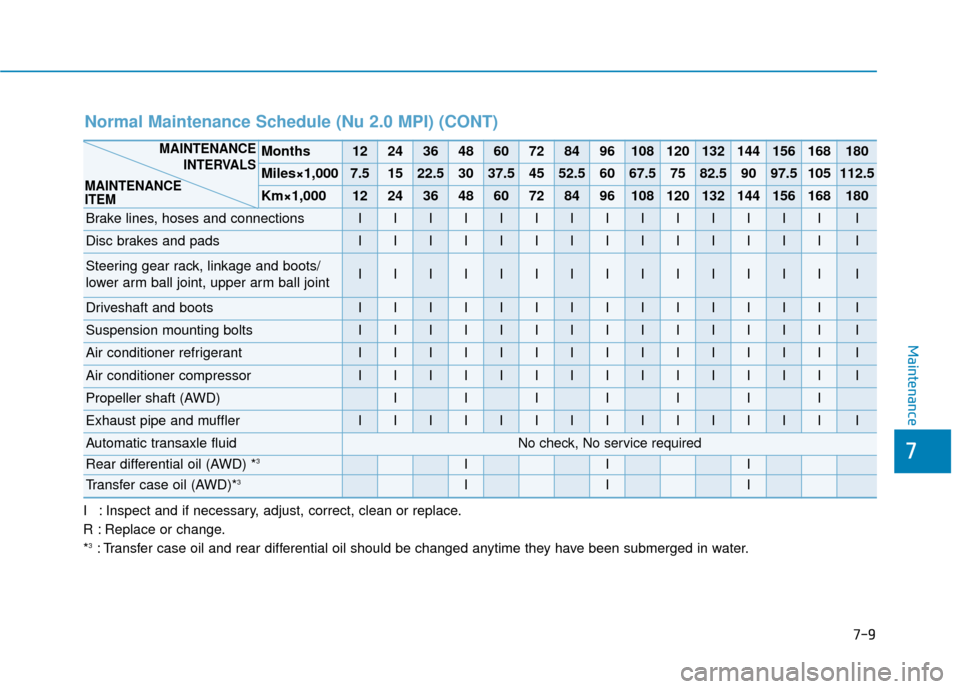
7-9
7
Maintenance
I : Inspect and if necessary, adjust, correct, clean or replace.
R : Replace or change.
*
3: Transfer case oil and rear differential oil should be changed anytime they have been submerged in water.
Normal Maintenance Schedule (Nu 2.0 MPI) (CONT)
Months1224364860728496108120132144156168180
Miles×1,0007.51522.53037.54552.56067.57582.59097.5105112.5
Km×1,0001224364860728496108120132144156168180
Brake lines, hoses and connectionsIIIIIIIIIIIIIII
Disc brakes and padsIIIIIIIIIIIIIII
Steering gear rack, linkage and boots/
lower arm ball joint, upper arm ball jointIIIIIIIIIIIIIII
Driveshaft and bootsIIIIIIIIIIIIIII
Suspension mounting boltsIIIIIIIIIIIIIII
Air conditioner refrigerantIIIIIIIIIIIIIII
Air conditioner compressorIIIIIIIIIIIIIII
Propeller shaft (AWD)IIIIIII
Exhaust pipe and mufflerIIIIIIIIIIIIIII
Automatic transaxle fluidNo check, No service required
Rear differential oil (AWD) *3III
Transfer case oil (AWD)*3III
MAINTENANCEINTERVALS
MAINTENANCE
ITEM
Page 403 of 505
7-12
Maintenance
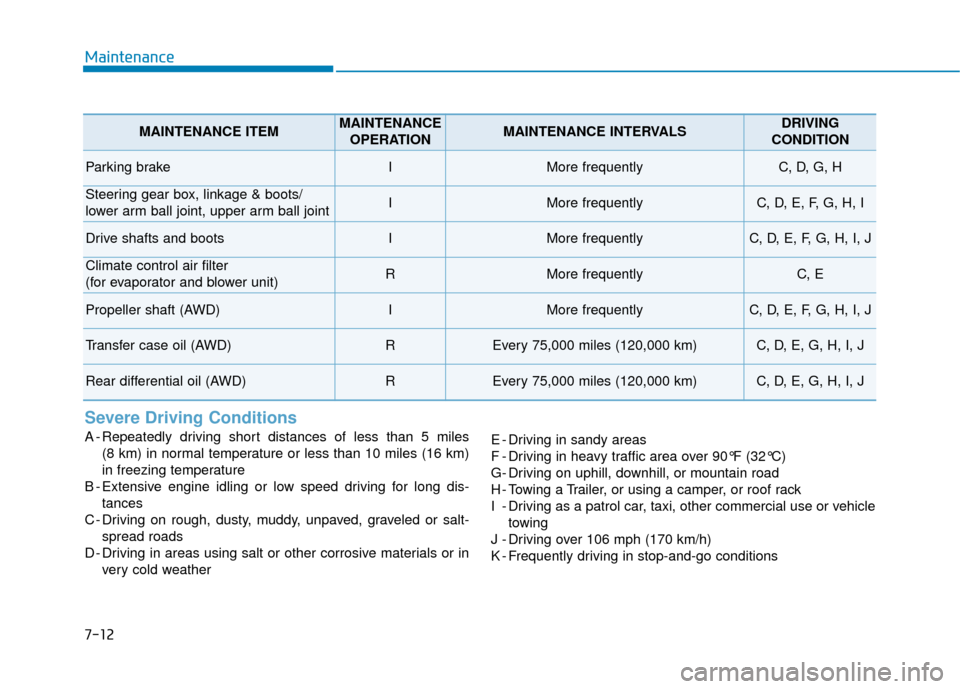
Severe Driving Conditions
A - Repeatedly driving short distances of less than 5 miles (8 km) in normal temperature or less than 10 miles (16 km)
in freezing temperature
B - Extensive engine idling or low speed driving for long dis- tances
C - Driving on rough, dusty, muddy, unpaved, graveled or salt- spread roads
D - Driving in areas using salt or other corrosive materials or in very cold weather E - Driving in sandy areas
F - Driving in heavy traffic area over 90°F (32°C)
G- Driving on uphill, downhill, or mountain road
H - Towing a Trailer, or using a camper, or roof rack
I - Driving as a patrol car, taxi, other commercial use or vehicle
towing
J - Driving over 106 mph (170 km/h)
K - Frequently driving in stop-and-go conditions
MAINTENANCE ITEMMAINTENANCE OPERATIONMAINTENANCE INTERVALSDRIVING
CONDITION
Parking brakeIMore frequentlyC, D, G, H
Steering gear box, linkage & boots/
lower arm ball joint, upper arm ball jointIMore frequentlyC, D, E, F, G, H, I
Drive shafts and bootsIMore frequentlyC, D, E, F, G, H, I, J
Climate control air filter
(for evaporator and blower unit)RMore frequentlyC, E
Propeller shaft (AWD)IMore frequentlyC, D, E, F, G, H, I, J
Transfer case oil (AWD)REvery 75,000 miles (120,000 km) C, D, E, G, H, I, J
Rear differential oil (AWD)REvery 75,000 miles (120,000 km) C, D, E, G, H, I, J
Page 405 of 505
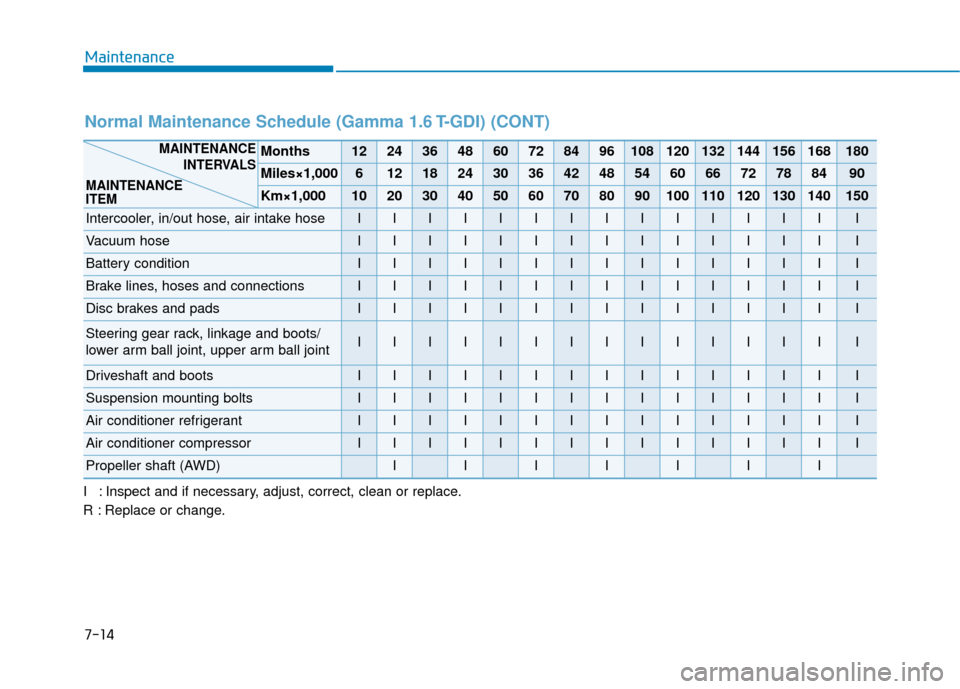
7-14
Maintenance
I : Inspect and if necessary, adjust, correct, clean or replace.
R : Replace or change.
Normal Maintenance Schedule (Gamma 1.6 T-GDI) (CONT)
Months1224364860728496108120132144156168180
Miles×1,00061218243036424854606672788490
Km×1,000102030405060708090100110120130140150
Intercooler, in/out hose, air intake hoseIIIIIIIIIIIIIII
Vacuum hoseIIIIIIIIIIIIIII
Battery conditionIIIIIIIIIIIIIII
Brake lines, hoses and connectionsIIIIIIIIIIIIIII
Disc brakes and padsIIIIIIIIIIIIIII
Steering gear rack, linkage and boots/
lower arm ball joint, upper arm ball jointIIIIIIIIIIIIIII
Driveshaft and bootsIIIIIIIIIIIIIII
Suspension mounting boltsIIIIIIIIIIIIIII
Air conditioner refrigerantIIIIIIIIIIIIIII
Air conditioner compressorIIIIIIIIIIIIIII
Propeller shaft (AWD)IIIIIII
MAINTENANCEINTERVALS
MAINTENANCE
ITEM
Page 406 of 505
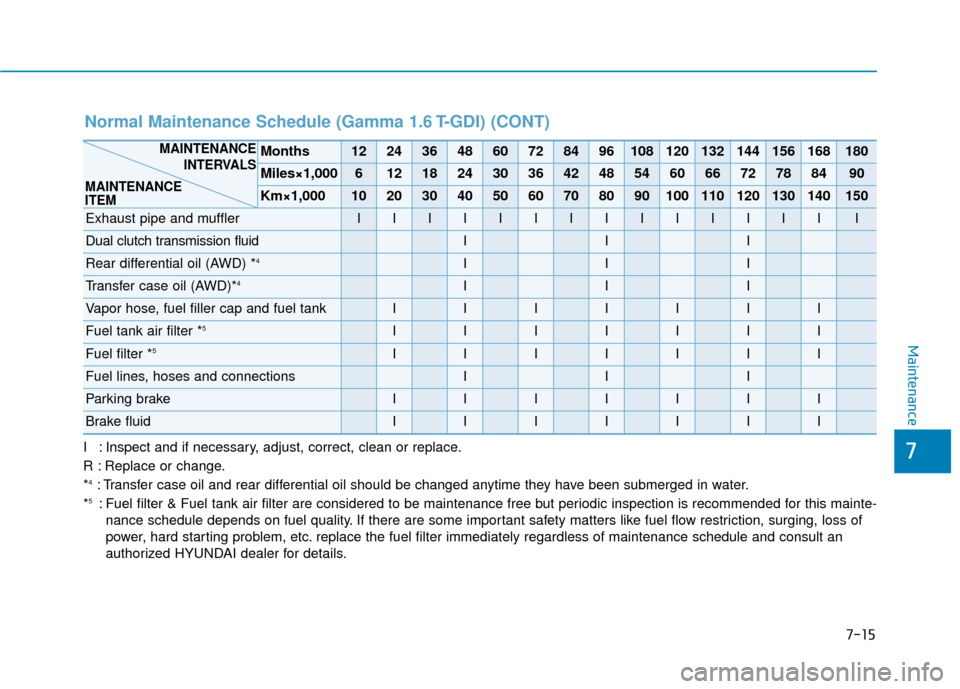
7-15
7
Maintenance
I : Inspect and if necessary, adjust, correct, clean or replace.
R : Replace or change.
*
4: Transfer case oil and rear differential oil should be changed anytime they have been submerged in water.
*5: Fuel filter & Fuel tank air filter are considered to be maintenance free\
but periodic inspection is recommended for this mainte- nance schedule depends on fuel quality. If there are some important safety matters like fuel flow restriction, surging, loss of
power, hard starting problem, etc. replace the fuel filter immediately regardless of maintenance schedule a\
nd consult an
authorized HYUNDAI dealer for details.
Normal Maintenance Schedule (Gamma 1.6 T-GDI) (CONT)
Months1224364860728496108120132144156168180
Miles×1,00061218243036424854606672788490
Km×1,000102030405060708090100110120130140150
Exhaust pipe and mufflerIIIIIIIIIIIIIII
Dual clutch transmission fluidIII
Rear differential oil (AWD) *4III
Transfer case oil (AWD)*4III
Vapor hose, fuel filler cap and fuel tankIIIIIII
Fuel tank air filter *5IIIIIII
Fuel filter *5IIIIIII
Fuel lines, hoses and connectionsIII
Parking brakeIIIIIII
Brake fluidIIIIIII
MAINTENANCE INTERVALS
MAINTENANCE
ITEM
Page 408 of 505
7-17
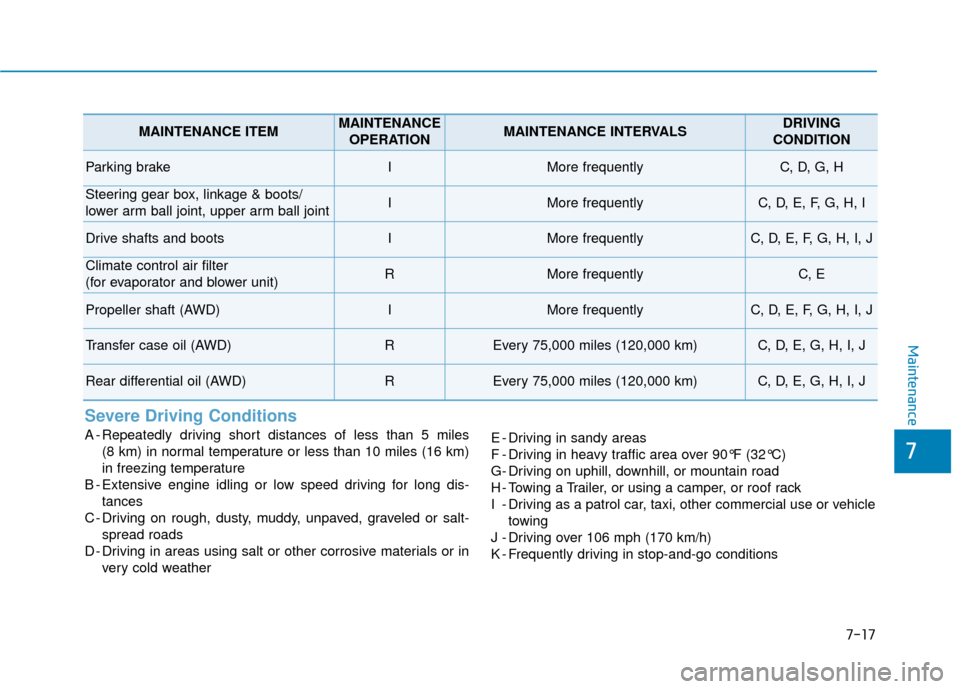
7
Maintenance
Severe Driving Conditions
A - Repeatedly driving short distances of less than 5 miles (8 km) in normal temperature or less than 10 miles (16 km)
in freezing temperature
B - Extensive engine idling or low speed driving for long dis- tances
C - Driving on rough, dusty, muddy, unpaved, graveled or salt- spread roads
D - Driving in areas using salt or other corrosive materials or in very cold weather E - Driving in sandy areas
F - Driving in heavy traffic area over 90°F (32°C)
G- Driving on uphill, downhill, or mountain road
H - Towing a Trailer, or using a camper, or roof rack
I - Driving as a patrol car, taxi, other commercial use or vehicle
towing
J - Driving over 106 mph (170 km/h)
K - Frequently driving in stop-and-go conditions
MAINTENANCE ITEMMAINTENANCE OPERATIONMAINTENANCE INTERVALSDRIVING
CONDITION
Parking brakeIMore frequentlyC, D, G, H
Steering gear box, linkage & boots/
lower arm ball joint, upper arm ball jointIMore frequentlyC, D, E, F, G, H, I
Drive shafts and bootsIMore frequentlyC, D, E, F, G, H, I, J
Climate control air filter
(for evaporator and blower unit)RMore frequentlyC, E
Propeller shaft (AWD)IMore frequentlyC, D, E, F, G, H, I, J
Transfer case oil (AWD)REvery 75,000 miles (120,000 km) C, D, E, G, H, I, J
Rear differential oil (AWD)REvery 75,000 miles (120,000 km) C, D, E, G, H, I, J
Page 489 of 505
8-6
Specifications, Consumer information and Reporting safety defects
V
VO
O L
LU
U M
M E
E
A
A N
N D
D
W
W E
EI
IG
G H
H T
T
A
A I
IR
R
C
C O
O N
ND
DI
IT
T I
IO
O N
NI
IN
N G
G
S
S Y
Y S
ST
T E
EM
M
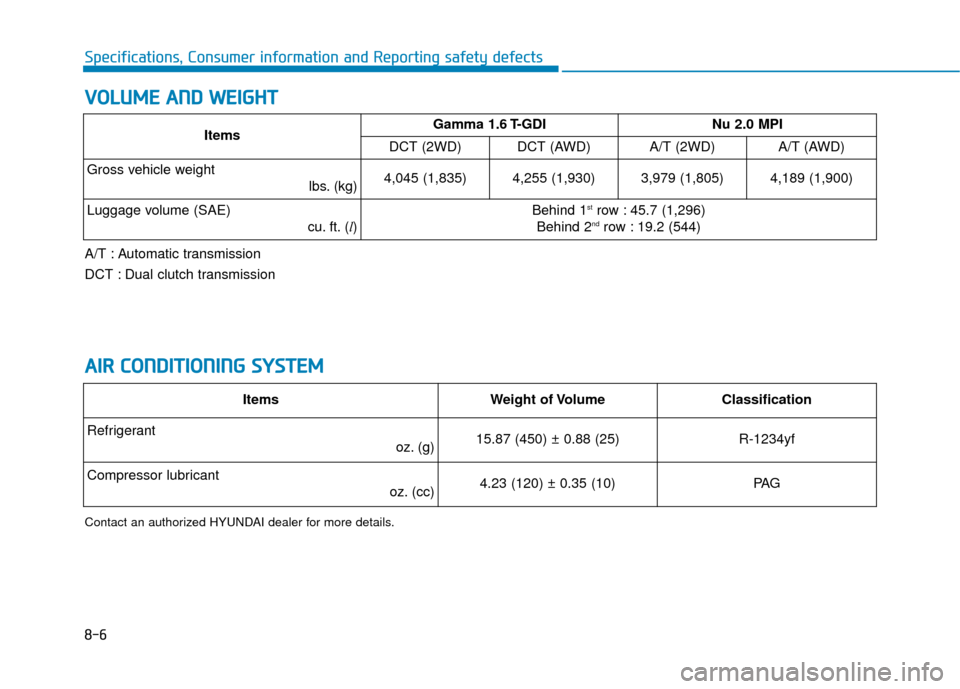
Contact an authorized HYUNDAI dealer for more details.
ItemsGamma 1.6 T-GDINu 2.0 MPI
DCT (2WD)DCT (AWD)A/T (2WD)A/T (AWD)
Gross vehicle weight
lbs. (kg)4,045 (1,835)4,255 (1,930)3,979 (1,805)4,189 (1,900)
Luggage volume (SAE)cu. ft. (l)Behind 1strow : 45.7 (1,296)
Behind 2ndrow : 19.2 (544)
ItemsWeight of VolumeClassification
Refrigerant oz. (g) 15.87 (450) ± 0.88 (25) R-1234yf
Compressor lubricantoz. (cc) 4.23 (120) ± 0.35 (10)PA G
A/T : Automatic transmission
DCT : Dual clutch transmission
Page 491 of 505
8-8
Specifications, Consumer information and Reporting safety defects
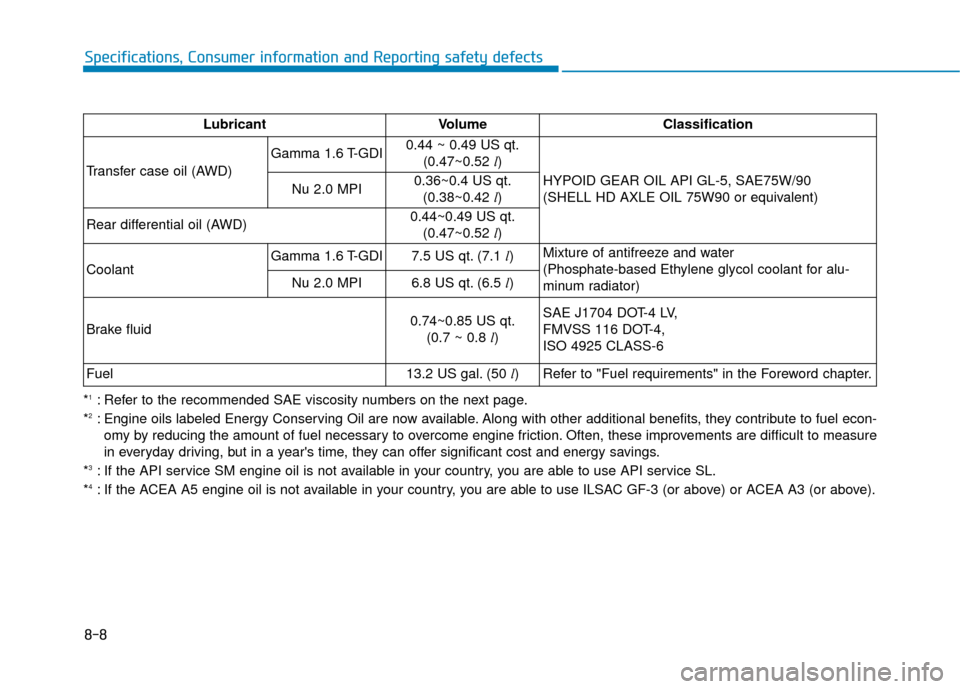
*1: Refer to the recommended SAE viscosity numbers on the next page.
*2: Engine oils labeled Energy Conserving Oil are now available. Along with other additional benefits, they contribute to fuel econ -
omy by reducing the amount of fuel necessary to overcome engine friction. Often, these improvements are difficult to measure
in everyday driving, but in a year's time, they can offer significant cost and energy savings.
*
3: If the API service SM engine oil is not available in your country, you are able to use API service SL.
*4: If the ACEA A5 engine oil is not available in your country, you are able to use ILSAC GF-3 (or above) or ACEA A3 (or above). Lubricant
Volume
Classification
Transfer case oil (AWD) Gamma 1.6 T-GDI
0.44 ~ 0.49 US qt.
(0.47~0.52 l)
HYPOID GEAR OIL API GL-5, SAE75W/90
(SHELL HD AXLE OIL 75W90 or equivalent)
Nu 2.0 MPI
0.36~0.4 US qt.
(0.38~0.42 l)
Rear differential oil (AWD)
0.44~0.49 US qt. (0.47~0.52 l)
Coolant Gamma 1.6 T-GDI
7.5 US qt. (7.1
l)Mixture of antifreeze and water
(Phosphate-based Ethylene glycol coolant for alu-
minum radiator)
Nu 2.0 MPI
6.8 US qt. (6.5
l)
Brake fluid
0.74~0.85 US qt. (0.7 ~ 0.8 l) SAE J1704 DOT-4 LV,
FMVSS 116 DOT-4,
ISO 4925 CLASS-6
Fuel13.2 US gal. (50 l)Refer to "Fuel requirements" in the Foreword chapter.
Page 498 of 505

I-2
Accessing Your Vehicle ....................................................3-3Immobilizer System....................................................3-\
11
Remote Key ..................................................................3-3
Smart Key.....................................................................3-6\
Air Bag - Advanced Supplemental Restraint System.....2-45 Additional Safety Precautions ....................................2-67
Air Bag Warning Labels.............................................2-67
How Does the Air Bag System Operate? ...................2-50
Occupant Classification System (OCS) .....................2-56
SRS Care ....................................................................2-66\
What to Expect After an Air Bag Inflates ..................2-55
Where Are the Air Bags? ...........................................2-47
Why Didn't My Air Bag Go Off in a Collision?........2-61
Air cleaner.......................................................................7\
-29 Filter Replacement .....................................................7-29
Air Conditioning System ..................................................8-6
All Wheel Drive (AWD) .................................................5-40 AWD operation...........................................................5-41
Emergency precautions ..............................................5-44
Appearance care..............................................................7-80 Exterior Care ..............................................................7-80
Interior Care ...............................................................7-85 Automatic Climate Control System ..............................3-118
Automatic Temperature Control Mode ....................3-119
Manual Temperature Control Mode .........................3-120
System Maintenance ................................................3-125
System Operation .....................................................3-123
Automatic Transmission .................................................5-14 Automatic Transmission Operation............................5-14
Good Driving Practices ..............................................5-18
Battery ........................................................................\
.....7-35 Battery Recharging .....................................................7-36
For Best Battery Service ............................................7-36
Reset Features ............................................................7-37
Before driving ...................................................................5-4 Before Entering the Vehicle .........................................5-4
Before Starting .............................................................5-4
Blind-spot Collision Warning (BCW) system ................5-47 BCW (Blind-spot Collision Warning) ........................5-48
Detecting sensor .........................................................5-52
Limitations of the System ..........................................5-53
RCCW (Rear Cross-Traffic Collision Warning) ........5-50
Brake fluid ......................................................................7-\
27 Checking the Brake Fluid Level ................................7-27
Index
A
B