Oil engine Hyundai Kona 2020 Owner's Guide
[x] Cancel search | Manufacturer: HYUNDAI, Model Year: 2020, Model line: Kona, Model: Hyundai Kona 2020Pages: 505, PDF Size: 13.47 MB
Page 457 of 505
7-66
Maintenance
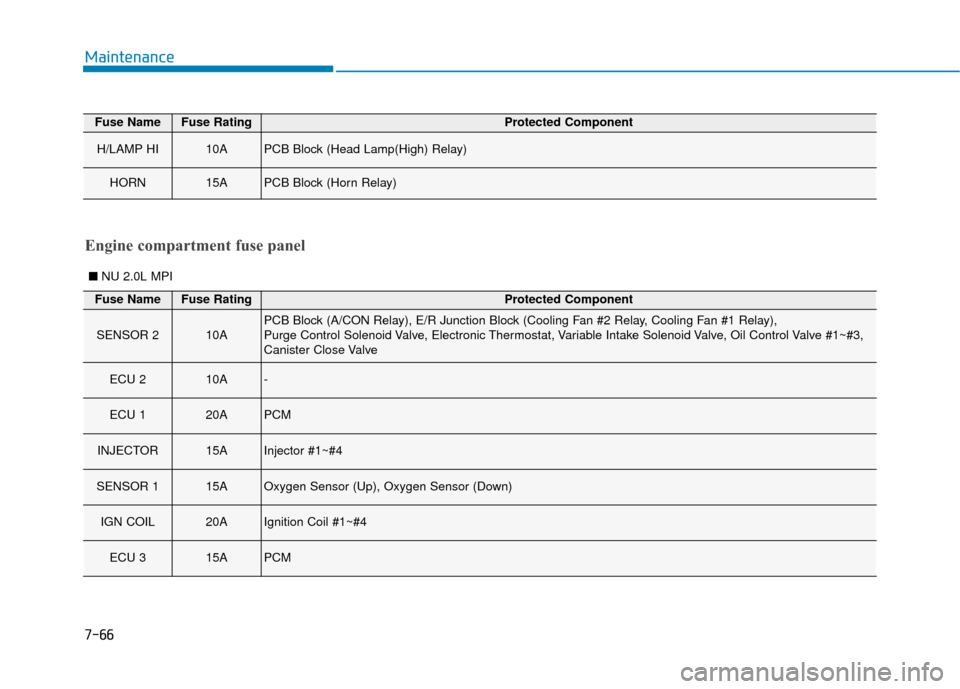
■NU 2.0L MPI
Engine compartment fuse panel
Fuse NameFuse RatingProtected Component
H/LAMP HI10APCB Block (Head Lamp(High) Relay)
HORN15APCB Block (Horn Relay)
Fuse NameFuse RatingProtected Component
SENSOR 210APCB Block (A/CON Relay), E/R Junction Block (Cooling Fan #2 Relay, Cooling Fan #1 Relay),
Purge Control Solenoid Valve, Electronic Thermostat, Variable Intake Solenoid Valve, Oil Control Valve #1~#3,
Canister Close Valve
ECU 210A-
ECU 120APCM
INJECTOR15AInjector #1~#4
SENSOR 115AOxygen Sensor (Up), Oxygen Sensor (Down)
IGN COIL20AIgnition Coil #1~#4
ECU 315APCM
Page 472 of 505
7-81
7
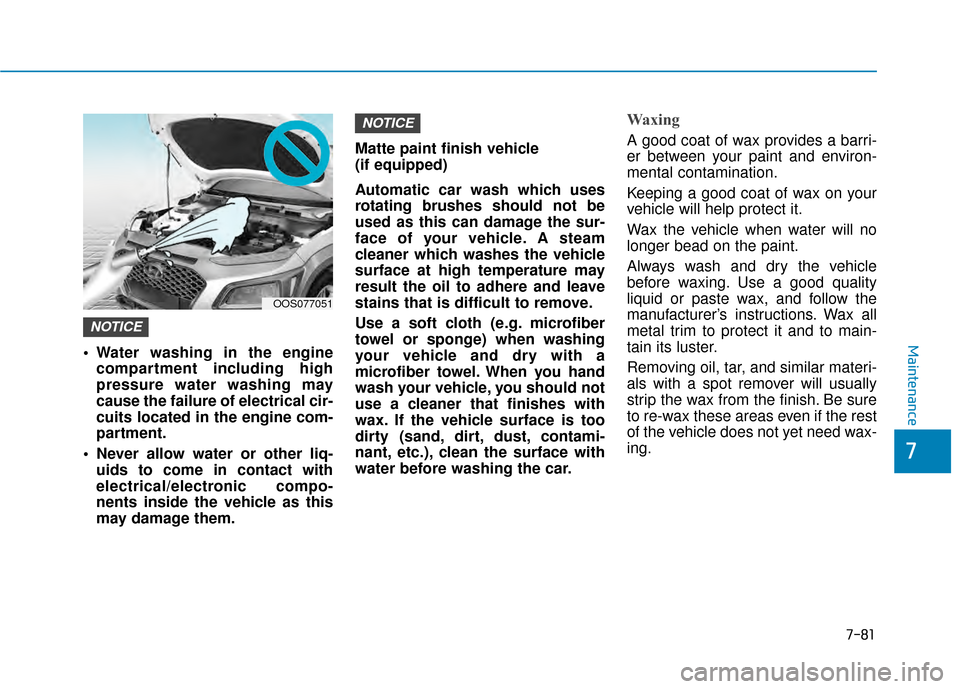
Maintenance Water washing in the enginecompartment including high
pressure water washing may
cause the failure of electrical cir-
cuits located in the engine com-
partment.
Never allow water or other liq- uids to come in contact with
electrical/electronic compo-
nents inside the vehicle as this
may damage them. Matte paint finish vehicle
(if equipped)
Automatic car wash which uses
rotating brushes should not be
used as this can damage the sur-
face of your vehicle. A steam
cleaner which washes the vehicle
surface at high temperature may
result the oil to adhere and leave
stains that is difficult to remove.
Use a soft cloth (e.g. microfiber
towel or sponge) when washing
your vehicle and dry with a
microfiber towel. When you hand
wash your vehicle, you should not
use a cleaner that finishes with
wax. If the vehicle surface is too
dirty (sand, dirt, dust, contami-
nant, etc.), clean the surface with
water before washing the car.
Waxing
A good coat of wax provides a barri-
er between your paint and environ-
mental contamination.
Keeping a good coat of wax on your
vehicle will help protect it.
Wax the vehicle when water will no
longer bead on the paint.
Always wash and dry the vehicle
before waxing. Use a good quality
liquid or paste wax, and follow the
manufacturer’s instructions. Wax all
metal trim to protect it and to main-
tain its luster.
Removing oil, tar, and similar materi-
als with a spot remover will usually
strip the wax from the finish. Be sure
to re-wax these areas even if the rest
of the vehicle does not yet need wax-
ing.
NOTICE
NOTICE
OOS077051
Page 490 of 505
8-7
88
Specifications, Consumer information and Reporting safety defects
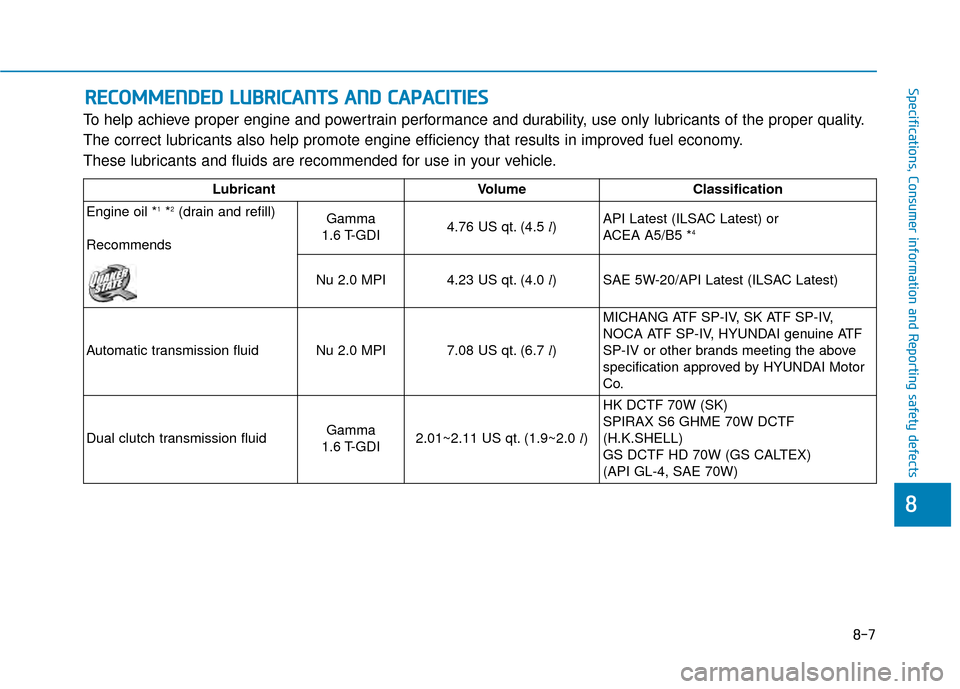
To help achieve proper engine and powertrain performance and durability, use only lubricants of the proper quality.
The correct lubricants also help promote engine efficiency that results in improved fuel economy.
These lubricants and fluids are recommended for use in your vehicle.
R RE
EC
CO
O M
M M
ME
EN
N D
DE
ED
D
L
L U
U B
BR
RI
IC
C A
A N
N T
TS
S
A
A N
N D
D
C
C A
A P
PA
A C
CI
IT
T I
IE
E S
S
LubricantVolume Classification
Engine oil *
1*2(drain and refill)
RecommendsGamma
1.6 T-GDI4.76 US qt. (4.5 l)API Latest (ILSAC Latest) or
ACEA A5/B5 *4
Nu 2.0 MPI4.23 US qt. (4.0
l)
SAE 5W-20/API Latest (ILSAC Latest)
Automatic transmission fluidNu 2.0 MPI7.08 US qt. (6.7 l)
MICHANG ATF SP-IV, SK ATF SP-IV,
NOCA ATF SP-IV, HYUNDAI genuine ATF
SP-IV or other brands meeting the above
specification approved by HYUNDAI Motor
Co.
Dual clutch transmission fluidGamma
1.6 T-GDI2.01~2.11 US qt. (1.9~2.0 l)
HK DCTF 70W (SK)
SPIRAX S6 GHME 70W DCTF
(H.K.SHELL)
GS DCTF HD 70W (GS CALTEX)
(API GL-4, SAE 70W)
Page 491 of 505
8-8
Specifications, Consumer information and Reporting safety defects
*1: Refer to the recommended SAE viscosity numbers on the next page.
*2: Engine oils labeled Energy Conserving Oil are now available. Along with other additional benefits, they contribute to fuel econ -
omy by reducing the amount of fuel necessary to overcome engine friction. Often, these improvements are difficult to measure
in everyday driving, but in a year's time, they can offer significant cost and energy savings.
*
3: If the API service SM engine oil is not available in your country, you are able to use API service SL.
*4: If the ACEA A5 engine oil is not available in your country, you are able to use ILSAC GF-3 (or above) or ACEA A3 (or above). Lubricant
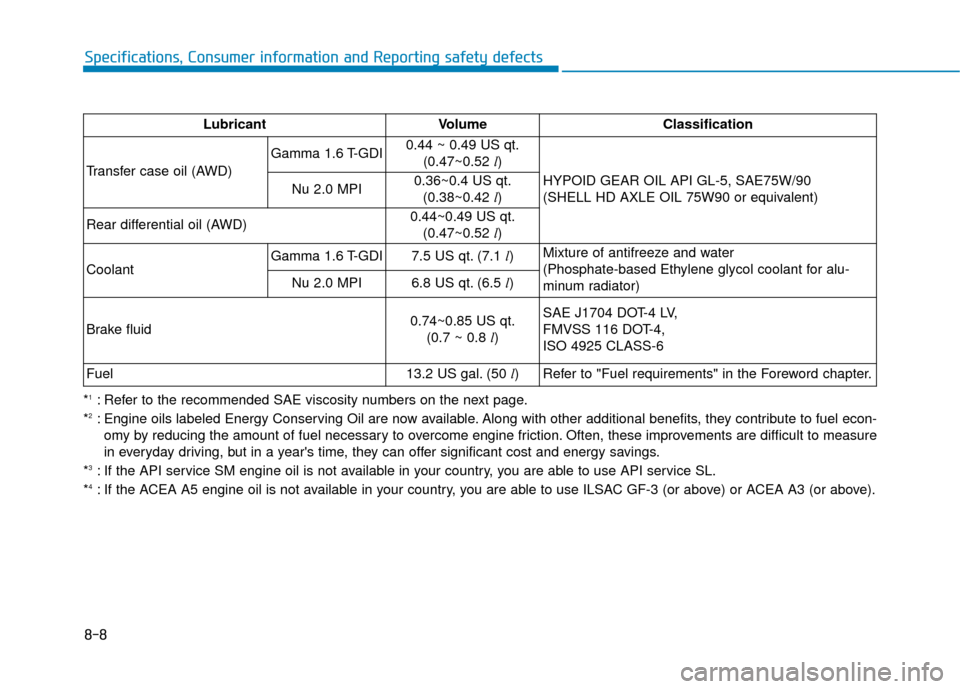
Volume
Classification
Transfer case oil (AWD) Gamma 1.6 T-GDI
0.44 ~ 0.49 US qt.
(0.47~0.52 l)
HYPOID GEAR OIL API GL-5, SAE75W/90
(SHELL HD AXLE OIL 75W90 or equivalent)
Nu 2.0 MPI
0.36~0.4 US qt.
(0.38~0.42 l)
Rear differential oil (AWD)
0.44~0.49 US qt. (0.47~0.52 l)
Coolant Gamma 1.6 T-GDI
7.5 US qt. (7.1
l)Mixture of antifreeze and water
(Phosphate-based Ethylene glycol coolant for alu-
minum radiator)
Nu 2.0 MPI
6.8 US qt. (6.5
l)
Brake fluid
0.74~0.85 US qt. (0.7 ~ 0.8 l) SAE J1704 DOT-4 LV,
FMVSS 116 DOT-4,
ISO 4925 CLASS-6
Fuel13.2 US gal. (50 l)Refer to "Fuel requirements" in the Foreword chapter.
Page 492 of 505
8-9
88
Specifications, Consumer information and Reporting safety defects
Recommended SAE viscosity
number
Always be sure to clean the area
around any filler plug, drain
plug, or dipstick before check-
ing or draining any lubricant.
This is especially important in
dusty or sandy areas and when
the vehicle is used on unpaved
roads. Cleaning the plug and
dipstick areas will prevent dirt
and grit from entering the
engine and other mechanisms
that could be damaged.
CAUTION
Temperature Range for SAE Viscosity Numbers
Temperature -30 -20 -10 0 10 20 30 40 50
-10 0 20 40 60 80 100 120
Engine Oil
Gamma
1.6 T-GDI *1
Nu 2.0 MPI *2
°C
(°F)
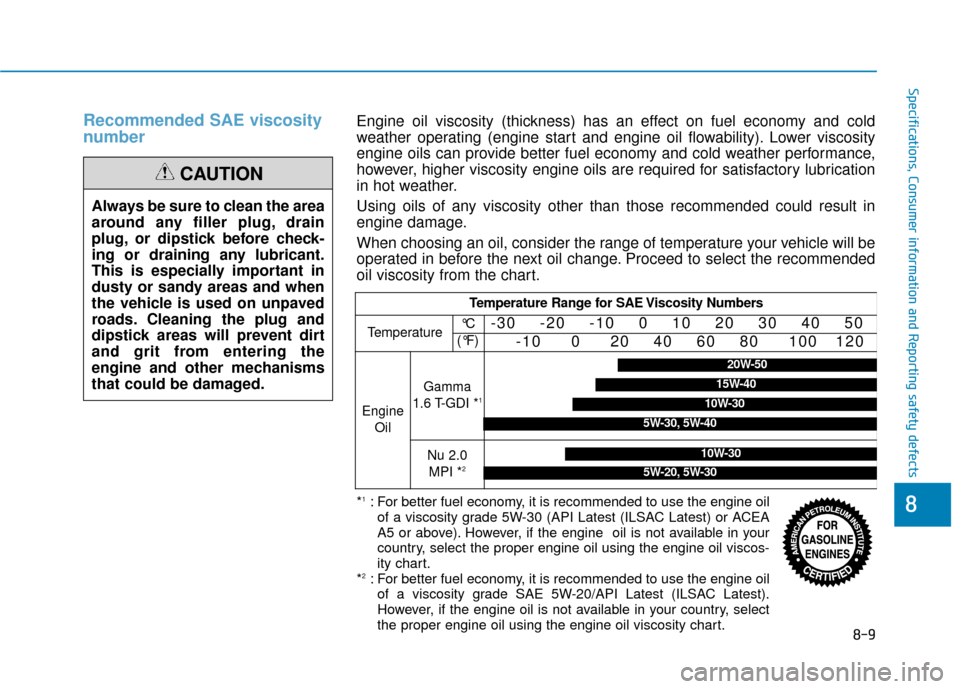
*1: For better fuel economy, it is recommended to use the engine oil of a viscosity grade 5W-30 (API Latest (ILSAC Latest) or ACEA
A5 or above). However, if the engine oil is not available in your
country, select the proper engine oil using the engine oil viscos-
ity chart.
*
2: For better fuel economy, it is recommended to use the engine oil of a viscosity grade SAE 5W-20/API Latest (ILSAC Latest).
However, if the engine oil is not available in your country, select
the proper engine oil using the engine oil viscosity chart.
5W-30, 5W-40
10W-30
15W-40
20W-50
10W-30
5W-20, 5W-30
Engine oil viscosity (thickness) has an effect on fuel economy and cold
weather operating (engine start and engine oil flowability). Lower viscosity
engine oils can provide better fuel economy and cold weather performance,
however, higher viscosity engine oils are required for satisfactory lubrication
in hot weather.
Using oils of any viscosity other than those recommended could result in
engine damage.
When choosing an oil, consider the range of temperature your vehicle will be
operated in before the next oil change. Proceed to select the recommended
oil viscosity from the chart.
Page 500 of 505
I-4
Emission control system .................................................7-88Crankcase Emission Control System .........................7-88
Evaporative Emission Control System Including Onboard Refueling Vapor Recovery (ORVR) ........7-88
Exhaust Emission Control System .............................7-89
Engine ........................................................................\
.......8-2
Engine Compartment.................................................1-6, 7-3
Engine coolant ................................................................7-23 Changing Engine Coolant ..........................................7-26
Checking the Engine Coolant Level ..........................7-23
Engine Number ...............................................................8-11
Engine oil ........................................................................\
7-21 Checking the Engine Oil and Filter ...........................7-22
Checking the Engine Oil Level ..................................7-21
Explanation of scheduled maintenance items.................7-18
Exterior Features .................................................3-43, 3-144 Fuel Filler Door ..........................................................3-46
Hood ........................................................................\
...3-43
Liftgate .......................................................................3\
-44
Roof Side Rails ........................................................3-144
Exterior Overview.............................................................1-2 Forward Collision-avoidance Assist (FCA) system
- Camera type ..............................................................5-55
FCA Sensor ................................................................5-59
FCA Warning Message and System Control..............5-57
Limitations of the System ..........................................5-63
System Malfunction ...................................................5-61
System Setting and Activation ...................................5-55
Forward collision-avoidance assist (FCA) system - sensor fusion type (Front radar + Front camera) ......5-68
System Setting and Activation ...................................5-68
FCA Sensor ................................................................5-72
FCA Warning Message and System Control..............5-70
Limitations of the System ..........................................5-75
System Malfunction ...................................................5-73
Fuses ........................................................................\
.......7-53 Engine Compartment Panel Fuse Replacement .........7-55
Fuse/Relay Panel Description ....................................7-57
Instrument Panel Fuse Replacement ..........................7-54
Hazard warning flasher .....................................................6-2
Head Up Display (HUD) ................................................3-87
Index
EF
H