vent HYUNDAI KONA 2021 Owners Manual
[x] Cancel search | Manufacturer: HYUNDAI, Model Year: 2021, Model line: KONA, Model: HYUNDAI KONA 2021Pages: 506, PDF Size: 34.9 MB
Page 477 of 506
7-85
7
Maintenance
Keep your garage dry
Don't park your vehicle in a damp,
poorly ventilated garage. This cre-
ates a favorable environment for cor-
rosion. This is particularly true if you
wash your vehicle in the garage or
drive it into the garage when it is still
wet or covered with snow, ice or
mud. Even a heated garage can con-
tribute to corrosion unless it is well
ventilated so moisture is dispersed.
Keep paint and trim in good condition
Scratches or chips in the finish
should be covered with "touch-up"
paint as soon as possible to reduce
the possibility of corrosion. If bare
metal is showing through, the atten-
tion of a qualified body and paint
shop is recommended.
Bird droppings are highly corrosive
and may damage painted surfaces in
just a few hours. Always remove bird
droppings as soon as possible.
Interior Care
Interior general precautions
Prevent caustic solutions such as
perfume and cosmetic oil, from con-
tacting the interior parts because
they may cause damage or discol-
oration. If they do contact the interior
parts, wipe them off immediately.
See the instructions for the proper
way to clean vinyl.
Never allow water or other liq-
uids to come in contact with
electrical/electronic compo-
nents inside the vehicle as this
may damage them.
When cleaning leather products
(steering wheel, seats etc.), use
neutral detergents or low alco-
hol content solutions. If you use
high alcohol content solutions
or acid/ alkaline detergents, the
color of the leather may fade or
the surface may get stripped off.
Cleaning the upholstery and
interior trim
Vinyl (if equipped)
Remove dust and loose dirt from
vinyl with a whisk broom or vacuum
cleaner. Clean vinyl surfaces with a
vinyl cleaner.
Fabric (if equipped)
Remove dust and loose dirt from fab-
ric with a whisk broom or vacuum
cleaner. Clean with a mild soap solu-
tion recommended for upholstery or
carpets. Remove fresh spots imme-
diately with a fabric spot cleaner. If
fresh spots do not receive immediate
attention, the fabric can be stained
and its color can be affected. Also, its
fire-resistant properties can be
reduced if the material is not proper-
ly maintained.
Using anything but recommended
cleaners and procedures may
affect the fabric's appearance and
fire-resistant properties.
NOTICE
NOTICE
Page 478 of 506
7-86
Maintenance
Leather (if equipped)
Features of seat leather
- Leather is made from the outer
skin of an animal, which goes
through a special process to be
available for use. Since it is a nat-
ural product, each part differs in
thickness or density.
Wrinkles may appear as a natural
result of stretching and shrinking
depending on the temperature
and humidity.
- The seat is made of stretchable
fabric to improve comfort.
- The parts contacting the body are
curved and the side supporting
area is high which provides driv-
ing comfort and stability.
- Wrinkles may appear naturally
from usage. It is not a fault of the
products. Caring for the leather seats
- Vacuum the seat periodically to
remove dust and sand on the seat.
It will prevent abrasion or damage
of the leather and maintain its qual-
ity.
- Wipe the natural leather seat cover
often with dry or soft cloth.
- Use of proper leather protector
may prevent abrasion of the cover
and helps maintain the color. Be
sure to read the instructions and
consult a specialist when using
leather coating or protective agent.
- Light colored (beige, cream beige)
leather is easily contaminated and
the stain is noticeable. Clean the
seats frequently.
- Avoid wiping with wet cloth. It may
cause the surface to crack.
Wrinkles or abrasions which
appear naturally from usage
are not covered by warranty.
Belts with metallic acces-
sories, zippers or keys inside
the back pocket may damage
the seat fabric.
Make sure not to wet the seat.
It may change the nature of
natural leather.
Jeans or clothes which could
bleach may contaminate the
surface of the seat covering
fabric.
CAUTION
Page 480 of 506

7-88
Maintenance
The emission control system of your
vehicle is covered by a written limited
warranty. Please see the warranty
information contained in the Owner’s
Handbook & Warranty Information
booklet in your vehicle.
Your vehicle is equipped with an
emission control system to meet all
applicable emission regulations.
There are three emission control
systems, as follows.
(1) Crankcase emission control sys-
tem
(2) Evaporative emission control sys-
tem
(3) Exhaust emission control system
In order to ensure the proper func-
tion of the emission control systems,
it is recommended that you have
your vehicle inspected and main-
tained by an authorized HYUNDAI
dealer in accordance with the main-
tenance schedule in this manual.For the Inspection and
Maintenance Test (with Electronic
Stability Control (ESC) system)
To prevent the vehicle from mis-
firing during dynamometer test-
ing, turn the Electronic Stability
Control (ESC) system off by
pressing the ESC switch (ESC
OFF light illuminated).
After dynamometer testing is
completed, turn the ESC system
back on by pressing the ESC
switch again.
1. Crankcase Emission Control
System
The positive crankcase ventilation
system is employed to prevent air
pollution caused by blow-by gases
being emitted from the crankcase.
This system supplies fresh filtered air
to the crankcase through the air
intake hose. Inside the crankcase,
the fresh air mixes with blow-by
gases, which then pass through the
PCV valve into the induction system.
2. Evaporative Emission Control
System Including Onboard
Refueling Vapor Recovery
(ORVR)
The Evaporative Emission Control
System is designed to prevent fuel
vapors from escaping into the atmos-
phere. The ORVR system is
designed to allow the vapors from
the fuel tank to be loaded into a can-
ister while refueling at the gas sta-
tion, preventing the escape of fuel
vapors into the atmosphere.
NOTICE
E EM
MI
IS
SS
SI
IO
ON
N
C
CO
ON
NT
TR
RO
OL
L
S
SY
YS
ST
TE
EM
M
Page 482 of 506
7-90
Maintenance
Do not operate the engine in con-
fined or closed areas (such as
garages) any more than what is
necessary to move the vehicle in or
out of the area.
When the vehicle is stopped in an
open area for more than a short
time with the engine running,
adjust the ventilation system (as
needed) to draw outside air into the
vehicle.
Never sit in a parked or stopped
vehicle for any extended time with
the engine running.
When the engine stalls or fails to
start, excessive attempts to restart
the engine may cause damage to
the emission control system.
Operating precautions for cat-
alytic converters (if equipped)
The exhaust system and cat-
alytic converter are very hot
during and immediately after
the engine has been running. To
avoid SERIOUS INJURY or
DEATH:
Do not park, idle, or drive the
vehicle over or near flamma-
ble objects, such as grass,
vegetation, paper, leaves, etc.
A hot exhaust system can
ignite flammable items under
your vehicle.
Keep away from the exhaust
system and catalytic convert-
er or you may get burned.
Also, Do not remove the heat
sink around the exhaust sys-
tem, do not seal the bottom of
the vehicle, and do not coat
the vehicle for corrosion con-
trol. It may present a fire risk
under certain conditions.
WARNING CALIFORNIA PROPOSITION 65
WARNING
Engine exhaust and a wide vari-
ety of automobile components
and parts, including compo-
nents found in the interior fur-
nishings in a vehicle, contain or
emit chemicals known to the
State of California to cause can-
cer and birth defects and repro-
ductive harm. In addition, cer-
tain fluids contained in vehicles
and certain products of compo-
nent wear contain or emit chem-
icals known to the State of
California to cause cancer and
birth defects or other reproduc-
tive harm.
WARNING
Page 483 of 506
7-91
7
Maintenance
Your vehicle is equipped with a cat-
alytic converter emission control
device.
To prevent damage to the catalytic
converter and to your vehicle, take
the following precautions:
Use only UNLEADED FUEL for
gasoline engines.
Do not operate the vehicle when
there are signs of engine malfunc-
tion, such as misfire or a noticeable
loss of performance.
Do not misuse or abuse the
engine. Examples of misuse are
coasting with the engine off and
descending steep grades in gear
with the engine off.
Do not operate the engine at high
idle speed for extended periods (5
minutes or more). Do not modify or tamper with any
part of the engine or emission con-
trol system. All inspections and
adjustments must be made by an
authorized HYUNDAI dealer.
Avoid driving with extremely low
fuel level. If you run out of gasoline,
it could cause the engine to misfire
and result in excessive loading of
the catalytic converter.
Page 493 of 506
8-9
88
Specifications, Consumer information and Reporting safety defects
Recommended SAE viscosity
number
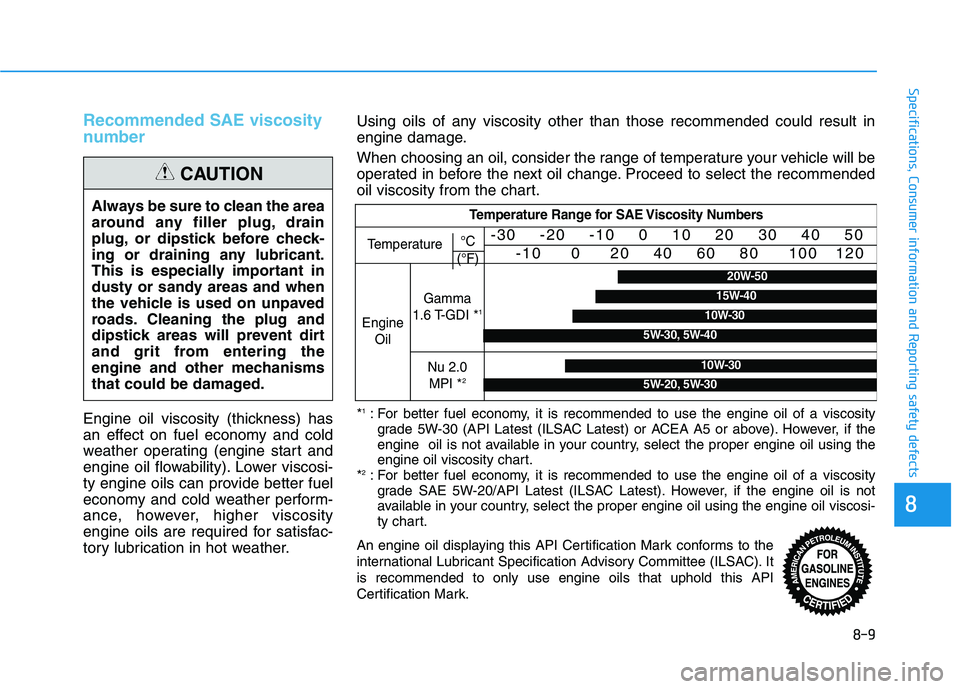
Engine oil viscosity (thickness) has
an effect on fuel economy and cold
weather operating (engine start and
engine oil flowability). Lower viscosi-
ty engine oils can provide better fuel
economy and cold weather perform-
ance, however, higher viscosity
engine oils are required for satisfac-
tory lubrication in hot weather.Always be sure to clean the area
around any filler plug, drain
plug, or dipstick before check-
ing or draining any lubricant.
This is especially important in
dusty or sandy areas and when
the vehicle is used on unpaved
roads. Cleaning the plug and
dipstick areas will prevent dirt
and grit from entering the
engine and other mechanisms
that could be damaged.
CAUTION
Temperature Range for SAE Viscosity Numbers
Temperature -30 -20 -10 0 10 20 30 40 50
-10 0 20 40 60 80 100 120
Engine
Oil
Gamma
1.6 T-GDI *1
Nu 2.0
MPI *2
°C
(°F)
*1: For better fuel economy, it is recommended to use the engine oil of a viscosity
grade 5W-30 (API Latest (ILSAC Latest) or ACEA A5 or above). However, if the
engine oil is not available in your country, select the proper engine oil using the
engine oil viscosity chart.
*
2: For better fuel economy, it is recommended to use the engine oil of a viscosity
grade SAE 5W-20/API Latest (ILSAC Latest). However, if the engine oil is not
available in your country, select the proper engine oil using the engine oil viscosi-
ty chart.
5W-30, 5W-40
10W-30
15W-40
20W-50
10W-30
5W-20, 5W-30
Using oils of any viscosity other than those recommended could result in
engine damage.
When choosing an oil, consider the range of temperature your vehicle will be
operated in before the next oil change. Proceed to select the recommended
oil viscosity from the chart.
An engine oil displaying this API Certification Mark conforms to the
international Lubricant Specification Advisory Committee (ILSAC). It
is recommended to only use engine oils that uphold this API
Certification Mark.
Page 500 of 506
I-3
Braking system ...............................................................5-29
Anti-lock Brake System (ABS)..................................5-32
Disc Brakes Wear Indicator........................................5-30
Downhill Brake Control (DBC) .................................5-37
Electronic Stability Control (ESC).............................5-34
Good Braking Practices..............................................5-39
Hill-Start Assist Control (HAC) .................................5-37
Parking Brake .............................................................5-30
Power Brakes..............................................................5-29
Vehicle Stability Management (VSM) .......................5-36
Bulb Wattage .....................................................................8-3
California perchlorate notice ..........................................7-92
Child Restraint System (CRS) ........................................2-34
Children Always in the Rear ......................................2-34
Installing a Child Restraint System (CRS) ................2-37
Selecting a Child Restraint System (CRS).................2-35
Climate Control Additional Features ............................3-132
Automatic Ventilation...............................................3-132
Cluster ionizer ..........................................................3-132
Sunroof Inside Air Recirculation .............................3-132
Climate control air filter .................................................7-30
Filter Inspection..........................................................7-30
Consumer Information ....................................................8-12
Cruise control..................................................................5-93
Cruise Control operation ............................................5-93Declaration of conformity .............................................5-55
Dimensions .......................................................................8-2
Door Locks .....................................................................3-13
Automatic Door Lock and Unlock Features ..............3-16
Child-Protector Rear Door Locks ..............................3-17
Operating Door Locks from Inside the Vehicle .........3-14
Operating Door Locks from Outside the Vehicle ......3-13
Drive Mode Integrated Control System .........................5-46
Driver Assist System.....................................................3-105
Parking Distance Warning (Reverse) system ...........3-106
Parking Distance Warning (Reverse) system
Precautions ............................................................3-109
Rear view monitor ....................................................3-105
Driver Attention Warning (DAW) system ......................5-89
Resetting the System ..................................................5-90
System Malfunction ...................................................5-91
System Setting and Activation ...................................5-89
System Standby ..........................................................5-91
Dual clutch transmission.................................................5-20
Dual Clutch Transmission Operation .........................5-20
Good Driving Practices ..............................................5-27
I
Index
C
D
Page 504 of 506
I-7
Recommended Lubricants and Capacities ........................8-7
Recommended SAE viscosity number .........................8-9
Reporting Safety Defects ................................................8-13
Scheduled maintenance services.......................................7-7
Maintenance Under Severe Usage Conditions
(Gamma 1.6 T-GDI) ................................................7-16
Maintenance Under Severe Usage Conditions
(Nu 2.0 MPI) ...........................................................7-11
Normal Maintenance Schedule
(Gamma 1.6 T-GDI) ................................................7-13
Normal Maintenance Schedule (Nu 2.0 MPI) .............7-8
Seat Belts ........................................................................2-21
Additional Seat Belt Safety Precautions ....................2-30
Care of Seat Belts .......................................................2-33
Seat Belt Restraint System .........................................2-23
Seat Belt Safety Precautions ......................................2-21
Seat Belt Warning Light .............................................2-22
Seats ..................................................................................2-3
Front Seats ....................................................................2-5
Head Restraints ..........................................................2-14
Rear Seats ...................................................................2-11
Safety Precautions ........................................................2-4
Seat Warmers and Air Ventilation Seats.....................2-18Smart Cruise Control system ..........................................5-98
Conventional Cruise Control Mode .........................5-109
Limitations of the System ........................................5-109
SCC Reaction Setting...............................................5-108
Sensor to Detect Distance to the Vehicle Ahead ......5-106
Smart Cruise Control Speed .......................................5-99
Smart Cruise Control Switch .....................................5-98
Smart Cruise Control Vehicle-to-Vehicle Distance ..5-103
Special driving conditions.............................................5-115
Driving at Night........................................................5-116
Driving in Flooded Areas .........................................5-117
Driving in the Rain ...................................................5-116
Hazardous Driving Conditions .................................5-115
Highway Driving ......................................................5-117
Reducing the risk of a rollover.................................5-118
Rocking the Vehicle..................................................5-115
Smooth Cornering ....................................................5-116
Steering Wheel ................................................................3-18
Electric Power Steering (EPS) ...................................3-18
Heated Steering Wheel (for Canada) .........................3-20
Horn ............................................................................3-21
Tilt Steering / Telescope Steering ..............................3-19
Storage Compartment ...................................................3-133
Center Console Storage ............................................3-133
Glove Box ................................................................3-133
Multi Box .................................................................3-134
Sunglass Holder........................................................3-134
I
Index
R
S