check engine light HYUNDAI KONA 2022 Owner's Guide
[x] Cancel search | Manufacturer: HYUNDAI, Model Year: 2022, Model line: KONA, Model: HYUNDAI KONA 2022Pages: 579, PDF Size: 35.31 MB
Page 451 of 579
8
Hazard warning flasher..................................................................................... 8-2
In case of an emergency while driving ............................................................ 8-2
If the engine stalls while driving ................................................................................. 8-2
If the engine stalls at a crossroad or crossing ............................................................ 8-2
If you have a flat tire while driving ..............................................................................8-3
If the engine will not start ................................................................................ 8-3
If the Engine Doesn't Turn Over or Turns Over Slowly ..............................................8-3
If the Engine Turns Over Normally but Doesn't Start ................................................8-3
Jump starting .................................................................................................... 8-4
If the engine overheats ......................................................................................8-7
Tire Pressure Monitoring System (TPMS) (Type A) ......................................... 8-9
Low tire pressure telltale ........................................................................................... 8-10
TPMS (Tire Pressure Monitoring System) malfunction indicator ............................ 8-10
Tire Pressure Monitoring System (TPMS) (Type B) ........................................ 8-13
Check tire pressure .................................................................................................... 8-13
Tire pressure monitoring system ............................................................................... 8-14
Low tire pressure warning light ................................................................................. 8-15
Low tire pressure position and tire pressure telltale ................................................ 8-15
TPMS malfunction indicator ...................................................................................... 8-16
Changing a tire with TPMS ........................................................................................ 8-16
If you have a flat tire (with spare tire) .............................................................8-18
Jack and tools............................................................................................................. 8-18
Changing tires ............................................................................................................ 8-19
Jack label ....................................................................................................................8-24
If you have a flat tire (with Tire Mobility Kit) ................................................. 8-25
Introduction ................................................................................................................ 8-25
Components of the Tire Mobility Kit .........................................................................8-26
Using the Tire Mobility Kit ......................................................................................... 8-27
How to adjust tire pressure ...................................................................................... 8-30
Notes on the safe use of the Tire Mobility Kit ..........................................................8-32
Towing ............................................................................................................. 8-33
Towing service ............................................................................................................8-33
Removable Towing Hook ..........................................................................................8-34
Emergency Towing ....................................................................................................8-35
Tie-down Hook .......................................................................................................... 8-36
8. Emergency situations
Page 453 of 579
08
8-3
If you have a flat tire while
driving
If a tire goes flat while you are driving:
Take your foot off the accelerator
pedal and let the vehicle slow down
while driving straight ahead. Do not
apply the brakes immediately or
attempt to pull off the road as this
may cause loss of vehicle control
resulting in an accident. When the
vehicle has slowed to such a speed
that it is safe to do so, brake carefully
and pull off the road. Drive off the
road as far as possible and park on
firm, level ground. If you are on a
divided highway, do not park in the
median area between the two traffic
lanes.
When the vehicle is stopped, press the
hazard warning flasher button, move
the shift lever into P (Park), apply the
parking brake, and place the ignition
switch in the LOCK/OFF position.
Have all passengers get out of the
vehicle. Be sure they all get out on the
side of the vehicle that is away from
traffic.
When changing a flat tire, follow the
instructions provided later in this
chapter.
IF THE ENGINE WILL NOT
START
If the Engine Doesn't Turn Over
or Turns Over Slowly
Be sure the shift lever is in N (Neutral)
or P (Park). The engine starts only
when the shift lever is in N (Neutral) or
P (Park).
Check the battery connections to be
sure they are clean and tight.
Turn on the interior light. If the light
dims or goes out when you operate
the starter, the battery is drained.
Do not push or pull the vehicle to start it.
This could cause damage to your vehicle.
See instructions for "Jump Starting"
provided in this chapter.
CAUTION
Push or pull starting the vehicle may
cause the catalytic converter to
overload which can lead to damage to
the emission control system.
If the Engine Turns Over
Normally but Doesn't Start
Check the fuel level and add fuel if
necessary.
If the engine still does not start, have
your vehicle checked by an authorized
HYUNDAI dealer.
Page 488 of 579

9
Tires and wheels ............................................................................................. 9-33
Tire care ......................................................................................................................9-33
Recommended cold tire inflation pressures ............................................................9-33
Check tire inflation pressure .....................................................................................9-34
Tire rotation ................................................................................................................9-35
Wheel alignment and tire balance ............................................................................9-36
Tire replacement ........................................................................................................9-36
Wheel replacement .................................................................................................... 9-37
Tire traction ................................................................................................................ 9-37
Tire maintenance ....................................................................................................... 9-37
Tire sidewall labeling ................................................................................................. 9-38
Tire Terminology and Definitions ............................................................................. 9-41
All Season Tires .......................................................................................................... 9-43
Summer Tires ............................................................................................................ 9-43
Snow Tires.................................................................................................................. 9-43
Radial-Ply Tires .......................................................................................................... 9-44
Low aspect ratio tires ................................................................................................ 9-44
Fuses ................................................................................................................ 9-45
Instrument panel fuse replacement ........................................................................ 9-46
Engine compartment panel fuse replacement ........................................................9-47
Fuse/relay panel description .................................................................................... 9-49
Light bulbs ....................................................................................................... 9-58
Headlamp, position lamp, turn signal lamp, Daytime Running Light (DRL)
replacement .............................................................................................................. 9-59
Front fog lamp ........................................................................................................... 9-62
Side repeater lamp replacement ............................................................................. 9-63
Rear combination lamp bulb replacement ............................................................. 9-63
High mounted stop lamp replacement ................................................................... 9-65
License Plate Light Bulb Replacement ................................................................... 9-66
Interior Light Bulb Replacement .............................................................................. 9-66
Appearance care .............................................................................................9-68
Exterior care .............................................................................................................. 9-68
Interior care ................................................................................................................ 9-74
Emission control system..................................................................................9-77
Gasoline Particulate Filter (GPF) ............................................................................... 9-79
California perchlorate notice .........................................................................9-80
Page 492 of 579

Maintenance
9-6
Owner maintenance schedule
When you stop for fuel:
Check the coolant level in the engine
coolant reservoir or the water-cooled
intercooler coolant reservoir.
Check the windshield washer fluid
level.
Check for low or under-inflated tires.
WARNING
Be careful when checking your coolant
level when the engine is hot. This may
result in coolant being blown out of the
opening and cause serious burns and
other injuries.
While operating your vehicle:
Note any changes in the sound of the
exhaust or any smell of exhaust fumes
in the vehicle.
Check for vibrations in the steering
wheel. Notice if there is any increased
steering effort or looseness in the
steering wheel, or change in its
straight-ahead position.
Notice if your vehicle constantly turns
slightly or “pulls” to one side when
traveling on smooth, level road.
When stopping, listen and check for
unusual sounds, pulling to one side,
increased brake pedal travel or “hard-
to-push” brake pedal.
If any slipping or changes in the
operation of your transmission occurs,
check the transmission fluid level.
Check the automatic transmission P
(Park) function.
Check the parking brake.
Check for fluid leaks under your
vehicle (water dripping from the air
conditioning system during or after
use is normal).
At least monthly:
Check coolant level in the engine
coolant reservoir.
Check the operation of all exterior
lights, including the stoplights, turn
signals and hazard warning flashers.
Check the inflation pressures of all
tires including the spare for tires that
are worn, show uneven wear, or are
damaged.
Check for loose wheel lug nuts.
At least twice a year: (i.e., every
Spring and Autumn)
Check radiator, heater and air
conditioning hoses for leaks or
damage.
Check windshield washer spray and
wiper operation. Clean wiper blades
with a clean cloth dampened with
washer fluid.
Check headlamp alignment.
Check muffler, exhaust pipes, shields
and clamps.
Check the seat belts for wear and
function.
At least once a year:
Clean body and door drain holes.
Lubricate door hinges and hood
hinges.
Lubricate door and hood locks and
latches.
Lubricate door rubber weather strips.
Check the air conditioning system.
Inspect and lubricate automatic
transmission linkage and controls.
Clean the battery and terminals.
Check the brake fluid level.
Page 531 of 579
![HYUNDAI KONA 2022 Owners Guide 09
9-45
FUSES
OLF074075
A
Blade type
Cartridge type
Multi fuse
A
A
B
B
B
B
A
[A] : Normal, [B] : Blown
A vehicle’s electrical system is protected
from electrical overload damage by
fuses.
This veh](/img/35/41169/w960_41169-530.png "HYUNDAI KONA 2022 Owners Guide 09
9-45
FUSES
OLF074075
A
Blade type
Cartridge type
Multi fuse
A
A
B
B
B
B
A
[A] : Normal, [B] : Blown
A vehicle’s electrical system is protected
from electrical overload damage by
fuses.
This veh")
09
9-45
FUSES
OLF074075
A
Blade type
Cartridge type
Multi fuse
A
A
B
B
B
B
A
[A] : Normal, [B] : Blown
A vehicle’s electrical system is protected
from electrical overload damage by
fuses.
This vehicle has 5 fuse panels, one
located in the driver’s side panel bolster,
the other in the engine compartment.
If any of your vehicle’s lights,
accessories, or controls do not work,
check the appropriate circuit fuse. If a
fuse has blown, the element inside the
fuse will be melted or broken.
If the electrical system does not work,
first check the driver’s side fuse panel.
Before replacing a blown fuse, turn the
engine and all switches off, and then
disconnect the negative battery cable.
Always replace a blown fuse with one of
the same rating.
If the replacement fuse blows, this
indicates an electrical problem.
Avoid using the system involved. We
recommend that you immediately
consult an authorized HYUNDAI dealer.
WARNING
NEVER replace a fuse with anything but
another fuse of the same rating.
A higher capacity fuse could cause
damage and possibly cause a fire.
Do not install a wire or aluminum
foil instead of the proper fuse -
even as a temporary repair. It may
cause extensive wiring damage and
possibly a fire.
NOTICE
Do not use a screwdriver or any other
metal object to remove fuses because
it may cause a short circuit and damage
the system.
Page 532 of 579
Maintenance
9-46
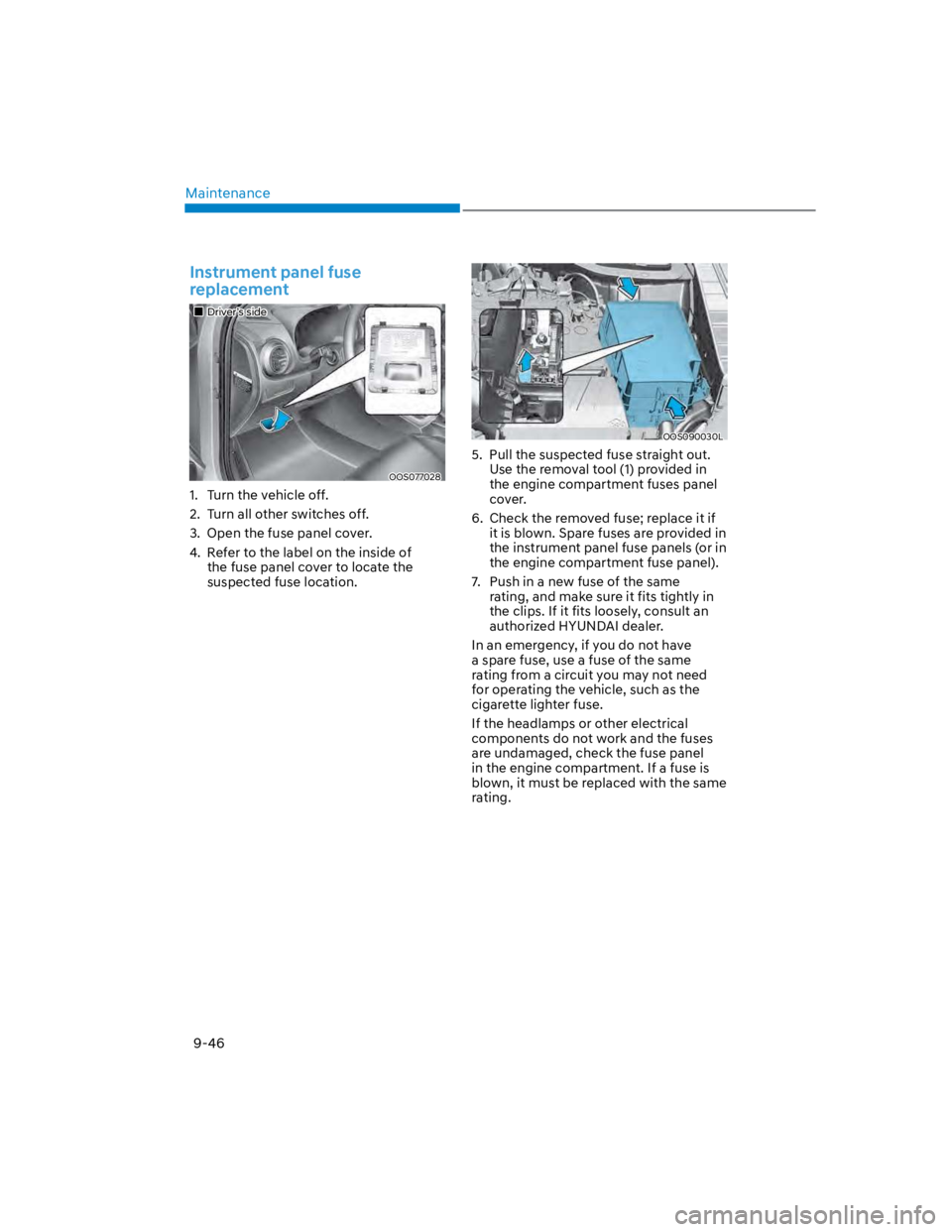
Instrument panel fuse
replacement
Driver’s side
OOS077028
1. Turn the vehicle off.
2. Turn all other switches off.
3. Open the fuse panel cover.
4. Refer to the label on the inside of
the fuse panel cover to locate the
suspected fuse location.
OOS090030L
5. Pull the suspected fuse straight out.
Use the removal tool (1) provided in
the engine compartment fuses panel
cover.
6. Check the removed fuse; replace it if
it is blown. Spare fuses are provided in
the instrument panel fuse panels (or in
the engine compartment fuse panel).
7. Push in a new fuse of the same
rating, and make sure it fits tightly in
the clips. If it fits loosely, consult an
authorized HYUNDAI dealer.
In an emergency, if you do not have
a spare fuse, use a fuse of the same
rating from a circuit you may not need
for operating the vehicle, such as the
cigarette lighter fuse.
If the headlamps or other electrical
components do not work and the fuses
are undamaged, check the fuse panel
in the engine compartment. If a fuse is
blown, it must be replaced with the same
rating.