Temperature HYUNDAI KONA 2022 Workshop Manual
[x] Cancel search | Manufacturer: HYUNDAI, Model Year: 2022, Model line: KONA, Model: HYUNDAI KONA 2022Pages: 579, PDF Size: 35.31 MB
Page 465 of 579
08
8-15
Low tire pressure
warning light
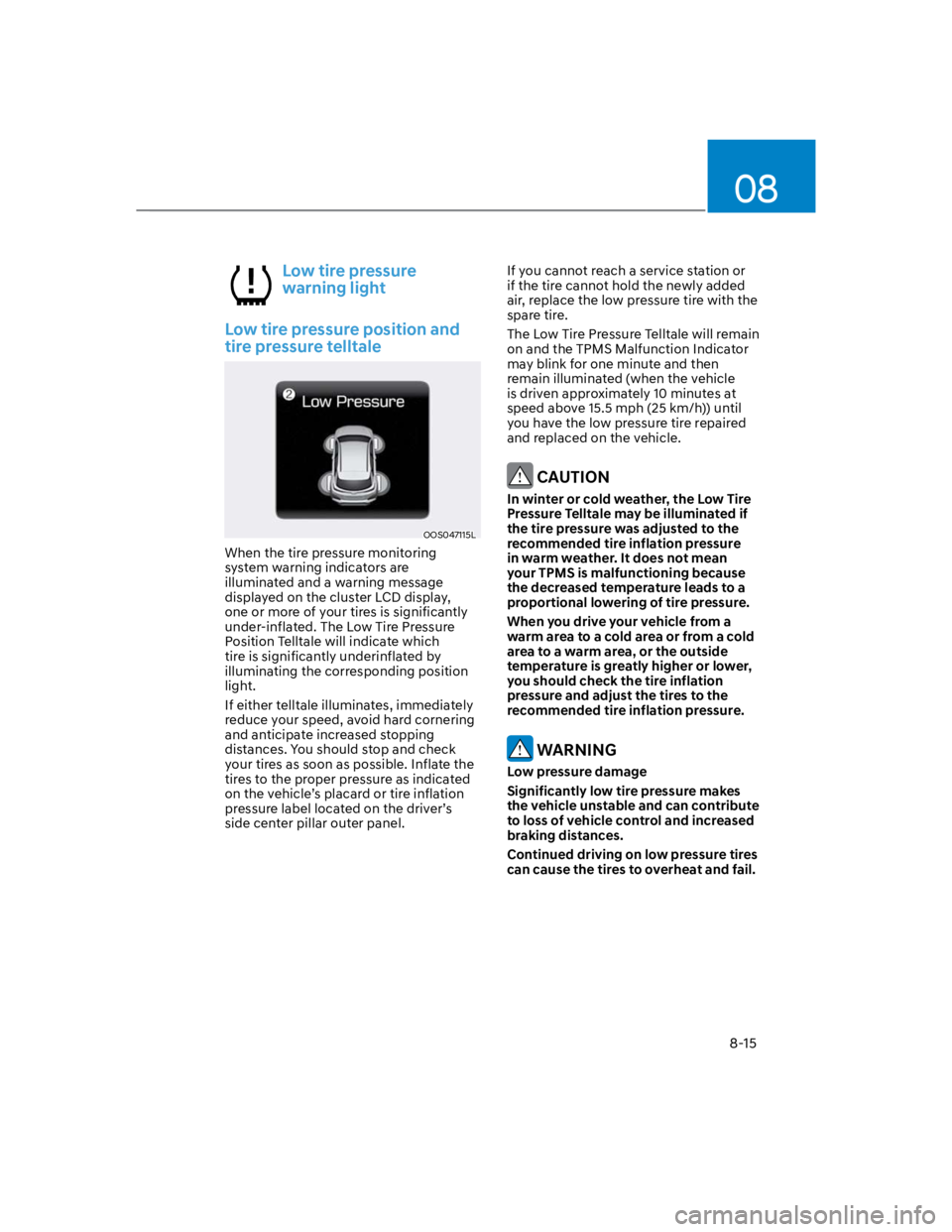
Low tire pressure position and
tire pressure telltale
OOS047115L
When the tire pressure monitoring
system warning indicators are
illuminated and a warning message
displayed on the cluster LCD display,
one or more of your tires is significantly
under-inflated. The Low Tire Pressure
Position Telltale will indicate which
tire is significantly underinflated by
illuminating the corresponding position
light.
If either telltale illuminates, immediately
reduce your speed, avoid hard cornering
and anticipate increased stopping
distances. You should stop and check
your tires as soon as possible. Inflate the
tires to the proper pressure as indicated
on the vehicle’s placard or tire inflation
pressure label located on the driver’s
side center pillar outer panel.
If you cannot reach a service station or
if the tire cannot hold the newly added
air, replace the low pressure tire with the
spare tire.
The Low Tire Pressure Telltale will remain
on and the TPMS Malfunction Indicator
may blink for one minute and then
remain illuminated (when the vehicle
is driven approximately 10 minutes at
speed above 15.5 mph (25 km/h)) until
you have the low pressure tire repaired
and replaced on the vehicle.
CAUTION
In winter or cold weather, the Low Tire
Pressure Telltale may be illuminated if
the tire pressure was adjusted to the
recommended tire inflation pressure
in warm weather. It does not mean
your TPMS is malfunctioning because
the decreased temperature leads to a
proportional lowering of tire pressure.
When you drive your vehicle from a
warm area to a cold area or from a cold
area to a warm area, or the outside
temperature is greatly higher or lower,
you should check the tire inflation
pressure and adjust the tires to the
recommended tire inflation pressure.
WARNING
Low pressure damage
Significantly low tire pressure makes
the vehicle unstable and can contribute
to loss of vehicle control and increased
braking distances.
Continued driving on low pressure tires
can cause the tires to overheat and fail.
Page 482 of 579

Emergency situations
8-32
Notes on the safe use of the Tire
Mobility Kit
Park your car at the side of the road
so that you can work with the Tire
Mobility Kit away from moving traffic.
To be sure your vehicle will not move,
even when you’re on fairly level
ground, always set your parking brake.
Only use the Tire Mobility Kit for
sealing/inflation passenger car tires.
Only punctured areas located within
the tread region of the tire can be
sealed using the tire mobility kit.
Do not use on motorcycles, bicycles
or any other type of tires.
When the tire and wheel are
damaged, do not use Tire Mobility Kit
for your safety.
Use of the Tire Mobility Kit may not be
effective for tire damage larger than
approximately 16 inch (4 mm).
Please contact the nearest HYUNDAI
dealer if the tire cannot be made
roadworthy with the Tire Mobility Kit.
Do not use the Tire Mobility Kit if a tire
is severely damaged by driving run flat
or with insufficient air pressure.
Do not remove any foreign objects
such as nails or screws that have
penetrated the tire.
Provided the car is outdoors, leave the
engine running. Otherwise operating
the compressor may eventually drain
the car battery.
Never leave the Tire Mobility Kit
unattended while it is being used.
Do not leave the compressor running
for more than 10 minutes at a time or
it may overheat.
Do not use the Tire Mobility Kit if the
ambient temperature is below -22°F
(30°C).
In case of skin contact with the
sealant, wash the area thoroughly
with plenty of water. If the irritation
persists, seek medical attention.
In case of eye contact with the
sealant, flush your eyes for at least 15
minutes. If the irritation persists, seek
medical attention.
In case of swallowing the sealant,
rinse the mouth and drink plenty of
water. However, never give anything
to an unconscious person and seek
medical attention immediately.
Long time exposure to the sealant
may cause damage to bodily tissue
such as kidney, etc.
Page 493 of 579

09
9-7
Follow Normal Maintenance Schedule if the vehicle is usually operated where none of
the following conditions apply. If any of the following conditions apply, you must follow
the Maintenance Under Severe Usage Conditions.
Repeatedly driving short distance of less than 5 miles (8 km) in normal temperature
or less than 10 miles (16 km) in freezing temperature
Extensive engine idling or low speed driving for long distances
Driving on rough, dusty, muddy, unpaved, graveled or salt-spread roads
Driving in areas using salt or other corrosive materials or in very cold weather
Driving in heavy dust conditions
Driving in heavy traffic area
Driving on uphill, downhill, or mountain road repeatedly
Towing a trailer or using a camper, or driving with loads on the roof
Driving as a patrol car, taxi, other commercial use of vehicle towing
Frequently driving under high speed or rapid acceleration/deceleration.
Frequently driving in stop-and-go condition
Engine oil usage which is not recommended (Mineral type, Semi-synthetic, Lower
grade spec, etc.)
If your vehicle is operated under the above conditions, you should inspect, replace
or refill more frequently than the following Normal Maintenance Schedule. After the
periods or distance shown in the chart, continue to follow the prescribed maintenance
intervals.
Information
SCHEDULED MAINTENANCE SERVICES
Page 498 of 579
Maintenance
9-12
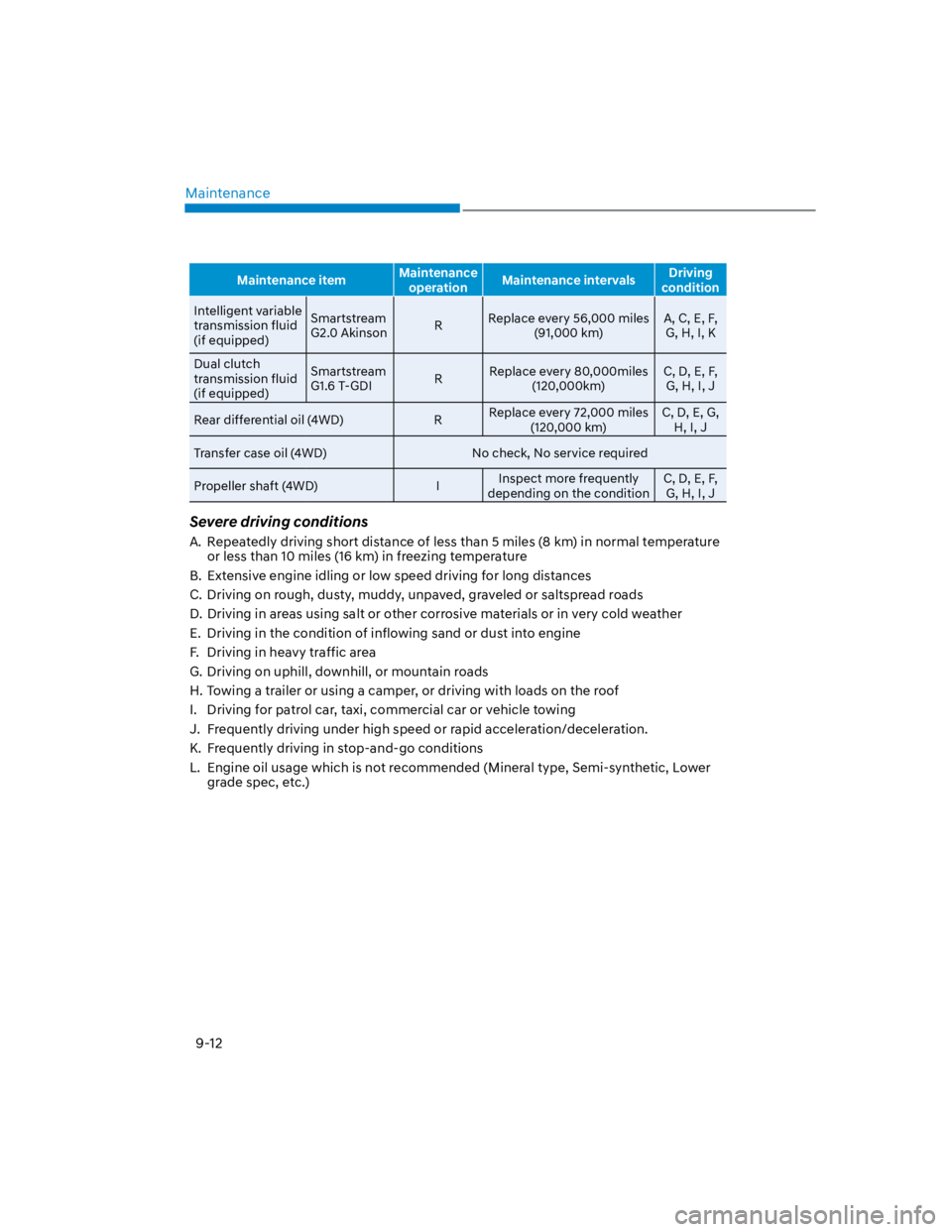
Maintenance itemMaintenance
operationMaintenance intervalsDriving
condition
Intelligent variable
transmission fluid
(if equipped)
Smartstream
G2.0 AkinsonRReplace every 56,000 miles
(91,000 km)
A, C, E, F,
G, H, I, K
Dual clutch
transmission fluid
(if equipped)
Smartstream
G1.6 T-GDIRReplace every 80,000miles
(120,000km)
C, D, E, F,
G, H, I, J
Rear differential oil (4WD) RReplace every 72,000 miles
(120,000 km)
C, D, E, G,
H, I, J
Transfer case oil (4WD) No check, No service required
Propeller shaft (4WD) IInspect more frequently
depending on the condition
C, D, E, F,
G, H, I, J
Severe driving conditions
A. Repeatedly driving short distance of less than 5 miles (8 km) in normal temperature
or less than 10 miles (16 km) in freezing temperature
B. Extensive engine idling or low speed driving for long distances
C. Driving on rough, dusty, muddy, unpaved, graveled or saltspread roads
D. Driving in areas using salt or other corrosive materials or in very cold weather
E. Driving in the condition of inflowing sand or dust into engine
F. Driving in heavy traffic area
G. Driving on uphill, downhill, or mountain roads
H. Towing a trailer or using a camper, or driving with loads on the roof
I. Driving for patrol car, taxi, commercial car or vehicle towing
J. Frequently driving under high speed or rapid acceleration/deceleration.
K. Frequently driving in stop-and-go conditions
L. Engine oil usage which is not recommended (Mineral type, Semi-synthetic, Lower
grade spec, etc.)
Page 501 of 579
09
9-15
ENGINE OIL
Checking the engine oil level
Engine oil is used for lubricating,
cooling, and operating various hydraulic
components in the engine. Engine oil
consumption while driving is normal,
and it is necessary to check and refill the
engine oil regularly. Also, check and refill
the oil level within the recommended
maintenance schedule to prevent
deterioration of oil performance.
Check the engine oil following the below
procedure.
Gasoline engine
1. Follow all of the oil manufacturer’s
precautions.
2. Be sure the vehicle is on the level
ground in P (Park) with the parking
brake set and the wheels blocked.
3. Turn the engine on and warm
the engine up until the coolant
temperature reaches a constant
normal temperature.
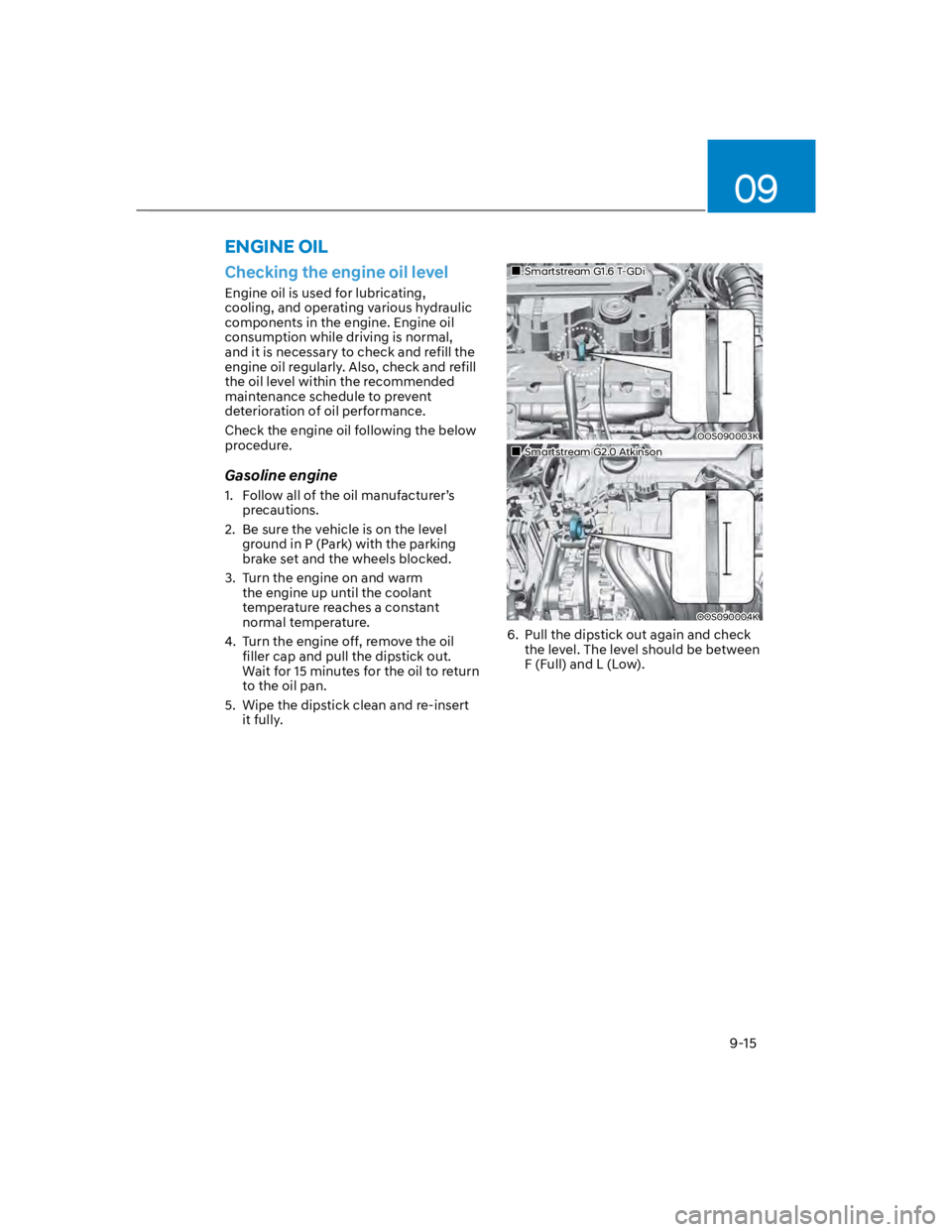
4. Turn the engine off, remove the oil
filler cap and pull the dipstick out.
Wait for 15 minutes for the oil to return
to the oil pan.
5. Wipe the dipstick clean and re-insert
it fully.
Smartstream G1.6 T-GDi
OOS090003K
Smartstream G2.0 Atkinson
OOS090004K
6. Pull the dipstick out again and check
the level. The level should be between
F (Full) and L (Low).
Page 506 of 579
Maintenance
9-20
Recommended coolant
When adding coolant, use only
deionized water, distilled water or soft
water for your vehicle and never mix
hard water in the coolant filled at the
factory.
An incorrect coolant mixture can
result in severe malfunction or engine
damage.
The engine in your vehicle has
aluminum engine parts and must be
protected by an phosphate-based
ethylene glycol coolant to prevent
corrosion and freezing.
Do not use alcohol or methanol
coolant or mix them with the specified
coolant.
Do not use a solution that contains
more than 60% antifreeze or less than
35% antifreeze, which would reduce
the effectiveness of the solution.
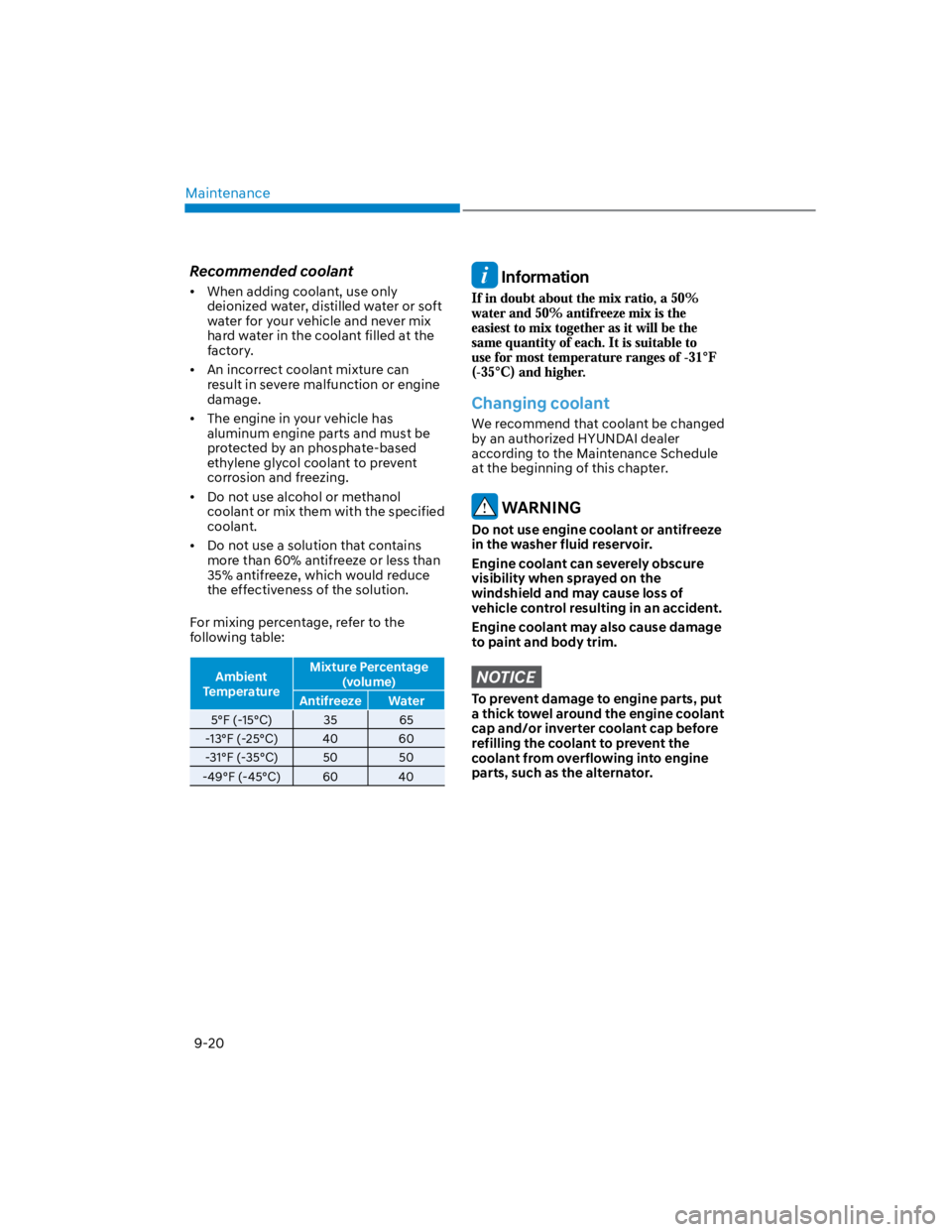
For mixing percentage, refer to the
following table:
Ambient
Temperature
Mixture Percentage
(volume)
Antifreeze Water
5°F (-15°C) 35 65
-13°F (-25°C) 40 60
-31°F (-35°C) 50 50
-49°F (-45°C) 60 40
Information
Changing coolant
We recommend that coolant be changed
by an authorized HYUNDAI dealer
according to the Maintenance Schedule
at the beginning of this chapter.
WARNING
Do not use engine coolant or antifreeze
in the washer fluid reservoir.
Engine coolant can severely obscure
visibility when sprayed on the
windshield and may cause loss of
vehicle control resulting in an accident.
Engine coolant may also cause damage
to paint and body trim.
NOTICE
To prevent damage to engine parts, put
a thick towel around the engine coolant
cap and/or inverter coolant cap before
refilling the coolant to prevent the
coolant from overflowing into engine
parts, such as the alternator.
Page 515 of 579
09
9-29
BATTERY
WARNING
To prevent SERIOUS INJURY or DEATH
to you or bystanders, always follow
these precautions when working near
or handling the battery:
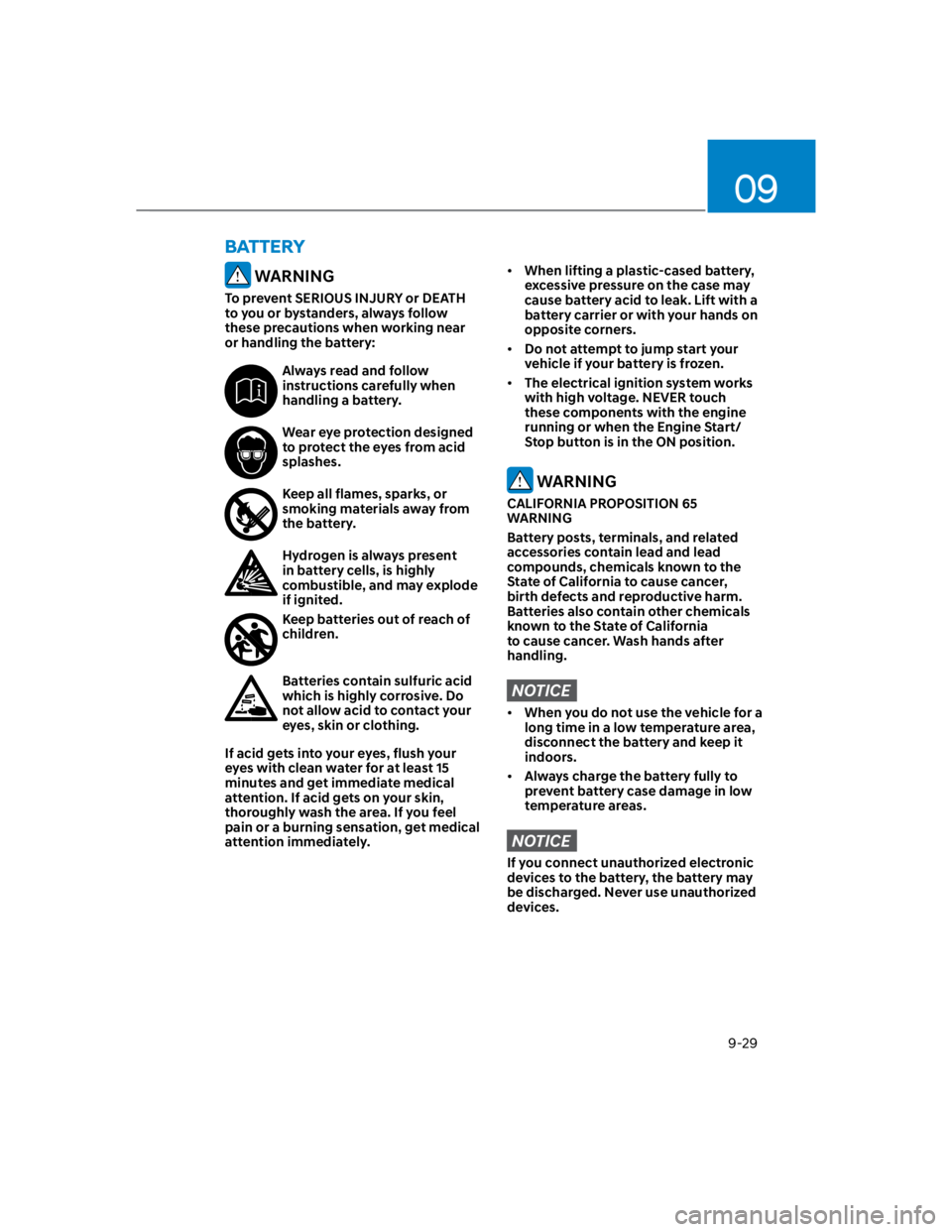
Always read and follow
instructions carefully when
handling a battery.
Wear eye protection designed
to protect the eyes from acid
splashes.
Keep all flames, sparks, or
smoking materials away from
the battery.
Hydrogen is always present
in battery cells, is highly
combustible, and may explode
if ignited.
Keep batteries out of reach of
children.
Batteries contain sulfuric acid
which is highly corrosive. Do
not allow acid to contact your
eyes, skin or clothing.
If acid gets into your eyes, flush your
eyes with clean water for at least 15
minutes and get immediate medical
attention. If acid gets on your skin,
thoroughly wash the area. If you feel
pain or a burning sensation, get medical
attention immediately.
When lifting a plastic-cased battery,
excessive pressure on the case may
cause battery acid to leak. Lift with a
battery carrier or with your hands on
opposite corners.
Do not attempt to jump start your
vehicle if your battery is frozen.
The electrical ignition system works
with high voltage. NEVER touch
these components with the engine
running or when the Engine Start/
Stop button is in the ON position.
WARNING
CALIFORNIA PROPOSITION 65
WARNING
Battery posts, terminals, and related
accessories contain lead and lead
compounds, chemicals known to the
State of California to cause cancer,
birth defects and reproductive harm.
Batteries also contain other chemicals
known to the State of California
to cause cancer. Wash hands after
handling.
NOTICE
When you do not use the vehicle for a
long time in a low temperature area,
disconnect the battery and keep it
indoors.
Always charge the battery fully to
prevent battery case damage in low
temperature areas.
NOTICE
If you connect unauthorized electronic
devices to the battery, the battery may
be discharged. Never use unauthorized
devices.
Page 526 of 579
Maintenance
9-40
7. Uniform tire quality grading
Quality grades can be found where
applicable on the tire sidewall between
tread shoulder and maximum section
width.
For example:
TREADWEAR 200
TRACTION AA
TEMPERATURE A
The tread wear grade is a comparative
rating based on the wear rate of the tire
when tested under controlled conditions
on a specified government test course.
For example, a tire graded 150 would
wear one-and-a-half times (1½) as well
on the government course as a tire
graded 100.
The relative performance of tires
depends upon the actual conditions
of their use, however, and may depart
significantly from the norm due to
variations in driving habits, service
practices and differences in road
characteristics and climate.
These grades are molded on the
sidewalls of passenger vehicle tires. The
tires available as standard or optional
equipment on your vehicle may vary with
respect to grade.
The traction grades, from highest to
lowest, are AA, A, B and C. Those grades
represent the tire’s ability to stop on wet
pavement as measured under controlled
conditions on specified government
test surfaces of asphalt and concrete.
A tire marked C may have poor traction
performance.
WARNING
The traction grade assigned to this
tire is based on straight ahead braking
traction tests, and does not include
acceleration, cornering, hydroplaning,
or peak traction characteristics.
The temperature grades are A (the
highest), B and C representing the tire’s
resistance to the generation of heat
and its ability to dissipate heat when
tested under controlled conditions on a
specified indoor laboratory test wheel.
Sustained high temperature can cause
the material of the tire to degenerate
and reduce tire life, and excessive
temperature can lead to sudden tire
failure. Grades B and A represent higher
levels of performance on the laboratory
test wheel than the minimum required
by law.
WARNING
The temperature grade for this tire is
established for a tire that is properly
inflated and not overloaded. Excessive
speed, under-inflation, over-inflation,
or excessive loading, either separately
or in combination, can cause heat build-
up and possible sudden tire failure.
This may cause loss of vehicle control
resulting in an accident.
A
Page 529 of 579

09
9-43
Traction
The friction between the tire and
the road surface. The amount of grip
provided.
Tread
The portion of a tire that comes into
contact with the road.
Treadwear Indicators
Narrow bands, sometimes called “wear
bars”, that show across the tread of a tire
when only 1/16 inch of tread remains.
UTQGS
Uniform Tire Quality Grading Standards
is a tire information system that provides
consumers with ratings for a tire’s
traction, temperature and treadwear.
Ratings are determined by tire
manufacturers using government testing
procedures. The ratings are molded into
the sidewall of the tire.
Vehicle Capacity Weight
The number of designated seating
positions multiplied by 150 lbs. (68 kg)
plus the rated cargo and luggage load.
Vehicle Maximum Load on the Tire
Load on an individual tire due to curb
and accessory weight plus maximum
occupant and cargo weight.
Vehicle Normal Load on the Tire
Load on an individual tire that is
determined by distributing to each axle
its share of the curb weight, accessory
weight, and normal occupant weight and
dividing by 2.
Vehicle Placard
A label permanently attached to a vehicle
showing the original equipment tire size
and recommended inflation pressure.
All Season Tires
HYUNDAI specifies all season tires
on some models to provide good
performance for use all year round,
including snowy and icy road conditions.
All season tires are identified by ALL
SEASON and/or M+S (Mud and Snow) on
the tire sidewall. Snow tires have better
snow traction than all season tires and
may be more appropriate in some areas.
Summer Tires
HYUNDAI specifies summer tires on
some models to provide superior
performance on dry roads. Summer tire
performance is substantially reduced in
snow and ice. Summer tires do not have
the tire traction rating M+S (Mud and
Snow) on the tire side wall. If you plan
to operate your vehicle in snowy or icy
conditions, HYUNDAI recommends the
use of snow tires or all season tires on all
four wheels.
Snow Tires
If you equip your car with snow tires,
they should be the same size and have
the same load capacity as the original
tires. Snow tires should be installed on
all four wheels; otherwise, poor handling
may result. Snow tires should carry 4
psi (28 kPa) more air pressure than the
pressure recommended for the standard
tires on the tire label on the driver’s
side of the center pillar, or up to the
maximum pressure shown on the tire
sidewall, whichever is less. Do not drive
faster than 75 mph (120 km/h) when your
vehicle is equipped with snow tires.
Page 555 of 579
09
9-69
NOTICE
Do not use strong soap, chemical
detergents or hot water, and do not
wash the vehicle in direct sunlight
or when the body of the vehicle is
warm.
Be careful when washing the side
windows of your vehicle.
Especially, with high-pressure water,
water may leak through the windows
and wet the interior.
To prevent damage to the plastic
parts, do not clean with chemical
solvents or strong detergents.
NOTICE
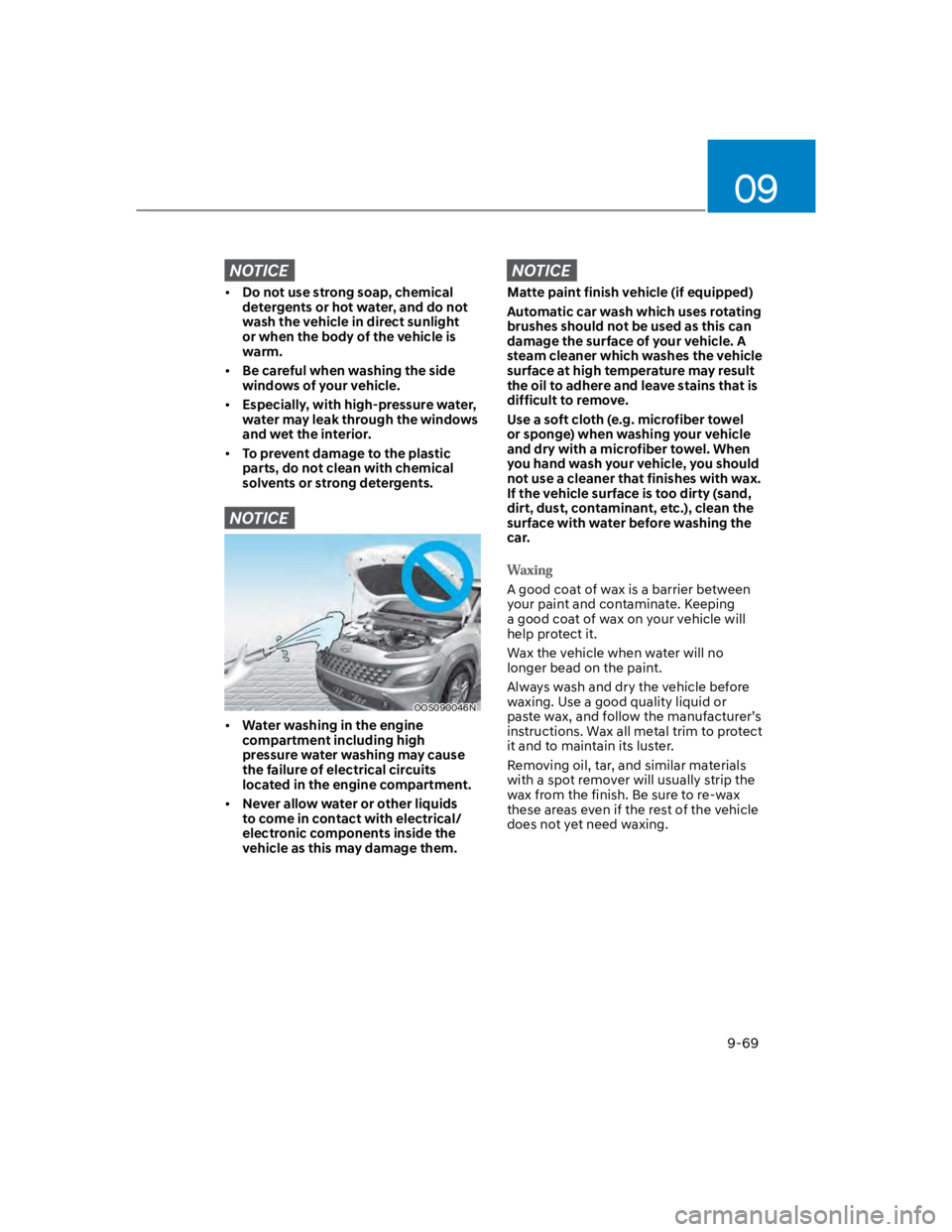
OOS090046N
Water washing in the engine
compartment including high
pressure water washing may cause
the failure of electrical circuits
located in the engine compartment.
Never allow water or other liquids
to come in contact with electrical/
electronic components inside the
vehicle as this may damage them.
NOTICE
Matte paint finish vehicle (if equipped)
Automatic car wash which uses rotating
brushes should not be used as this can
damage the surface of your vehicle. A
steam cleaner which washes the vehicle
surface at high temperature may result
the oil to adhere and leave stains that is
difficult to remove.
Use a soft cloth (e.g. microfiber towel
or sponge) when washing your vehicle
and dry with a microfiber towel. When
you hand wash your vehicle, you should
not use a cleaner that finishes with wax.
If the vehicle surface is too dirty (sand,
dirt, dust, contaminant, etc.), clean the
surface with water before washing the
car.
A good coat of wax is a barrier between
your paint and contaminate. Keeping
a good coat of wax on your vehicle will
help protect it.
Wax the vehicle when water will no
longer bead on the paint.
Always wash and dry the vehicle before
waxing. Use a good quality liquid or
paste wax, and follow the manufacturer’s
instructions. Wax all metal trim to protect
it and to maintain its luster.
Removing oil, tar, and similar materials
with a spot remover will usually strip the
wax from the finish. Be sure to re-wax
these areas even if the rest of the vehicle
does not yet need waxing.