ignition HYUNDAI KONA 2022 Workshop Manual
[x] Cancel search | Manufacturer: HYUNDAI, Model Year: 2022, Model line: KONA, Model: HYUNDAI KONA 2022Pages: 579, PDF Size: 35.31 MB
Page 296 of 579
06
6-39
To cancel ESC operation:
State 1
Press the ESC OFF button briefly. The
ESC OFF indicator light and/or message
'Traction Control disabled' will illuminate.
In this state, the traction control function
of ESC (engine management) is disabled,
but the brake control function of ESC
(braking management) still operates.
State 2
Press and hold the ESC OFF button
continuously for more than 3 seconds.
The ESC OFF indicator light and/or
message 'Traction & Stability Control
disabled' illuminates and a warning
chime sounds. In this state, both the
traction control function of ESC (engine
management) and the brake control
function of ESC (braking management)
are disabled.
If the ignition switch is placed to the
LOCK/OFF position when ESC is off, ESC
remains off. Upon restarting the engine,
the ESC will automatically turn on again.
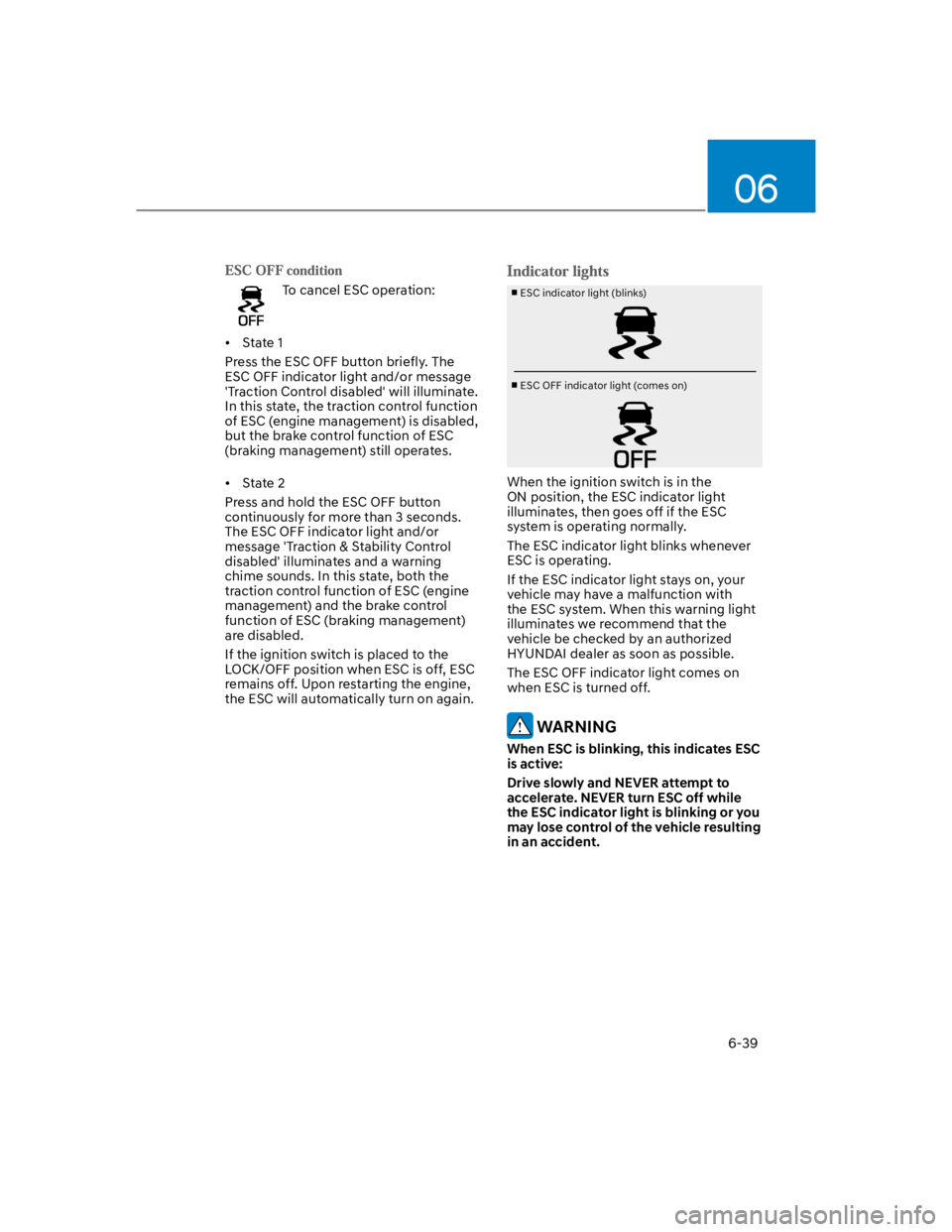
ESC indicator light (blinks)
ESC OFF indicator light (comes on)
When the ignition switch is in the
ON position, the ESC indicator light
illuminates, then goes off if the ESC
system is operating normally.
The ESC indicator light blinks whenever
ESC is operating.
If the ESC indicator light stays on, your
vehicle may have a malfunction with
the ESC system. When this warning light
illuminates we recommend that the
vehicle be checked by an authorized
HYUNDAI dealer as soon as possible.
The ESC OFF indicator light comes on
when ESC is turned off.
WARNING
When ESC is blinking, this indicates ESC
is active:
Drive slowly and NEVER attempt to
accelerate. NEVER turn ESC off while
the ESC indicator light is blinking or you
may lose control of the vehicle resulting
in an accident.
Page 299 of 579
Driving your vehicle
6-42
Downhill Brake Control (DBC)
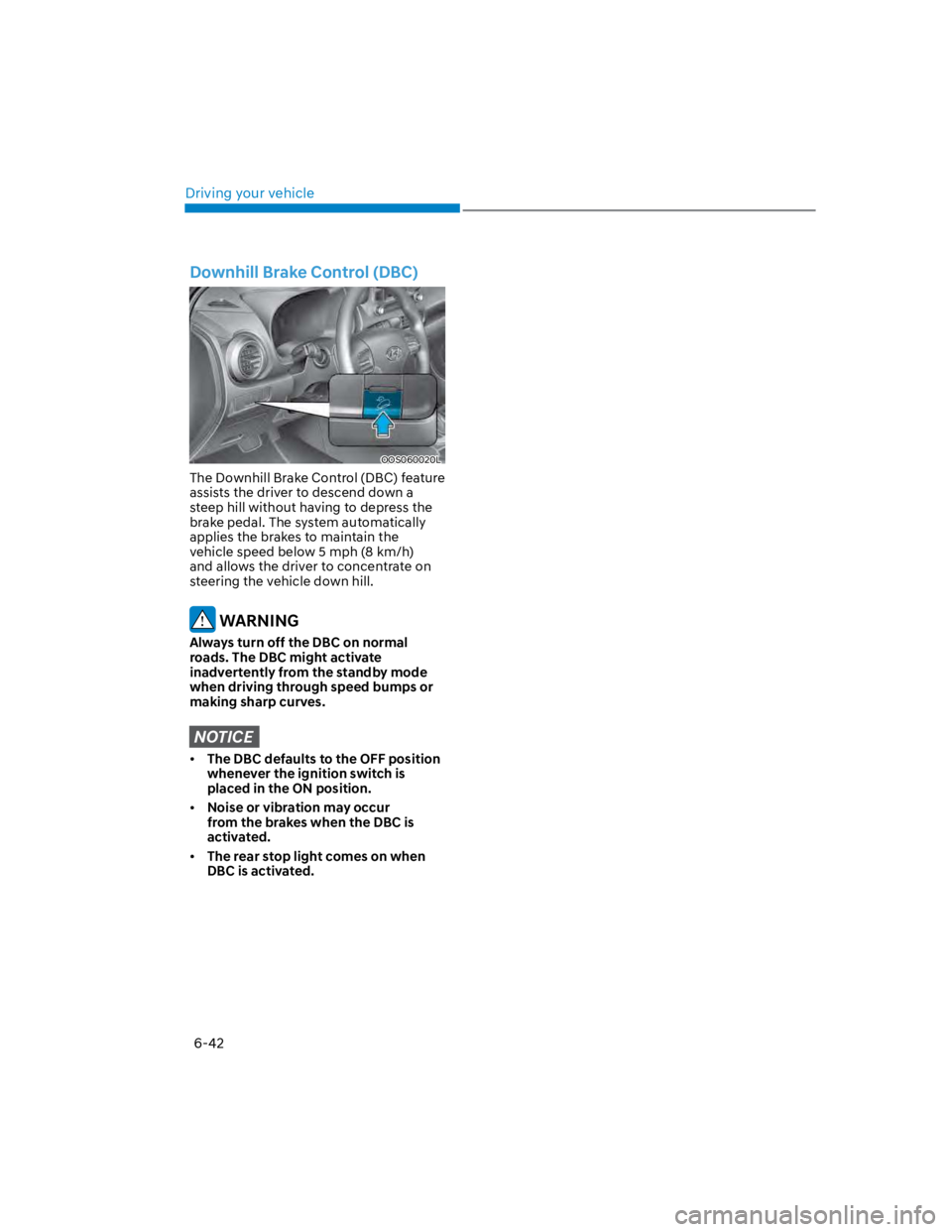
OOS060020L
The Downhill Brake Control (DBC) feature
assists the driver to descend down a
steep hill without having to depress the
brake pedal. The system automatically
applies the brakes to maintain the
vehicle speed below 5 mph (8 km/h)
and allows the driver to concentrate on
steering the vehicle down hill.
WARNING
Always turn off the DBC on normal
roads. The DBC might activate
inadvertently from the standby mode
when driving through speed bumps or
making sharp curves.
NOTICE
The DBC defaults to the OFF position
whenever the ignition switch is
placed in the ON position.
Noise or vibration may occur
from the brakes when the DBC is
activated.
The rear stop light comes on when
DBC is activated.
Page 307 of 579
Driving your vehicle
6-50
WARNING
Do not drive across the contour of steep
hills. A slight change in the wheel angle
can destabilize the vehicle, or a stable
vehicle may lose stability if the vehicle
stops its forward motion. Your vehicle
may roll over and lead to a serious injury
or death.
Try to avoid driving in deep standing
water. It may stall your engine and
clog your exhaust pipes.
If you need to drive in water, stop
your vehicle, set the vehicle in AWD
LOCK mode and drive under 5 mph (8
km/h).
Do not change gear while driving in
water.
CAUTION
Always drive slowly in water. If you
drive too fast, water may get into the
engine compartment and wet the
ignition system causing your vehicle to
suddenly stop.
Become familiar with the off-road
conditions before driving.
Always pay attention when driving off-
road and avoid dangerous areas.
Drive slowly when driving in heavy
wind.
Reduce vehicle speed when
cornering. The center of gravity
of 4WD vehicles is higher than
conventional 2WD vehicles, making
them more likely to roll over when you
rapidly turn corners.
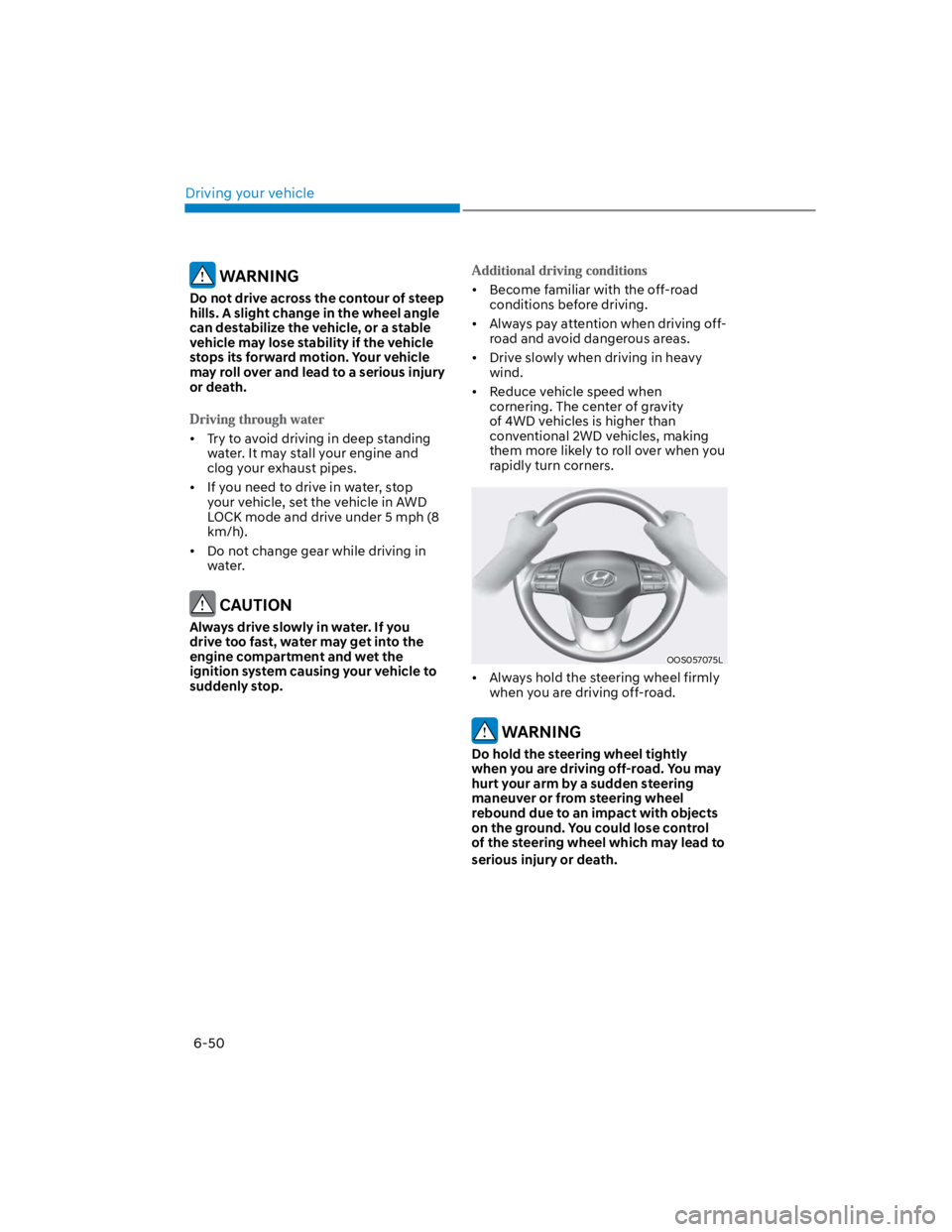
OOS057075L
Always hold the steering wheel firmly
when you are driving off-road.
WARNING
Do hold the steering wheel tightly
when you are driving off-road. You may
hurt your arm by a sudden steering
maneuver or from steering wheel
rebound due to an impact with objects
on the ground. You could lose control
of the steering wheel which may lead to
serious injury or death.
Page 311 of 579
Driving your vehicle
6-54
Your vehicle may be equipped with
the ISG system, which reduces fuel
consumption by stopping and restarting
the engine automatically.
The engine starts automatically as soon
as the starting conditions are met.
NOTICE
When the engine automatically starts
by the ISG system, some warning lights
(ABS, ESC, ESC OFF, EPS or Parking
brake warning light) may turn on for a
few seconds. This happens because of
low battery voltage. It does not mean
the system is malfunctioning.
Activating the ISG
The ISG system turns on whenever you
switch the ignition on.
Deactivating the ISG
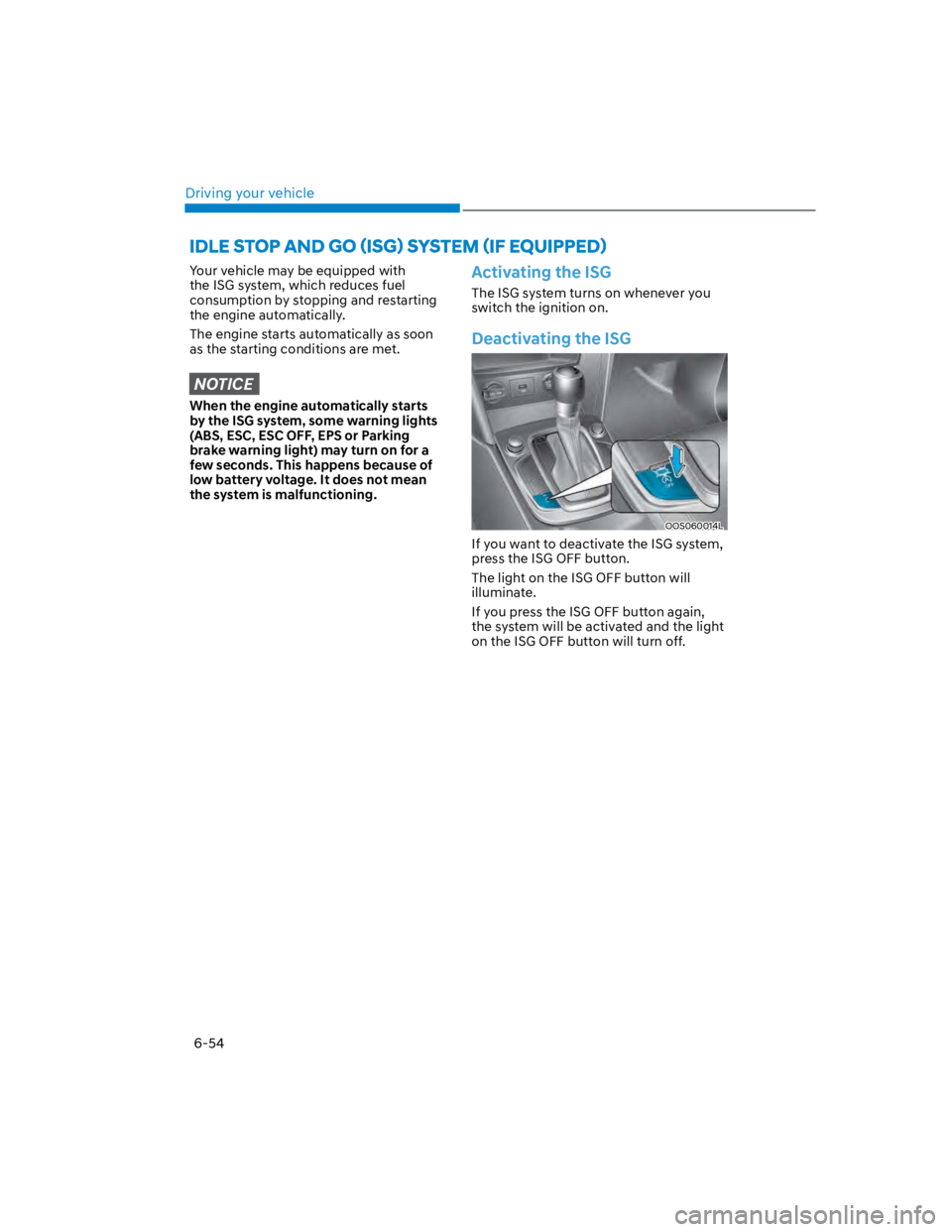
OOS060014L
If you want to deactivate the ISG system,
press the ISG OFF button.
The light on the ISG OFF button will
illuminate.
If you press the ISG OFF button again,
the system will be activated and the light
on the ISG OFF button will turn off.
Page 315 of 579
Driving your vehicle
6-58
ISG malfunction
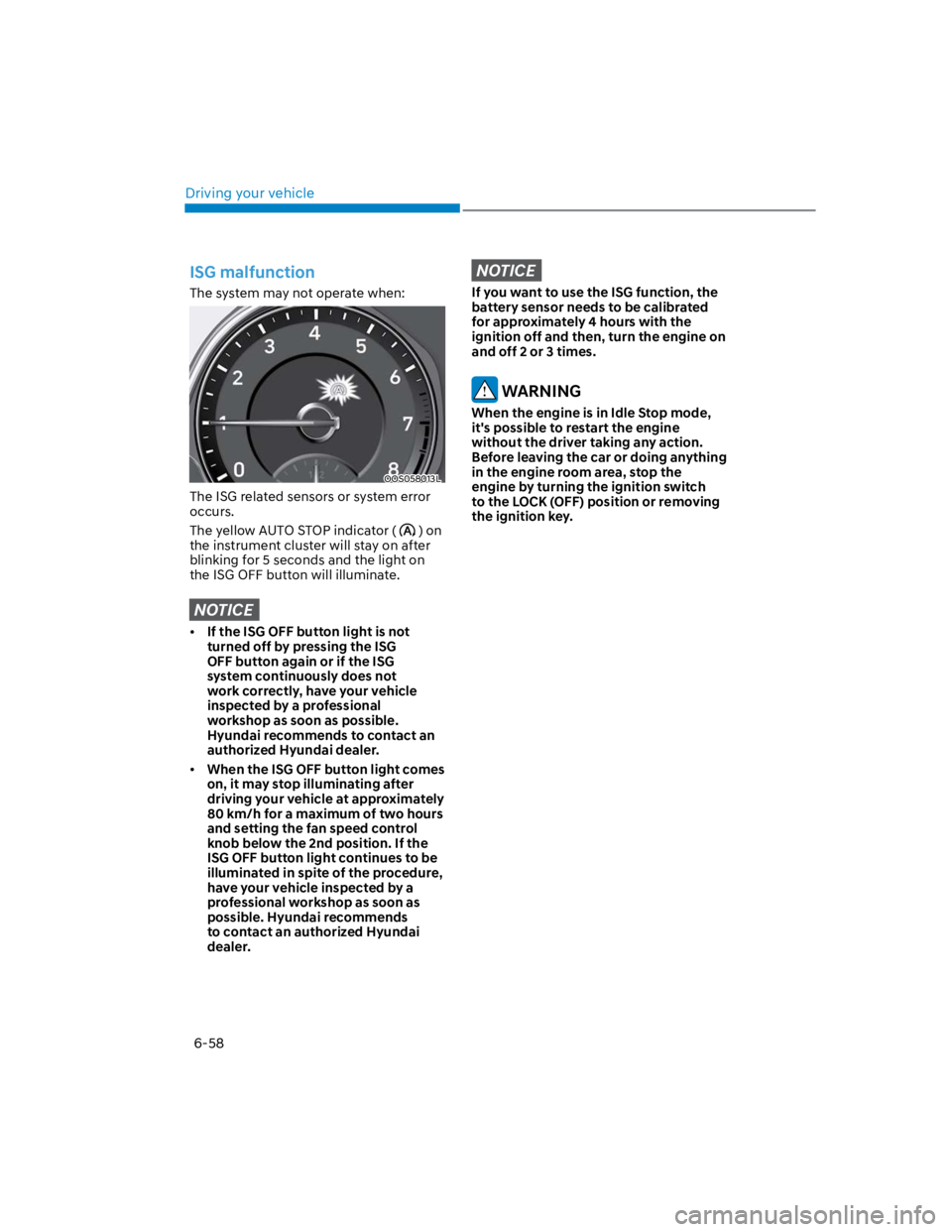
The system may not operate when:
OOS058013L
The ISG related sensors or system error
occurs.
The yellow AUTO STOP indicator () on
the instrument cluster will stay on after
blinking for 5 seconds and the light on
the ISG OFF button will illuminate.
NOTICE
If the ISG OFF button light is not
turned off by pressing the ISG
OFF button again or if the ISG
system continuously does not
work correctly, have your vehicle
inspected by a professional
workshop as soon as possible.
Hyundai recommends to contact an
authorized Hyundai dealer.
When the ISG OFF button light comes
on, it may stop illuminating after
driving your vehicle at approximately
80 km/h for a maximum of two hours
and setting the fan speed control
knob below the 2nd position. If the
ISG OFF button light continues to be
illuminated in spite of the procedure,
have your vehicle inspected by a
professional workshop as soon as
possible. Hyundai recommends
to contact an authorized Hyundai
dealer.
NOTICE
If you want to use the ISG function, the
battery sensor needs to be calibrated
for approximately 4 hours with the
ignition off and then, turn the engine on
and off 2 or 3 times.
WARNING
When the engine is in Idle Stop mode,
it's possible to restart the engine
without the driver taking any action.
Before leaving the car or doing anything
in the engine room area, stop the
engine by turning the ignition switch
to the LOCK (OFF) position or removing
the ignition key.
Page 326 of 579

06
6-69
Check spark plugs and ignition system
Inspect the spark plugs, as specified in
chapter 9. If necessary, replace them.
Also check all ignition wirings and
components for any cracks, wear-out,
and damage.
To prevent locks from freezing
To prevent the locks from being frozen,
spray approved de-icing fluid or glycerin
into key holes. When a lock opening is
already covered with ice, spray approved
de-icing fluid over the ice to remove it.
When an internal part of a lock freezes,
try to thaw it with a heated key. Carefully
use the heated key to avoid an injury.
Use approved window washer anti-
freeze solution in system
To prevent the window washer from
being frozen, add authorized window
washer anti-freeze solution, as specified
on the window washer container.
Window washer anti-freeze solution is
available from an authorized HYUNDAI
dealer, and most vehicle accessory
outlets. Do not use engine coolant or
other types of anti-freeze solution, to
prevent any damage to the vehicle paint.
Do not let your parking brake freeze
Under some conditions your parking
brake can freeze in the engaged position.
This is most likely to happen when there
is an accumulation of snow or ice around
or near the rear brakes or if the brakes
are wet. When there is the risk that your
parking brake may freeze, temporarily
apply it with the gear in P (Park). Also,
block the rear wheels in advance, so the
vehicle may not roll. Then, release the
parking brake.
Do not let ice and snow accumulate
underneath
Under some conditions, snow and ice
can build up under the fenders and
interfere with the steering. When driving
in such conditions during the severe
winter, you should check underneath
the vehicle on a regular basis, to ensure
that the front wheels and the steering
components is unblocked.
Carry emergency equipment
In accordance with weather conditions,
you should carry appropriate emergency
equipment, while driving. Some of the
items you may want to carry include tire
chains, tow straps or chains, flashlight,
emergency flares, sand, shovel, jumper
cables, window scraper, gloves, ground
cloth, coveralls, blanket, etc.
Do not place objects or materials in the
engine compartment
Putting objects or materials in the engine
compartment may cause an engine
failure or combustion, because they may
block the engine cooling. Such damage
will not be covered by the manufacturer’s
warranty.
Page 453 of 579
08
8-3
If you have a flat tire while
driving
If a tire goes flat while you are driving:
Take your foot off the accelerator
pedal and let the vehicle slow down
while driving straight ahead. Do not
apply the brakes immediately or
attempt to pull off the road as this
may cause loss of vehicle control
resulting in an accident. When the
vehicle has slowed to such a speed
that it is safe to do so, brake carefully
and pull off the road. Drive off the
road as far as possible and park on
firm, level ground. If you are on a
divided highway, do not park in the
median area between the two traffic
lanes.
When the vehicle is stopped, press the
hazard warning flasher button, move
the shift lever into P (Park), apply the
parking brake, and place the ignition
switch in the LOCK/OFF position.
Have all passengers get out of the
vehicle. Be sure they all get out on the
side of the vehicle that is away from
traffic.
When changing a flat tire, follow the
instructions provided later in this
chapter.
IF THE ENGINE WILL NOT
START
If the Engine Doesn't Turn Over
or Turns Over Slowly
Be sure the shift lever is in N (Neutral)
or P (Park). The engine starts only
when the shift lever is in N (Neutral) or
P (Park).
Check the battery connections to be
sure they are clean and tight.
Turn on the interior light. If the light
dims or goes out when you operate
the starter, the battery is drained.
Do not push or pull the vehicle to start it.
This could cause damage to your vehicle.
See instructions for "Jump Starting"
provided in this chapter.
CAUTION
Push or pull starting the vehicle may
cause the catalytic converter to
overload which can lead to damage to
the emission control system.
If the Engine Turns Over
Normally but Doesn't Start
Check the fuel level and add fuel if
necessary.
If the engine still does not start, have
your vehicle checked by an authorized
HYUNDAI dealer.
Page 454 of 579
Emergency situations
8-4
Jump starting can be dangerous if done
incorrectly. Follow the jump starting
procedure in this section to avoid serious
injury or damage to your vehicle. If in
doubt about how to properly jump start
your vehicle, we strongly recommend
that you have a service technician or
towing service do it for you.
WARNING
To prevent SERIOUS INJURY or DEATH
to you or bystanders, always follow
these precautions when working near
or handling the battery:
Always read and follow
instructions carefully when
handling a battery.
Wear eye protection designed
to protect the eyes from acid
splashes.
Keep all flames, sparks, or
smoking materials away from
the battery.
Hydrogen is always present
in battery cells, is highly
combustible, and may explode
if ignited.
Keep batteries out of reach of
children.
Batteries contain sulfuric acid
which is highly corrosive. Do
not allow acid to contact your
eyes, skin or clothing.
If acid gets into your eyes, flush your
eyes with clean water for at least 15
minutes and get immediate medical
attention. If acid gets on your skin,
thoroughly wash the area. If you feel
pain or a burning sensation, get medical
attention immediately.
When lifting a plastic-cased battery,
excessive pressure on the case may
cause battery acid to leak. Lift with a
battery carrier or with your hands on
opposite corners.
Do not attempt to jump start your
vehicle if your battery is frozen.
NEVER attempt to recharge the
battery when the vehicle’s battery
cables are connected to the battery.
The electrical ignition system works
with high voltage.
NEVER touch these components
with the engine running or when the
Engine Start/Stop button is in the ON
position.
Do not allow the (+) and (-) jumper
cables to touch. It may cause sparks.
The battery may rupture or explode
when you jump start with a low or
frozen battery.
JUMP STARTING
Page 459 of 579
08
8-9
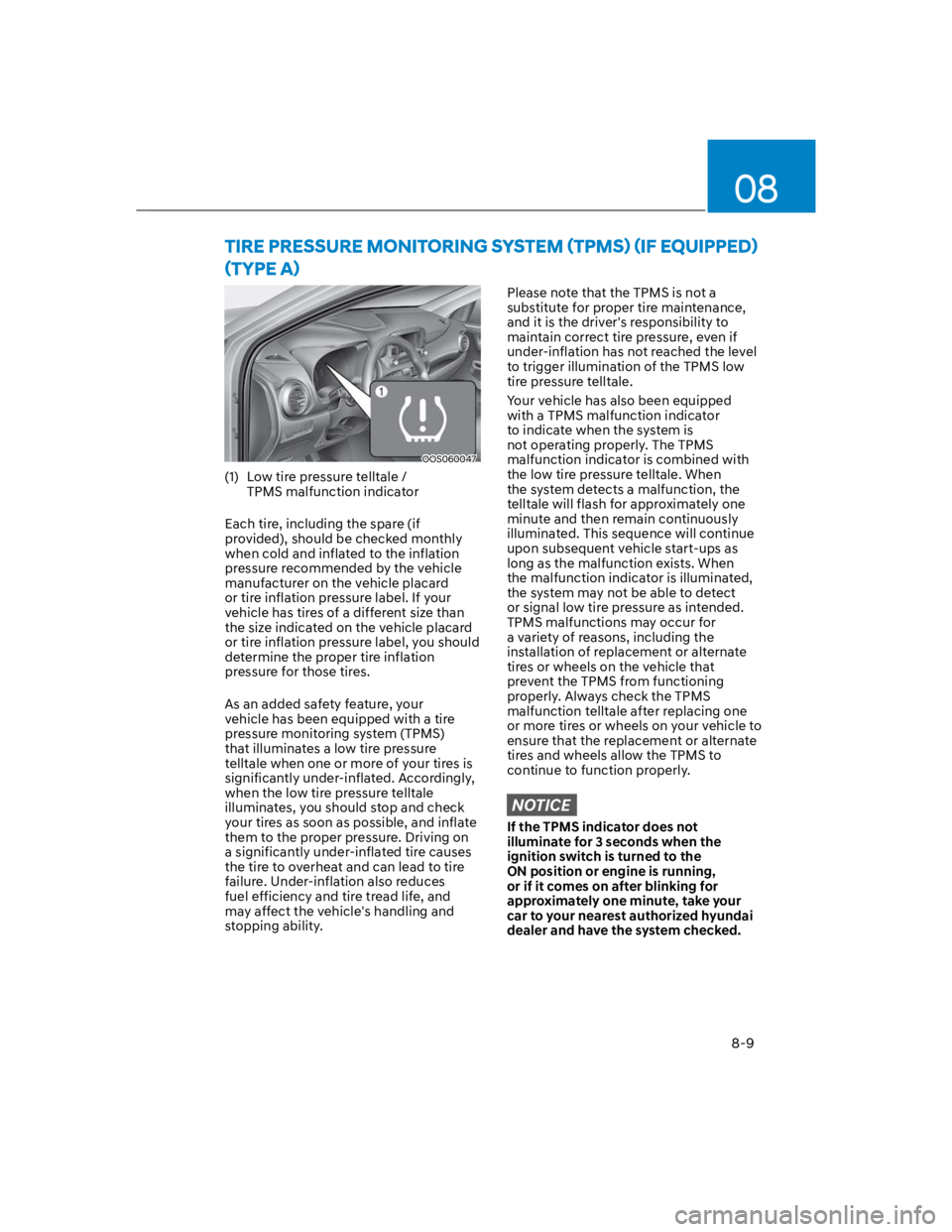
OOS060047
(1) Low tire pressure telltale /
TPMS malfunction indicator
Each tire, including the spare (if
provided), should be checked monthly
when cold and inflated to the inflation
pressure recommended by the vehicle
manufacturer on the vehicle placard
or tire inflation pressure label. If your
vehicle has tires of a different size than
the size indicated on the vehicle placard
or tire inflation pressure label, you should
determine the proper tire inflation
pressure for those tires.
As an added safety feature, your
vehicle has been equipped with a tire
pressure monitoring system (TPMS)
that illuminates a low tire pressure
telltale when one or more of your tires is
significantly under-inflated. Accordingly,
when the low tire pressure telltale
illuminates, you should stop and check
your tires as soon as possible, and inflate
them to the proper pressure. Driving on
a significantly under-inflated tire causes
the tire to overheat and can lead to tire
failure. Under-inflation also reduces
fuel efficiency and tire tread life, and
may affect the vehicle's handling and
stopping ability.
Please note that the TPMS is not a
substitute for proper tire maintenance,
and it is the driver's responsibility to
maintain correct tire pressure, even if
under-inflation has not reached the level
to trigger illumination of the TPMS low
tire pressure telltale.
Your vehicle has also been equipped
with a TPMS malfunction indicator
to indicate when the system is
not operating properly. The TPMS
malfunction indicator is combined with
the low tire pressure telltale. When
the system detects a malfunction, the
telltale will flash for approximately one
minute and then remain continuously
illuminated. This sequence will continue
upon subsequent vehicle start-ups as
long as the malfunction exists. When
the malfunction indicator is illuminated,
the system may not be able to detect
or signal low tire pressure as intended.
TPMS malfunctions may occur for
a variety of reasons, including the
installation of replacement or alternate
tires or wheels on the vehicle that
prevent the TPMS from functioning
properly. Always check the TPMS
malfunction telltale after replacing one
or more tires or wheels on your vehicle to
ensure that the replacement or alternate
tires and wheels allow the TPMS to
continue to function properly.
NOTICE
If the TPMS indicator does not
illuminate for 3 seconds when the
ignition switch is turned to the
ON position or engine is running,
or if it comes on after blinking for
approximately one minute, take your
car to your nearest authorized hyundai
dealer and have the system checked.
Page 469 of 579
08
8-19
Changing tires
WARNING
A vehicle can slip or roll off of a jack
causing serious injury or death to you or
those nearby. Take the following safety
precautions:
Do not get under a vehicle that is
supported by a jack.
NEVER attempt to change a tire in
the lane of traffic. ALWAYS move the
vehicle completely off the road on
level, firm ground away from traffic
before trying to change a tire. If you
cannot find a level, firm place off
the road, call a towing service for
assistance.
Be sure to use the jack provided with
the vehicle.
ALWAYS place the jack on the
designated jacking positions on the
vehicle and NEVER on the bumpers
or any other part of the vehicle for
jacking support.
Do not start or run the engine while
the vehicle is on the jack.
Do not allow anyone to remain in the
vehicle while it is on the jack.
Keep children away from the road
and the vehicle.
Follow these steps to change your
vehicle’s tire:
1. Park on a level, firm surface.
2. Move the shift lever into P (Park),
apply the parking brake, and place
the ignition switch in the LOCK/OFF
position.
3. Press the hazard warning flasher
button.
4. Remove the wheel lug wrench, jack,
jack handle, and spare tire from the
vehicle.
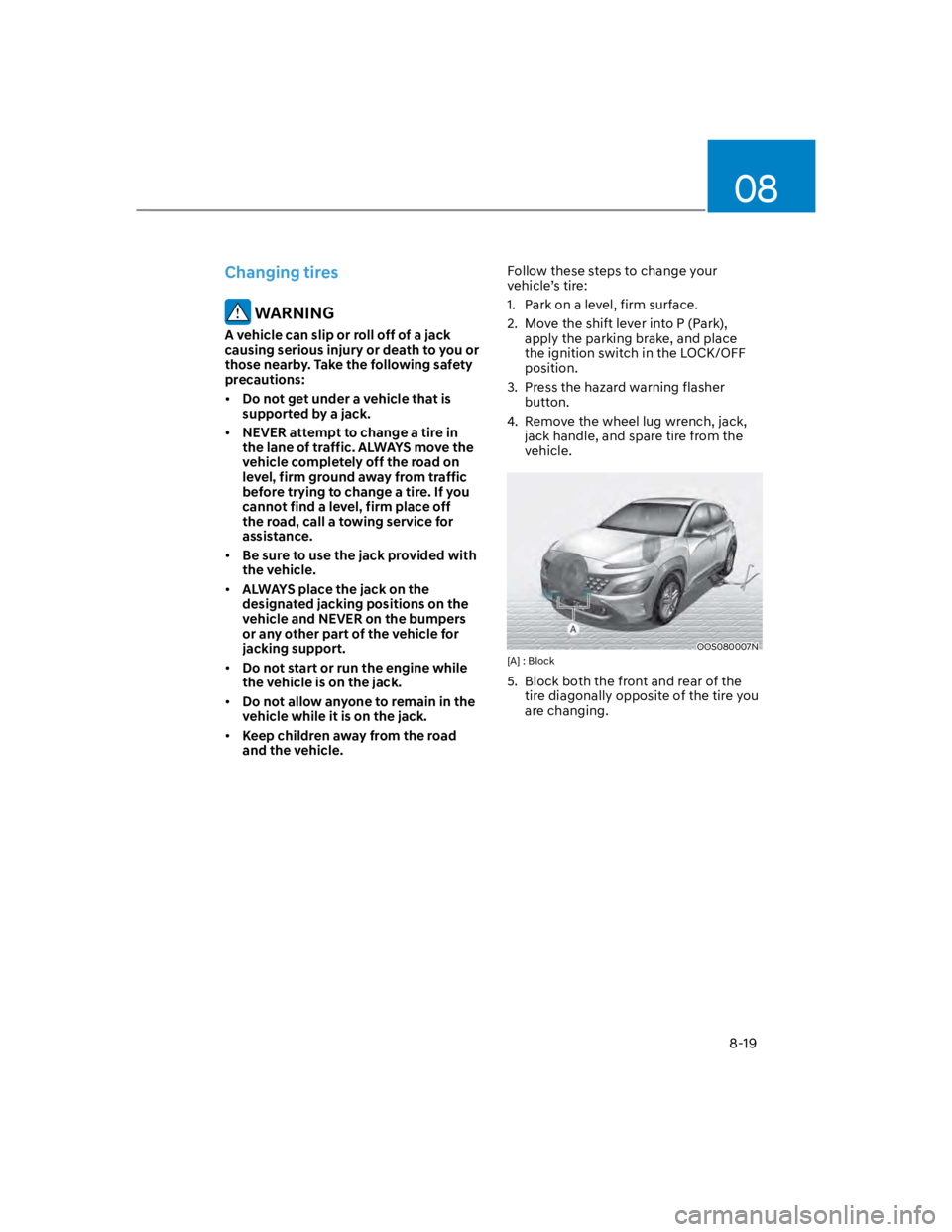
OOS080007N
[A] : Block
5. Block both the front and rear of the
tire diagonally opposite of the tire you
are changing.