boot HYUNDAI KONA 2022 Owners Manual
[x] Cancel search | Manufacturer: HYUNDAI, Model Year: 2022, Model line: KONA, Model: HYUNDAI KONA 2022Pages: 579, PDF Size: 35.31 MB
Page 264 of 579
06
6-7
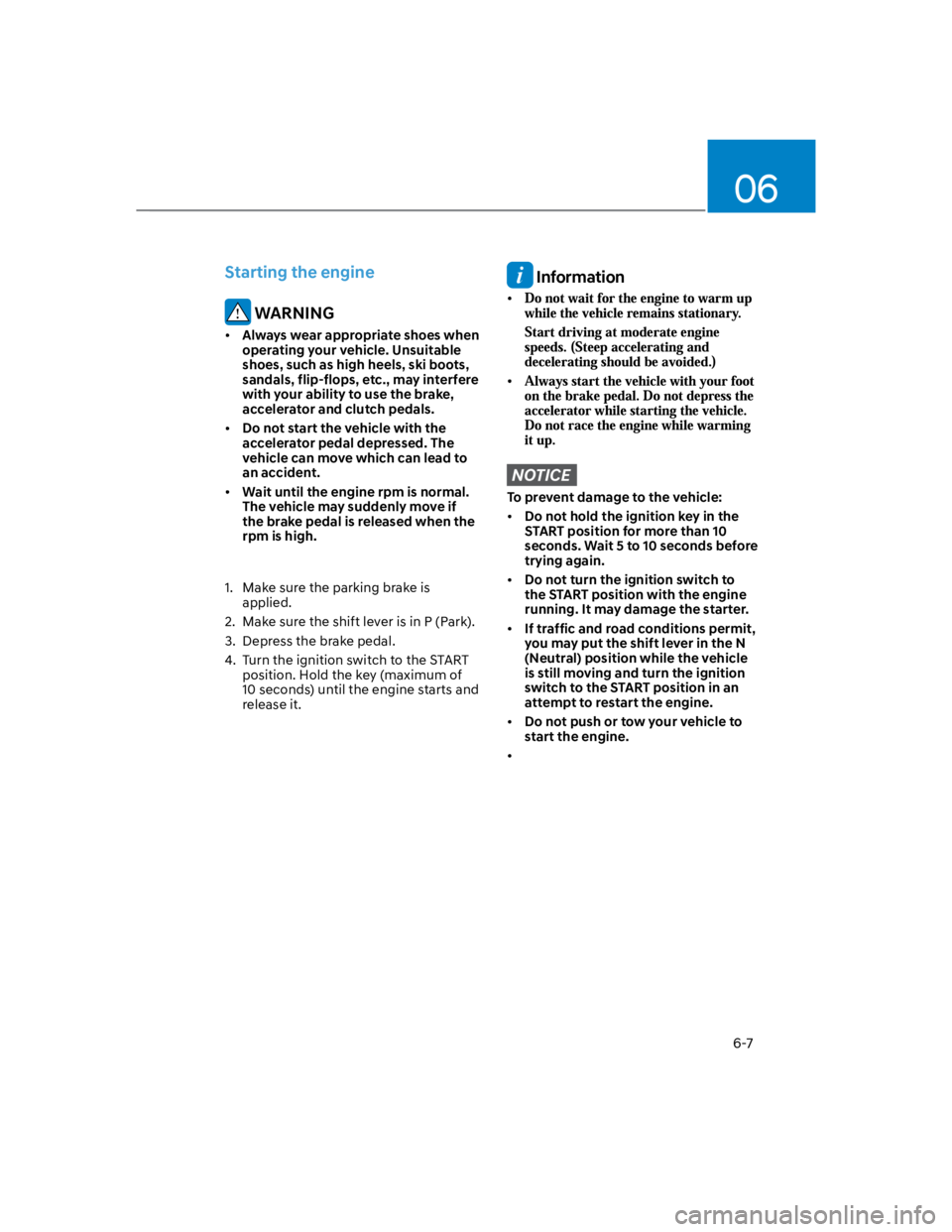
Starting the engine
WARNING
Always wear appropriate shoes when
operating your vehicle. Unsuitable
shoes, such as high heels, ski boots,
sandals, flip-flops, etc., may interfere
with your ability to use the brake,
accelerator and clutch pedals.
Do not start the vehicle with the
accelerator pedal depressed. The
vehicle can move which can lead to
an accident.
Wait until the engine rpm is normal.
The vehicle may suddenly move if
the brake pedal is released when the
rpm is high.
1. Make sure the parking brake is
applied.
2. Make sure the shift lever is in P (Park).
3. Depress the brake pedal.
4. Turn the ignition switch to the START
position. Hold the key (maximum of
10 seconds) until the engine starts and
release it.
Information
NOTICE
To prevent damage to the vehicle:
Do not hold the ignition key in the
START position for more than 10
seconds. Wait 5 to 10 seconds before
trying again.
Do not turn the ignition switch to
the START position with the engine
running. It may damage the starter.
If traffic and road conditions permit,
you may put the shift lever in the N
(Neutral) position while the vehicle
is still moving and turn the ignition
switch to the START position in an
attempt to restart the engine.
Do not push or tow your vehicle to
start the engine.
Page 267 of 579
Driving your vehicle
6-10
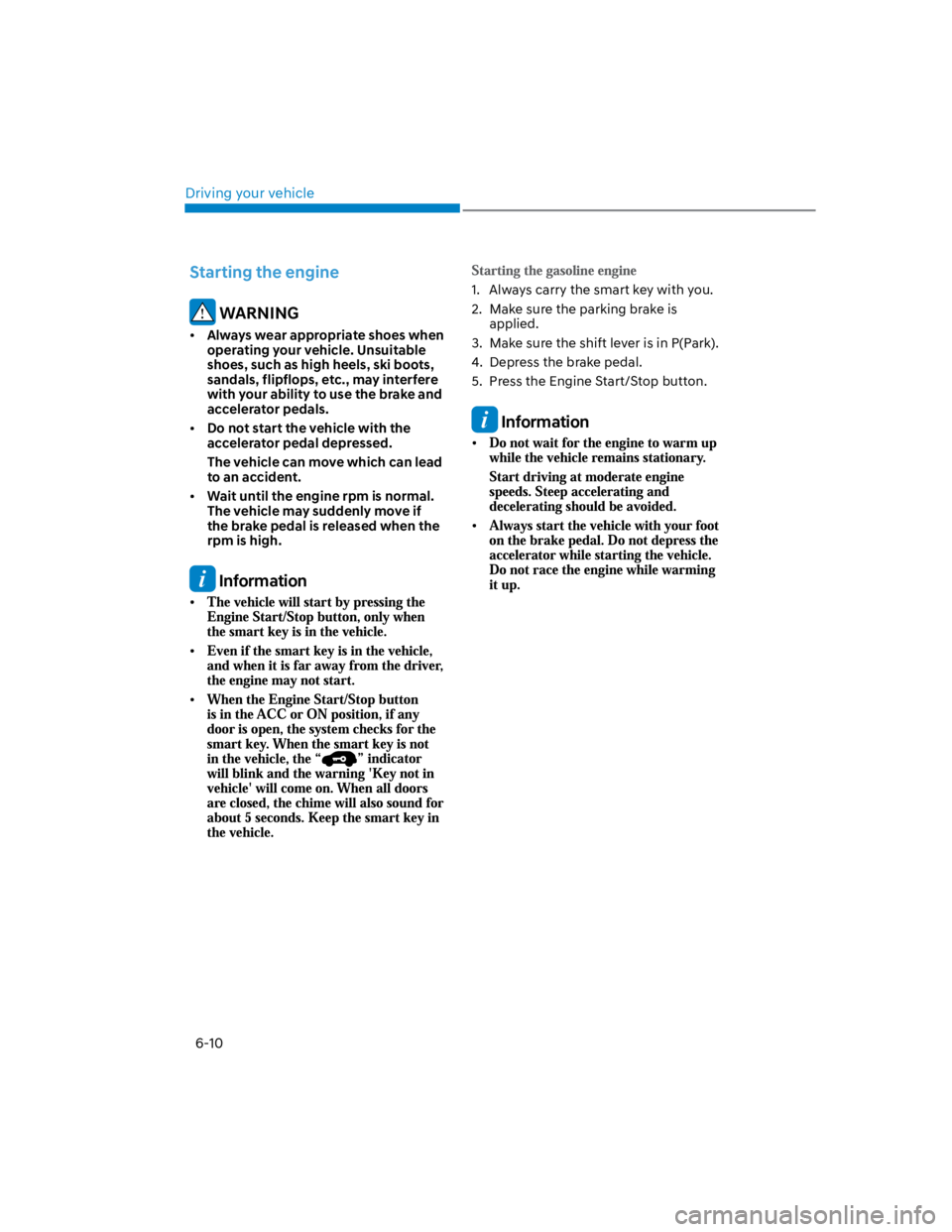
Starting the engine
WARNING
Always wear appropriate shoes when
operating your vehicle. Unsuitable
shoes, such as high heels, ski boots,
sandals, flipflops, etc., may interfere
with your ability to use the brake and
accelerator pedals.
Do not start the vehicle with the
accelerator pedal depressed.
The vehicle can move which can lead
to an accident.
Wait until the engine rpm is normal.
The vehicle may suddenly move if
the brake pedal is released when the
rpm is high.
Information
1. Always carry the smart key with you.
2. Make sure the parking brake is
applied.
3. Make sure the shift lever is in P(Park).
4. Depress the brake pedal.
5. Press the Engine Start/Stop button.
Information
Page 495 of 579
09
9-9
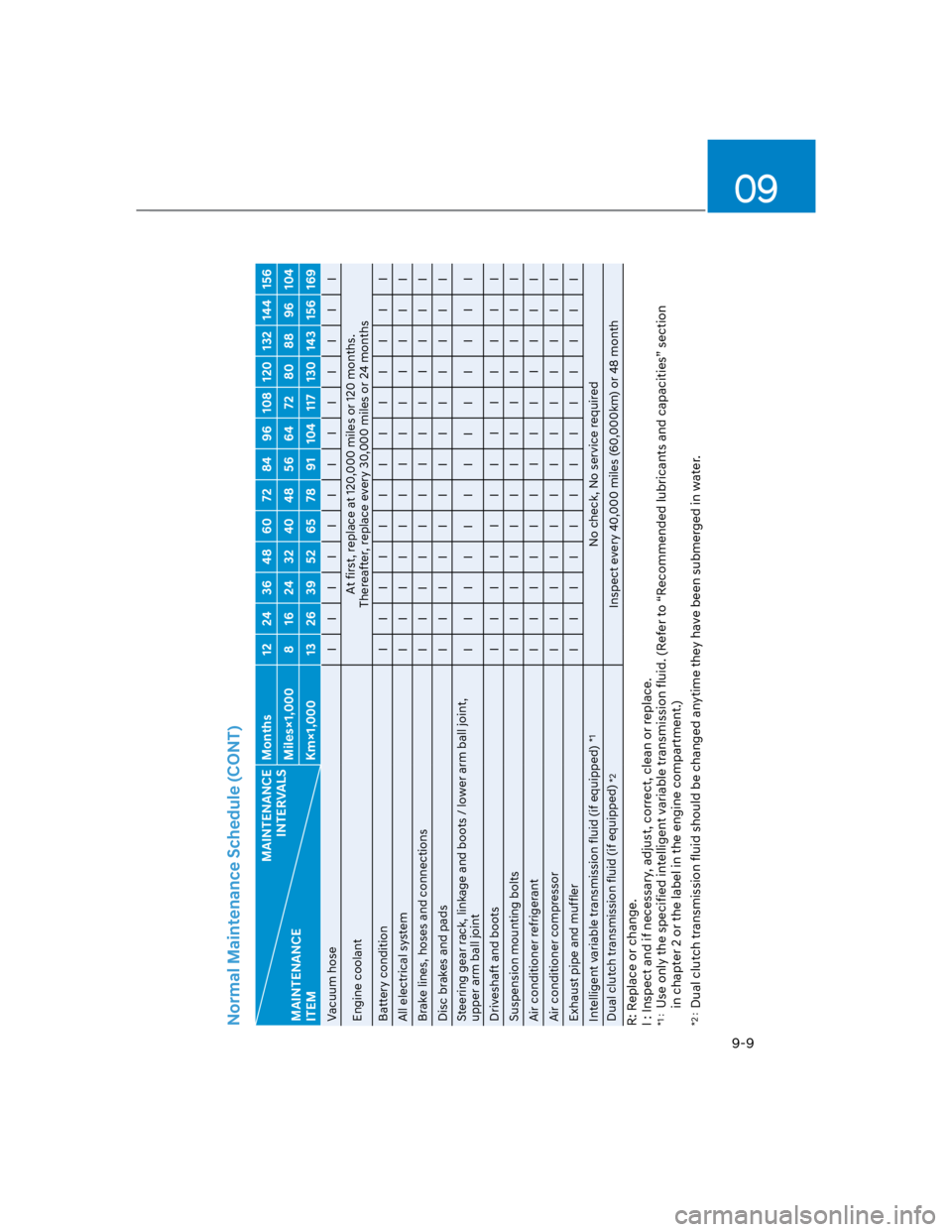
Normal Maintenance Schedule (CONT)
MAINTENANCE
INTERVALS
MAINTENANCE
ITEM
Months 12 24 36 48 60 72 84 96 108 120 132 144 156
Miles×1,000 8 16 24 32 40 48 56 64 72 80 88 96 104
Km×1,000 13 26 39 52 65 78 91 104 117 130 143 156 169
Vacuum hose I I I I I I I I I I I I I
Engine coolant
At first, replace at 120,000 miles or 120 months.
Thereafter, replace every 30,000 miles or 24 months
Battery condition I I I I I I I I I I I I I
All electrical system I I I I I I I I I I I I I
Brake lines, hoses and connections I I I I I I I I I I I I I
Disc brakes and pads I I I I I I I I I I I I I
Steering gear rack, linkage and boots / lower arm ball joint,
upper arm ball joint
I I I I I I I I I I I I I
Driveshaft and boots I I I I I I I I I I I I I
Suspension mounting bolts I I I I I I I I I I I I I
Air conditioner refrigerant I I I I I I I I I I I I I
Air conditioner compressor I I I I I I I I I I I I I
Exhaust pipe and muffler I I I I I I I I I I I I I
Intelligent variable transmission fluid (if equipped)
*1
No check, No service required
Dual clutch transmission fluid (if equipped)
*2
Inspect every 40,000 miles (60,000km) or 48 month
R: Replace or change.
I : Inspect and if necessary, adjust, correct, clean or replace.
*1 :
Use only the specified intelligent variable transmission fluid. (Refer to “Recommended lubricants and capacities” section
in chapter 2 or the label in the engine compartment.)
*2 :
Dual clutch transmission fluid should be changed anytime they have been submerged in water.
Page 497 of 579
09
9-11
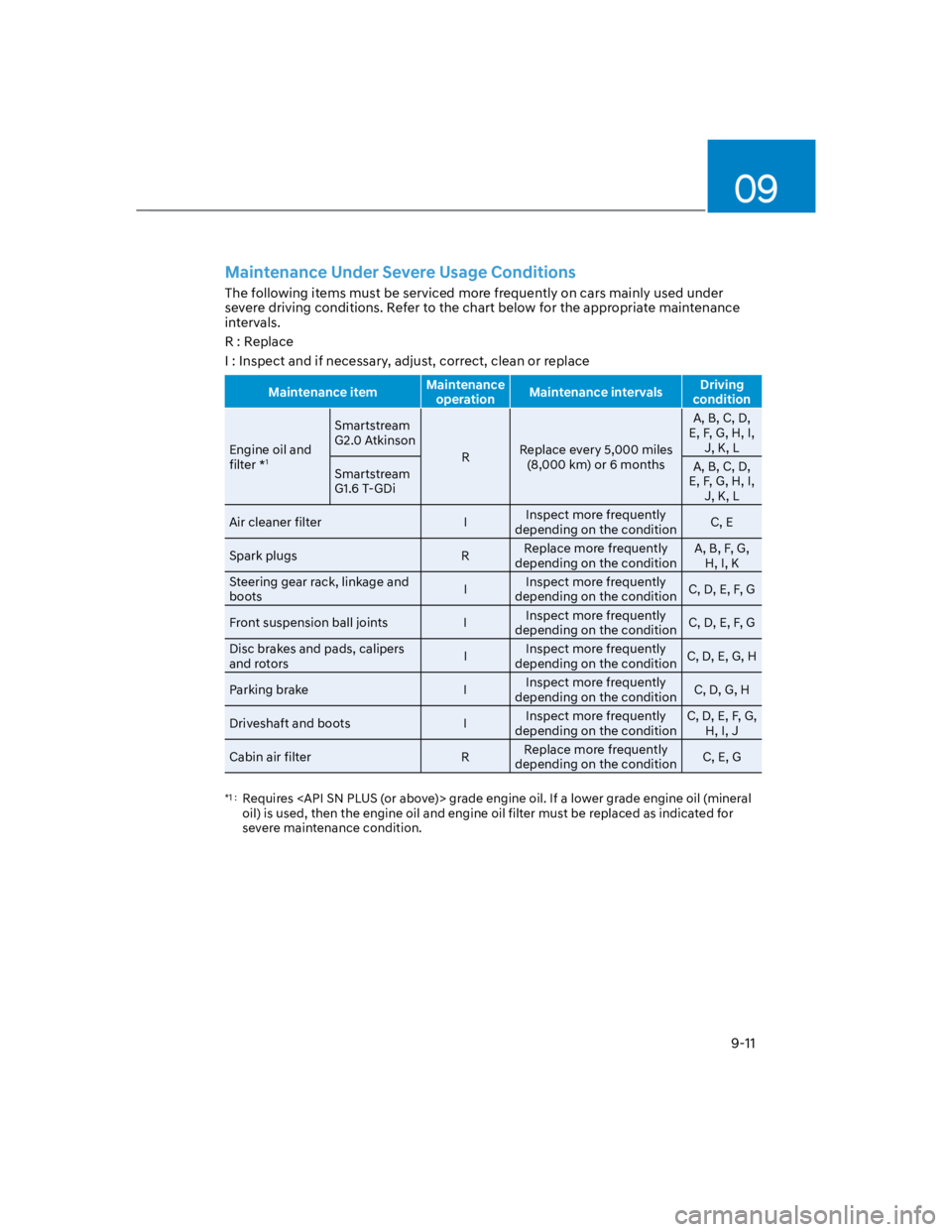
Maintenance Under Severe Usage Conditions
The following items must be serviced more frequently on cars mainly used under
severe driving conditions. Refer to the chart below for the appropriate maintenance
intervals.
R : Replace
I : Inspect and if necessary, adjust, correct, clean or replace
Maintenance itemMaintenance
operationMaintenance intervalsDriving
condition
Engine oil and
filter *1
Smartstream
G2.0 Atkinson
RReplace every 5,000 miles
(8,000 km) or 6 months
A, B, C, D,
E, F, G, H, I,
J, K, L
Smartstream
G1.6 T-GDi
A, B, C, D,
E, F, G, H, I,
J, K, L
Air cleaner filter IInspect more frequently
depending on the conditionC, E
Spark plugs RReplace more frequently
depending on the condition
A, B, F, G,
H, I, K
Steering gear rack, linkage and
bootsIInspect more frequently
depending on the conditionC, D, E, F, G
Front suspension ball joints IInspect more frequently
depending on the conditionC, D, E, F, G
Disc brakes and pads, calipers
and rotorsIInspect more frequently
depending on the conditionC, D, E, G, H
Parking brake IInspect more frequently
depending on the conditionC, D, G, H
Driveshaft and boots IInspect more frequently
depending on the condition
C, D, E, F, G,
H, I, J
Cabin air filter RReplace more frequently
depending on the conditionC, E, G
*1 : Requires
oil) is used, then the engine oil and engine oil filter must be replaced as indicated for
severe maintenance condition.
Page 499 of 579
09
9-13
Engine oil and filter
The engine oil and filter should be
changed at the intervals specified in the
maintenance schedule. If the vehicle
is being driven in severe conditions,
more frequent oil and filter changes are
required.
Drive belts
Inspect all drive belts for evidence
of cuts, cracks, excessive wear or oil
saturation and replace if necessary.
Drive belts should be checked
periodically for proper tension and
adjusted as necessary.
Information
Fuel lines, fuel hoses and
connections
Check the fuel lines, fuel hoses and
connections for leakage and damage.
We recommend an authorized HYUNDAI
dealer replace any damaged or leaking
parts immediately.
Fuel filter (for gasoline engine)
The fuel filter is considered to be
maintenance free but periodic inspection
is recommended for this maintenance
depends on fuel quality. If there are
some important matters like fuel flow
restriction, surging, loss of power, hard
starting problem etc., replace the fuel
filter immediately. Consult an authorized
HYUNDAI dealer for details.
Vapor hose and fuel filler cap
The vapor hose and fuel filler cap should
be inspected at those intervals specified
in the maintenance schedule. Make sure
a new vapor hose or fuel filler cap is
correctly replaced.
Vacuum crankcase ventilation
hoses (if equipped)
Inspect the surface of hoses for evidence
of heat and/or mechanical damage.
Hard and brittle rubber, cracking,
tears, cuts, abrasions, and excessive
swelling indicate deterioration. Particular
attention should be paid to examine
those hose surfaces nearest to high heat
sources, such as the exhaust manifold.
Inspect the hose routing to ensure that
the hoses do not come in contact with
any heat source, sharp edges or moving
component which might cause heat
damage or mechanical wear. Inspect
all hose connections, such as clamps
and couplings, to make sure they are
secure, and that no leaks are present.
Hoses should be replaced immediately if
there is any evidence of deterioration or
damage.
Air cleaner filter
We recommend that the air cleaner filter
be replaced by an authorized HYUNDAI
dealer.
Spark plugs
Make sure to install new spark plugs of
the correct heat range.
When assembling parts, be sure to
wipe the inside and outside of the boot
bottom of the ignition coil and the
insulator of the spark plug with a soft
cloth to prevent contamination of the
spark plug insulator.
EXPLANATION OF SCHEDULED MAINTENANCE ITEMS
Page 500 of 579
Maintenance
9-14
Cooling system
Check cooling system components, such
as radiator, coolant reservoir, hoses and
connections for leakage and damage.
Replace any damaged parts.
Engine coolant
The coolant should be changed at the
intervals specified in the maintenance
schedule.
Intelligent variable transmission
fluid (if equipped)
Intelligent variable transmission fluid
should not be checked under normal
usage conditions.
Have the Intelligent variable transmission
fluid changed by an authorized HYUNDAI
dealer according to the maintenance
schedule.
Dual clutch transmission fluid (if
equipped)
Inspect the dual clutch transmission fluid
according to the maintenance schedule.
Brake hoses and lines
Visually check for proper installation,
chafing, cracks, deterioration and any
leakage. Replace any deteriorated or
damaged parts immediately.
Brake fluid
Check the brake fluid level in the brake
fluid reservoir. The level should be
between the MIN and the MAX marks
on the side of the reservoir. Use only
hydraulic brake fluid conforming to DOT
4 specification.
Parking brake
Inspect the parking brake system
including the parking brake lever and
cables.
Brake discs, pads, calipers and
rotors
Check the pads, the disc, and the rotor
for any excessive wear-out. Inspect
calipers for any fluid leakage.
For more information on checking the
pads or lining wear limit, refer to the
HYUNDAI web site.
(http://service.hyundai-motor.com)
Propeller shaft
Check the propeller shaft, boots, clamps,
rubber couplings and center-bearing
rubber for cracks, deterioration, or
damage. Replace any damaged parts
and if necessary, repack the grease.
Suspension mounting bolts
Check the suspension connections for
looseness or damage. Retighten to the
specified torque.
Steering gear box, linkage &
boots/lower arm ball joint
With the vehicle stopped and the engine
off, check for excessive free-play in the
steering wheel. Check the linkage for
bends or damage. Check the dust boots
and ball joints for deterioration, cracks,
or damage.
Replace any damaged parts.
Drive shafts and boots
Check the drive shafts, boots and clamps
for cracks, deterioration, or damage.
Replace any damaged parts and, if
necessary, repack the grease.
Air conditioning refrigerant
Check the air conditioning lines and
connections for leakage and damage.
Page 554 of 579
Maintenance
9-68
NOTICE
If you park your vehicle near a stainless
steel sign or glass facade building, the
vehicle’s exterior plastic parts such
as a bumper, spoiler, garnish, lamp
or outside rearview mirror might be
damaged due to sunlight reflected from
the sign or building. To prevent damage
of the exterior plastic parts, you should
avoid parking in areas where light may
be reflected or use a car cover. (The
exterior plastic parts applied to your
vehicle may vary.)
Exterior care
Exterior general caution
It is very important to follow the label
directions when using any chemical
cleaner or polish. Read all warning and
caution statements that appear on the
label.
Finish maintenance
To help protect your vehicle’s finish from
rust and deterioration, wash it thoroughly
and frequently at least once a month
with lukewarm or cold water.
If you use your vehicle for off-road
driving, you should wash it after each
off-road trip. Pay special attention to the
removal of any accumulation of salt, dirt,
mud, and other foreign materials. Make
sure the drain holes in the lower edges
of the doors and rocker panels are kept
clear and clean.
Insects, tar, tree sap, bird droppings,
industrial pollution and similar deposits
can damage your vehicle’s finish if not
removed immediately.
Even prompt washing with plain water
may not completely remove all these
deposits. A mild soap, safe for use on
painted surfaces, should be used.
After washing, rinse the vehicle
thoroughly with lukewarm or cold water.
Do not allow soap to dry on the finish.
When using high-pressure washers,
make sure to maintain sufficient
distance from the vehicle.
Insufficient clearance or excessive
pressure can lead to component
damage or water penetration.
Do not spray the camera, sensors or
its surrounding area directly with a
high pressure washer. Shock applied
from high pressure water may cause
the device to not operate normally.
Do not bring the nozzle tip close to
boots (rubber or plastic covers) or
connectors as they may be damaged
if they come into contact with high
pressure water.
WARNING
After washing the vehicle, test the
brakes while driving slowly to see
if they have been affected by water
before getting on the road. If braking
performance is impaired, dry the
brakes by applying them lightly while
maintaining a slow forward speed.
APPEARANCE CARE