fuel pump Hyundai Matrix 2004 User Guide
[x] Cancel search | Manufacturer: HYUNDAI, Model Year: 2004, Model line: Matrix, Model: Hyundai Matrix 2004Pages: 317, PDF Size: 5.12 MB
Page 161 of 317
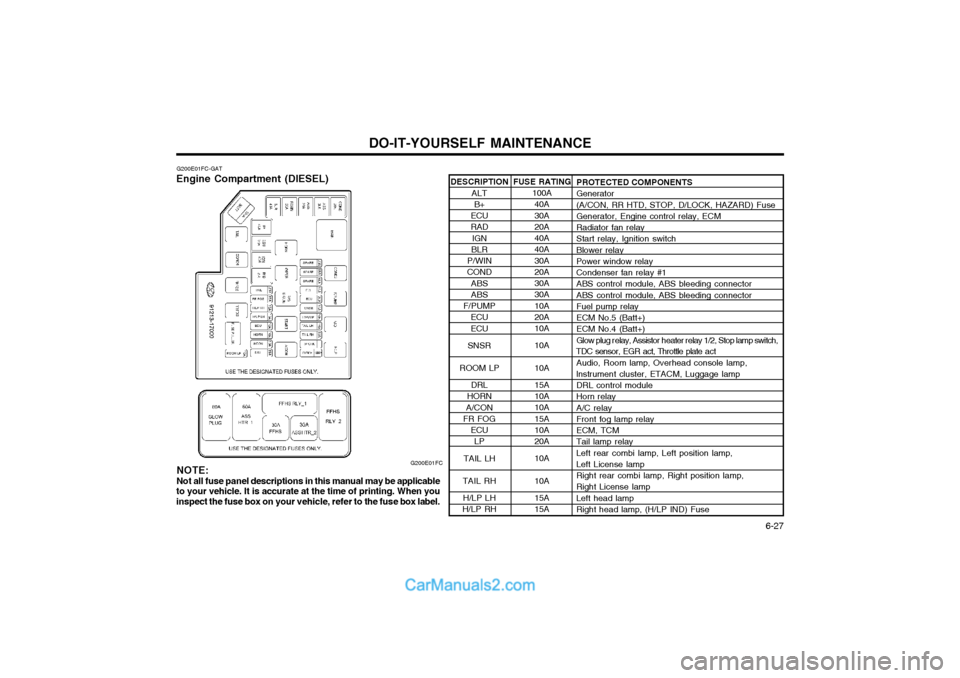
DO-IT-YOURSELF MAINTENANCE 6-27
DESCRIPTION
ALTB+
ECU RAD IGN
BLR
P/WINCOND ABSABS
F/PUMP ECU ECU
SNSR
ROOM LP DRL
HORN
A/CON
FR FOG
ECULP
TAIL LH
TAIL RH H/LP LH
H/LP RH
G200E01FC-GAT
Engine Compartment (DIESEL)
G200E01FCPROTECTED COMPONENTS Generator (A/CON, RR HTD, STOP, D/LOCK, HAZARD) Fuse Generator, Engine control relay, ECM Radiator fan relay Start relay, Ignition switch Blower relay Power window relay Condenser fan relay #1 ABS control module, ABS bleeding connector ABS control module, ABS bleeding connector Fuel pump relay ECM No.5 (Batt+) ECM No.4 (Batt+)
Glow plug r elay, Assistor h eater relay 1/2, Stop lamp switch,
TDC sensor, EGR act, Throttle plate a ct
Audio, Room lamp, Overhead console lamp, lnstrument cluster, ETACM, Luggage lamp DRL control module Horn relay A/C relay Front fog lamp relay ECM, TCM Tail lamp relay Left rear combi lamp, Left position lamp, Left License lamp Right rear combi lamp, Right position lamp, Right License lamp Left head lamp Right head lamp, (H/LP IND) Fuse
FUSE RATING
100A40A 30A 20A 40A 40A 30A 20A 30A 30A 10A 20A 10A 10A 10A 15A 10A 10A 15A 10A 20A 10A 10A 15A 15A
NOTE:
Not all fuse panel descriptions in this manual may be applicable
to your vehicle. It is accurate at the time of printing. When you inspect the fuse box on your vehicle, refer to the fuse box label.
Page 168 of 317
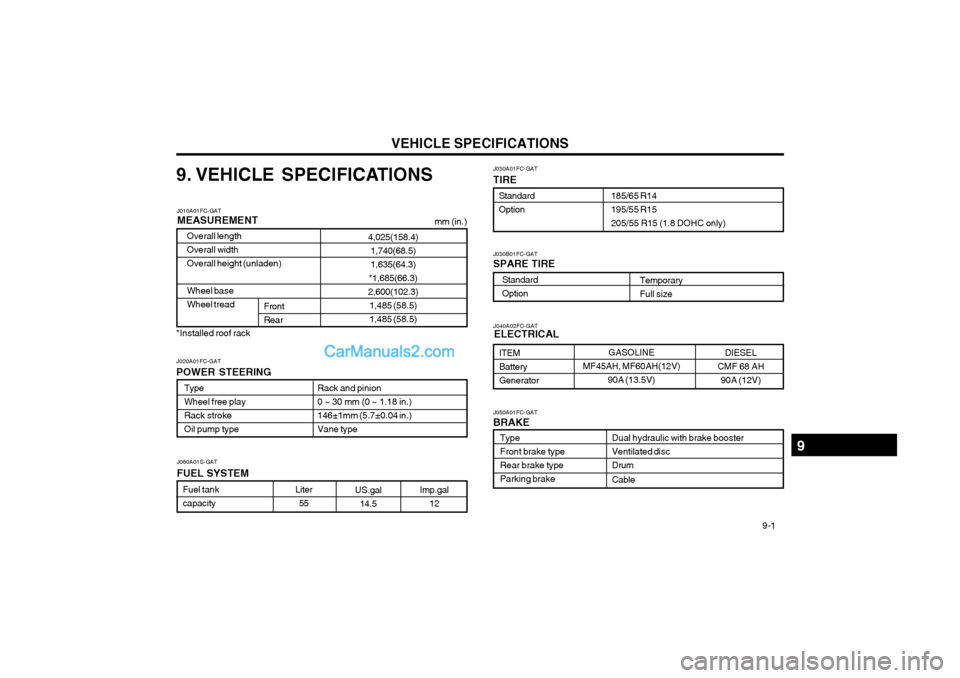
VEHICLE SPECIFICATIONS 9-1
J030A01FC-GAT
TIRE J040A02FC-GAT
ELECTRICAL
ITEM BatteryGenerator
Type Front brake typeRear brake typeParking brake Dual hydraulic with brake boosterVentilated discDrum Cable
J050A01FC-GAT BRAKE
9. VEHICLE SPECIFICATIONS
J010A01FC-GAT
MEASUREMENT
J060A01S-GAT FUEL SYSTEM
J020A01FC-GAT
POWER STEERING Type Wheel free playRack strokeOil pump type Rack and pinion0 ~ 30 mm (0 ~ 1.18 in.)146±1mm (5.7±0.04 in.)Vane type
Front Rear
Fuel tankcapacity Imp.gal
12
US.gal
14.5
Liter
55
Overall lengthOverall widthOverall height (unladen) Wheel base Wheel tread
mm (in.)
4,025(158.4) 1,740(68.5)1,635(64.3)
*1,685(66.3)
2,600(102.3) 1,485 (58.5)1,485 (58.5)
DIESEL
CMF 68 AH 90A (12V)
GASOLINE
MF45AH, MF60AH(12V) 90A (13.5V)
*Installed roof rack
Standard Option
J030B01FC-GAT SPARE TIRE
Temporary Full size
185/65 R14 195/55 R15205/55 R15 (1.8 DOHC only)
StandardOption
9
Page 183 of 317
1- 1
CONTROLS AND EQUIPMENT
from jerry cans or by means of a funnel that the fuel being used is unleaded.The use of leaded fuel in this vehicle will result in irreversible pollution of the catalyst ele- ment. Such pollution will prevent correct op- eration of the catalyst and give rise to in- creased operating temperatures leading to the catalyst element melting and restricting the exhaust flow along with an increase in exhaust emission levels. CAUTION: The vehicle warranty will not extend to damage arising from the use of incorrect fuels. Use Diesel Diesel fuel of 52 to 54 cetane is the correct rating to use in Hyundai vehicle. If two types of diesel fuel are available, use summer or winter fuel properly according to the following temperature conditions.
o Above 23°F (-5°C) ... Summer type diesel fuel.
o Below 23°F (-5°C) ... Winter type diesel fuel. Watch the fuel level in the tank very carefully: If the engine stops through fuel failure, thecircuits must be completely purged to permit restarting.
SB000A1-E 1
. CONTROLS AND
EQUIPMENT
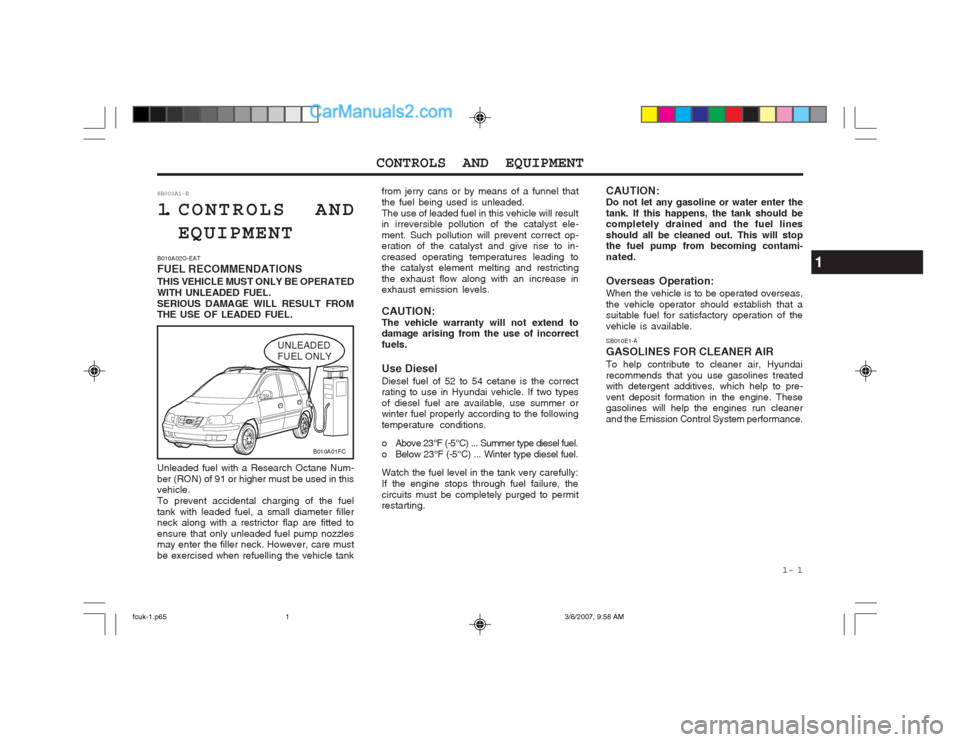
B010A02O-EAT FUEL RECOMMENDATIONSTHIS VEHICLE MUST ONLY BE OPERATED WITH UNLEADED FUEL.SERIOUS DAMAGE WILL RESULT FROM THE USE OF LEADED FUEL.
UNLEADED FUEL ONLY
Unleaded fuel with a Research Octane Num-ber (RON) of 91 or higher must be used in this vehicle. To prevent accidental charging of the fueltank with leaded fuel, a small diameter filler neck along with a restrictor flap are fitted to ensure that only unleaded fuel pump nozzles may enter the filler neck. However, care must be exercised when refuelling the vehicle tank SB010E1-A GASOLINES FOR CLEANER AIRTo help contribute to cleaner air, Hyundai recommends that you use gasolines treated with detergent additives, which help to pre- vent deposit formation in the engine. These gasolines will help the engines run cleaner and the Emission Control System performance.
CAUTION:Do not let any gasoline or water enter thetank. If this happens, the tank should be completely drained and the fuel lines should all be cleaned out. This will stop the fuel pump from becoming contami- nated. Overseas Operation: When the vehicle is to be operated overseas, the vehicle operator should establish that a suitable fuel for satisfactory operation of the vehicle is available.
1
B010A01FC
fcuk-1.p65
3/6/2007, 9:58 AM
1
Page 213 of 317
1- 31
CONTROLS AND EQUIPMENT
circuits becoming defective, approximately fifty per cent of the normal braking perfor- mance will be available. If failure of one of the circuits occurs, therequired amount of pedal effort, pedal travel and stopping distance will be increased. Use of the gearbox is recommended to assist in bringing the vehicle to rest. The vehicle must not be driven once brake failure has occurred until the system has been repaired and is functioning normally. The braking system employs a vacuum servo in order that the pedal efforts are reduced. Power for the servo is derived from the engine and therefore, in the event of the engine stopping or the vehicle being towed, pedal efforts will be substantially increased.
SB210L2-E
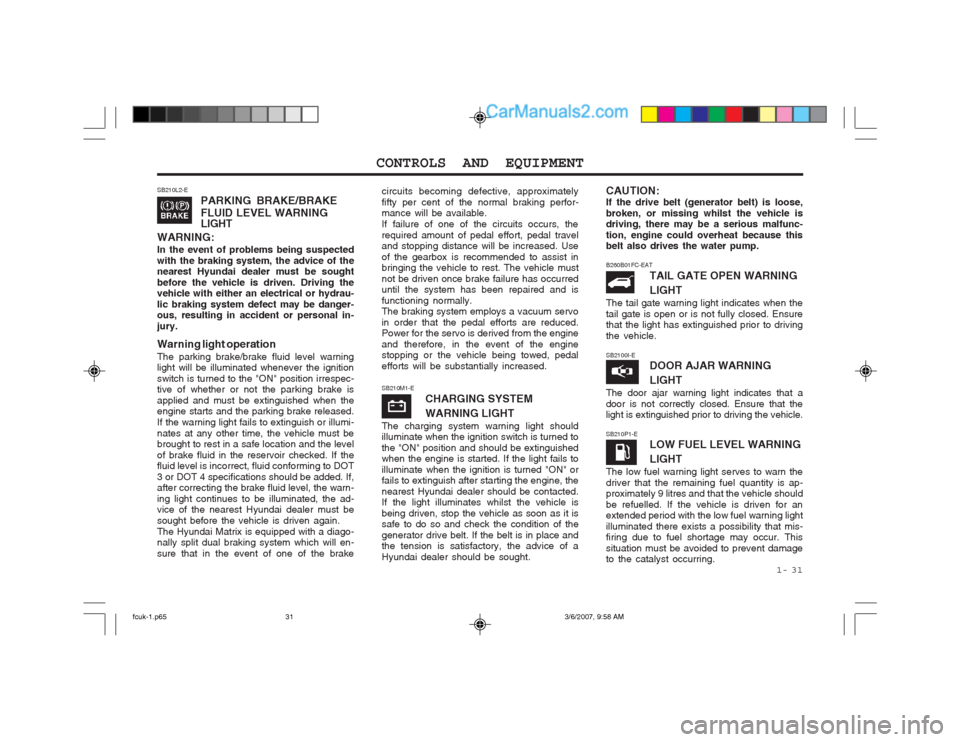
PARKING BRAKE/BRAKE FLUID LEVEL WARNING LIGHT
WARNING: In the event of problems being suspected with the braking system, the advice of the nearest Hyundai dealer must be sought before the vehicle is driven. Driving the vehicle with either an electrical or hydrau- lic braking system defect may be danger- ous, resulting in accident or personal in- jury. Warning light operation The parking brake/brake fluid level warning light will be illuminated whenever the ignition switch is turned to the "ON" position irrespec- tive of whether or not the parking brake is applied and must be extinguished when the engine starts and the parking brake released. If the warning light fails to extinguish or illumi-nates at any other time, the vehicle must be brought to rest in a safe location and the level of brake fluid in the reservoir checked. If the fluid level is incorrect, fluid conforming to DOT 3 or DOT 4 specifications should be added. If, after correcting the brake fluid level, the warn- ing light continues to be illuminated, the ad- vice of the nearest Hyundai dealer must be sought before the vehicle is driven again.The Hyundai Matrix is equipped with a diago- nally split dual braking system which will en- sure that in the event of one of the brake
CAUTION: If the drive belt (generator belt) is loose,broken, or missing whilst the vehicle is driving, there may be a serious malfunc- tion, engine could overheat because this belt also drives the water pump.
SB210M1-E CHARGING SYSTEM WARNING LIGHT
The charging system warning light should illuminate when the ignition switch is turned to the "ON" position and should be extinguished when the engine is started. If the light fails to illuminate when the ignition is turned "ON" or fails to extinguish after starting the engine, the nearest Hyundai dealer should be contacted. If the light illuminates whilst the vehicle is being driven, stop the vehicle as soon as it is safe to do so and check the condition of the generator drive belt. If the belt is in place and the tension is satisfactory, the advice of a Hyundai dealer should be sought.
B260B01FC-EAT TAIL GATE OPEN WARNING LIGHT
The tail gate warning light indicates when the tail gate is open or is not fully closed. Ensure that the light has extinguished prior to driving the vehicle. SB2100I-E DOOR AJAR WARNING LIGHT
The door ajar warning light indicates that a door is not correctly closed. Ensure that the light is extinguished prior to driving the vehicle.
SB210P1-E LOW FUEL LEVEL WARNING LIGHT
The low fuel warning light serves to warn the driver that the remaining fuel quantity is ap- proximately 9 litres and that the vehicle should be refuelled. If the vehicle is driven for an extended period with the low fuel warning light illuminated there exists a possibility that mis- firing due to fuel shortage may occur. This situation must be avoided to prevent damage to the catalyst occurring.
fcuk-1.p65 3/6/2007, 9:58 AM
31
Page 215 of 317
1- 33
CONTROLS AND EQUIPMENT
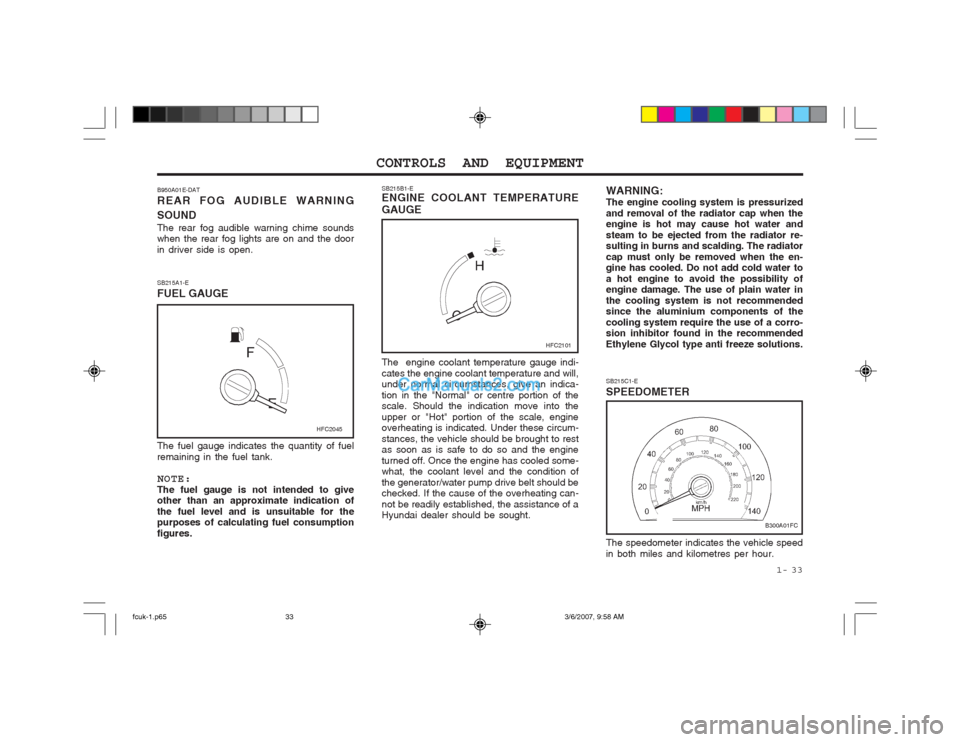
The fuel gauge indicates the quantity of fuel remaining in the fuel tank. NOTE: The fuel gauge is not intended to give other than an approximate indication of the fuel level and is unsuitable for the purposes of calculating fuel consumption figures. SB215B1-E ENGINE COOLANT TEMPERATURE GAUGE The engine coolant temperature gauge indi- cates the engine coolant temperature and will, under normal circumstances, give an indica- tion in the "Normal" or centre portion of the scale. Should the indication move into the upper or "Hot" portion of the scale, engine overheating is indicated. Under these circum- stances, the vehicle should be brought to rest as soon as is safe to do so and the engine turned off. Once the engine has cooled some- what, the coolant level and the condition of the generator/water pump drive belt should be checked. If the cause of the overheating can- not be readily established, the assistance of a Hyundai dealer should be sought.
SB215A1-E FUEL GAUGE
B950A01E-DATREAR FOG AUDIBLE WARNING SOUND The rear fog audible warning chime sounds when the rear fog lights are on and the door in driver side is open.
HFC2101
HFC2045
WARNING: The engine cooling system is pressurizedand removal of the radiator cap when the engine is hot may cause hot water and steam to be ejected from the radiator re- sulting in burns and scalding. The radiator cap must only be removed when the en- gine has cooled. Do not add cold water to a hot engine to avoid the possibility of engine damage. The use of plain water in the cooling system is not recommended since the aluminium components of the cooling system require the use of a corro- sion inhibitor found in the recommended Ethylene Glycol type anti freeze solutions.
B300A01FC
SB215C1-E SPEEDOMETER The speedometer indicates the vehicle speed in both miles and kilometres per hour.
fcuk-1.p65
3/6/2007, 9:58 AM
33
Page 260 of 317
3-1
IN CASE OF EMERGENCY
SD000A1-E
3. IN CASE OF EMERGENCY
SD020A1-E IF THE ENGINE WILL NOT START
Seek assistance from the nearest Hyundai
dealer with regard to the method of ignition and
fuel system diagnosis. CAUTION: If the engine refuses to start, no attemptshould be made to push or tow start the vehicle. Vehicles with automatic transaxle or fuel injection will not be able to be started in this manner since no drive is transmitted through the automatic transaxle whilst the engine is not running, and in the case of fuel injected derivatives, the fuel pump will not operate under tow start con- ditions. In addition, if the vehicle is equipped with an exhaust catalyst, dam- age to the catalyst may result if the vehicle is tow started. SD020B1-E IF THE ENGINE CANNOT BECRANKED
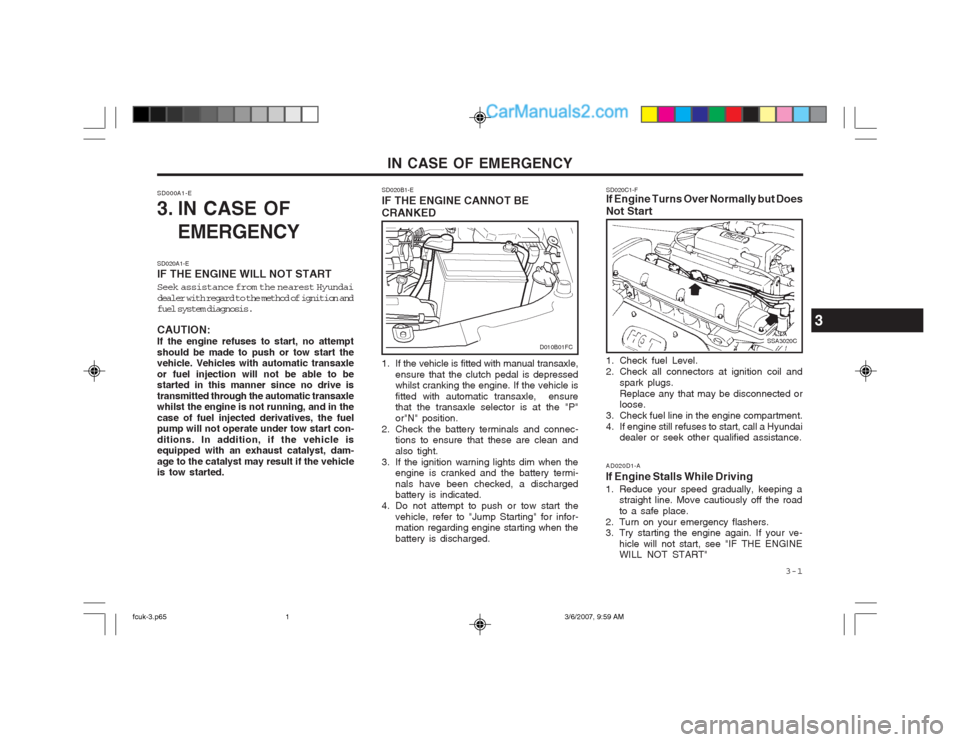
SD020C1-F If Engine Turns Over Normally but Does Not Start
SSA3020C
1. Check fuel Level.
2. Check all connectors at ignition coil and spark plugs.Replace any that may be disconnected or loose.
3. Check fuel line in the engine compartment.
4. If engine still refuses to start, call a Hyundai dealer or seek other qualified assistance.
1. If the vehicle is fitted with manual transaxle,
ensure that the clutch pedal is depressed whilst cranking the engine. If the vehicle is fitted with automatic transaxle, ensure that the transaxle selector is at the "P" or"N" position.
2. Check the battery terminals and connec- tions to ensure that these are clean andalso tight.
3. If the ignition warning lights dim when the engine is cranked and the battery termi-nals have been checked, a discharged battery is indicated.
4. Do not attempt to push or tow start the vehicle, refer to "Jump Starting" for infor-mation regarding engine starting when the battery is discharged. AD020D1-A
If Engine Stalls While Driving
1. Reduce your speed gradually, keeping a straight line. Move cautiously off the road to a safe place.
2. Turn on your emergency flashers.
3. Try starting the engine again. If your ve- hicle will not start, see "IF THE ENGINEWILL NOT START"
3
D010B01FC
fcuk-3.p65 3/6/2007, 9:59 AM
1
Page 261 of 317
IN CASE OF EMERGENCY
3-2
CAUTION: Personal injury and damage to the vehicle may occur if jump starting is not per- formed correctly. If any doubt exists as to how this operation should be performed, seek assistance from qualified personnel. WARNING: Motor vehicle batteries contain sulphuric acid and emit hydrogen gas. Protective clothing should be worn and care exer- cised to prevent the acid from coming into contact with skin or clothing and the ve- hicle. Naked lights should not be permitted in the vicinity of the battery. Care should be exercised to prevent sparks occurring during connection. If acid accidentally comes into contact with skin or eyes, the affected area should immediately be flushed CAUTION: If the jump cable is incorrectly installed,
damage to the vehicle electrical system may occur, in particular the electronic components such as the Fuel Injection system computer and the Automatic
Transaxle computer. The battery must never be disconnected whilst the engine is running. SD040A2-E IF THE ENGINE OVERHEATS
If the temperature gauge indicates overheat- ing:
1. Pull off the road and stop as soon as it is safe to do so.
2. Place the gear selector lever in "P" (auto- matic), or neutral (manual transaxle) and set the parking brake. If the air condition- ing is on, turn it off.
3. If coolant is running out under the car or
steam is coming out from under the bonnet stop the engine. Do not open the bonnet until the coolant has stopped running or the steaming has stopped. If there is no visible loss of coolant and no steam, leave the engine running and check to be sure the engine cooling fan is operating.If the fan is not running, turn the engine off.
4. Check to see if the water pump drive belt is missing. If it is not missing, check to seethat it is tight. If the drive belt seems to be
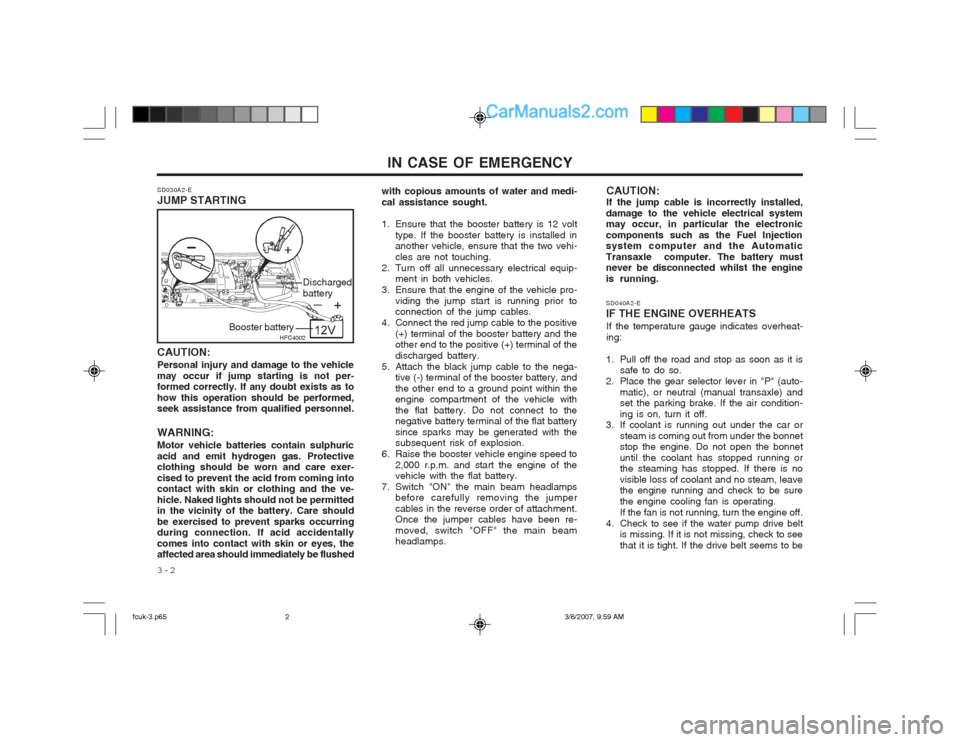
SD030A2-E JUMP STARTING
with copious amounts of water and medi- cal assistance sought.
1. Ensure that the booster battery is 12 volt
type. If the booster battery is installed in another vehicle, ensure that the two vehi- cles are not touching.
2. Turn off all unnecessary electrical equip- ment in both vehicles.
3. Ensure that the engine of the vehicle pro- viding the jump start is running prior to connection of the jump cables.
4. Connect the red jump cable to the positive (+) terminal of the booster battery and theother end to the positive (+) terminal of the discharged battery.
5. Attach the black jump cable to the nega- tive (-) terminal of the booster battery, andthe other end to a ground point within the engine compartment of the vehicle with the flat battery. Do not connect to the negative battery terminal of the flat battery since sparks may be generated with the subsequent risk of explosion.
6. Raise the booster vehicle engine speed to 2,000 r.p.m. and start the engine of thevehicle with the flat battery.
7. Switch "ON" the main beam headlamps before carefully removing the jumper cables in the reverse order of attachment. Once the jumper cables have been re- moved, switch "OFF" the main beam headlamps.
HFC4002
Booster battery Discharged battery
fcuk-3.p65
3/6/2007, 9:59 AM
2
Page 262 of 317
3-3
IN CASE OF EMERGENCY
satisfactory, check for coolant leaking from the radiator, hoses or under the car. (If the air conditioning had been in use, it is normal for cold water to be draining from it).
WARNING: While the engine is running, keep hands and clothing away from moving parts such as the fan and drive belts to prevent injury. WARNING (Diesel only): Never work on injection system with en-gine running or within 30 seconds after shutting off engine. High pressure pump, rail, injectors and high pressure pipes are subject to high pressure even after the engine stopped. The fuel jet produced by fuel leaks may cause serious injury, if it touch the body. People using pacemak- ers should not move than 30cm closer to the ECU or wiring harness within the engine room while engine is running, since the high currents in the Common Rail system produce considerable mag- netic fields.
5. If the water pump drive belt is broken or coolant is leaking out, stop the engine immediately and call the nearest Hyundai dealer for assistance. WARNING:Do not remove the radiator cap when theengine is hot since steam and boiling water may be ejected from the radiator resulting in burns or scalding.
6. If the cause of the overheating cannot be found, wait until the engine temperature has returned to normal. Then, if coolant has been lost, carefully remove the radia- tor cap and add water to bring the fluid level in the reservoir up to the base of the radiator fill opening. Fill the coolant expan- sion tank to the halfway mark.
7. Proceed with caution until it is established that the engine is operating normally. If theengine overheats repeatedly, the advice of a Hyundai dealer should be sought.
CAUTION: Serious loss of coolant indicates there isa leak in the cooling system and this should be checked as soon as possible by a Hyundai dealer. D040A01FC-EAT
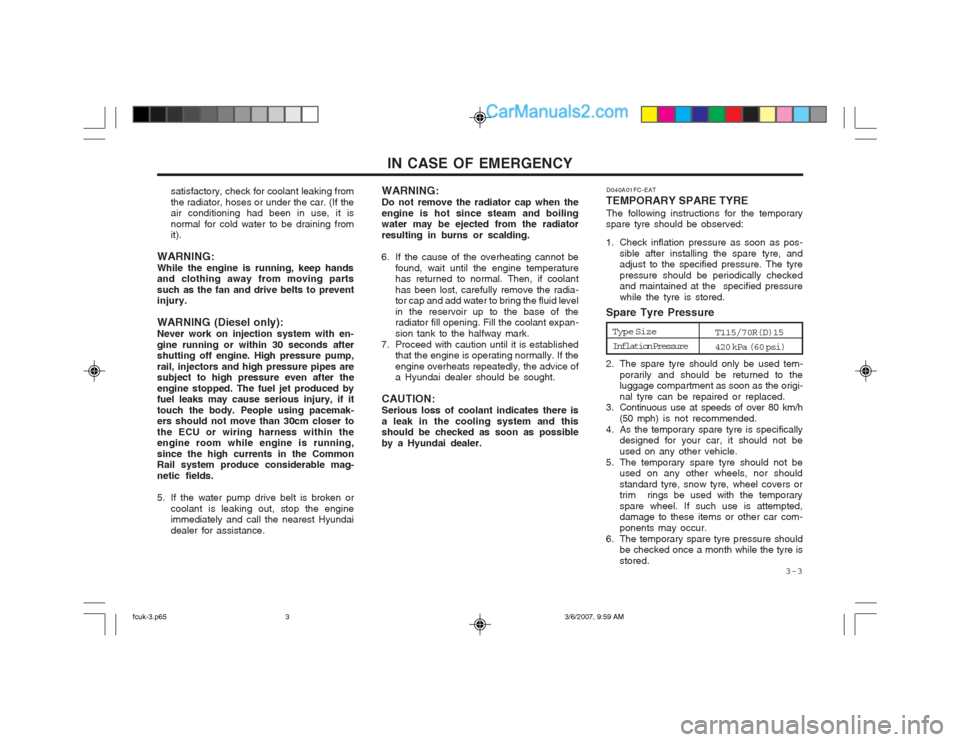
TEMPORARY SPARE TYRE The following instructions for the temporary
spare tyre should be observed:
1. Check inflation pressure as soon as pos-
sible after installing the spare tyre, and adjust to the specified pressure. The tyre pressure should be periodically checked and maintained at the specified pressure while the tyre is stored.
2. The spare tyre should only be used tem- porarily and should be returned to the luggage compartment as soon as the origi- nal tyre can be repaired or replaced.
3. Continuous use at speeds of over 80 km/h
(50 mph) is not recommended.
4. As the temporary spare tyre is specifically designed for your car, it should not beused on any other vehicle.
5. The temporary spare tyre should not be used on any other wheels, nor shouldstandard tyre, snow tyre, wheel covers or trim rings be used with the temporary spare wheel. If such use is attempted, damage to these items or other car com- ponents may occur.
6. The temporary spare tyre pressure should be checked once a month while the tyre isstored.
Spare Tyre Pressure
Type Size
Inflation Pressure T115/70R(D)15
420 kPa (60 psi)
fcuk-3.p65
3/6/2007, 9:59 AM
3
Page 272 of 317
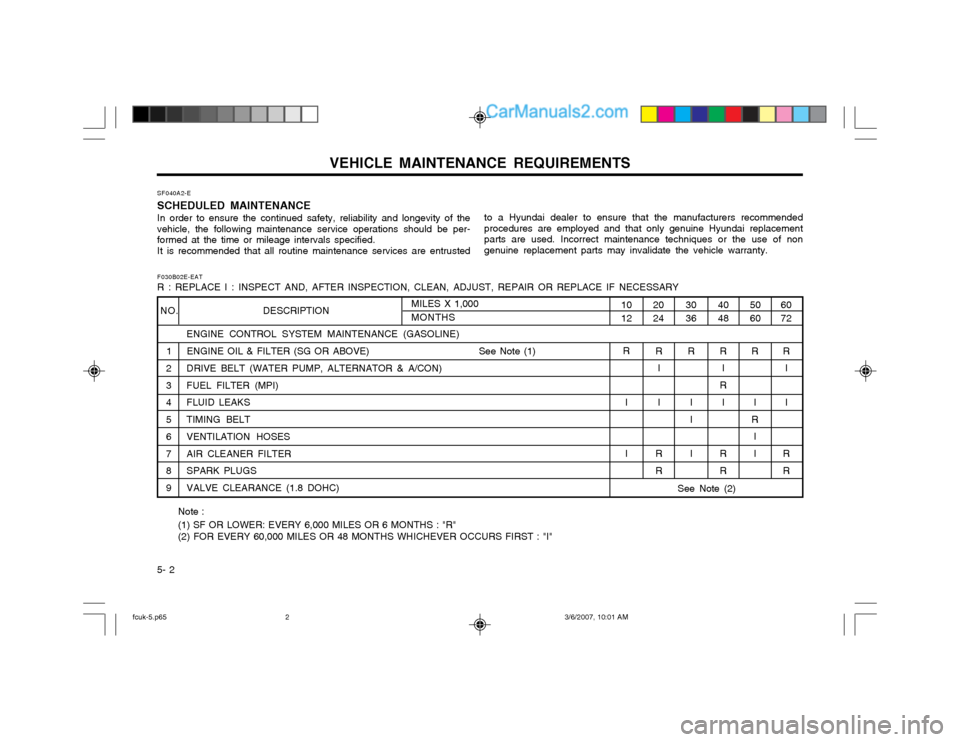
VEHICLE MAINTENANCE REQUIREMENTS
5- 2 SF040A2-E
SCHEDULED MAINTENANCE In order to ensure the continued safety, reliability and longevity of the
vehicle, the following maintenance service operations should be per- formed at the time or mileage intervals specified.
It is recommended that all routine maintenance services are entrusted to a Hyundai dealer to ensure that the manufacturers recommendedprocedures are employed and that only genuine Hyundai replacementparts are used. Incorrect maintenance techniques or the use of nongenuine replacement parts may invalidate the vehicle warranty.
F030B02E-EAT R : REPLACE I : INSPECT AND, AFTER INSPECTION, CLEAN, ADJUST, REPAIR OR REPLACE IF NECESSARY
Note :
(1) SF OR LOWER: EVERY 6,000 MILES OR 6 MONTHS : "R" (2) FOR EVERY 60,000 MILES OR 48 MONTHS WHICHEVER OCCURS FIRST : "I"ENGINE CONTROL SYSTEM MAINTENANCE (GASOLINE)
1 ENGINE OIL & FILTER (SG OR ABOVE) See Note (1)
2 DRIVE BELT (WATER PUMP, ALTERNATOR & A/CON)
3 FUEL FILTER (MPI)
4 FLUID LEAKS
5 TIMING BELT
6 VENTILATION HOSES
7 AIR CLEANER FILTER
8 SPARK PLUGS
9 VALVE CLEARANCE (1.8 DOHC)
NO. DESCRIPTION60 72
5060
4048
3036
2024
1012
MILES X 1,000MONTHS
R
I I
R R
R
I
R I I
R
I
R I
R R
R
I I I
R
II
R R
R
I I
See Note (2)
fcuk-5.p65 3/6/2007, 10:01 AM
2
Page 273 of 317
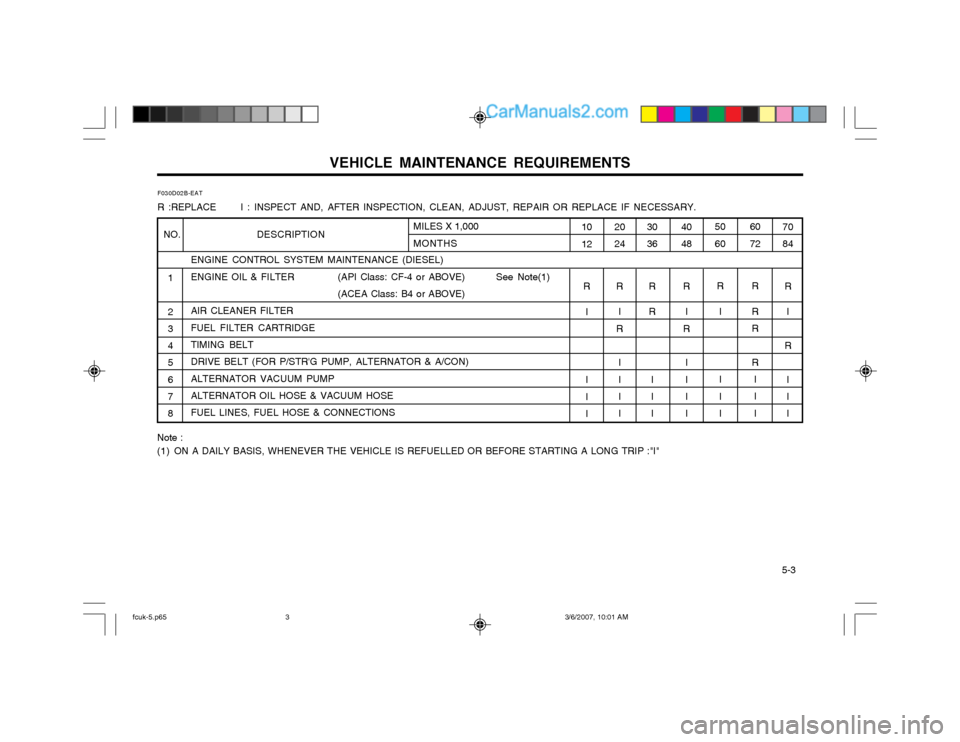
VEHICLE MAINTENANCE REQUIREMENTS 5-3
F030D02B-EAT R :REPLACE I : INSPECT AND, AFTER INSPECTION, CLEAN, ADJUST, REPAIR OR REPLACE IF NECESSARY.
ENGINE CONTROL SYSTEM MAINTENANCE (DIESEL)
ENGINE OIL & FILTER (API Class: CF-4 or ABOVE) See Note(1)
(ACEA Class: B4 or ABOVE)
AIR CLEANER FILTERFUEL FILTER CARTRIDGETIMING BELT DRIVE BELT (FOR P/STR'G PUMP, ALTERNATOR & A/CON) ALTERNATOR VACUUM PUMPALTERNATOR OIL HOSE & VACUUM HOSE FUEL LINES, FUEL HOSE & CONNECTIONS
NO. DESCRIPTION
1 2 34 5 67 8 60 72
R R R R I I I50 60
R I I I I40 48
R I
R
II I I30 36
R R
I I I20 24R I
R
II I I
1012
R I I I IMILES X 1,000 MONTHS70 84
R I
R I I I
Note :
(1) ON A DAILY BASIS, WHENEVER THE VEHICLE IS REFUELLED OR BEFORE STARTING A LONG TRIP :"I"
fcuk-5.p65 3/6/2007, 10:01 AM
3