weight Hyundai Matrix 2004 User Guide
[x] Cancel search | Manufacturer: HYUNDAI, Model Year: 2004, Model line: Matrix, Model: Hyundai Matrix 2004Pages: 317, PDF Size: 5.12 MB
Page 257 of 317
DRIVING YOUR HYUNDAI 2- 13
SC200B3-E
TOWING ATTACHMENTS It is strongly recommended that only an Hyundai Approved towing attachment is used to ensure that the loads placed upon the body structure are correctly distributed. The use of a non approved attachment will result in the invalidation of the vehicle warranty. Hyundai towing attachments are designed and con- structed to ensure maximum towing perfor- mance and ease of fitment. A range of acces- sories including electrical kits are available through the Hyundai dealer network. It is of the utmost importance that those areas of the vehicle which are subjected to greater stress during towing are maintained in accor- dance with the recommendations given at the end of this book. In addition, the daily operating checks relating to engine oil, transmission oil and tyres must be performed at each refuelling to ensure maximum reliability and safety. The use of a proprietary stabiliser will assist inachieving an inherently stable outfit but whilst the use of such equipment will improve the characteristics of a balanced outfit, it will not compensate for a badly loaded and therefore unstable outfit. The tyres and braking equipment fitted to the trailer or caravan must be maintained in ac- cordance with the recommendations of the manufacturer. Special attention should be paid to tyres which deteriorate through time and
WARNING: It is not recommended that the vehicle be used for towing until the first 1,000 miles of Running in has been completed. All Hyundai MATRIX models are suited to tow- ing trailers and caravans up to the limits indicated on page 2-14. MATRIX models fitted with automatic transaxle have a transaxle oil cooler and further transaxle cooling should not be required.
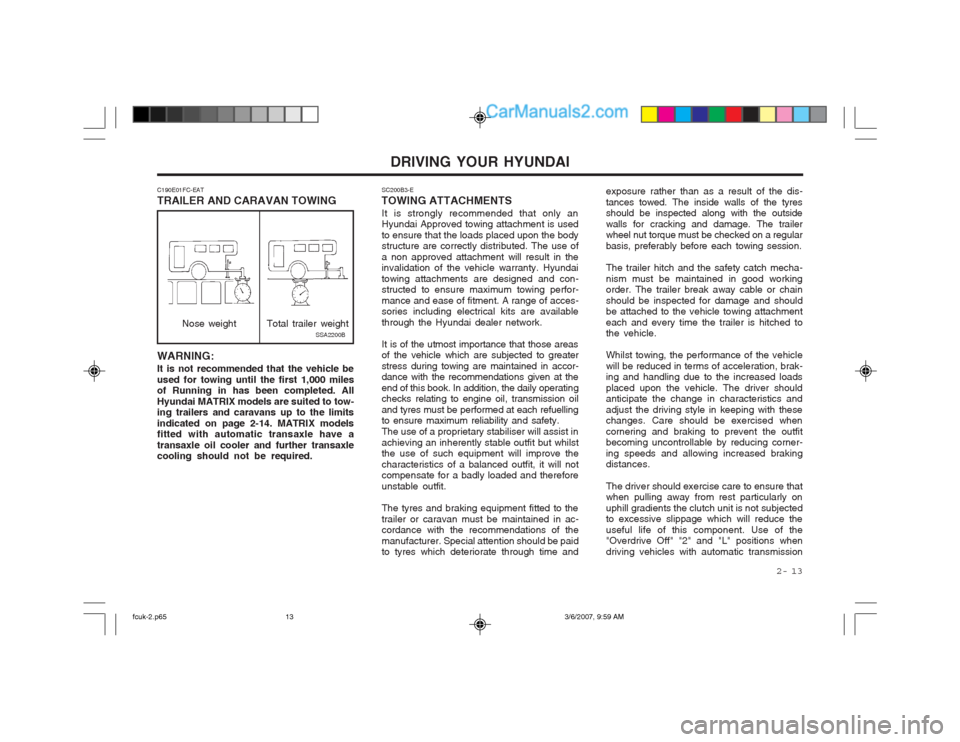
C190E01FC-EAT TRAILER AND CARAVAN TOWING
Nose weightSSA2200B
Total trailer weight
exposure rather than as a result of the dis- tances towed. The inside walls of the tyres should be inspected along with the outside walls for cracking and damage. The trailer wheel nut torque must be checked on a regular basis, preferably before each towing session. The trailer hitch and the safety catch mecha- nism must be maintained in good working order. The trailer break away cable or chain should be inspected for damage and should be attached to the vehicle towing attachment each and every time the trailer is hitched to the vehicle. Whilst towing, the performance of the vehicle will be reduced in terms of acceleration, brak- ing and handling due to the increased loads placed upon the vehicle. The driver should anticipate the change in characteristics and adjust the driving style in keeping with these changes. Care should be exercised when cornering and braking to prevent the outfit becoming uncontrollable by reducing corner- ing speeds and allowing increased braking distances. The driver should exercise care to ensure that when pulling away from rest particularly on uphill gradients the clutch unit is not subjected to excessive slippage which will reduce the useful life of this component. Use of the "Overdrive Off" "2" and "L" positions when driving vehicles with automatic transmission
fcuk-2.p65
3/6/2007, 9:59 AM
13
Page 258 of 317
DRIVING YOUR HYUNDAI
2- 14 YC200E2-E
Trailer or Vehicle Towing Tips
1. Before towing, check towbar hitch and safety cable connections as well as proper operation of the trailer running lights, brake lights, and turn signals.
2. Always drive your vehicle at a moderate speed (Less than 60 MPH)
3. Trailer towing requires more fuel than nor- mal conditions.
4. To maintain engine braking efficiency and electrical charging performance, do not usefifth gear (manual transaxle) or overdrive (automatic transaxle). Towing BracketAttachment Location
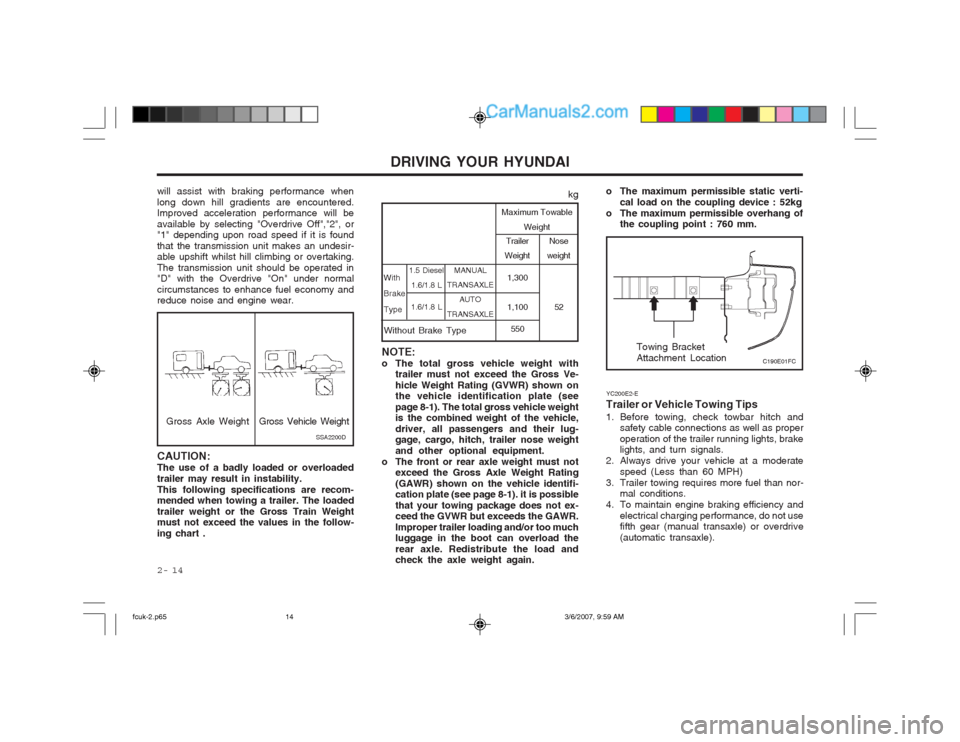
NOTE:
o The total gross vehicle weight with
trailer must not exceed the Gross Ve-hicle Weight Rating (GVWR) shown on the vehicle identification plate (see page 8-1). The total gross vehicle weight is the combined weight of the vehicle, driver, all passengers and their lug- gage, cargo, hitch, trailer nose weight and other optional equipment.
o The front or rear axle weight must not exceed the Gross Axle Weight Rating(GAWR) shown on the vehicle identifi- cation plate (see page 8-1). it is possible that your towing package does not ex- ceed the GVWR but exceeds the GAWR. Improper trailer loading and/or too much luggage in the boot can overload the rear axle. Redistribute the load and check the axle weight again. MANUAL
TRANSAXLE AUTO
TRANSAXLE Trailer
Weight
1,300 1,100 550 Nose
weight
52
kg
Maximum Towable Weight
With Brake Type
1.5 Diesel 1.6/1.8 L
1.6/1.8 L
Without Brake Type
o The maximum permissible static verti- cal load on the coupling device : 52kg
o The maximum permissible overhang of the coupling point : 760 mm.
C190E01FC
will assist with braking performance when long down hill gradients are encountered. Improved acceleration performance will be available by selecting "Overdrive Off","2", or "1" depending upon road speed if it is found that the transmission unit makes an undesir- able upshift whilst hill climbing or overtaking. The transmission unit should be operated in "D" with the Overdrive "On" under normal circumstances to enhance fuel economy and reduce noise and engine wear.
Gross Axle Weight
CAUTION: The use of a badly loaded or overloadedtrailer may result in instability.This following specifications are recom- mended when towing a trailer. The loaded trailer weight or the Gross Train Weight must not exceed the values in the follow- ing chart . SSA2200DGross Vehicle Weight
fcuk-2.p65
3/6/2007, 9:59 AM
14