change time Hyundai Matrix 2004 Owner's Guide
[x] Cancel search | Manufacturer: HYUNDAI, Model Year: 2004, Model line: Matrix, Model: Hyundai Matrix 2004Pages: 317, PDF Size: 5.12 MB
Page 222 of 317
CONTROLS AND EQUIPMENT
1- 40 SB290A02-F
CIGAR LIGHTER
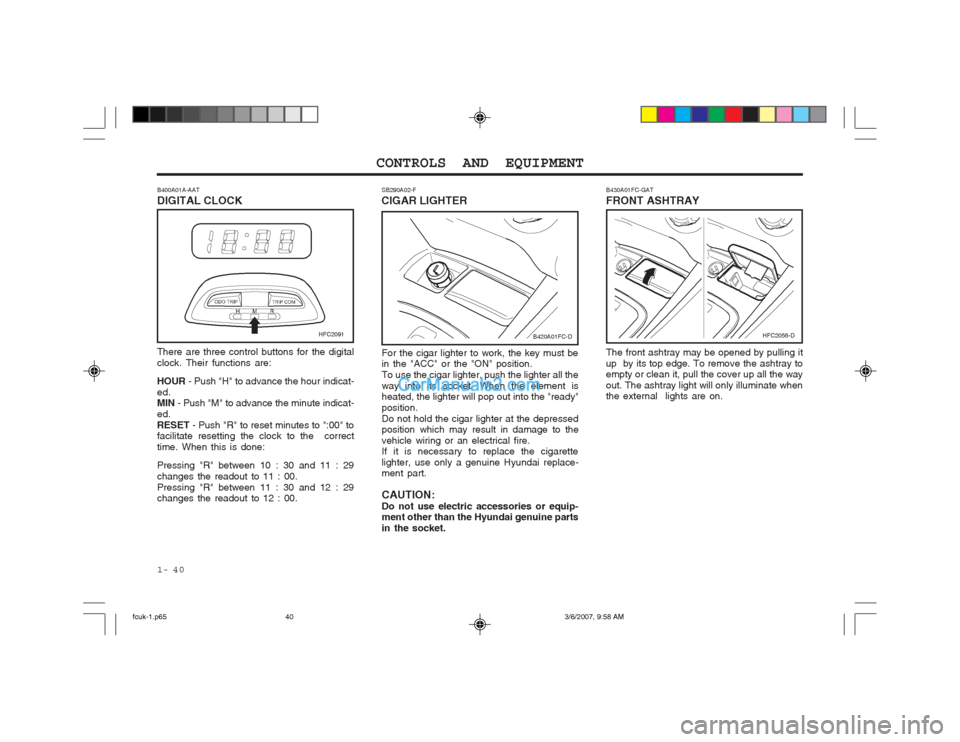
For the cigar lighter to work, the key must be in the "ACC" or the "ON" position. To use the cigar lighter, push the lighter all theway into its socket. When the element is heated, the lighter will pop out into the "ready" position.Do not hold the cigar lighter at the depressed position which may result in damage to the vehicle wiring or an electrical fire. If it is necessary to replace the cigarette lighter, use only a genuine Hyundai replace- ment part. CAUTION: Do not use electric accessories or equip- ment other than the Hyundai genuine parts in the socket. The front ashtray may be opened by pulling itup by its top edge. To remove the ashtray to empty or clean it, pull the cover up all the way out. The ashtray light will only illuminate when the external lights are on.
B430A01FC-GAT FRONT ASHTRAY
There are three control buttons for the digital clock. Their functions are: HOUR - Push "H" to advance the hour indicat-
ed. MIN - Push "M" to advance the minute indicat-
ed. RESET - Push "R" to reset minutes to ":00" to
facilitate resetting the clock to the correcttime. When this is done: Pressing "R" between 10 : 30 and 11 : 29 changes the readout to 11 : 00.Pressing "R" between 11 : 30 and 12 : 29 changes the readout to 12 : 00.
B400A01A-AAT DIGITAL CLOCK
B420A01FC-DHFC2091HFC2056-D
fcuk-1.p65
3/6/2007, 9:58 AM
40
Page 237 of 317
1- 55
CONTROLS AND EQUIPMENT
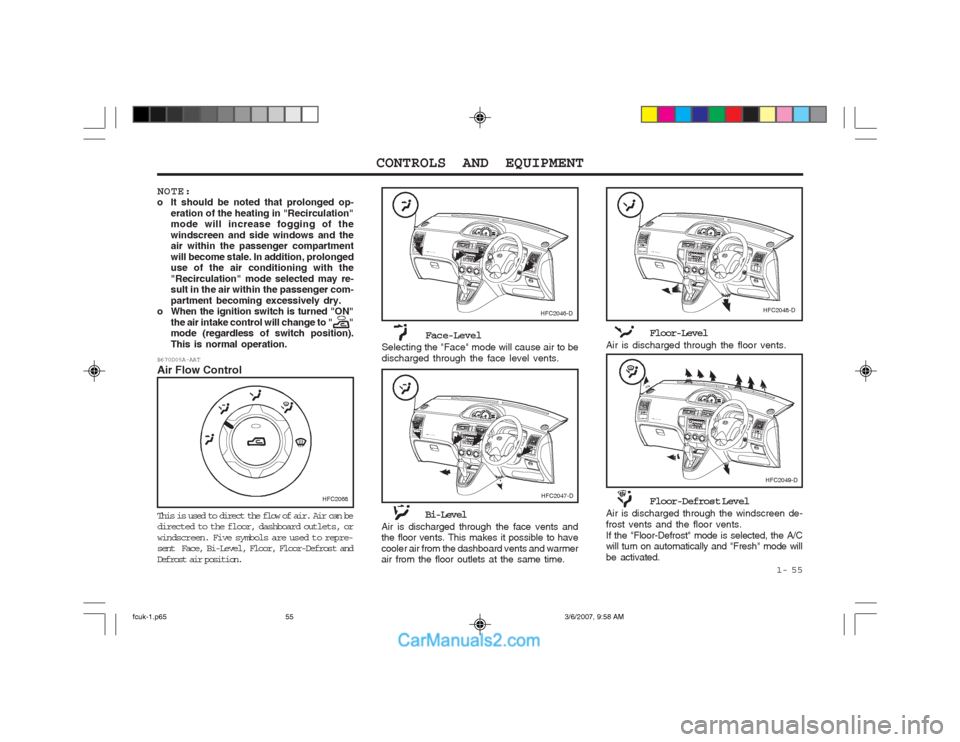
Face-Level
Selecting the "Face" mode will cause air to be discharged through the face level vents.
NOTE:
o It should be noted that prolonged op- eration of the heating in "Recirculation" mode will increase fogging of the windscreen and side windows and the air within the passenger compartment will become stale. In addition, prolonged use of the air conditioning with the "Recirculation" mode selected may re- sult in the air within the passenger com- partment becoming excessively dry.
o When the ignition switch is turned "ON"
the air intake control will change to "
"
mode (regardless of switch position). This is normal operation.
B670D05A-AAT Air Flow Control
HFC2068
This is used to direct the flow of air. Air can be
directed to the floor, dashboard outlets, or windscreen. Five symbols are used to repre- sent Face, Bi-Level, Floor, Floor-Defrost and
Defrost air position.
HFC2046-D
HFC2047-D
HFC2048-D
HFC2049-D
Bi-Level
Air is discharged through the face vents and the floor vents. This makes it possible to have cooler air from the dashboard vents and warmer air from the floor outlets at the same time. Floor-Level
Air is discharged through the floor vents.
Floor-Defrost Level
Air is discharged through the windscreen de- frost vents and the floor vents.If the "Floor-Defrost" mode is selected, the A/C
will turn on automatically and "Fresh" mode will be activated.
fcuk-1.p65 3/6/2007, 9:58 AM
55
Page 249 of 317
DRIVING YOUR HYUNDAI 2- 5
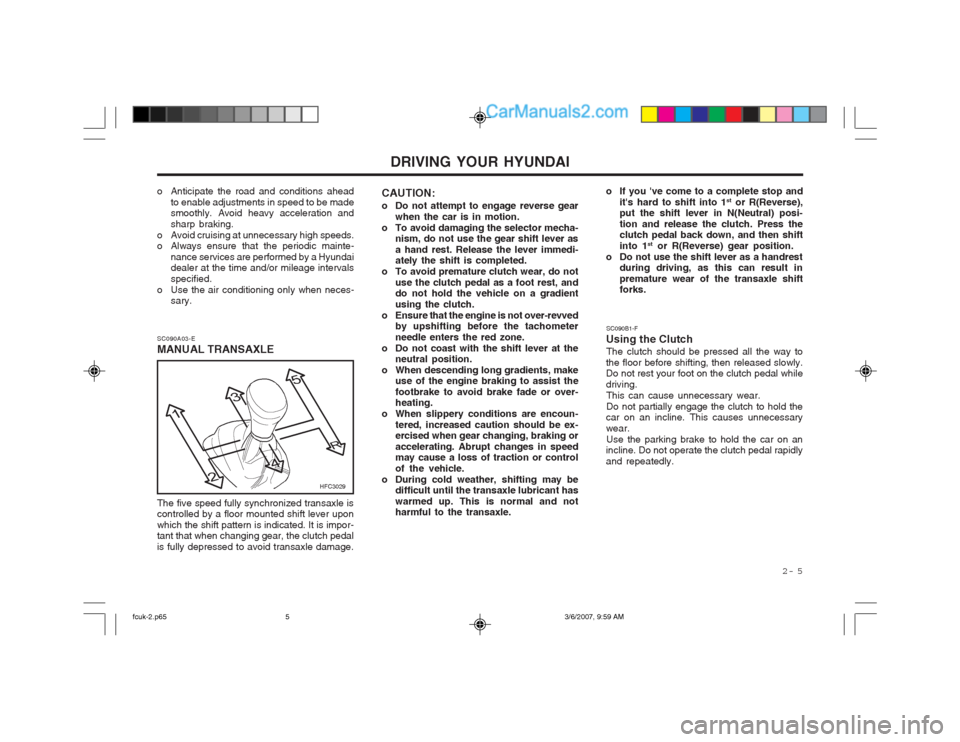
SC090A03-E MANUAL TRANSAXLE
HFC3029
The five speed fully synchronized transaxle is controlled by a floor mounted shift lever upon which the shift pattern is indicated. It is impor- tant that when changing gear, the clutch pedal is fully depressed to avoid transaxle damage. CAUTION:
o Do not attempt to engage reverse gear
when the car is in motion.
o To avoid damaging the selector mecha- nism, do not use the gear shift lever as a hand rest. Release the lever immedi- ately the shift is completed.
o To avoid premature clutch wear, do not use the clutch pedal as a foot rest, anddo not hold the vehicle on a gradient using the clutch.
o Ensure that the engine is not over-revved by upshifting before the tachometerneedle enters the red zone.
o Do not coast with the shift lever at the neutral position.
o When descending long gradients, make use of the engine braking to assist thefootbrake to avoid brake fade or over- heating.
o When slippery conditions are encoun- tered, increased caution should be ex-ercised when gear changing, braking or accelerating. Abrupt changes in speed may cause a loss of traction or control of the vehicle.
o During cold weather, shifting may be difficult until the transaxle lubricant haswarmed up. This is normal and not harmful to the transaxle. SC090B1-F
Using the Clutch The clutch should be pressed all the way to
the floor before shifting, then released slowly.Do not rest your foot on the clutch pedal while driving. This can cause unnecessary wear.Do not partially engage the clutch to hold the
car on an incline. This causes unnecessarywear.
Use the parking brake to hold the car on an
incline. Do not operate the clutch pedal rapidlyand repeatedly.
o Anticipate the road and conditions ahead
to enable adjustments in speed to be made smoothly. Avoid heavy acceleration and sharp braking.
o Avoid cruising at unnecessary high speeds.
o Always ensure that the periodic mainte- nance services are performed by a Hyundaidealer at the time and/or mileage intervals specified.
o Use the air conditioning only when neces- sary.
o If you 've come to a complete stop and
it's hard to shift into 1 st
or R(Reverse),
put the shift lever in N(Neutral) posi- tion and release the clutch. Press the clutch pedal back down, and then shift into 1 st
or R(Reverse) gear position.
o Do not use the shift lever as a handrest during driving, as this can result inpremature wear of the transaxle shift forks.
fcuk-2.p65 3/6/2007, 9:59 AM
5
Page 257 of 317
DRIVING YOUR HYUNDAI 2- 13
SC200B3-E
TOWING ATTACHMENTS It is strongly recommended that only an Hyundai Approved towing attachment is used to ensure that the loads placed upon the body structure are correctly distributed. The use of a non approved attachment will result in the invalidation of the vehicle warranty. Hyundai towing attachments are designed and con- structed to ensure maximum towing perfor- mance and ease of fitment. A range of acces- sories including electrical kits are available through the Hyundai dealer network. It is of the utmost importance that those areas of the vehicle which are subjected to greater stress during towing are maintained in accor- dance with the recommendations given at the end of this book. In addition, the daily operating checks relating to engine oil, transmission oil and tyres must be performed at each refuelling to ensure maximum reliability and safety. The use of a proprietary stabiliser will assist inachieving an inherently stable outfit but whilst the use of such equipment will improve the characteristics of a balanced outfit, it will not compensate for a badly loaded and therefore unstable outfit. The tyres and braking equipment fitted to the trailer or caravan must be maintained in ac- cordance with the recommendations of the manufacturer. Special attention should be paid to tyres which deteriorate through time and
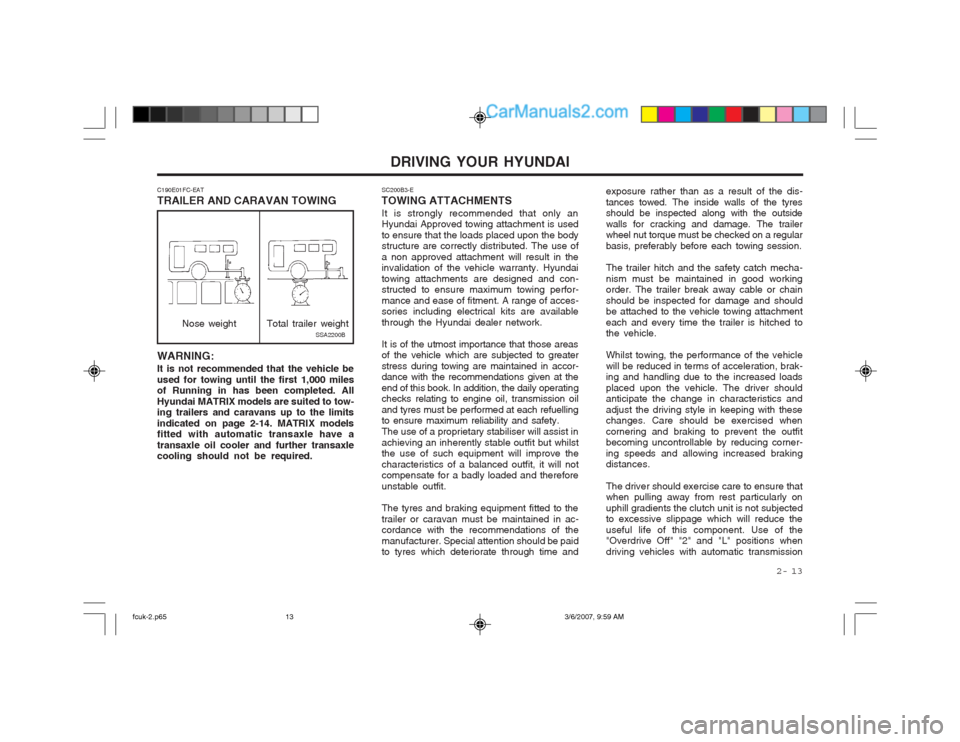
WARNING: It is not recommended that the vehicle be used for towing until the first 1,000 miles of Running in has been completed. All Hyundai MATRIX models are suited to tow- ing trailers and caravans up to the limits indicated on page 2-14. MATRIX models fitted with automatic transaxle have a transaxle oil cooler and further transaxle cooling should not be required.
C190E01FC-EAT TRAILER AND CARAVAN TOWING
Nose weightSSA2200B
Total trailer weight
exposure rather than as a result of the dis- tances towed. The inside walls of the tyres should be inspected along with the outside walls for cracking and damage. The trailer wheel nut torque must be checked on a regular basis, preferably before each towing session. The trailer hitch and the safety catch mecha- nism must be maintained in good working order. The trailer break away cable or chain should be inspected for damage and should be attached to the vehicle towing attachment each and every time the trailer is hitched to the vehicle. Whilst towing, the performance of the vehicle will be reduced in terms of acceleration, brak- ing and handling due to the increased loads placed upon the vehicle. The driver should anticipate the change in characteristics and adjust the driving style in keeping with these changes. Care should be exercised when cornering and braking to prevent the outfit becoming uncontrollable by reducing corner- ing speeds and allowing increased braking distances. The driver should exercise care to ensure that when pulling away from rest particularly on uphill gradients the clutch unit is not subjected to excessive slippage which will reduce the useful life of this component. Use of the "Overdrive Off" "2" and "L" positions when driving vehicles with automatic transmission
fcuk-2.p65
3/6/2007, 9:59 AM
13
Page 259 of 317
DRIVING YOUR HYUNDAI 2- 15
5. Always secure items in the trailer to pre-
vent load shift while driving.
6. Check the condition and air pressure of all tyres on the trailer and your car. Low tyre pressure can seriously affect the handling. Also check the spare tyre.
7. The vehicle/trailer combination is more af- fected by crosswind and buffeting. When being passed by a large vehicle,keep a constant speed and steer straight ahead. If there is too much wind buffeting slow down to get out of the other vehicle's air turbulence.
8. When parking your car and trailer, espe- cially on a hill, be sure to follow all thenormal precautions. Turn your front wheel into the curb, set the parking brake firmly, and put the transaxle in 1st or Reverse (manual) or Park (automatic). In addition, place wheel chocks at each of the trailer's tyres.
9. If the trailer has electric brakes, start your vehicle and trailer moving, and then applythe trailer brake controller by hand to be sure the brakes are working. This lets you check your electrical connection at the same time.
10.During your trip, check occasionally to be sure that the load is secure, and that thelights and any trailer brakes are still work- ing. 11.Avoid jerky starts, sudden acceleration or
sudden stops.
12.Avoid sharp turns and rapid lane changes.
13.Avoid holding the brake pedal down too long or too frequently. This could causethe brakes to overheat, resulting in re- duced braking efficiency.
14.When going down a hill, shift into a lower gear and use the engine braking effect.When ascending a long grade, downshiftthe transaxle to a lower gear and reduce speed to reduce chances of engine over- loading and/or overheating.
15.If you have to stop while going uphill, do not hold the vehicle in place by pressing onthe accelerator. This can cause the auto- matic transaxle to overheat. Use the park- ing brake or footbrake.
NOTE: When towing check transaxle fluid more frequently. CAUTION: If overheating should occur when towing,(temperature gauge reads near red zone), taking the following action may reduce or eliminate the problem.
1. Turn off the air conditioner.
2. Reduce highway speed.
3. Select a lower gear when going uphill.
4. While in stop and go traffic, place the gear selection in park or neutral andidle the engine at a higher speed.
fcuk-2.p65 3/6/2007, 9:59 AM
15
Page 263 of 317
IN CASE OF EMERGENCY
3-4
SD070A1-E
CHANGING A FLAT TYRE
It is of the utmost importance that care is
exercised when changing road wheels. En- sure that the parking brake is set and that the gear shift lever is in reverse (P, if the vehicle has automatic transaxle).
D060A01FC-D
SD050A2-E SPARE WHEEL (Not all models) The spare wheel is stored under the luggage compartment floor and is accessed from within the luggage compartment by lifting the carpet and the floor panel.To remove the spare wheel, unscrew the retainer, rotating this in an anti clockwise direction and lift out the wheel. To replace the wheel, screw the retainer by hand until tight having located the wheel in the luggage com- partment floor well. The inflation pressure of the spare wheel should be checked at least monthly and whenever the wheel is fitted to the vehicle. Spare Tyre Pressure
CAUTION:
o Do not use snow chains with your
temporary spare tyre.
o Do not use more than one temporary
spare tyre at a time. SD060A1-E
IN THE EVENT OF A PUNCTURE If a puncture occurs whilst driving the vehicle:
1. Bring the car to rest as soon as it is safe to do so and with the minimum amount of braking required which will assist in main- taining the maximum amount of control. The vehicle should be parked wherever possible upon firm level ground to facilitate wheel changing.
2. If the vehicle is creating a hazard and the road conditions do not permit the wheel tobe changed safely, assistance should be sought.
3. Passengers must not be allowed to remain inside the vehicle during wheel changing.If a puncture occurs whilst the vehicle is on a motorway, the passengers should take refuge on the motorway embankment to avoid the possibility of injury occurring should the vehicle be struck by other motorway traffic.
4. Wheel changing should be performed ac- cording to the following instructions.
Type
Inflation Pressure Full Size
210 kPa (30 psi)
fcuk-3.p65
3/6/2007, 9:59 AM
4
Page 284 of 317
OWNER MAINTENANCE
6-6 the level again, allow several minutes for the oil to drain into the sump. Replace the oil fillercap rotating it in a clockwise direction untiltight. The quantity of oil required to raise the level from the minimum to maximum level is approx-imately 1 litre. The distance between the "F" and "L" marks is equal to about 1 liter(Gasoline Engine)/1.2liter(Diesel Engine) of oil.
o The engine oil consumption is strongly
effected by the viscosity and quality of oil,engine rpm and driving condition etc. More engine oil may be consumed under severe driving conditions such as highspeeds, frequent acceleration and decel-eration, compared to normal driving.
ZG030E1-A
ENGINE OIL CONSUMPTION Function of engine oil
Engine oil has the primary function of lubricat-
ing and cooling the inside of the engine. Engine oil consumption
It is normal that an engine should consume
some engine oil while normal driving. The cause of oil consumption in a normal engine are asfollows;
o Engine oil is used to lubricate pistons, piston rings and cylinders. A thin film of oil is left on the cylinder wallwhen a piston moves downwards in thecylinder. High negative pressure generatedduring engine operation sucks some of theoil into the combustion chamber. This oil with some oil of the cylinder wall is burned by the high temperature combustiongases during the combustion process. SG040A1-E
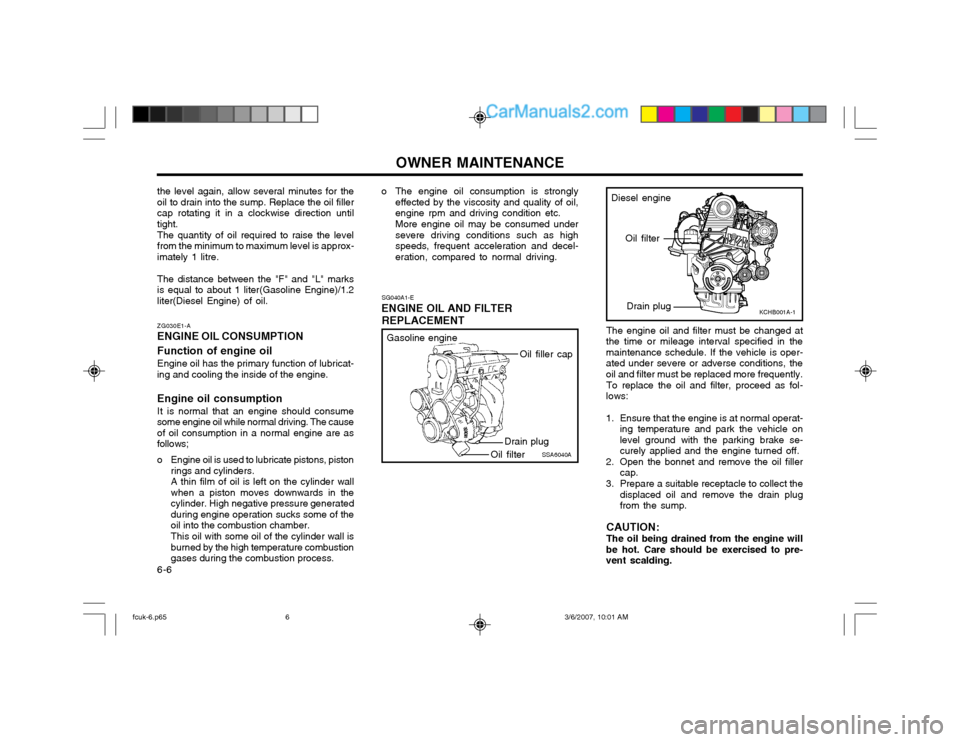
ENGINE OIL AND FILTER REPLACEMENT
SSA6040A
Oil filler cap
Drain plug
Oil filter The engine oil and filter must be changed at
the time or mileage interval specified in the maintenance schedule. If the vehicle is oper-ated under severe or adverse conditions, theoil and filter must be replaced more frequently.
To replace the oil and filter, proceed as fol-
lows:
1. Ensure that the engine is at normal operat- ing temperature and park the vehicle on level ground with the parking brake se-curely applied and the engine turned off.
2. Open the bonnet and remove the oil filler cap.
3. Prepare a suitable receptacle to collect the displaced oil and remove the drain plugfrom the sump.
CAUTION: The oil being drained from the engine will
be hot. Care should be exercised to pre- vent scalding.
Diesel engine
Gasoline engine Drain plug
Oil filter
KCHB001A-1
fcuk-6.p65
3/6/2007, 10:01 AM
6
Page 286 of 317
OWNER MAINTENANCE
6-8 SG050C1-E
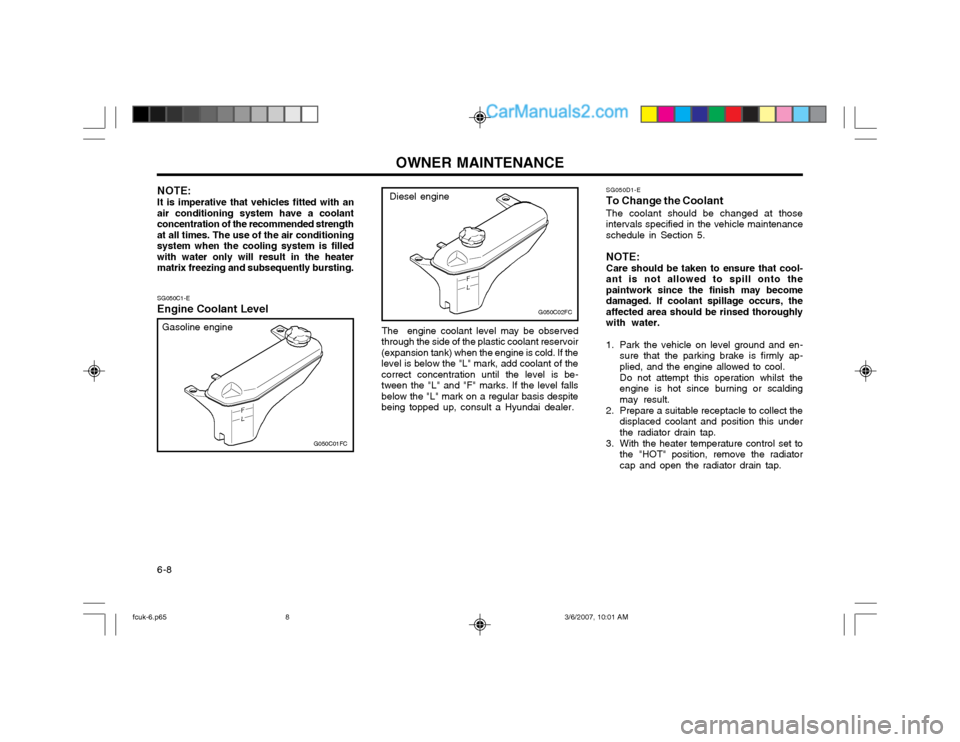
Engine Coolant Level
The engine coolant level may be observed
through the side of the plastic coolant reservoir (expansion tank) when the engine is cold. If thelevel is below the "L" mark, add coolant of thecorrect concentration until the level is be-tween the "L" and "F" marks. If the level fallsbelow the "L" mark on a regular basis despitebeing topped up, consult a Hyundai dealer.
G050C01FC
G050C02FC
Diesel engine
Gasoline engine
NOTE: It is imperative that vehicles fitted with an
air conditioning system have a coolant concentration of the recommended strengthat all times. The use of the air conditioningsystem when the cooling system is filledwith water only will result in the heatermatrix freezing and subsequently bursting. SG050D1-E
To Change the Coolant
The coolant should be changed at thoseintervals specified in the vehicle maintenanceschedule in Section 5. NOTE: Care should be taken to ensure that cool- ant is not allowed to spill onto thepaintwork since the finish may becomedamaged. If coolant spillage occurs, theaffected area should be rinsed thoroughlywith water.
1. Park the vehicle on level ground and en- sure that the parking brake is firmly ap-plied, and the engine allowed to cool. Do not attempt this operation whilst the engine is hot since burning or scaldingmay result.
2. Prepare a suitable receptacle to collect the displaced coolant and position this underthe radiator drain tap.
3. With the heater temperature control set to the "HOT" position, remove the radiatorcap and open the radiator drain tap.
fcuk-6.p65 3/6/2007, 10:01 AM
8
Page 293 of 317
OWNER MAINTENANCE 6-15
WARNING: Brake fluid is hygroscopic and should
never be stored in an unsealed container. The presence of water in the brakingsystem will cause vapour locks and in-crease the possibility of brake fade alongwith promoting corrosion within the brak-ing system. The brake fluid must bechanged at the specified time or mileageinterval to ensure continued safe opera-tion of the system. Brake fluid will causerapid and serious damage to paintwork. Ifaccidental spillage occurs, the affectedarea must be rinsed with water immedi-ately. Do not allow brake fluid to comeinto contact with the eyes or to be in-gested and ensure that fluid is safelystored away form the reach of children.
G120D02FC
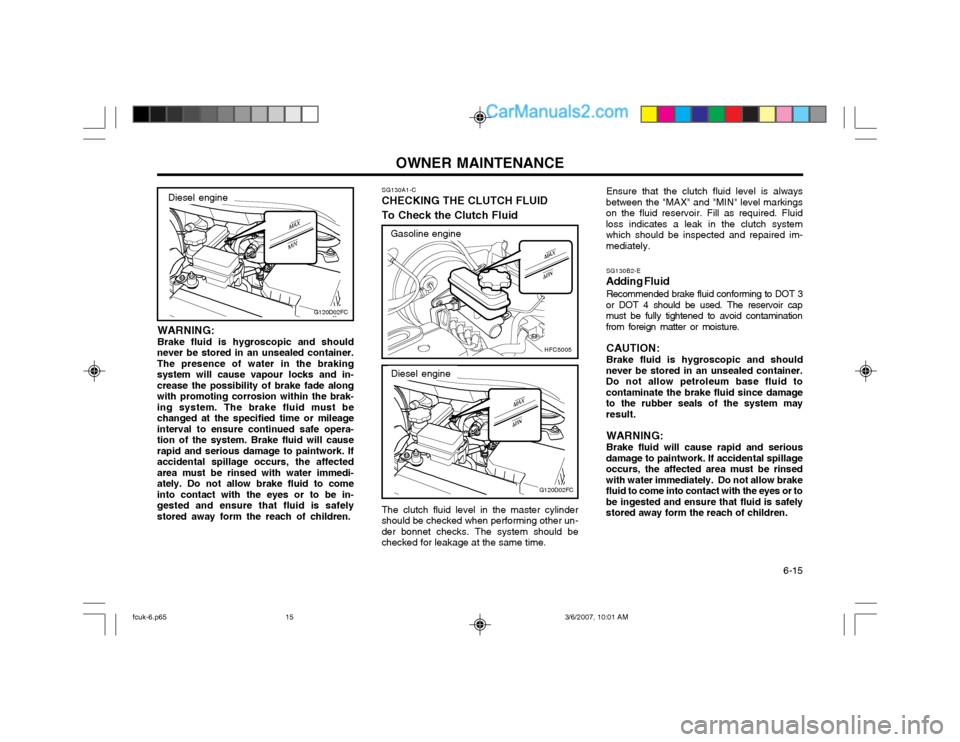
Diesel engine SG130A1-C
CHECKING THE CLUTCH FLUID To Check the Clutch Fluid
SG130B2-E
Adding Fluid
Recommended brake fluid conforming to DOT 3
or DOT 4 should be used. The reservoir cap must be fully tightened to avoid contaminationfrom foreign matter or moisture.
CAUTION: Brake fluid is hygroscopic and should
never be stored in an unsealed container. Do not allow petroleum base fluid tocontaminate the brake fluid since damageto the rubber seals of the system mayresult.
WARNING: Brake fluid will cause rapid and serious
damage to paintwork. If accidental spillage occurs, the affected area must be rinsedwith water immediately. Do not allow brakefluid to come into contact with the eyes or tobe ingested and ensure that fluid is safelystored away form the reach of children.
HFC5005
Gasoline engine
The clutch fluid level in the master cylinder
should be checked when performing other un- der bonnet checks. The system should bechecked for leakage at the same time.
G120D02FC
Diesel engine Ensure that the clutch fluid level is always
between the "MAX" and "MIN" level markings on the fluid reservoir. Fill as required. Fluidloss indicates a leak in the clutch systemwhich should be inspected and repaired im-mediately.
fcuk-6.p65 3/6/2007, 10:01 AM
15