maintenance Hyundai Matrix 2004 Workshop Manual
[x] Cancel search | Manufacturer: HYUNDAI, Model Year: 2004, Model line: Matrix, Model: Hyundai Matrix 2004Pages: 317, PDF Size: 5.12 MB
Page 177 of 317
SA020A1-EResponsibilty For Maintenance
It is the responsibility of the vehicle owner/driver to ensure that all routine mainte- nance services are undertaken in line with the recommendations specified in Section 5 of this manual. In addition, in order to ensure continued validity of the newvehicle warranty and safe operation of the vehicle, non scheduled maintenance/running repairs should be undertaken at the earliest available opportunity.Under severe operating conditions, more frequent maintenance is required.Details of the maintenance schedule for such conditions are also given in section 5. It is recommended that all maintenance operations and repairs are entrusted to afranchised Hyundai dealer to ensure that the latest repair methods, specializedtooling and genuine Hyundai parts are used to ensure the continued reliability andsafety of the vehicle.
fcuk-0.p65 3/6/2007, 9:55 AM
3
Page 178 of 317
SA030A1-EFOREWORD
Hyundai Motor Company wish to take this opportunity to thank you for purchasing a Hyundai product and to welcome you to the ever increasing number of discriminating motorists who drive Hyundai vehicles. The advanced engineeringand construction methods employed during both design and production of the Hyundai marque are something ofwhich we are proud, and this commitment to providing a high quality product is supported by a comprehensive aftersales and warranty service of which we are equally proud. This owners manual will introduce the operating and maintenance requirements for the vehicle and it is recommended that it is carefully read to ensure that the maximum performance and durability along with safe and satisfactory operationare obtained. The recommended routine maintenance servicing along with any running repairs that may be required should be entrusted to a franchised Hyundai dealer to ensure that only the latest methods and genuine Hyundai replacement parts are used for the continued reliability, safety and performance of the vehicle. Should any question or query exist regarding any aspect of your Hyundai please contact the nearest Hyundai dealer who will be only too pleased to assist wherever possible. Note: This owners manual should be considered as part of the vehicle and should be kept in the vehicle at all times for
ease of reference. In the event of the vehicle being sold please ensure that this manual is left in the vehicle for the reference of the new owner. CAUTION: Severe engine and transaxle damage may result from the use of poor quality fuels and lubricants that do not meet Hyundai specifications. You must always use high quality fuels and lubricants that meet thespecifications listed on Page 9-3 in the Vehicle Specifications section of the Owner's Manual. Copyright 2003 Hyundai Motor Company. All rights reserved. No part of this publication may be reproduced, stored in any
retrieval system or transmitted in any form or by any means without the prior written permission of Hyundai Motor Company.
fcuk-0.p65 3/6/2007, 9:55 AM
4
Page 181 of 317
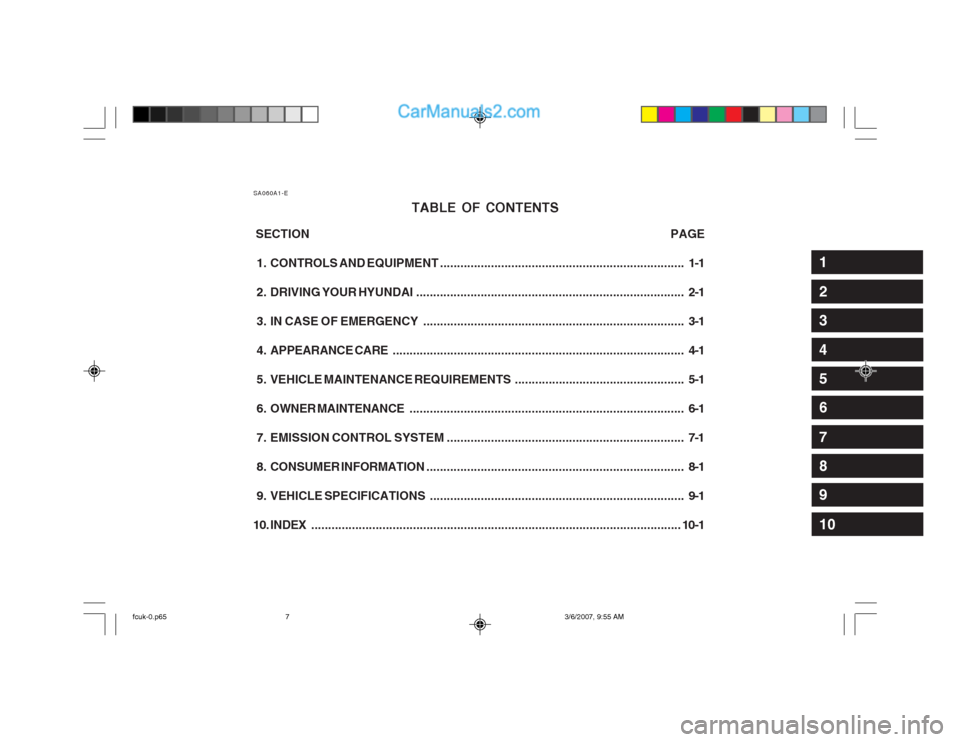
SA060A1-ETABLE OF CONTENTS
SECTION PAGE
1. CONTROLS AND EQUIPMENT........................................................................ 1-1
2. DRIVING YOUR HYUNDAI............................................................................... 2-1
3. IN CASE OF EMERGENCY ............................................................................. 3-1
4. APPEARANCE CARE ...................................................................................... 4-1
5. VEHICLE MAINTENANCE REQUIREMENTS.................................................. 5-1
6. OWNER MAINTENANCE ................................................................................. 6-1
7. EMISSION CONTROL SYSTEM ...................................................................... 7-1
8. CONSUMER INFORMATION ............................................................................ 8-1
9. VEHICLE SPECIFICATIONS ........................................................................... 9-1
10. INDEX ............................................................................................................. 10-1
1
2
3
4
5
6
7
8
9
10
fcuk-0.p65 3/6/2007, 9:55 AM
7
Page 207 of 317
1- 25
CONTROLS AND EQUIPMENT
YT10355A
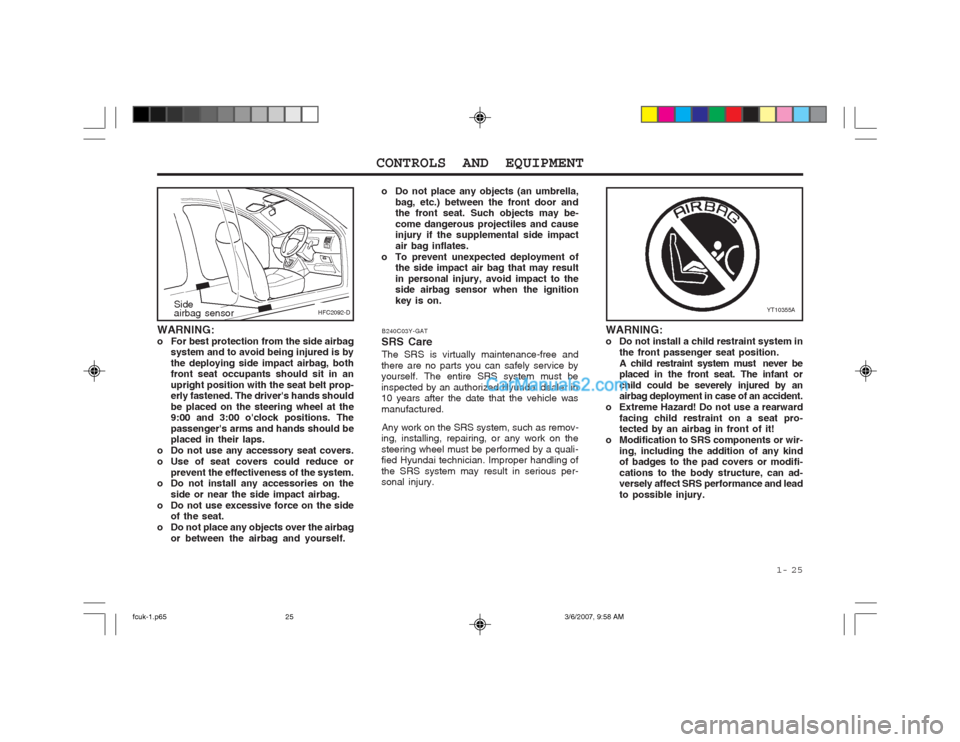
WARNING:
o Do not install a child restraint system in
the front passenger seat position.
A child restraint system must never be placed in the front seat. The infant or child could be severely injured by an airbag deployment in case of an accident.
o Extreme Hazard! Do not use a rearward facing child restraint on a seat pro-tected by an airbag in front of it!
o Modification to SRS components or wir- ing, including the addition of any kindof badges to the pad covers or modifi- cations to the body structure, can ad- versely affect SRS performance and lead to possible injury.
WARNING:
o For best protection from the side airbag
system and to avoid being injured is bythe deploying side impact airbag, both front seat occupants should sit in an upright position with the seat belt prop- erly fastened. The driver's hands should be placed on the steering wheel at the 9:00 and 3:00 o'clock positions. The passenger's arms and hands should be placed in their laps.
o Do not use any accessory seat covers.
o Use of seat covers could reduce or prevent the effectiveness of the system.
o Do not install any accessories on the
side or near the side impact airbag.
o Do not use excessive force on the side of the seat.
o Do not place any objects over the airbag or between the airbag and yourself. B240C03Y-GAT
SRS Care The SRS is virtually maintenance-free and
there are no parts you can safely service by yourself. The entire SRS system must be inspected by an authorized Hyundai dealer in 10 years after the date that the vehicle was manufactured.
Any work on the SRS system, such as remov-
ing, installing, repairing, or any work on thesteering wheel must be performed by a quali- fied Hyundai technician. Improper handling of the SRS system may result in serious per- sonal injury.
HFC2092-DSide airbag sensor o Do not place any objects (an umbrella,
bag, etc.) between the front door and the front seat. Such objects may be- come dangerous projectiles and cause injury if the supplemental side impact air bag inflates.
o To prevent unexpected deployment of the side impact air bag that may resultin personal injury, avoid impact to the side airbag sensor when the ignition key is on.
fcuk-1.p65 3/6/2007, 9:58 AM
25
Page 216 of 317
CONTROLS AND EQUIPMENT
1- 34
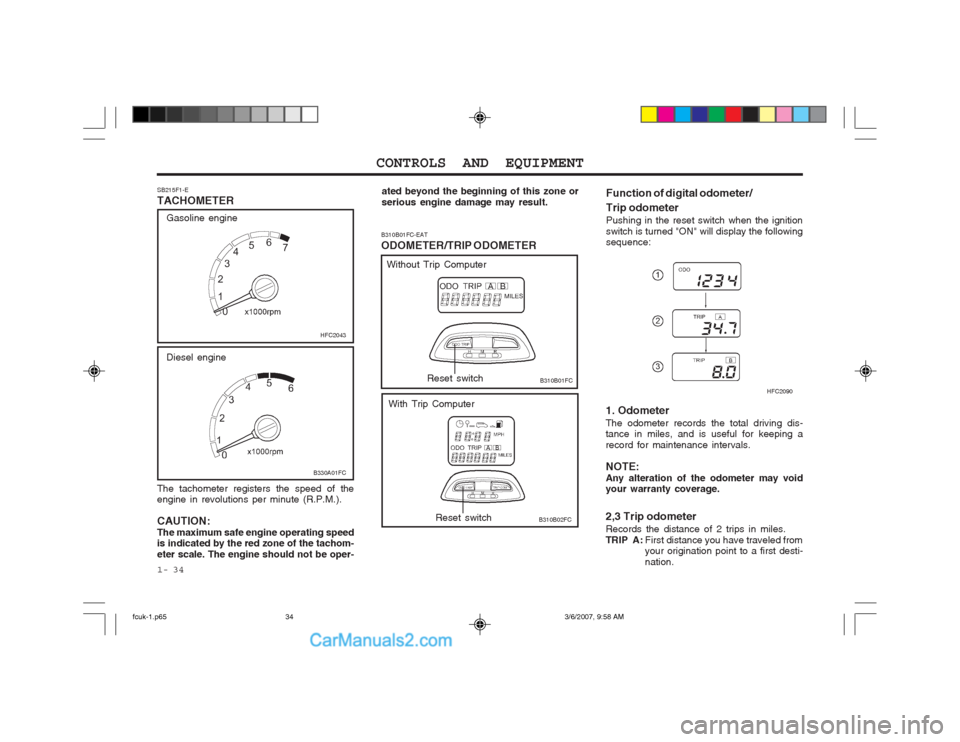
The tachometer registers the speed of the engine in revolutions per minute (R.P.M.). CAUTION: The maximum safe engine operating speed is indicated by the red zone of the tachom- eter scale. The engine should not be oper-
SB215F1-E TACHOMETER
HFC2043
B330A01FC
Diesel engine
Gasoline engine
ated beyond the beginning of this zone or serious engine damage may result.
B310B01FC-EAT ODOMETER/TRIP ODOMETER
B310B01FC Function of digital odometer/ Trip odometer
Pushing in the reset switch when the ignition switch is turned "ON" will display the following sequence:Reset switch
B310B02FCReset switch
Without Trip Computer
With Trip Computer 1. Odometer The odometer records the total driving dis- tance in miles, and is useful for keeping a record for maintenance intervals. NOTE: Any alteration of the odometer may void your warranty coverage. 2,3 Trip odometer Records the distance of 2 trips in miles.
TRIP A :First distance you have traveled from your origination point to a first desti- nation. HFC2090
fcuk-1.p65
3/6/2007, 9:58 AM
34
Page 245 of 317
DRIVING YOUR HYUNDAI 2- 1
SC000A1-E 2
. DRIVING YOUR HYUNDAI
SC020A1-E
WARNING: ENGINE EXHAUST CAN BE DANGEROUS!
Engine exhaust gases are potentially lethal. If at any time engine exhaust gas is detected within the passenger
compartment, move the vehicle to an open area and open all windows.
o Never inhale exhaust gas.
Exhaust gases contain Carbon Monoxide which is colourless and odourless. Carbon Monoxide is poisonous and can
cause unconsciousness and death by asphyxiation. o Exhaust System Maintenance.
Ensure that the exhaust system is maintained in good condition and is free from excessive corrosion and damage
which may result in leakage. If the vehicle is driven over an object which strikes the exhaust system, ensure that theexhaust system is inspected at the first available opportunity to ensure that no leakage exists.
o Confined Areas.
Do not run the engine in confined spaces, allowing the engine to idle in a garage, even when the doors are open is dangerous practice. Only start the engine immediately prior to moving the vehicle out of the garage.
o Prolonged Idling.
If it is necessary to allow the vehicle to idle for prolonged periods, ensure that the heating system air intake control is set to the "Fresh" position, the blower is set to high speed operation and that the vehicle is standing in an open area.
o Load Carrying.
If it is necessary to carry long objects which do not permit the boot lid to be fully closed, the side windows must remain
closed and the heating air intake control set to the "Fresh" position with the blower running at the highest speed setting. To ensure correct operation of the heater system, the air intake grilles at the base of the windscreen must not beobstructed by snow leaves etc..
2
fcuk-2.p65 3/6/2007, 9:59 AM
1
Page 252 of 317
DRIVING YOUR HYUNDAI
2- 8 o Always engage the parking brake when
the vehicle is unattended, never use the "P" position in place of the parking brake.
o Under normal circumstances, the selector
should be placed in the "D" position andthe transaxle allowed to select the most ideal ratio for the circumstances. In this position maximum fuel economy will be achieved.
o When descending steep gradients where
engine braking is required, the selector should be placed at the "2" or "L" position depending upon the vehicle speed.
o When ascending steep gradients using large throttle openings, the transaxle mayre-peatedly change between two adjacent ratios. This is a normal characteristic and may be prevented by cancelling the over- drive facility if the shifting occurs between third and fourth ratios, selecting position "2" if the shifting occurs between third and second ratios or selecting position "1" if the shifting occurs between first and second ratios.
o Never move the selector to or from the "P" or "N" position with the accelerator de-pressed.
o Ensure that the overdrive switch is at the "ON" position for maximum economy. o If rapid acceleration is required, fully de-
press the accelerator pedal. In this condi- tion, the kickdown mechanism will be oper- ated and the transaxle will automatically downshift according to the vehicle speed.
o The automatic transaxle may be used to
great effect if the vehicle becomes stuck insnow or mud by allowing the vehicle to be rocked to and fro. The engine speed should be held at approximately 1,000rpm by means of the accelerator pedal and the selector lever moved between the "D" and "R" positions to induce a rocking motion.
o Do not depress the accelerator pedal with
the brakes applied and the selector at the "R", "D", "2" or "L" position.
o Turn the overdrive switch on for good fuel economy and smooth driving. But if enginebraking is needed in the "D" range or if repeated upshifting and downshifting be- tween the 3rd and 4th gear is needed when climbing a gentle slope, it is recom- mended that the overdrive switch be turned off. Turn the overdrive switch back on immediately afterward.
C090I02A-EAT CAUTION:
o Shift into "R" and "P" only when the
vehicle has completely stopped.
o Do not accelerate the engine in reverse or any of the forward positions with the brakes applied.
o Always apply the footbrake when shift- ing from "P" or "N", to "R", "D", "2" or"L" position.
o Do not use the "P" (Park) position in place of the parking brake. Always setthe parking brake, shift the transaxle into "P" (Park) and turn off the ignition when you leave the vehicle, even mo- mentarily. Never leave the vehicle unat- tended whilst the engine is running.
o Check the automatic transaxle fluid level regularly, and add fluid as necessary.See the maintenance schedule for theproper fluid recommendation.
FC120D1-E
General Operating Instructions
o The button in the selector handle must be depressed before the selector can be moved.
o The engine may only be started when the selector is at position "P" or "N".
o Ensure that the footbrake is firmly applied when shifting from "P" or "N" to "D", "2", "L" or "R" and vice versa.
fcuk-2.p65 3/6/2007, 9:59 AM
8
Page 255 of 317
DRIVING YOUR HYUNDAI 2- 11
o Don't "lug" or "over-rev" the engine. Lug-
ging is driving too slowly in too high a gear resulting in the engine bucking. If this happens to you, shift to a lower gear.Over-revving is racing the engine beyond its safe limit. This can be avoided by shifting at the recommended speeds.
o Use your air conditioning sparingly. The air
conditioning system is operated by the engine power so your fuel economy is reduced when you use it.
SC150A1-F DRIVING FOR ECONOMYYou can save fuel and get more miles from your car if you follow these suggestions:
o Drive smoothly. Accelerate at a moderate
rate. Don't make "jack-rabbit" starts or full- throttle shifts and maintain a steady cruis- ing speed. Don't race between stoplights. Try to adjust your speed to that of the other traffic so you don't have to change speeds unnecessarily.Avoid heavy traffic whenever possible. Al- ways maintain a safe distance from other vehicles so you can avoid unnecessary braking. This also reduces brake wear.
o Drive at a moderate speed. The faster you drive, the more fuel your car uses. Drivingat a moderate speed, especially on the highway, is one of the most effective ways to reduce fuel consumption.
o Don't "ride" the brake or clutch pedal. This can increase fuel consumption and alsoincrease wear on these components. In addition, driving with your foot resting on the brake pedal may cause the brakes to overheat, which reduces their effective- ness and may lead to more serious con-
sequences.
o Take care of your tyres. Keep them inflated to the recommended pressure. Incorrectinfla-tion, either too much or too little, re- sults in unnecessary tyre wear. Check the tyre pres-sures at least once a month. o Be sure that the wheels are aligned cor-
rectly. Improper alignment can result from hitting curbs or driving too fast over irregu- lar surfaces. Poor alignment causes faster tyre wear and may also result in other problems as well as greater fuel consump- tion.
o Keep your car in good condition. For better fuel economy and reduced maintenancecosts, maintain your car in accordance with the maintenance schedule in Section 5. If you drive your car in severe condi- tions, more frequent maintenance is re- quired (see Section 5 for details).
o Keep your car clean. For maximum ser- vice, your car should be kept clean and free of corrosive materials. It is especially important that mud, dirt, ice, etc. not be allowed to accumulate on the underside of the car. This extra weight can result in increased fuel consumption and also con- tribute to corrosion.
o Travel lightly. Don't carry unnecessary
weight in your car. Weight is an enemy ofgood fuel economy.
o Don't let the engine idle longer than neces- sary. If you are waiting (and not in traffic),turn off your engine and restart only when you're ready to go.
o Remember, your car does not require extended warm-up. As soon as the engineis running smoothly, you can drive away. In very cold weather, however, give your engine a slightly longer warm-up period. SC160A1-F SMOOTH CORNERINGAvoid braking or gear changing in corners, especially when roads are wet. Ideally, cor- ners should always be taken under gentle acceleration. If you follow these suggestions, tyre wear will be held to a minimum. SC170A1-E WINTER MOTORINGThe onset of winter conditions subject motor vehicles to greater operating demands. There- fore, the following suggestions will assist in maintaining peak performance and reliability during these periods:
fcuk-2.p65
3/6/2007, 9:59 AM
11
Page 269 of 317
APPEARANCE CARE 4-1
garding the retreatment programme must be observed in accordance with the Terms and Conditions outlined in the separate Anti Per- foration Warranty Booklet. NOTE: The underbody should never be steamcleaned since the underbody coating may be removed by this process. During the interim period between powerwashing the underbody, the more vulnera- ble areas such as wheel arches should be hosed off particularly during the winter sea- son to prevent prolonged contact with road salts.Ensure that the various drain points located at the bottom of the door panels and sills are kept clear to prevent water from becom- ing trapped within the cavities. Wherever possible, the parking of the vehicle in a confined, poorly ventilated location (a ga- rage for example) should be avoided when the vehicle is wet or is covered with snow or ice. Under these conditions, the internal cavities of the vehicle will remain damp for prolonged periods of time which will en- courage corrosion. Parking the vehicle where good ventilation exists (outside for example) is preferable.
SE040A1-E VALETING Regular cleaning of the exterior paintwork serves two important functions. Firstly, the removal of abrasive dirt and contaminants will maintain the lustre of the paintwork and will prevent discolouration and dulling due to prolonged con- tact. Secondly, the presence of damage through im- pact or abrasion will be apparent allowing early rectification to be made thus preventing corro- sion from becoming established and spreading beneath the paint film. To avoid "water spotting" the vehicle should not be washed in direct sun- light particularly in the case of vehicles having dark body colours. The heat from the sun rays is absorbed by the paint film increasing the surface temperature. This action causes water used for washing to evaporate quickly leaving behind the deposits from the water and the shampoo used. Use only a shampoo intended for the purpose and ensure that the body work is thoroughly wetted to soften the dirt film prior to attempting to remove this. After removing the dirt film with a soft sponge, the body work should be thoroughly rinsed and then dried with a good quality chamois leather to prevent streaking or spotting of the paint work. Household detergents, solvents and abrasive cleaning materials should not be used in order to avoid damaging the paint film.
SE030A1-E UNDERBODY COATINGSEvery Hyundai passenger car receives a full underbody and cavity injection treatment during production. In order that this treatment may retain maximum effectiveness it is recommend- ed that the underbody receives a power wash and a thorough inspection after each winter season. In doing so any accumulations of mud, which act as moisture traps and com- bine with road salts to accelerate corrosion will be removed. In order to maintain the Anti Perforation Warranty, the requirements re-
SE000A1-E
4. APPEARANCE
CARE
SE020A1-E PROTECTING YOUR HYUNDAI FROM CORROSION By using the most advanced design and con- struction practices, every Hyundai is built to retain the original factory finish for many years. However, long term durability is also greatly dependant upon maintaining the various protec- tion systems and coatings used in manufacture since constant, exposure to the elements will result in a breakdown and loss of effectiveness. The following suggestions are made to assist in the maintenance of the vehicle bodywork.
4
fcuk-4.p65 3/6/2007, 10:00 AM
1
Page 270 of 317
APPEARANCE CARE
4-2
Plastic wheel covers should be cleaned using a sponge and water. Cast alloy wheels should be cleaned using a mild soap or neutral deter- gent. Abrasive compounds must not be used since in the event of these damaging the lac- quer coating, oxidization of the aluminium wheel will occur, spoiling the appearance. The use of an a toothbrush will facilitate cleaning between the wheel "spokes".
ensure that accidental spillages are immediately flushed with water. Do not use abrasive cleaning materials which may damage the bumpers. Avoid subjecting the bumpers to high tempera- tures such as may be encountered in high bake paint ovens.
SE040B1-E STAIN/SPOT REMOVAL Should tree sap, dead insects or tar prove to be difficult to remove from the paint film, turpentine or a proprietary paint cutting compound may be used. Ensure that the area to be cleaned is not rubbed intensively to prevent breaking through the colour coat and exposing the under coat. SE040C1-E POLISHINGThe exterior paint work should be polished with a proprietary wax polish when water no longer collects in bead form on the paint work. The instructions of the product manufacturer should be adhered to. SE040E1-E BUMPER MAINTENANCEThe special material from which the bumpers are manufactured warrants special attention to pre- serve the appearance of the bumpers. Avoid contact with battery electrolyte or brake fluid and SE040F1-E ACCIDENT REPAIRSIn the event of the body work sustaining damage, the following points should be noted prior to repairs being undertaken. If body panels are replaced or repaired, anti corrosion treatment must be applied to the repair area. The product used must be compatible withthose used in manufacture. It is recommended that repairs are entrusted to a Hyundai dealer to ensure that replacement parts used are of the same high quality as those used in manufacture of the vehicle and that the correct repair methods and materials will ensure adequate levels of corrosion protection and the continued validity of the Anti Perforation Warranty. SE050A1-E INTERIORDuring the winter period, it is possible that the passenger compartment flooring may become wet from damp footwear or quantities of snow adhering to footwear. The carpet should not be allowed to remain in this condition since the carpet may begin to create musty smells and will
SE050D1-E SEAT BELTS Seat belts should be cleaned only with a mild soap solution. Strong detergents, solvens or bleaches may damage the belt webbing and therefore reduce the effectiveness of the belt. Belts which display signs of fraying, wear of cut should be replaced. SE050E1-E WINDOWS A proprietary glass cleaner should be used to clean the inside of the windows. However, the rear heated windshield must only be cleaned using a light horizontal cleaning action. Care should be exercised to avoid the use of abrasive cleaners or contact with items of jewellery which may damage the heating elements.
promote corrosion of the floor pan in addition tothe carpet and under felt beginning to rot. SE050C1-E INTERIOR VALETING The soft trim and carpets should be maintained with the regular use of a vacuum cleaner. Heavy soiling should be removed with a dry cleaning agent recommended for this purpose following the instructions of the product manufacturer. Paint thinner, solvents or other such cleaning materials should not be used since damage to the upholstery may result.
fcuk-4.p65
3/6/2007, 10:00 AM
2