fuel cap Hyundai Matrix 2007 User Guide
[x] Cancel search | Manufacturer: HYUNDAI, Model Year: 2007, Model line: Matrix, Model: Hyundai Matrix 2007Pages: 490, PDF Size: 12.81 MB
Page 259 of 490
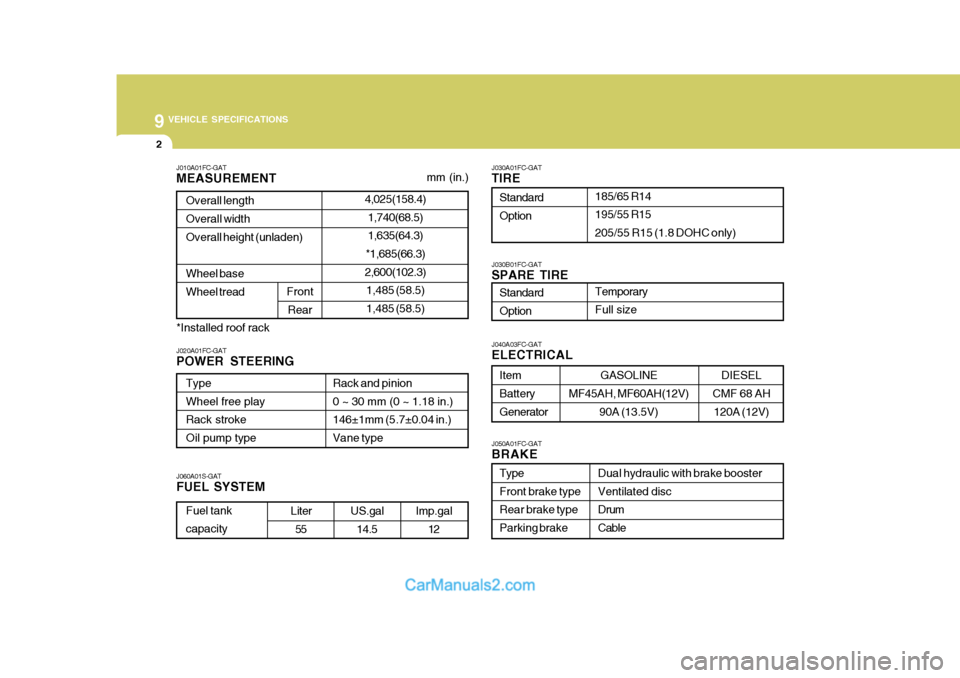
9 VEHICLE SPECIFICATIONS
2
J010A01FC-GAT MEASUREMENT
4,025(158.4)1,740(68.5) 1,635(64.3)
*1,685(66.3)
2,600(102.3) 1,485 (58.5)1,485 (58.5)
Overall lengthOverall width Overall height (unladen) Wheel base Wheel tread
Front
Rear
Type Wheel free playRack stroke Oil pump type Rack and pinion0 ~ 30 mm (0 ~ 1.18 in.) 146±1mm (5.7±0.04 in.)Vane type
J060A01S-GAT FUEL SYSTEM
J020A01FC-GATPOWER STEERING J030A01FC-GATTIRE
185/65 R14 195/55 R15205/55 R15 (1.8 DOHC only)
StandardOption
J050A01FC-GAT BRAKE Dual hydraulic with brake booster Ventilated discDrum Cable
Type Front brake typeRear brake type Parking brake
Item Battery Generator
J040A03FC-GAT ELECTRICAL
GASOLINE
MF45AH, MF60AH(12V) 90A (13.5V)
mm (in.)
Fuel tank capacityLiter
55 US.gal
14.5 Imp.gal
12
DIESEL
CMF 68 AH 120A (12V)
*Installed roof rack J030B01FC-GAT SPARE TIRE
Temporary Full size
StandardOption
Page 264 of 490
10
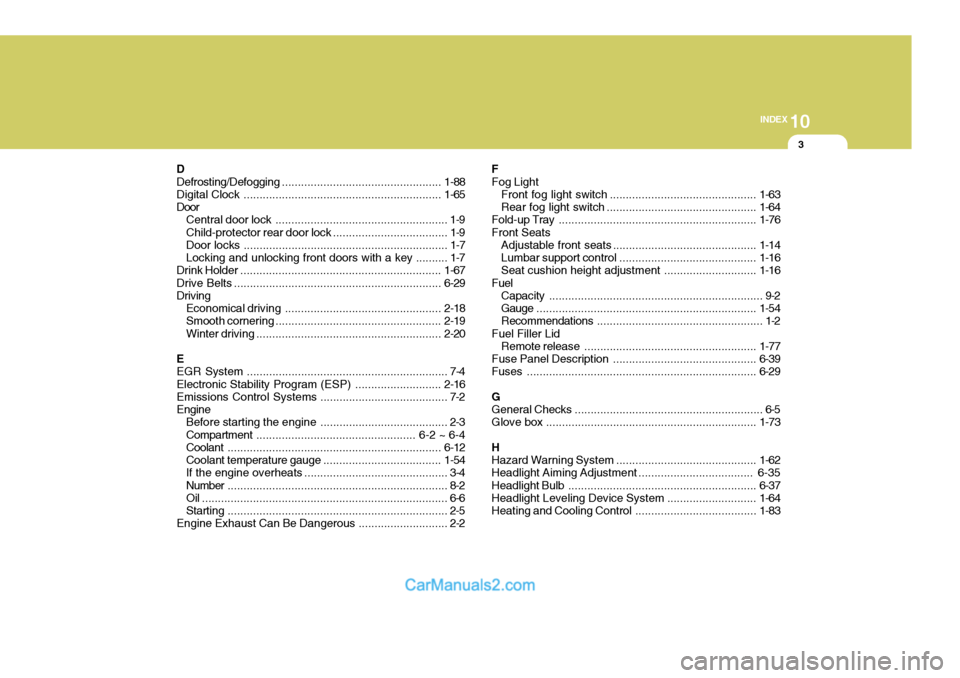
INDEX
3
D Defrosting/Defogging .................................................. 1-88
Digital Clock .............................................................. 1-65
Door Central door lock ...................................................... 1-9
Child-protector rear door lock .................................... 1-9
Door locks ................................................................ 1-7
Locking and unlocking front doors with a key .......... 1-7
Drink Holder ............................................................... 1-67
Drive Belts ................................................................. 6-29
Driving
Economical driving ................................................. 2-18
Smooth corneri ng .................................................... 2-19
Winter driving .......................................................... 2-20
E
EGR System ............................................................... 7-4 Electronic Stability Program (ESP) ...........................2-16
Emissions Control Systems ........................................ 7-2Engine Before starting the engine ........................................ 2-3Compartment .................................................. 6-2 ~ 6-4
Coolant ................................................................... 6-12
Coolant temperature gauge .....................................1-54
If the engine overheats ............................................. 3-4
Number ..................................................................... 8-2
Oil ............................................................................. 6-6Starting ..................................................................... 2-5
Engine Exhaust Can Be Dangerous ............................ 2-2 FFog Light
Front fog light switch .............................................. 1-63
Rear fog light switch ............................................... 1-64
Fold-up Tray .............................................................. 1-76
Front Seats Adjustable front seats ............................................. 1-14
Lumbar support control ........................................... 1-16
Seat cushion height adjustment ............................. 1-16
Fuel Capacity ................................................................... 9-2
Gauge ..................................................................... 1-54
Recommendations .................................................... 1-2
Fuel Filler Lid Remote release ...................................................... 1-77
Fuse Panel Description ............................................. 6-39
Fuses ........................................................................ 6-29
GGeneral Checks ........................................................... 6-5
Glove box .................................................................. 1-73
HHazard Warning System ............................................ 1-62
Headlight Aiming Adjustm ent .................................... 6-35
Headlight Bulb ........................................................... 6-37
Headlight Leveling Device S ystem ............................1-64
Heating and Cooling Control ......................................1-83
Page 350 of 490

1
CONTROLS AND EQUIPMENT
71
!
SB440A2-E (Not all models) The fuel filler flap may be opened from inside the vehicle by pulling up on the fuel filler flap release. NOTE: If the fuel filler flap will not open because ice has formed around it, tap lightly or push on it to break theice and release it. Do not lever the flap. If necessary, spray around the flap with an approved deicer fluid(do not use radiator anti-freeze) or move the vehicle to a warm place and allow the ice to melt.
CAUTION:
Ensure that the bonnet prop has been removed prior to closing the bonnet. Always check to ensure thatthe bonnet has latched prior to set- ting the vehicle in motion.
HFC2015-D
HFC203
!
WARNING:
The bonnet prop must be correctly inserted into the panel to prevent thepossibility of injury arising from the bonnet falling. REMOTE FUEL FILLER FLAP RELEASE!WARNING:
o Petrol vapors are dangerous. Be- fore refueling, always stop the en- gine and never allow sparks oropen flames near the filler area. If you need to replace the filler cap, use a genuine Hyundai replace-ment part. If you open the fuel filler cap dur- ing high ambient temperatures, aslight "pressure sound" may be heard. This is normal and not a cause for concern.Whenever you open the fuel filler cap, turn it slowly.
HFC2016
fcuk-1.p65 12/27/2006, 10:12 AM
71
Page 351 of 490

1CONTROLS AND EQUIPMENT
72HATCHBACK DOOR
o Automotive fuels are flammable/
explosive materials. When refuel- ing, please note the following guidelines carefully.
o Before touching the fuel nozzle or fuel filler cap, have one's hands incontact with metal parts away from the filler neck to discharge staticelectricity.
o Do not get back in the vehicle
whilst refueling. Do not operateanything that can produce static electricity. Static electricity dis- charge can ignite fuel vapors re-sulting in explosion.
o When using a portable fuel con-
tainer be sure to place the con-tainer on the ground whilst refuel- ing. Static electricity discharge from the container can ignite fuelvapors causing a fire. Whilst start- ing refueling contact should be maintained until the filling is com-plete. o Do not use cellular phones around
a gas station. The electric currentor electronic interference from cellular phones can ignite fuel vapors causing a fire.
o When refueling always shut the engine off. Sparks by electricalequipment of the engine can ig-nite fuel vapors causing a fire. After refueling, check to make sure the fuel filler cap is securely closed,and then start the engine.
o Do not smoke or try to light ciga-
rettes around a gas station. Auto-motive fuels are flammable.
!
B540A01FC-EAT
WARNING:
The hatchback door should always be kept completely closed whilst the vehicle is in motion. If it is left open or ajar, poisonous exhaust gasesmay enter the car resulting in seri- ous illness or death to the occu- pants. See additional warnings con-cerning exhaust gases on page 2-2. B540A02FC
LOCK
UNLOCK
fcuk-1.p65
12/27/2006, 10:12 AM
72
Page 404 of 490

3
IN CASE OF EMERGENCY
5
!
!
!WARNING:
Whilst the engine is running, keep hands and clothing away from mov- ing parts such as the fan and drive belts to prevent injury. 5. If the water pump drive belt is broken
or coolant is leaking out, stop theengine immediately and call the near- est Hyundai authorised repairer for assistance.
WARNING (Diesel only):
Never work on injection system with engine running or within 30 seconds after shutting off engine. High pres-sure pump, rail, injectors and high pressure pipes are subject to high pressure even after the enginestopped. The fuel jet produced by fuel leaks may cause serious injury, if it touches the body. People usingpacemakers should not move closer than 30cm etc. to the ECU or wiring harness within the engine roomwhilst engine is running, since the high currents in the Common Rail system produce considerable mag-netic fields.
!
WARNING:
Do not remove the radiator cap when the engine is hot since steam and boiling water may be ejected fromthe radiator resulting in burns or scalding.
6. If the cause of the overheating can- not be found, wait until the engine temperature has returned to normal. Then, if coolant has been lost, care-fully remove the radiator cap and add water to bring the fluid level in the reservoir up to the base of the radia-tor fill opening. Fill the coolant ex- pansion tank to the halfway mark. To ensure the correct water to cool-ant mix is obtained after top up, testing by an authorised repairer is required. 7. Proceed with caution until it is estab-
lished that the engine is operatingnormally. If the engine overheats repeatedly, the advice of a Hyundai authorised repairer should be sought.
CAUTION:
Serious loss of coolant indicatesthere is a leak in the cooling systemand this should be checked as soon as possible by a Hyundai authorised repairer.
fcuk-3.p65 12/27/2006, 10:15 AM
5
Page 426 of 490

5VEHICLE MAINTENANCE REQUIREMENTS
8
6ZF060H1-A
o Air Cleaner Filter
A Genuine Hyundai air cleaner filter is
recommended when filter is replaced.
6ZF060J1-A
o Spark Plugs
Make sure to install new spark plugs
of the correct heat range.
6ZF070B1-A
o Cooling System
Check the cooling system part, such
as radiator, coolant reservoir, hoses and connections for leakage and dam- age. Replace any damaged parts.
6ZF060E1-A
o Timing Belt Replace timimg belt and inspect all associated parts related for damage and deformation. Replace any dam- aged parts immediately. 6ZF060G1-A
o Vapour Hose and Fuel Filler Cap The vapour hose and fuel filler cap should be inspected at those intervals specified in the maintenance sched-ule. Make sure that a new vapour hose or fuel filler cap is correctly replaced.
6ZF060F1-A
o Vacuum, Crankcase
Ventilation Hoses
Inspect the surface of hoses for evi-
dence of heat and/or mechanical dam-age. Hard and brittle rubber, cracking, tears, cuts, abrasions, and excessiveswelling indicate deterioration. Partic- ular attention should be paid to exam- ining those hose surfaces nearest tohigh heat sources, such as the ex- haust manifold.
Inspect the hose routing to assure that
the hoses do not come in contact withany heat source, sharp edges or mov- ing component which might cause heatdamage or mechanical wear. Inspect all hose connections, such as clamps and couplings, to make sure they aresecure, and that no leaks are present. Hoses should be replaced immedi- ately if there is any evidence of dete-rioration or damage. F060N02E-AAT
o Valve Clearance
Inspect excessive valve noise and/or
engine vibration and adjust if neces-sary. A qualified technician should perform the operation.
fcuk-5.p65 12/27/2006, 10:15 AM
8
Page 430 of 490
6 OWNER MAINTENANCE
2
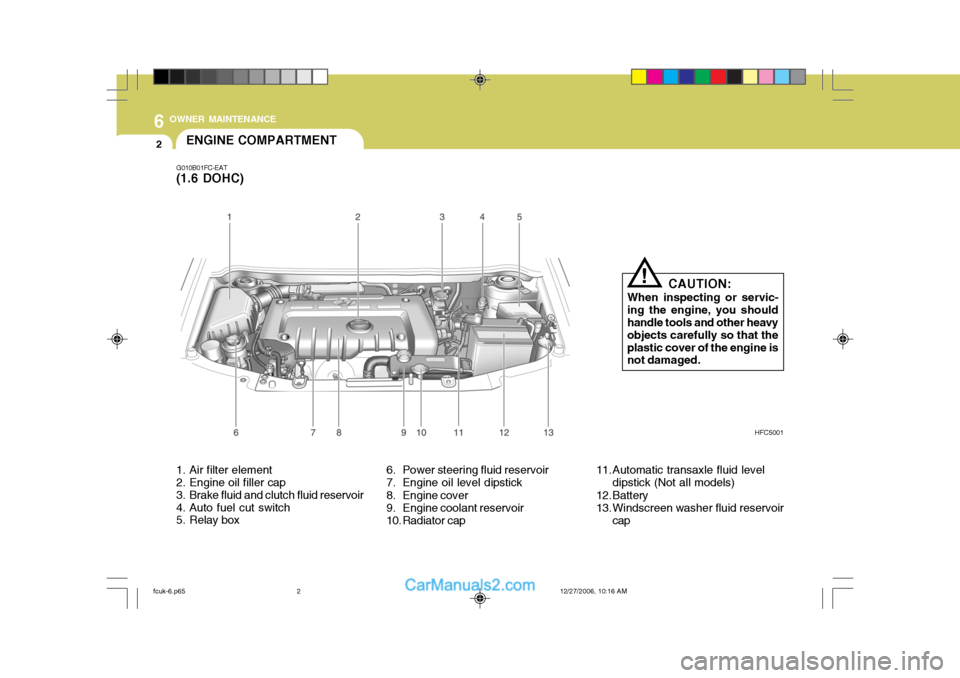
1. Air filter element
2. Engine oil filler cap
3. Brake fluid and clutch fluid reservoir
4. Auto fuel cut switch
5. Relay box 6. Power steering fluid reservoir
7. Engine oil level dipstick
8. Engine cover
9. Engine coolant reservoir
10. Radiator cap11. Automatic transaxle fluid level
dipstick (Not all models)
12. Battery
13. Windscreen washer fluid reservoir cap HFC5001
G010B01FC-EAT (1.6 DOHC)
CAUTION:
When inspecting or servic-
ing the engine, you should handle tools and other heavy objects carefully so that theplastic cover of the engine is not damaged.
!
ENGINE COMPARTMENT
fcuk-6.p65
12/27/2006, 10:16 AM
2
Page 431 of 490
6
OWNER MAINTENANCE
3
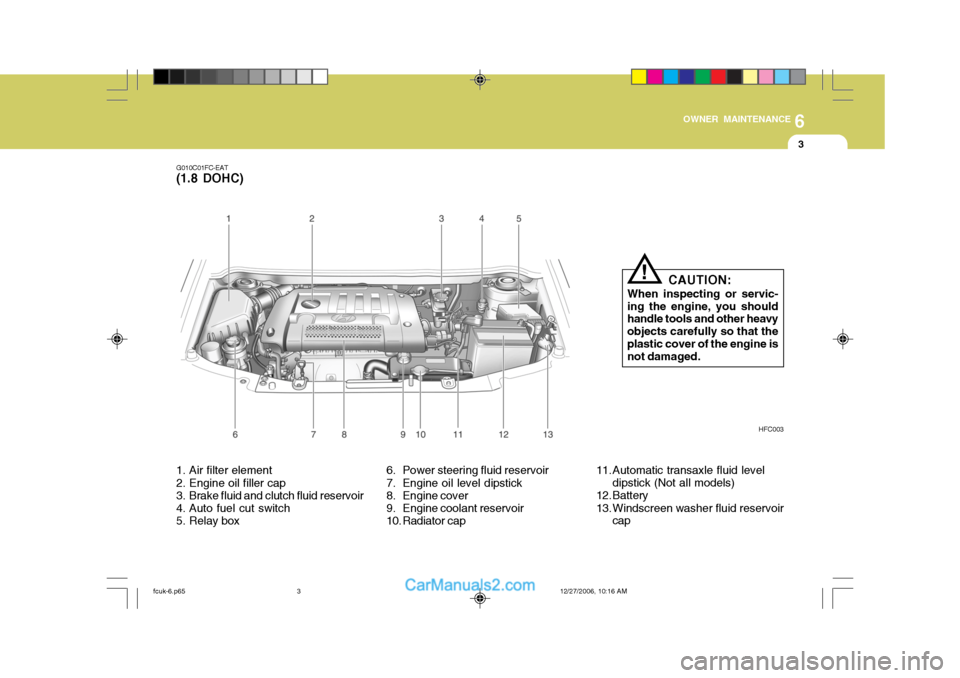
G010C01FC-EAT
(1.8 DOHC)
HFC003
1. Air filter element
2. Engine oil filler cap
3. Brake fluid and clutch fluid reservoir
4. Auto fuel cut switch
5. Relay box 6. Power steering fluid reservoir
7. Engine oil level dipstick
8. Engine cover
9. Engine coolant reservoir
10. Radiator cap11. Automatic transaxle fluid level
dipstick (Not all models)
12. Battery
13. Windscreen washer fluid reservoir cap CAUTION:
When inspecting or servic- ing the engine, you should handle tools and other heavy objects carefully so that the plastic cover of the engine is not damaged.
!
fcuk-6.p65 12/27/2006, 10:16 AM
3
Page 432 of 490

6 OWNER MAINTENANCE
4
1. Air filter element
2. Engine oil filler cap
3. Brake fluid and clutch fluid reservoir
4. Fuel filter 5. Relay box
6. Power steering fluid reservoir
7. Engine oil level dipstick
8. Engine coolant reservoir G010E02FC
G010E02FC-EAT
Diesel (1.5 CRDi)
CAUTION:
When inspecting or servic-
ing the engine, you should handle tools and other heavyobjects carefully so that the plastic cover of the engine is not damaged.
!
9. Radiator cap
10. Battery
11. Windscreen washer fluid reservoir
cap
fcuk-6.p65 12/27/2006, 10:16 AM
4
Page 460 of 490

6 OWNER MAINTENANCE
32
2. Pump the hand pump until there are
no more bubbles in the fuel coming out of the air pipe. When doing this, place a cloth around the air pipe to prevent the escaping fuel from spew-ing about.
3. Replace the air cap when there are no more bubbles in the fuel.
4. Continue pumping until the hand pump becomes stiff.
5. Finally, check to be sure that there
is no leakage of fuel. If in doubt, consult your nearest Hyundai authorised repairer. G350B01FC
Air pipeG350B01FC-EAT
(Diesel engine)
The fuel system should be bled to
remove air as described in the illustra- tion if the fuel supply is exhaustedduring travel, when the fuel filter is replaced, or if the vehicle is not used for a long time.
1. Remove the air cap with pushing
the button.
G350A01FC
BLEEDING THE FUEL SYSTEM
SG230B1-E POWER STEERING HOSES Power steering hoses should be checked for damage, deterioration and leakage at each service.
fcuk-6.p65 12/27/2006, 10:16 AM
32