rear seat Hyundai Matrix 2007 Owner's Guide
[x] Cancel search | Manufacturer: HYUNDAI, Model Year: 2007, Model line: Matrix, Model: Hyundai Matrix 2007Pages: 490, PDF Size: 12.81 MB
Page 46 of 490
1FEATURES OF YOUR HYUNDAI
34
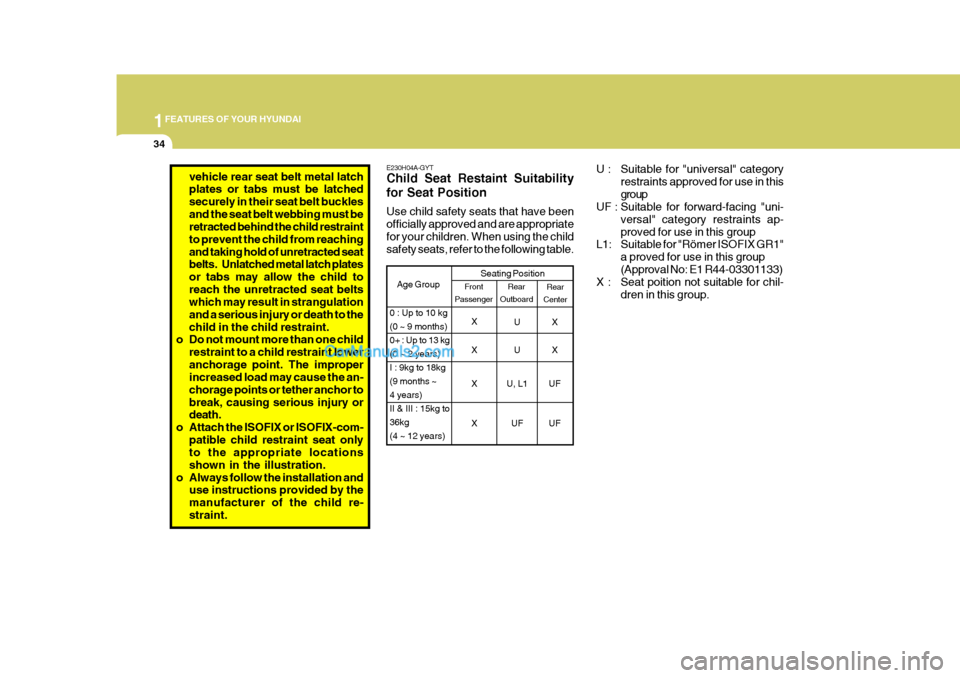
U : Suitable for "universal" categoryrestraints approved for use in this group
UF : Suitable for forward-facing "uni-
versal" category restraints ap-proved for use in this group
L1: Suitable for "Römer ISOFIX GR1"
a proved for use in this group(Approval No: E1 R44-03301133)
X : Seat poition not suitable for chil-
dren in this group.
Rear
Center
Age Group Seating Position
UX
XUX
X U, L1 UF XU FUF
Rear
Outboard
Front
Passenger
0 : Up to 10 kg (0 ~ 9 months)0+ : Up to 13 kg(0 ~ 2 years)I : 9kg to 18kg(9 months ~4 years)II & III : 15kg to36kg(4 ~ 12 years) X
E230H04A-GYT Child Seat Restaint Suitability for Seat Position Use child safety seats that have been officially approved and are appropriatefor your children. When using the child safety seats, refer to the following table.
vehicle rear seat belt metal latch plates or tabs must be latched securely in their seat belt bucklesand the seat belt webbing must be retracted behind the child restraint to prevent the child from reachingand taking hold of unretracted seat
belts. Unlatched metal latch plates or tabs may allow the child toreach the unretracted seat belts which may result in strangulation and a serious injury or death to thechild in the child restraint.
o Do not mount more than one child
restraint to a child restraint loweranchorage point. The improper increased load may cause the an- chorage points or tether anchor tobreak, causing serious injury or death.
o Attach the ISOFIX or ISOFIX-com- patible child restraint seat onlyto the appropriate locations shown in the illustration.
o Always follow the installation and use instructions provided by themanufacturer of the child re-straint.
Page 50 of 490
1FEATURES OF YOUR HYUNDAI
38
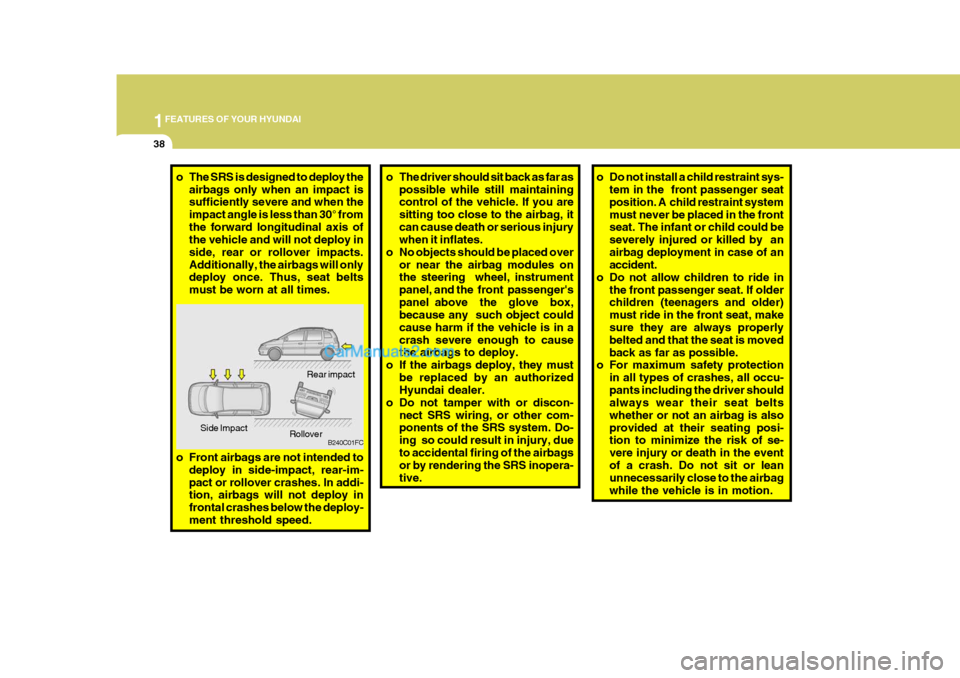
o Front airbags are not intended to
deploy in side-impact, rear-im- pact or rollover crashes. In addi- tion, airbags will not deploy in frontal crashes below the deploy-ment threshold speed.
o Do not install a child restraint sys-tem in the front passenger seat position. A child restraint systemmust never be placed in the front seat. The infant or child could be severely injured or killed by anairbag deployment in case of an accident.
o Do not allow children to ride in
the front passenger seat. If olderchildren (teenagers and older) must ride in the front seat, makesure they are always properly belted and that the seat is moved back as far as possible.
o For maximum safety protection
in all types of crashes, all occu-pants including the driver should always wear their seat belts whether or not an airbag is alsoprovided at their seating posi- tion to minimize the risk of se- vere injury or death in the eventof a crash. Do not sit or lean unnecessarily close to the airbag while the vehicle is in motion.o The driver should sit back as far as
possible while still maintaining control of the vehicle. If you are sitting too close to the airbag, itcan cause death or serious injury when it inflates.
o No objects should be placed over or near the airbag modules onthe steering wheel, instrument panel, and the front passenger'spanel above the glove box, because any such object could cause harm if the vehicle is in acrash severe enough to cause the airbags to deploy.
o If the airbags deploy, they must be replaced by an authorizedHyundai dealer.
o Do not tamper with or discon- nect SRS wiring, or other com-ponents of the SRS system. Do- ing so could result in injury, dueto accidental firing of the airbags or by rendering the SRS inopera- tive.
o The SRS is designed to deploy the
airbags only when an impact is sufficiently severe and when the impact angle is less than 30° fromthe forward longitudinal axis of the vehicle and will not deploy in side, rear or rollover impacts.Additionally, the airbags will only deploy once. Thus, seat belts must be worn at all times.
B240C01FC
Rear impact
Side Impact Rollover
Page 55 of 490
1
FEATURES OF YOUR HYUNDAI
43
B240C01HP
!
o Modification to SRS components
or wiring, including the addition of any kind of badges to the pad covers or modifications to the body structure, can adverselyaffect SRS performance and lead to possible injury.
o For cleaning the airbag pad cov- ers, use only a soft, dry cloth orone which has been moistened with plain water. Solvents orcleaners could adversely affect the airbag covers and proper deployment of the system.
o No objects should be placed over or near the airbag modules onthe steering wheel, instrumentpanel, and the front passenger's panel above the glove box, be- cause any such object couldcause harm if the vehicle is in a crash severe enough to cause the airbags to inflate.
o If the airbags inflate, they must be replaced by an authorizedHyundai dealer.
o Do not tamper with or discon- nect SRS wiring, or other com-ponents of the SRS system.
WARNING:
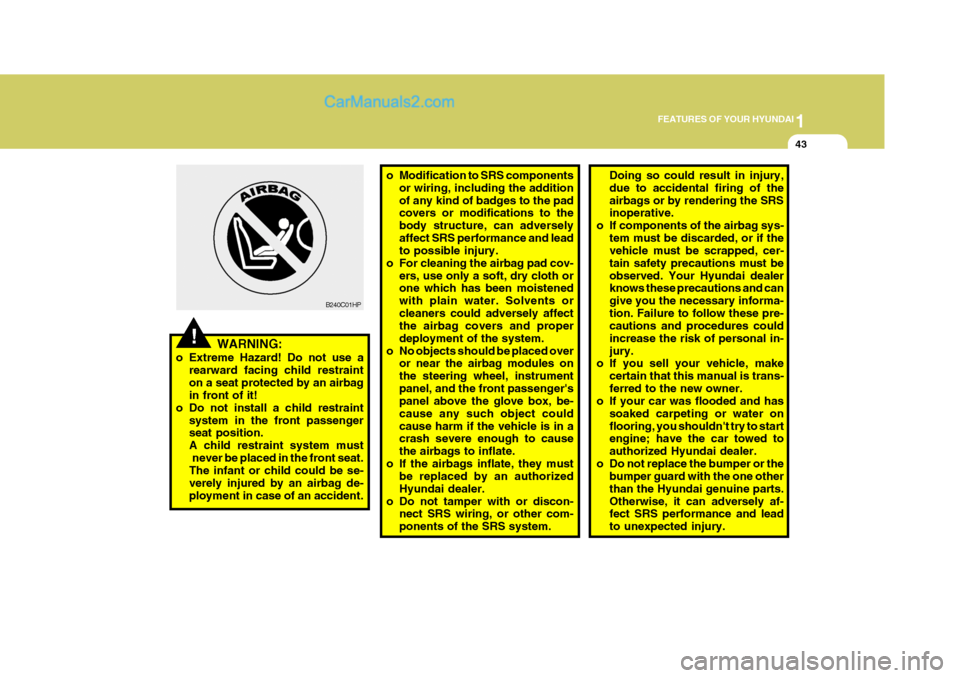
o Extreme Hazard! Do not use a rearward facing child restrainton a seat protected by an airbag in front of it!
o Do not install a child restraint system in the front passengerseat position. A child restraint system must
never be placed in the front seat. The infant or child could be se- verely injured by an airbag de-ployment in case of an accident. Doing so could result in injury,due to accidental firing of theairbags or by rendering the SRS inoperative.
o If components of the airbag sys-
tem must be discarded, or if thevehicle must be scrapped, cer- tain safety precautions must beobserved. Your Hyundai dealer knows these precautions and can give you the necessary informa-tion. Failure to follow these pre- cautions and procedures could increase the risk of personal in-jury.
o If you sell your vehicle, make
certain that this manual is trans-ferred to the new owner.
o If your car was flooded and has
soaked carpeting or water onflooring, you shouldn't try to start engine; have the car towed to authorized Hyundai dealer.
o Do not replace the bumper or the bumper guard with the one otherthan the Hyundai genuine parts.Otherwise, it can adversely af- fect SRS performance and lead to unexpected injury.
Page 80 of 490

1FEATURES OF YOUR HYUNDAI
68PARKING BRAKE
B530A02A-AAT The parking brake must always be set when the vehicle is to be left unattended. When the parking brake is applied, andthe ignition key is at the "ON" position, the parking brake warning lamp will be illuminated. Before driving the vehicle,the parking brake must be fully released and the warning lamp extinguished.
o To engage the parking brake, first
apply the foot brake and then without pressing the release button in, pull theparking brake lever up as far as pos- sible. B530A01FC
REAR SEAT ARM REST
B611A02FC-AAT (If Installed) The rear seat arm rest is located in the center of the rear seat back with a storage box. The drink holder in the box can be usedby opening the lid of the arm rest. B610A01FC
WARNING:
o Do not place objects other than cups or cans on the drink holder. Such objects can be thrown out in the event of a sudden stop oran accident, possibly injuring the passengers in the vehicle.
o Be careful not to injure your fin-
gers when you open the lid of thearm rest.
!
In addition it is recommended that when parking the vehicle on a gradi-ent, the shift lever should be posi- tioned in the appropriate low gear on manual transaxle vehicles or in thePark position on automatic transaxle vehicles.
o To release the parking brake, first apply the foot brake and pull up theparking brake lever slightly. Sec- ondly, depress the release buttonand lower the parking brake lever while holding the button.
CAUTION:
Driving with the parking brake ap- plied will cause excessive brake pad (or lining) and brake rotor wear.
!
Page 163 of 490

2
DRIVING YOUR HYUNDAI
17
!WARNING:
Nothing should be carried on top of the shelf panel behind the rear seat. If there were an accident or a sud- den stop, such objects could moveforward and cause damage to the vehicle or injure the occupants.
o After being parked, check to be sure the parking brake is not engaged and that the parking brake indicator light is out before driving away.
o Driving through water may get the brakes wet. They can also get wet when the car is washed. Wet brakescan be dangerous! Your car will not stop as quickly if the brakes are wet. Wet brakes may cause the car topull to one side. To dry the brakes, apply the brakes lightly until the braking action returns to normal,taking care to keep the car under control at all times. If the braking action does not return to normal,stop as soon as it is safe to do so and call your Hyundai dealer for assistance.
C310D01JM-AAT Indicators and Warning The indicators should illuminate when the ignition key is turned to ON orSTART but should go out after three seconds. If the indicators do not illuminate, orthe ESP or ESP-OFF indicator does not go out after 3 seconds, have the vehicle checked by an authorizeddealer. Should there be any unusual condi- tions in the device while driving, ESP- OFF indicator illuminates as a warn- ing.If ESP-OFF indicator illuminates, pull your car to a safe place and stop the engine.Then, start the engine again to check if the ESP-OFF indicator goes out. If the indicator remains lit even after the engine has been started, have your car checked by an authorizedHyundai dealer.
GOOD BRAKING PRACTICES
C130A01A-AAT o Don't coast down hills with the car
out of gear. This is extremely haz- ardous. Keep the car in gear at all times, use the brakes to slow down,then shift to a lower gear so that engine braking will help you main- tain a safe speed.
o Don't "ride" the brake pedal. Rest- ing your foot on the brake pedalwhile driving can be dangerous be-cause it can result in the brakes overheating and losing their effec- tiveness. It also increases the wearof the brake components.
o If a tire goes flat while you are
driving, apply the brakes gently and keep the car pointed straight ahead while you slow down. When you aremoving slowly enough for it to be safe to do so, pull off the road and stop in a safe place.
o If your car is equipped with an auto- matic transaxle, don't let your carcreep forward. To avoid creepingforward, keep your foot on the brake pedal when the car is stopped.
o Use caution when parking on a hill. Engage the parking brake and placethe gear selector lever in "P" (auto- matic transaxle) or in first or reversegear (manual transaxle).
Page 193 of 490

44CORROSION PREVENTION AND APPEARANCE CARE
6
E040E01A-AAT Cleaning the Windows You may use any household window cleaner on the windows. However, when cleaning the inside of the rear window be careful not to damage therear window defroster wiring. E050A01A-AAT Any Questions? If you have any questions about the care of your car, consult your Hyundaidealer.
E040C01A-AAT Cleaning the Carpets Use a foam-type carpet cleaner. Clean- ers of this type are available in aerosol cans in liquid form or powder. Read theinstructions and follow them exactly. Using a vacuum cleaner with the ap- propriate attachment, remove as muchdirt from the carpets as possible. Apply the foam following the manufacturer's directions, then rub in overlappingcircles. Do not add water. These clean- ers work best when the carpet is kept as dry as possible.
E040B01A-AAT To Clean the Leather Upholstery (If Installed) In the normal course of use, leather upholstered surfaces will, like anymaterial, pick-up dust and dirt. This dust and dirt must be cleaned off or it may work into the surface of the leather,causing damage. Fine leather needs care, and should be cleaned when necessary. Washing leather thoroughly with soap and water will keep your leather lustrous, beauti-ful and ensure you have many years of wear. Take a piece of cheese cloth and usingany mild soap and lukewarm water, work up a good lather. Thoroughly wash the leather. Wipe clean with aslightly damp cloth and dry with soft cloth. Do this as often as the leather becomes soiled. During tanning operations, sufficient oils are incorporated through process-ing that none need be applied during the life of the leather. Oil applied to the finished surface will in no way help the leather and may do more harm thangood. Varnishes and furniture polishesshould never be used under any con- ditions.
E040D01A-AAT Cleaning the Seat Belts To clean the seat belts, use a cloth or sponge with mild soap or detergentand warm water. Do not use strong detergents, dye, bleach or abrasive materials on the seat belts as this mayweaken the fabric. While cleaning the belts, inspect them for excessive wear, cuts, fraying orother signs of damage and replace them if necessary.
Page 246 of 490
6 DO-IT-YOURSELF MAINTENANCE
42
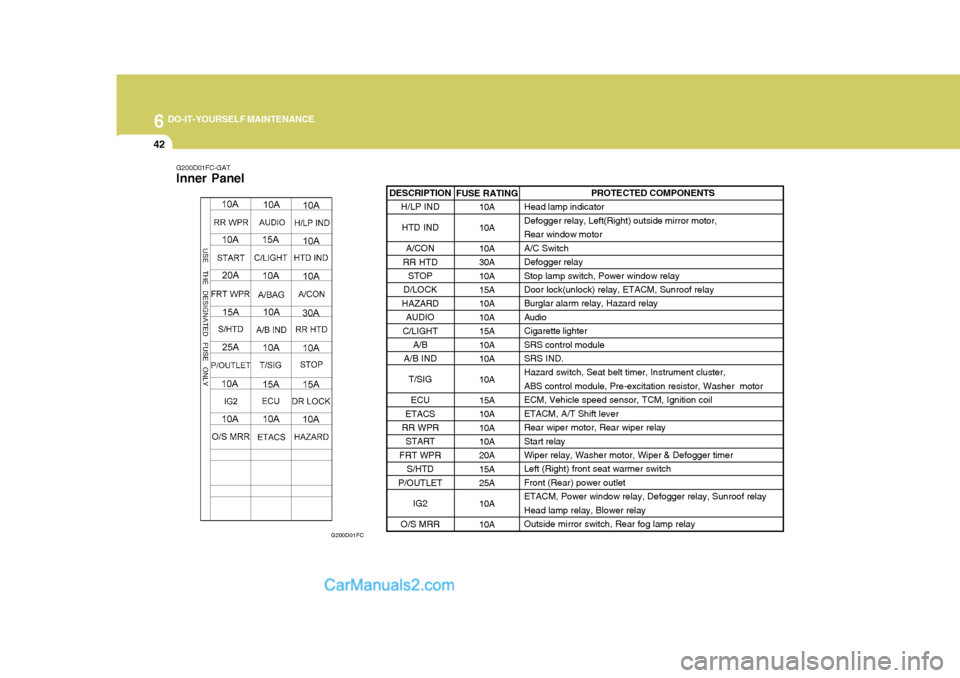
G200D01FC-GAT Inner Panel
G200D01FC
DESCRIPTIONH/LP IND
HTD IND
A/CON
RR HTD STOP
D/LOCK
HAZARD AUDIO
C/LIGHT A/B
A/B IND
T/SIG
ECU
ETACS
RR WPR
START
FRT WPR S/HTD
P/OUTLET
IG2
O/S MRRPROTECTED COMPONENTS
Head lamp indicator Defogger relay, Left(Right) outside mirror motor,Rear window motorA/C SwitchDefogger relayStop lamp switch, Power window relay Door lock(unlock) relay, ETACM, Sunroof relay Burglar alarm relay, Hazard relayAudioCigarette lighterSRS control moduleSRS IND. Hazard switch, Seat belt timer, Instrument cluster, ABS control module, Pre-excitation resistor, Washer motorECM, Vehicle speed sensor, TCM, Ignition coilETACM, A/T Shift leverRear wiper motor, Rear wiper relayStart relay Wiper relay, Washer motor, Wiper & Defogger timer Left (Right) front seat warmer switchFront (Rear) power outletETACM, Power window relay, Defogger relay, Sunroof relayHead lamp relay, Blower relayOutside mirror switch, Rear fog lamp relay
FUSE RATING
10A 10A 10A 30A10A15A 10A 10A15A10A10A 10A 15A 10A10A 10A 20A15A25A 10A 10A
Page 264 of 490
10
INDEX
3
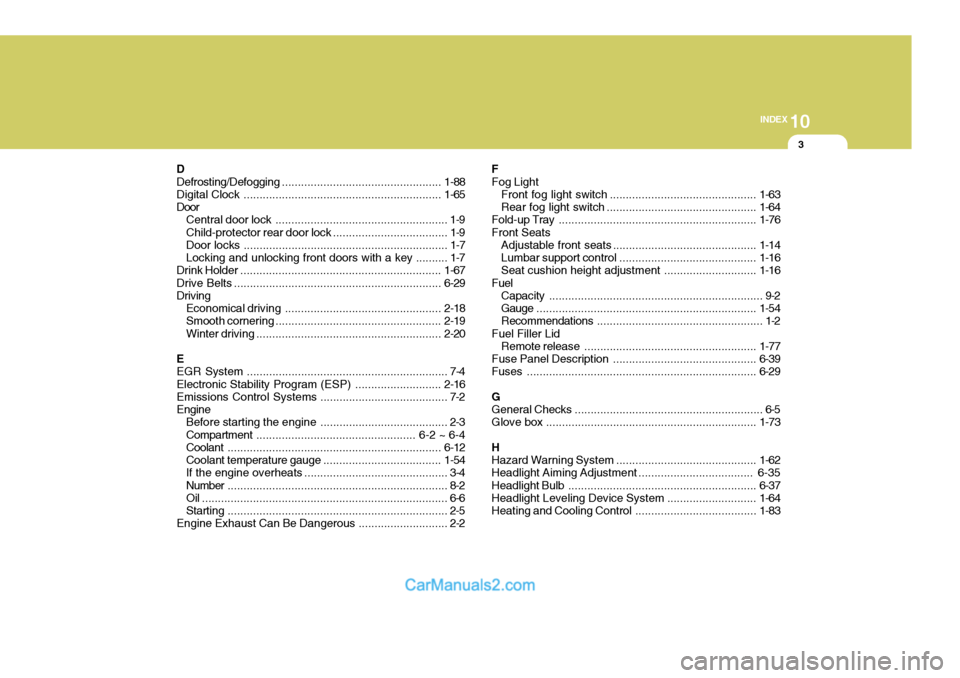
D Defrosting/Defogging .................................................. 1-88
Digital Clock .............................................................. 1-65
Door Central door lock ...................................................... 1-9
Child-protector rear door lock .................................... 1-9
Door locks ................................................................ 1-7
Locking and unlocking front doors with a key .......... 1-7
Drink Holder ............................................................... 1-67
Drive Belts ................................................................. 6-29
Driving
Economical driving ................................................. 2-18
Smooth corneri ng .................................................... 2-19
Winter driving .......................................................... 2-20
E
EGR System ............................................................... 7-4 Electronic Stability Program (ESP) ...........................2-16
Emissions Control Systems ........................................ 7-2Engine Before starting the engine ........................................ 2-3Compartment .................................................. 6-2 ~ 6-4
Coolant ................................................................... 6-12
Coolant temperature gauge .....................................1-54
If the engine overheats ............................................. 3-4
Number ..................................................................... 8-2
Oil ............................................................................. 6-6Starting ..................................................................... 2-5
Engine Exhaust Can Be Dangerous ............................ 2-2 FFog Light
Front fog light switch .............................................. 1-63
Rear fog light switch ............................................... 1-64
Fold-up Tray .............................................................. 1-76
Front Seats Adjustable front seats ............................................. 1-14
Lumbar support control ........................................... 1-16
Seat cushion height adjustment ............................. 1-16
Fuel Capacity ................................................................... 9-2
Gauge ..................................................................... 1-54
Recommendations .................................................... 1-2
Fuel Filler Lid Remote release ...................................................... 1-77
Fuse Panel Description ............................................. 6-39
Fuses ........................................................................ 6-29
GGeneral Checks ........................................................... 6-5
Glove box .................................................................. 1-73
HHazard Warning System ............................................ 1-62
Headlight Aiming Adjustm ent .................................... 6-35
Headlight Bulb ........................................................... 6-37
Headlight Leveling Device S ystem ............................1-64
Heating and Cooling Control ......................................1-83
Page 265 of 490

10INDEX
4
Heating and VentilationAir flow control ........................................................ 1-85
Air intake control .................................................... 1-87
Bi-level heating ....................................................... 1-88
Fan speed control ................................................... 1-84
Heating controls ...................................................... 1-87
Temperature control ................................................ 1-84
High-mounted Rear Stoplight .....................................1-76
Hood Release ............................................................ 1-76
Horn ........................................................................... 1-82
I Ignition Sw itch ............................................................. 2-3
Immobilizer S ystem ..................................................... 1-5
Instrument Cluster and Indicator .................. 1-44 ~ 1-47
Interior Light Interior light ............................................................. 1-71
Map light ................................................................. 1-71
Intermittent Wiper ...................................................... 1-62
J Jump Starting .............................................................. 3-3
K
Keys ............................................................................ 1-4 If you lose your keys ............................................. 3-15
Positions ................................................................... 2-4 L Lubrication Chart
.......................................................... 9-4
Luggage Net .............................................................. 1-80
MMaintenance Intervals Explanation of scheduled maintenance items .......... 5-8Maintenance under severe usage conditions ............ 5-7
Scheduled maintenance .................................. 5-4 ~ 5-6
Service requirements ................................................ 5-2
Mirror
Day-night inside rearview ....... .................................1-75
Outside rearvi ew ..................................................... 1-73
Multi Box ................................................................... 1-72
O
Odometer ................................................................... 1-56
Outside Rearview Mirror Heater................................. 1-74
PParking Brake ............................................................ 1-68
Power Outlet .............................................................. 1-66
Power Steering Fluid Level ....................................... 6-32
Pre-tensioner Seat Belt ............................................. 1-35
Page 266 of 490
10
INDEX
5
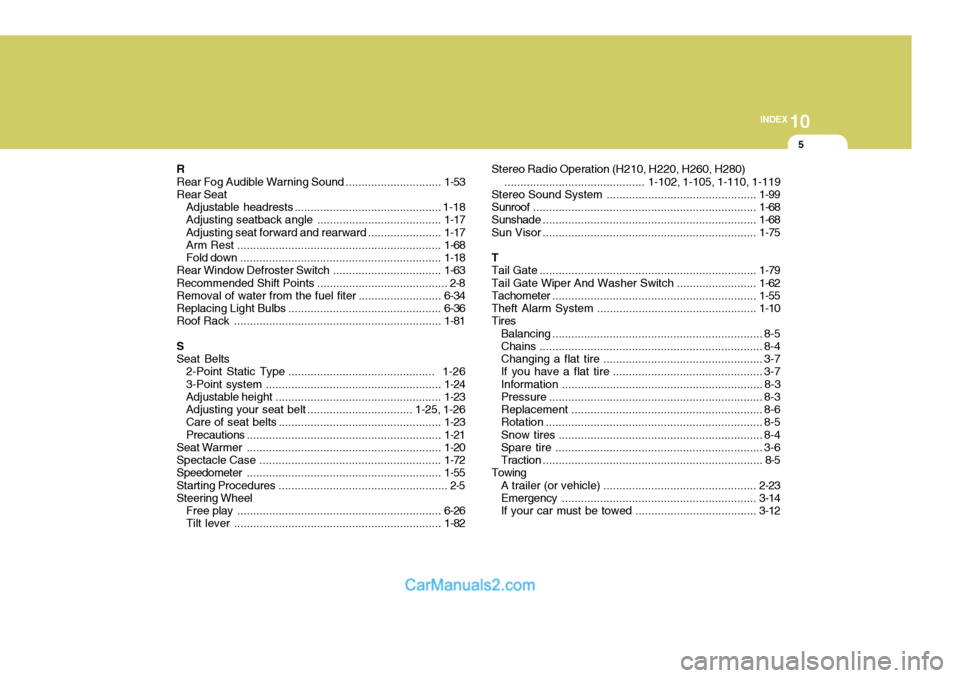
R Rear Fog Audible Warning Sound ..............................1-53
Rear Seat
Adjustable headrests . ............................................. 1-18
Adjusting seatback angle ....................................... 1-17
Adjusting seat forward and rearward .......................1-17
Arm Rest ................................................................ 1-68
Fold down ............................................................... 1-18
Rear Window Defroster Switch .................................. 1-63
Recommended Shift Points ......................................... 2-8 Removal of water from the fuel fiter .......................... 6-34
Replacing Light Bulbs ................................................ 6-36
Roof Rack ................................................................. 1-81
S Seat Belts 2-Point Static Type .............................................. 1-263-Point system ....................................................... 1-24
Adjustabl e height .................................................... 1-23
Adjusting your seat belt ................................. 1-25, 1-26
Care of seat belts ................................................... 1-23
Precautions ............................................................. 1-21
Seat Warmer ............................................................. 1-20
Spectacle Ca se ......................................................... 1-72
Speedometer ............................................................. 1-55
Starting Pr ocedures..................................................... 2-5
Steering Wheel
Free play ................................................................ 6-26
Tilt lever ................................................................. 1-82Stereo Radio Operation (H210, H220, H260, H280)
............................................ 1-102, 1-105, 1-110, 1-119
Stereo Sound System ............................................... 1-99
Sunroof ...................................................................... 1-68
Sunshade ................................................................... 1-68
Sun Visor ................................................................... 1-75
T Tail Gate .................................................................... 1-79
Tail Gate Wiper And Washer Switch ......................... 1-62
Tachometer ................................................................ 1-55
Theft Alarm System .................................................. 1-10
Tires
Balancing .................................................................. 8-5
Chains ...................................................................... 8-4
Changing a flat tire .................................................. 3-7
If you have a flat tire ............................................... 3-7
Information ............................................................... 8-3
Pressure ................................................................... 8-3
Replacement ............................................................ 8-6
Rotation .................................................................... 8-5
Snow tires ................................................................ 8-4
Spare tire ................................................................. 3-6
Traction ..................................................................... 8-5
Towing
A trailer (or vehicle) ................................................ 2-23
Emergency ............................................................. 3-14
If your car must be towed ...................................... 3-12