tow Hyundai Matrix 2007 Owner's Guide
[x] Cancel search | Manufacturer: HYUNDAI, Model Year: 2007, Model line: Matrix, Model: Hyundai Matrix 2007Pages: 490, PDF Size: 12.81 MB
Page 170 of 490
2 DRIVING YOUR HYUNDAI
24
C190E02L
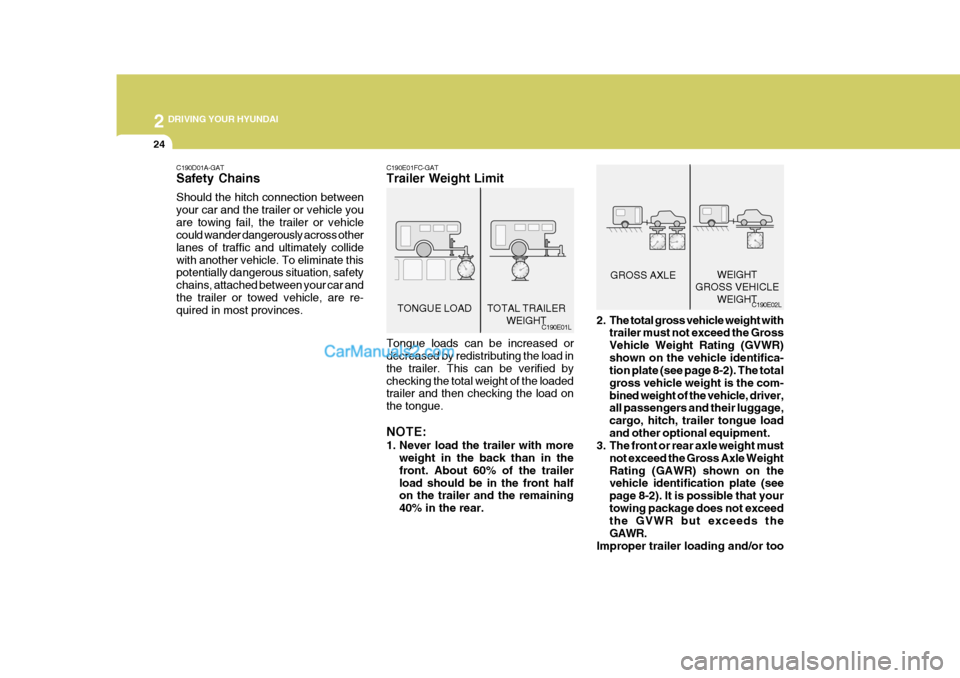
GROSS AXLE
WEIGHT
GROSS VEHICLE WEIGHT
2. The total gross vehicle weight with trailer must not exceed the Gross Vehicle Weight Rating (GVWR)shown on the vehicle identifica- tion plate (see page 8-2). The total gross vehicle weight is the com-bined weight of the vehicle, driver, all passengers and their luggage, cargo, hitch, trailer tongue loadand other optional equipment.
3. The front or rear axle weight must
not exceed the Gross Axle WeightRating (GAWR) shown on the vehicle identification plate (see page 8-2). It is possible that yourtowing package does not exceed the GVWR but exceeds the GAWR.
Improper trailer loading and/or too
C190D01A-GAT Safety Chains Should the hitch connection between your car and the trailer or vehicle youare towing fail, the trailer or vehicle could wander dangerously across other lanes of traffic and ultimately collidewith another vehicle. To eliminate this potentially dangerous situation, safety chains, attached between your car andthe trailer or towed vehicle, are re- quired in most provinces. C190E01FC-GAT Trailer Weight Limit
TONGUE LOAD TOTAL TRAILER WEIGHTC190E01L
Tongue loads can be increased or decreased by redistributing the load in the trailer. This can be verified bychecking the total weight of the loaded trailer and then checking the load on the tongue. NOTE:
1. Never load the trailer with more weight in the back than in the front. About 60% of the trailerload should be in the front half on the trailer and the remaining 40% in the rear.
Page 171 of 490

2
DRIVING YOUR HYUNDAI
25
!
kg (Lbs)
!
COUPLING POINT
C190E01FC MANUAL
TRANSAXLE AUTO
TRANSAXLE Trailer
1,300
(2,865) 1,100
(2,424)
550 (1,212) Tongue
52
(115)
Maximum Towable Weight
With BrakeType
1.5 Diesel 1.6/1.8 L 1.6/1.8 L
Without Brake Type
much luggage in the trunk can overload the rear axle. Redistrib-ute the load and check the axle weight again.
4. The maximum permissible static
vertical load on the coupling de-vice ; 52kg
5. The maximum permissible over- The following specifications are rec-ommended when towing a trailer. The loaded trailer weigh cannot safelyexceed the values in the following chart.
WARNING:
hang of the coupling point : 760 mm CAUTION: Improperly loading your car andtrailer can serious affect its steering and braking performance causing a crash in which could cause seriousinjury or death. C190F02A-GAT Trailer or Vehicle Towing Tips
1. Before towing, check hitch and
safety chain connections as well as proper operation of the trailer run- ning lights, brake lights, and turn signals.
2. Always drive your vehicle at a mod- erate speed (Less than 100 km/h).
3. Trailer towing requires more fuel than normal conditions.
4. To maintain engine braking effi-
ciency and electrical charging per-formance, do not use fifth gear (manual transaxle) or overdrive (au- tomatic transaxle).
5. Always secure items in the trailer to prevent load shift while driving.
6. Check the condition and air pres- sure of all tires on the trailer and your vehicle. Low tire pressure can seriously affect the handling. Alsocheck the spare tire.
7. The vehicle/trailer combination is
more affected by crosswind andbuffeting. When being passed by a large vehicle, keep a constant speed and steer straight ahead. If there istoo much wind buffeting, slow down to get out of the other vehicle's air turbulence.
Page 172 of 490

2 DRIVING YOUR HYUNDAI
26
CAUTION:
If overheating should occur when towing, (temperature gauge reads near the red zone), taking the follow- ing actions may reduce or eliminatethe problem.
1. Turn off the air conditioner.
2. Reduce highway speed.
3. Select a lower gear when going uphill.
4. While in stop and go traffic, place the gear selection in park or neu- tral and idle the engine at a higherspeed.
!
8. When parking your vehicle and
trailer, especially on a hill, be sure to follow all the normal precautions. Turn your front wheel into the curb, set the parking brake firmly, and putthe transaxle in 1st or Reverse (manual) or Park (automatic). In addition, place wheel chocks ateach of the trailer's tires.
9. If the trailer has electric brakes,
start your vehicle and trailer mov-ing, and then apply the trailer brake controller by hand to be sure the brakes are working. This lets youcheck your electrical connection at the same time.
10.During your trip, check occasion- ally to be sure that the load issecure, and that the lights and any trailer brakes are still working.
11.Avoid jerky starts, sudden accel- eration or sudden stops.
12.Avoid sharp turns and rapid lane changes.
13.Avoid holding the brake pedal down
too long or too frequently. This couldcause the brakes to overheat, re- sulting in reduced braking efficiency. 14. When going down a hill, shift into a
lower gear and use the engine brak- ing effect. When ascending a long grade, downshift the transaxle to a lowergear and reduce speed to reduce chances of engine overloading and/ or overheating.
15.If you have to stop while going uphill, do not hold the vehicle inplace by pressing on the accelera-tor. This can cause the automatic transaxle to overheat. Use the park- ing brake or footbrake.
NOTE: When towing check transaxle fluid more frequently.
Page 173 of 490
3
If the Engine Will not Start .......................................... 3-2
Jump Starting .............................................................. 3-3
If the Engine Overheats .............................................. 3-4
Spare Tire .................................................................... 3-6
If You Have a Flat Tire ................................................ 3-7
Changing A Flat Tire ................................................... 3-7
If Your vehicle Must Be Towed ...................................3-12
Emergency Towing ..................................................... 3-14
If You Lose Your K eys ................................................ 3-15
WHAT TO DO IN AN EMERGENCY
3
Page 184 of 490

3 WHAT TO DO IN AN EMERGENCY
12
air may leak from the tire. If you lose a valve cap, buy another and install it assoon as possible. After you have changed wheels, al- ways secure the flat tire in its place inthe luggage room and return the jack and tools to their proper storage loca- tions.
Wheel nut tightening torque: Steel wheel & aluminium alloy wheel: 900-1,100 kg.cm (65-80 lb.ft)
D060J01FC-GAT After Changing Wheels If you have a tire gauge, remove the valve cap and check the air pressure. If the pressure is lower than recom-mended, drive slowly to the nearest service station and inflate to the cor- rect pressure. If it is too high, adjust ituntil it is correct. Always reinstall the valve cap after checking or adjusting tire pressure. If the cap is not replaced, HFC502
IF YOUR VEHICLE MUST BE TOWED
D080A01O-GAT If your vehicle has to be towed, it should be done by your Hyundai dealeror a commercial tow truck service. This will help assure that your vehicle is not damaged in towing. Also, profes-sionals are generally aware of local laws governing towing. In any case, rather than risk damage to your car, itis suggested that you show this infor- mation to the tow truck operator. Be sure that a safety chain system is usedand that all local laws are observed. It is recommended that your vehicle be towed with a wheel lift and dollies orflatbed equipment with all the wheels off the ground.
! CAUTION:
o Your vehicle can be damaged if towed incorrectly!
o Be sure the transaxle is in neu-
tral.
o When the engine will not start, be
sure the steering is unlocked by placing the key in the "ACC" po- sition.
Page 185 of 490

3
WHAT TO DO IN AN EMERGENCY
13
CAUTION:
o When towing the vehicle, take care not to cause damage to the bumper or underbody of the vehicle.
o Do not tow with sling type truck as this may cause damage to thebumper or underbody of the ve-hicle. HFC004
D080B01O-GAT Towing the Vehicle
HFC005
Your vehicle can be towed by wheel lift type truck (1), (2) or flatbed equipment (3).
!
1) If the vehicle is being towed with the
rear wheels on the ground, be sure the parking brake is released.
NOTE: Before towing, check the level of the automatic transaxle fluid. If it is below the "HOT" range on the dip-stick, add fluid. If you cannot add fluid, a towing dolly must be used.
2) If any of the loaded wheels or sus- pension components are damaged or the vehicle is being towed withthe front wheels on the ground, use a towing dolly under the front wheels.
o Manual Transaxle: If you do not use a towing dolly, place the ignition key in the "ACC"position and put the transaxle in "N (Neutral)".
1)
2)
3)
dolly
CAUTION:
Do not tow with the key removed or in the "LOCK" position when tow- ing from the rear without a towingdolly.
!
Page 186 of 490

3 WHAT TO DO IN AN EMERGENCY
14
NOTE: Before towing, check the level of the automatic transaxle fluid. If it is be- low the "HOT" range on the dipstick,add fluid. If you cannot add fluid, a towing dolly must be used.
!
EMERGENCY TOWING
D080D04A-AAT
For emergency towing when no com- mercial tow vehicle is available, attach a tow cable, chain or strap to one of thetowing hooks under the front/rear of your vehicle. Do not attempt to tow your vehicle in this manner on any unpavedsurface. This could result in serious damage to your vehicle. Nor should towing be attempted if thewheels, drive train, axles, steering or brakes are damaged. Before towing, be sure the transaxle is in neutral andthe key is in "ACC" (with the engine off) or in the "ON" position (with the engine running). A driver must be in the towedvehicle to steer it and operate the brakes. D080D04FC
HFC006
!
o Automatic Transaxle:
Be sure to use a towing dolly under the front wheels.
CAUTION:
A vehicle with an automatic transaxleshould never be towed from the rearwith the front wheels on the ground. This can cause serious damage to the transaxle.
3) It is recommended that your vehicle be towed with all the wheels off the ground. Front
Rear CAUTION:
If the car is being towed with all fourwheels on the ground, it can be towed only from the front. Be sure that the transaxle is in neutral. Do not tow at speeds greater than 50km/h (30 mph) and for more than 25 km (15 miles). Be sure the steering is unlocked byplacing the key in the "ACC" posi- tion. A driver must be in the towed vehicle to operate the steering andbrakes.
Page 200 of 490
5
VEHICLE MAINTENANCE REQUIREMENTS
7
ENGINE AND FILTER (GASOLINE)
ENGINE OIL AND FILTER
(DIESEL)AIR CLEANER FILTER SPARK PLUGS TIMING BELTBRAKE PADS, CALIPERS AND ROTORSREAR BRAKE DRUMS/LININGS/PADS, PARKING BRAKESTEERING GEAR RACK, LINKAGE & BOOTS/LOWER ARM BALL JOINT DRIVESHAFTS & BOOTSMANUAL TRANSAXLE OILAUTOMATIC TRANSAXLEFLUIDAIR CONDITIONER FILTER (IN FRONT OF BLOWER UNIT) A, B, C, D, E, F, G, H, I, K A, B, C, F, H, I, J C, E B, H D, E, F, GC, D, G, HC, D, G, H C, D, E, F, G C, D, E, G A, C, D, E, F, G, H, I, J A, C, E, F, G, H, I C, E
R R R RR
II I I
RR R DRIVING
CONDITION
EVERY 7,500 KM OR 6 MONTHS EVERY 7,500 KM OR 6 MONTHSEVERY 5,000 KM OR 6 MONTHSMORE FREQUENTLYMORE FREQUENTLYEVERY 60,000 KM OR 48 MONTHS MORE FREQUENTLY MORE FREQUENTLY MORE FREQUENTLY EVERY 15,000 KM OR 12 MONTHS EVERY 100,000 KMEVERY 45,000 KMEVERY 40,000 KM MORE FREQUENTLY MAINTENANCE INTERVALS
European Community Only Except European Community
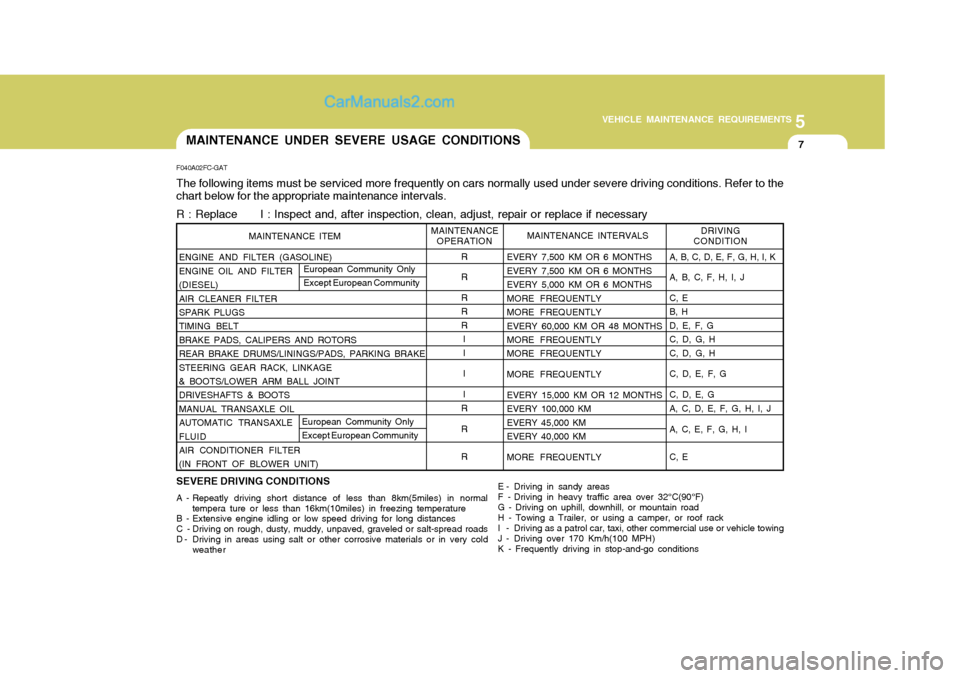
F040A02FC-GAT The following items must be serviced more frequently on cars normally used under severe driving conditions. Refer to the chart below for the appropriate maintenance intervals. R : Replace I : Inspect and, after inspection, clean, adjust, repair or replace if necessary
SEVERE DRIVING CONDITIONS
A - Repeatly driving short distance of less than 8km(5miles) in normal
tempera ture or less than 16km(10miles) in freezing temperature
B - Extensive engine idling or low speed driving for long distances
C - Driving on rough, dusty, muddy, unpaved, graveled or salt-spread roads
D - Driving in areas using salt or other corrosive materials or in very cold weather
MAINTENANCEOPERATION
MAINTENANCE ITEM
E - Driving in sandy areas
F - Driving in heavy traffic area over 32°C(90°F) G - Driving on uphill, downhill, or mountain road H - Towing a Trailer, or using a camper, or roof rack
I - Driving as a patrol car, taxi, other commercial use or vehicle towing
J - Driving over 170 Km/h(100 MPH)K - Frequently driving in stop-and-go conditions
MAINTENANCE UNDER SEVERE USAGE CONDITIONS
European Community Only Except European Community
Page 233 of 490

6
DO-IT-YOURSELF MAINTENANCE
29
On the backside of the mult box, you
will find a list showing the circuits protected by each fuse. If any of your car's lights or other
electrical accessories stop working, ablown fuse could be the reason. If the fuse has burned out, you will see that the metal strip inside the fuse hasburned through. If you suspect a blown fuse, follow this procedure:
1. Turn off the ignition and all other switches.
2. Open the fuse box and examine
each fuse. Remove each fuse by pulling it toward you (a small "fuse puller" tool is contained in the fuse box to simplify this operation).
3. Be sure to check all other fuses even if you find one that appears tohave burned out. Good
G200B03Y
Burned out
CAUTION:
A burned-out fuse indicates thatthere is a problem in the electrical circuit. If you replace a fuse and it blows as soon as the accessory isturned on, the problem is serious and should be referred to a Hyundai dealer for diagnosis andrepair. Never replace a fuse with anything except a fuse with the same or a lower amperage rating.A higher capacity fuse could cause damage and create a fire hazard. NOTE: See page 6-39 for the fuse panel descriptions.
!
G200B01FC
4. Replace the blown fuse by pressing a new fuse of the same rating into place. The fuse should be a snug fit. If it is not, have the fuse clip repaired or replaced by a Hyundai dealer. If you do not have a sparefuse, you may be able to borrow a fuse of the same or lower rating from an accessory you can tempo-rarily get along without (the radio or cigarette lighter, for example). Al- ways remember to replace the bor-rowed fuse.
Page 266 of 490
10
INDEX
5
R Rear Fog Audible Warning Sound ..............................1-53
Rear Seat
Adjustable headrests . ............................................. 1-18
Adjusting seatback angle ....................................... 1-17
Adjusting seat forward and rearward .......................1-17
Arm Rest ................................................................ 1-68
Fold down ............................................................... 1-18
Rear Window Defroster Switch .................................. 1-63
Recommended Shift Points ......................................... 2-8 Removal of water from the fuel fiter .......................... 6-34
Replacing Light Bulbs ................................................ 6-36
Roof Rack ................................................................. 1-81
S Seat Belts 2-Point Static Type .............................................. 1-263-Point system ....................................................... 1-24
Adjustabl e height .................................................... 1-23
Adjusting your seat belt ................................. 1-25, 1-26
Care of seat belts ................................................... 1-23
Precautions ............................................................. 1-21
Seat Warmer ............................................................. 1-20
Spectacle Ca se ......................................................... 1-72
Speedometer ............................................................. 1-55
Starting Pr ocedures..................................................... 2-5
Steering Wheel
Free play ................................................................ 6-26
Tilt lever ................................................................. 1-82Stereo Radio Operation (H210, H220, H260, H280)
............................................ 1-102, 1-105, 1-110, 1-119
Stereo Sound System ............................................... 1-99
Sunroof ...................................................................... 1-68
Sunshade ................................................................... 1-68
Sun Visor ................................................................... 1-75
T Tail Gate .................................................................... 1-79
Tail Gate Wiper And Washer Switch ......................... 1-62
Tachometer ................................................................ 1-55
Theft Alarm System .................................................. 1-10
Tires
Balancing .................................................................. 8-5
Chains ...................................................................... 8-4
Changing a flat tire .................................................. 3-7
If you have a flat tire ............................................... 3-7
Information ............................................................... 8-3
Pressure ................................................................... 8-3
Replacement ............................................................ 8-6
Rotation .................................................................... 8-5
Snow tires ................................................................ 8-4
Spare tire ................................................................. 3-6
Traction ..................................................................... 8-5
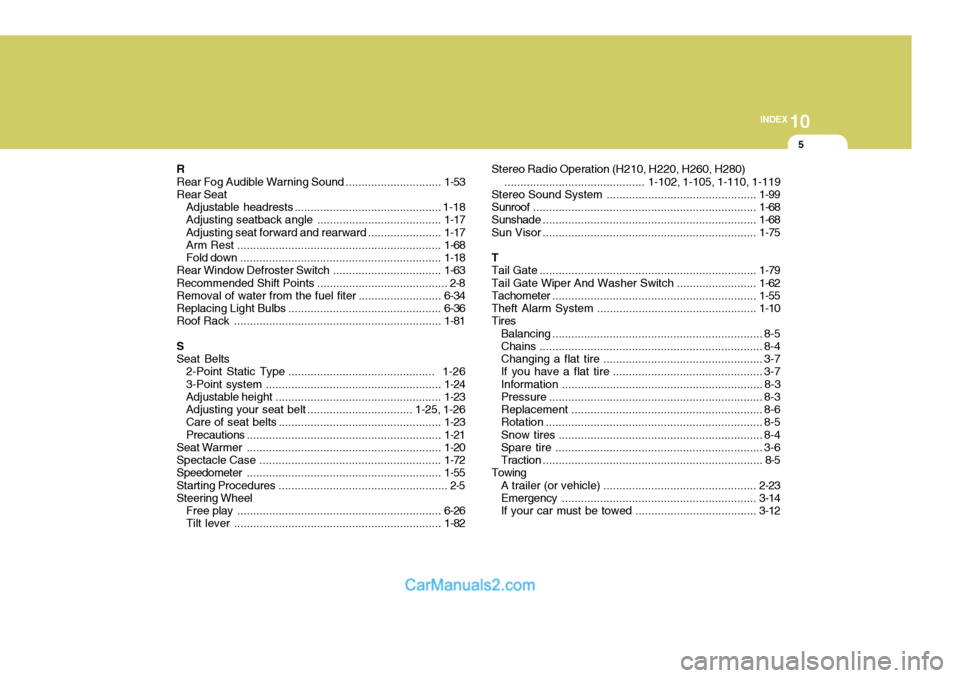
Towing
A trailer (or vehicle) ................................................ 2-23
Emergency ............................................................. 3-14
If your car must be towed ...................................... 3-12