maintenance Hyundai Matrix 2007 Repair Manual
[x] Cancel search | Manufacturer: HYUNDAI, Model Year: 2007, Model line: Matrix, Model: Hyundai Matrix 2007Pages: 490, PDF Size: 12.81 MB
Page 244 of 490

6 DO-IT-YOURSELF MAINTENANCE
40
G200E03FC
G200E03FC-GAT
(Diesel Engine)
NOTE: Not all fuse panel descriptions in this manual may be applicable to your vehicle. It is accurate at the time of printing. When you inspect the fuse box on your vehicle, refer to the fuse box label.
Page 245 of 490

6
DO-IT-YOURSELF MAINTENANCE
41
ALT B+
ECU RAD
IGN
BLR
P/WIN
COND ABSABS
F/PUMP ECU ECU
SNSR
ROOM LP DRL
HORN
A/CON
FR FOG ECU
LP
TAIL LH
TAIL RH H/LP LH
H/LP RH
PTC HTR 1
GLOW
PTC HTR 2 FFHS
PTC HTR 3 PROTECTED COMPONENTS
Generator (A/CON, RR HTD, STOP, D/LOCK, HAZARD) Fuse, Deicer Generator, Engine control relay, ECM Radiator fan relayStart relay, Ignition switchBlower relayPower window relayCondenser fan relay #1 ABS control module, ABS bleeding connector, ESP ABS control module, ABS bleeding connector, ESPFuel pump relayECM No.5 (Batt+)ECM No.4 (Batt+), Stop lamp switch, PTC heater relay #1Glow plug relay, Assistor heater relay 1/2, Stop lamp switch, TDC sensor, EGR act, Throttle plate act, VGT vacuum Audio, Room lamp, Overhead console lamp, lnstrument cluster, ETACM, Luggage lampDRL control moduleHorn relayA/C relayFront fog lamp relay ECM, TCM Tail lamp relayLeft rear combi lamp, Left position lamp, Left License lampRight rear combi lamp, Right position lamp, Right License lampLeft head lampRight head lamp, (H/LP IND) Fuse PTC heater relay #1 GLOW relayPTC heater relay #2FFHS relayPTC heater relay #3
FUSE RATING
140A40A30A30A40A40A 30A 30A40A40A10A30A 10A 15A 10A 15A10A10A 15A 10A20A10A10A15A 15A 40A80A40A30A40A
FUSE
FUSIBLE LINK DESCRIPTION
Page 246 of 490
6 DO-IT-YOURSELF MAINTENANCE
42
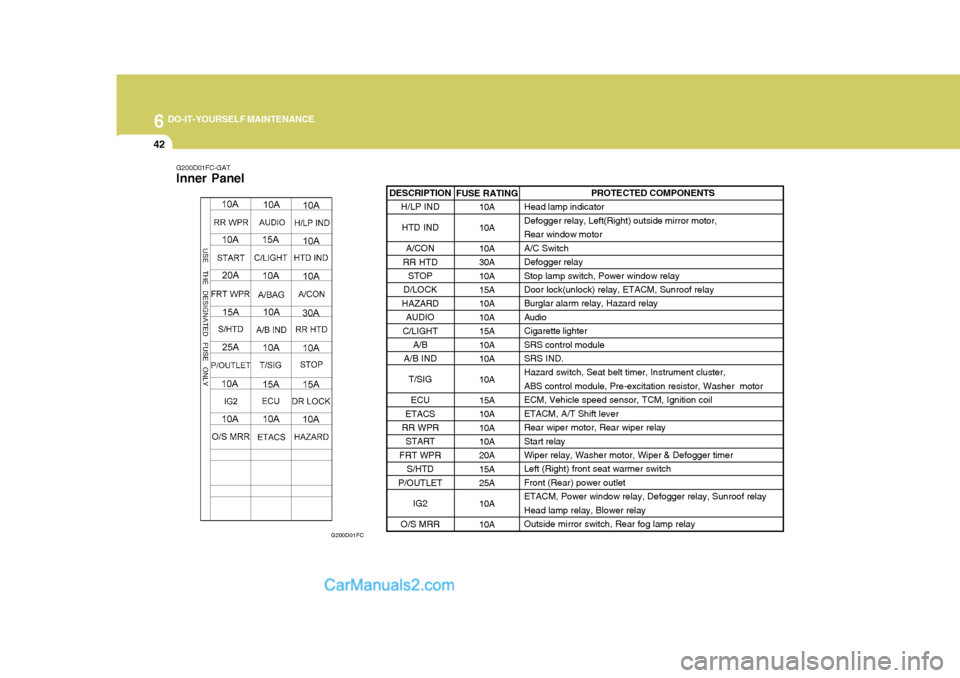
G200D01FC-GAT Inner Panel
G200D01FC
DESCRIPTIONH/LP IND
HTD IND
A/CON
RR HTD STOP
D/LOCK
HAZARD AUDIO
C/LIGHT A/B
A/B IND
T/SIG
ECU
ETACS
RR WPR
START
FRT WPR S/HTD
P/OUTLET
IG2
O/S MRRPROTECTED COMPONENTS
Head lamp indicator Defogger relay, Left(Right) outside mirror motor,Rear window motorA/C SwitchDefogger relayStop lamp switch, Power window relay Door lock(unlock) relay, ETACM, Sunroof relay Burglar alarm relay, Hazard relayAudioCigarette lighterSRS control moduleSRS IND. Hazard switch, Seat belt timer, Instrument cluster, ABS control module, Pre-excitation resistor, Washer motorECM, Vehicle speed sensor, TCM, Ignition coilETACM, A/T Shift leverRear wiper motor, Rear wiper relayStart relay Wiper relay, Washer motor, Wiper & Defogger timer Left (Right) front seat warmer switchFront (Rear) power outletETACM, Power window relay, Defogger relay, Sunroof relayHead lamp relay, Blower relayOutside mirror switch, Rear fog lamp relay
FUSE RATING
10A 10A 10A 30A10A15A 10A 10A15A10A10A 10A 15A 10A10A 10A 20A15A25A 10A 10A
Page 248 of 490

7EMISSION CONTROL SYSTEMS
2EMISSION CONTROL SYSTEMS
H010A01A-GAT
(If Installed)
Your Hyundai is equipped with an
emission control system to meet all requirements of the Emission prohibi- tion rules of your province.
There are three emission control sys-
tems which are as follows.
(1) Crankcase emission control sys- tem
(2) Evaporative emission control sys- tem
(3) Exhaust emission control system
In order to assure the proper function
of the emission control systems, it is recommended that you have your carinspected and maintained by an au- thorized Hyundai dealer in accordance with the maintenance schedule in thismanual. H010B01A-AAT
1. Crankcase Emission Control
System
The positive crankcase ventilation
system is employed to prevent airpollution caused by blow-by gasesbeing emitted from the crankcase. This system supplies fresh filtered air to the crankcase through the air in-take hose. Inside the crankcase, the fresh air mixes with blow-by gases, then passes through the PCV valveinto the induction system.
H010C01E-GAT
2. Evaporative Emission Control
System
The Evaporative Emission Control
System is designed to prevent fuel vapors from escaping into the atmo- sphere. Canister
While the engine is inoperative, fuel
vapors generated inside the fuel tank are absorbed and stored in the canis- ter. When the engine is running, thefuel vapors absorbed in the canister are drawn into the induction system through the purge control solenoidvalve. Purge Control Solenoid Valve (PCSV)
The purge control solenoid valve is
controlled by the Engine Control Mod- ule (ECM); when the engine coolant temperature is low during idling, the PCSV closes so that evaporated fuelis not taken into the engine. After the engine warms-up during ordinary driv- ing, the PCSV opens so as to intro-duce evaporated fuel to the engine.
H010D01A-AAT
3. Exhaust Emission Control
System
The Exhaust Emission Control Sys-
tem is a highly effective system which controls exhaust emissions while maintaining good vehicle performance.
Page 265 of 490

10INDEX
4
Heating and VentilationAir flow control ........................................................ 1-85
Air intake control .................................................... 1-87
Bi-level heating ....................................................... 1-88
Fan speed control ................................................... 1-84
Heating controls ...................................................... 1-87
Temperature control ................................................ 1-84
High-mounted Rear Stoplight .....................................1-76
Hood Release ............................................................ 1-76
Horn ........................................................................... 1-82
I Ignition Sw itch ............................................................. 2-3
Immobilizer S ystem ..................................................... 1-5
Instrument Cluster and Indicator .................. 1-44 ~ 1-47
Interior Light Interior light ............................................................. 1-71
Map light ................................................................. 1-71
Intermittent Wiper ...................................................... 1-62
J Jump Starting .............................................................. 3-3
K
Keys ............................................................................ 1-4 If you lose your keys ............................................. 3-15
Positions ................................................................... 2-4 L Lubrication Chart
.......................................................... 9-4
Luggage Net .............................................................. 1-80
MMaintenance Intervals Explanation of scheduled maintenance items .......... 5-8Maintenance under severe usage conditions ............ 5-7
Scheduled maintenance .................................. 5-4 ~ 5-6
Service requirements ................................................ 5-2
Mirror
Day-night inside rearview ....... .................................1-75
Outside rearvi ew ..................................................... 1-73
Multi Box ................................................................... 1-72
O
Odometer ................................................................... 1-56
Outside Rearview Mirror Heater................................. 1-74
PParking Brake ............................................................ 1-68
Power Outlet .............................................................. 1-66
Power Steering Fluid Level ....................................... 6-32
Pre-tensioner Seat Belt ............................................. 1-35
Page 270 of 490

F1
The information in this Owner's Manual is current at the time of publication. However, the right to amend specifications witho
ut
notice or obligation to incorporate such amendments into vehicles already produced is reserved. This manual applies to all markets and includes descriptions and explanations of optional as well as standard equipment. As a result, some of the equipment operating descriptions referred to may not apply to the particular vehicle with which this manual is supplied. Please refer to the nearest franchised Hyundai authorised repairer for information regarding current standard and optional equipment levels.
HFC001-2D SA010A1-E
OWNER'S MANUAL
Operation
Maintenance
Specifications
fcuk-0.p65 12/27/2006, 10:10 AM
1
Page 271 of 490
F2
Responsibilty For Maintenance
It is the responsibility of the vehicle owner/driver to ensure that all routine mainte- nance services are undertaken in line with the recommendations specified in Section 5 of this manual. In addition, in order to ensure continued validity of the new vehiclewarranty and safe operation of the vehicle, non scheduled maintenance/running repairs should be undertaken at the earliest available opportunity. Under severe operating conditions, more frequent maintenance is required. Detailsof the maintenance schedule for such conditions are also given in section 5. It is recommended that all maintenance operations and repairs are entrusted to a franchised Hyundai authorised repairer to ensure that the latest repair methods,specialised tooling and genuine Hyundai parts are used to ensure the continued reliability and safety of the vehicle.
SA020A1-E
fcuk-0.p65
12/27/2006, 10:10 AM
2
Page 272 of 490
F3
SA030A1-E
FOREWORD
Hyundai Motor Company wish to take this opportunity to thank you for purchasing a Hyundai product and to welcome you to the ever increasing number of discriminating motorists who drive Hyundai vehicles. The advanced engineering and construction methods employed during both design and production of the Hyundaimarque are something of which we are proud, and this commitment to providing a high quality product is supported by a comprehensive after sales and warranty service of which we are equally proud. This owners manual will introduce the operating and maintenance requirements for the vehicle and it is recommended that it is carefully read to ensure that the maximum performance and durability along with safe and satisfactory operation are obtained. The recommended routine maintenance servicing along with anyrunning repairs that may be required should be entrusted to a franchised Hyundai authorised repairer ensure that only the latest methods and genuine Hyundai replacement parts are used for the continued reliability, safety and performance of the vehicle. Should any question or query exist regarding any aspect of your Hyundai please contact the nearest Hyundai authorised repairer who will be only too pleased to assist wherever possible. Note: This owners manual should be considered as part of the vehicle and should be kept in the vehicle at
all times for ease of reference. In the event of the vehicle being sold please ensure that this manual is left in the vehicle for the reference of the new owner.
CAUTION:
Severe engine and transaxle damage may result from the use of poor quality fuels and lubricants that do not meet Hyundai specifications. You must always use high quality fuels and lubricants that meet the specifications listed on Page 9-4 in the Vehicle Specifications section of the Owner's Manual. Copyright 2006 Hyundai Motor Company. All rights reserved. No part of this publication may be reproduced, stored in any retrieval system or transmitted in any form or by any means without the prior written permissionof Hyundai Motor Company.
!
fcuk-0.p65 12/27/2006, 10:10 AM
3
Page 274 of 490
F5
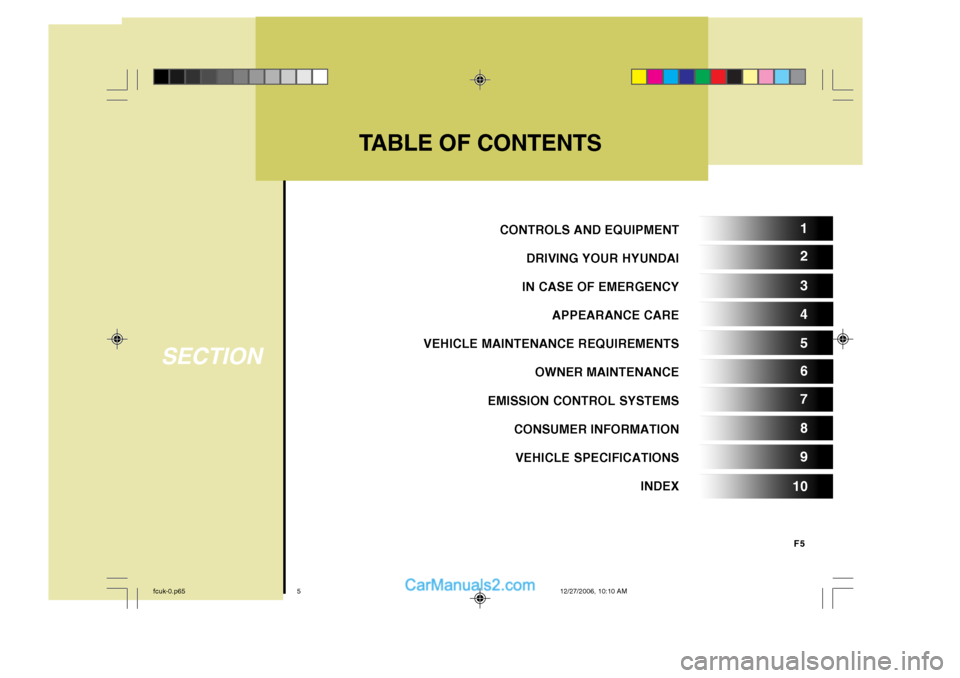
CONTROLS AND EQUIPMENT
DRIVING YOUR HYUNDAI
IN CASE OF EMERGENCY
APPEARANCE CARE
VEHICLE MAINTENANCE REQUIREMENTS OWNER MAINTENANCE
EMISSION CONTROL SYSTEMS CONSUMER INFORMATIONVEHICLE SPECIFICATIONS
INDEX
TABLE OF CONTENTS
SECTION
5
1 2 3 4 6 7 8 9
10
fcuk-0.p65 12/27/2006, 10:10 AM
5
Page 317 of 490
1CONTROLS AND EQUIPMENT
38
!
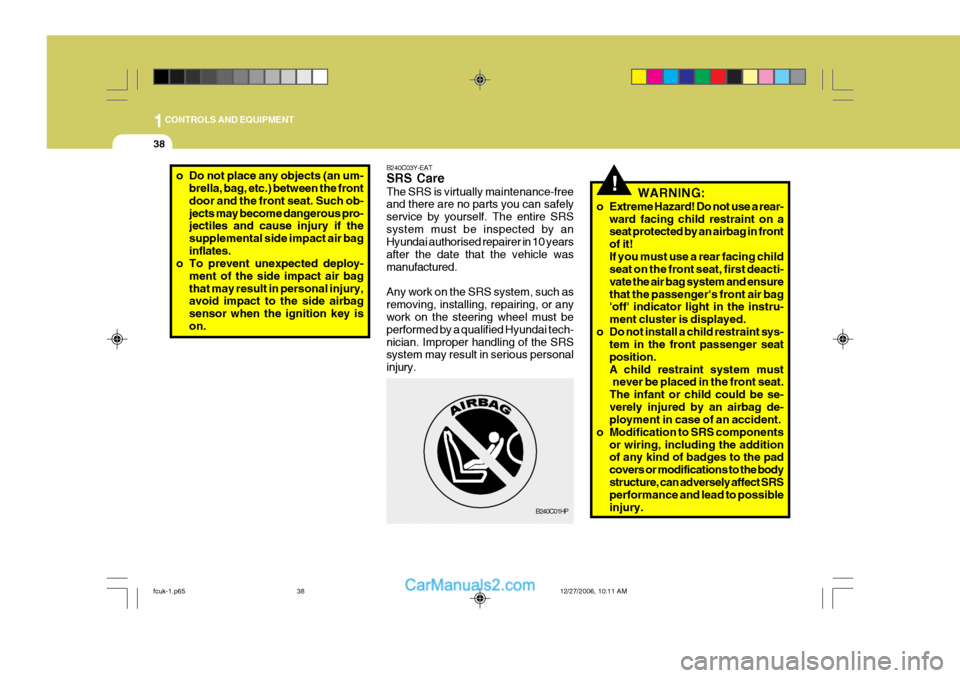
B240C03Y-EAT SRS Care The SRS is virtually maintenance-free and there are no parts you can safely service by yourself. The entire SRSsystem must be inspected by an Hyundai authorised repairer in 10 years after the date that the vehicle wasmanufactured. Any work on the SRS system, such as removing, installing, repairing, or any work on the steering wheel must be performed by a qualified Hyundai tech-nician. Improper handling of the SRS system may result in serious personal injury.
B240C01HP WARNING:
o Extreme Hazard! Do not use a rear- ward facing child restraint on a seat protected by an airbag in front of it!If you must use a rear facing child seat on the front seat, first deacti- vate the air bag system and ensurethat the passenger's front air bag 'off' indicator light in the instru- ment cluster is displayed.
o Do not install a child restraint sys- tem in the front passenger seatposition.A child restraint system must
never be placed in the front seat. The infant or child could be se-verely injured by an airbag de- ployment in case of an accident.
o Modification to SRS components or wiring, including the additionof any kind of badges to the pad covers or modifications to the bodystructure, can adversely affect SRS performance and lead to possible injury.
o Do not place any objects (an um-
brella, bag, etc.) between the frontdoor and the front seat. Such ob-jects may become dangerous pro- jectiles and cause injury if the supplemental side impact air baginflates.
o To prevent unexpected deploy-
ment of the side impact air bagthat may result in personal injury, avoid impact to the side airbag sensor when the ignition key ison.
fcuk-1.p65 12/27/2006, 10:11 AM
38