power steering Hyundai Nexo 2019 Owner's Guide
[x] Cancel search | Manufacturer: HYUNDAI, Model Year: 2019, Model line: Nexo, Model: Hyundai Nexo 2019Pages: 560, PDF Size: 24.2 MB
Page 350 of 560
5-84
Driving your vehicle
LKA system failure indicator
The LKA system failureindicator (y ellow) will illu-
minate if the LKA system
is not working properly.
Have your vehicle checked
by an authorized HYUNDAI
dealer.
When there is a problem with the
system do one of the following:
Turn the system on after turning the vehicle off and on again.
Check if the POWER button is in the ON position.
Check if the system is affected by the weather. (ex: fog, heavy rain,
etc.)
Check if there is foreign matter on the camera lens.
If the problem is not solved, have
your vehicle checked by an author-
ized HYUNDAI dealer.
The LKA system will not be in the
ENABLED state and/or the steering
wheel will not be assisted when:
The turn signal is turned on before changing a lane. If you change
lanes without the turn signal on, the
steering wheel might be controlled.
The vehicle is not driven in the mid- dle of the lane when the system is
turned on or right after changing a
lane.
ESC (Electronic Stability Control) or VSM (Vehicle Stability Management)
is activated.
The vehicle is driven on a sharp curve.
Vehicle speed is below 35 mph (56 km/h) and over 110 mph (177
km/h).
The vehicle makes sharp lane changes.
The vehicle brakes suddenly.
The lane is very wide or narrow.
There are more than two lane lines on the road. (e.g. construction area)
Only one side of the lane marker is detected. Radius of a curve is too small.
The vehicle is driven on a steep
incline.
The steering wheel is turned sud- denly.
Page 384 of 560
5-118
Driving your vehicle
Hazardous Driving Conditions
When hazardous driving elements
are encountered such as water,
snow, ice, mud and sand, take the
bellow suggestions:
Drive cautiously and keep a longerbraking distance.
Avoid abrupt braking or steering.
When your vehicle is stuck in snow, mud, or sand, use second gear.
Accelerate slowly to avoid unnec-
essary wheel spin.
Put sand, rock salt, tire chains or other non-slip materials under the
wheels to provide additional trac-
tion while the vehicle becomes
stuck in ice, snow, or mud.
Rocking the Vehicle
If it is necessary to rock the vehicle
to free it from snow, sand, or mud,
first turn the steering wheel right and
left to clear the area around your
front wheels. Then, shift back and
forth between R (Reverse) and a for-
ward gear.
Try to avoid spinning the wheels, and
do not race the vehicle.
To prevent reduction gear wear, wait
until the wheels stop spinning before
shifting gears. Release the accelera-
tor pedal while shifting, and press
lightly on the accelerator pedal while
the reduction gear is in gear. Slowly
spinning the wheels in forward and
reverse directions causes a rocking
motion that may free the vehicle.
S SP
P E
EC
CI
IA
A L
L
D
D R
RI
IV
V I
IN
N G
G
C
C O
O N
ND
DI
IT
T I
IO
O N
NS
S
If the vehicle is stuck and
excessive wheel spin occurs,
the temperature in the tires can
increase very quickly. If the tires
become damaged, a tire blow
out or tire explosion can occur.
This condition is dangerous -
you and others may be injured.
Do not attempt this procedure if
people or objects are anywhere
near the vehicle.
If you attempt to free the vehi-
cle, the vehicle can overheat
quickly, possibly causing an
fuel cell power module com-
partment fire or other damage.
Try to avoid spinning the
wheels as much as possible to
prevent overheating of either
the tires or the vehicle. DO NOT
allow the vehicle to spin the
wheels above 56 km/h (35 mph).
WARNING
Page 391 of 560
5-125
Driving your vehicle
5
Use approved window washeranti-freeze in system
To keep the water in the window
washer system from freezing, add an
approved window washer anti-freeze
solution in accordance with instruc-
tions on the container. Window wash-
er anti-freeze is available from an
authorized HYUNDAI dealer and
most auto parts outlets. Do not use
coolant or other types of anti-freeze
as these may damage the paint fin-
ish.
Do not let your parking brakefreeze
Under some conditions your parking
brake can freeze in the engaged
position. This is most likely to happen
when there is an accumulation of
snow or ice around or near the rear
brakes or if the brakes are wet. If
there is a risk the parking brake may
freeze, apply it only temporarily while
you shift to P (Park) and block the
rear wheels so the car cannot roll.
Then release the parking brake.
Do not let ice and snow accu-mulate underneath
Under some conditions, snow and
ice can build up under the fenders
and interfere with the steering. When
driving in severe winter conditions
where this may happen, you should
periodically check underneath the
car to be sure the movement of the
front wheels and the steering com-
ponents is not obstructed.
Don't place foreign objects ormaterials in the fuel cell powermodule compartment
Placement of foreign object or mate-
rials which prevent cooling of the
vehicle, in the fuel cell power module
compartment, may cause a failure.
The manufacturer is not responsible
for the damage caused by such
placement.
To keep locks from freezing
To keep the locks from freezing,
squirt an approved de-icer fluid or
glycerine into the key opening. If a
lock is covered with ice, squirt it with
an approved de-icing fluid to remove
the ice. If the lock is frozen internally,
you may be able to thaw it out by
using a heated key. Handle the heat-
ed key with care to avoid injury.
Page 423 of 560

6-26
Emergency Towing
If towing is necessary, we recom-
mend you have it done by an author-
ized HYUNDAI dealer or a commer-
cial tow truck service.
If towing service is not available in an
emergency, your vehicle may be
temporarily towed using a cable or
chain secured to the emergency tow-
ing hook at the front (or rear) of the
vehicle.
Use extreme caution when towing
the vehicle with a cable or chain. A
driver must be in the vehicle to steer
it and operate the brakes.
Towing in this manner may be done
only on hard-surfaced roads for a
short distance and at low speeds.
Also, the wheels, axles, power train,
steering and brakes must all be in
good condition.Always follow these emergency tow-
ing precautions:
While depressing the brake pedal
shift to the N (Neutral) position and
turn the vehicle off. The POWER
button will be in the ACC position.
Release the parking brake.
Depress the brake pedal with more force than normal since you will
have reduced braking perform-
ance.
More steering effort will be required because the power steer-
ing system will be disabled.
Use a vehicle heavier than your own to tow your vehicle.
The drivers of both vehicles should communicate with each other fre-
quently.
Before emergency towing, check that the hook is not broken or dam-
aged.
Fasten the towing cable or chain securely to the hook.
Do not jerk the hook. Apply steady and even force. Use a towing cable or chain less
than 16 feet (5 m) long. Attach a
white or red cloth (about 12 inch
(30 cm) wide) in the middle of the
cable or chain for easy visibility.
Drive carefully so the towing cable or chain remains tight during tow-
ing.
Before towing, check the reduction gear for fluid leaks under your vehi-
cle. If the reduction gear is leaking,
flatbed equipment or a towing dolly
must be used.
What to do in an emergency
OFE068022
Page 430 of 560
7-6
Maintenance
Owner maintenance schedule
When you stop for fuel:
• Check for both fuel cell stack andDevice cooling coolant level in
coolant reservoir.
Check the windshield washer fluid level.
Look for low or under-inflated tires.
While operating your vehicle:
Check for vibrations in the steering wheel. Notice if there is any
increased steering effort or loose-
ness in the steering wheel, or
change in its straight-ahead posi-
tion.
Notice if your vehicle constantly turns slightly or "pulls" to one side
when traveling on smooth, level
road.
When stopping, listen and check for unusual sounds, pulling to one
side, increased brake pedal travel
or "hard-to-push" brake pedal.
If any slipping or changes in the operation of your reduction gear
occurs, check the reduction gear
fluid level.
Check the reduction gear P (Park) function.
Check the parking brake.
Check for fluid leaks under your vehicle (water dripping from the air
conditioning system during or after
use is normal).
At least monthly:
Check coolant level in the coolantreservoir.
Check the operation of all exterior lights, including the brake lights,
turn signals and hazard warning
flashers.
Check the inflation pressures of all tires that are worn, show uneven
wear, or are damaged.
Check for loose wheel lug nuts.
At least twice a year: (i.e., every Spring and Fall)
Check radiator, heater and air con-
ditioning hoses for leaks or dam-
age.
Check windshield washer spray and wiper operation. Clean wiper
blades with clean cloth dampened
with washer fluid.
Check headlamp alignment.
Check the seat belts for wear and function.
Be careful when checking the
coolant level when the fuel cell
power module is hot. Scalding
hot coolant and steam may
blow out under pressure. This
could cause burns or other seri-
ous injury.
WARNING
Page 519 of 560
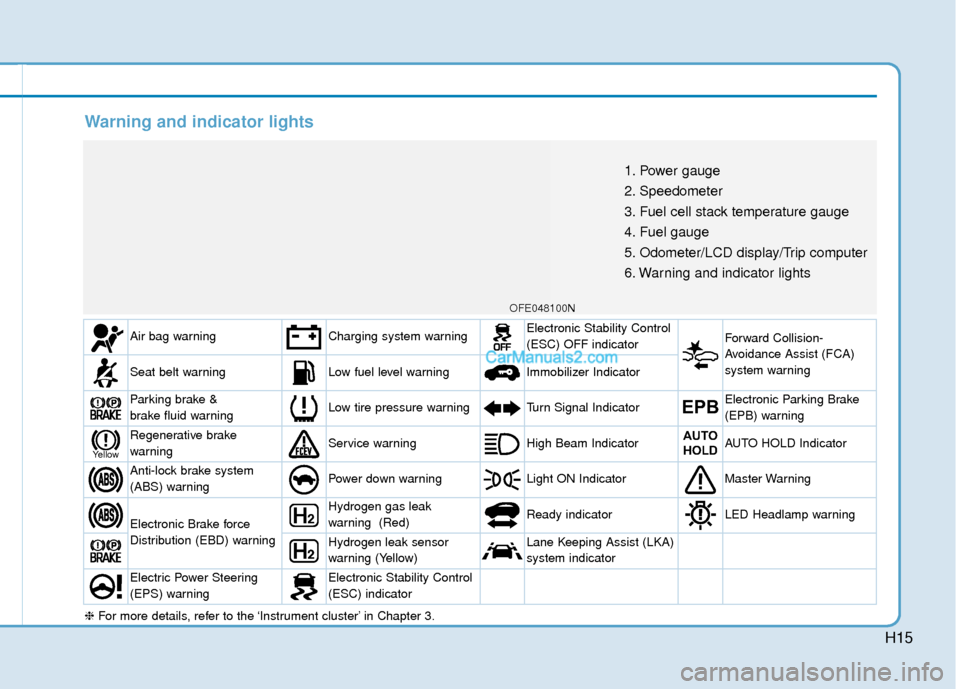
H15
Warning and indicator lights
OFE048100N
1. Power gauge
2. Speedometer
3. Fuel cell stack temperature gauge
4. Fuel gauge
5. Odometer/LCD display/Trip computer
6. Warning and indicator lights
Air bag warningCharging system warningElectronic Stability Control
(ESC) OFF indicator Forward Collision-
Avoidance Assist (FCA)
system warning
Seat belt warningLow fuel level warning Immobilizer Indicator
Parking brake &
brake fluid warningLow tire pressure warningTurn Signal IndicatorEPBElectronic Parking Brake
(EPB) warning
Regenerative brake
warningService warning High Beam IndicatorAUTO
HOLDAUTO HOLD Indicator
Anti-lock brake system
(ABS) warningPower down warning Light ON IndicatorMaster Warning
Electronic Brake force
Distribution (EBD) warning
Hydrogen gas leak
warning (Red) Ready indicatorLED Headlamp warning
Hydrogen leak sensor
warning (Yellow)Lane Keeping Assist (LKA)
system indicator
Electric Power Steering
(EPS) warningElectronic Stability Control
(ESC) indicator
Yellow
❈ For more details, refer to the ‘Instrument cluster’ in Chapter 3.
Page 553 of 560
I-4
Driver Assist System.....................................................3-104Parking Distance Warning (Reverse/Forward) System ...................................................................3-104\
Rear View Monitor ...................................................3-108
Surround View Monitoring ......................................3-109
Driver Attention Warning (DAW) System......................5-94 System Setting and Activation ...................................5-94
Resetting the System ..................................................5-95
System Standby ..........................................................5-96
System Malfunction ...................................................5-96
Electric Power Steering (EPS) ........................................3-20
Electronic Parking Brake (EPB) .....................................5-19
Electronic Stability Control (ESC) .................................5-31
Emergency Fuel Filler Door Release..............................3-57
Explanation of scheduled maintenance items.................7-12
Exterior Care ...................................................................7-62
Exterior Features .............................................................3-42 Hood ........................................................................\
...3-42
Non-Powered Liftgate ................................................3-43
Power Liftgate ............................................................3-45
Smart Liftgate.............................................................3-51
Fuel Filler Door ..........................................................3-55
Emergency Fuel Filler Door Release .........................3-57 Exterior Features ...........................................................3-175
Roof Side Rails ........................................................3-175
Exterior Lights ................................................................3-89
Exterior Overview.............................................................1-2
Features of FCEV............................................................H10 How to Start the Vehicle .............................................H10
How to Stop the Vehicle .............................................H11
Virtual Engine Sound System .....................................H11
Fuel filler door ............................................................H12
Warning and indicator lights.......................................H15
LCD Display Messages ..............................................H16
FCEV mode ................................................................H21
When the high voltage battery is weak ......................H25
If the 12 volt battery is discharged .............................H25
Emergency while driving............................................H26
Floor Mat Anchor(s) .....................................................3-171
Forward Collision-avoidance Assist (FCA) System.......5-39 System Setting and Activation ...................................5-39
FCA Warning Message and System Control..............5-41
FCA Sensor (Front Radar/Front View Camera).........5-44
System Malfunction ...................................................5-46
Limitations of the System ..........................................5-47
Index
E
F
Page 554 of 560

I-5
Front Seats ........................................................................\
2-6
Front Windshield Washers ............................................3-102
Front Windshield Wipers ..............................................3-101
Fuel Cell Power Module Compartment ............................1-6
Fuel cell power module compartment ..............................7-3
Fuel Filler Door ..............................................................3-55
Fuel cell stack....................................................................H4
Fuses ........................................................................\
.......7-45Instrument Panel Fuse Replacement ..........................7-46
Fuel cell power module compartment Panel Fuse Replacement .........................................7-47
Fuse/Relay Panel Description ....................................7-49
Glove Box .....................................................................3-1\
62
Good Braking Practices ..................................................5-36
Hazard Warning Flasher ...................................................6-2
Head Restraints ...............................................................2-13
Heated Steering Wheel ...................................................3-22
High pressure hydrogen storage tanks ..............................H5
Hill-Start Assist Control (HAC) .....................................5-36
Hood........................................................................\
........3-42
Horn ........................................................................\
........3-21 If the 12 Volt Battery is Discharged .................................6-5
Before Jump Starting....................................................6-5
Jump Starting................................................................6-6
If the Vehicle Overheats....................................................6-9
If the Vehicle Will Not Start .............................................6-4
If You Have a Flat Tire (With Tire Mobility Kit)...........6-17
Immobilizer System ..........................................................3-9
Important Safety Precautions............................................2-2 Always Wear Your Seat Belt ........................................2-2
Restrain All Children....................................................2-2
Air Bag Hazards ...........................................................2-2
Driver Distraction.........................................................2-2
Control Your Speed ......................................................2-3
Keep Your Vehicle in Safe Condition ..........................2-3
In Case of an Emergency While Driving .........................6-2 If an accident occurs...................................................\
..6-2
If a fire occurs ..............................................................6-3
Emergency venting of hydrogen gas ............................6-3
If a submersion in water occurs ...................................6-3
If the vehicle stalls at a crossroad or crossing .............6-3
If you have a flat tire while driving .............................6-4
If the vehicle stalls while driving .................................6-4
Inside Rearview Mirror...................................................3-23
I
Index
G
H
I
Page 556 of 560

I-7
Lighting ........................................................................\
...3-89Exterior Lights............................................................3-89
Welcome System ........................................................3-99
Luggage Net Holder .....................................................3-172
Maintenance services ........................................................7-4 Owner's Responsibility.................................................7-4
Owner Maintenance Precautions..................................7-4
Mirrors ........................................................................\
....3-23 Inside Rearview Mirror ..............................................3-23
Side View Mirrors ......................................................3-31
Motor Number ..................................................................8-8
Multimedia system............................................................4-2 USB and iPod
®port .....................................................4-2
Antenna ........................................................................\
4-2
Steering wheel audio controls ......................................4-3
Bluetooth
®Wireless Technology..................................4-4
Audio/Video/Navigation system (AVN) ......................4-4
Non-Powered Liftgate.....................................................3-43 Occupant Classification System (OCS)..........................2-58
Owner maintenance ..........................................................7-5
Owner maintenance schedule .......................................7-6
Paddle Shifter (Regenerative Braking Control) .............5-17
Parking Distance Warning (Reverse/Forward) System .......................................................................3\
-104
Power Brakes ..................................................................5-18
Power Button ....................................................................5-6 POWER Button Positions ............................................5-7
Starting the Vehicle ......................................................5-9
Turning Off the Vehicle..............................................5-10
Power Liftgate.................................................................3-45
Power Outlet .................................................................3-165
Rear Cross-traffic Collision Warning (RCCW)/ Rear Cross-traffic Collision-avoidance Assist
(RCCA)........................................................................\
5-67
System Description ....................................................5-67
System Setting and Activation ...................................5-68
Warning and System Control .....................................5-69
Limitations of the System ..........................................5-73
I
Index
M
N
O
P
R
Page 558 of 560
I-9
Smart Cruise Control Vehicle-to-Vehicle Distance ..5-105
Sensor to Detect Distance to the Vehicle Ahead ......5-108
Limitations of the System ........................................5-110
Smart Key ........................................................................\
.3-3
Smart Liftgate .................................................................3-51
Snow Tires ......................................................................7-\
42
Special Driving Conditions ...........................................5-118 Hazardous Driving Conditions .................................5-118
Rocking the Vehicle..................................................5-118
Smooth Cornering ....................................................5-119
Driving at Night........................................................\
5-119
Driving in the Rain ...................................................5-119
Driving in Flooded Areas .........................................5-120
Highway Driving ......................................................5-120
Reducing the Risk of a Rollover ..............................5-121
Stack cooling coolant ......................................................7-16 Checking the Coolant Level .......................................7-16
Changing Coolant.......................................................7-18
Steering Wheel ................................................................3-20 Electric Power Steering (EPS) ...................................3-20
Tilt Steering/Telescope Steering.................................3-21
Horn ........................................................................\
....3-21
Heated Steering Wheel ...............................................3-22
Storage Compartment ...................................................3-162 Center Console Storage ............................................3-162
Glove Box ................................................................3-162 Sunroof........................................................................\
....3-37
Sunroof Opening and Closing ....................................3-38
Sliding the Sunroof ....................................................3-38
Tilting the Sunroof .....................................................3-39
Sunshade.....................................................................3-3\
9
Resetting the Sunroof .................................................3-40
Sunroof Open Warning...............................................3-41
Sunvisor ........................................................................\
3-164
Surround View Monitoring ...........................................3-109
The components of FCEV.................................................H3 FCEV system module ...................................................H4
High pressure hydrogen storage tanks..........................H5
Battery system ..............................................................H5
Theft-Alarm System .......................................................3-19
Tilt Steering/Telescope Steering .....................................3-21
Tire Pressure Monitoring System (TPMS) .....................6-11 Check Tire Pressure ....................................................6-11
Tire Pressure Monitoring System...............................6-12
Low Tire Pressure Telltale..........................................6-13
Low Tire Pressure LCD Display with Position Indicator ..................................................................6-13
TPMS Malfunction Indicator .....................................6-14
Changing a Tire with TPMS ......................................6-15
Tire Specification and Pressure Label ..............................8-8
I
Index
T