ESP Hyundai Nexo 2019 Repair Manual
[x] Cancel search | Manufacturer: HYUNDAI, Model Year: 2019, Model line: Nexo, Model: Hyundai Nexo 2019Pages: 560, PDF Size: 24.2 MB
Page 487 of 560
7-63
7
Maintenance
After washing, rinse the vehicle thor-
oughly with lukewarm or cold water.
Do not allow soap to dry on the fin-
ish. Do not use strong soap, chemi-
cal detergents or hot water, and
do not wash the vehicle in direct
sunlight or when the body of the
vehicle is warm.
Be careful when washing the side windows of your vehicle.
Especially, with high-pressure
water, water may leak through
the windows and wet the interi-
or.
To prevent damage to the plastic parts, do not clean with chemi-
cal solvents or strong deter-
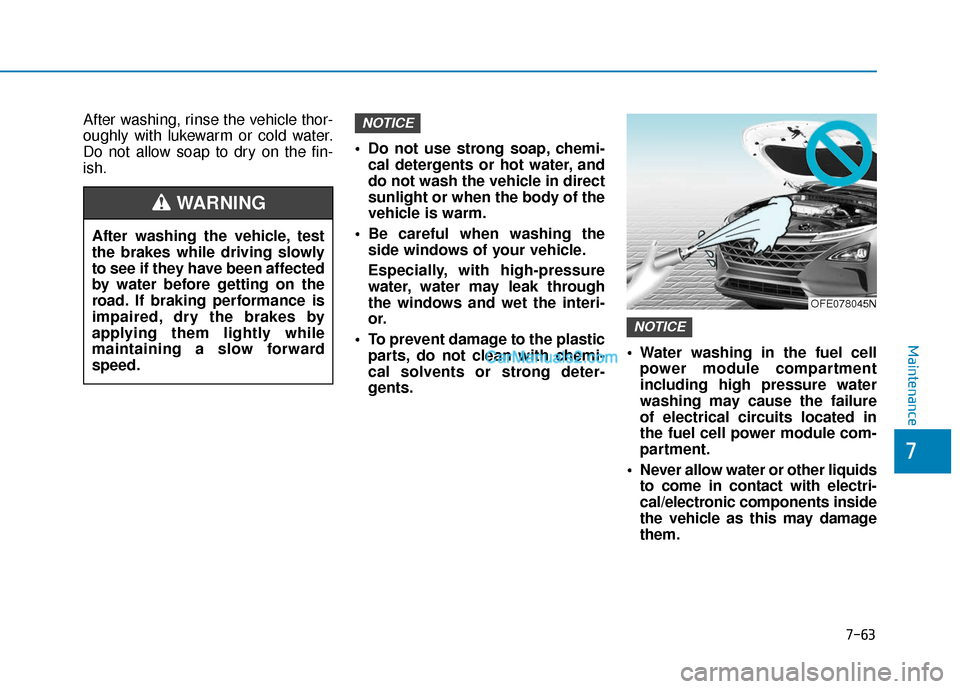
gents. Water washing in the fuel cell
power module compartment
including high pressure water
washing may cause the failure
of electrical circuits located in
the fuel cell power module com-
partment.
Never allow water or other liquids to come in contact with electri-
cal/electronic components inside
the vehicle as this may damage
them.
NOTICE
NOTICE
OFE078045N
After washing the vehicle, test
the brakes while driving slowly
to see if they have been affected
by water before getting on the
road. If braking performance is
impaired, dry the brakes by
applying them lightly while
maintaining a slow forward
speed.
WARNING
Page 518 of 560
H14
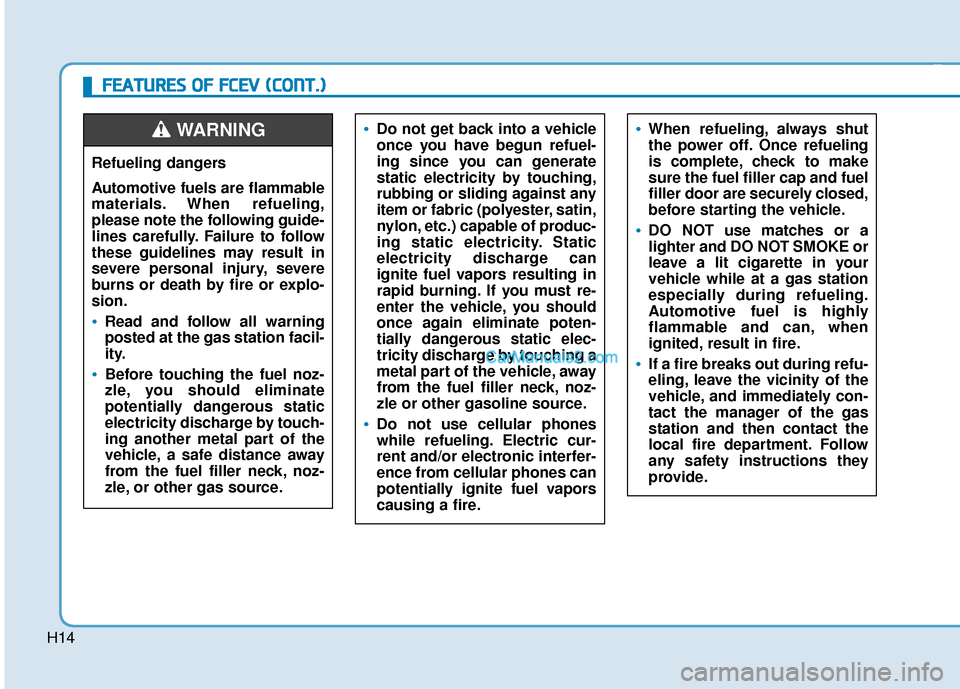
Do not get back into a vehicle
once you have begun refuel-
ing since you can generate
static electricity by touching,
rubbing or sliding against any
item or fabric (polyester, satin,
nylon, etc.) capable of produc-
ing static electricity. Static
electricity discharge can
ignite fuel vapors resulting in
rapid burning. If you must re-
enter the vehicle, you should
once again eliminate poten-
tially dangerous static elec-
tricity discharge by touching a
metal part of the vehicle, away
from the fuel filler neck, noz-
zle or other gasoline source.
Do not use cellular phones
while refueling. Electric cur-
rent and/or electronic interfer-
ence from cellular phones can
potentially ignite fuel vapors
causing a fire.
When refueling, always shut
the power off. Once refueling
is complete, check to make
sure the fuel filler cap and fuel
filler door are securely closed,
before starting the vehicle.
DO NOT use matches or a
lighter and DO NOT SMOKE or
leave a lit cigarette in your
vehicle while at a gas station
especially during refueling.
Automotive fuel is highly
flammable and can, when
ignited, result in fire.
If a fire breaks out during refu-
eling, leave the vicinity of the
vehicle, and immediately con-
tact the manager of the gas
station and then contact the
local fire department. Follow
any safety instructions they
provide.
F FE
E A
A T
TU
U R
RE
ES
S
O
O F
F
F
F C
C E
E V
V
(
( C
C O
O N
NT
T.
.)
)
Refueling dangers
Automotive fuels are flammable
materials. When refueling,
please note the following guide-
lines carefully. Failure to follow
these guidelines may result in
severe personal injury, severe
burns or death by fire or explo-
sion.
Read and follow all warning
posted at the gas station facil-
ity.
Before touching the fuel noz-
zle, you should eliminate
potentially dangerous static
electricity discharge by touch-
ing another metal part of the
vehicle, a safe distance away
from the fuel filler neck, noz-
zle, or other gas source.
WARNING
Page 546 of 560
H42
CategoryQuestionsAnswers
Fuel Cell
Stack/High VoltageBattery
(4 items)
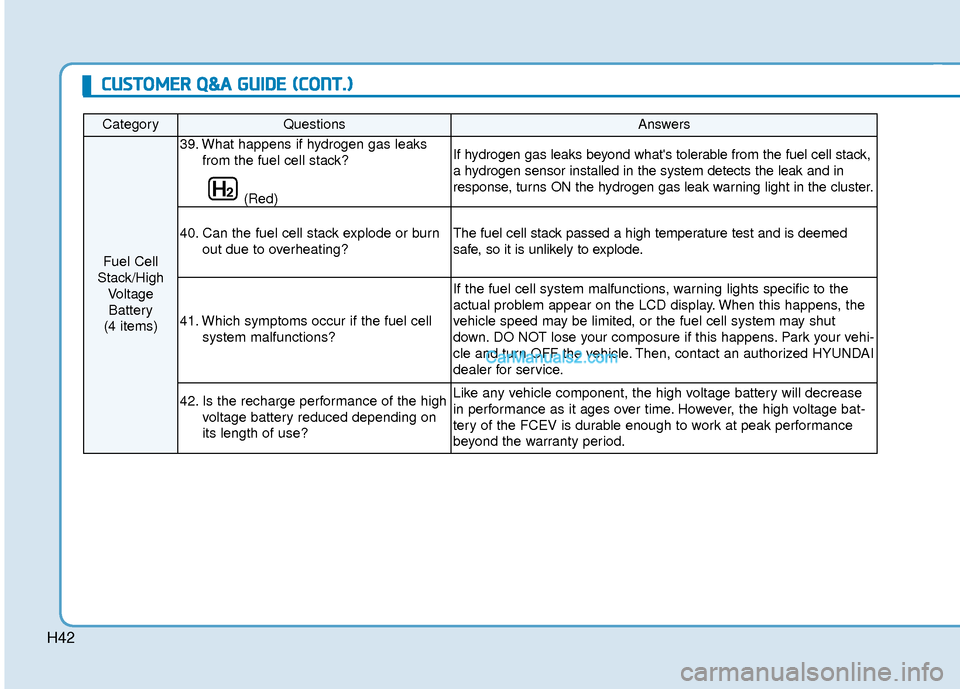
39. What happens if hydrogen gas leaks from the fuel cell stack?
(Red)If hydrogen gas leaks beyond what's tolerable from the fuel cell stack,
a hydrogen sensor installed in the system detects the leak and in
response, turns ON the hydrogen gas leak warning light in the cluster.
40. Can the fuel cell stack explode or burnout due to overheating?The fuel cell stack passed a high temperature test and is deemed
safe, so it is unlikely to explode.
41. Which symptoms occur if the fuel cellsystem malfunctions?
If the fuel cell system malfunctions, warning lights specific to the
actual problem appear on the LCD display. When this happens, the
vehicle speed may be limited, or the fuel cell system may shut
down. DO NOT lose your composure if this happens. Park your vehi-
cle and turn OFF the vehicle. Then, contact an authorized HYUNDAI
dealer for service.
42. Is the recharge performance of the highvoltage battery reduced depending on
its length of use? Like any vehicle component, the high voltage battery will decrease
in performance as it ages over time. However, the high voltage bat-
tery of the FCEV is durable enough to work at peak performance
beyond the warranty period.
C CU
U S
ST
T O
O M
M E
ER
R
Q
Q &
&A
A
G
G U
U I
ID
D E
E
(
( C
C O
O N
NT
T.
.)
)
Page 547 of 560
H43
CategoryQuestionsAnswers
Vehicle
Accidents/ Towing
(5 items)
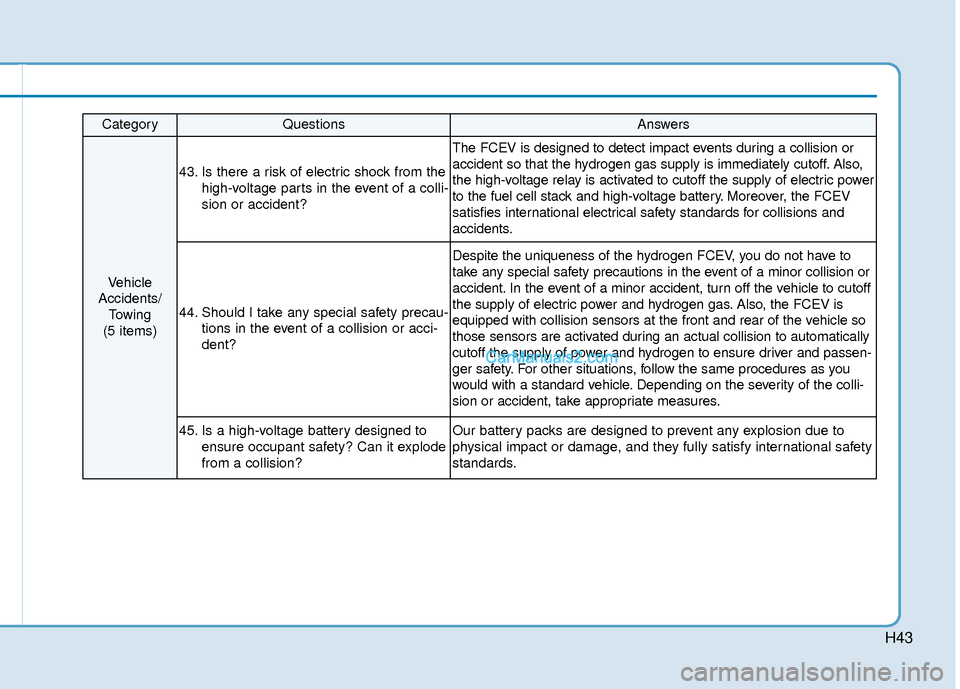
43. Is there a risk of electric shock from the high-voltage parts in the event of a colli-
sion or accident?
The FCEV is designed to detect impact events during a collision or
accident so that the hydrogen gas supply is immediately cutoff. Also,
the high-voltage relay is activated to cutoff the supply of electric power
to the fuel cell stack and high-voltage battery. Moreover, the FCEV
satisfies international electrical safety standards for collisions and
accidents.
44. Should I take any special safety precau-tions in the event of a collision or acci-
dent?
Despite the uniqueness of the hydrogen FCEV, you do not have to
take any special safety precautions in the event of a minor collision or
accident. In the event of a minor accident, turn off the vehicle to cutoff
the supply of electric power and hydrogen gas. Also, the FCEV is
equipped with collision sensors at the front and rear of the vehicle so
those sensors are activated during an actual collision to automatically
cutoff the supply of power and hydrogen to ensure driver and passen-
ger safety. For other situations, follow the same procedures as you
would with a standard vehicle. Depending on the severity of the colli-
sion or accident, take appropriate measures.
45. Is a high-voltage battery designed toensure occupant safety? Can it explode
from a collision?Our battery packs are designed to prevent any explosion due to
physical impact or damage, and they fully satisfy international safety
standards.
Page 556 of 560

I-7
Lighting ........................................................................\
...3-89Exterior Lights............................................................3-89
Welcome System ........................................................3-99
Luggage Net Holder .....................................................3-172
Maintenance services ........................................................7-4 Owner's Responsibility.................................................7-4
Owner Maintenance Precautions..................................7-4
Mirrors ........................................................................\
....3-23 Inside Rearview Mirror ..............................................3-23
Side View Mirrors ......................................................3-31
Motor Number ..................................................................8-8
Multimedia system............................................................4-2 USB and iPod
®port .....................................................4-2
Antenna ........................................................................\
4-2
Steering wheel audio controls ......................................4-3
Bluetooth
®Wireless Technology..................................4-4
Audio/Video/Navigation system (AVN) ......................4-4
Non-Powered Liftgate.....................................................3-43 Occupant Classification System (OCS)..........................2-58
Owner maintenance ..........................................................7-5
Owner maintenance schedule .......................................7-6
Paddle Shifter (Regenerative Braking Control) .............5-17
Parking Distance Warning (Reverse/Forward) System .......................................................................3\
-104
Power Brakes ..................................................................5-18
Power Button ....................................................................5-6 POWER Button Positions ............................................5-7
Starting the Vehicle ......................................................5-9
Turning Off the Vehicle..............................................5-10
Power Liftgate.................................................................3-45
Power Outlet .................................................................3-165
Rear Cross-traffic Collision Warning (RCCW)/ Rear Cross-traffic Collision-avoidance Assist
(RCCA)........................................................................\
5-67
System Description ....................................................5-67
System Setting and Activation ...................................5-68
Warning and System Control .....................................5-69
Limitations of the System ..........................................5-73
I
Index
M
N
O
P
R