Battery Hyundai Nexo 2019 Manual PDF
[x] Cancel search | Manufacturer: HYUNDAI, Model Year: 2019, Model line: Nexo, Model: Hyundai Nexo 2019Pages: 560, PDF Size: 24.2 MB
Page 536 of 560
H32
CategoryQuestionsAnswers
Vehicle
overview
(10 items)
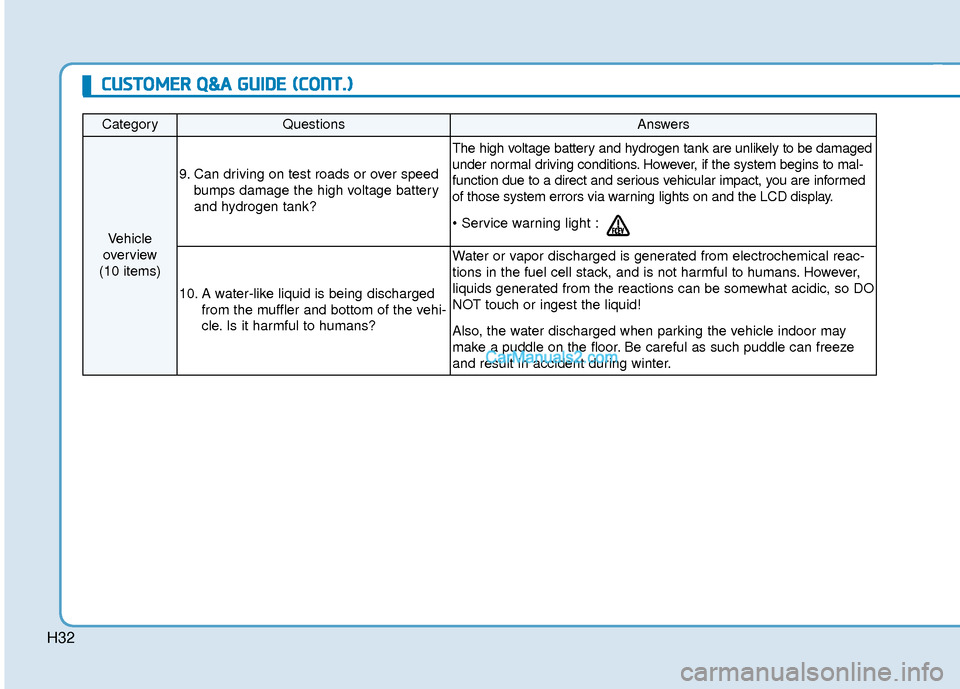
9. Can driving on test roads or over speed bumps damage the high voltage battery
and hydrogen tank?
The high voltage battery and hydrogen tank are unlikely to be damaged
under normal driving conditions. However, if the system begins to mal-
function due to a direct and serious vehicular impact, you are informed
of those system errors via warning lights on and the LCD display.
10. A water-like liquid is being discharged from the muffler and bottom of the vehi-
cle. Is it harmful to humans?
Water or vapor discharged is generated from electrochemical reac-
tions in the fuel cell stack, and is not harmful to humans. However,
liquids generated from the reactions can be somewhat acidic, so DO
NOT touch or ingest the liquid!
Also, the water discharged when parking the vehicle indoor may
make a puddle on the floor. Be careful as such puddle can freeze
and result in accident during winter.
C CU
U S
ST
T O
O M
M E
ER
R
Q
Q &
&A
A
G
G U
U I
ID
D E
E
(
( C
C O
O N
NT
T.
.)
)
Page 537 of 560
H33
CategoryQuestionsAnswers
Vehicle
Management (12 items)
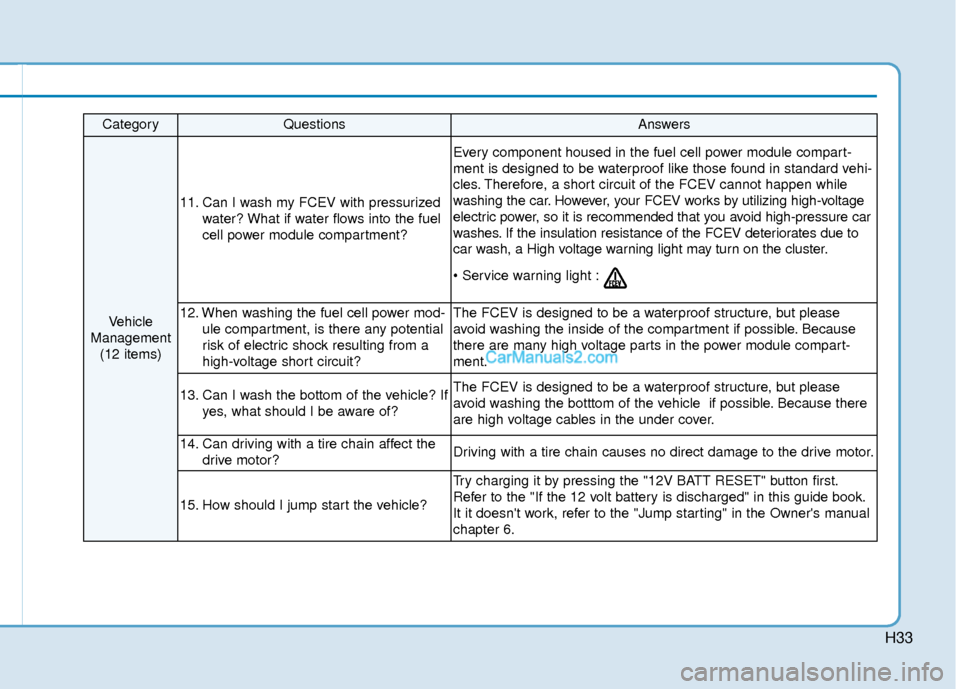
11. Can I wash my FCEV with pressurized water? What if water flows into the fuel
cell power module compartment?
Every component housed in the fuel cell power module compart-
ment is designed to be waterproof like those found in standard vehi-
cles. Therefore, a short circuit of the FCEV cannot happen while
washing the car. However, your FCEV works by utilizing high-voltage
electric power, so it is recommended that you avoid high-pressure car
washes. If the insulation resistance of the FCEV deteriorates due to
car wash, a High voltage warning light may turn on the cluster.
12. When washing the fuel cell power mod-ule compartment, is there any potential
risk of electric shock resulting from a
high-voltage short circuit?The FCEV is designed to be a waterproof structure, but please
avoid washing the inside of the compartment if possible. Because
there are many high voltage parts in the power module compart-
ment.
13. Can I wash the bottom of the vehicle? Ifyes, what should I be aware of?The FCEV is designed to be a waterproof structure, but please
avoid washing the botttom of the vehicle if possible. Because there
are high voltage cables in the under cover.
14. Can driving with a tire chain affect thedrive motor?Driving with a tire chain causes no direct damage to the drive motor.
15. How should I jump start the vehicle?
Try charging it by pressing the "12V BATT RESET" button first.
Refer to the "If the 12 volt battery is discharged" in this guide book.
It it doesn't work, refer to the "Jump starting" in the Owner's manual
chapter 6.
Page 538 of 560
H34
CategoryQuestionsAnswers
Vehicle
Management (12 items)
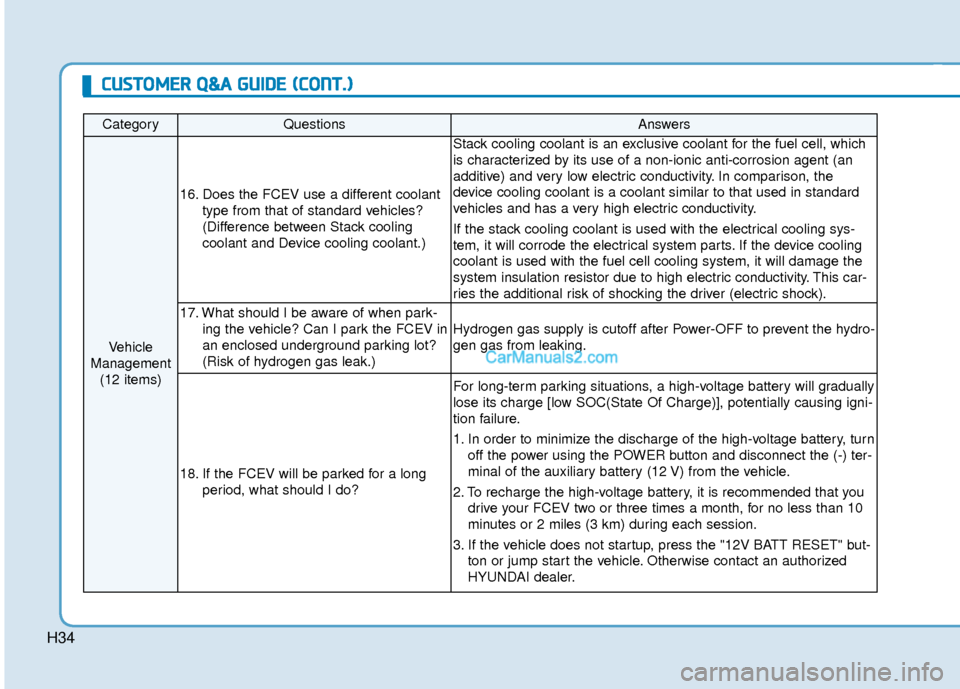
16. Does the FCEV use a different coolant type from that of standard vehicles?
(Difference between Stack cooling
coolant and Device cooling coolant.)
Stack cooling coolant is an exclusive coolant for the fuel cell, which
is characterized by its use of a non-ionic anti-corrosion agent (an
additive) and very low electric conductivity. In comparison, the
device cooling coolant is a coolant similar to that used in standard
vehicles and has a very high electric conductivity.
If the stack cooling coolant is used with the electrical cooling sys-
tem, it will corrode the electrical system parts. If the device cooling
coolant is used with the fuel cell cooling system, it will damage the
system insulation resistor due to high electric conductivity. This car-
ries the additional risk of shocking the driver (electric shock).
17. What should I be aware of when park-ing the vehicle? Can I park the FCEV in
an enclosed underground parking lot?
(Risk of hydrogen gas leak.)
Hydrogen gas supply is cutoff after Power-OFF to prevent the hydro-
gen gas from leaking.
18. If the FCEV will be parked for a longperiod, what should I do?
For long-term parking situations, a high-voltage battery will gradually
lose its charge [low SOC(State Of Charge)], potentially causing igni-
tion failure.
1. In order to minimize the discharge of the high-voltage battery, turnoff the power using the POWER button and disconnect the (-) ter-
minal of the auxiliary battery (12 V) from the vehicle.
2. To recharge the high-voltage battery, it is recommended that you drive your FCEV two or three times a month, for no less than 10
minutes or 2 miles (3 km) during each session.
3. If the vehicle does not startup, press the "12V BATT RESET" but- ton or jump start the vehicle. Otherwise contact an authorized
HYUNDAI dealer.
C CU
U S
ST
T O
O M
M E
ER
R
Q
Q &
&A
A
G
G U
U I
ID
D E
E
(
( C
C O
O N
NT
T.
.)
)
Page 540 of 560
H36
CategoryQuestionsAnswers
Cluster/
Warning Lamp (9 items)
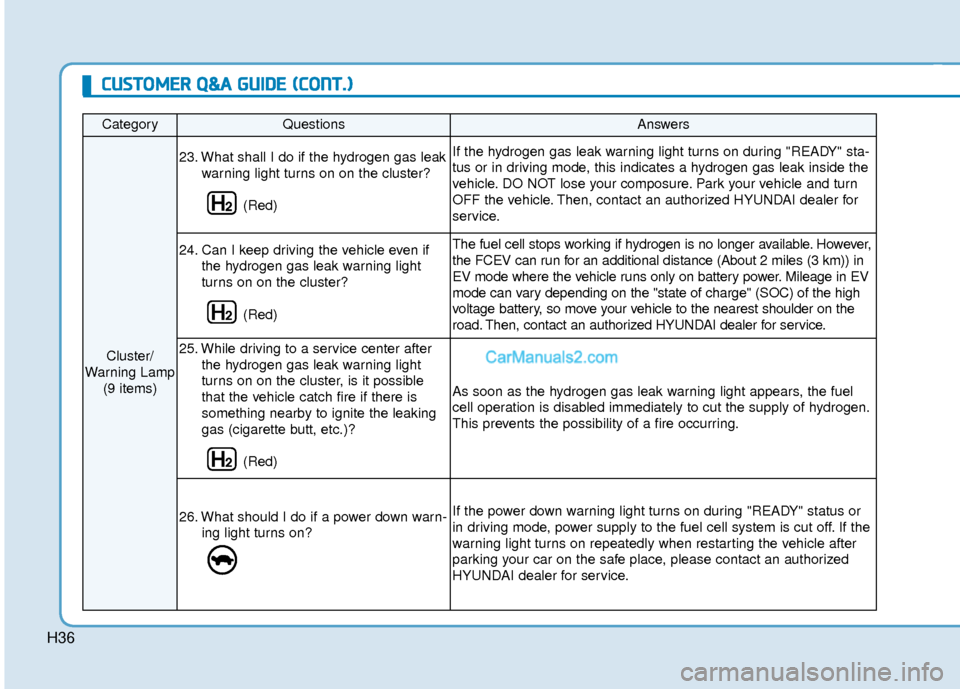
23. What shall I do if the hydrogen gas leak warning light turns on on the cluster?
(Red)If the hydrogen gas leak warning light turns on during "READY" sta-
tus or in driving mode, this indicates a hydrogen gas leak inside the
vehicle. DO NOT lose your composure. Park your vehicle and turn
OFF the vehicle. Then, contact an authorized HYUNDAI dealer for
service.
24. Can I keep driving the vehicle even ifthe hydrogen gas leak warning light
turns on on the cluster?
(Red)The fuel cell stops working if hydrogen is no longer available. However,
the FCEV can run for an additional distance (About 2 miles (3 km)) in
EV mode where the vehicle runs only on battery power. Mileage in EV
mode can vary depending on the "state of charge" (SOC) of the high
voltage battery, so move your vehicle to the nearest shoulder on the
road. Then, contact an authorized HYUNDAI dealer for service.
25. While driving to a service center afterthe hydrogen gas leak warning light
turns on on the cluster, is it possible
that the vehicle catch fire if there is
something nearby to ignite the leaking
gas (cigarette butt, etc.)?
(Red)
As soon as the hydrogen gas leak warning light appears, the fuel
cell operation is disabled immediately to cut the supply of hydrogen.
This prevents the possibility of a fire occurring.
26. What should I do if a power down warn-ing light turns on?If the power down warning light turns on during "READY" status or
in driving mode, power supply to the fuel cell system is cut off. If the
warning light turns on repeatedly when restarting the vehicle after
parking your car on the safe place, please contact an authorized
HYUNDAI dealer for service.
C CU
U S
ST
T O
O M
M E
ER
R
Q
Q &
&A
A
G
G U
U I
ID
D E
E
(
( C
C O
O N
NT
T.
.)
)
Page 542 of 560
H38
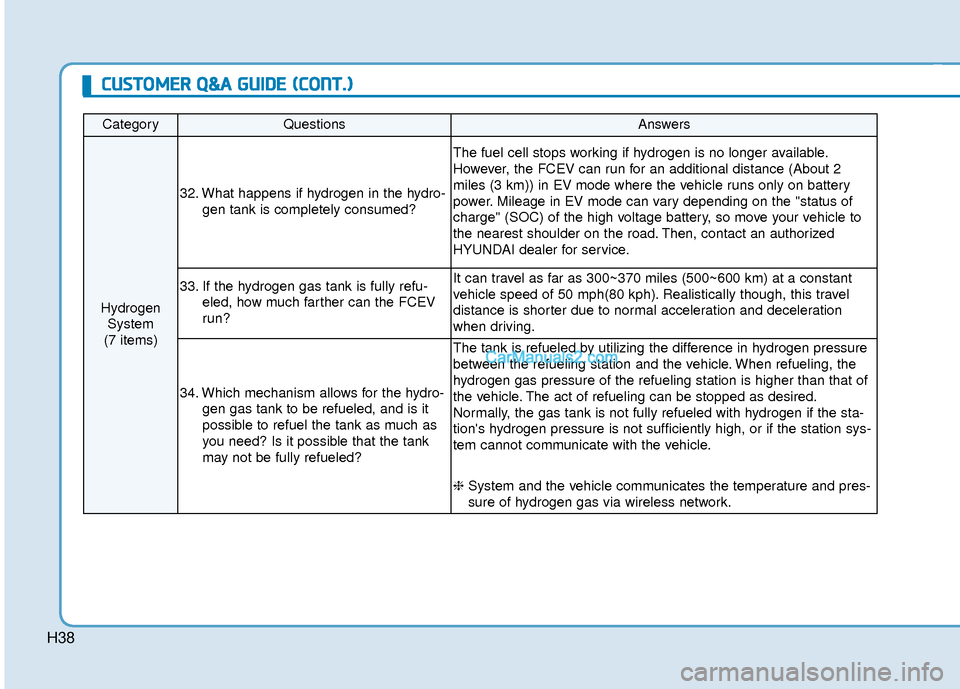
CategoryQuestionsAnswers
HydrogenSystem
(7 items)
32. What happens if hydrogen in the hydro- gen tank is completely consumed?
The fuel cell stops working if hydrogen is no longer available.
However, the FCEV can run for an additional distance (About 2
miles (3 km)) in EV mode where the vehicle runs only on battery
power. Mileage in EV mode can vary depending on the "status of
charge" (SOC) of the high voltage battery, so move your vehicle to
the nearest shoulder on the road. Then, contact an authorized
HYUNDAI dealer for service.
33. If the hydrogen gas tank is fully refu-eled, how much farther can the FCEV
run?It can travel as far as 300~370 miles (500~600 km) at a constant
vehicle speed of 50 mph(80 kph). Realistically though, this travel
distance is shorter due to normal acceleration and deceleration
when driving.
34. Which mechanism allows for the hydro-gen gas tank to be refueled, and is it
possible to refuel the tank as much as
you need? Is it possible that the tank
may not be fully refueled?
The tank is refueled by utilizing the difference in hydrogen pressure
between the refueling station and the vehicle. When refueling, the
hydrogen gas pressure of the refueling station is higher than that of
the vehicle. The act of refueling can be stopped as desired.
Normally, the gas tank is not fully refueled with hydrogen if the sta-
tion's hydrogen pressure is not sufficiently high, or if the station sys-
tem cannot communicate with the vehicle.
❈System and the vehicle communicates the temperature and pres-
sure of hydrogen gas via wireless network.
C CU
U S
ST
T O
O M
M E
ER
R
Q
Q &
&A
A
G
G U
U I
ID
D E
E
(
( C
C O
O N
NT
T.
.)
)
Page 546 of 560
H42
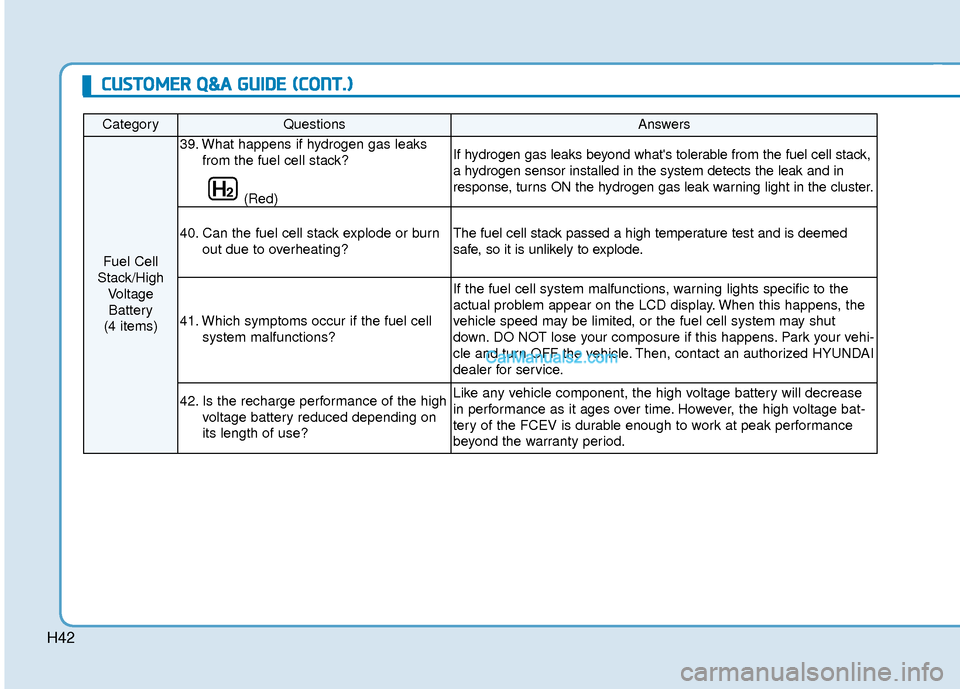
CategoryQuestionsAnswers
Fuel Cell
Stack/High VoltageBattery
(4 items)
39. What happens if hydrogen gas leaks from the fuel cell stack?
(Red)If hydrogen gas leaks beyond what's tolerable from the fuel cell stack,
a hydrogen sensor installed in the system detects the leak and in
response, turns ON the hydrogen gas leak warning light in the cluster.
40. Can the fuel cell stack explode or burnout due to overheating?The fuel cell stack passed a high temperature test and is deemed
safe, so it is unlikely to explode.
41. Which symptoms occur if the fuel cellsystem malfunctions?
If the fuel cell system malfunctions, warning lights specific to the
actual problem appear on the LCD display. When this happens, the
vehicle speed may be limited, or the fuel cell system may shut
down. DO NOT lose your composure if this happens. Park your vehi-
cle and turn OFF the vehicle. Then, contact an authorized HYUNDAI
dealer for service.
42. Is the recharge performance of the highvoltage battery reduced depending on
its length of use? Like any vehicle component, the high voltage battery will decrease
in performance as it ages over time. However, the high voltage bat-
tery of the FCEV is durable enough to work at peak performance
beyond the warranty period.
C CU
U S
ST
T O
O M
M E
ER
R
Q
Q &
&A
A
G
G U
U I
ID
D E
E
(
( C
C O
O N
NT
T.
.)
)
Page 547 of 560
H43
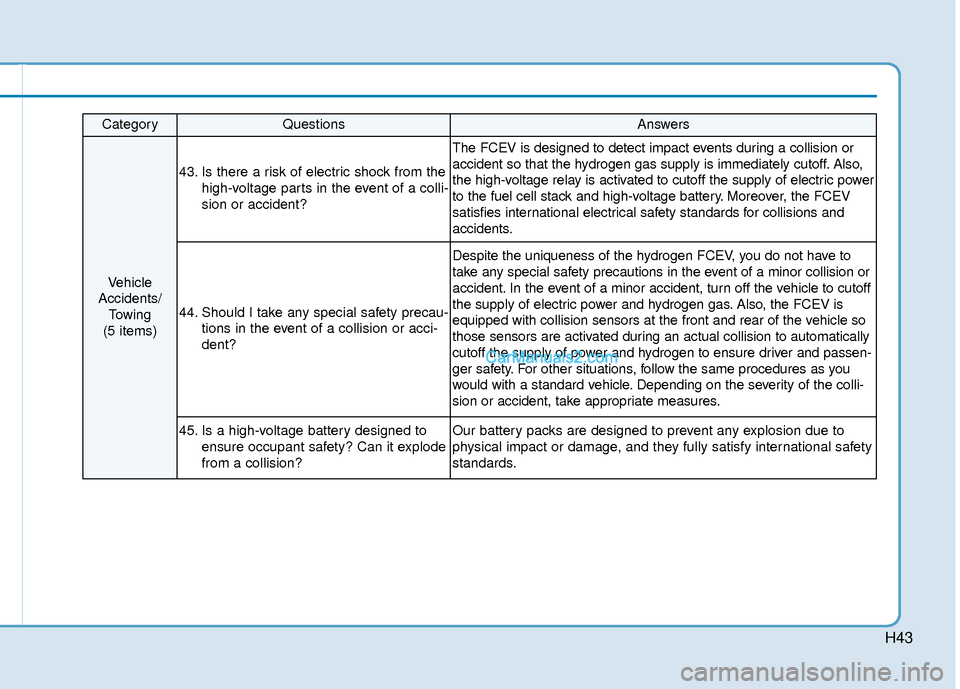
CategoryQuestionsAnswers
Vehicle
Accidents/ Towing
(5 items)
43. Is there a risk of electric shock from the high-voltage parts in the event of a colli-
sion or accident?
The FCEV is designed to detect impact events during a collision or
accident so that the hydrogen gas supply is immediately cutoff. Also,
the high-voltage relay is activated to cutoff the supply of electric power
to the fuel cell stack and high-voltage battery. Moreover, the FCEV
satisfies international electrical safety standards for collisions and
accidents.
44. Should I take any special safety precau-tions in the event of a collision or acci-
dent?
Despite the uniqueness of the hydrogen FCEV, you do not have to
take any special safety precautions in the event of a minor collision or
accident. In the event of a minor accident, turn off the vehicle to cutoff
the supply of electric power and hydrogen gas. Also, the FCEV is
equipped with collision sensors at the front and rear of the vehicle so
those sensors are activated during an actual collision to automatically
cutoff the supply of power and hydrogen to ensure driver and passen-
ger safety. For other situations, follow the same procedures as you
would with a standard vehicle. Depending on the severity of the colli-
sion or accident, take appropriate measures.
45. Is a high-voltage battery designed toensure occupant safety? Can it explode
from a collision?Our battery packs are designed to prevent any explosion due to
physical impact or damage, and they fully satisfy international safety
standards.
Page 551 of 560

I-2
12V battery......................................................................7-\
27Battery recharging ......................................................7-28
Reset Features ............................................................7-28
AC Inverter ...................................................................3-166\
Accessing Your Vehicle ....................................................3-3 Smart Key.....................................................................3-3\
Immobilizer System .....................................................3-9
Active Hood Lift System ................................................2-70 System activation .......................................................2-70
System limitation........................................................2-71
System malfunction ....................................................2-72
Air Bag - Advanced Supplemental Restraint System.....2-47 Where Are the Air Bags? ...........................................2-49
How Does the Air Bag System Operate? ...................2-52
What to Expect After an Air Bag Inflates ..................2-57
Occupant Classification System (OCS) .....................2-58
Why Didn't My Air Bag Go Off in a Collision?........2-60
SRS Care ....................................................................2-60\
Additional Safety Precautions ....................................2-60
Air Bag Warning Labels.............................................2-60
Why Didn't My Air Bag Go Off in a Collision?........2-63
SRS Care ....................................................................2-68\
Additional Safety Precautions ....................................2-69
Air Bag Warning Labels.............................................2-69 Air Bag Warning Labels .................................................2-69
Air cleaner.......................................................................7\
-20
Filter Replacement .....................................................7-20
Air Conditioning System ..................................................8-5
Anti-lock Brake System (ABS) ......................................5-29
Appearance care..............................................................7-62 Exterior Care ..............................................................7-62
Interior Care ...............................................................7-67
Auto Hold .......................................................................5\
-25
Automatic Climate Control System..............................3-146 Automatic Temperature Control Mode ....................3-147
Manual Temperature Control Mode .........................3-147
System Operation .....................................................3-154
System Maintenance ................................................3-155
Before Driving ..................................................................5-4 Before Entering the Vehicle .........................................5-4
Before Starting .............................................................5-4
Blind-Spot Collision Warning/ Blind-Spot Collision-avoidance Assist ........................5-53
System Description ....................................................5-53
System Setting and Activation ...................................5-54
Warning and System Control .....................................5-57
Detecting Sensor (Front View Camera and Rear Corner Radar) .................................................5-59
Limitations of the System ..........................................5-62
Index
A
B
Page 553 of 560
I-4
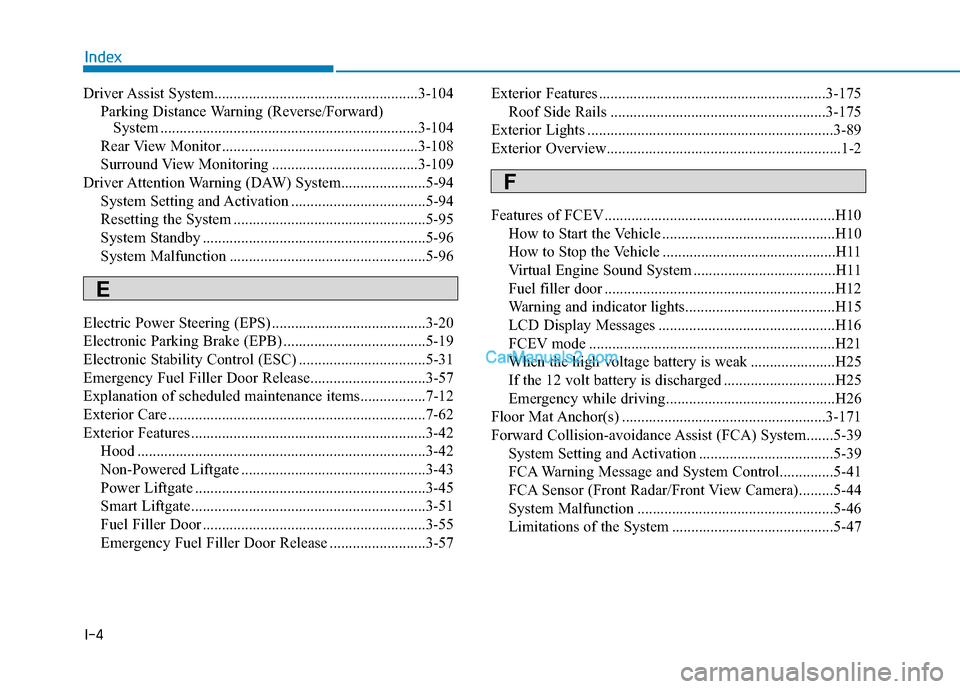
Driver Assist System.....................................................3-104Parking Distance Warning (Reverse/Forward) System ...................................................................3-104\
Rear View Monitor ...................................................3-108
Surround View Monitoring ......................................3-109
Driver Attention Warning (DAW) System......................5-94 System Setting and Activation ...................................5-94
Resetting the System ..................................................5-95
System Standby ..........................................................5-96
System Malfunction ...................................................5-96
Electric Power Steering (EPS) ........................................3-20
Electronic Parking Brake (EPB) .....................................5-19
Electronic Stability Control (ESC) .................................5-31
Emergency Fuel Filler Door Release..............................3-57
Explanation of scheduled maintenance items.................7-12
Exterior Care ...................................................................7-62
Exterior Features .............................................................3-42 Hood ........................................................................\
...3-42
Non-Powered Liftgate ................................................3-43
Power Liftgate ............................................................3-45
Smart Liftgate.............................................................3-51
Fuel Filler Door ..........................................................3-55
Emergency Fuel Filler Door Release .........................3-57 Exterior Features ...........................................................3-175
Roof Side Rails ........................................................3-175
Exterior Lights ................................................................3-89
Exterior Overview.............................................................1-2
Features of FCEV............................................................H10 How to Start the Vehicle .............................................H10
How to Stop the Vehicle .............................................H11
Virtual Engine Sound System .....................................H11
Fuel filler door ............................................................H12
Warning and indicator lights.......................................H15
LCD Display Messages ..............................................H16
FCEV mode ................................................................H21
When the high voltage battery is weak ......................H25
If the 12 volt battery is discharged .............................H25
Emergency while driving............................................H26
Floor Mat Anchor(s) .....................................................3-171
Forward Collision-avoidance Assist (FCA) System.......5-39 System Setting and Activation ...................................5-39
FCA Warning Message and System Control..............5-41
FCA Sensor (Front Radar/Front View Camera).........5-44
System Malfunction ...................................................5-46
Limitations of the System ..........................................5-47
Index
E
F
Page 554 of 560

I-5
Front Seats ........................................................................\
2-6
Front Windshield Washers ............................................3-102
Front Windshield Wipers ..............................................3-101
Fuel Cell Power Module Compartment ............................1-6
Fuel cell power module compartment ..............................7-3
Fuel Filler Door ..............................................................3-55
Fuel cell stack....................................................................H4
Fuses ........................................................................\
.......7-45Instrument Panel Fuse Replacement ..........................7-46
Fuel cell power module compartment Panel Fuse Replacement .........................................7-47
Fuse/Relay Panel Description ....................................7-49
Glove Box .....................................................................3-1\
62
Good Braking Practices ..................................................5-36
Hazard Warning Flasher ...................................................6-2
Head Restraints ...............................................................2-13
Heated Steering Wheel ...................................................3-22
High pressure hydrogen storage tanks ..............................H5
Hill-Start Assist Control (HAC) .....................................5-36
Hood........................................................................\
........3-42
Horn ........................................................................\
........3-21 If the 12 Volt Battery is Discharged .................................6-5
Before Jump Starting....................................................6-5
Jump Starting................................................................6-6
If the Vehicle Overheats....................................................6-9
If the Vehicle Will Not Start .............................................6-4
If You Have a Flat Tire (With Tire Mobility Kit)...........6-17
Immobilizer System ..........................................................3-9
Important Safety Precautions............................................2-2 Always Wear Your Seat Belt ........................................2-2
Restrain All Children....................................................2-2
Air Bag Hazards ...........................................................2-2
Driver Distraction.........................................................2-2
Control Your Speed ......................................................2-3
Keep Your Vehicle in Safe Condition ..........................2-3
In Case of an Emergency While Driving .........................6-2 If an accident occurs...................................................\
..6-2
If a fire occurs ..............................................................6-3
Emergency venting of hydrogen gas ............................6-3
If a submersion in water occurs ...................................6-3
If the vehicle stalls at a crossroad or crossing .............6-3
If you have a flat tire while driving .............................6-4
If the vehicle stalls while driving .................................6-4
Inside Rearview Mirror...................................................3-23
I
Index
G
H
I