lights HYUNDAI NEXO 2019 Owner's Guide
[x] Cancel search | Manufacturer: HYUNDAI, Model Year: 2019, Model line: Nexo, Model: Hyundai Nexo 2019Pages: 561, PDF Size: 48.42 MB
Page 400 of 561
6-2
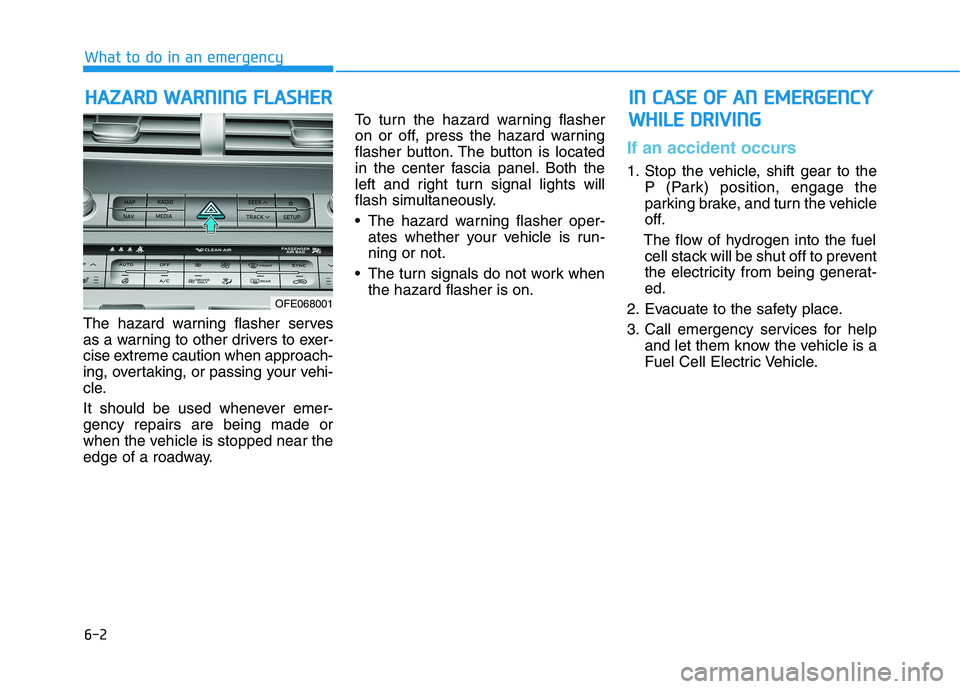
The hazard warning flasher serves
as a warning to other drivers to exer-
cise extreme caution when approach-
ing, overtaking, or passing your vehi-
cle.
It should be used whenever emer-
gency repairs are being made or
when the vehicle is stopped near the
edge of a roadway.To turn the hazard warning flasher
on or off, press the hazard warning
flasher button. The button is located
in the center fascia panel. Both the
left and right turn signal lights will
flash simultaneously.
• The hazard warning flasher oper-
ates whether your vehicle is run-
ning or not.
The turn signals do not work when
the hazard flasher is on.
If an accident occurs
1. Stop the vehicle, shift gear to the
P (Park) position, engage the
parking brake, and turn the vehicle
off.
The flow of hydrogen into the fuel
cell stack will be shut off to prevent
the electricity from being generat-
ed.
2. Evacuate to the safety place.
3. Call emergency services for help
and let them know the vehicle is a
Fuel Cell Electric Vehicle.
H HA
AZ
ZA
AR
RD
D
W
WA
AR
RN
NI
IN
NG
G
F
FL
LA
AS
SH
HE
ER
R
What to do in an emergency
OFE068001
I IN
N
C
CA
AS
SE
E
O
OF
F
A
AN
N
E
EM
ME
ER
RG
GE
EN
NC
CY
Y
W WH
HI
IL
LE
E
D
DR
RI
IV
VI
IN
NG
G
Page 404 of 561
6-6
What to do in an emergency
The following items may need to be
reset after the battery has been dis-
charged or the battery has been dis-
connected. See chapter 3 or 4 for:
Power Windows
Trip Computer
Climate Control System
Clock
Audio System
Sunroof
Driver Position Memory System
External power source using 12V
battery
The use of external power acces-
sories may reduce performance
and function of the vehicle.
Especially, the use of dash cam-
eras may shut off the power of the
vehicle prior to the dash camera's
automatic shut-down.
If the power of the vehicle is shut
off, start the vehicle as explained.
(refer to "Using the 12V Battery
Switch")
Jump Starting
In the event vehicle still does not
have a functional 12V battery (check
if interior lights will not turn on) then
you can try a jump start using a 12V
booster pack or jumper cables from
another vehicle's 12V battery
according to the following instruc-
tions.1. Position the vehicles close enough
that the jumper cables will reach,
but do not allow the vehicles to
touch.
2. Avoid fans or any moving parts in
the fuel cell power module com-
partment at all times, even when
the vehicles are turned off.
3. Turn off all electrical devices such
as radios, lights, air conditioning,
etc. Put the vehicles in P (Park)
and set the parking brake. Turn
both vehicles OFF.
NOTICE
Jump starting can be danger-
ous if done incorrectly. Follow
the jump starting procedure in
this section to avoid serious
injury or damage to your vehi-
cle. If in doubt about how to
properly jump start your vehi-
cle, we strongly recommend
that you have a service techni-
cian or towing service do it for
you.
CAUTION
Page 431 of 561
7-6
Maintenance
Owner maintenance schedule
When you stop for fuel:
• Check for both fuel cell stack andDevice cooling coolant level in
coolant reservoir.
Check the windshield washer fluid level.
Look for low or under-inflated tires.
While operating your vehicle:
Check for vibrations in the steering wheel. Notice if there is any
increased steering effort or loose-
ness in the steering wheel, or
change in its straight-ahead posi-
tion.
Notice if your vehicle constantly turns slightly or "pulls" to one side
when traveling on smooth, level
road.
When stopping, listen and check for unusual sounds, pulling to one
side, increased brake pedal travel
or "hard-to-push" brake pedal.
If any slipping or changes in the operation of your reduction gear
occurs, check the reduction gear
fluid level.
Check the reduction gear P (Park) function.
Check the parking brake.
Check for fluid leaks under your vehicle (water dripping from the air
conditioning system during or after
use is normal).
At least monthly:
Check coolant level in the coolantreservoir.
Check the operation of all exterior lights, including the brake lights,
turn signals and hazard warning
flashers.
Check the inflation pressures of all tires that are worn, show uneven
wear, or are damaged.
Check for loose wheel lug nuts.
At least twice a year: (i.e., every Spring and Fall)
Check radiator, heater and air con-
ditioning hoses for leaks or dam-
age.
Check windshield washer spray and wiper operation. Clean wiper
blades with clean cloth dampened
with washer fluid.
Check headlamp alignment.
Check the seat belts for wear and function.
Be careful when checking the
coolant level when the fuel cell
power module is hot. Scalding
hot coolant and steam may
blow out under pressure. This
could cause burns or other seri-
ous injury.
WARNING
Page 470 of 561
7-45
7
Maintenance
F
FU
U S
SE
E S
S
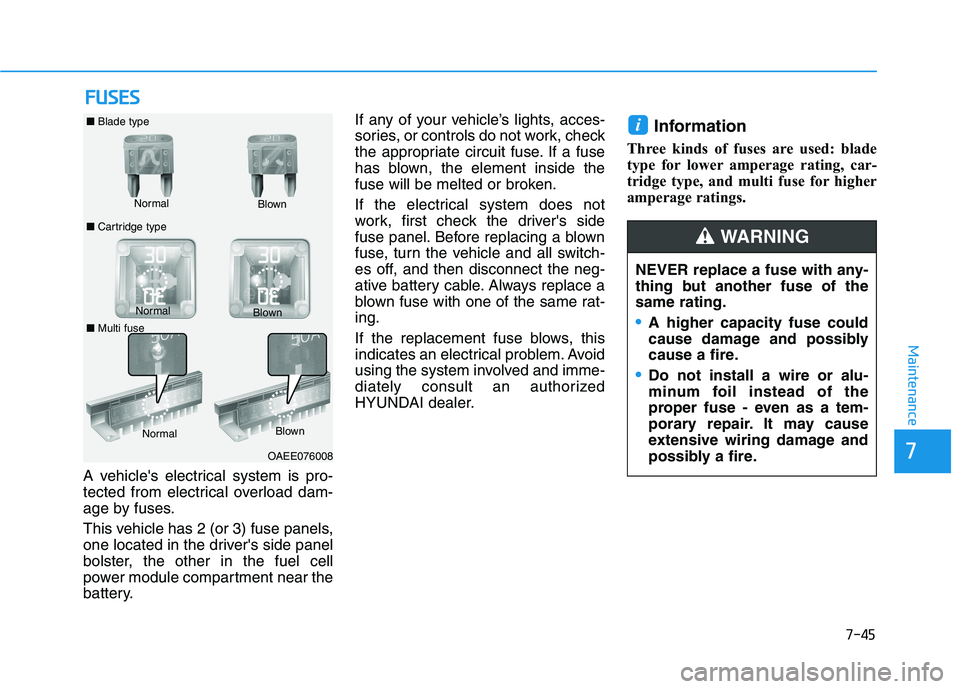
A vehicle's electrical system is pro-
tected from electrical overload dam-
age by fuses.
This vehicle has 2 (or 3) fuse panels,
one located in the driver's side panel
bolster, the other in the fuel cell
power module compartment near the
battery. If any of your vehicle’s lights, acces-
sories, or controls do not work, check
the appropriate circuit fuse. If a fuse
has blown, the element inside the
fuse will be melted or broken.
If the electrical system does not
work, first check the driver's side
fuse panel. Before replacing a blown
fuse, turn the vehicle and all switch-
es off, and then disconnect the neg-
ative battery cable. Always replace a
blown fuse with one of the same rat-
ing.
If the replacement fuse blows, this
indicates an electrical problem. Avoid
using the system involved and imme-
diately consult an authorized
HYUNDAI dealer.
Information
Three kinds of fuses are used: blade
type for lower amperage rating, car-
tridge type, and multi fuse for higher
amperage ratings.
i
NEVER replace a fuse with any-
thing but another fuse of the
same rating.
A higher capacity fuse could
cause damage and possibly
cause a fire.
Do not install a wire or alu-
minum foil instead of the
proper fuse - even as a tem-
porary repair. It may cause
extensive wiring damage and
possibly a fire.
WARNING
Normal
■
Blade type
■ Cartridge type Blown
Normal Blown
OAEE076008
Normal
Blown
■ Multi fuse
Page 486 of 561
7-61
7
Maintenance
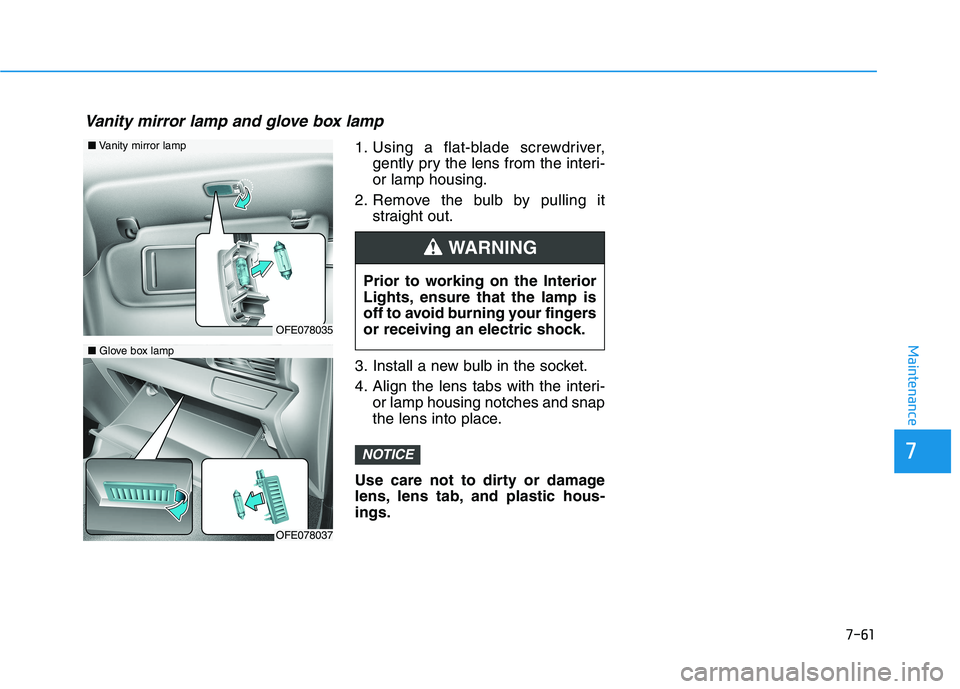
1. Using a flat-blade screwdriver,gently pry the lens from the interi-
or lamp housing.
2. Remove the bulb by pulling it straight out.
3. Install a new bulb in the socket.
4. Align the lens tabs with the interi- or lamp housing notches and snap
the lens into place.
Use care not to dirty or damage
lens, lens tab, and plastic hous-
ings.
NOTICE
Prior to working on the Interior
Lights, ensure that the lamp is
off to avoid burning your fingers
or receiving an electric shock.
WARNING
■ Vanity mirror lamp
■ Glove box lamp
OFE078035
OFE078037
Vanity mirror lamp and glove box lamp
Page 506 of 561
Introduction of FCEV .........................................................H2
The components of FCEV..................................................H3
Fuel cell stack ...................................................................................H4
FCEV system module .......................................................................H4
High pressure hydrogen storage tanks ......................................H5
Battery system..................................................................................H5
Features of FCEV .............................................................H10
How to Start the Vehicle ..............................................................H10
How to Stop the Vehicle ..............................................................H11
Virtual Engine Sound System......................................................H11
Fuel filler door ................................................................................H12
Warning and indicator lights .......................................................H15
LCD Display Messages ..................................................................H16
FCEV mode.......................................................................................H21
When the high voltage battery is weak ...................................H25
If the 12 volt battery is discharged...........................................H25
Emergency while driving ..............................................................H26
Customer Q&A Guide .......................................................H30
F FC
CE
EV
V
V
Ve
eh
hi
ic
cl
le
e
S
Sy
ys
st
te
em
m
O
Ov
ve
er
rv
vi
ie
ew
w
FCEV : Fuel Cell Electric Vehicle
Page 520 of 561
H15
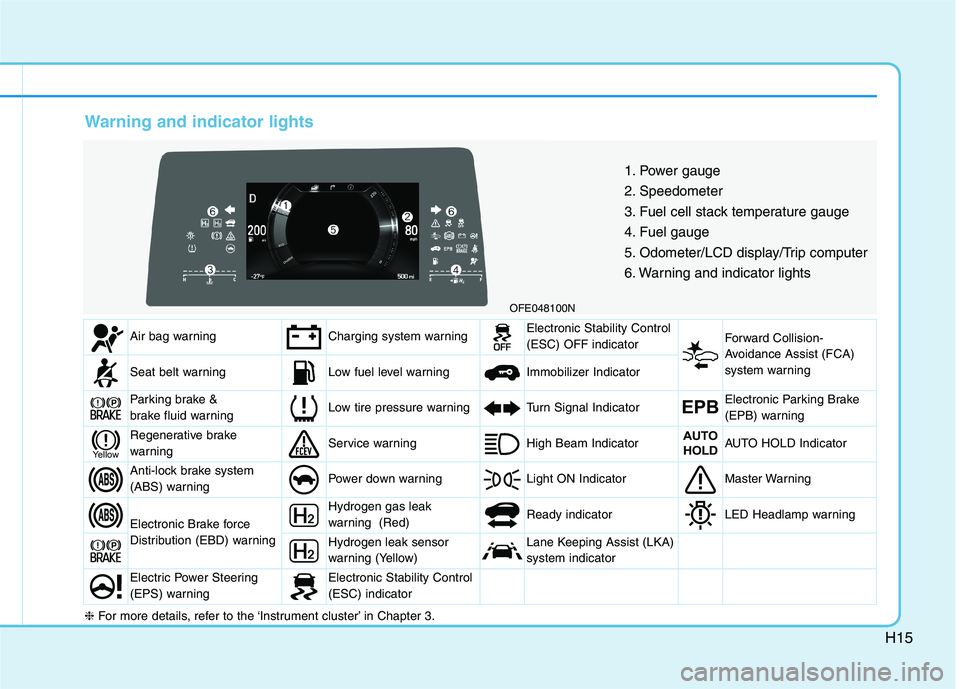
Warning and indicator lights
OFE048100N
1. Power gauge
2. Speedometer
3. Fuel cell stack temperature gauge
4. Fuel gauge
5. Odometer/LCD display/Trip computer
6. Warning and indicator lights
Air bag warningCharging system warningElectronic Stability Control
(ESC) OFF indicator Forward Collision-
Avoidance Assist (FCA)
system warning
Seat belt warningLow fuel level warning Immobilizer Indicator
Parking brake &
brake fluid warningLow tire pressure warningTurn Signal IndicatorEPBElectronic Parking Brake
(EPB) warning
Regenerative brake
warningService warning High Beam IndicatorAUTO
HOLDAUTO HOLD Indicator
Anti-lock brake system
(ABS) warningPower down warning Light ON IndicatorMaster Warning
Electronic Brake force
Distribution (EBD) warning
Hydrogen gas leak
warning (Red) Ready indicatorLED Headlamp warning
Hydrogen leak sensor
warning (Yellow)Lane Keeping Assist (LKA)
system indicator
Electric Power Steering
(EPS) warningElectronic Stability Control
(ESC) indicator
Yellow
❈For more details, refer to the ‘Instrument cluster’ in Chapter 3.
Page 537 of 561
H32
CategoryQuestionsAnswers
Vehicle
overview
(10 items)
9. Can driving on test roads or over speed
bumps damage the high voltage battery
and hydrogen tank?
The high voltage battery and hydrogen tank are unlikely to be damaged
under normal driving conditions. However, if the system begins to mal-
function due to a direct and serious vehicular impact, you are informed
of those system errors via warning lights on and the LCD display.
10. A water-like liquid is being discharged
from the muffler and bottom of the vehi-
cle. Is it harmful to humans?
Water or vapor discharged is generated from electrochemical reac-
tions in the fuel cell stack, and is not harmful to humans. However,
liquids generated from the reactions can be somewhat acidic, so DO
NOT touch or ingest the liquid!
Also, the water discharged when parking the vehicle indoor may
make a puddle on the floor. Be careful as such puddle can freeze
and result in accident during winter.
C CU
US
ST
TO
OM
ME
ER
R
Q
Q&
&A
A
G
GU
UI
ID
DE
E
(
(C
CO
ON
NT
T.
.)
)
Page 547 of 561
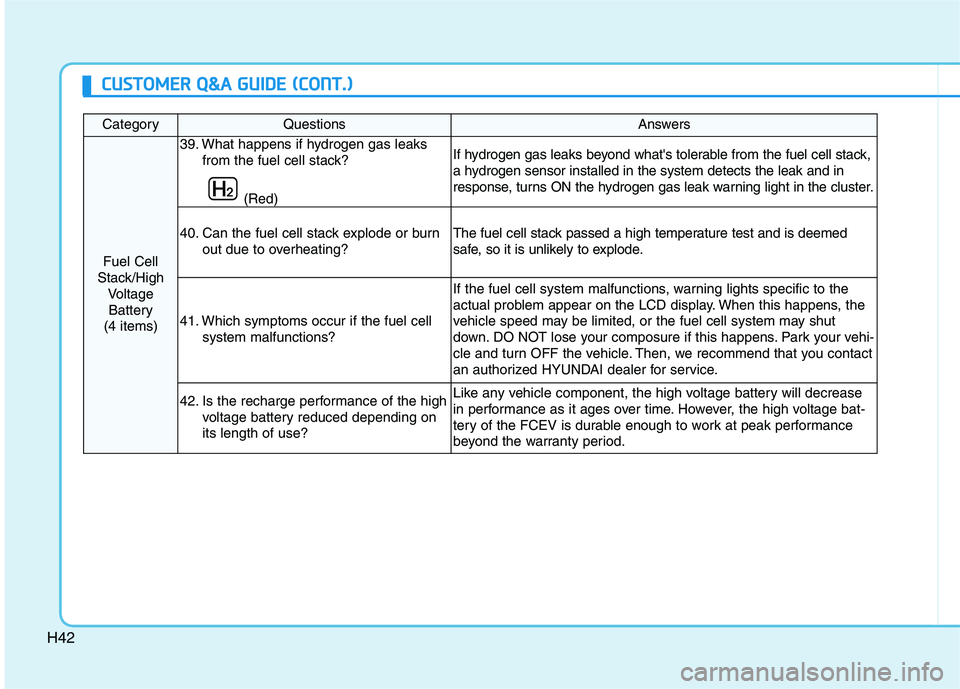
H42
CategoryQuestionsAnswers
Fuel Cell
Stack/High
Voltage
Battery
(4 items)
39. What happens if hydrogen gas leaks
from the fuel cell stack?
(Red)If hydrogen gas leaks beyond what's tolerable from the fuel cell stack,
a hydrogen sensor installed in the system detects the leak and in
response, turns ON the hydrogen gas leak warning light in the cluster.
40. Can the fuel cell stack explode or burn
out due to overheating?The fuel cell stack passed a high temperature test and is deemed
safe, so it is unlikely to explode.
41. Which symptoms occur if the fuel cell
system malfunctions?
If the fuel cell system malfunctions, warning lights specific to the
actual problem appear on the LCD display. When this happens, the
vehicle speed may be limited, or the fuel cell system may shut
down. DO NOT lose your composure if this happens. Park your vehi-
cle and turn OFF the vehicle. Then, we recommend that you contact
an authorized HYUNDAI dealer for service.
42. Is the recharge performance of the high
voltage battery reduced depending on
its length of use? Like any vehicle component, the high voltage battery will decrease
in performance as it ages over time. However, the high voltage bat-
tery of the FCEV is durable enough to work at peak performance
beyond the warranty period.
C CU
US
ST
TO
OM
ME
ER
R
Q
Q&
&A
A
G
GU
UI
ID
DE
E
(
(C
CO
ON
NT
T.
.)
)
Page 554 of 561
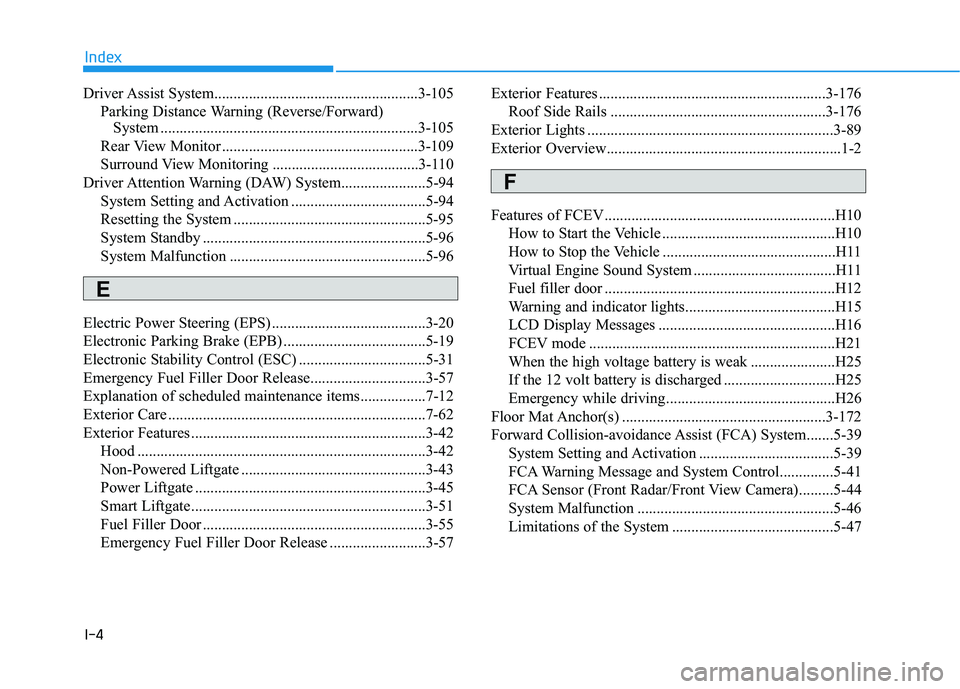
I-4
Driver Assist System.....................................................3-105
Parking Distance Warning (Reverse/Forward)
System ...................................................................3-105
Rear View Monitor ...................................................3-109
Surround View Monitoring ......................................3-110
Driver Attention Warning (DAW) System......................5-94
System Setting and Activation ...................................5-94
Resetting the System ..................................................5-95
System Standby ..........................................................5-96
System Malfunction ...................................................5-96
Electric Power Steering (EPS) ........................................3-20
Electronic Parking Brake (EPB) .....................................5-19
Electronic Stability Control (ESC) .................................5-31
Emergency Fuel Filler Door Release..............................3-57
Explanation of scheduled maintenance items.................7-12
Exterior Care ...................................................................7-62
Exterior Features .............................................................3-42
Hood ...........................................................................3-42
Non-Powered Liftgate ................................................3-43
Power Liftgate ............................................................3-45
Smart Liftgate.............................................................3-51
Fuel Filler Door ..........................................................3-55
Emergency Fuel Filler Door Release .........................3-57Exterior Features ...........................................................3-176
Roof Side Rails ........................................................3-176
Exterior Lights ................................................................3-89
Exterior Overview.............................................................1-2
Features of FCEV............................................................H10
How to Start the Vehicle .............................................H10
How to Stop the Vehicle .............................................H11
Virtual Engine Sound System .....................................H11
Fuel filler door ............................................................H12
Warning and indicator lights.......................................H15
LCD Display Messages ..............................................H16
FCEV mode ................................................................H21
When the high voltage battery is weak ......................H25
If the 12 volt battery is discharged .............................H25
Emergency while driving............................................H26
Floor Mat Anchor(s) .....................................................3-172
Forward Collision-avoidance Assist (FCA) System.......5-39
System Setting and Activation ...................................5-39
FCA Warning Message and System Control..............5-41
FCA Sensor (Front Radar/Front View Camera).........5-44
System Malfunction ...................................................5-46
Limitations of the System ..........................................5-47
Index
E
F