fuel cell stack HYUNDAI NEXO 2020 Owner's Manual
[x] Cancel search | Manufacturer: HYUNDAI, Model Year: 2020, Model line: NEXO, Model: HYUNDAI NEXO 2020Pages: 561, PDF Size: 48.42 MB
Page 531 of 561
H26
F FE
EA
AT
TU
UR
RE
ES
S
O
OF
F
F
FC
CE
EV
V
(
(C
CO
ON
NT
T.
.)
)
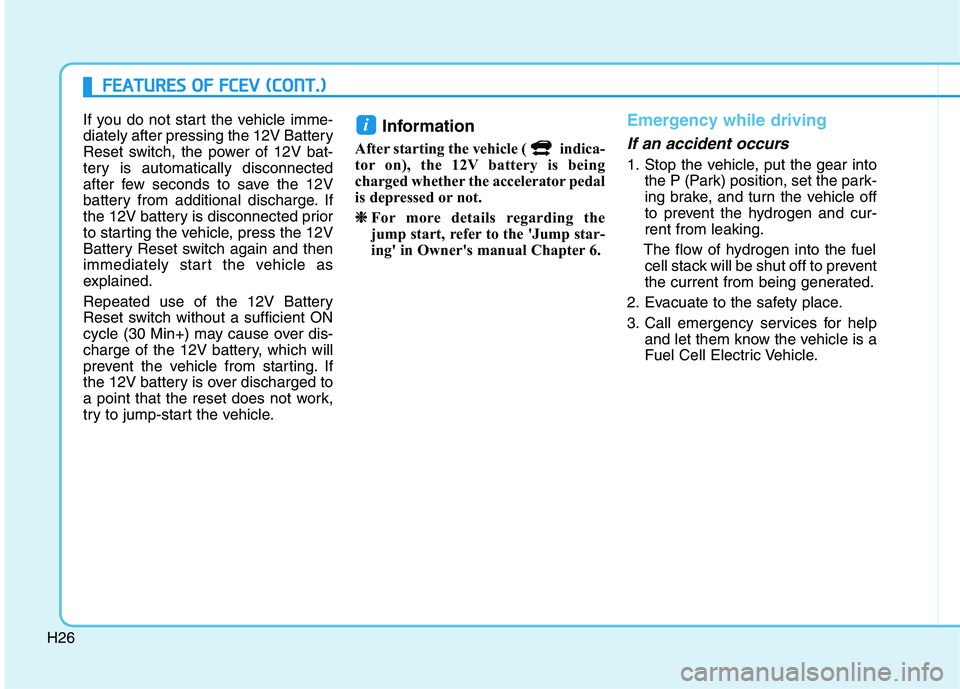
If you do not start the vehicle imme-
diately after pressing the 12V Battery
Reset switch, the power of 12V bat-
tery is automatically disconnected
after few seconds to save the 12V
battery from additional discharge. If
the 12V battery is disconnected prior
to starting the vehicle, press the 12V
Battery Reset switch again and then
immediately start the vehicle as
explained.
Repeated use of the 12V Battery
Reset switch without a sufficient ON
cycle (30 Min+) may cause over dis-
charge of the 12V battery, which will
prevent the vehicle from starting. If
the 12V battery is over discharged to
a point that the reset does not work,
try to jump-start the vehicle.Information
After starting the vehicle ( indica-
tor on), the 12V battery is being
charged whether the accelerator pedal
is depressed or not.
❈ ❈
For more details regarding the
jump start, refer to the 'Jump star-
ing' in Owner's manual Chapter 6.
Emergency while driving
If an accident occurs
1. Stop the vehicle, put the gear into
the P (Park) position, set the park-
ing brake, and turn the vehicle off
to prevent the hydrogen and cur-
rent from leaking.
The flow of hydrogen into the fuel
cell stack will be shut off to prevent
the current from being generated.
2. Evacuate to the safety place.
3. Call emergency services for help
and let them know the vehicle is a
Fuel Cell Electric Vehicle.
i
Page 532 of 561

H27
If a fire occurs
1. Stop the vehicle, put the gear into
the P(Park) position, set the park-
ing brake, and turn the vehicle off
to prevent the hydrogen and cur-
rent from leaking.
The flow of hydrogen into the fuel
cell stack will be shut off to prevent
the current from being generated.
2. If the fire is small, which can be
extinguished with fire extinguisher,
use carbon dioxide extinguisher.
You can also extinguish the fire
with water when the vehicle power
is turned off.If the fire is too big to be extinguished
with the fire extinguisher, evacuate
from the vehicle, call the fire depart-
ment, and let them know the vehicle
is a Fuel Cell Electric Vehicle. Do not
come close to the vehicle until the
fire is totally extinguished.
Emergency venting of hydrogen
gas
If the temperature near the safety
valve located at the rear under vehi-
cle is over 110°C caused by a fire or
other reasons, the safety valve will
open to vent hydrogen gas. Venting
the hydrogen gas makes a loud
noise because the venting speed is
very fast. Stay well away from the
vehicle. This jet stream of hydrogen
gas could ignite.
If a submersion in water occurs
If your vehicle was flooded and has
soaked carpeting or water on the
flooring, you should not try to start
the vehicle by pressing the POWER
button.
Call an authorized HYUNDAI dealer. Do not use water to extinguish a
fire when the vehicle power is
turned on. Serious electric
shock may result.
WARNING
Page 537 of 561
H32
CategoryQuestionsAnswers
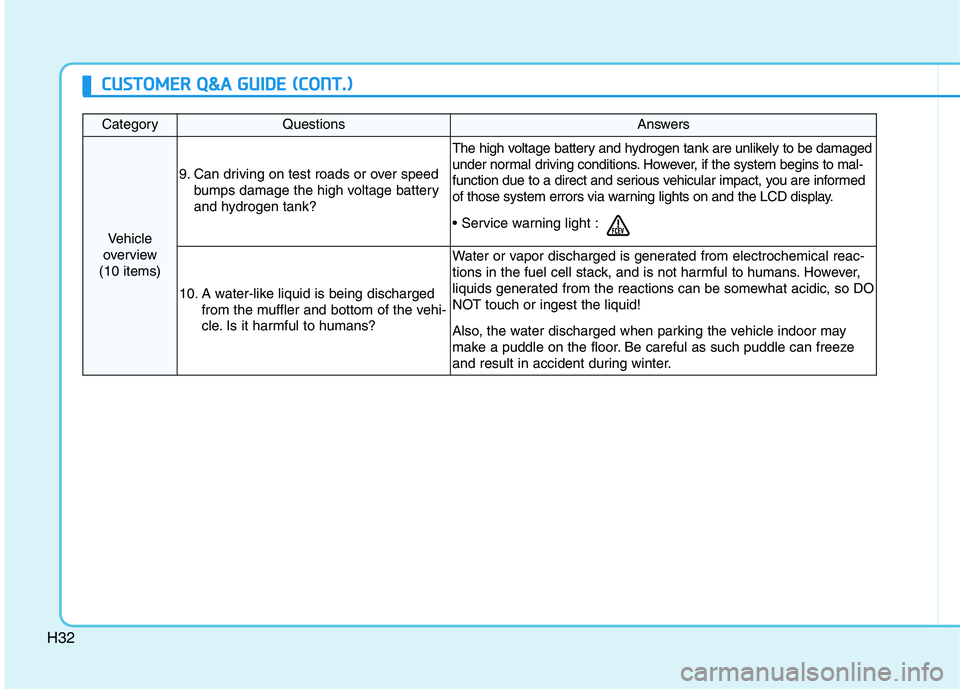
Vehicle
overview
(10 items)
9. Can driving on test roads or over speed
bumps damage the high voltage battery
and hydrogen tank?
The high voltage battery and hydrogen tank are unlikely to be damaged
under normal driving conditions. However, if the system begins to mal-
function due to a direct and serious vehicular impact, you are informed
of those system errors via warning lights on and the LCD display.
10. A water-like liquid is being discharged
from the muffler and bottom of the vehi-
cle. Is it harmful to humans?
Water or vapor discharged is generated from electrochemical reac-
tions in the fuel cell stack, and is not harmful to humans. However,
liquids generated from the reactions can be somewhat acidic, so DO
NOT touch or ingest the liquid!
Also, the water discharged when parking the vehicle indoor may
make a puddle on the floor. Be careful as such puddle can freeze
and result in accident during winter.
C CU
US
ST
TO
OM
ME
ER
R
Q
Q&
&A
A
G
GU
UI
ID
DE
E
(
(C
CO
ON
NT
T.
.)
)
Page 539 of 561
H34
CategoryQuestionsAnswers
Vehicle
Management
(12 items)
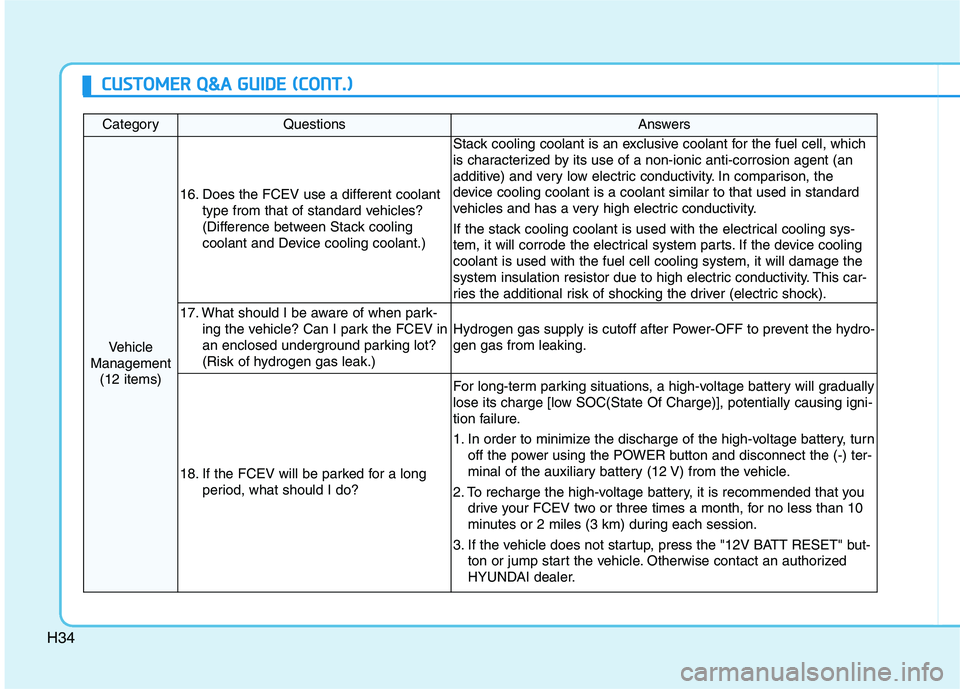
16. Does the FCEV use a different coolant
type from that of standard vehicles?
(Difference between Stack cooling
coolant and Device cooling coolant.)
Stack cooling coolant is an exclusive coolant for the fuel cell, which
is characterized by its use of a non-ionic anti-corrosion agent (an
additive) and very low electric conductivity. In comparison, the
device cooling coolant is a coolant similar to that used in standard
vehicles and has a very high electric conductivity.
If the stack cooling coolant is used with the electrical cooling sys-
tem, it will corrode the electrical system parts. If the device cooling
coolant is used with the fuel cell cooling system, it will damage the
system insulation resistor due to high electric conductivity. This car-
ries the additional risk of shocking the driver (electric shock).
17. What should I be aware of when park-
ing the vehicle? Can I park the FCEV in
an enclosed underground parking lot?
(Risk of hydrogen gas leak.)
Hydrogen gas supply is cutoff after Power-OFF to prevent the hydro-
gen gas from leaking.
18. If the FCEV will be parked for a long
period, what should I do?
For long-term parking situations, a high-voltage battery will gradually
lose its charge [low SOC(State Of Charge)], potentially causing igni-
tion failure.
1. In order to minimize the discharge of the high-voltage battery, turn
off the power using the POWER button and disconnect the (-) ter-
minal of the auxiliary battery (12 V) from the vehicle.
2. To recharge the high-voltage battery, it is recommended that you
drive your FCEV two or three times a month, for no less than 10
minutes or 2 miles (3 km) during each session.
3. If the vehicle does not startup, press the "12V BATT RESET" but-
ton or jump start the vehicle. Otherwise contact an authorized
HYUNDAI dealer.
C CU
US
ST
TO
OM
ME
ER
R
Q
Q&
&A
A
G
GU
UI
ID
DE
E
(
(C
CO
ON
NT
T.
.)
)
Page 547 of 561
H42
CategoryQuestionsAnswers
Fuel Cell
Stack/High
Voltage
Battery
(4 items)
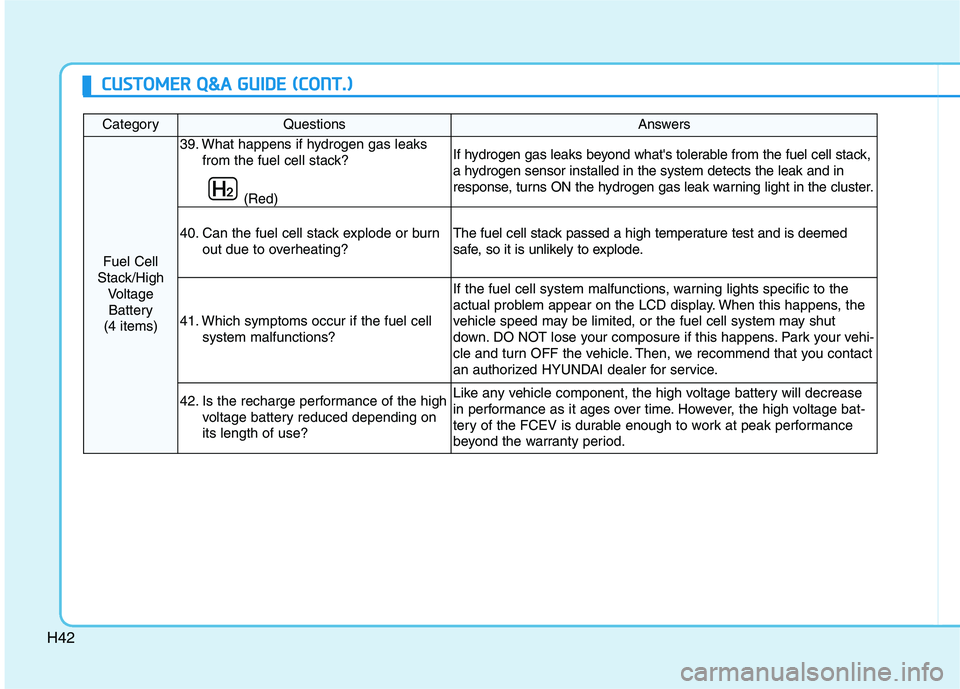
39. What happens if hydrogen gas leaks
from the fuel cell stack?
(Red)If hydrogen gas leaks beyond what's tolerable from the fuel cell stack,
a hydrogen sensor installed in the system detects the leak and in
response, turns ON the hydrogen gas leak warning light in the cluster.
40. Can the fuel cell stack explode or burn
out due to overheating?The fuel cell stack passed a high temperature test and is deemed
safe, so it is unlikely to explode.
41. Which symptoms occur if the fuel cell
system malfunctions?
If the fuel cell system malfunctions, warning lights specific to the
actual problem appear on the LCD display. When this happens, the
vehicle speed may be limited, or the fuel cell system may shut
down. DO NOT lose your composure if this happens. Park your vehi-
cle and turn OFF the vehicle. Then, we recommend that you contact
an authorized HYUNDAI dealer for service.
42. Is the recharge performance of the high
voltage battery reduced depending on
its length of use? Like any vehicle component, the high voltage battery will decrease
in performance as it ages over time. However, the high voltage bat-
tery of the FCEV is durable enough to work at peak performance
beyond the warranty period.
C CU
US
ST
TO
OM
ME
ER
R
Q
Q&
&A
A
G
GU
UI
ID
DE
E
(
(C
CO
ON
NT
T.
.)
)
Page 548 of 561
H43
CategoryQuestionsAnswers
Vehicle
Accidents/
Towing
(5 items)
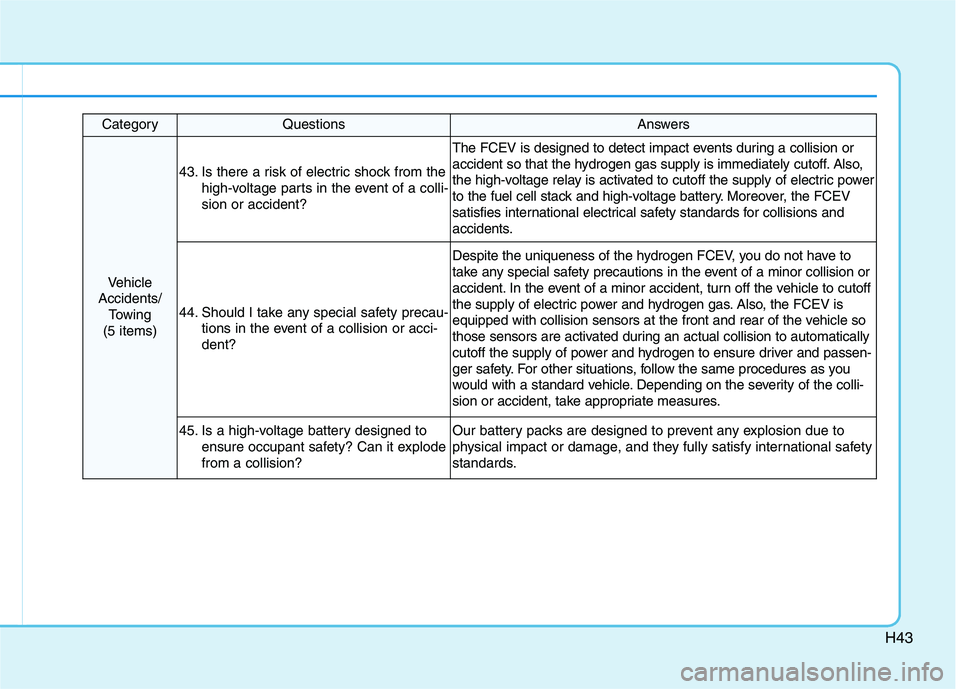
43. Is there a risk of electric shock from the
high-voltage parts in the event of a colli-
sion or accident?
The FCEV is designed to detect impact events during a collision or
accident so that the hydrogen gas supply is immediately cutoff. Also,
the high-voltage relay is activated to cutoff the supply of electric power
to the fuel cell stack and high-voltage battery. Moreover, the FCEV
satisfies international electrical safety standards for collisions and
accidents.
44. Should I take any special safety precau-
tions in the event of a collision or acci-
dent?
Despite the uniqueness of the hydrogen FCEV, you do not have to
take any special safety precautions in the event of a minor collision or
accident. In the event of a minor accident, turn off the vehicle to cutoff
the supply of electric power and hydrogen gas. Also, the FCEV is
equipped with collision sensors at the front and rear of the vehicle so
those sensors are activated during an actual collision to automatically
cutoff the supply of power and hydrogen to ensure driver and passen-
ger safety. For other situations, follow the same procedures as you
would with a standard vehicle. Depending on the severity of the colli-
sion or accident, take appropriate measures.
45. Is a high-voltage battery designed to
ensure occupant safety? Can it explode
from a collision?Our battery packs are designed to prevent any explosion due to
physical impact or damage, and they fully satisfy international safety
standards.
Page 550 of 561
H45
CategoryQuestionsAnswers
Explosion or
Fire (5 items)
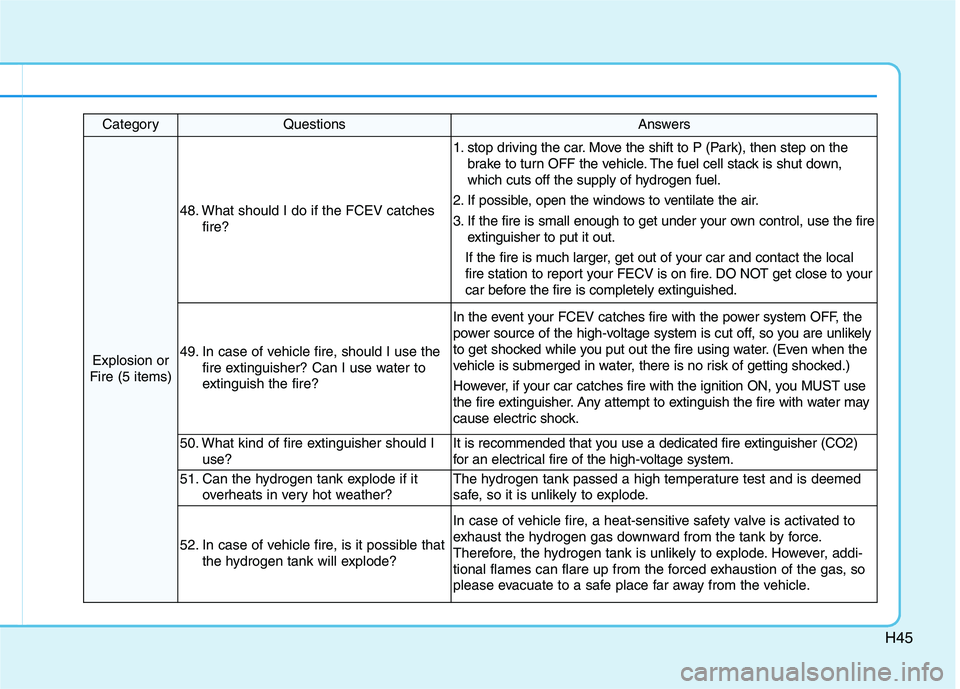
48. What should I do if the FCEV catches
fire?
1. stop driving the car. Move the shift to P (Park), then step on the
brake to turn OFF the vehicle. The fuel cell stack is shut down,
which cuts off the supply of hydrogen fuel.
2. If possible, open the windows to ventilate the air.
3. If the fire is small enough to get under your own control, use the fire
extinguisher to put it out.
If the fire is much larger, get out of your car and contact the local
fire station to report your FECV is on fire. DO NOT get close to your
car before the fire is completely extinguished.
49. In case of vehicle fire, should I use the
fire extinguisher? Can I use water to
extinguish the fire?
In the event your FCEV catches fire with the power system OFF, the
power source of the high-voltage system is cut off, so you are unlikely
to get shocked while you put out the fire using water. (Even when the
vehicle is submerged in water, there is no risk of getting shocked.)
However, if your car catches fire with the ignition ON, you MUST use
the fire extinguisher. Any attempt to extinguish the fire with water may
cause electric shock.
50. What kind of fire extinguisher should I
use?It is recommended that you use a dedicated fire extinguisher (CO2)
for an electrical fire of the high-voltage system.
51. Can the hydrogen tank explode if it
overheats in very hot weather?The hydrogen tank passed a high temperature test and is deemed
safe, so it is unlikely to explode.
52. In case of vehicle fire, is it possible that
the hydrogen tank will explode?
In case of vehicle fire, a heat-sensitive safety valve is activated to
exhaust the hydrogen gas downward from the tank by force.
Therefore, the hydrogen tank is unlikely to explode. However, addi-
tional flames can flare up from the forced exhaustion of the gas, so
please evacuate to a safe place far away from the vehicle.
Page 555 of 561
I-5
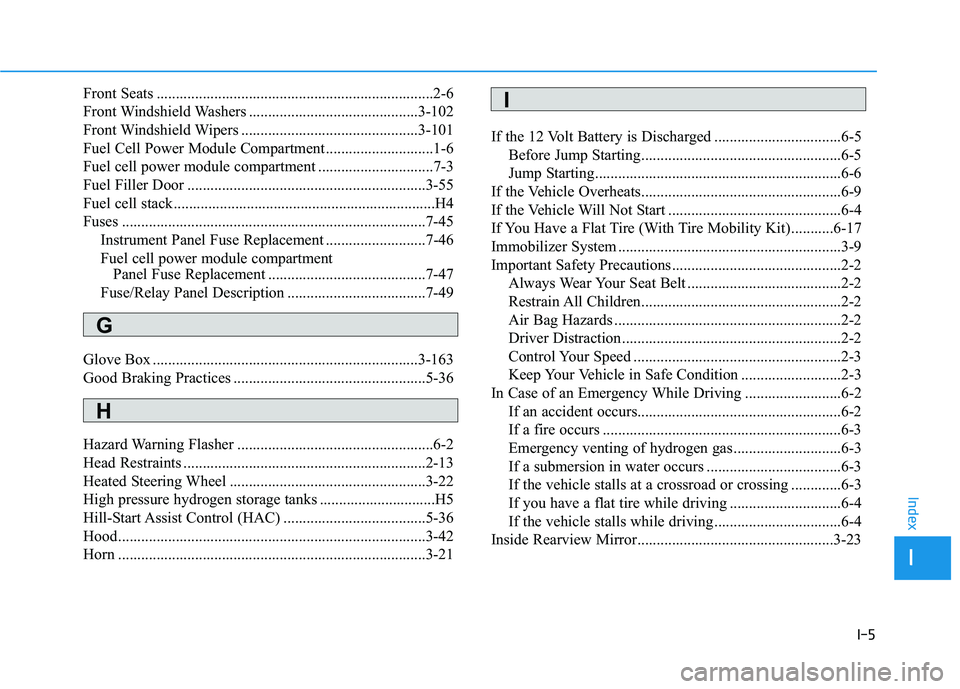
Front Seats ........................................................................2-6
Front Windshield Washers ............................................3-102
Front Windshield Wipers ..............................................3-101
Fuel Cell Power Module Compartment ............................1-6
Fuel cell power module compartment ..............................7-3
Fuel Filler Door ..............................................................3-55
Fuel cell stack....................................................................H4
Fuses ...............................................................................7-45
Instrument Panel Fuse Replacement ..........................7-46
Fuel cell power module compartment
Panel Fuse Replacement .........................................7-47
Fuse/Relay Panel Description ....................................7-49
Glove Box .....................................................................3-163
Good Braking Practices ..................................................5-36
Hazard Warning Flasher ...................................................6-2
Head Restraints ...............................................................2-13
Heated Steering Wheel ...................................................3-22
High pressure hydrogen storage tanks ..............................H5
Hill-Start Assist Control (HAC) .....................................5-36
Hood................................................................................3-42
Horn ................................................................................3-21If the 12 Volt Battery is Discharged .................................6-5
Before Jump Starting....................................................6-5
Jump Starting................................................................6-6
If the Vehicle Overheats....................................................6-9
If the Vehicle Will Not Start .............................................6-4
If You Have a Flat Tire (With Tire Mobility Kit)...........6-17
Immobilizer System ..........................................................3-9
Important Safety Precautions............................................2-2
Always Wear Your Seat Belt ........................................2-2
Restrain All Children....................................................2-2
Air Bag Hazards ...........................................................2-2
Driver Distraction.........................................................2-2
Control Your Speed ......................................................2-3
Keep Your Vehicle in Safe Condition ..........................2-3
In Case of an Emergency While Driving .........................6-2
If an accident occurs.....................................................6-2
If a fire occurs ..............................................................6-3
Emergency venting of hydrogen gas ............................6-3
If a submersion in water occurs ...................................6-3
If the vehicle stalls at a crossroad or crossing .............6-3
If you have a flat tire while driving .............................6-4
If the vehicle stalls while driving .................................6-4
Inside Rearview Mirror...................................................3-23
I
Index
G
H
I