roof HYUNDAI NEXO 2020 Owner's Manual
[x] Cancel search | Manufacturer: HYUNDAI, Model Year: 2020, Model line: NEXO, Model: HYUNDAI NEXO 2020Pages: 561, PDF Size: 48.42 MB
Page 436 of 561
7-11
7
MaintenanceSevere driving conditions
A - Repeatedly driving short distances of less than 5 miles (8 km) in normal temperature or less than 10 miles (16 km)
in freezing temperature
B - Extensive low speed driving for long distances
C - Driving on rough, dusty, muddy, unpaved, graveled or salt- spread roads
D - Driving in areas using salt or other corrosive materials or in very cold weather E - Driving in sandy areas
F - Driving in heavy traffic area over 90°F (32°C)
G- Driving on uphill, downhill, or mountain road
H - Towing a Trailer, or using a camper, or roof rack
I - Driving as a patrol car, taxi, other commercial use or vehicle
towing
J - Driving over 106 mph (170 km/h)
K - Frequently driving in stop-and-go conditions
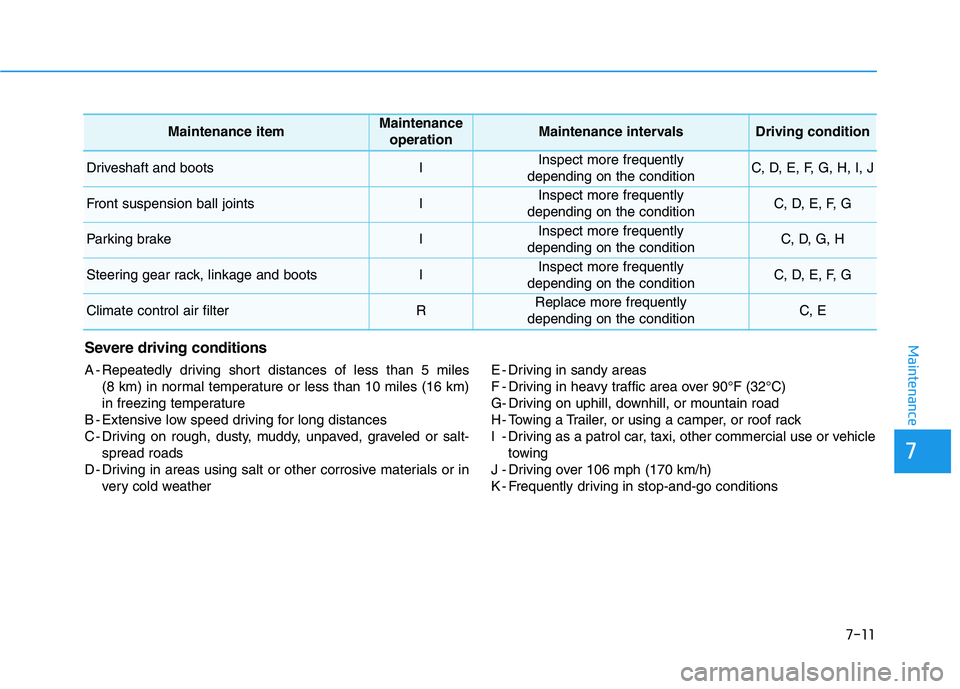
Maintenance itemMaintenance operationMaintenance intervalsDriving condition
Driveshaft and bootsIInspect more frequently
depending on the conditionC, D, E, F, G, H, I, J
Front suspension ball jointsIInspect more frequently
depending on the conditionC, D, E, F, G
Parking brakeIInspect more frequently
depending on the conditionC, D, G, H
Steering gear rack, linkage and bootsIInspect more frequently
depending on the conditionC, D, E, F, G
Climate control air filterRReplace more frequently
depending on the conditionC, E
Page 453 of 561
7-28
Maintenance
Battery recharging
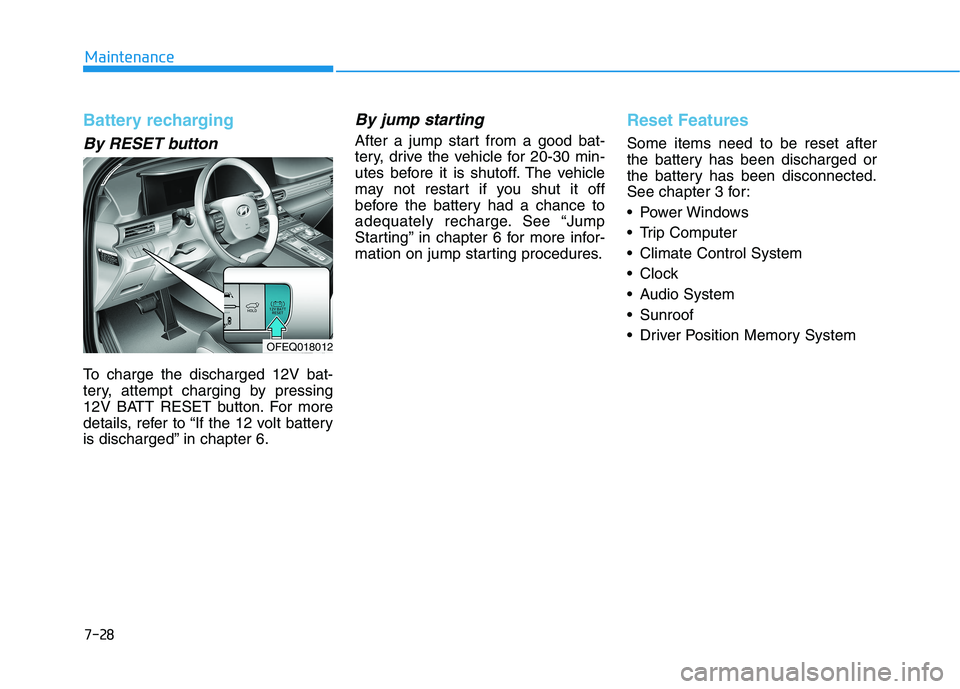
By RESET button
To charge the discharged 12V bat-
tery, attempt charging by pressing
12V BATT RESET button. For more
details, refer to “If the 12 volt battery
is discharged” in chapter 6.
By jump starting
After a jump start from a good bat-
tery, drive the vehicle for 20-30 min-
utes before it is shutoff. The vehicle
may not restart if you shut it off
before the battery had a chance to
adequately recharge. See “Jump
Starting” in chapter 6 for more infor-
mation on jump starting procedures.
Reset Features
Some items need to be reset after
the battery has been discharged or
the battery has been disconnected.
See chapter 3 for:
Power Windows
Trip Computer
Climate Control System
Clock
Audio System
Sunroof
Driver Position Memory System
OFEQ018012
Page 465 of 561
7-40
Maintenance
Maximum Inflation Pressure
The maximum air pressure to which
a cold tire may be inflated. The max-
imum air pressure is molded onto the
sidewall.
Maximum Load Rating
The load rating for a tire at the maxi-
mum permissible inflation pressure
for that tire.
Maximum Loaded VehicleWeight
The sum of curb weight; accessory
weight; vehicle capacity weight; and
production options weight.
Normal Occupant Weight
The number of occupants a vehicle
is designed to seat multiplied by 150
pounds (68 kg).
Occupant Distribution
Designated seating positions.
Outward Facing Sidewall
An asymmetrical tire has a particular
side that faces outward when mount-
ed on a vehicle. The outward facing
sidewall bears white lettering or
bears manufacturer, brand, and/or
model name molding that is higher or
deeper than the same moldings on
the inner facing sidewall.
Passenger (P-Metric) tire
A tire used on passenger cars and
some light duty trucks and multipur-
pose vehicles.
Ply
A layer of rubber-coated parallel
cords.
Pneumatic tire
A mechanical device made of rubber,
chemicals, fabric and steel or other
materials, that, when mounted on an
automotive wheel provides the trac-
tion and contains the gas or fluid that
sustains the load.
Pneumatic options weight
The combined weight of installed
regular production options weighing
over 5 lb. (2.3 kg) in excess of the
standard items which they replace,
not previously considered in curb
weight or accessory weight, includ-
ing heavy duty breaks, ride levelers,
roof rack, heavy duty battery, and
special trim.
Recommended InflationPressure
Vehicle manufacturer's recommend-
ed tire inflation pressure as shown
on the tire placard.
Page 477 of 561
7-52
Maintenance
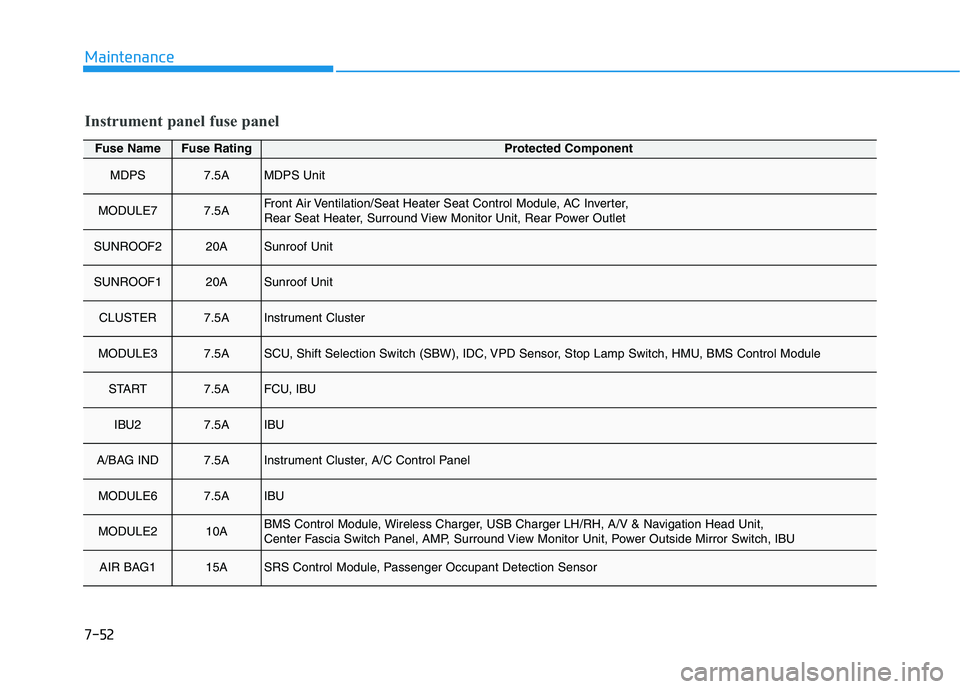
Fuse NameFuse RatingProtected Component
MDPS7.5AMDPS Unit
MODULE77.5AFront Air Ventilation/Seat Heater Seat Control Module, AC Inverter,
Rear Seat Heater, Surround View Monitor Unit, Rear Power Outlet
SUNROOF220ASunroof Unit
SUNROOF120ASunroof Unit
CLUSTER7.5AInstrument Cluster
MODULE37.5ASCU, Shift Selection Switch (SBW), IDC, VPD Sensor, Stop Lamp Switch, HMU, BMS Control Module
START7.5AFCU, IBU
IBU27.5AIBU
A/BAG IND7.5AInstrument Cluster, A/C Control Panel
MODULE67.5AIBU
MODULE210ABMS Control Module, Wireless Charger, USB Charger LH/RH, A/V & Navigation Head Unit,
Center Fascia Switch Panel, AMP, Surround View Monitor Unit, Power Outside Mirror Switch, IBU
AIR BAG115ASRS Control Module, Passenger Occupant Detection Sensor
Instrument panel fuse panel
Page 479 of 561
7-54
Maintenance
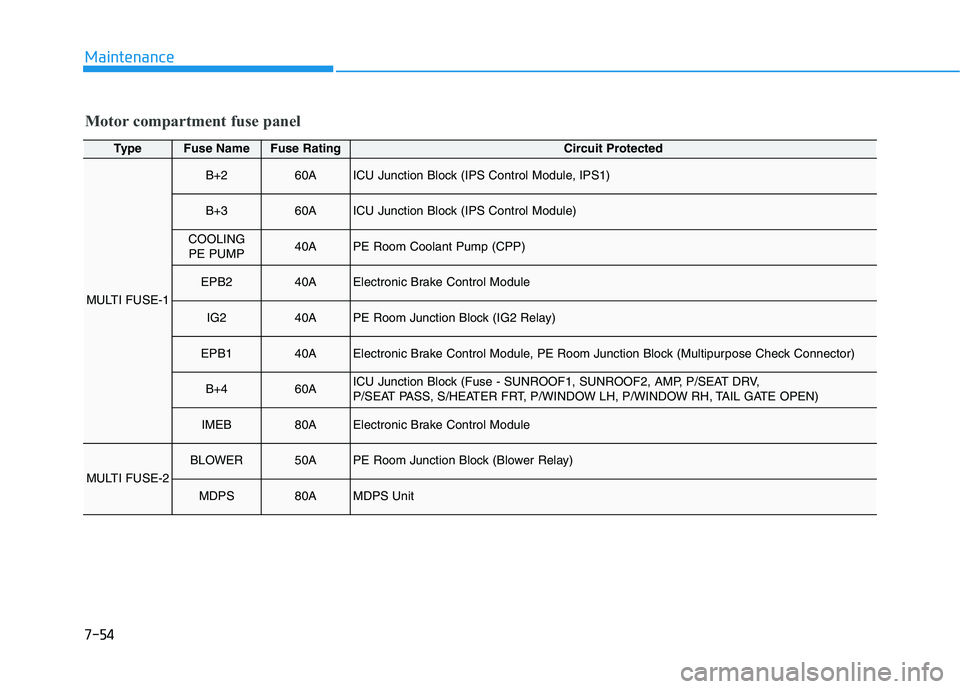
Motor compartment fuse panel
TypeFuse NameFuse RatingCircuit Protected
MULTI FUSE-1
B+260AICU Junction Block (IPS Control Module, IPS1)
B+360AICU Junction Block (IPS Control Module)
COOLING PE PUMP40APE Room Coolant Pump (CPP)
EPB240AElectronic Brake Control Module
IG240APE Room Junction Block (IG2 Relay)
EPB140AElectronic Brake Control Module, PE Room Junction Block (Multipurpose Check Connector)
B+460AICU Junction Block (Fuse - SUNROOF1, SUNROOF2, AMP, P/SEAT DRV,
P/SEAT PASS, S/HEATER FRT, P/WINDOW LH, P/WINDOW RH, TAIL GATE OPEN)
IMEB80AElectronic Brake Control Module
MULTI FUSE-2
BLOWER50APE Room Junction Block (Blower Relay)
MDPS80AMDPS Unit
Page 497 of 561
D DI
IM
ME
EN
NS
SI
IO
ON
NS
S
8-2
Specifications, Consumer information and Reporting safety defects
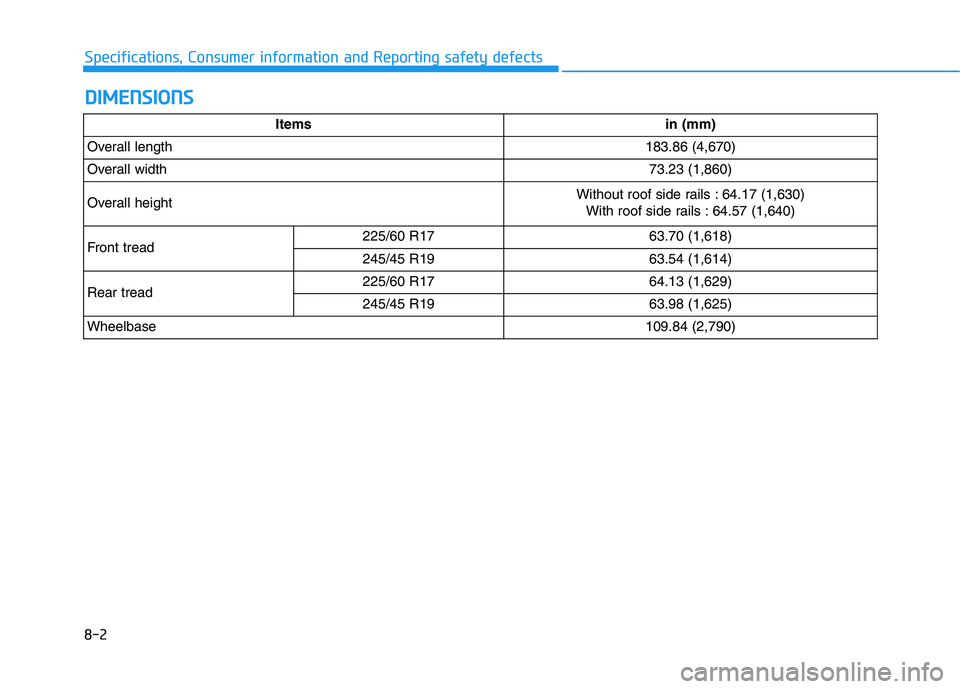
Itemsin (mm)
Overall length183.86 (4,670)
Overall width73.23 (1,860)
Overall heightWithout roof side rails : 64.17 (1,630)
With roof side rails : 64.57 (1,640)
Front tread225/60 R1763.70 (1,618)
245/45 R1963.54 (1,614)
Rear tread 225/60 R1764.13 (1,629)
245/45 R1963.98 (1,625)
Wheelbase109.84 (2,790)
Page 535 of 561
H30
C CU
US
ST
TO
OM
ME
ER
R
Q
Q&
&A
A
G
GU
UI
ID
DE
E
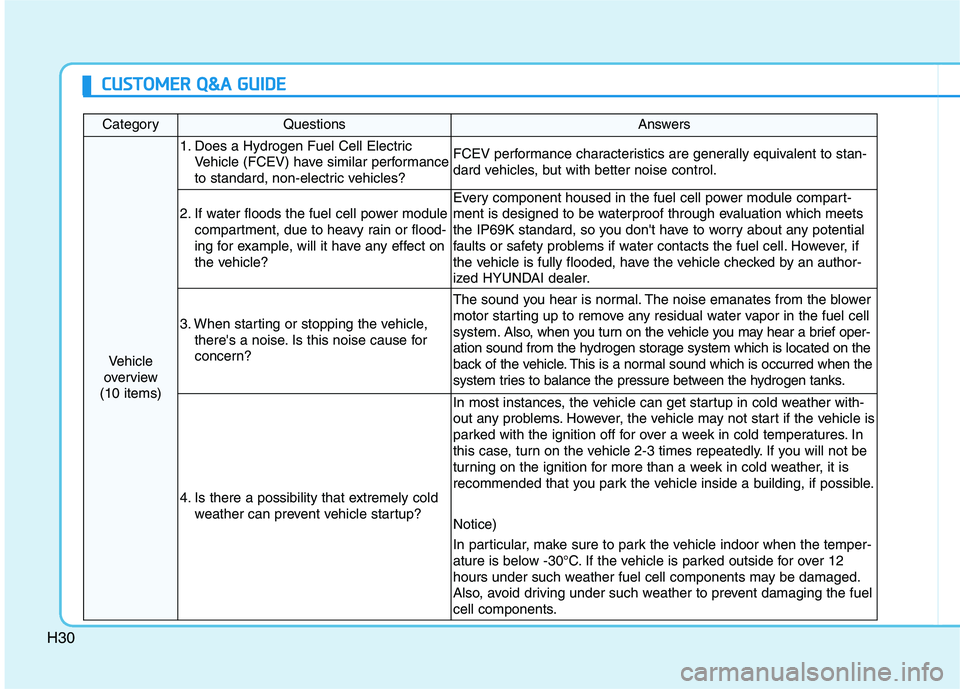
CategoryQuestionsAnswers
Vehicle
overview
(10 items)
1. Does a Hydrogen Fuel Cell Electric
Vehicle (FCEV) have similar performance
to standard, non-electric vehicles?FCEV performance characteristics are generally equivalent to stan-
dard vehicles, but with better noise control.
2. If water floods the fuel cell power module
compartment, due to heavy rain or flood-
ing for example, will it have any effect on
the vehicle?
Every component housed in the fuel cell power module compart-
ment is designed to be waterproof through evaluation which meets
the IP69K standard, so you don't have to worry about any potential
faults or safety problems if water contacts the fuel cell. However, if
the vehicle is fully flooded, have the vehicle checked by an author-
ized HYUNDAI dealer.
3. When starting or stopping the vehicle,
there's a noise. Is this noise cause for
concern?
The sound you hear is normal. The noise emanates from the blower
motor starting up to remove any residual water vapor in the fuel cell
system.Also, when you turn on the vehicle you may hear a brief oper-
ation sound from the hydrogen storage system which is located on the
back of the vehicle. This is a normal sound which is occurred when the
system tries to balance the pressure between the hydrogen tanks.
4. Is there a possibility that extremely cold
weather can prevent vehicle startup?
In most instances, the vehicle can get startup in cold weather with-
out any problems. However, the vehicle may not start if the vehicle is
parked with the ignition off for over a week in cold temperatures. In
this case, turn on the vehicle 2-3 times repeatedly. If you will not be
turning on the ignition for more than a week in cold weather, it is
recommended that you park the vehicle inside a building, if possible.
Notice)
In particular, make sure to park the vehicle indoor when the temper-
ature is below -30°C. If the vehicle is parked outside for over 12
hours under such weather fuel cell components may be damaged.
Also, avoid driving under such weather to prevent damaging the fuel
cell components.
Page 538 of 561
H33
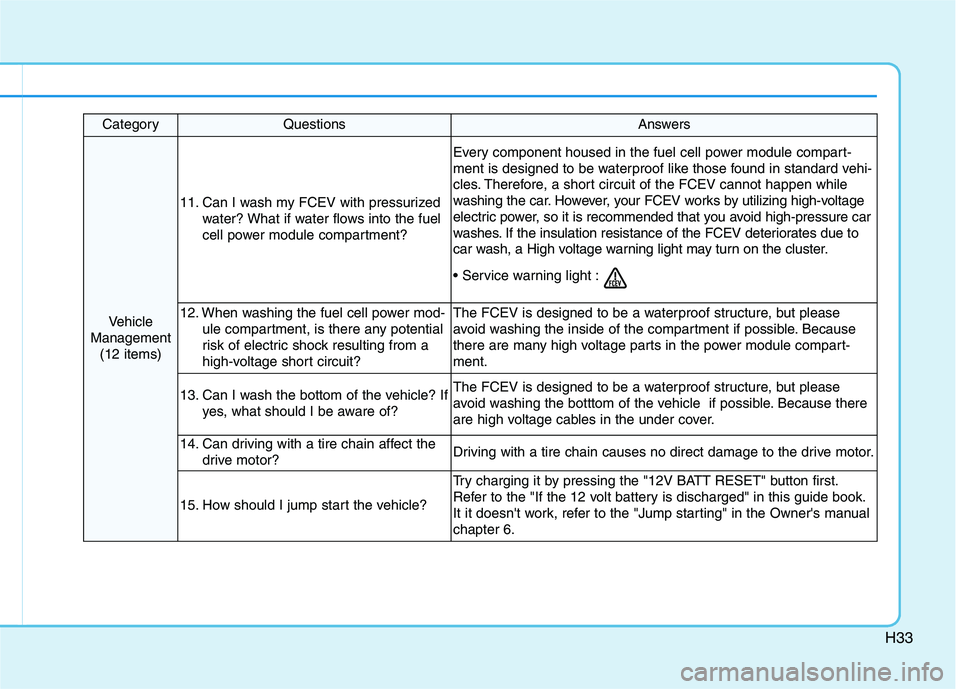
CategoryQuestionsAnswers
Vehicle
Management
(12 items)
11. Can I wash my FCEV with pressurized
water? What if water flows into the fuel
cell power module compartment?
Every component housed in the fuel cell power module compart-
ment is designed to be waterproof like those found in standard vehi-
cles. Therefore, a short circuit of the FCEV cannot happen while
washing the car. However, your FCEV works by utilizing high-voltage
electric power, so it is recommended that you avoid high-pressure car
washes. If the insulation resistance of the FCEV deteriorates due to
car wash, a High voltage warning light may turn on the cluster.
12. When washing the fuel cell power mod-
ule compartment, is there any potential
risk of electric shock resulting from a
high-voltage short circuit?The FCEV is designed to be a waterproof structure, but please
avoid washing the inside of the compartment if possible. Because
there are many high voltage parts in the power module compart-
ment.
13. Can I wash the bottom of the vehicle? If
yes, what should I be aware of?The FCEV is designed to be a waterproof structure, but please
avoid washing the botttom of the vehicle if possible. Because there
are high voltage cables in the under cover.
14. Can driving with a tire chain affect the
drive motor?Driving with a tire chain causes no direct damage to the drive motor.
15. How should I jump start the vehicle?
Try charging it by pressing the "12V BATT RESET" button first.
Refer to the "If the 12 volt battery is discharged" in this guide book.
It it doesn't work, refer to the "Jump starting" in the Owner's manual
chapter 6.
Page 553 of 561
I-3
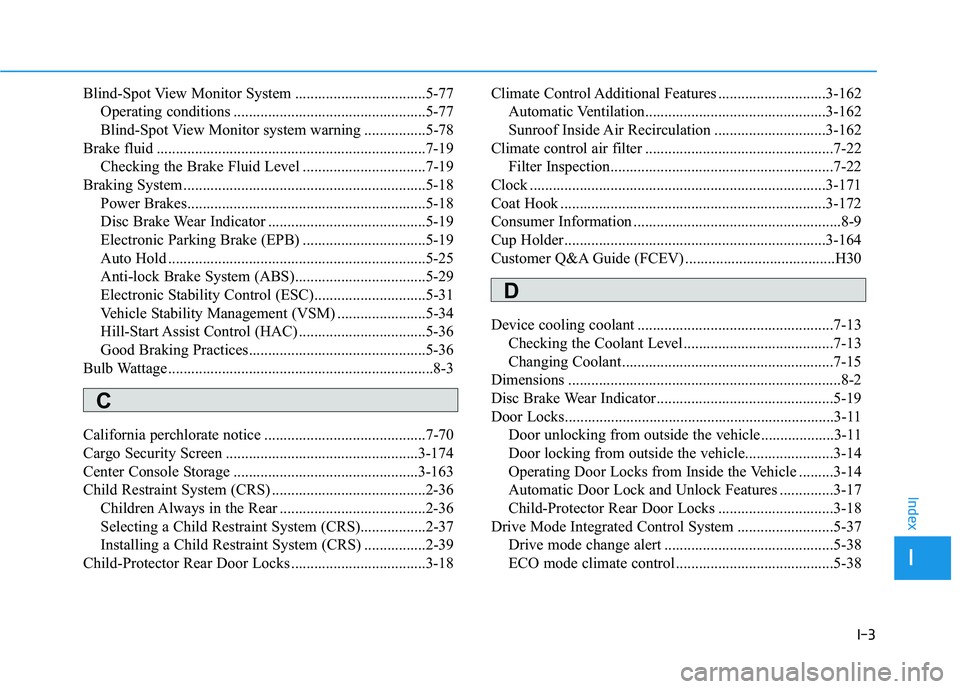
Blind-Spot View Monitor System ..................................5-77
Operating conditions ..................................................5-77
Blind-Spot View Monitor system warning ................5-78
Brake fluid ......................................................................7-19
Checking the Brake Fluid Level ................................7-19
Braking System ...............................................................5-18
Power Brakes..............................................................5-18
Disc Brake Wear Indicator .........................................5-19
Electronic Parking Brake (EPB) ................................5-19
Auto Hold ...................................................................5-25
Anti-lock Brake System (ABS)..................................5-29
Electronic Stability Control (ESC).............................5-31
Vehicle Stability Management (VSM) .......................5-34
Hill-Start Assist Control (HAC) .................................5-36
Good Braking Practices..............................................5-36
Bulb Wattage .....................................................................8-3
California perchlorate notice ..........................................7-70
Cargo Security Screen ..................................................3-174
Center Console Storage ................................................3-163
Child Restraint System (CRS) ........................................2-36
Children Always in the Rear ......................................2-36
Selecting a Child Restraint System (CRS).................2-37
Installing a Child Restraint System (CRS) ................2-39
Child-Protector Rear Door Locks ...................................3-18Climate Control Additional Features ............................3-162
Automatic Ventilation...............................................3-162
Sunroof Inside Air Recirculation .............................3-162
Climate control air filter .................................................7-22
Filter Inspection..........................................................7-22
Clock .............................................................................3-171
Coat Hook .....................................................................3-172
Consumer Information ......................................................8-9
Cup Holder....................................................................3-164
Customer Q&A Guide (FCEV) .......................................H30
Device cooling coolant ...................................................7-13
Checking the Coolant Level .......................................7-13
Changing Coolant.......................................................7-15
Dimensions .......................................................................8-2
Disc Brake Wear Indicator..............................................5-19
Door Locks......................................................................3-11
Door unlocking from outside the vehicle...................3-11
Door locking from outside the vehicle.......................3-14
Operating Door Locks from Inside the Vehicle .........3-14
Automatic Door Lock and Unlock Features ..............3-17
Child-Protector Rear Door Locks ..............................3-18
Drive Mode Integrated Control System .........................5-37
Drive mode change alert ............................................5-38
ECO mode climate control .........................................5-38
I
Index
C
D
Page 554 of 561
I-4
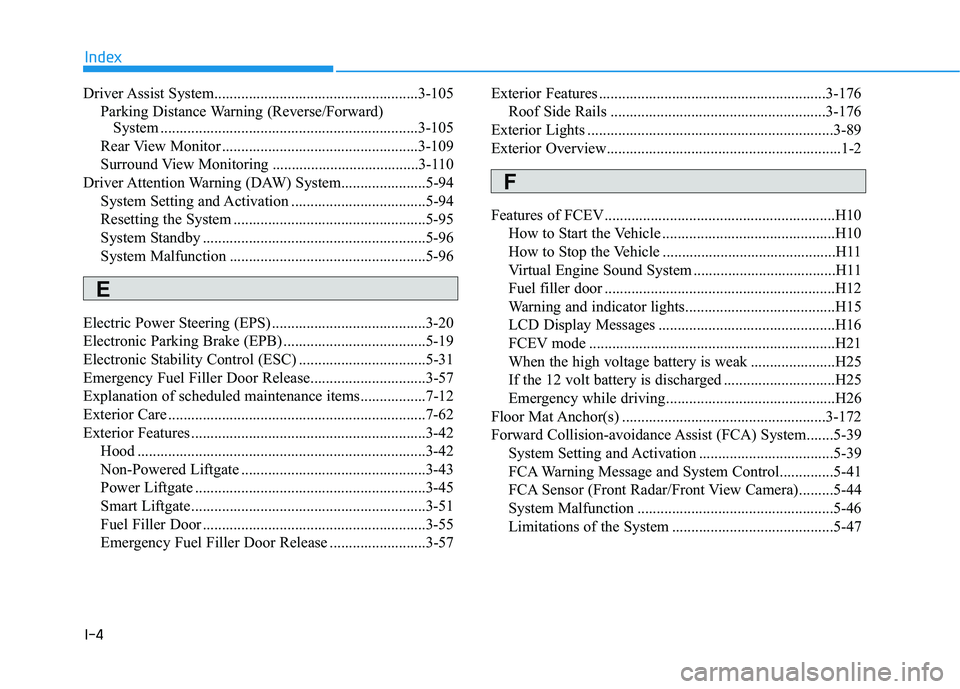
Driver Assist System.....................................................3-105
Parking Distance Warning (Reverse/Forward)
System ...................................................................3-105
Rear View Monitor ...................................................3-109
Surround View Monitoring ......................................3-110
Driver Attention Warning (DAW) System......................5-94
System Setting and Activation ...................................5-94
Resetting the System ..................................................5-95
System Standby ..........................................................5-96
System Malfunction ...................................................5-96
Electric Power Steering (EPS) ........................................3-20
Electronic Parking Brake (EPB) .....................................5-19
Electronic Stability Control (ESC) .................................5-31
Emergency Fuel Filler Door Release..............................3-57
Explanation of scheduled maintenance items.................7-12
Exterior Care ...................................................................7-62
Exterior Features .............................................................3-42
Hood ...........................................................................3-42
Non-Powered Liftgate ................................................3-43
Power Liftgate ............................................................3-45
Smart Liftgate.............................................................3-51
Fuel Filler Door ..........................................................3-55
Emergency Fuel Filler Door Release .........................3-57Exterior Features ...........................................................3-176
Roof Side Rails ........................................................3-176
Exterior Lights ................................................................3-89
Exterior Overview.............................................................1-2
Features of FCEV............................................................H10
How to Start the Vehicle .............................................H10
How to Stop the Vehicle .............................................H11
Virtual Engine Sound System .....................................H11
Fuel filler door ............................................................H12
Warning and indicator lights.......................................H15
LCD Display Messages ..............................................H16
FCEV mode ................................................................H21
When the high voltage battery is weak ......................H25
If the 12 volt battery is discharged .............................H25
Emergency while driving............................................H26
Floor Mat Anchor(s) .....................................................3-172
Forward Collision-avoidance Assist (FCA) System.......5-39
System Setting and Activation ...................................5-39
FCA Warning Message and System Control..............5-41
FCA Sensor (Front Radar/Front View Camera).........5-44
System Malfunction ...................................................5-46
Limitations of the System ..........................................5-47
Index
E
F