stop start HYUNDAI NEXO 2020 Owner's Manual
[x] Cancel search | Manufacturer: HYUNDAI, Model Year: 2020, Model line: NEXO, Model: HYUNDAI NEXO 2020Pages: 561, PDF Size: 48.42 MB
Page 401 of 561
6-3
What to do in an emergency
If a fire occurs
1. Stop the vehicle, shift gear to the
P(Park) position, engage the park-
ing brake, and turn the vehicle off.
The flow of hydrogen into the fuel
cell stack will be shut off to prevent
the electricity from being generat-
ed.
2. If the fire is small, which can be
extinguished with fire extinguisher,
use carbon dioxide extinguisher.
You can also extinguish the fire
with water when the vehicle power
is turned off.If the fire is too big to be extin-
guished with the fire extinguisher,
evacuate from the vehicle, call the
fire department, and let them know
the vehicle is a Fuel Cell Electric
Vehicle. Do not come close to the
vehicle until the fire is totally extin-
guished.
Emergency venting of hydro-
gen gas
If the temperature near the safety
valve located at the rear under vehi-
cle is over 230°F (110°C) caused by
a fire or other reasons, the safety
valve will open to vent hydrogen gas.
Venting the hydrogen gas makes a
loud noise because the venting
speed is very fast. Stay well away
from the vehicle. The discharge of
hydrogen gas from the vehicle is
flammable and could cause a fire.
If a submersion in water
occurs
If your vehicle was flooded and has
soaked carpeting or water on the
flooring, you should not try to start
the vehicle by pressing the POWER
button.
Contact an authorized HYUNDAI
dealer immediately.
If the vehicle stalls at a cross-
road or crossing
If the vehicle stalls at a crossroad or
crossing, set the gear in the N
(Neutral) position and then push the
vehicle to a safe place.
6
Do not use water to extinguish a
fire when the vehicle power is
turned on. Serious electric
shock may result.
WARNING
Page 402 of 561
6-4
If you have a flat tire while
driving
If a tire goes flat while you are driv-
ing:
1. Take your foot off the accelerator
pedal and let the vehicle slow
down while driving straight ahead.
Do not apply the brakes immedi-
ately or attempt to pull off the road
as this may cause a loss of con-
trol. When the vehicle has slowed
to such a speed that it is safe to do
so, brake carefully and pull off the
road. Drive off the road as far as
possible and park on firm, level
ground. If you are on a divided
highway, do not park in the medi-
an area between the two traffic
lanes.
2. When the vehicle is stopped, turn
on your emergency hazard flash-
ers, set the parking brake and shift
gear to the P(Park) position.
3. Have all passengers get out of the
vehicle. Be sure they all get out on
the side of the vehicle that is away
from traffic.
If the vehicle stalls while driv-
ing
1. Reduce your speed gradually,
keeping a straight line. Move cau-
tiously off the road to a safe place.
2. Turn on your emergency flashers.
3. Try to start the vehicle again. If
your vehicle will not start, contact
an authorized HYUNDAI dealer. Be sure the shift lever is in P
(Park). The vehicle starts only
when the shift lever is in P (Park).
This vehicle does not have a regu-
lar 12V battery that needs periodic
replacement. It is lithium ion poly-
mer type integrated into the high
voltage battery. The vehicle has a
12V battery protection system that
cuts 12V battery from vehicle draw
to prevent full discharge. If vehicle
will not start, first try pressing the
12V Battery Reset switch (left side
of the steering wheel near the fuel
door open switch) to reconnect the
12V battery, but you must start
vehicle within 15 seconds of press-
ing the 12V Battery Reset switch.
After starting vehicle, operate the
vehicle safely outdoors in ready
mode stopped and/or drive it for 30
minutes total to charge the 12V
battery fully.
Check the fuel level and add fuel if
necessary.
Do not push or pull the vehicle to
start it.
If the vehicle still does not start, call
an authorized HYUNDAI dealer for
assistance.
What to do in an emergency
I IF
F
T
TH
HE
E
V
VE
EH
HI
IC
CL
LE
E
W
WI
IL
LL
L
N
NO
OT
T
S ST
TA
AR
RT
T
Page 405 of 561
6-7
What to do in an emergency
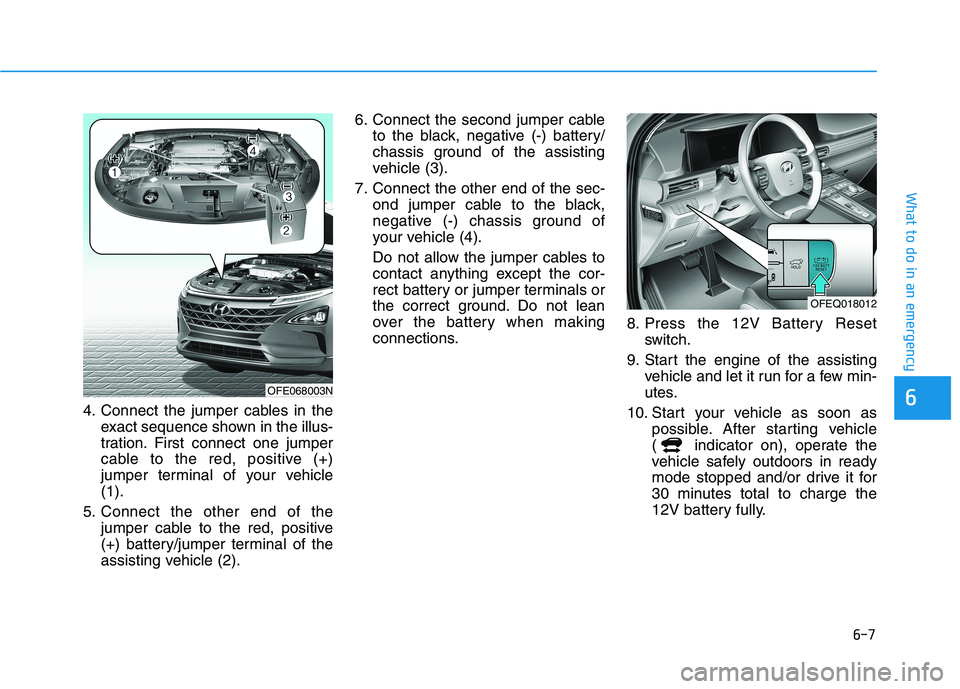
64. Connect the jumper cables in the
exact sequence shown in the illus-
tration. First connect one jumper
cable to the red, positive (+)
jumper terminal of your vehicle
(1).
5. Connect the other end of the
jumper cable to the red, positive
(+) battery/jumper terminal of the
assisting vehicle (2).6. Connect the second jumper cable
to the black, negative (-) battery/
chassis ground of the assisting
vehicle (3).
7. Connect the other end of the sec-
ond jumper cable to the black,
negative (-) chassis ground of
your vehicle (4).
Do not allow the jumper cables to
contact anything except the cor-
rect battery or jumper terminals or
the correct ground. Do not lean
over the battery when making
connections.8. Press the 12V Battery Reset
switch.
9. Start the engine of the assisting
vehicle and let it run for a few min-
utes.
10. Start your vehicle as soon as
possible. After starting vehicle
( indicator on), operate the
vehicle safely outdoors in ready
mode stopped and/or drive it for
30 minutes total to charge the
12V battery fully.
OFE068003N
OFEQ018012
Page 406 of 561
6-8
What to do in an emergency
If your vehicle will not start after a
few attempts, it probably requires
servicing. In this event please seek
qualified assistance. If the cause of
your battery discharging is not
apparent, have your vehicle checked
by an authorized HYUNDAI dealer.
Disconnect the jumper cables in the
exact reverse order you connected
them:
1. Disconnect the jumper cable from
the black, negative (-) chassis
ground of your vehicle (4).
2. Disconnect the other end of the
jumper cable from the black, neg-
ative (-) battery/chassis ground of
the assisting vehicle (3).
3. Disconnect the second jumper
cable from the red, positive (+)
battery/jumper terminal of the
assisting vehicle (2).
4. Disconnect the other end of the
jumper cable from the red, positive
(+) jumper terminal of your vehicle
(1).
Information
The voltage range of the charger
should be 13.3~14V and its current
range should be less than 60A. (13.8V
is recommended).
Information
An inappropriately disposed
battery can be harmful to the
environment and human
health. Dispose of the battery
according to your local law(s)
or regulations.
To prevent damage to your vehi-
cle:
• Only use a 12-volt power supply
(battery or jumper system) to
jump start your vehicle.
Do not attempt to jump start
your vehicle by push-starting.
NOTICE
ii
The use of an improper charg-
er with a voltage and current
range higher than specified
may cause overheating and
damage to the 12V battery.
The use of an incorrect charg-
er will lead to a power shut-off
to save the 12V battery. Stop
using the incorrect charger
once the power of the vehicle
is shut off.
CAUTION
Pb
Page 410 of 561
6-12
What to do in an emergency
Tire Pressure Monitoring
System
Each tire, including the spare (if pro-
vided), should be checked monthly
when cold and inflated to the inflation
pressure recommended by the vehi-
cle manufacturer on the vehicle plac-
ard or tire inflation pressure label. If
your vehicle has tires of a different
size than the size indicated on the
vehicle placard or tire inflation pres-
sure label, you should determine the
proper tire inflation pressure for
those tires.As an added safety feature, your
vehicle has been equipped with a tire
pressure monitoring system (TPMS)
that illuminates a low tire pressure
telltale when one or more of your
tires is significantly under-inflated.
Accordingly, when the low tire pres-
sure telltale illuminates, you should
stop and check your tires as soon as
possible, and inflate them to the
proper pressure. Driving on a signifi-
cantly under-inflated tire causes the
tire to overheat and can lead to tire
failure.
Under-inflation also reduces fuel effi-
ciency and tire tread life, and may
affect the vehicle's handling and
stopping ability.
Please note that the TPMS is not a
substitute for proper tire mainte-
nance, and it is the driver's responsi-
bility to maintain correct tire pres-
sure, even if under-inflation has not
reached the level to trigger illumina-
tion of the TPMS low tire pressure
telltale.Your vehicle has also been equipped
with a TPMS malfunction indicator to
indicate when the system is not
operating properly. The TPMS mal-
function indicator is combined with
the low tire pressure telltale. When
the system detects a malfunction,
the telltale will flash for approximate-
ly one minute and then remain con-
tinuously illuminated. This sequence
will continue upon subsequent vehi-
cle start-ups as long as the malfunc-
tion exists.
When the malfunction indicator is
illuminated, the system may not be
able to detect or signal low tire pres-
sure as intended. TPMS malfunc-
tions may occur for a variety of rea-
sons, including the installation of
replacement or alternate tires or
wheels on the vehicle that prevent
the TPMS from functioning properly.
Always check the TPMS malfunction
telltale after replacing one or more
tires or wheels on your vehicle to
ensure that the replacement or alter-
nate tires and wheels allow the TPMS
to continue to function properly. Over-inflation or under-inflation
can reduce tire life, adversely
affect vehicle handling, and
lead to sudden tire failure that
may cause loss of vehicle con-
trol resulting in an accident.
WARNING
Page 477 of 561
7-52
Maintenance
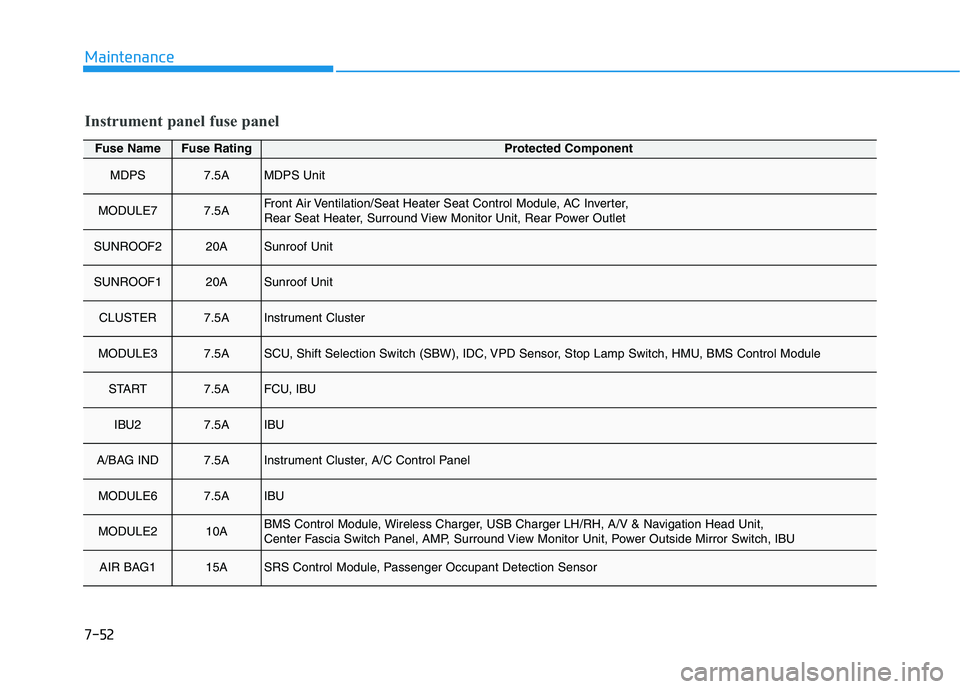
Fuse NameFuse RatingProtected Component
MDPS7.5AMDPS Unit
MODULE77.5AFront Air Ventilation/Seat Heater Seat Control Module, AC Inverter,
Rear Seat Heater, Surround View Monitor Unit, Rear Power Outlet
SUNROOF220ASunroof Unit
SUNROOF120ASunroof Unit
CLUSTER7.5AInstrument Cluster
MODULE37.5ASCU, Shift Selection Switch (SBW), IDC, VPD Sensor, Stop Lamp Switch, HMU, BMS Control Module
START7.5AFCU, IBU
IBU27.5AIBU
A/BAG IND7.5AInstrument Cluster, A/C Control Panel
MODULE67.5AIBU
MODULE210ABMS Control Module, Wireless Charger, USB Charger LH/RH, A/V & Navigation Head Unit,
Center Fascia Switch Panel, AMP, Surround View Monitor Unit, Power Outside Mirror Switch, IBU
AIR BAG115ASRS Control Module, Passenger Occupant Detection Sensor
Instrument panel fuse panel
Page 506 of 561
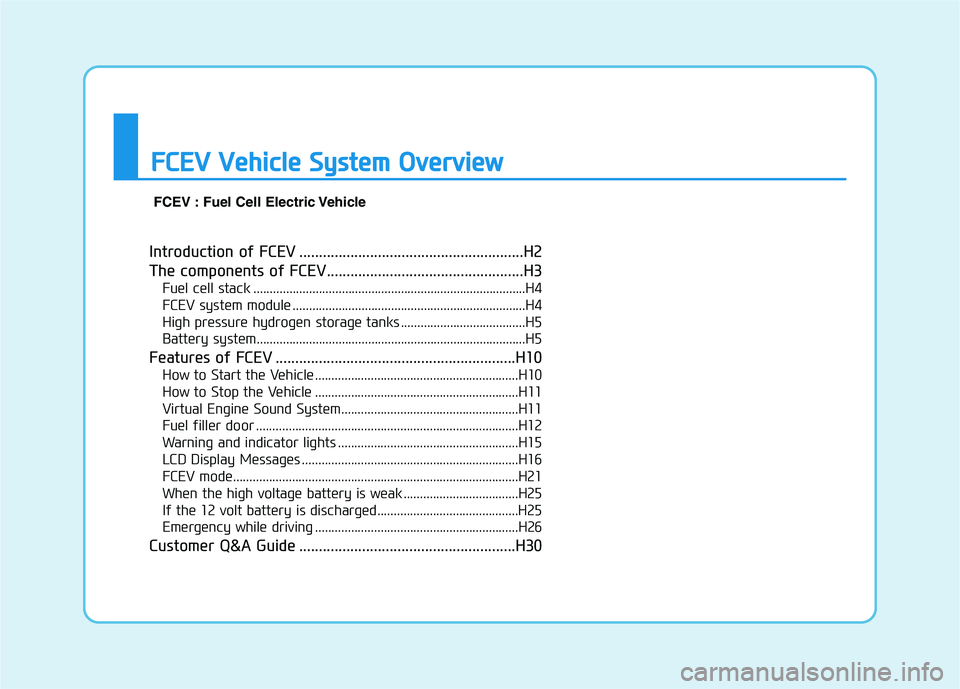
Introduction of FCEV .........................................................H2
The components of FCEV..................................................H3
Fuel cell stack ...................................................................................H4
FCEV system module .......................................................................H4
High pressure hydrogen storage tanks ......................................H5
Battery system..................................................................................H5
Features of FCEV .............................................................H10
How to Start the Vehicle ..............................................................H10
How to Stop the Vehicle ..............................................................H11
Virtual Engine Sound System......................................................H11
Fuel filler door ................................................................................H12
Warning and indicator lights .......................................................H15
LCD Display Messages ..................................................................H16
FCEV mode.......................................................................................H21
When the high voltage battery is weak ...................................H25
If the 12 volt battery is discharged...........................................H25
Emergency while driving ..............................................................H26
Customer Q&A Guide .......................................................H30
F FC
CE
EV
V
V
Ve
eh
hi
ic
cl
le
e
S
Sy
ys
st
te
em
m
O
Ov
ve
er
rv
vi
ie
ew
w
FCEV : Fuel Cell Electric Vehicle
Page 524 of 561
H19
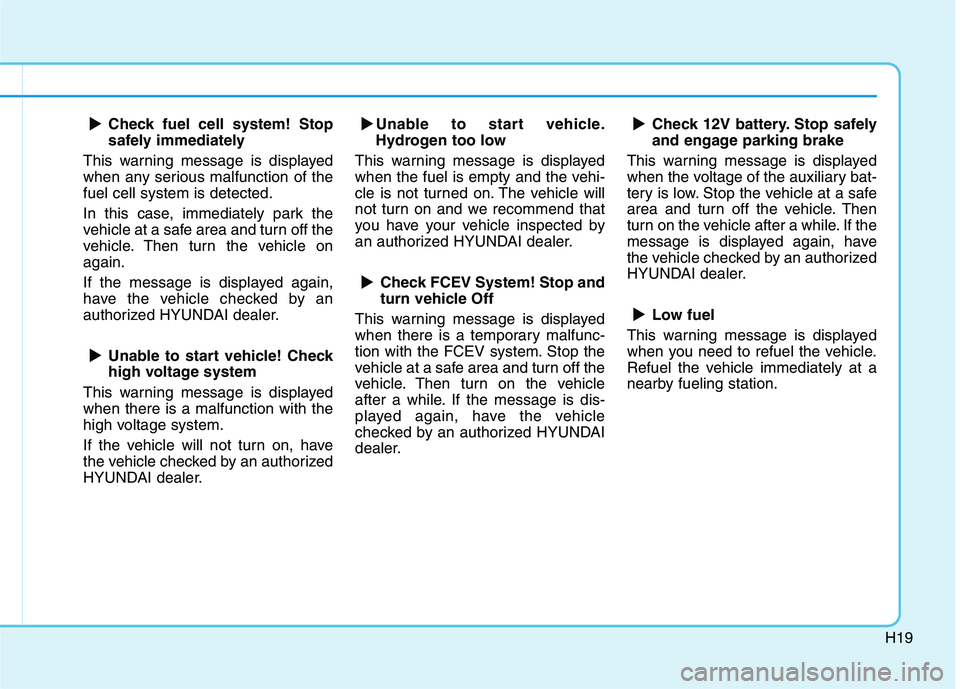
Check fuel cell system! Stop
safely immediately
This warning message is displayed
when any serious malfunction of the
fuel cell system is detected.
In this case, immediately park the
vehicle at a safe area and turn off the
vehicle. Then turn the vehicle on
again.
If the message is displayed again,
have the vehicle checked by an
authorized HYUNDAI dealer.
Unable to start vehicle! Check
high voltage system
This warning message is displayed
when there is a malfunction with the
high voltage system.
If the vehicle will not turn on, have
the vehicle checked by an authorized
HYUNDAI dealer.Unable to start vehicle.
Hydrogen too low
This warning message is displayed
when the fuel is empty and the vehi-
cle is not turned on. The vehicle will
not turn on and we recommend that
you have your vehicle inspected by
an authorized HYUNDAI dealer.
Check FCEV System! Stop and
turn vehicle Off
This warning message is displayed
when there is a temporary malfunc-
tion with the FCEV system. Stop the
vehicle at a safe area and turn off the
vehicle. Then turn on the vehicle
after a while. If the message is dis-
played again, have the vehicle
checked by an authorized HYUNDAI
dealer.Check 12V battery. Stop safely
and engage parking brake
This warning message is displayed
when the voltage of the auxiliary bat-
tery is low. Stop the vehicle at a safe
area and turn off the vehicle. Then
turn on the vehicle after a while. If the
message is displayed again, have
the vehicle checked by an authorized
HYUNDAI dealer.
Low fuel
This warning message is displayed
when you need to refuel the vehicle.
Refuel the vehicle immediately at a
nearby fueling station.
▲ ▲ ▲
▲
▲ ▲ ▲
▲
▲ ▲ ▲
▲
Page 531 of 561
H26
F FE
EA
AT
TU
UR
RE
ES
S
O
OF
F
F
FC
CE
EV
V
(
(C
CO
ON
NT
T.
.)
)
If you do not start the vehicle imme-
diately after pressing the 12V Battery
Reset switch, the power of 12V bat-
tery is automatically disconnected
after few seconds to save the 12V
battery from additional discharge. If
the 12V battery is disconnected prior
to starting the vehicle, press the 12V
Battery Reset switch again and then
immediately start the vehicle as
explained.
Repeated use of the 12V Battery
Reset switch without a sufficient ON
cycle (30 Min+) may cause over dis-
charge of the 12V battery, which will
prevent the vehicle from starting. If
the 12V battery is over discharged to
a point that the reset does not work,
try to jump-start the vehicle.Information
After starting the vehicle ( indica-
tor on), the 12V battery is being
charged whether the accelerator pedal
is depressed or not.
❈ ❈
For more details regarding the
jump start, refer to the 'Jump star-
ing' in Owner's manual Chapter 6.
Emergency while driving
If an accident occurs
1. Stop the vehicle, put the gear into
the P (Park) position, set the park-
ing brake, and turn the vehicle off
to prevent the hydrogen and cur-
rent from leaking.
The flow of hydrogen into the fuel
cell stack will be shut off to prevent
the current from being generated.
2. Evacuate to the safety place.
3. Call emergency services for help
and let them know the vehicle is a
Fuel Cell Electric Vehicle.
i
Page 532 of 561

H27
If a fire occurs
1. Stop the vehicle, put the gear into
the P(Park) position, set the park-
ing brake, and turn the vehicle off
to prevent the hydrogen and cur-
rent from leaking.
The flow of hydrogen into the fuel
cell stack will be shut off to prevent
the current from being generated.
2. If the fire is small, which can be
extinguished with fire extinguisher,
use carbon dioxide extinguisher.
You can also extinguish the fire
with water when the vehicle power
is turned off.If the fire is too big to be extinguished
with the fire extinguisher, evacuate
from the vehicle, call the fire depart-
ment, and let them know the vehicle
is a Fuel Cell Electric Vehicle. Do not
come close to the vehicle until the
fire is totally extinguished.
Emergency venting of hydrogen
gas
If the temperature near the safety
valve located at the rear under vehi-
cle is over 110°C caused by a fire or
other reasons, the safety valve will
open to vent hydrogen gas. Venting
the hydrogen gas makes a loud
noise because the venting speed is
very fast. Stay well away from the
vehicle. This jet stream of hydrogen
gas could ignite.
If a submersion in water occurs
If your vehicle was flooded and has
soaked carpeting or water on the
flooring, you should not try to start
the vehicle by pressing the POWER
button.
Call an authorized HYUNDAI dealer. Do not use water to extinguish a
fire when the vehicle power is
turned on. Serious electric
shock may result.
WARNING