warning HYUNDAI NEXO 2020 Owners Manual
[x] Cancel search | Manufacturer: HYUNDAI, Model Year: 2020, Model line: NEXO, Model: HYUNDAI NEXO 2020Pages: 561, PDF Size: 48.42 MB
Page 532 of 561

H27
If a fire occurs
1. Stop the vehicle, put the gear into
the P(Park) position, set the park-
ing brake, and turn the vehicle off
to prevent the hydrogen and cur-
rent from leaking.
The flow of hydrogen into the fuel
cell stack will be shut off to prevent
the current from being generated.
2. If the fire is small, which can be
extinguished with fire extinguisher,
use carbon dioxide extinguisher.
You can also extinguish the fire
with water when the vehicle power
is turned off.If the fire is too big to be extinguished
with the fire extinguisher, evacuate
from the vehicle, call the fire depart-
ment, and let them know the vehicle
is a Fuel Cell Electric Vehicle. Do not
come close to the vehicle until the
fire is totally extinguished.
Emergency venting of hydrogen
gas
If the temperature near the safety
valve located at the rear under vehi-
cle is over 110°C caused by a fire or
other reasons, the safety valve will
open to vent hydrogen gas. Venting
the hydrogen gas makes a loud
noise because the venting speed is
very fast. Stay well away from the
vehicle. This jet stream of hydrogen
gas could ignite.
If a submersion in water occurs
If your vehicle was flooded and has
soaked carpeting or water on the
flooring, you should not try to start
the vehicle by pressing the POWER
button.
Call an authorized HYUNDAI dealer. Do not use water to extinguish a
fire when the vehicle power is
turned on. Serious electric
shock may result.
WARNING
Page 536 of 561
H31
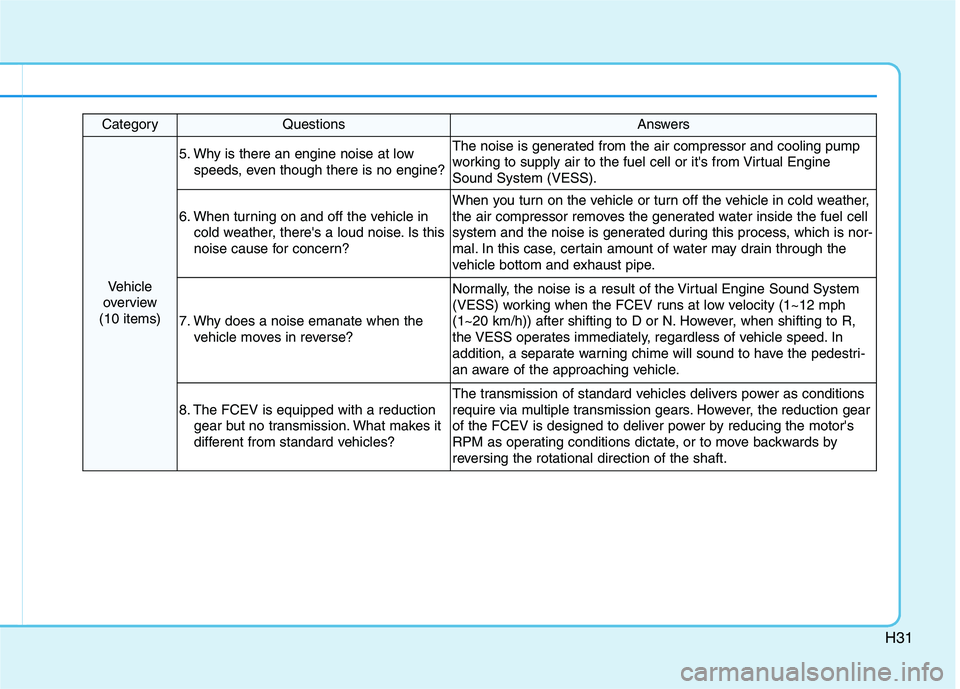
CategoryQuestionsAnswers
Vehicle
overview
(10 items)
5. Why is there an engine noise at low
speeds, even though there is no engine?The noise is generated from the air compressor and cooling pump
working to supply air to the fuel cell or it's from Virtual Engine
Sound System (VESS).
6. When turning on and off the vehicle in
cold weather, there's a loud noise. Is this
noise cause for concern?
When you turn on the vehicle or turn off the vehicle in cold weather,
the air compressor removes the generated water inside the fuel cell
system and the noise is generated during this process, which is nor-
mal. In this case, certain amount of water may drain through the
vehicle bottom and exhaust pipe.
7. Why does a noise emanate when the
vehicle moves in reverse?
Normally, the noise is a result of the Virtual Engine Sound System
(VESS) working when the FCEV runs at low velocity (1~12 mph
(1~20 km/h)) after shifting to D or N. However, when shifting to R,
the VESS operates immediately, regardless of vehicle speed. In
addition, a separate warning chime will sound to have the pedestri-
an aware of the approaching vehicle.
8. The FCEV is equipped with a reduction
gear but no transmission. What makes it
different from standard vehicles?
The transmission of standard vehicles delivers power as conditions
require via multiple transmission gears. However, the reduction gear
of the FCEV is designed to deliver power by reducing the motor's
RPM as operating conditions dictate, or to move backwards by
reversing the rotational direction of the shaft.
Page 537 of 561
H32
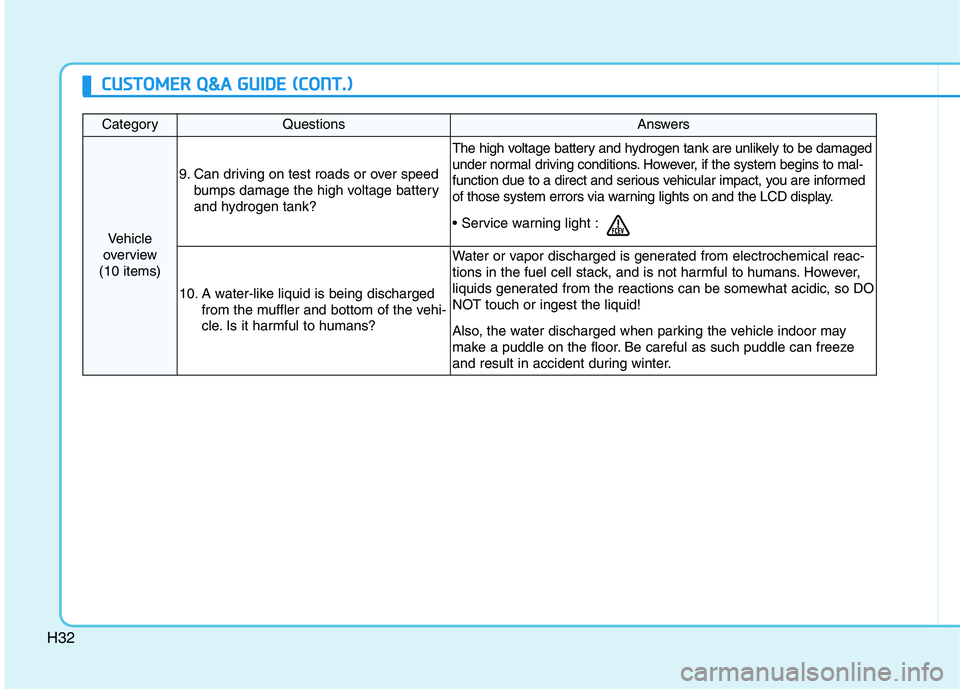
CategoryQuestionsAnswers
Vehicle
overview
(10 items)
9. Can driving on test roads or over speed
bumps damage the high voltage battery
and hydrogen tank?
The high voltage battery and hydrogen tank are unlikely to be damaged
under normal driving conditions. However, if the system begins to mal-
function due to a direct and serious vehicular impact, you are informed
of those system errors via warning lights on and the LCD display.
10. A water-like liquid is being discharged
from the muffler and bottom of the vehi-
cle. Is it harmful to humans?
Water or vapor discharged is generated from electrochemical reac-
tions in the fuel cell stack, and is not harmful to humans. However,
liquids generated from the reactions can be somewhat acidic, so DO
NOT touch or ingest the liquid!
Also, the water discharged when parking the vehicle indoor may
make a puddle on the floor. Be careful as such puddle can freeze
and result in accident during winter.
C CU
US
ST
TO
OM
ME
ER
R
Q
Q&
&A
A
G
GU
UI
ID
DE
E
(
(C
CO
ON
NT
T.
.)
)
Page 538 of 561
H33
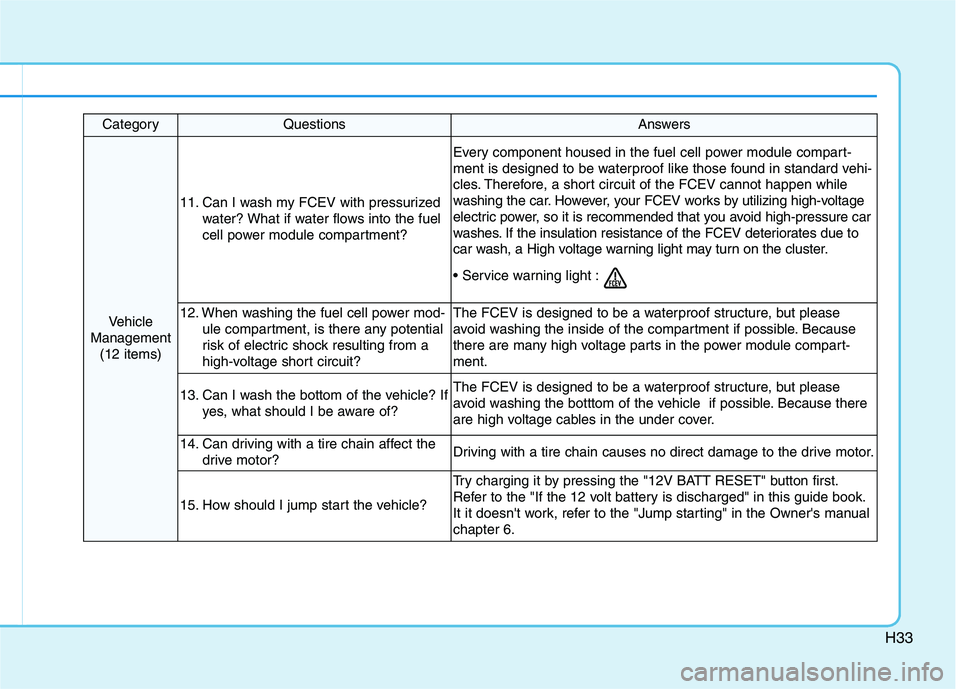
CategoryQuestionsAnswers
Vehicle
Management
(12 items)
11. Can I wash my FCEV with pressurized
water? What if water flows into the fuel
cell power module compartment?
Every component housed in the fuel cell power module compart-
ment is designed to be waterproof like those found in standard vehi-
cles. Therefore, a short circuit of the FCEV cannot happen while
washing the car. However, your FCEV works by utilizing high-voltage
electric power, so it is recommended that you avoid high-pressure car
washes. If the insulation resistance of the FCEV deteriorates due to
car wash, a High voltage warning light may turn on the cluster.
12. When washing the fuel cell power mod-
ule compartment, is there any potential
risk of electric shock resulting from a
high-voltage short circuit?The FCEV is designed to be a waterproof structure, but please
avoid washing the inside of the compartment if possible. Because
there are many high voltage parts in the power module compart-
ment.
13. Can I wash the bottom of the vehicle? If
yes, what should I be aware of?The FCEV is designed to be a waterproof structure, but please
avoid washing the botttom of the vehicle if possible. Because there
are high voltage cables in the under cover.
14. Can driving with a tire chain affect the
drive motor?Driving with a tire chain causes no direct damage to the drive motor.
15. How should I jump start the vehicle?
Try charging it by pressing the "12V BATT RESET" button first.
Refer to the "If the 12 volt battery is discharged" in this guide book.
It it doesn't work, refer to the "Jump starting" in the Owner's manual
chapter 6.
Page 540 of 561
H35
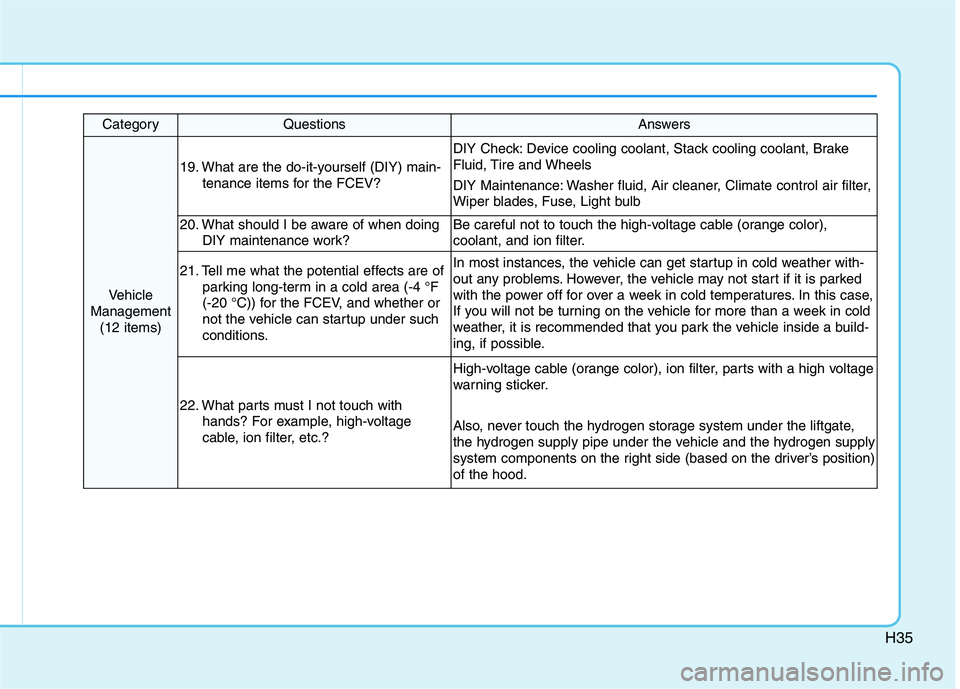
CategoryQuestionsAnswers
Vehicle
Management
(12 items)
19. What are the do-it-yourself (DIY) main-
tenance items for the FCEV?
DIY Check: Device cooling coolant, Stack cooling coolant, Brake
Fluid, Tire and Wheels
DIY Maintenance: Washer fluid, Air cleaner, Climate control air filter,
Wiper blades, Fuse, Light bulb
20. What should I be aware of when doing
DIY maintenance work?Be careful not to touch the high-voltage cable (orange color),
coolant, and ion filter.
21. Tell me what the potential effects are of
parking long-term in a cold area (-4 °F
(-20 °C)) for the FCEV, and whether or
not the vehicle can startup under such
conditions.In most instances, the vehicle can get startup in cold weather with-
out any problems. However, the vehicle may not start if it is parked
with the power off for over a week in cold temperatures. In this case,
If you will not be turning on the vehicle for more than a week in cold
weather, it is recommended that you park the vehicle inside a build-
ing, if possible.
22. What parts must I not touch with
hands? For example, high-voltage
cable, ion filter, etc.?
High-voltage cable (orange color), ion filter, parts with a high voltage
warning sticker.
Also, never touch the hydrogen storage system under the liftgate,
the hydrogen supply pipe under the vehicle and the hydrogen supply
system components on the right side (based on the driver’s position)
of the hood.
Page 541 of 561
H36
CategoryQuestionsAnswers
Cluster/
Warning Lamp
(9 items)
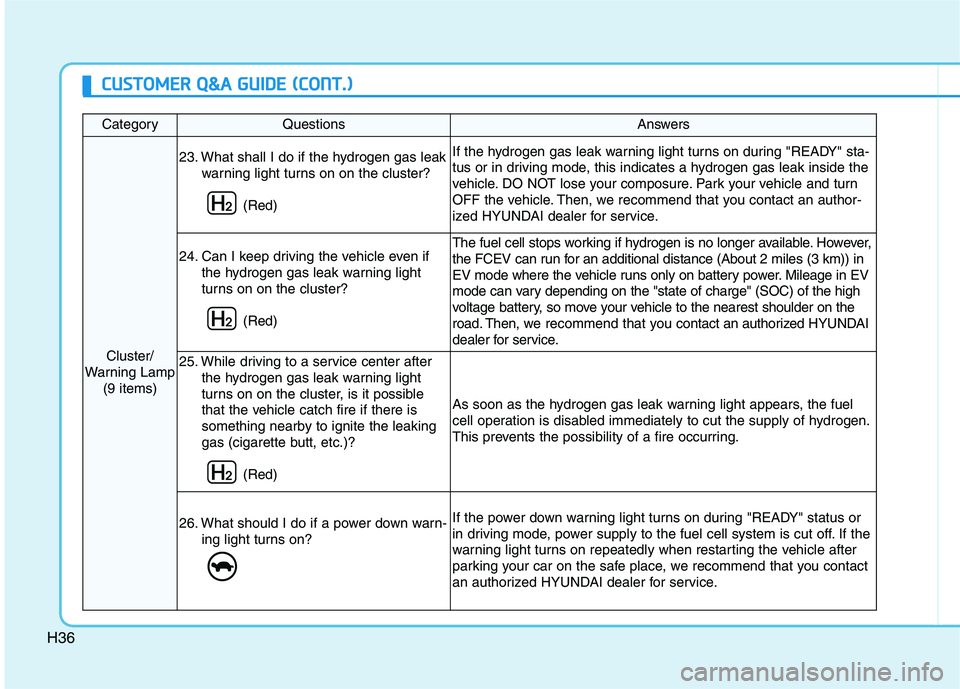
23. What shall I do if the hydrogen gas leak
warning light turns on on the cluster?
(Red)If the hydrogen gas leak warning light turns on during "READY" sta-
tus or in driving mode, this indicates a hydrogen gas leak inside the
vehicle. DO NOT lose your composure. Park your vehicle and turn
OFF the vehicle. Then, we recommend that you contact an author-
ized HYUNDAI dealer for service.
24. Can I keep driving the vehicle even if
the hydrogen gas leak warning light
turns on on the cluster?
(Red)The fuel cell stops working if hydrogen is no longer available. However,
the FCEV can run for an additional distance (About 2 miles (3 km)) in
EV mode where the vehicle runs only on battery power. Mileage in EV
mode can vary depending on the "state of charge" (SOC) of the high
voltage battery, so move your vehicle to the nearest shoulder on the
road. Then, we recommend that you contact an authorized HYUNDAI
dealer for service.
25. While driving to a service center after
the hydrogen gas leak warning light
turns on on the cluster, is it possible
that the vehicle catch fire if there is
something nearby to ignite the leaking
gas (cigarette butt, etc.)?
(Red)
As soon as the hydrogen gas leak warning light appears, the fuel
cell operation is disabled immediately to cut the supply of hydrogen.
This prevents the possibility of a fire occurring.
26. What should I do if a power down warn-
ing light turns on?If the power down warning light turns on during "READY" status or
in driving mode, power supply to the fuel cell system is cut off. If the
warning light turns on repeatedly when restarting the vehicle after
parking your car on the safe place, we recommend that you contact
an authorized HYUNDAI dealer for service.
C CU
US
ST
TO
OM
ME
ER
R
Q
Q&
&A
A
G
GU
UI
ID
DE
E
(
(C
CO
ON
NT
T.
.)
)
Page 542 of 561
H37
CategoryQuestionsAnswers
Cluster/
Warning Lamp
(9 items)
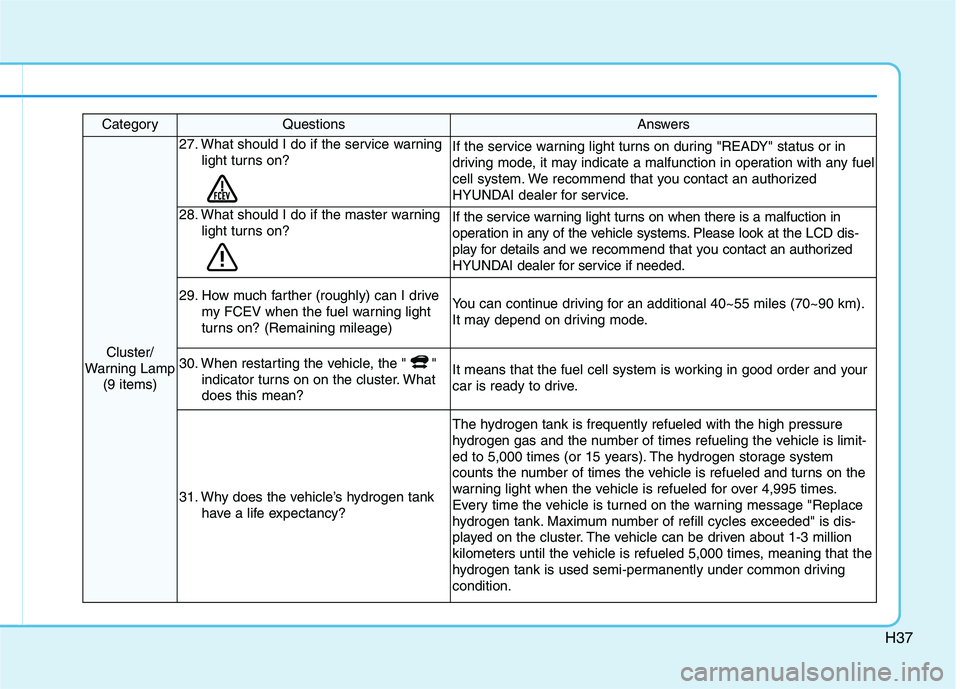
27. What should I do if the service warning
light turns on?If the service warning light turns on during "READY" status or in
driving mode, it may indicate a malfunction in operation with any fuel
cell system. We recommend that you contact an authorized
HYUNDAI dealer for service.
28. What should I do if the master warning
light turns on?If the service warning light turns on when there is a malfuction in
operation in any of the vehicle systems. Please look at the LCD dis-
play for details and we recommend that you contact an authorized
HYUNDAI dealer for service if needed.
29. How much farther (roughly) can I drive
my FCEV when the fuel warning light
turns on? (Remaining mileage)You can continue driving for an additional 40~55 miles (70~90 km).
It may depend on driving mode.
30. When restarting the vehicle, the " "
indicator turns on on the cluster. What
does this mean?It means that the fuel cell system is working in good order and your
car is ready to drive.
31. Why does the vehicle’s hydrogen tank
have a life expectancy?
The hydrogen tank is frequently refueled with the high pressure
hydrogen gas and the number of times refueling the vehicle is limit-
ed to 5,000 times (or 15 years). The hydrogen storage system
counts the number of times the vehicle is refueled and turns on the
warning light when the vehicle is refueled for over 4,995 times.
Every time the vehicle is turned on the warning message "Replace
hydrogen tank. Maximum number of refill cycles exceeded" is dis-
played on the cluster. The vehicle can be driven about 1-3 million
kilometers until the vehicle is refueled 5,000 times, meaning that the
hydrogen tank is used semi-permanently under common driving
condition.
Page 547 of 561
H42
CategoryQuestionsAnswers
Fuel Cell
Stack/High
Voltage
Battery
(4 items)
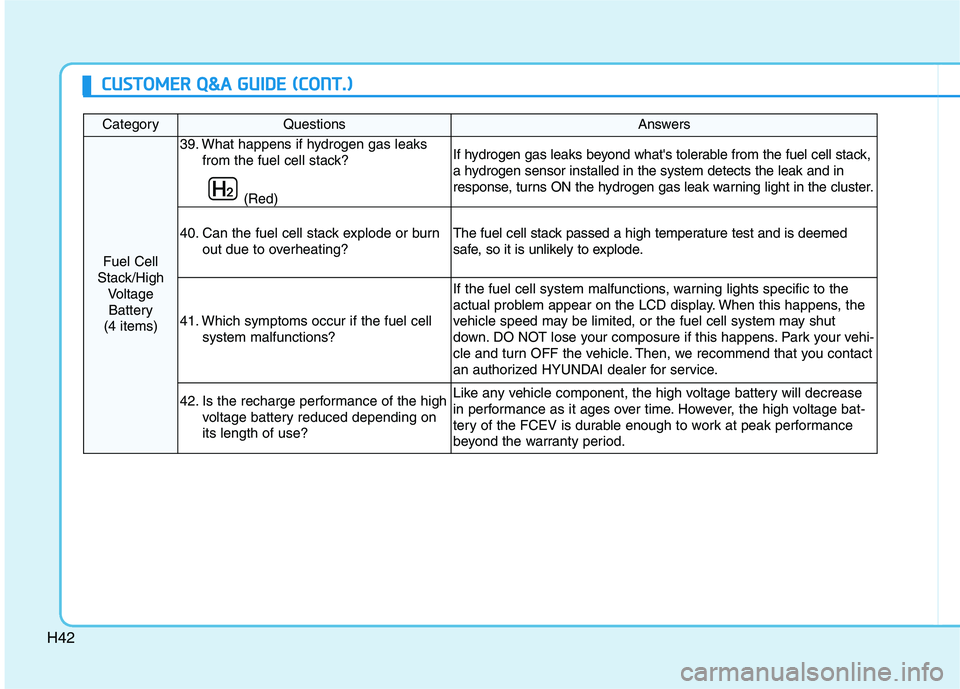
39. What happens if hydrogen gas leaks
from the fuel cell stack?
(Red)If hydrogen gas leaks beyond what's tolerable from the fuel cell stack,
a hydrogen sensor installed in the system detects the leak and in
response, turns ON the hydrogen gas leak warning light in the cluster.
40. Can the fuel cell stack explode or burn
out due to overheating?The fuel cell stack passed a high temperature test and is deemed
safe, so it is unlikely to explode.
41. Which symptoms occur if the fuel cell
system malfunctions?
If the fuel cell system malfunctions, warning lights specific to the
actual problem appear on the LCD display. When this happens, the
vehicle speed may be limited, or the fuel cell system may shut
down. DO NOT lose your composure if this happens. Park your vehi-
cle and turn OFF the vehicle. Then, we recommend that you contact
an authorized HYUNDAI dealer for service.
42. Is the recharge performance of the high
voltage battery reduced depending on
its length of use? Like any vehicle component, the high voltage battery will decrease
in performance as it ages over time. However, the high voltage bat-
tery of the FCEV is durable enough to work at peak performance
beyond the warranty period.
C CU
US
ST
TO
OM
ME
ER
R
Q
Q&
&A
A
G
GU
UI
ID
DE
E
(
(C
CO
ON
NT
T.
.)
)
Page 552 of 561
I-2
12V battery......................................................................7-27
Battery recharging ......................................................7-28
Reset Features ............................................................7-28
AC Inverter ...................................................................3-167
Accessing Your Vehicle ....................................................3-3
Smart Key.....................................................................3-3
Immobilizer System .....................................................3-9
Active Hood Lift System ................................................2-70
System activation .......................................................2-70
System limitation........................................................2-71
System malfunction ....................................................2-72
Air Bag - Advanced Supplemental Restraint System.....2-47
Where Are the Air Bags? ...........................................2-49
How Does the Air Bag System Operate? ...................2-52
What to Expect After an Air Bag Inflates ..................2-57
Occupant Classification System (OCS) .....................2-58
Why Didn't My Air Bag Go Off in a Collision?........2-60
SRS Care ....................................................................2-60
Additional Safety Precautions ....................................2-60
Air Bag Warning Labels.............................................2-60
Why Didn't My Air Bag Go Off in a Collision?........2-63
SRS Care ....................................................................2-68
Additional Safety Precautions ....................................2-69
Air Bag Warning Labels.............................................2-69Air Bag Warning Labels .................................................2-69
Air cleaner.......................................................................7-20
Filter Replacement .....................................................7-20
Air Conditioning System ..................................................8-5
Anti-lock Brake System (ABS) ......................................5-29
Appearance care..............................................................7-62
Exterior Care ..............................................................7-62
Interior Care ...............................................................7-67
Auto Hold .......................................................................5-25
Automatic Climate Control System..............................3-147
Automatic Temperature Control Mode ....................3-148
Manual Temperature Control Mode .........................3-148
System Operation .....................................................3-155
System Maintenance ................................................3-156
Before Driving ..................................................................5-4
Before Entering the Vehicle .........................................5-4
Before Starting .............................................................5-4
Blind-Spot Collision Warning/
Blind-Spot Collision-avoidance Assist ........................5-53
System Description ....................................................5-53
System Setting and Activation ...................................5-54
Warning and System Control .....................................5-57
Detecting Sensor (Front View Camera and
Rear Corner Radar) .................................................5-59
Limitations of the System ..........................................5-62
Index
A
B
Page 553 of 561
I-3
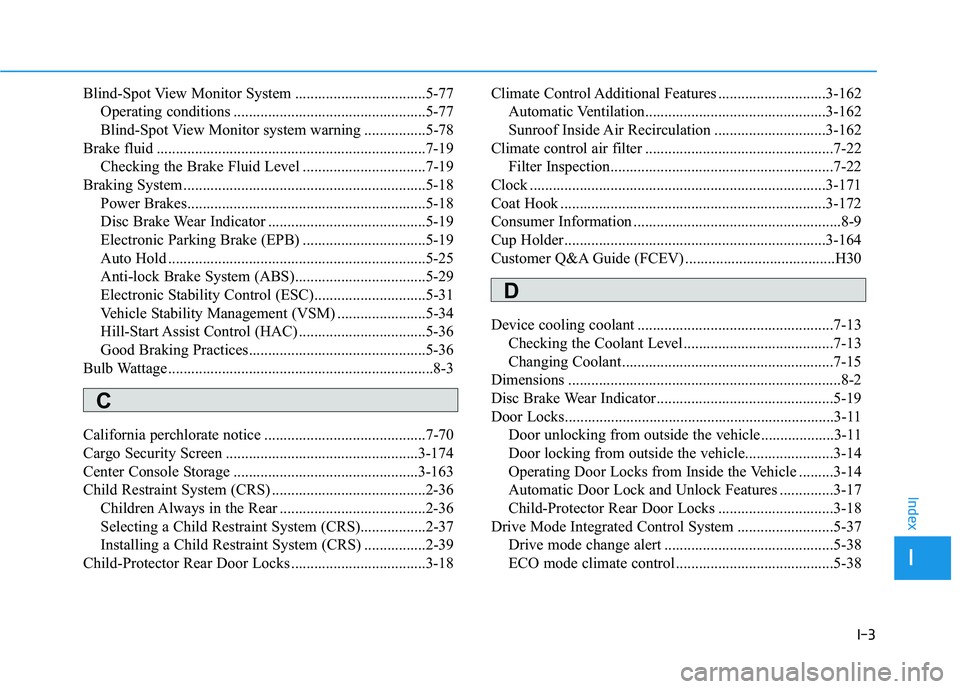
Blind-Spot View Monitor System ..................................5-77
Operating conditions ..................................................5-77
Blind-Spot View Monitor system warning ................5-78
Brake fluid ......................................................................7-19
Checking the Brake Fluid Level ................................7-19
Braking System ...............................................................5-18
Power Brakes..............................................................5-18
Disc Brake Wear Indicator .........................................5-19
Electronic Parking Brake (EPB) ................................5-19
Auto Hold ...................................................................5-25
Anti-lock Brake System (ABS)..................................5-29
Electronic Stability Control (ESC).............................5-31
Vehicle Stability Management (VSM) .......................5-34
Hill-Start Assist Control (HAC) .................................5-36
Good Braking Practices..............................................5-36
Bulb Wattage .....................................................................8-3
California perchlorate notice ..........................................7-70
Cargo Security Screen ..................................................3-174
Center Console Storage ................................................3-163
Child Restraint System (CRS) ........................................2-36
Children Always in the Rear ......................................2-36
Selecting a Child Restraint System (CRS).................2-37
Installing a Child Restraint System (CRS) ................2-39
Child-Protector Rear Door Locks ...................................3-18Climate Control Additional Features ............................3-162
Automatic Ventilation...............................................3-162
Sunroof Inside Air Recirculation .............................3-162
Climate control air filter .................................................7-22
Filter Inspection..........................................................7-22
Clock .............................................................................3-171
Coat Hook .....................................................................3-172
Consumer Information ......................................................8-9
Cup Holder....................................................................3-164
Customer Q&A Guide (FCEV) .......................................H30
Device cooling coolant ...................................................7-13
Checking the Coolant Level .......................................7-13
Changing Coolant.......................................................7-15
Dimensions .......................................................................8-2
Disc Brake Wear Indicator..............................................5-19
Door Locks......................................................................3-11
Door unlocking from outside the vehicle...................3-11
Door locking from outside the vehicle.......................3-14
Operating Door Locks from Inside the Vehicle .........3-14
Automatic Door Lock and Unlock Features ..............3-17
Child-Protector Rear Door Locks ..............................3-18
Drive Mode Integrated Control System .........................5-37
Drive mode change alert ............................................5-38
ECO mode climate control .........................................5-38
I
Index
C
D