climate control HYUNDAI NEXO 2021 Owner's Manual
[x] Cancel search | Manufacturer: HYUNDAI, Model Year: 2021, Model line: NEXO, Model: HYUNDAI NEXO 2021Pages: 561, PDF Size: 48.42 MB
Page 453 of 561
7-28
Maintenance
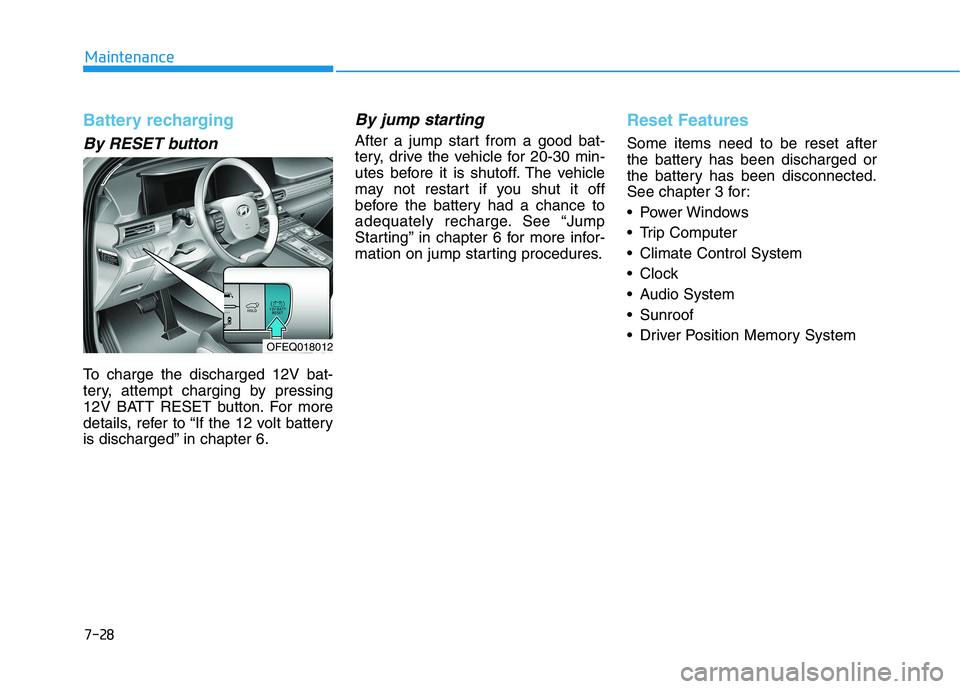
Battery recharging
By RESET button
To charge the discharged 12V bat-
tery, attempt charging by pressing
12V BATT RESET button. For more
details, refer to “If the 12 volt battery
is discharged” in chapter 6.
By jump starting
After a jump start from a good bat-
tery, drive the vehicle for 20-30 min-
utes before it is shutoff. The vehicle
may not restart if you shut it off
before the battery had a chance to
adequately recharge. See “Jump
Starting” in chapter 6 for more infor-
mation on jump starting procedures.
Reset Features
Some items need to be reset after
the battery has been discharged or
the battery has been disconnected.
See chapter 3 for:
Power Windows
Trip Computer
Climate Control System
Clock
Audio System
Sunroof
Driver Position Memory System
OFEQ018012
Page 459 of 561
7-34
Maintenance
Wheel Replacement
When replacing the metal wheels for
any reason, make sure the new
wheels are equivalent to the original
factory units in diameter, rim width
and offset.
Tire Traction
Tire traction can be reduced if you
drive on worn tires, tires that are
improperly inflated or on slippery
road surfaces. Tires should be
replaced when tread wear indicators
appear. To reduce the possibility of
losing control, slow down whenever
there is rain, snow or ice on the road.
Tire Maintenance
In addition to proper inflation, correct
wheel alignment helps to decrease
tire wear. If you find a tire is worn
unevenly, have your dealer check the
wheel alignment.
When you have new tires installed,
make sure they are balanced. This
will increase vehicle ride comfort and
tire life. Additionally, a tire should
always be rebalanced if it is removed
from the wheel.
Tire Sidewall Labeling
This information identifies and
describes the fundamental charac-
teristics of the tire and also provides
the tire identification number (TIN)
for safety standard certification. The
TIN can be used to identify the tire in
case of a recall.
Tires degrade over time, even
when they are not being used.
Regardless of the remaining
tread, HYUNDAI recommends
that tires be replaced after six
(6) years of normal service.
When replacing tires (or
wheels), it is recommended to
replace the two front or two
rear tires (or wheels) as a pair.
Replacing just one tire can
seriously affect your vehicle's
handling.
Heat caused by hot climates
or frequent high loading con-
ditions can accelerate the
aging process. Failure to fol-
low this warning may cause
sudden tire failure, which
could lead to a loss of vehicle
control resulting in an acci-
dent.
Page 462 of 561
7-37
7
Maintenance
6. Maximum load rating
This number indicates the maximum
load in kilograms and pounds that
can be carried by the tire. When
replacing the tires on the vehicle,
always use a tire that has the same
load rating as the factory installed
tire.
7. Uniform tire quality grading
Quality grades can be found where
applicable on the tire sidewall
between tread shoulder and maxi-
mum section width.
For example:
TREAD wear 200
TRACTION AA
TEMPERATURE A
Tread wear
The tread wear grade is a compara-
tive rating based on the wear rate of
the tire when tested under controlled
conditions on a specified govern-
ment test course. For example, a tire
graded 150 would wear one-and-a-
half times (1½) as well on the gov-
ernment course as a tire graded 100.
The relative performance of tires
depends upon the actual conditions
of their use, however, and may
depart significantly from the norm
due to variations in driving habits,
service practices and differences in
road characteristics and climate.
These grades are molded on the
sidewalls of passenger vehicle tires.
The tires available as standard or
optional equipment on your vehicle
may vary with respect to grade.
Traction - AA, A, B & C
The traction grades, from highest to
lowest, are AA, A, B and C. Those
grades represent the tire's ability to
stop on wet pavement as measured
under controlled conditions on spec-
ified government test surfaces of
asphalt and concrete. A tire marked
C may have poor traction perform-
ance.The traction grade assigned to
this tire is based on straight-
ahead braking traction tests,
and does not include accelera-
tion, cornering, hydroplaning,
or peak traction characteristics.
WARNING
Page 540 of 561
H35
CategoryQuestionsAnswers
Vehicle
Management
(12 items)
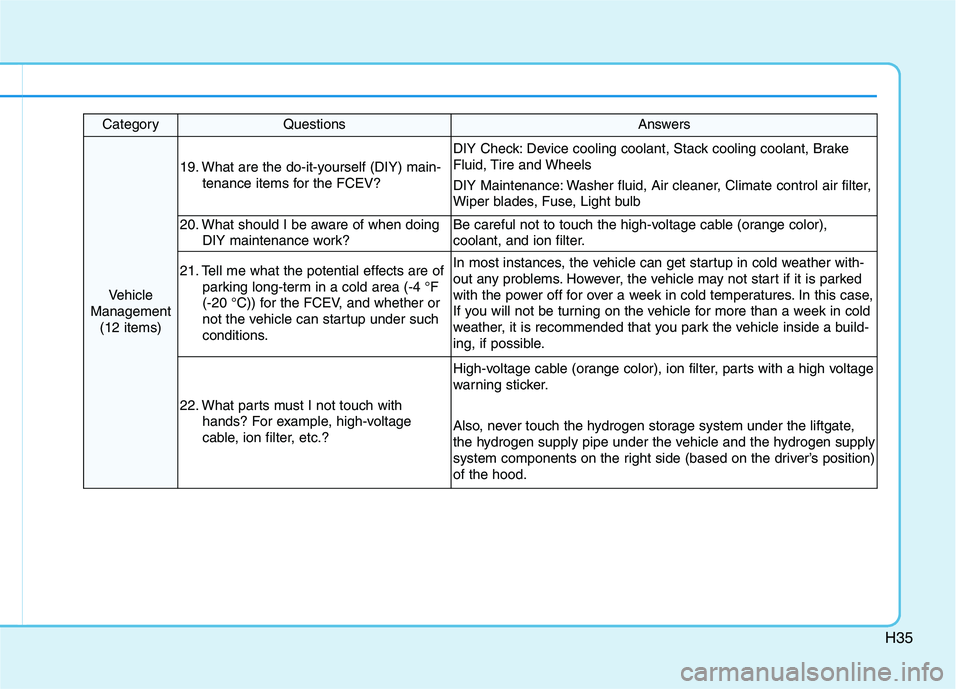
19. What are the do-it-yourself (DIY) main-
tenance items for the FCEV?
DIY Check: Device cooling coolant, Stack cooling coolant, Brake
Fluid, Tire and Wheels
DIY Maintenance: Washer fluid, Air cleaner, Climate control air filter,
Wiper blades, Fuse, Light bulb
20. What should I be aware of when doing
DIY maintenance work?Be careful not to touch the high-voltage cable (orange color),
coolant, and ion filter.
21. Tell me what the potential effects are of
parking long-term in a cold area (-4 °F
(-20 °C)) for the FCEV, and whether or
not the vehicle can startup under such
conditions.In most instances, the vehicle can get startup in cold weather with-
out any problems. However, the vehicle may not start if it is parked
with the power off for over a week in cold temperatures. In this case,
If you will not be turning on the vehicle for more than a week in cold
weather, it is recommended that you park the vehicle inside a build-
ing, if possible.
22. What parts must I not touch with
hands? For example, high-voltage
cable, ion filter, etc.?
High-voltage cable (orange color), ion filter, parts with a high voltage
warning sticker.
Also, never touch the hydrogen storage system under the liftgate,
the hydrogen supply pipe under the vehicle and the hydrogen supply
system components on the right side (based on the driver’s position)
of the hood.
Page 552 of 561
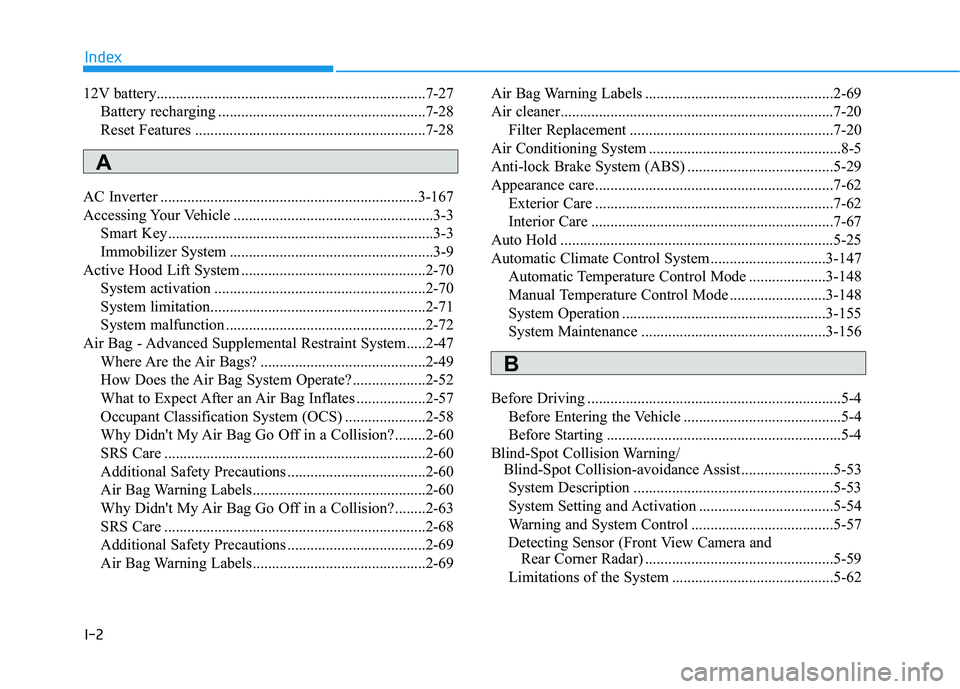
I-2
12V battery......................................................................7-27
Battery recharging ......................................................7-28
Reset Features ............................................................7-28
AC Inverter ...................................................................3-167
Accessing Your Vehicle ....................................................3-3
Smart Key.....................................................................3-3
Immobilizer System .....................................................3-9
Active Hood Lift System ................................................2-70
System activation .......................................................2-70
System limitation........................................................2-71
System malfunction ....................................................2-72
Air Bag - Advanced Supplemental Restraint System.....2-47
Where Are the Air Bags? ...........................................2-49
How Does the Air Bag System Operate? ...................2-52
What to Expect After an Air Bag Inflates ..................2-57
Occupant Classification System (OCS) .....................2-58
Why Didn't My Air Bag Go Off in a Collision?........2-60
SRS Care ....................................................................2-60
Additional Safety Precautions ....................................2-60
Air Bag Warning Labels.............................................2-60
Why Didn't My Air Bag Go Off in a Collision?........2-63
SRS Care ....................................................................2-68
Additional Safety Precautions ....................................2-69
Air Bag Warning Labels.............................................2-69Air Bag Warning Labels .................................................2-69
Air cleaner.......................................................................7-20
Filter Replacement .....................................................7-20
Air Conditioning System ..................................................8-5
Anti-lock Brake System (ABS) ......................................5-29
Appearance care..............................................................7-62
Exterior Care ..............................................................7-62
Interior Care ...............................................................7-67
Auto Hold .......................................................................5-25
Automatic Climate Control System..............................3-147
Automatic Temperature Control Mode ....................3-148
Manual Temperature Control Mode .........................3-148
System Operation .....................................................3-155
System Maintenance ................................................3-156
Before Driving ..................................................................5-4
Before Entering the Vehicle .........................................5-4
Before Starting .............................................................5-4
Blind-Spot Collision Warning/
Blind-Spot Collision-avoidance Assist ........................5-53
System Description ....................................................5-53
System Setting and Activation ...................................5-54
Warning and System Control .....................................5-57
Detecting Sensor (Front View Camera and
Rear Corner Radar) .................................................5-59
Limitations of the System ..........................................5-62
Index
A
B
Page 553 of 561
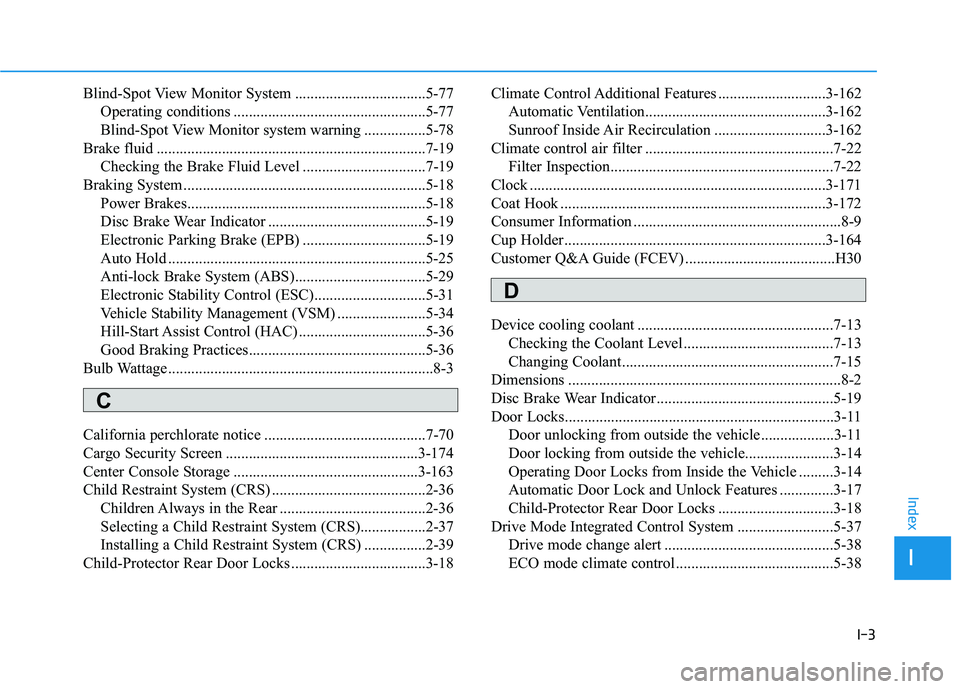
I-3
Blind-Spot View Monitor System ..................................5-77
Operating conditions ..................................................5-77
Blind-Spot View Monitor system warning ................5-78
Brake fluid ......................................................................7-19
Checking the Brake Fluid Level ................................7-19
Braking System ...............................................................5-18
Power Brakes..............................................................5-18
Disc Brake Wear Indicator .........................................5-19
Electronic Parking Brake (EPB) ................................5-19
Auto Hold ...................................................................5-25
Anti-lock Brake System (ABS)..................................5-29
Electronic Stability Control (ESC).............................5-31
Vehicle Stability Management (VSM) .......................5-34
Hill-Start Assist Control (HAC) .................................5-36
Good Braking Practices..............................................5-36
Bulb Wattage .....................................................................8-3
California perchlorate notice ..........................................7-70
Cargo Security Screen ..................................................3-174
Center Console Storage ................................................3-163
Child Restraint System (CRS) ........................................2-36
Children Always in the Rear ......................................2-36
Selecting a Child Restraint System (CRS).................2-37
Installing a Child Restraint System (CRS) ................2-39
Child-Protector Rear Door Locks ...................................3-18Climate Control Additional Features ............................3-162
Automatic Ventilation...............................................3-162
Sunroof Inside Air Recirculation .............................3-162
Climate control air filter .................................................7-22
Filter Inspection..........................................................7-22
Clock .............................................................................3-171
Coat Hook .....................................................................3-172
Consumer Information ......................................................8-9
Cup Holder....................................................................3-164
Customer Q&A Guide (FCEV) .......................................H30
Device cooling coolant ...................................................7-13
Checking the Coolant Level .......................................7-13
Changing Coolant.......................................................7-15
Dimensions .......................................................................8-2
Disc Brake Wear Indicator..............................................5-19
Door Locks......................................................................3-11
Door unlocking from outside the vehicle...................3-11
Door locking from outside the vehicle.......................3-14
Operating Door Locks from Inside the Vehicle .........3-14
Automatic Door Lock and Unlock Features ..............3-17
Child-Protector Rear Door Locks ..............................3-18
Drive Mode Integrated Control System .........................5-37
Drive mode change alert ............................................5-38
ECO mode climate control .........................................5-38
I
Index
C
D