fuel pressure HYUNDAI NEXO 2023 User Guide
[x] Cancel search | Manufacturer: HYUNDAI, Model Year: 2023, Model line: NEXO, Model: HYUNDAI NEXO 2023Pages: 558, PDF Size: 35.01 MB
Page 442 of 558
The electric motor for the cooling fan
is controlled by coolant temperature,
refrigerant pressure and vehicle
speed. As the coolant temperature
decreases, the electric motor will
automatically shut off. This is a nor-mal condition.
Changing Coolant
For the fuel cell stack, an exclusive
coolant must be used . When chang-
ing the fuel cell stack coolant, werecommend that coolant be changed
by an authorized HYUNDAI dealeraccording to the MaintenanceSchedule at the beginning of this
chapter.To prevent damage to parts in the
fuel cell power module compart-
ment, put a thick towel around the
coolant cap before refilling the
coolant to prevent the coolant
from overflowing into parts in the
fuel cell power module compart-ment.
NOTICE
7-18
Maintenance
The electric motor for
the cooling fan may
continue to operate
or start up when the
vehicle is not running
and can cause serious injury.
Keep hands, clothing and tools
away from the rotating fan
blades of the cooling fan.
WARNING
Do not use coolant or antifreeze
in the washer fluid reservoir.
Coolant can severely obscure
visibility when sprayed on the
windshield and may cause loss
of vehicle control resulting in anaccident.
Coolant may also cause dam-
age to paint and body trim.
WARNING
Do not mix-up the caps of
device cooling coolant and
stack cooling coolant because
the fluid material is different. If
the cap is mixed, the fuel cell
system may be damage.
We recommend that you con-
sult an authorized HYUNDAI
dealer.
CAUTION
Page 453 of 558
7-29
7
Maintenance
TTIIRR EESS AA NN DD WW HHEEEELLSS
Tire Care
For proper maintenance, safety, and
maximum fuel economy, you must
always maintain recommended tire
inflation pressures and stay within
the load limits and weight distribution
recommended for your vehicle.ALWAYS replace tires with the
same size as each tire that
was originally supplied with
this vehicle. Using tires andwheels other than the recom-
mended sizes could cause
unusual handling characteris-
tics, poor vehicle control, or
negatively affect your vehi-
cle's Anti-Lock Brake System(ABS) resulting in a seriousaccident.
Tire failure may cause loss of
vehicle control resulting in an
accident. To reduce risk of
SERIOUS INJURY or DEATH,
take the following precautions:
Inspect your tires monthly for
proper inflation as well as
wear and damage.
The recommended cold tire
pressure for your vehicle can
be found in this manual andon the tire label located on the
driver's side center pillar.
Always use a tire pressure
gauge to measure tire pres-
sure. Tires with too much ortoo little pressure wear
unevenly causing poor han-dling.
Replace tires that are worn,
show uneven wear, or are
damaged. Worn tires can
cause loss of braking effec-
tiveness, steering) control, ortraction.
WARNING
Page 455 of 558
7-31
7
Maintenance
Check Tire Inflation Pressure
Check your tires once a month or
more.
How to check
Use a good quality tire pressure
gauge to check tire pressure. You
can not tell if your tires are properly
inflated simply by looking at them.
Radial tires may look properly inflat-
ed when they are under-inflated.
Remove the valve cap from the tire
valve stem. Press the tire gauge firm-
ly onto the valve to get a pressure
measurement. If the cold tire inflationpressure matches the recommendedpressure on the tire and loading
information label, no further adjust-
ment is necessary. If the pressure is
low, add air until you reach the rec-
ommended pressure. Make sure to
put the valve caps back on the valve
stems. Without the valve cap, dirt or
moisture could get into the valve
core and cause air leakage. If a valve
cap is missing, install a new one as
soon as possible.If you overfill the tire, release air bypushing on the metal stem in the
center of the tire valve. Recheck the
tire pressure with the tire gauge. Be
sure to put the valve caps back on
the valve stems. Without the valve
cap, dirt or moisture could get into
the valve core and cause air leakage.
If a valve cap is missing, install a new
one as soon as possible.
Under-inflation results in
excessive wear, poor handling
and reduced fuel economy.
Wheel deformation is also
possible. Keep your tire pres-
sures at the proper levels. If a
tire frequently needs refilling,
have it checked by an author-
ized HYUNDAI dealer.
Over-inflation produces a
harsh ride, excessive wear atthe center of the tire tread,and a greater possibility of
damage from road hazards.
CAUTION
Page 463 of 558
7-39
7
Maintenance
Bead
The tire bead contains steel wires
wrapped by steel cords that hold the
tire onto the rim.
Bias Ply Tire
A pneumatic tire in which the plies
are laid at alternate angles less than
90 degrees to the centerline of thetread.
Cold Tire Pressure
The amount of air pressure in a tire,
measured in kilopascals (kPa) or
pounds per square inch (psi) before
a tire has built up heat from driving.
Curb Weight
This means the weight of a motor
vehicle with standard and optional
equipment including the maximum
capacity of fuel, oil and coolant, but
without passengers and cargo.
DOT Markings
The DOT code includes the TireIdentification Number (TIN), an
alphanumeric designator which can
also identify the tire manufacturer,
production plant, brand and date ofproduction.
GVWR
Gross Vehicle Weight Rating
GAWR FRT
Gross Axle Weight Rating for the
Front Axle.
GAWR RR
Gross Axle Weight Rating for the
Rear axle.
Intended Outboard Sidewall
The side of an asymmetrical tire, that
must always face outward when
mounted on a vehicle.
Kilopascal (kPa)
The metric unit for air pressure.
Light truck(LT) tire
A tire designated by its manufacturer
as primarily intended for use on light-
weight trucks or multipurpose pas-
senger vehicles.
Load ratings
The maximum load that a tire is rated
to carry for a given inflation pressure.
Load Index
An assigned number ranging from 1to 279 that corresponds to the load
carrying capacity of a tire.
Page 487 of 558
7-63
7
Maintenance
Do not use strong soap, chemi-cal detergents or hot water, and
do not wash the vehicle in direct
sunlight or when the body of the
vehicle is warm.
Be careful when washing the side windows of your vehicle.
Especially, with high-pressure
water, water may leak through
the windows and wet the interi-
or.
To prevent damage to the plastic parts, do not clean with chemi-
cal solvents or strong deter-
gents. Water washing in the fuel cell
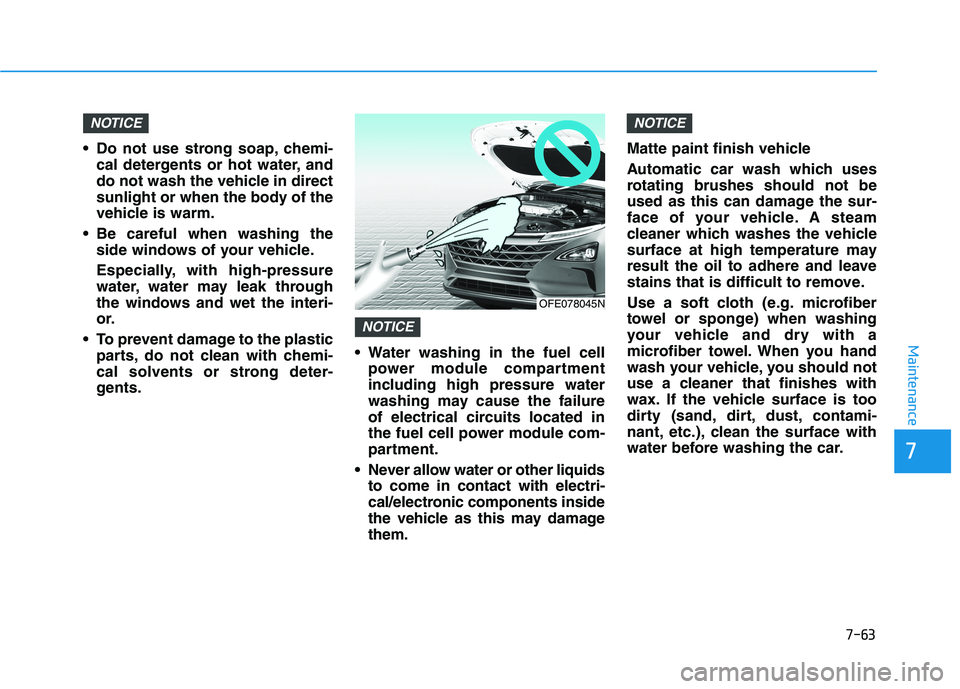
power module compartment
including high pressure water
washing may cause the failure
of electrical circuits located in
the fuel cell power module com-
partment.
Never allow water or other liquids to come in contact with electri-
cal/electronic components inside
the vehicle as this may damagethem. Matte paint finish vehicle
Automatic car wash which uses
rotating brushes should not be
used as this can damage the sur-
face of your vehicle. A steam
cleaner which washes the vehicle
surface at high temperature may
result the oil to adhere and leave
stains that is difficult to remove.
Use a soft cloth (e.g. microfiber
towel or sponge) when washing
your vehicle and dry with a
microfiber towel. When you hand
wash your vehicle, you should not
use a cleaner that finishes with
wax. If the vehicle surface is too
dirty (sand, dirt, dust, contami-
nant, etc.), clean the surface with
water before washing the car.
NOTICE
NOTICE
NOTICE
OFE078045N
Page 503 of 558
Introduction of FCEV .........................................................H2
The components of FCEV..................................................H3Fuel cell stack ..................................................................................H4
FCEV powertrain...............................................................................H4
High pressure hydrogen storage tanks ......................................H5
Battery system..................................................................................H5
Features of FCEV .............................................................H10 How to Start the Vehicle ..............................................................H10
How to Stop the Vehicle ..............................................................H11
Virtual Engine Sound System......................................................H11
Fuel filler door ................................................................................H12
Warning and indicator lights .......................................................H15
LCD Display Messages ..................................................................H16
FCEV mode.......................................................................................H21
When the high voltage battery is weak ...................................H25
If the 12 volt battery is discharged...........................................H25
Emergency while driving ..............................................................H26
Customer Q&A Guide .......................................................H30
FF CC EE VV VV eehh iicc llee SS yyssttee mm OO vvee rrvv iiee ww
FCEV : Fuel Cell Electric Vehicle
Page 507 of 558
H5
3. High pressure hydrogenstorage tanks
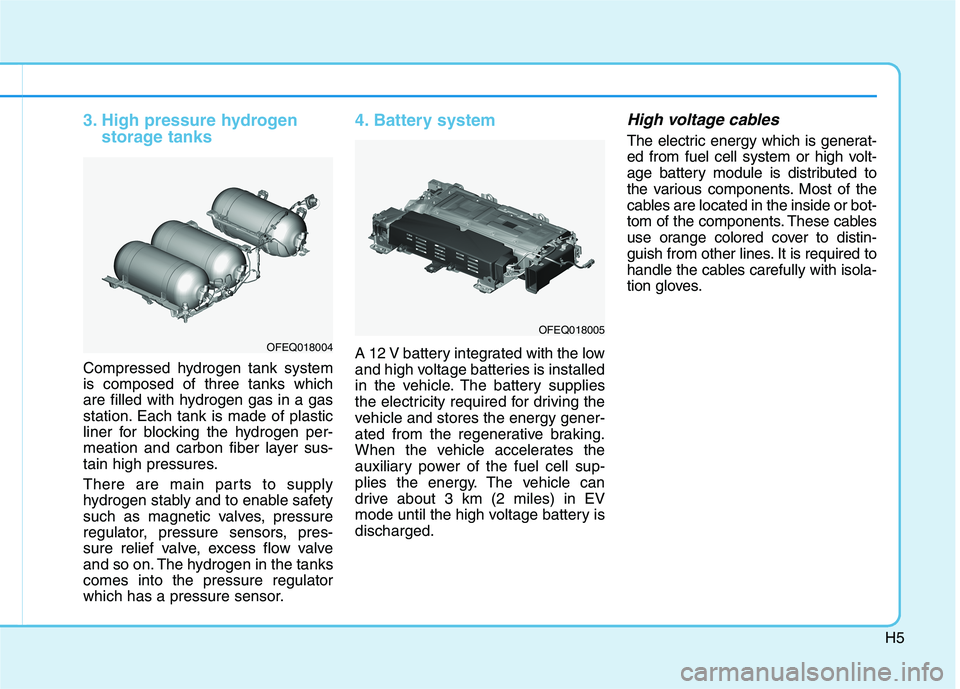
Compressed hydrogen tank system is composed of three tanks which
are filled with hydrogen gas in a gas
station. Each tank is made of plastic
liner for blocking the hydrogen per-
meation and carbon fiber layer sus-
tain high pressures.
There are main parts to supply
hydrogen stably and to enable safety
such as magnetic valves, pressure
regulator, pressure sensors, pres-
sure relief valve, excess flow valve
and so on. The hydrogen in the tankscomes into the pressure regulator
which has a pressure sensor.
4. Battery system
A 12 V battery integrated with the low
and high voltage batteries is installed
in the vehicle. The battery supplies
the electricity required for driving the
vehicle and stores the energy gener-
ated from the regenerative braking.
When the vehicle accelerates the
auxiliary power of the fuel cell sup-
plies the energy. The vehicle can
drive about 3 km (2 miles) in EV
mode until the high voltage battery isdischarged.
High voltage cables
The electric energy which is generat-
ed from fuel cell system or high volt-
age battery module is distributed to
the various components. Most of the
cables are located in the inside or bot-
tom of the components. These cables
use orange colored cover to distin-
guish from other lines. It is required to
handle the cables carefully with isola-
tion gloves.
OFEQ018004
OFEQ018005
Page 517 of 558
H15
Warning and indicator lights
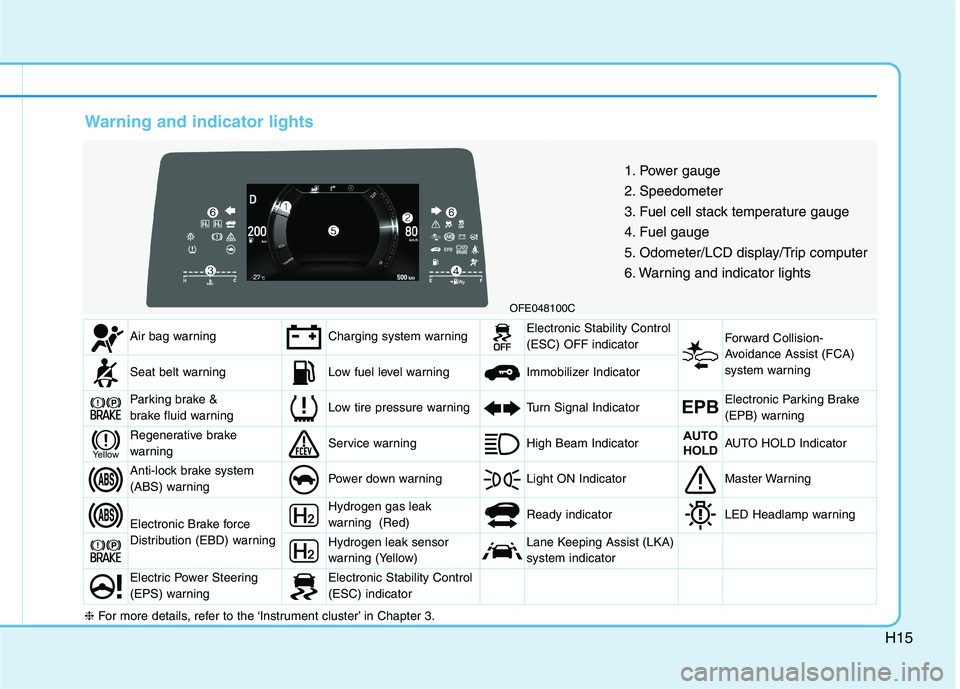
OFE048100C1. Power gauge
2. Speedometer
3. Fuel cell stack temperature gauge
4. Fuel gauge
5. Odometer/LCD display/Trip computer
6. Warning and indicator lights
Air bag warningCharging system warningElectronic Stability Control (ESC) OFF indicator Forward Collision-
Avoidance Assist (FCA)
system warning
Seat belt warningLow fuel level warning Immobilizer Indicator
Parking brake &
brake fluid warningLow tire pressure warningTurn Signal IndicatorEPBElectronic Parking Brake
(EPB) warning
Regenerative brake
warningService warning High Beam IndicatorAUTO
HOLDAUTO HOLD Indicator
Anti-lock brake system
(ABS) warningPower down warning Light ON IndicatorMaster Warning
Electronic Brake force
Distribution (EBD) warning
Hydrogen gas leak
warning (Red) Ready indicatorLED Headlamp warning
Hydrogen leak sensor
warning (Yellow)Lane Keeping Assist (LKA) system indicator
Electric Power Steering
(EPS) warningElectronic Stability Control (ESC) indicator
Yellow
❈ For more details, refer to the ‘Instrument cluster’ in Chapter 3.
Page 526 of 558
H24
FFEE AA TTUU RREESS OO FF FF CC EE VV (( CC OO NNTT..))
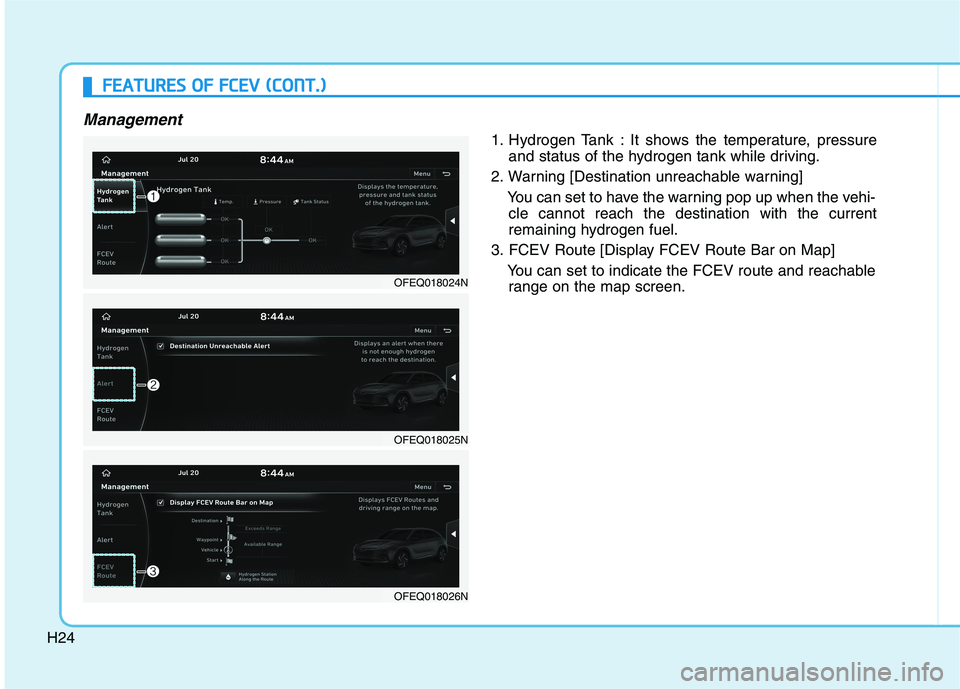
Management
1. Hydrogen Tank : It shows the temperature, pressure
and status of the hydrogen tank while driving.
2. Warning [Destination unreachable warning]
You can set to have the warning pop up when the vehi-cle cannot reach the destination with the current
remaining hydrogen fuel.
3. FCEV Route [Display FCEV Route Bar on Map]
You can set to indicate the FCEV route and reachablerange on the map screen.
OFEQ018024N
OFEQ018025N
OFEQ018026N
Page 531 of 558
H29
Hydrogen station
You can search the hydrogen fueling station and set the station as the
destination in the AVN screen. Select
'Menu-Nearby POI' in the mapscreen and select 'Fuel stations' to
see the list of stations. Set the near-
est station as the destination. Check
the station operation status and
opening hours before visiting the sta-tion.
Fully refueling the vehicle may be
impossible depending on the station
condition and the reachable range
may change accordingly.
Also, the refueling time may vary
depending on the hydrogen fueling
pressure and ambient temperature.
The reachable range may change
according to the driving environment
(weather, traffic, etc.) and driving
method (sudden acceleration, heat-ing and air conditioning, etc.).
* Refueling the hydrogen gas mustbe done by the person who has
completed the certification course
and training related to the high-
pressure gas. Self-refueling is pro-hibited.