towing HYUNDAI NEXO 2023 User Guide
[x] Cancel search | Manufacturer: HYUNDAI, Model Year: 2023, Model line: NEXO, Model: HYUNDAI NEXO 2023Pages: 558, PDF Size: 35.01 MB
Page 423 of 558
6-26
Emergency Towing
If towing is necessary, we recom-
mend you have it done by an author-
ized HYUNDAI dealer or a commer-
cial tow truck service.
If towing service is not available in an
emergency, your vehicle may be
temporarily towed using a cable or
chain secured to the emergency tow-ing hook at the front (or rear) of the
vehicle.
Use extreme caution when towing
the vehicle with a cable or chain. A
driver must be in the vehicle to steer
it and operate the brakes.
Towing in this manner may be done
only on hard-surfaced roads for a
short distance and at low speeds.
Also, the wheels, axles, power train,
steering and brakes must all be ingood condition.Always follow these emergency tow-ing precautions:
While depressing the brake pedal
shift to the N (Neutral) position and
turn the vehicle off. The POWER
button will be in the ACC position.
Release the parking brake.
Depress the brake pedal with more force than normal since you will
have reduced braking perform-
ance.
More steering effort will be required because the power steer-
ing system will be disabled.
Use a vehicle heavier than your own to tow your vehicle.
The drivers of both vehicles should communicate with each other fre-
quently.
Before emergency towing, check that the hook is not broken or dam-aged.
Fasten the towing cable or chain securely to the hook.
Do not jerk the hook. Apply steady and even force.
What to do in an emergency
The driver must be in the vehi-
cle for steering and braking
operations when the vehicle is
being towed. Passengers other
than the driver must not be in
the vehicle.
CAUTION
Page 424 of 558
6-27
What to do in an emergency
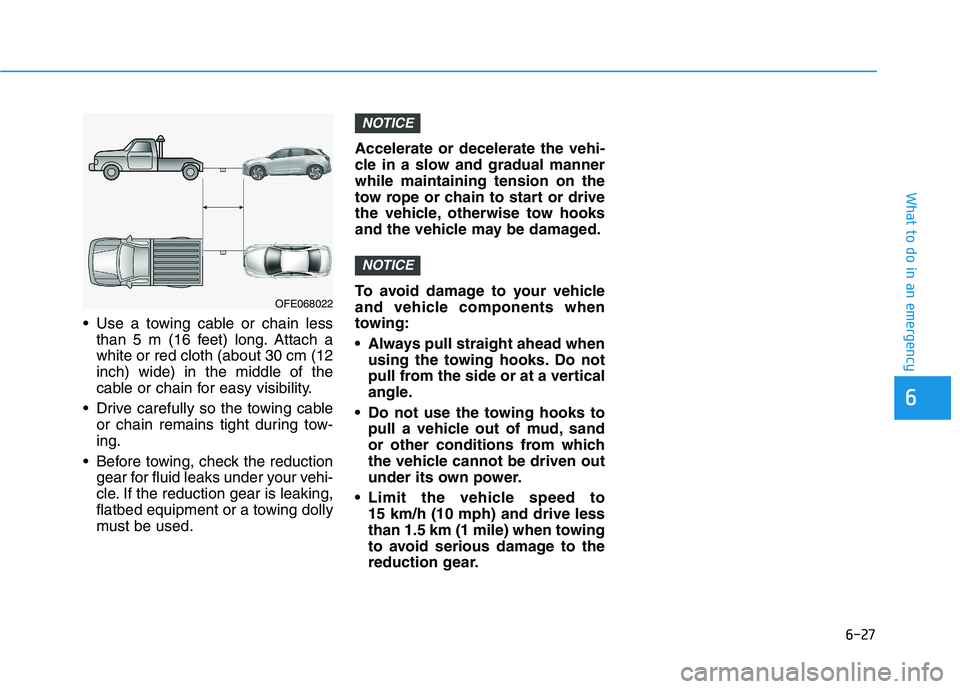
Use a towing cable or chain lessthan 5 m (16 feet) long. Attach a white or red cloth (about 30 cm (12inch) wide) in the middle of the
cable or chain for easy visibility.
Drive carefully so the towing cable or chain remains tight during tow-ing.
Before towing, check the reduction gear for fluid leaks under your vehi-
cle. If the reduction gear is leaking,
flatbed equipment or a towing dolly
must be used. Accelerate or decelerate the vehi-
cle in a slow and gradual mannerwhile maintaining tension on the
tow rope or chain to start or drive
the vehicle, otherwise tow hooks
and the vehicle may be damaged.
To avoid damage to your vehicle
and vehicle components when
towing:
Always pull straight ahead when
using the towing hooks. Do not
pull from the side or at a vertical
angle.
Do not use the towing hooks to pull a vehicle out of mud, sand
or other conditions from which
the vehicle cannot be driven out
under its own power.
Limit the vehicle speed to 15 km/h (10 mph) and drive less
than 1.5 km (1 mile) when towing
to avoid serious damage to the
reduction gear.
NOTICE
NOTICE
6
OFE068022
Page 431 of 558
7-7
7
Maintenance
At least once a year:
Clean body and door drain holes.
Lubricate door hinges and hoodhinges.
Lubricate door and hood locks and latches.
Lubricate door rubber weather strips.
Lubricate door checker.
Check the air conditioning system.
Inspect and lubricate reduction gear linkage and controls.
Check the brake fluid level.
SS CC HH EEDD UU LLEE DD MM AAIINN TTEENN AANN CCEE SS EE RR VV IICC EE SS
Follow Normal Maintenance Schedule if the vehicle is usually operated where
none of the following conditions apply. If any of the following conditions apply,
you must follow the Maintenance Under Severe Usage Conditions.
Repeated driving short distance of less than 8 km (5 miles) in normal tem-
perature or less than 16 km (10 miles) in freezing temperature
Low speed driving for long distances
Driving on rough, dusty, muddy, unpaved, graveled or salt-spread roads
Driving in areas using salt or other corrosive materials or in very cold weather
Driving in heavy dust condition
Driving in heavy traffic area
Driving on uphill, downhill, or mountain road repeatedly
Towing a trailer or using a camper, or roof rack
Driving as a patrol car, taxi, other commercial use of vehicle towing
Driving over 170 km/h (106 miles/h)
Frequently driving in stop-and-go condition
If your vehicle is operated under the above conditions, you should inspect, replace or refill more frequently than the following Normal MaintenanceSchedule. After the periods or distance shown in the chart, continue to followthe prescribed maintenance intervals.
Page 435 of 558
7-11
7
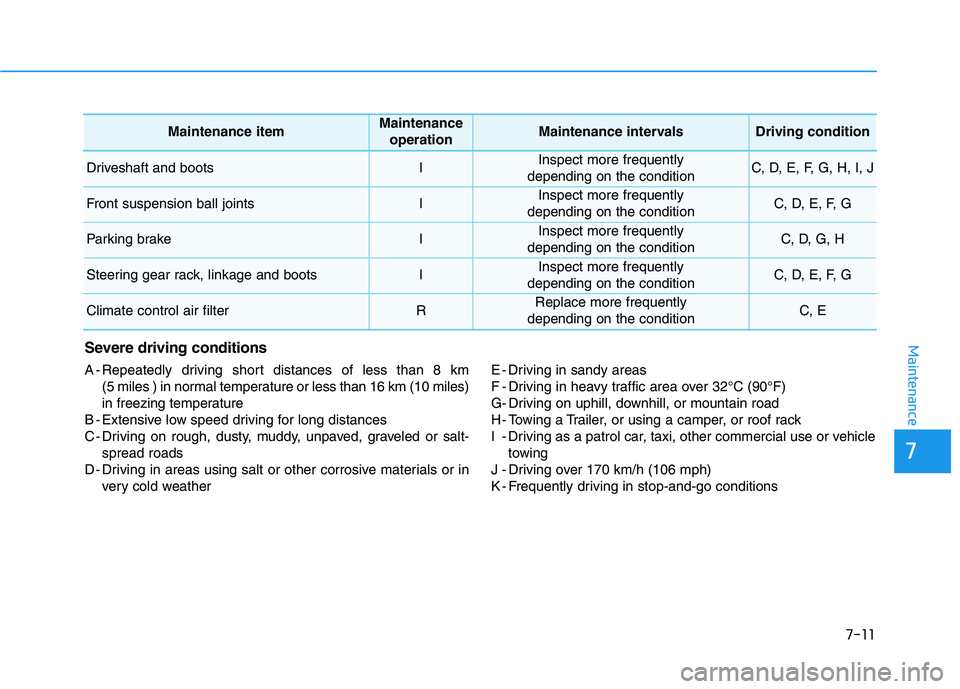
MaintenanceSevere driving conditions
A - Repeatedly driving short distances of less than 8 km(5 miles ) in normal temperature or less than 16 km (10 miles)
in freezing temperature
B - Extensive low speed driving for long distances
C - Driving on rough, dusty, muddy, unpaved, graveled or salt- spread roads
D - Driving in areas using salt or other corrosive materials or in very cold weather E - Driving in sandy areas
F - Driving in heavy traffic area over 32°C (90°F)
G- Driving on uphill, downhill, or mountain road
H - Towing a Trailer, or using a camper, or roof rack
I - Driving as a patrol car, taxi, other commercial use or vehicle
towing
J - Driving over 170 km/h (106 mph)
K - Frequently driving in stop-and-go conditions
Maintenance itemMaintenance operationMaintenance intervalsDriving condition
Driveshaft and bootsIInspect more frequently
depending on the conditionC, D, E, F, G, H, I, J
Front suspension ball jointsIInspect more frequently
depending on the conditionC, D, E, F, G
Parking brakeIInspect more frequently
depending on the conditionC, D, G, H
Steering gear rack, linkage and bootsIInspect more frequently
depending on the conditionC, D, E, F, G
Climate control air filterRReplace more frequently
depending on the conditionC, E
Page 545 of 558
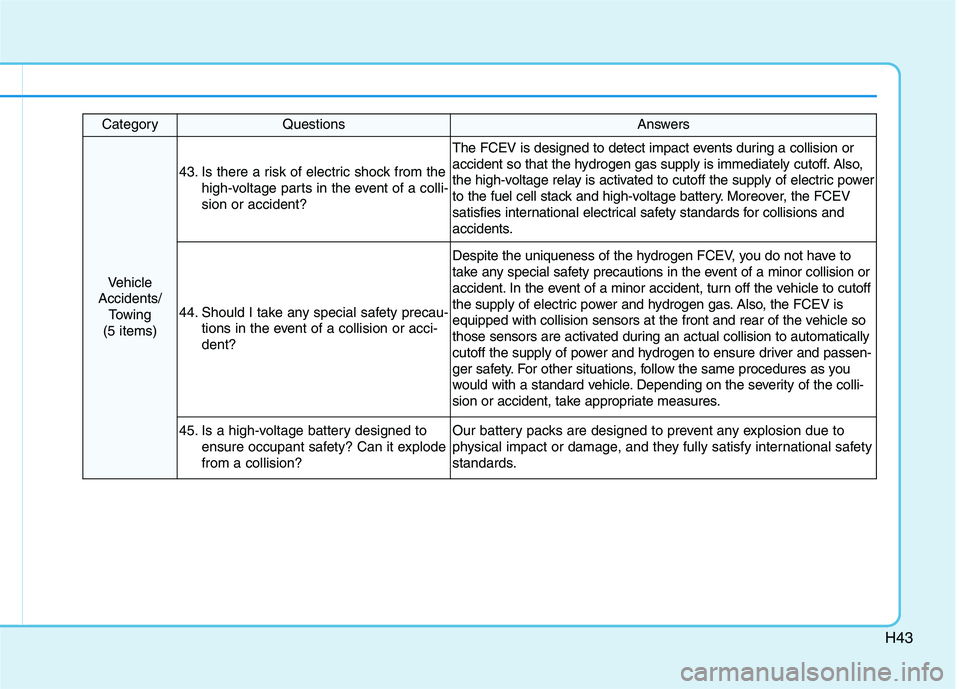
H43
CategoryQuestionsAnswers
Vehicle
Accidents/ Towing
(5 items)
43. Is there a risk of electric shock from the high-voltage parts in the event of a colli- sion or accident?
The FCEV is designed to detect impact events during a collision or
accident so that the hydrogen gas supply is immediately cutoff. Also,
the high-voltage relay is activated to cutoff the supply of electric power
to the fuel cell stack and high-voltage battery. Moreover, the FCEV
satisfies international electrical safety standards for collisions and
accidents.
44. Should I take any special safety precau-tions in the event of a collision or acci- dent?
Despite the uniqueness of the hydrogen FCEV, you do not have to
take any special safety precautions in the event of a minor collision or
accident. In the event of a minor accident, turn off the vehicle to cutoff
the supply of electric power and hydrogen gas. Also, the FCEV is
equipped with collision sensors at the front and rear of the vehicle so
those sensors are activated during an actual collision to automatically
cutoff the supply of power and hydrogen to ensure driver and passen-
ger safety. For other situations, follow the same procedures as you
would with a standard vehicle. Depending on the severity of the colli-
sion or accident, take appropriate measures.
45. Is a high-voltage battery designed toensure occupant safety? Can it explode from a collision?Our battery packs are designed to prevent any explosion due to
physical impact or damage, and they fully satisfy international safety
standards.
Page 546 of 558
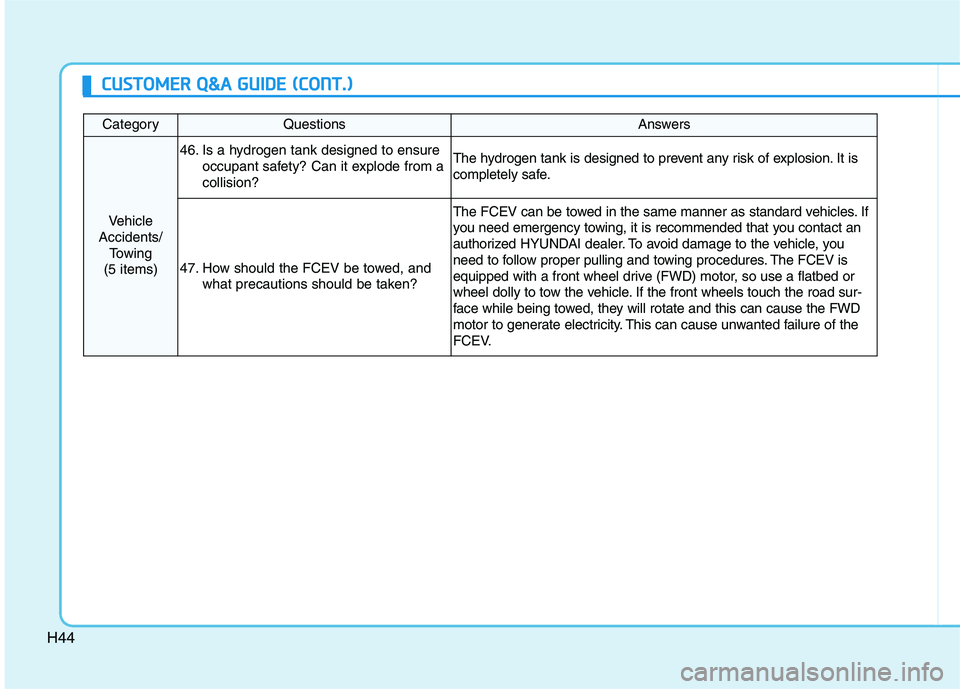
H44
CategoryQuestionsAnswers
Vehicle
Accidents/
Towing
(5 items)
46. Is a hydrogen tank designed to ensure occupant safety? Can it explode from a collision?The hydrogen tank is designed to prevent any risk of explosion. It is
completely safe.
47. How should the FCEV be towed, andwhat precautions should be taken?
The FCEV can be towed in the same manner as standard vehicles. If
you need emergency towing, it is recommended that you contact an
authorized HYUNDAI dealer. To avoid damage to the vehicle, you
need to follow proper pulling and towing procedures. The FCEV is
equipped with a front wheel drive (FWD) motor, so use a flatbed or
wheel dolly to tow the vehicle. If the front wheels touch the road sur-
face while being towed, they will rotate and this can cause the FWD
motor to generate electricity. This can cause unwanted failure of the
FCEV.
CCUU SSTT OO MM EERR QQ &&AA GG UU IIDD EE (( CC OO NNTT..))
Page 557 of 558
I-10
Tire Specification and Pressure Label ..............................8-8
Tires and Wheels .....................................................7-29, 8-4
All Season Tires .........................................................7-42
Check Tire Inflation Pressure .....................................7-31
Low Aspect Ratio Tires ..............................................7-43
Radial-Ply Tires ..........................................................7-42
Recommended Cold Tire Inflation Pressures.............7-30
Snow Tires ..................................................................7-42
Summer Tires .............................................................7-42
Tire Care .....................................................................7-29
Tire Maintenance ........................................................7-34
Tire Replacement........................................................7-33
Tire Rotation...............................................................7-32
Tire Sidewall Labeling ...............................................7-34
Tire Terminology and Definitions ..............................7-38
Tire Traction ...............................................................7-34
Wheel Alignment and Tire Balance ...........................7-33
Wheel Replacement....................................................7-34
Towing ............................................................................6-24
Emergency Towing.....................................................6-26
Removable Towing Hook...........................................6-25
Towing Service ...........................................................6-24
Traction Motor Number ....................................................8-8
Trailer Towing...............................................................5-130
Trip Computer .................................................................3-85 USB Charger .................................................................3-169
Vehicle Certification Label ...............................................8-7
Vehicle Identification Number (VIN) ...............................8-7
Vehicle Load Limit .......................................................5-125
Tire Loading Information Label...............................5-125
Vehicle Stability Management (VSM)............................5-34
Volume and Weight ...........................................................8-5
Warning and Indicator Lights .........................................3-65
Washer Fluid ...................................................................7-20 Checking the Washer Fluid Level ..............................7-20
Welcome System.............................................................3-99
Windows .........................................................................3-33 Power Windows..........................................................3-34
Windshield Defrosting and Defogging .........................3-158 Auto Defogging System (Additional Feature with Automatic Temperature Control System) .....3-160
Rear Window Defroster............................................3-161
Winter Driving ..............................................................5-122
Snow or Icy Conditions............................................5-122
Winter Precautions ...................................................5-123
Index
U
V
W