Fuel cell HYUNDAI NEXO 2023 Repair Manual
[x] Cancel search | Manufacturer: HYUNDAI, Model Year: 2023, Model line: NEXO, Model: HYUNDAI NEXO 2023Pages: 558, PDF Size: 35.01 MB
Page 540 of 558
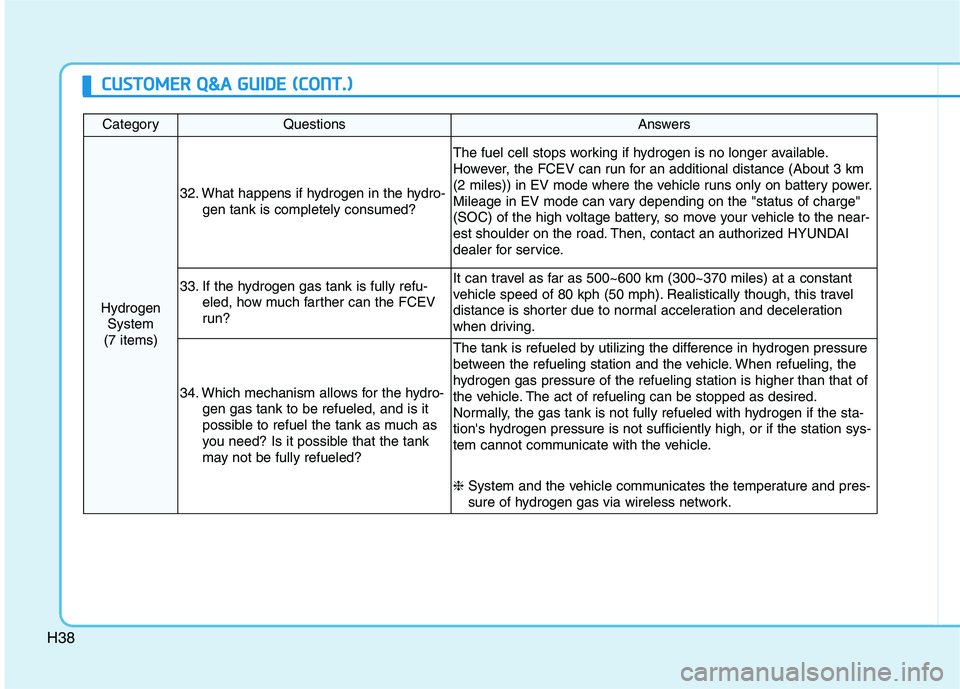
H38
CategoryQuestionsAnswers
HydrogenSystem
(7 items)
32. What happens if hydrogen in the hydro- gen tank is completely consumed?
The fuel cell stops working if hydrogen is no longer available.
However, the FCEV can run for an additional distance (About 3 km
(2 miles)) in EV mode where the vehicle runs only on battery power.
Mileage in EV mode can vary depending on the "status of charge"
(SOC) of the high voltage battery, so move your vehicle to the near-
est shoulder on the road. Then, contact an authorized HYUNDAI
dealer for service.
33. If the hydrogen gas tank is fully refu-eled, how much farther can the FCEV
run?It can travel as far as 500~600 km (300~370 miles) at a constant
vehicle speed of 80 kph (50 mph). Realistically though, this travel
distance is shorter due to normal acceleration and deceleration
when driving.
34. Which mechanism allows for the hydro-
gen gas tank to be refueled, and is it
possible to refuel the tank as much as
you need? Is it possible that the tank
may not be fully refueled?
The tank is refueled by utilizing the difference in hydrogen pressure
between the refueling station and the vehicle. When refueling, the
hydrogen gas pressure of the refueling station is higher than that of
the vehicle. The act of refueling can be stopped as desired.
Normally, the gas tank is not fully refueled with hydrogen if the sta-
tion's hydrogen pressure is not sufficiently high, or if the station sys-
tem cannot communicate with the vehicle. ❈System and the vehicle communicates the temperature and pres-
sure of hydrogen gas via wireless network.
CCUU SSTT OO MM EERR QQ &&AA GG UU IIDD EE (( CC OO NNTT..))
Page 542 of 558
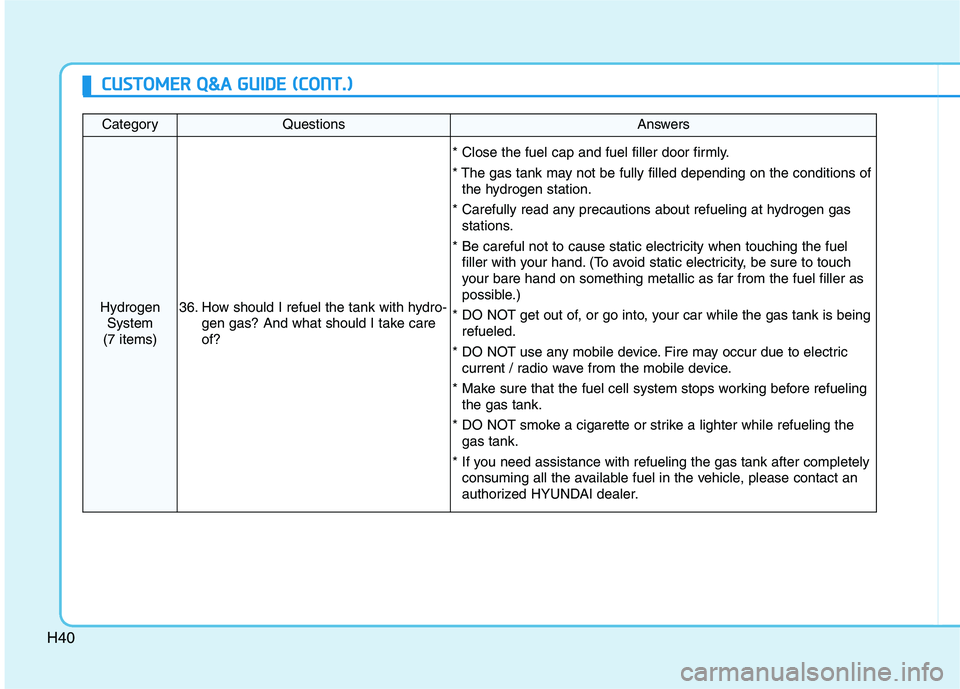
H40
CCUU SSTT OO MM EERR QQ &&AA GG UU IIDD EE (( CC OO NNTT..))
CategoryQuestionsAnswers
Hydrogen
System
(7 items)36. How should I refuel the tank with hydro- gen gas? And what should I take care of?
* Close the fuel cap and fuel filler door firmly.
* The gas tank may not be fully filled depending on the conditions ofthe hydrogen station.
* Carefully read any precautions about refueling at hydrogen gas stations.
* Be careful not to cause static electricity when touching the fuel filler with your hand. (To avoid static electricity, be sure to touch
your bare hand on something metallic as far from the fuel filler as
possible.)
* DO NOT get out of, or go into, your car while the gas tank is being refueled.
* DO NOT use any mobile device. Fire may occur due to electric current / radio wave from the mobile device.
* Make sure that the fuel cell system stops working before refueling the gas tank.
* DO NOT smoke a cigarette or strike a lighter while refueling the gas tank.
* If you need assistance with refueling the gas tank after completely consuming all the available fuel in the vehicle, please contact an
authorized HYUNDAI dealer.
Page 544 of 558
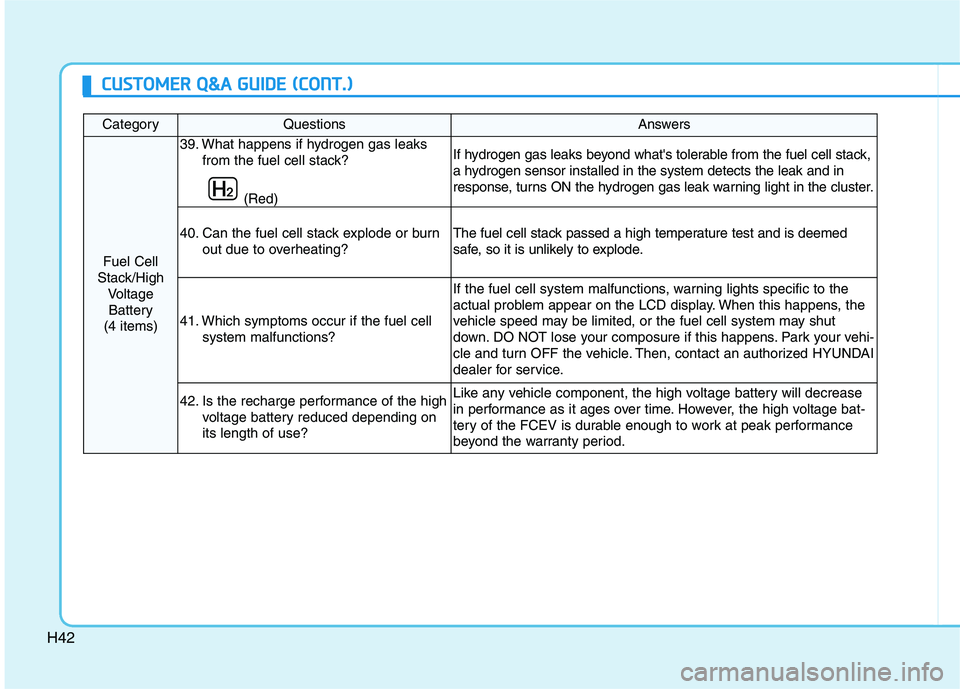
H42
CategoryQuestionsAnswers
Fuel Cell
Stack/High VoltageBattery
(4 items)
39. What happens if hydrogen gas leaks
from the fuel cell stack?
(Red)If hydrogen gas leaks beyond what's tolerable from the fuel cell stack,
a hydrogen sensor installed in the system detects the leak and in
response, turns ON the hydrogen gas leak warning light in the cluster.
40. Can the fuel cell stack explode or burnout due to overheating?The fuel cell stack passed a high temperature test and is deemed
safe, so it is unlikely to explode.
41. Which symptoms occur if the fuel cellsystem malfunctions?
If the fuel cell system malfunctions, warning lights specific to the
actual problem appear on the LCD display. When this happens, the
vehicle speed may be limited, or the fuel cell system may shut
down. DO NOT lose your composure if this happens. Park your vehi-
cle and turn OFF the vehicle. Then, contact an authorized HYUNDAI
dealer for service.
42. Is the recharge performance of the high
voltage battery reduced depending on its length of use? Like any vehicle component, the high voltage battery will decrease
in performance as it ages over time. However, the high voltage bat-
tery of the FCEV is durable enough to work at peak performance
beyond the warranty period.
CCUU SSTT OO MM EERR QQ &&AA GG UU IIDD EE (( CC OO NNTT..))
Page 545 of 558
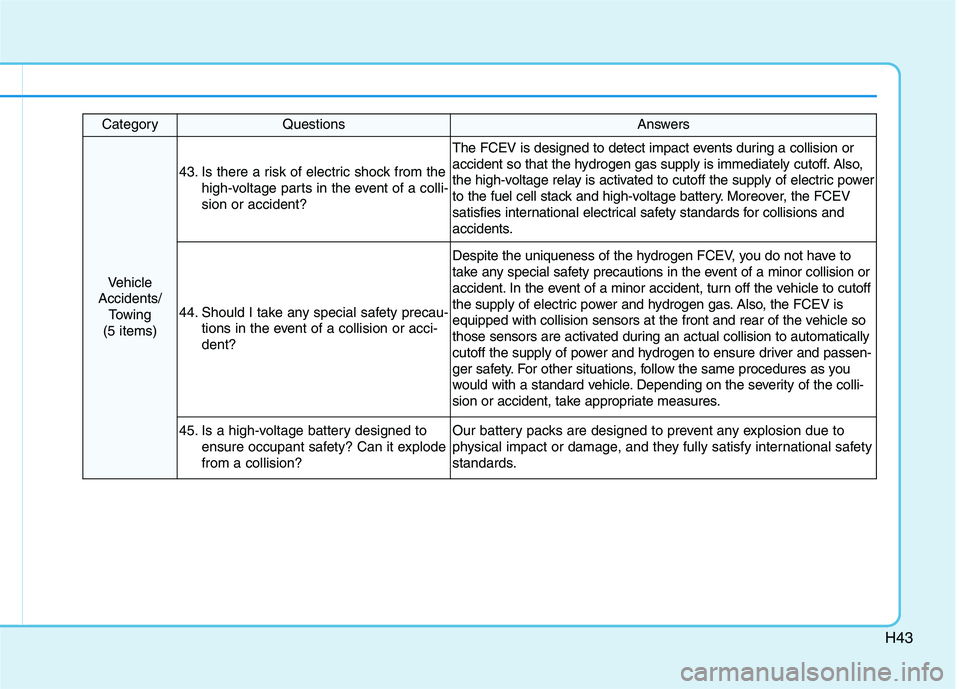
H43
CategoryQuestionsAnswers
Vehicle
Accidents/ Towing
(5 items)
43. Is there a risk of electric shock from the high-voltage parts in the event of a colli- sion or accident?
The FCEV is designed to detect impact events during a collision or
accident so that the hydrogen gas supply is immediately cutoff. Also,
the high-voltage relay is activated to cutoff the supply of electric power
to the fuel cell stack and high-voltage battery. Moreover, the FCEV
satisfies international electrical safety standards for collisions and
accidents.
44. Should I take any special safety precau-tions in the event of a collision or acci- dent?
Despite the uniqueness of the hydrogen FCEV, you do not have to
take any special safety precautions in the event of a minor collision or
accident. In the event of a minor accident, turn off the vehicle to cutoff
the supply of electric power and hydrogen gas. Also, the FCEV is
equipped with collision sensors at the front and rear of the vehicle so
those sensors are activated during an actual collision to automatically
cutoff the supply of power and hydrogen to ensure driver and passen-
ger safety. For other situations, follow the same procedures as you
would with a standard vehicle. Depending on the severity of the colli-
sion or accident, take appropriate measures.
45. Is a high-voltage battery designed toensure occupant safety? Can it explode from a collision?Our battery packs are designed to prevent any explosion due to
physical impact or damage, and they fully satisfy international safety
standards.
Page 547 of 558
H45
CategoryQuestionsAnswers
Explosion or
Fire (5 items)
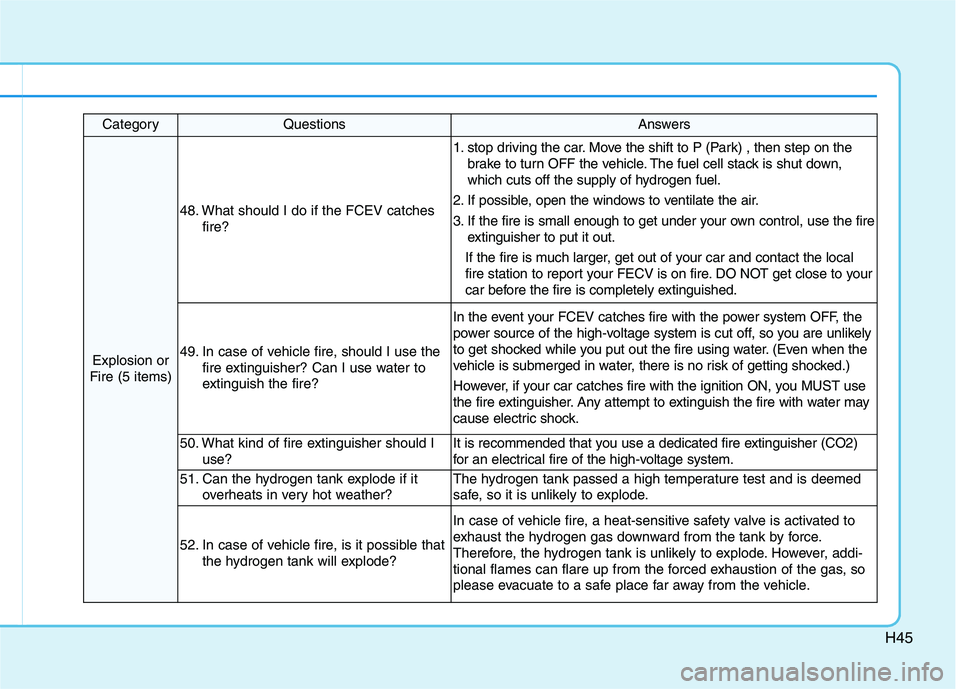
48. What should I do if the FCEV catches fire?
1. stop driving the car. Move the shift to P (Park) , then step on thebrake to turn OFF the vehicle. The fuel cell stack is shut down,
which cuts off the supply of hydrogen fuel.
2. If possible, open the windows to ventilate the air.
3. If the fire is small enough to get under your own control, use the fire extinguisher to put it out.
If the fire is much larger, get out of your car and contact the local
fire station to report your FECV is on fire. DO NOT get close to your
car before the fire is completely extinguished.
49. In case of vehicle fire, should I use the fire extinguisher? Can I use water to
extinguish the fire?
In the event your FCEV catches fire with the power system OFF, the
power source of the high-voltage system is cut off, so you are unlikely
to get shocked while you put out the fire using water. (Even when the
vehicle is submerged in water, there is no risk of getting shocked.)
However, if your car catches fire with the ignition ON, you MUST use
the fire extinguisher. Any attempt to extinguish the fire with water may
cause electric shock.
50. What kind of fire extinguisher should Iuse?It is recommended that you use a dedicated fire extinguisher (CO2)
for an electrical fire of the high-voltage system.
51. Can the hydrogen tank explode if itoverheats in very hot weather?The hydrogen tank passed a high temperature test and is deemed
safe, so it is unlikely to explode.
52. In case of vehicle fire, is it possible that
the hydrogen tank will explode?
In case of vehicle fire, a heat-sensitive safety valve is activated to
exhaust the hydrogen gas downward from the tank by force.
Therefore, the hydrogen tank is unlikely to explode. However, addi-
tional flames can flare up from the forced exhaustion of the gas, so
please evacuate to a safe place far away from the vehicle.
Page 552 of 558
I-5
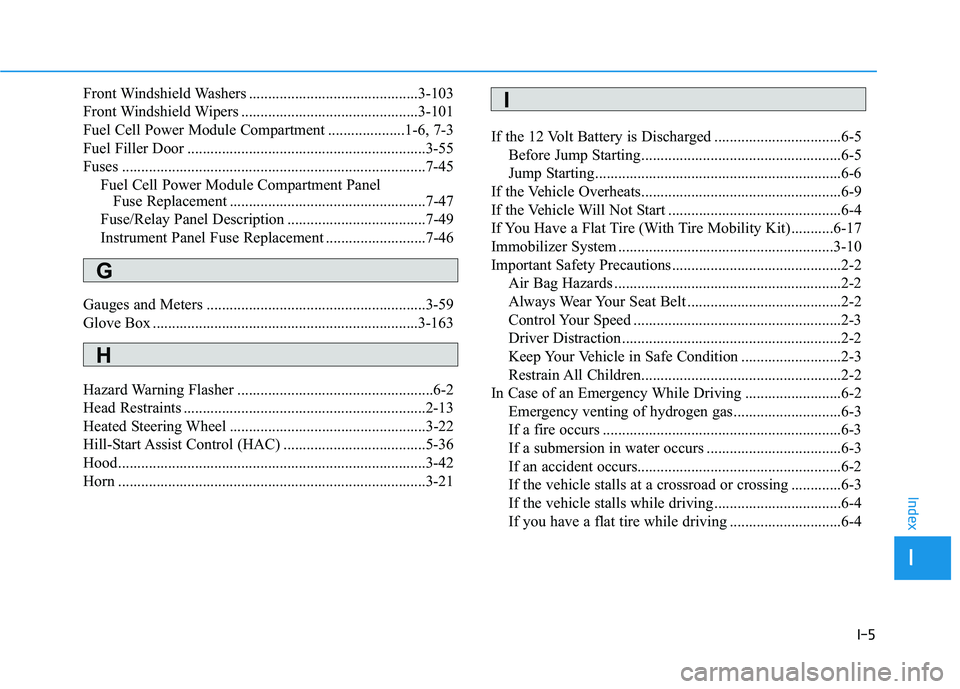
Front Windshield Washers ............................................3-103
Front Windshield Wipers ..............................................3-101
Fuel Cell Power Module Compartment ....................1-6, 7-3
Fuel Filler Door ..............................................................3-55
Fuses ...............................................................................7-45
Fuel Cell Power Module Compartment Panel Fuse Replacement ...................................................7-47
Fuse/Relay Panel Description ....................................7-49
Instrument Panel Fuse Replacement ..........................7-46
Gauges and Meters .........................................................3-59
Glove Box .....................................................................3-163
Hazard Warning Flasher ...................................................6-2
Head Restraints ...............................................................2-13
Heated Steering Wheel ...................................................3-22
Hill-Start Assist Control (HAC) .....................................5-36
Hood................................................................................3-42
Horn ................................................................................3-21 If the 12 Volt Battery is Discharged .................................6-5
Before Jump Starting....................................................6-5
Jump Starting................................................................6-6
If the Vehicle Overheats....................................................6-9
If the Vehicle Will Not Start .............................................6-4
If You Have a Flat Tire (With Tire Mobility Kit)...........6-17
Immobilizer System ........................................................3-10
Important Safety Precautions............................................2-2 Air Bag Hazards ...........................................................2-2
Always Wear Your Seat Belt ........................................2-2
Control Your Speed ......................................................2-3
Driver Distraction.........................................................2-2
Keep Your Vehicle in Safe Condition ..........................2-3
Restrain All Children....................................................2-2
In Case of an Emergency While Driving .........................6-2
Emergency venting of hydrogen gas............................6-3
If a fire occurs ..............................................................6-3
If a submersion in water occurs ...................................6-3
If an accident occurs.....................................................6-2
If the vehicle stalls at a crossroad or crossing .............6-3
If the vehicle stalls while driving .................................6-4
If you have a flat tire while driving .............................6-4
I
Index
G
H
I
Page 556 of 558
I-9
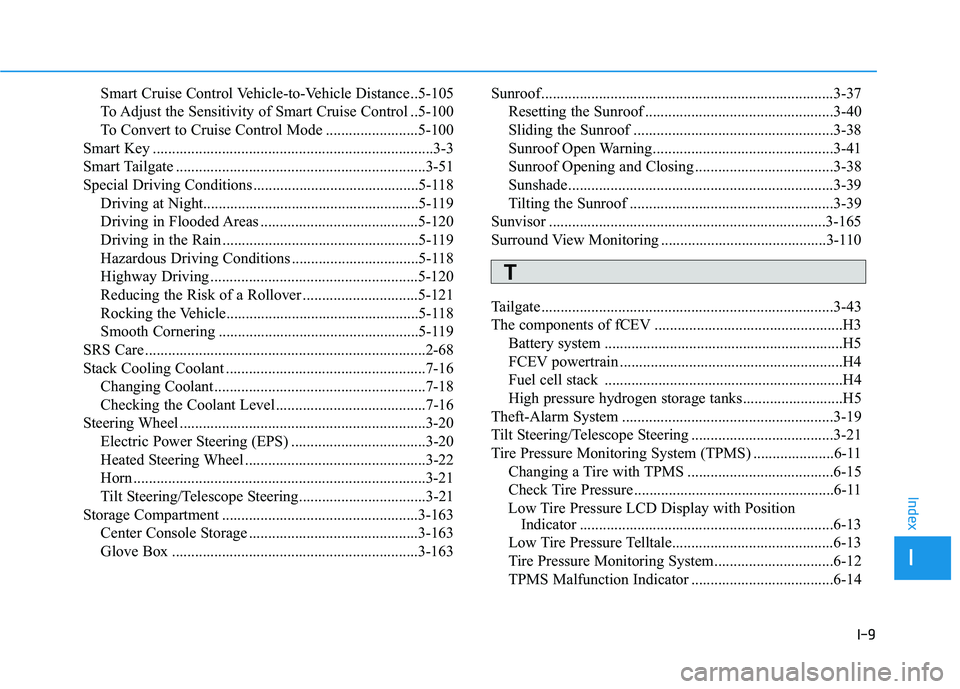
Smart Cruise Control Vehicle-to-Vehicle Distance ..5-105
To Adjust the Sensitivity of Smart Cruise Control ..5-100
To Convert to Cruise Control Mode ........................5-100
Smart Key .........................................................................3-3
Smart Tailgate .................................................................3-51
Special Driving Conditions ...........................................5-118 Driving at Night........................................................5-119
Driving in Flooded Areas .........................................5-120
Driving in the Rain ...................................................5-119
Hazardous Driving Conditions .................................5-118
Highway Driving ......................................................5-120
Reducing the Risk of a Rollover ..............................5-121
Rocking the Vehicle..................................................5-118
Smooth Cornering ....................................................5-119
SRS Care .........................................................................2-68
Stack Cooling Coolant ....................................................7-16 Changing Coolant.......................................................7-18
Checking the Coolant Level .......................................7-16
Steering Wheel ................................................................3-20
Electric Power Steering (EPS) ...................................3-20
Heated Steering Wheel ...............................................3-22
Horn ............................................................................3-21
Tilt Steering/Telescope Steering.................................3-21
Storage Compartment ...................................................3-163 Center Console Storage ............................................3-163
Glove Box ................................................................3-163 Sunroof............................................................................3-37
Resetting the Sunroof .................................................3-40
Sliding the Sunroof ....................................................3-38
Sunroof Open Warning...............................................3-41
Sunroof Opening and Closing ....................................3-38
Sunshade.....................................................................3-39
Tilting the Sunroof .....................................................3-39
Sunvisor ........................................................................3-165
Surround View Monitoring ...........................................3-110
Tailgate ............................................................................3-43
The components of fCEV .................................................H3 Battery system ..............................................................H5
FCEV powertrain ..........................................................H4
Fuel cell stack ..............................................................H4
High pressure hydrogen storage tanks..........................H5
Theft-Alarm System .......................................................3-19
Tilt Steering/Telescope Steering .....................................3-21
Tire Pressure Monitoring System (TPMS) .....................6-11 Changing a Tire with TPMS ......................................6-15
Check Tire Pressure ....................................................6-11
Low Tire Pressure LCD Display with Position Indicator ..................................................................6-13
Low Tire Pressure Telltale..........................................6-13
Tire Pressure Monitoring System...............................6-12
TPMS Malfunction Indicator .....................................6-14
I
Index
T