trailer Hyundai Palisade 2020 Owner's Guide
[x] Cancel search | Manufacturer: HYUNDAI, Model Year: 2020, Model line: Palisade, Model: Hyundai Palisade 2020Pages: 611, PDF Size: 18.86 MB
Page 472 of 611
5-163
Driving your vehicle
5
To prevent vehicle damage:
Due to higher load during trailerusage, overheating might occur
on hot days or during uphill driv-
ing. If the coolant gauge indi-
cates over-heating, switch off
the air conditioner and stop the
vehicle in a safe area to cool
down the engine.
When towing check the automat- ic transmission fluid more fre-
quently.
NOTICE
Page 474 of 611
5-165
Driving your vehicle
5
Tire Loading Information Label
Vehicle capacity weight
1. 7 persons : 1173 lbs. (532 kg)
2. 8 persons : 1323 lbs. (600 kg)
Vehicle capacity weight is the maxi-
mum combined weight of occupants
and cargo. If your vehicle is equipped
with a trailer, the combined weight
includes the tongue load.
Seating capacity
1. Total : 7 persons (Front seat : 2 persons,
Rear seat : 5 persons)
2. Total : 8 persons (Front seat : 2 persons,
Rear seat : 6 persons)
Seating capacity is the maximum
number of occupants including a
driver, your vehicle may carry.
However, the seating capacity may
be reduced based upon the weight of
all of the occupants, and the weight
of the cargo being carried or towed.
Do not overload the vehicle as there
is a limit to the total weight, or load
limit including occupants and cargo,
the vehicle can carry.
OLX2079056N
■
Type A
OLX2079057N
■
Type B
OLX2079058N
■
Type C
OLX2079059N
■
Type D
The label located on the driver's door sill gives the original tire size, cold tire
pressures recommended for your vehicle, the number of people that can be
in your vehicle and vehicle capacity weight.
Page 475 of 611
5-166
Driving your vehicle
Cargo capacity
The cargo capacity of your vehicle
will increase or decrease depending
on the weight and the number of
occupants and the tongue load, if
your vehicle is equipped with a trailer.
Steps for determining correctload limit
1. Locate the statement "The com-
bined weight of occupants and
cargo should never exceed XXX
kg or XXX lbs." on your vehicle's
placard.
2. Determine the combined weight of the driver and passengers that will
be riding in your vehicle.
3. Subtract the combined weight of the driver and passengers from
XXX kg or XXX lbs.
4. The resulting figure equals the available amount of cargo and lug-
gage load capacity. For example, if
the "XXX" amount equals 1400
lbs. and there will be five 150 lb.
passengers in your vehicle, the
amount of available cargo and lug-
gage load capacity is 650 lbs.
(1400 - 750 (5 x 150) = 650 lbs.)
5. Determine the combined weight of luggage and cargo being loaded
on the vehicle. That weight may
not safely exceed the available
cargo and luggage load capacity
calculated in Step 4. 6. If your vehicle will be towing a trail-
er, load from your trailer will be
transferred to your vehicle.
Consult this manual to determine
how this reduces the available
cargo and luggage load capacity
of your vehicle.
Do not overload the vehicle as
there is a limit to the total
weight, or load limit, including
occupants and cargo, the vehi-
cle can carry. Overloading can
shorten the life of the vehicle. If
the GVWR or the GAWR is
exceeded, parts on the vehicle
can break, and it can change
the handling of your vehicle.
These could cause you to lose
control and result in an acci-
dent.
WARNING
Page 477 of 611
5-168
Driving your vehicle
Certification label
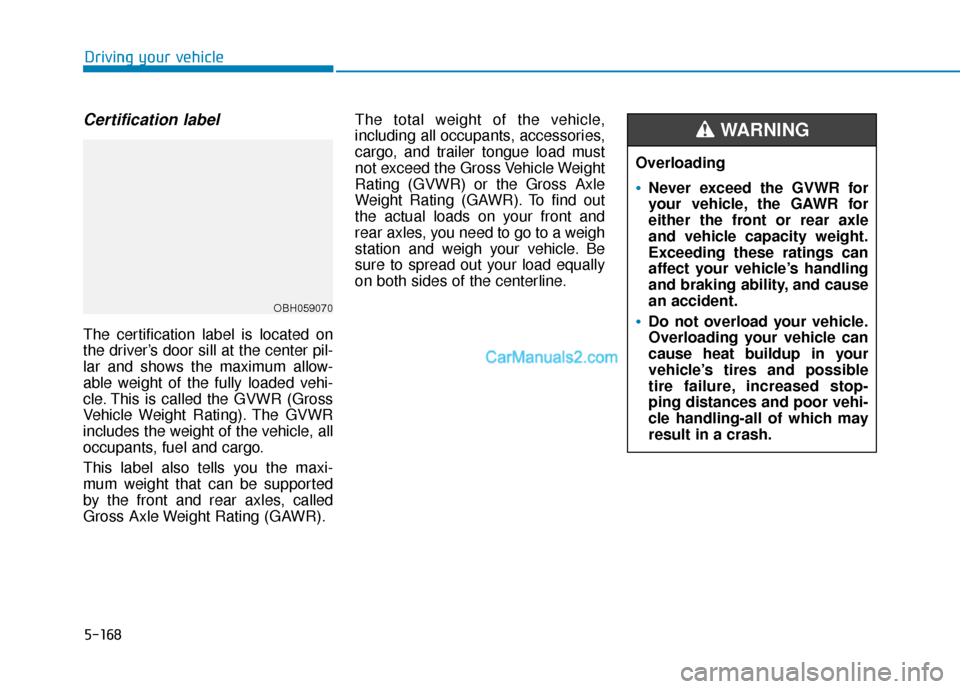
The certification label is located on
the driver’s door sill at the center pil-
lar and shows the maximum allow-
able weight of the fully loaded vehi-
cle. This is called the GVWR (Gross
Vehicle Weight Rating). The GVWR
includes the weight of the vehicle, all
occupants, fuel and cargo.
This label also tells you the maxi-
mum weight that can be supported
by the front and rear axles, called
Gross Axle Weight Rating (GAWR).The total weight of the vehicle,
including all occupants, accessories,
cargo, and trailer tongue load must
not exceed the Gross Vehicle Weight
Rating (GVWR) or the Gross Axle
Weight Rating (GAWR). To find out
the actual loads on your front and
rear axles, you need to go to a weigh
station and weigh your vehicle. Be
sure to spread out your load equally
on both sides of the centerline.
OBH059070
Overloading
Never exceed the GVWR for
your vehicle, the GAWR for
either the front or rear axle
and vehicle capacity weight.
Exceeding these ratings can
affect your vehicle’s handling
and braking ability, and cause
an accident.
Do not overload your vehicle.
Overloading your vehicle can
cause heat buildup in your
vehicle’s tires and possible
tire failure, increased stop-
ping distances and poor vehi-
cle handling-all of which may
result in a crash.
WARNING
Page 498 of 611
6-20
What to do in an emergency
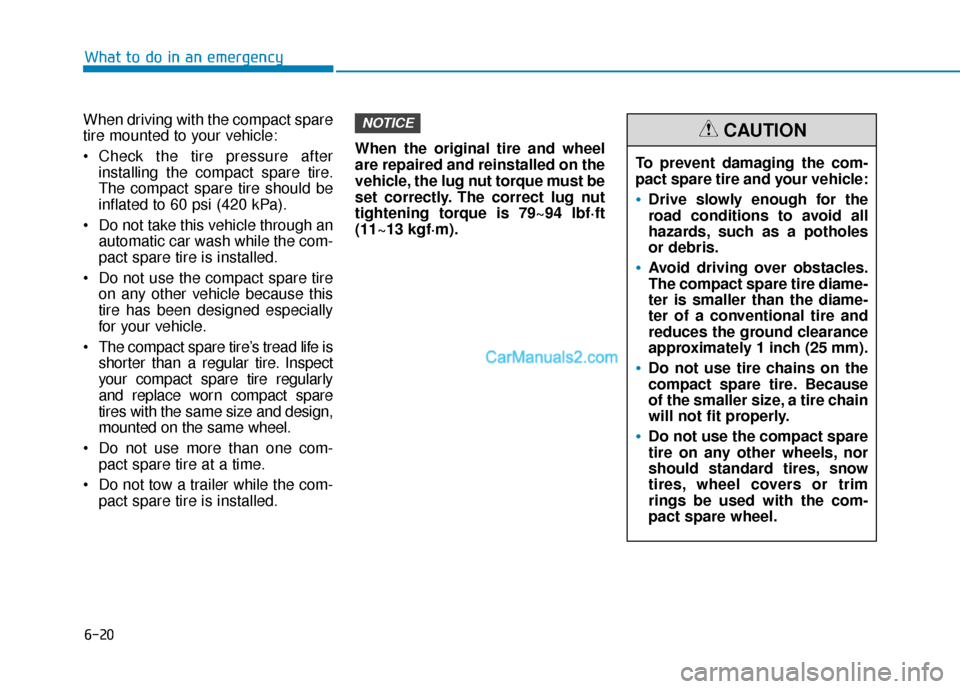
When driving with the compact spare
tire mounted to your vehicle:
Check the tire pressure after installing the compact spare tire.
The compact spare tire should be
inflated to 60 psi (420 kPa).
Do not take this vehicle through an automatic car wash while the com-
pact spare tire is installed.
Do not use the compact spare tire on any other vehicle because this
tire has been designed especially
for your vehicle.
The compact spare tire’s tread life is shorter than a regular tire. Inspect
your compact spare tire regularly
and replace worn compact spare
tires with the same size and design,
mounted on the same wheel.
Do not use more than one com- pact spare tire at a time.
Do not tow a trailer while the com- pact spare tire is installed. When the original tire and wheel
are repaired and reinstalled on the
vehicle, the lug nut torque must be
set correctly. The correct lug nut
tightening torque is 79~94 lbf·ft
(11~13 kgf·m).
NOTICE
To prevent damaging the com-
pact spare tire and your vehicle:
Drive slowly enough for the
road conditions to avoid all
hazards, such as a potholes
or debris.
Avoid driving over obstacles.
The compact spare tire diame-
ter is smaller than the diame-
ter of a conventional tire and
reduces the ground clearance
approximately 1 inch (25 mm).
Do not use tire chains on the
compact spare tire. Because
of the smaller size, a tire chain
will not fit properly.
Do not use the compact spare
tire on any other wheels, nor
should standard tires, snow
tires, wheel covers or trim
rings be used with the com-
pact spare wheel.
CAUTION
Page 510 of 611
Check headlamp alignment.
Check muffler, exhaust pipes,shields and clamps.
Check seat belts for wear and function.
At least once a year:
Clean body and door drain holes.
Lubricate door hinges and hoodhinges.
Lubricate door and hood locks and latches.
Lubricate door rubber weather strips.
Lubricate door checker.
Check the air conditioning system.
Inspect and lubricate automatic transmission linkage and controls.
Clean the battery and terminals.
Check the brake fluid level. Follow Normal Maintenance
Schedule if the vehicle is usually
operated where none of the following
conditions apply. If any of the follow-
ing conditions apply, you must follow
the Maintenance Under Severe
Usage Conditions.
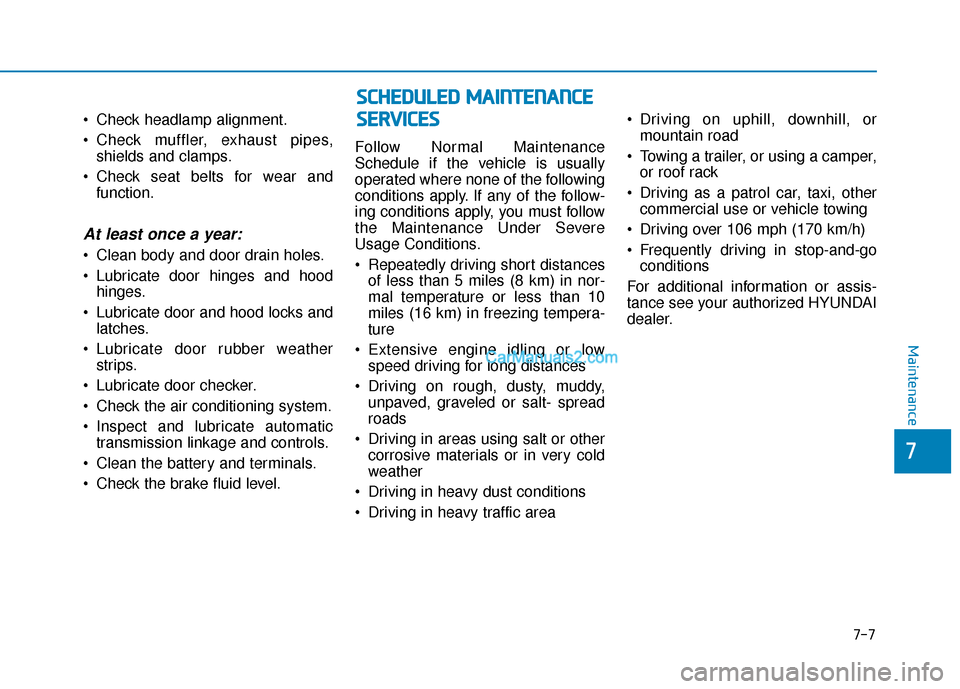
Repeatedly driving short distances
of less than 5 miles (8 km) in nor-
mal temperature or less than 10
miles (16 km) in freezing tempera-
ture
Extensive engine idling or low speed driving for long distances
Driving on rough, dusty, muddy, unpaved, graveled or salt- spread
roads
Driving in areas using salt or other corrosive materials or in very cold
weather
Driving in heavy dust conditions
Driving in heavy traffic area Driving on uphill, downhill, or
mountain road
Towing a trailer, or using a camper, or roof rack
Driving as a patrol car, taxi, other commercial use or vehicle towing
Driving over 106 mph (170 km/h)
Frequently driving in stop-and-go conditions
For additional information or assis-
tance see your authorized HYUNDAI
dealer.
S S C
C H
H E
ED
D U
U L
LE
E D
D
M
M A
AI
IN
N T
TE
EN
N A
AN
N C
CE
E
S
S E
E R
R V
V I
IC
C E
E S
S
Maintenance
7
7-7
Page 515 of 611
Maintenance
7-12
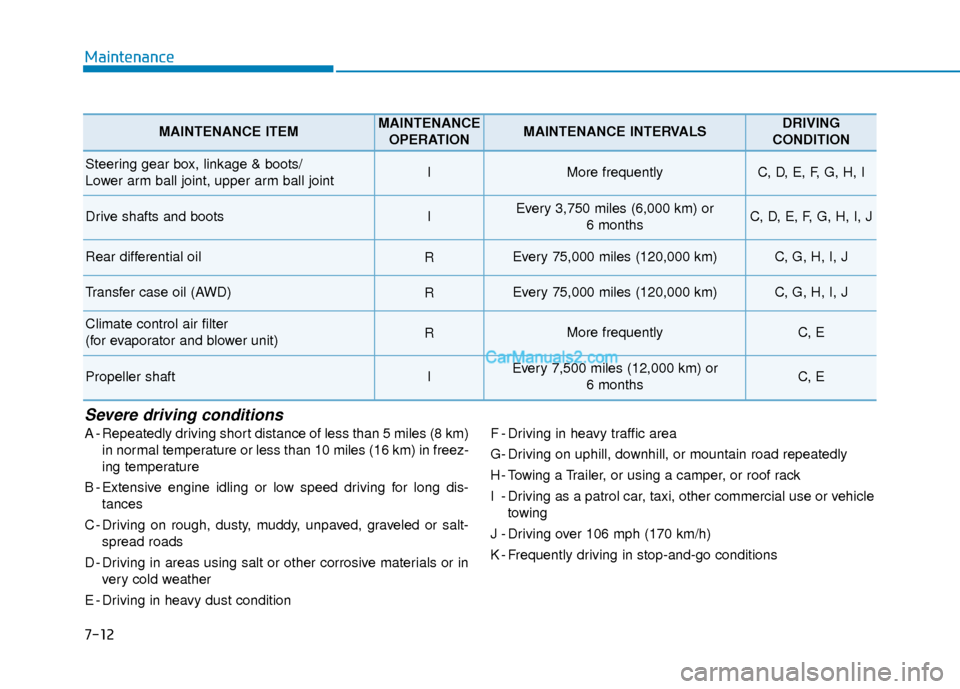
Severe driving conditions
A - Repeatedly driving short distance of less than 5 miles (8 km)in normal temperature or less than 10 miles (16 km) in freez-
ing temperature
B - Extensive engine idling or low speed driving for long dis- tances
C - Driving on rough, dusty, muddy, unpaved, graveled or salt- spread roads
D - Driving in areas using salt or other corrosive materials or in very cold weather
E - Driving in heavy dust condition F - Driving in heavy traffic area
G- Driving on uphill, downhill, or mountain road repeatedly
H - Towing a Trailer, or using a camper, or roof rack
I - Driving as a patrol car, taxi, other commercial use or vehicle
towing
J - Driving over 106 mph (170 km/h)
K - Frequently driving in stop-and-go conditions
MAINTENANCE ITEMMAINTENANCE OPERATIONMAINTENANCE INTERVALSDRIVING
CONDITION
Steering gear box, linkage & boots/
Lower arm ball joint, upper arm ball jointIMore frequentlyC, D, E, F, G, H, I
Drive shafts and bootsIEvery 3,750 miles (6,000 km) or 6 monthsC, D, E, F, G, H, I, J
Rear differential oilREvery 75,000 miles (120,000 km)C, G, H, I, J
Transfer case oil (AWD)REvery 75,000 miles (120,000 km)C, G, H, I, J
Climate control air filter
(for evaporator and blower unit)RMore frequentlyC, E
Propeller shaftIEvery 7,500 miles (12,000 km) or 6 monthsC, E
Page 560 of 611
7-57
7
Maintenance
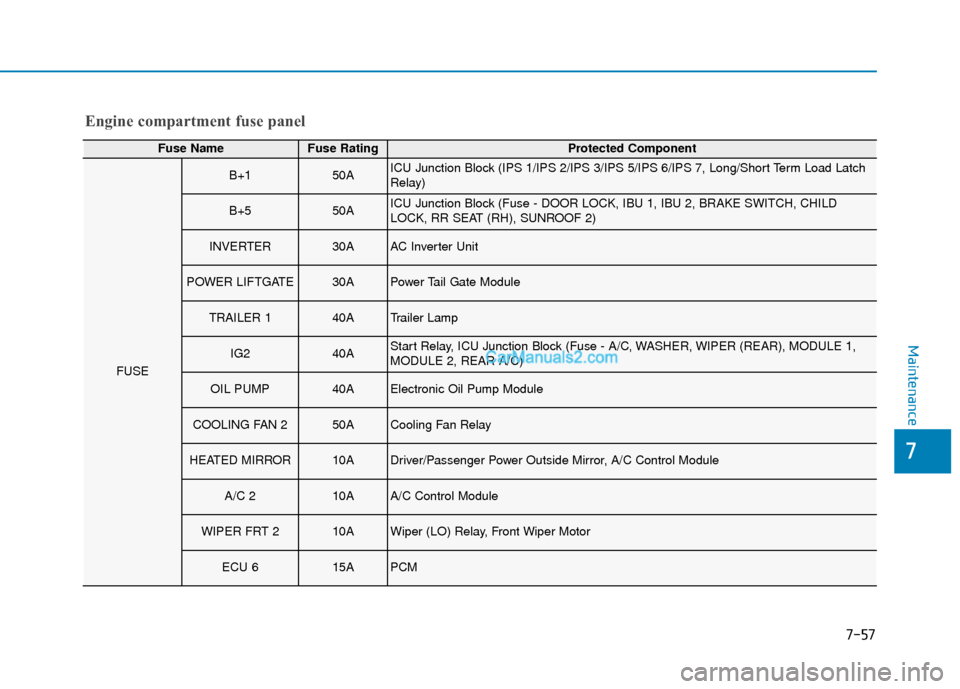
Engine compartment fuse panel
Fuse NameFuse RatingProtected Component
FUSE
B+150AICU Junction Block (IPS 1/IPS 2/IPS 3/IPS 5/IPS 6/IPS 7, Long/Short Term Load Latch
Relay)
B+550AICU Junction Block (Fuse - DOOR LOCK, IBU 1, IBU 2, BRAKE SWITCH, CHILD
LOCK, RR SEAT (RH), SUNROOF 2)
INVERTER30AAC Inverter Unit
POWER LIFTGATE30APower Tail Gate Module
TRAILER 140ATrailer Lamp
IG240AStart Relay, ICU Junction Block (Fuse - A/C, WASHER, WIPER (REAR), MODULE 1,
MODULE 2, REAR A/C)
OIL PUMP40AElectronic Oil Pump Module
COOLING FAN 250ACooling Fan Relay
HEATED MIRROR10ADriver/Passenger Power Outside Mirror, A/C Control Module
A/C 210AA/C Control Module
WIPER FRT 210AWiper (LO) Relay, Front Wiper Motor
ECU 615APCM
Maintenance
7
Page 600 of 611

I-3
Battery ........................................................................\
.....7-29Battery recharging ......................................................7-31
Battery saver function ...................................................3-138
Before driving ...................................................................5-5
Blind-Spot Collision Warning (BCW) system ...............5-78
Blind-Spot Collision-Avoidance Assist (BCA) system ..5-78
Blind-spot view monitor system ...................................3-150
Bluetooth
®Wireless Technology ......................................4-4
Brake fluid ......................................................................7-\
21
Brake system ...................................................................5-23 Anti-lock Brake System (ABS)..................................5-33
Auto hold ....................................................................5-29\
Disc brakes wear indicator .........................................5-24
Downhill Brake Control (DBC) .................................5-39
Electronic Parking Brake (EPB) ................................5-24
Electronic Stability Control (ESC).............................5-35
Good braking practices ..............................................5-42
Hill-start Assist Control (HAC) .................................5-39
Power brakes ..............................................................5-23
Trailer Stability Assist (TSA) .....................................5-42
Vehicle Stability Management (VSM) .......................5-38 Bulb replacement ............................................................7-61
Daytime running light (DRL) ...........................7-61, 7-63
Front parking lamp ...........................................7-61, 7-63
Front turn signal lamp.......................................7-61, 7-63
Headlamp ..........................................................7-61, 7-63
High mounted stop lamp ............................................7-66
Interior light................................................................7-67
License plate light ......................................................7-66
Rear combination light bulb .......................................7-64
Side marker lamp ..............................................7-61, 7-63
Side repeater lamp ......................................................7-64
Bulb wattage .....................................................................8-3\
Capacities (Lubricants) .....................................................8-7
Care Exterior care ...............................................................7-69
Interior care ................................................................7-74
Tire care ......................................................................7-\
33
Cargo security screen ....................................................3-205
Center console storage ..................................................3-192
Central door lock/unlock switch .....................................3-17
Certification label ...........................................................8-10
Check tire inflation pressure ...........................................7-35
I
Index
B
C
Page 610 of 611
I-13
Tire traction ................................................................7-38
Use of compact spare tires .........................................6-19
Wheel alignment and tire balance ..............................7-36
Wheel replacement .....................................................7-38
Towing ........................................................................\
....6-22
Trailer Stability Assist (TSA) .........................................5-42
Trailer towing................................................................5-156
Trip computer ................................................................3-110 Accumulated Info display ........................................3-112
Average fuel economy ..............................................3-111
Digital speedometer ..................................................3-113
Driving Info display .................................................3-112
Instant fuel economy ................................................3-111
Smart shift ................................................................3-113
Turn signals...................................................................3-137\
USB charger ..................................................................3-200
USB port ........................................................................\
...4-2
Use of compact spare tires ..............................................6-19
User settings mode........................................................3-100 Vanity mirror lamp........................................................3-141
Vehicle break-in process ....................................................F9
Vehicle certification label ...............................................8-10
Vehicle identification number (VIN) ..............................8-10
Vehicle load limit ..........................................................5-164
Vehicle modification ..........................................................F9
Vehicle Stability Management (VSM)............................5-38
Vehicle weight and luggage volume .................................8-6
View modes ...................................................................3-115
Warning and indicator lights...........................................3-76
Air bag warning light .................................................3-77
All Wheel Drive (AWD) warning light......................3-83
All wheel drive lock indicator light ...........................3-89
Anti-lock Brake System (ABS) warning light ...........3-78
Auto hold ON indicator light .....................................3-88
Auto stop indicator light ............................................3-85
Charging system warning light .................................3-81
Cruise indicator light ..................................................3-88
Downhill Brake Control (DBC) indicator light .........3-89
Electric Power Steering (EPS) warning light.............3-79
Electronic brake force warning light..........................3-78
Electronic Parking Brake (EPB) warning light..........3-80
Electronic stability control (ESC) indicator light ......3-85
I
Index
U
V
W