stop start Hyundai Palisade 2020 Repair Manual
[x] Cancel search | Manufacturer: HYUNDAI, Model Year: 2020, Model line: Palisade, Model: Hyundai Palisade 2020Pages: 611, PDF Size: 18.86 MB
Page 487 of 611
6-9
What to do in an emergency
6
Tire Pressure Monitoring
System
Each tire, including the spare (if pro-
vided), should be checked monthly
when cold and inflated to the inflation
pressure recommended by the vehi-
cle manufacturer on the vehicle plac-
ard or tire inflation pressure label. (If
your vehicle has tires of a different
size than the size indicated on the
vehicle placard or tire inflation pres-
sure label, you should determine the
proper tire inflation pressure for
those tires.)As an added safety feature, your
vehicle has been equipped with a tire
pressure monitoring system (TPMS)
that illuminates a low tire pressure
telltale when one or more of your
tires is significantly under-inflated.
Accordingly, when the low tire pres-
sure telltale illuminates, you should
stop and check your tires as soon as
possible, and inflate them to the
proper pressure. Driving on a signifi-
cantly under-inflated tire causes the
tire to overheat and can lead to tire
failure.
Under-inflation also reduces fuel effi-
ciency and tire tread life, and may
affect the vehicle’s handling and
stopping ability.
Please note that the TPMS is not a
substitute for proper tire mainte-
nance, and it is the driver's responsi-
bility to maintain correct tire pres-
sure, even if under-inflation has not
reached the level to trigger illumina-
tion of the TPMS low tire pressure
telltale.Your vehicle has also been equipped
with a TPMS malfunction indicator to
indicate when the system is not
operating properly. The TPMS mal-
function indicator is combined with
the low tire pressure telltale. When
the system detects a malfunction,
the telltale will flash for approximate-
ly one minute and then remain con-
tinuously illuminated. This sequence
will continue upon subsequent vehi-
cle start-ups as long as the malfunc-
tion exists.
When the malfunction indicator is
illuminated, the system may not be
able to detect or signal low tire pres-
sure as intended. TPMS malfunc-
tions may occur for a variety of rea-
sons, including the installation of
replacement or alternate tires or
wheels on the vehicle that prevent
the TPMS from functioning properly.
Always check the TPMS malfunction
telltale after replacing one or more
tires or wheels on your vehicle to
ensure that the replacement or alter-
nate tires and wheels allow the TPMS
to continue to function properly.
Over-inflation or under-inflation
can reduce tire life, adversely
affect vehicle handling, and
lead to sudden tire failure that
may cause loss of vehicle con-
trol resulting in an accident.
WARNING
Page 518 of 611
7-15
7
Maintenance
Brake Hoses and Lines
Visually check for proper installation,
chafing, cracks, deterioration and
any leakage. Replace any deteriorat-
ed or damaged parts immediately.
Brake Fluid
Check the brake fluid level in the
brake fluid reservoir. The level should
be between the MIN and the MAX
marks on the side of the reservoir.
Use only hydraulic brake fluid con-
forming to DOT 3 or DOT 4 specifi-
cation.
Parking Brake
Inspect the parking brake system.
Brake Discs, Pads, Calipers
and Rotors
Check the pads for excessive wear,
discs for run out and wear, and
calipers for fluid leakage.
Exhaust Pipe and Muffler
Visually inspect the exhaust pipes,
muffler and hangers for cracks, dete-
rioration, or damage. Start the
engine and listen carefully for any
exhaust gas leakage. Tighten con-
nections or replace parts as neces-
sary.
Suspension Mounting Bolts
Check the suspension connections
for looseness or damage. Retighten
to the specified torque.
Steering Gear Box, Linkage &
Boots/Lower Arm Ball Joint
With the vehicle stopped and the
engine off, check for excessive free-
play in the steering wheel. Check the
linkage for bends or damage. Check
the dust boots and ball joints for
deterioration, cracks, or damage.
Replace any damaged parts.
Drive Shafts and Boots
Check the drive shafts, boots and
clamps for cracks, deterioration, or
damage. Replace any damaged
parts and, if necessary, repack the
grease.
Air Conditioning Refrigerant
Check the air conditioning lines and
connections for leakage and dam-
age.
Page 522 of 611
7-19
7
Maintenance
Do not use a solution that containsmore than 60% antifreeze or less
than 35% antifreeze, which would
reduce the effectiveness of the
solution.
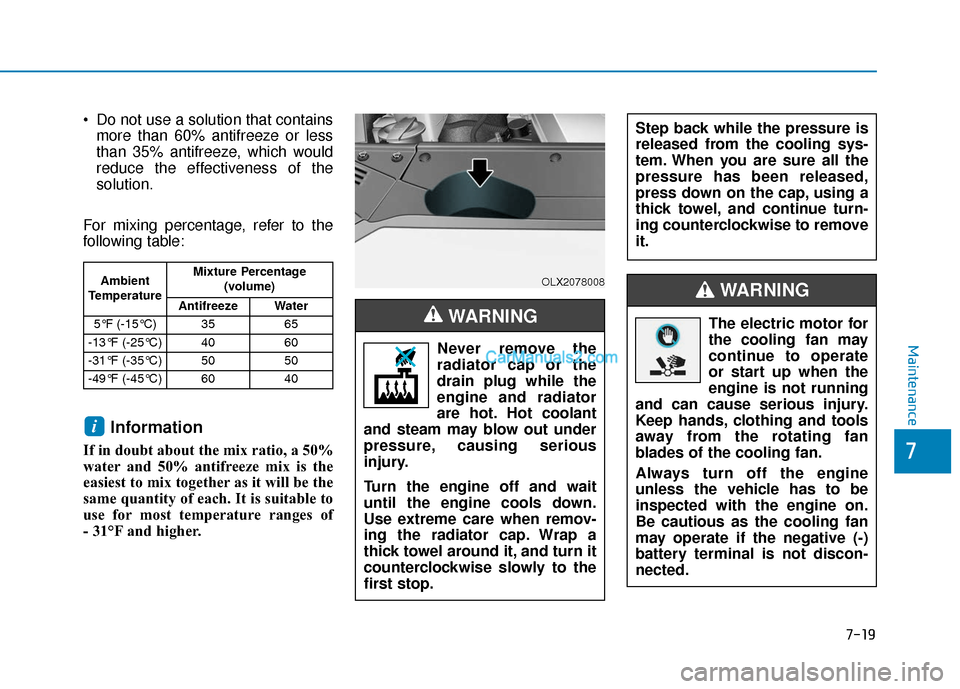
For mixing percentage, refer to the
following table:
Information
If in doubt about the mix ratio, a 50%
water and 50% antifreeze mix is the
easiest to mix together as it will be the
same quantity of each. It is suitable to
use for most temperature ranges of
- 31°F and higher.
i
The electric motor for
the cooling fan may
continue to operate
or start up when the
engine is not running
and can cause serious injury.
Keep hands, clothing and tools
away from the rotating fan
blades of the cooling fan.
Always turn off the engine
unless the vehicle has to be
inspected with the engine on.
Be cautious as the cooling fan
may operate if the negative (-)
battery terminal is not discon-
nected.
WARNING Ambient
Temperature Mixture Percentage
(volume)
Antifreeze Water
5°F (-15°C) 35 65
-13°F (-25°C) 40 60
-31°F (-35°C) 50 50
-49°F (-45°C) 60 40
Never remove the
radiator cap or the
drain plug while the
engine and radiator
are hot. Hot coolant
and steam may blow out under
pressure, causing serious
injury.
Turn the engine off and wait
until the engine cools down.
Use extreme care when remov-
ing the radiator cap. Wrap a
thick towel around it, and turn it
counterclockwise slowly to the
first stop.
WARNING
Step back while the pressure is
released from the cooling sys-
tem. When you are sure all the
pressure has been released,
press down on the cap, using a
thick towel, and continue turn-
ing counterclockwise to remove
it.
OLX2078008
Page 582 of 611
7-79
7
Maintenance
• Do not operate the engine in con-fined or closed areas (such as
garages) any more than what is
necessary to move the vehicle in or
out of the area.
When the vehicle is stopped in an open area for more than a short
time with the engine running,
adjust the ventilation system (as
needed) to draw outside air into the
vehicle.
Never sit in a parked or stopped vehicle for any extended time with
the engine running.
When the engine stalls or fails to start, excessive attempts to restart
the engine may cause damage to
the emission control system.Operating precautions for cat-alytic converters (if equipped)
The exhaust system and cat-
alytic converter are very hot
during and immediately after
the engine has been running. To
avoid SERIOUS INJURY or
DEATH:
• Do not park, idle, or drive the
vehicle over or near flamma-
ble objects, such as grass,
vegetation, paper, leaves, etc.
A hot exhaust system can
ignite flammable items under
your vehicle.
Keep away from the exhaust
system and catalytic convert-
er or you may get burned.
Also, Do not remove the heat
sink around the exhaust sys-
tem, do not seal the bottom of
the vehicle, and do not coat
the vehicle for corrosion con-
trol. It may present a fire risk
under certain conditions.
WARNING CALIFORNIA PROPOSITION 65
WARNING
Engine exhaust and a wide vari-
ety of automobile components
and parts, including compo-
nents found in the interior fur-
nishings in a vehicle, contain or
emit chemicals known to the
State of California to cause can-
cer and birth defects and repro-
ductive harm. In addition, cer-
tain fluids contained in vehicles
and certain products of compo-
nent wear contain or emit chem-
icals known to the State of
California to cause cancer and
birth defects or other reproduc-
tive harm.
For more information go to
https://www.p65warnings.ca.go
v/passenger-vehicle
WARNING
Page 600 of 611

I-3
Battery ........................................................................\
.....7-29Battery recharging ......................................................7-31
Battery saver function ...................................................3-138
Before driving ...................................................................5-5
Blind-Spot Collision Warning (BCW) system ...............5-78
Blind-Spot Collision-Avoidance Assist (BCA) system ..5-78
Blind-spot view monitor system ...................................3-150
Bluetooth
®Wireless Technology ......................................4-4
Brake fluid ......................................................................7-\
21
Brake system ...................................................................5-23 Anti-lock Brake System (ABS)..................................5-33
Auto hold ....................................................................5-29\
Disc brakes wear indicator .........................................5-24
Downhill Brake Control (DBC) .................................5-39
Electronic Parking Brake (EPB) ................................5-24
Electronic Stability Control (ESC).............................5-35
Good braking practices ..............................................5-42
Hill-start Assist Control (HAC) .................................5-39
Power brakes ..............................................................5-23
Trailer Stability Assist (TSA) .....................................5-42
Vehicle Stability Management (VSM) .......................5-38 Bulb replacement ............................................................7-61
Daytime running light (DRL) ...........................7-61, 7-63
Front parking lamp ...........................................7-61, 7-63
Front turn signal lamp.......................................7-61, 7-63
Headlamp ..........................................................7-61, 7-63
High mounted stop lamp ............................................7-66
Interior light................................................................7-67
License plate light ......................................................7-66
Rear combination light bulb .......................................7-64
Side marker lamp ..............................................7-61, 7-63
Side repeater lamp ......................................................7-64
Bulb wattage .....................................................................8-3\
Capacities (Lubricants) .....................................................8-7
Care Exterior care ...............................................................7-69
Interior care ................................................................7-74
Tire care ......................................................................7-\
33
Cargo security screen ....................................................3-205
Center console storage ..................................................3-192
Central door lock/unlock switch .....................................3-17
Certification label ...........................................................8-10
Check tire inflation pressure ...........................................7-35
I
Index
B
C
Page 602 of 611
I-5
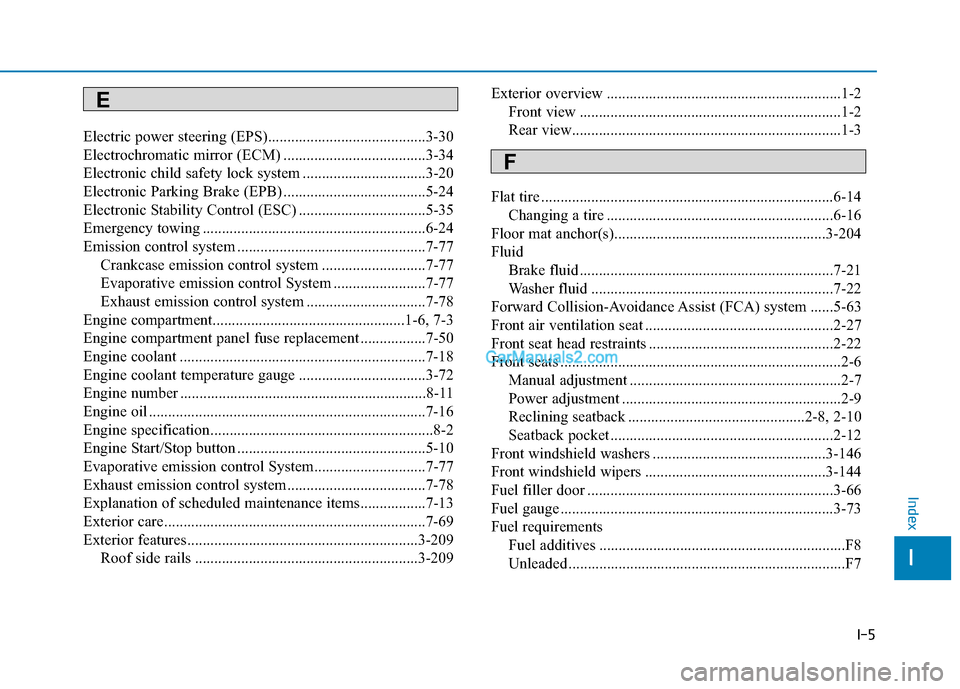
Electric power steering (EPS).........................................3-30
Electrochromatic mirror (ECM) .....................................3-34
Electronic child safety lock system ................................3-20
Electronic Parking Brake (EPB) .....................................5-24
Electronic Stability Control (ESC) .................................5-35
Emergency towing ..........................................................6-24
Emission control system .................................................7-77Crankcase emission control system ...........................7-77
Evaporative emission control System ........................7-77
Exhaust emission control system ...............................7-78
Engine compartment..................................................1-6, 7-3
Engine compartment panel fuse replacement .................7-50
Engine coolant ................................................................7-18
Engine coolant temperature gauge .................................3-72
Engine number ................................................................8-11
Engine oil ........................................................................\
7-16
Engine specification..........................................................8-2
Engine Start/Stop button .................................................5-10
Evaporative emission control System.............................7-77
Exhaust emission control system....................................7-78
Explanation of scheduled maintenance items.................7-13
Exterior care....................................................................7-69\
Exterior features............................................................3-209 Roof side rails ..........................................................3-209 Exterior overview .............................................................1-2
Front view ....................................................................1-2
Rear view......................................................................1-\
3
Flat tire ........................................................................\
....6-14 Changing a tire ...........................................................6-16
Floor mat anchor(s).......................................................3-204
Fluid Brake fluid ..................................................................7-21
Washer fluid ...............................................................7-22
Forward Collision-Avoidance Assist (FCA) system ......5-63
Front air ventilation seat .................................................2-27
Front seat head restraints ................................................2-22
Front seats ........................................................................\
.2-6 Manual adjustment .......................................................2-7
Power adjustment .........................................................2-9
Reclining seatback ..............................................2-8, 2-10
Seatback pocket ..........................................................2-12
Front windshield washers .............................................3-146
Front windshield wipers ...............................................3-144
Fuel filler door ................................................................3-66
Fuel gauge .......................................................................3\
-73
Fuel requirements Fuel additives ................................................................F8
Unleaded ........................................................................\
F7
I
Index
E
F
Page 603 of 611

I-6
Fuses ........................................................................\
.......7-48Engine compartment panel fuse replacement ............7-50
Fuse/relay panel description .......................................7-51
Instrument panel fuse replacement.............................7-49
Multi fuse ...................................................................7-50
Gauges and meters ..........................................................3-71
Glove box......................................................................3-\
192
Grove box lamp ............................................................3-141
Hazard warning flasher .....................................................6-2
Hazardous driving conditions .......................................5-148
Head Restraints ...............................................................2-21 Front seat head restraints............................................2-22
Rear seat head restraints .............................................2-24
Head up display ............................................................3-130
Headlamp delay function ..............................................3-138
Headlamp position ........................................................3-133
Heated steering wheel .....................................................3-32
High Beam Assist (HBA) .............................................3-134
High beam operation.....................................................3-134
Highway driving ...........................................................5-150
Highway Driving Assist (HDA) system .......................5-121
Hill-start Assist Control (HAC) ......................................5-39
Hood........................................................................\
........3-53 Horn ........................................................................\
........3-31
How to use this manual .....................................................F6
Idle Stop and Go (ISG) System ......................................5-50
If the engine doesn't turn over or turns over slowly.........6-3
If the engine overheats ......................................................6-6
If the engine stalls at a crossroad or crossing...................6-2
If the engine stalls while driving ......................................6-2
If the engine turns over normally but doesn't start ...........6-3
If the engine will not start.................................................6-3
If you have a flat tire while driving ..................................6-3
Immobilizer system.........................................................3-14
Important safety precautions.............................................2-2
Air Bag Hazards ...........................................................2-2
Always Wear Your Seat Belt ........................................2-2
Control Your Speed ......................................................2-3
Driver Distraction.........................................................2-2
Keep Your Vehicle in Safe Condition ..........................2-3
Restrain All Children....................................................2-2
In case of emergency while driving..................................6-2
Index
I
G
H