Oil HYUNDAI PALISADE 2022 Service Manual
[x] Cancel search | Manufacturer: HYUNDAI, Model Year: 2022, Model line: PALISADE, Model: HYUNDAI PALISADE 2022Pages: 663, PDF Size: 15.74 MB
Page 629 of 663
7-70
Maintenance
High-pressure washing
When using high-pressure wash-ers, make sure to maintain suffi-
cient distance from the vehicle.
Insufficient clearance or excessive
pressure can lead to component
damage or water penetration.
Do not spray the camera, sensors or its surrounding area directly with
a high pressure washer. Shock
applied from high pressure water
may cause the device to not oper-
ate normally.
Do not bring the nozzle tip close to boots (rubber or plastic covers)or
connectors as they may be dam-
aged if they come into contact with
high pressure water.
Do not use any high-pressure noz- zles, which induce either one-direct
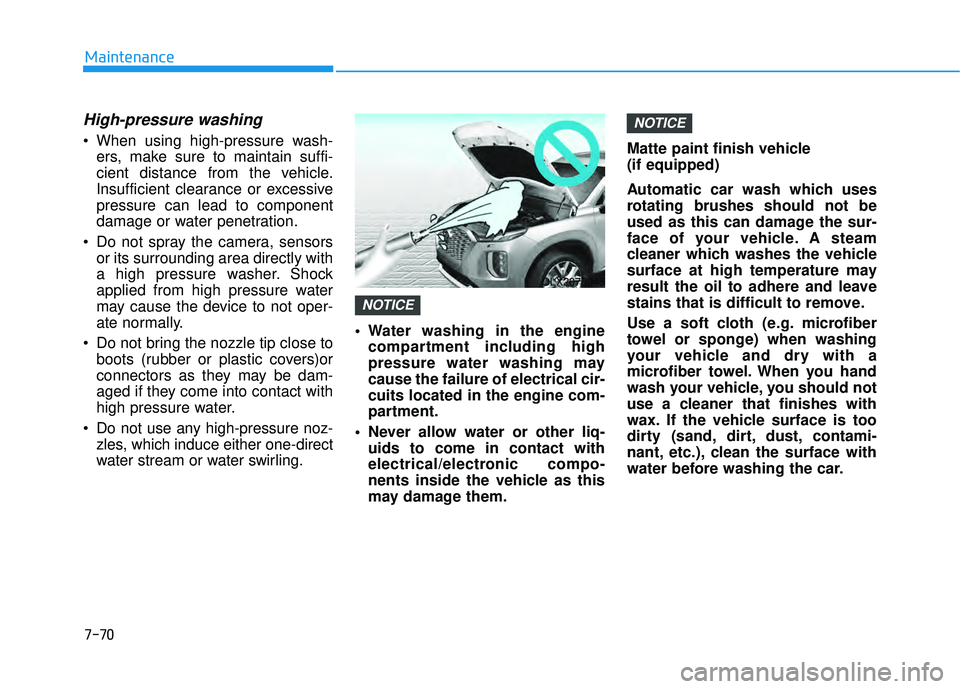
water stream or water swirling. Water washing in the engine
compartment including high
pressure water washing may
cause the failure of electrical cir-
cuits located in the engine com-
partment.
Never allow water or other liq- uids to come in contact with
electrical/electronic compo-
nents inside the vehicle as this
may damage them. Matte paint finish vehicle
(if equipped)
Automatic car wash which uses
rotating brushes should not be
used as this can damage the sur-
face of your vehicle. A steam
cleaner which washes the vehicle
surface at high temperature may
result the oil to adhere and leave
stains that is difficult to remove.
Use a soft cloth (e.g. microfiber
towel or sponge) when washing
your vehicle and dry with a
microfiber towel. When you hand
wash your vehicle, you should not
use a cleaner that finishes with
wax. If the vehicle surface is too
dirty (sand, dirt, dust, contami-
nant, etc.), clean the surface with
water before washing the car.
NOTICE
NOTICE
OLX2078045
Page 630 of 663
7-71
7
Maintenance
Waxing
A good coat of wax provides a barri-
er between your paint and environ-
mental contamination.
Keeping a good coat of wax on your
vehicle will help protect it.
Wax the vehicle when water will no
longer bead on the paint.
Always wash and dry the vehicle
before waxing. Use a good quality
liquid or paste wax, and follow the
manufacturer’s instructions. Wax all
metal trim to protect it and to main-
tain its luster.
Removing oil, tar, and similar materi-
als with a spot remover will usually
strip the wax from the finish. Be sure
to re-wax these areas even if the rest
of the vehicle does not yet need wax-
ing. Wiping dust or dirt off the body
with a dry cloth will scratch the
finish.
Do not use steel wool, abrasive cleaners, or strong detergents
containing highly alkaline or
caustic agents on chrome-plat-
ed or anodized aluminum parts.
This may result in damage to the
protective coating and cause
discoloration or paint deteriora-
tion.
Matte paint finish vehicle
(if equipped)
Do not use any polish protector
such as a detergent, an abrasive
and a polish. In case wax is
applied, remove the wax immedi-
ately using a silicon remover and
if any tar or tar contaminant is on
the surface use a tar remover to
clean. However, be careful not to
apply too much pressure on the
painted area.
Repairing your vehicle's finish
Deep scratches or stone chips in the
painted surface must be repaired
promptly. Exposed metal will quickly
rust and may develop into a major
repair expense.
If your vehicle is damaged and
requires any metal repair or
replacement, be sure the body
shop applies anti-corrosion mate-
rials to the parts repaired or
replaced.
Matte paint finish vehicle
(if equipped)
In case of matte paint finish vehi-
cles, it is impossible to modify
only the damaged area and repair
of the whole part is necessary. If
the vehicle is damaged and paint-
ing is required, we recommend
that you have your vehicle main-
tained and repaired by an author-
ized HYUNDAI dealer. Take
extreme care, as it is difficult to
restore the quality after the repair.
NOTICE
NOTICE
NOTICE
NOTICE
Page 633 of 663
7-74
Maintenance
vehicle, pay particular attention to
the components under the fenders
and other areas that are hidden
from view. Do a thorough job; just
dampening the accumulated mud
rather than washing it away will
accelerate corrosion rather than
prevent it. Water under high pres-
sure and steam are particularly
effective in removing accumulated
mud and corrosive materials.
When cleaning lower door panels, rocker panels and frame members,
be sure that drain holes are kept
open so that moisture can escape
and not be trapped inside to accel-
erate corrosion.
Keep your garage dry
Don't park your vehicle in a damp,
poorly ventilated garage. This cre-
ates a favorable environment for cor-
rosion. This is particularly true if you
wash your vehicle in the garage or
drive it into the garage when it is still
wet or covered with snow, ice or
mud. Even a heated garage can con-
tribute to corrosion unless it is well
ventilated so moisture is dispersed.
Keep paint and trim in good condition
Scratches or chips in the finish
should be covered with "touch-up"
paint as soon as possible to reduce
the possibility of corrosion. If bare
metal is showing through, the atten-
tion of a qualified body and paint
shop is recommended.
Bird droppings are highly corrosive
and may damage painted surfaces in
just a few hours. Always remove bird
droppings as soon as possible.
Interior Care
Interior general precautions
Prevent caustic solutions such as
perfume and cosmetic oil, from con-
tacting the interior parts because
they may cause damage or discol-
oration. If they do contact the interior
parts, wipe them off immediately.
See the instructions for the proper
way to clean vinyl.
Never allow water or other liq-uids to come in contact with
electrical/electronic compo-
nents inside the vehicle as this
may damage them.
When cleaning leather products (steering wheel, seats etc.), use
neutral detergents or low alco-
hol content solutions. If you use
high alcohol content solutions
or acid/alkaline detergents, the
color of the leather may fade or
the surface may get stripped off.
NOTICE
Page 635 of 663
7-76
Maintenance
Caring for the leather seats - Vacuum the seat periodically toremove dust and sand on the
seat. It will prevent abrasion or
damage of the leather and main-
tain its quality.
- Wipe the natural leather seat cover often with dry or soft cloth.
- Use of proper leather protector may prevent abrasion of the
cover and helps maintain the
color. Be sure to read the instruc-
tions and consult a specialist
when using leather coating or
protective agent.
- Light colored (beige, cream beige) leather is easily contami-
nated and the stain is noticeable.
Clean the seats frequently.
- Avoid wiping with wet cloth. It may cause the surface to crack. Cleaning the leather seats
- Remove all contaminationsinstantly. Refer to instructions
below for removal of each con-
taminant.
- Cosmetic products (sunscreen, foundation, etc.)
Apply cleansing cream on a cloth
and wipe the contaminated spot.
Wipe off the cream with a wet
cloth and remove water with a dry
cloth.
- Beverages (coffee, soft drink, etc.)
Apply a small amount of neutral
detergent and wipe until contami-
nations do not smear.
- Oil Remove oil instantly with
absorbable cloth and wipe with
stain remover used only for natu-
ral leather.
- Chewing gum Harden the gum with ice and
remove gradually.
Cleaning the seat belt webbing
Clean the belt webbing with any mild
soap solution recommended for
cleaning upholstery or carpet. Follow
the instructions provided with the
soap. Do not bleach or re-dye the
webbing because this may weaken
the seat belt.
Cleaning the interior windowglass
If the interior glass surfaces of the
vehicle become fogged (that is, cov-
ered with an oily, greasy or waxy
film), they should be cleaned with
glass cleaner. Follow the directions
on the glass cleaner container.
Do not scrape or scratch the
inside of the rear window. This
may result in damage to the rear
window defroster grid.
NOTICE
Page 647 of 663
8-7
88
Specifications, Consumer information and Reporting safety defects
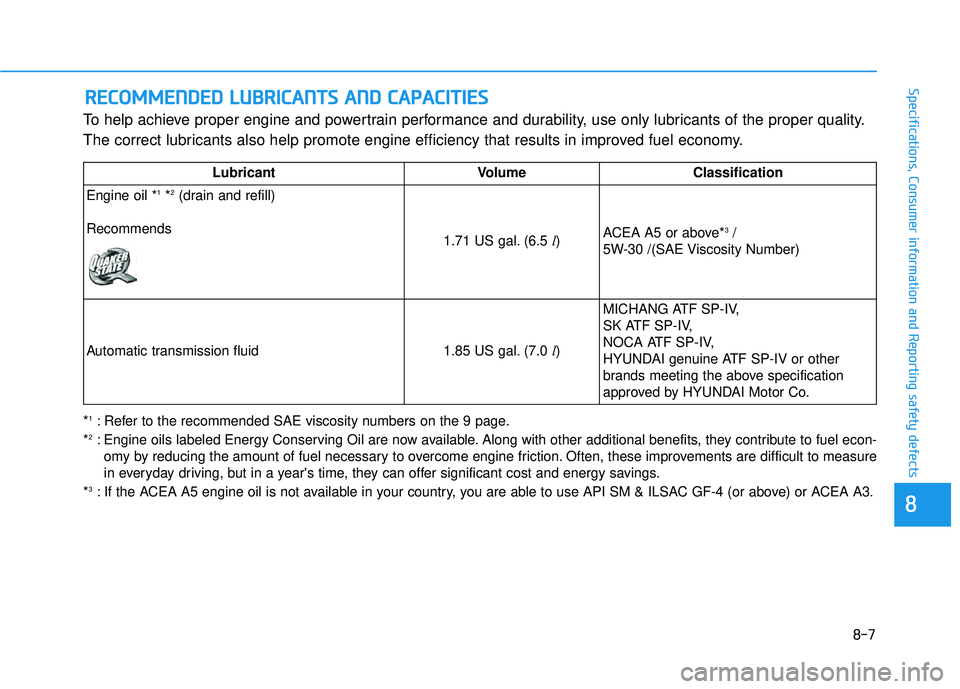
To help achieve proper engine and powertrain performance and durability, use only lubricants of the proper quality.
The correct lubricants also help promote engine efficiency that results in improved fuel economy.
R RE EC CO O M M M ME EN N D DE ED D L L U U B BR RI IC C A A N N T TS S A A N N D D C C A A P PA A C CI IT T I IE E S S
LubricantVolume Classification
Engine oil *
1*2(drain and refill)
Recommends
1.71 US gal. (6.5 l) ACEA A5 or above*3/
5W-30 /(SAE Viscosity Number)
Automatic transmission fluid1.85 US gal. (7.0 l)
MICHANG ATF SP-IV,
SK ATF SP-IV,
NOCA ATF SP-IV,
HYUNDAI genuine ATF SP-IV or other
brands meeting the above specification
approved by HYUNDAI Motor Co.
*1: Refer to the recommended SAE viscosity numbers on the 9 page.
*2: Engine oils labeled Energy Conserving Oil are now available. Along with other additional benefits, they contribute to fuel econ -
omy by reducing the amount of fuel necessary to overcome engine friction. Often, these improvements are difficult to measure
in everyday driving, but in a year's time, they can offer significant cost and energy savings.
*
3: If the ACEA A5 engine oil is not available in your country, you are able to use API SM & ILSAC GF-4 (or above) or ACEA A3.
Page 648 of 663
8-8
Specifications, Consumer information and Reporting safety defects
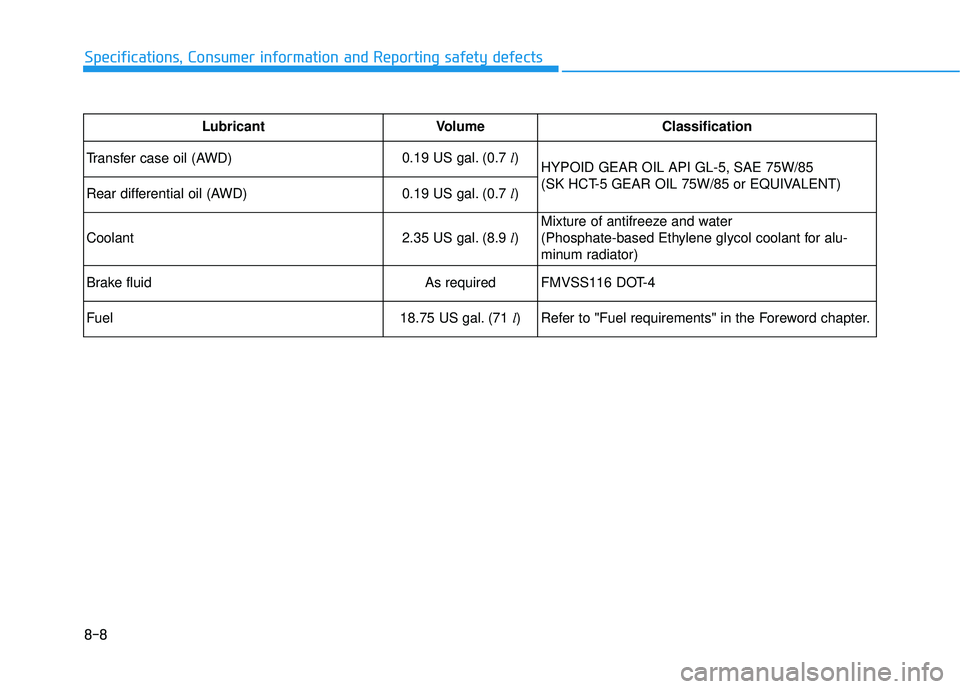
LubricantVolumeClassification
Transfer case oil (AWD)
0.19 US gal. (0.7 l) HYPOID GEAR OIL API GL-5, SAE 75W/85
(SK HCT-5 GEAR OIL 75W/85 or EQUIVALENT)
Rear differential oil (AWD)
0.19 US gal. (0.7 l)
Coolant
2.35 US gal. (8.9 l) Mixture of antifreeze and water
(Phosphate-based Ethylene glycol coolant for alu-
minum radiator)
Brake fluid
As required FMVSS116 DOT-4
Fuel18.75 US gal. (71 l)Refer to "Fuel requirements" in the Foreword chapter.
Page 649 of 663
8-9
88
Specifications, Consumer information and Reporting safety defects
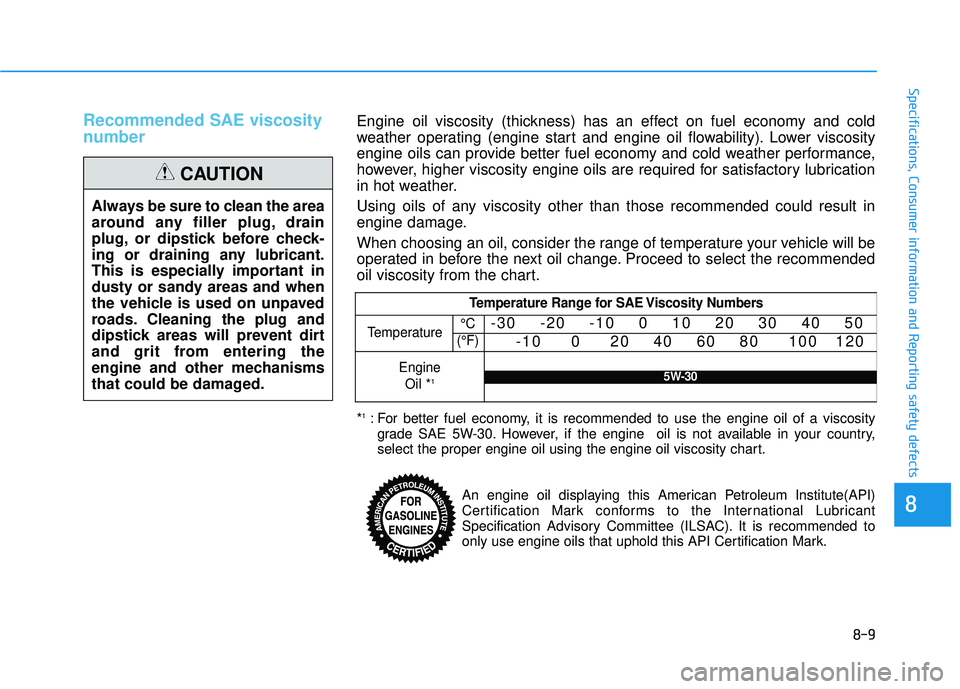
Recommended SAE viscosity
number
Always be sure to clean the area
around any filler plug, drain
plug, or dipstick before check-
ing or draining any lubricant.
This is especially important in
dusty or sandy areas and when
the vehicle is used on unpaved
roads. Cleaning the plug and
dipstick areas will prevent dirt
and grit from entering the
engine and other mechanisms
that could be damaged.
CAUTION
*1: For better fuel economy, it is recommended to use the engine oil of a viscositygrade SAE 5W-30. However, if the engine oil is not available in your country,
select the proper engine oil using the engine oil viscosity chart.
An engine oil displaying this American Petroleum Institute(API)
Certification Mark conforms to the International Lubricant
Specification Advisory Committee (ILSAC). It is recommended to
only use engine oils that uphold this API Certification Mark.
Engine oil viscosity (thickness) has an effect on fuel economy and cold
weather operating (engine start and engine oil flowability). Lower viscosity
engine oils can provide better fuel economy and cold weather performance,
however, higher viscosity engine oils are required for satisfactory lubrication
in hot weather.
Using oils of any viscosity other than those recommended could result in
engine damage.
When choosing an oil, consider the range of temperature your vehicle will be
operated in before the next oil change. Proceed to select the recommended
oil viscosity from the chart.
Temperature Range for SAE Viscosity Numbers
Temperature -30 -20 -10 0 10 20 30 40 50
-10 0 20 40 60 80 100 120
Engine Oil *1
°C
(°F)
5W-30
Page 657 of 663
I-4
Drive Mode Integrated Control System (2WD) .............5-55Drive Mode ................................................................5-55
Drive Mode Integrated Control System(AWD)..............5-59 Drive Mode ................................................................5-59
Driver Attention Warning (DAW) ................................5-136 Driver Attention Warning malfunction and limitations ........................................................5-140
Driver Attention Warning operation.........................5-138
Driver Attention Warning settings ..........................5-137
Driver position memory system ....................................3-32 Easy Access Function .................................................3-34
Recalling Positions from Memory .............................3-33
Resetting the Driver's Seat Memory System .............3-33
Storing Positions into Memory .................................3-32
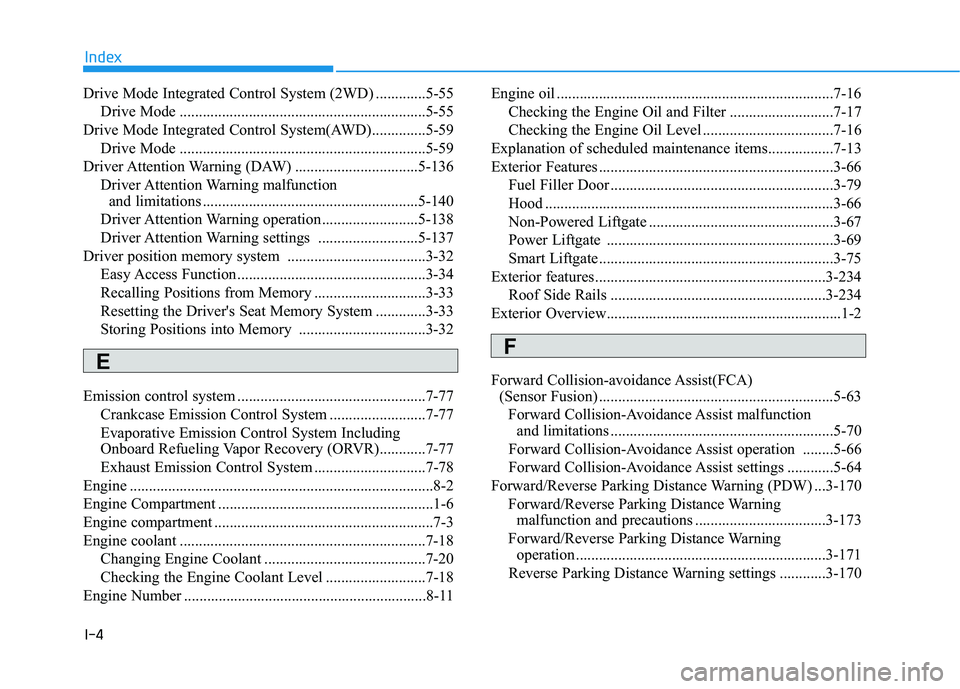
Emission control system .................................................7-77 Crankcase Emission Control System .........................7-77
Evaporative Emission Control System Including
Onboard Refueling Vapor Recovery (ORVR)............7-77 Exhaust Emission Control System .............................7-78
Engine ........................................................................\
.......8-2
Engine Compartment ........................................................1-6
Engine compartment .........................................................7-3
Engine coolant ................................................................7-18 Changing Engine Coolant ..........................................7-20
Checking the Engine Coolant Level ..........................7-18
Engine Number ...............................................................8-11 Engine oil ........................................................................\
7-16
Checking the Engine Oil and Filter ...........................7-17
Checking the Engine Oil Level ..................................7-16
Explanation of scheduled maintenance items.................7-13
Exterior Features .............................................................3-66 Fuel Filler Door ..........................................................3-79
Hood ........................................................................\
...3-66
Non-Powered Liftgate ................................................3-67
Power Liftgate ...........................................................3-69
Smart Liftgate.............................................................3-75
Exterior features............................................................3-234 Roof Side Rails ........................................................3-234
Exterior Overview.............................................................1-2
Forward Collision-avoidance Assist(FCA) (Sensor Fusion) .............................................................5-63
Forward Collision-Avoidance Assist malfunction and limitations ..........................................................5-70
Forward Collision-Avoidance Assist operation ........5-66
Forward Collision-Avoidance Assist settings ............5-64
Forward/Reverse Parking Distance Warning (PDW) ...3-170 Forward/Reverse Parking Distance Warning malfunction and precautions ..................................3-173
Forward/Reverse Parking Distance Warning operation .................................................................3-171
Reverse Parking Distance Warning settings ............3-170
Index
EF